

The Best AI Sales Assistants: What Actually Works in 2026
Your VP of Sales just dropped a Slack message: "We need an AI sales assistant. Evaluate options by Friday." You open a browser tab, and within ten minutes you've got 15 listicles recommending 150 different tools, none of them showing real pricing. The AI SDR category alone is a projected $15 billion market by 2030, growing at 29.5% CAGR - and Gartner's Hype Cycle for Sales Transformation places AI agents for sales squarely at the "Peak of Inflated Expectations."
Here's the thing: the most common complaint on r/sales captures it perfectly. Most tools marketed as "AI assistants" are glorified reminder systems with a ChatGPT wrapper. The tools below are the ones that demonstrate actual autonomous reasoning - with real pricing, benchmarks, and opinions from running bake-offs across this category.
Our Picks
| Tool | Best For | Starting Price |
|---|---|---|
| Prospeo | Prospecting & data accuracy | Free (75 emails/mo) |
| Salesforce Agentforce | CRM-native AI (enterprise) | $2/conversation |
| Gong | Conversation intelligence | ~$30-60K/year |
| Instantly | Outbound automation (SMB) | $37/mo |
| Pipedrive AI | Budget CRM AI | $14/user/mo |
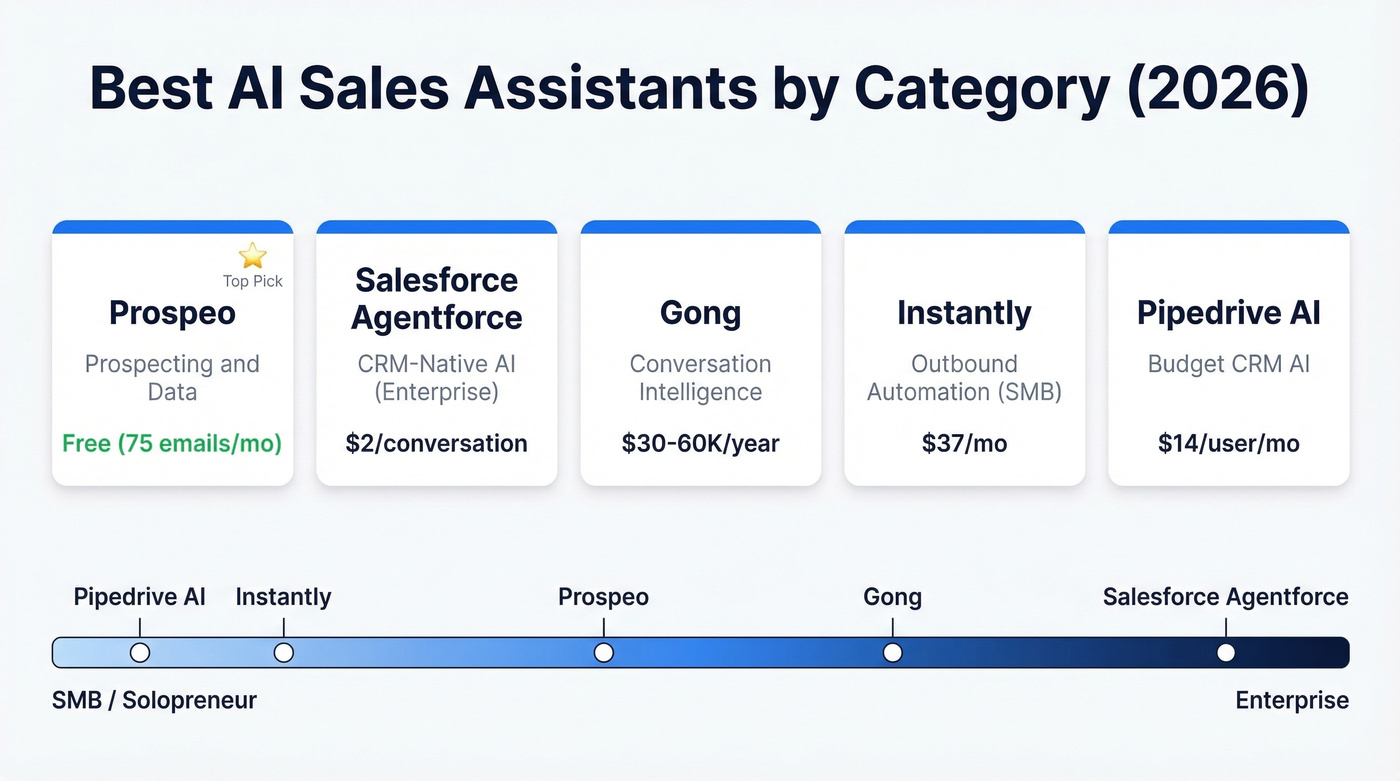
Prospeo takes the top spot because every AI sales assistant is only as good as the data feeding it. 98% email accuracy and a 7-day refresh cycle mean your downstream tools - sequencers, CRM AI, coaching platforms - actually work instead of sending perfectly crafted messages to dead inboxes.
Do AI Sales Assistants Actually Work?
Yes. With caveats.
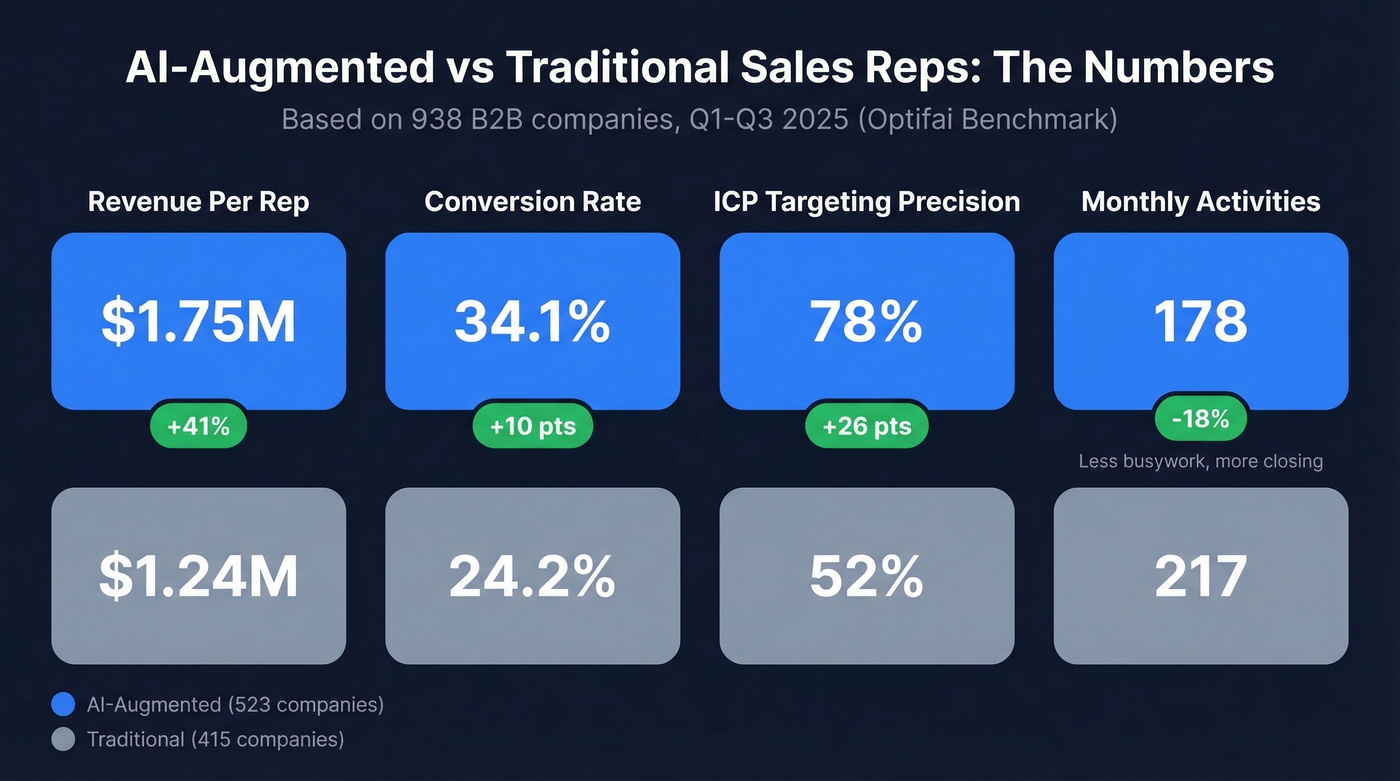
An Optifai benchmark across 938 B2B companies (Q1-Q3 2025 data, 523 AI-augmented vs. 415 traditional) found AI-augmented reps generated $1.75M in revenue per rep compared to $1.24M - a 41% lift. Conversion rates jumped from 24.2% to 34.1%. ICP targeting precision went from 52% to 78%. And the counterintuitive part: AI-augmented reps logged fewer activities per month (178 vs. 217). They did less busywork and closed more.
Outreach's Sales 2025 analysis tells a similar story. Deals supported by their Kaia assistant close 11 days faster on average, with a 90% reduction in research and personalization time. Win rates lift up to 10 percentage points on deals over $50K. Opportunities closed within 50 days hit a 47% win rate; after that threshold, it drops to 20% or lower. Speed matters, and AI compresses timelines.
Bain puts the upside at 30%+ win-rate improvement in early successes but flags the uncomfortable truth: sellers spend roughly 25% of their time actually selling. AI's biggest win isn't making reps smarter. It's giving them their time back.
The caveat nobody wants to hear: these results require clean data and proper implementation. Most teams skip both.
Our take: If your average deal size is under $10K, you don't need a $50K/year enterprise platform. A $50/month stack of verified data plus automated outbound will outperform a bloated AI layer sitting on top of a dirty CRM every single time.
Best Tools by Category
Prospecting & Data Enrichment
Prospeo
Every downstream tool in your sales stack - your sequencer, your CRM AI, your coaching platform - is only as good as the contact data it runs on. We've tested dozens of data providers over the years, and accuracy is the single variable that determines whether your outbound motion works or burns your domain reputation.
The numbers: 300M+ professional profiles, 143M+ verified emails at 98% accuracy, and 125M+ verified mobile numbers with a 30% pickup rate. The 7-day data refresh cycle is the real differentiator - the industry average is six weeks, which means most databases serve you stale contacts while you're trying to run real-time outbound. That gap compounds fast when you're sending hundreds of emails a day.

The proof point that sticks with us: Snyk had 50 AEs prospecting 4-6 hours per week with bounce rates running 35-40%. After switching, bounces dropped under 5%, AE-sourced pipeline jumped 180%, and they were generating 200+ new opportunities per month. That's not incremental - that's a different operating model.
Search filters cover 30+ criteria including buyer intent (15,000 Bombora topics), technographics, job changes, and headcount growth. Native integrations include Salesforce, HubSpot, Smartlead, Instantly, Lemlist, Clay, Zapier, and Make. Pricing starts free (75 emails/month + 100 Chrome extension credits/month), scales at roughly $0.01 per email, and there are no contracts.
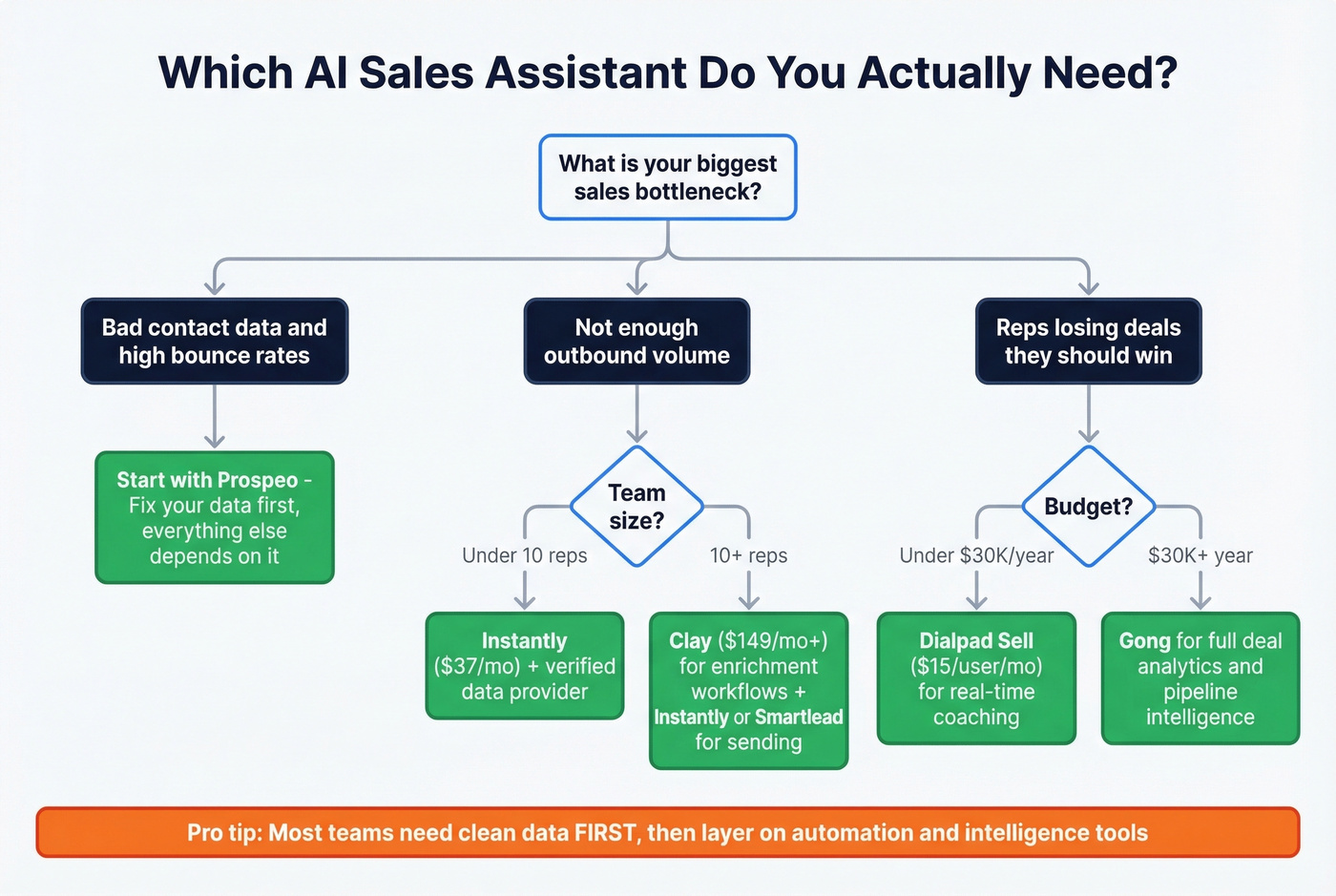
Clay
Clay is the workflow orchestration layer for teams that need complex, multi-step enrichment sequences. It pulls from dozens of data sources and lets you build waterfall enrichment flows - try provider A, fall back to provider B, enrich with provider C.
Pricing runs $149-$800/month depending on volume. The tradeoff: Clay has a genuine learning curve. If you don't have someone comfortable building automations, you'll spend weeks getting it right. But for RevOps teams that want granular control over their enrichment logic, nothing else comes close. (If you’re comparing data sources, see our breakdown of the best data enrichment tools.)
ZoomInfo Copilot
Use this if: you're already locked into a ZoomInfo contract and want to extract more value. The AI layer surfaces intent signals and recommends next actions. Gartner Peer Insights gives it a 4.3/5 across 36 ratings.
Skip this if: you're evaluating from scratch. At $15-50K/year with annual contracts, you're paying enterprise prices for 87% email accuracy when 98% accuracy exists at a fraction of the cost.
Outbound Automation & AI SDR
Instantly
Instantly is the best SMB outbound tool for teams that want email warmup, lead discovery, and sequencing in a single platform without enterprise complexity. Unlimited email accounts on higher tiers mean you can scale sender infrastructure without per-seat math killing your budget.
Pricing starts at $37/month for email sending and $39.90/month for the leads database. The platform handles warmup automatically, saving you from the deliverability nightmare of cold domains.
One thing we've learned running campaigns: Instantly's built-in lead database is decent for quick searches, but quality varies by segment. Teams consistently get better results pairing Instantly's sending infrastructure with a dedicated data provider for the actual contact list. Use Instantly for what it's best at - sending and warming - and feed it verified data from elsewhere. (If you’re shopping this category, compare options in our guide to outbound email automation.)
Artisan (Ava)
Artisan's Ava is the fully autonomous AI SDR play - it handles everything from prospecting to booking meetings without human intervention. Set your ICP, let Ava run. The black-box approach means less control over messaging and targeting logic, which makes some sales leaders nervous. Custom pricing, though comparable autonomous platforms typically run $1,000-3,000/month. Worth evaluating if you want a true hands-off virtual sales assistant, but go in with realistic expectations about message quality.
CRM-Native AI
Salesforce Agentforce
Agentforce is the most powerful CRM-native AI on the market. It's also absurdly complex to price.
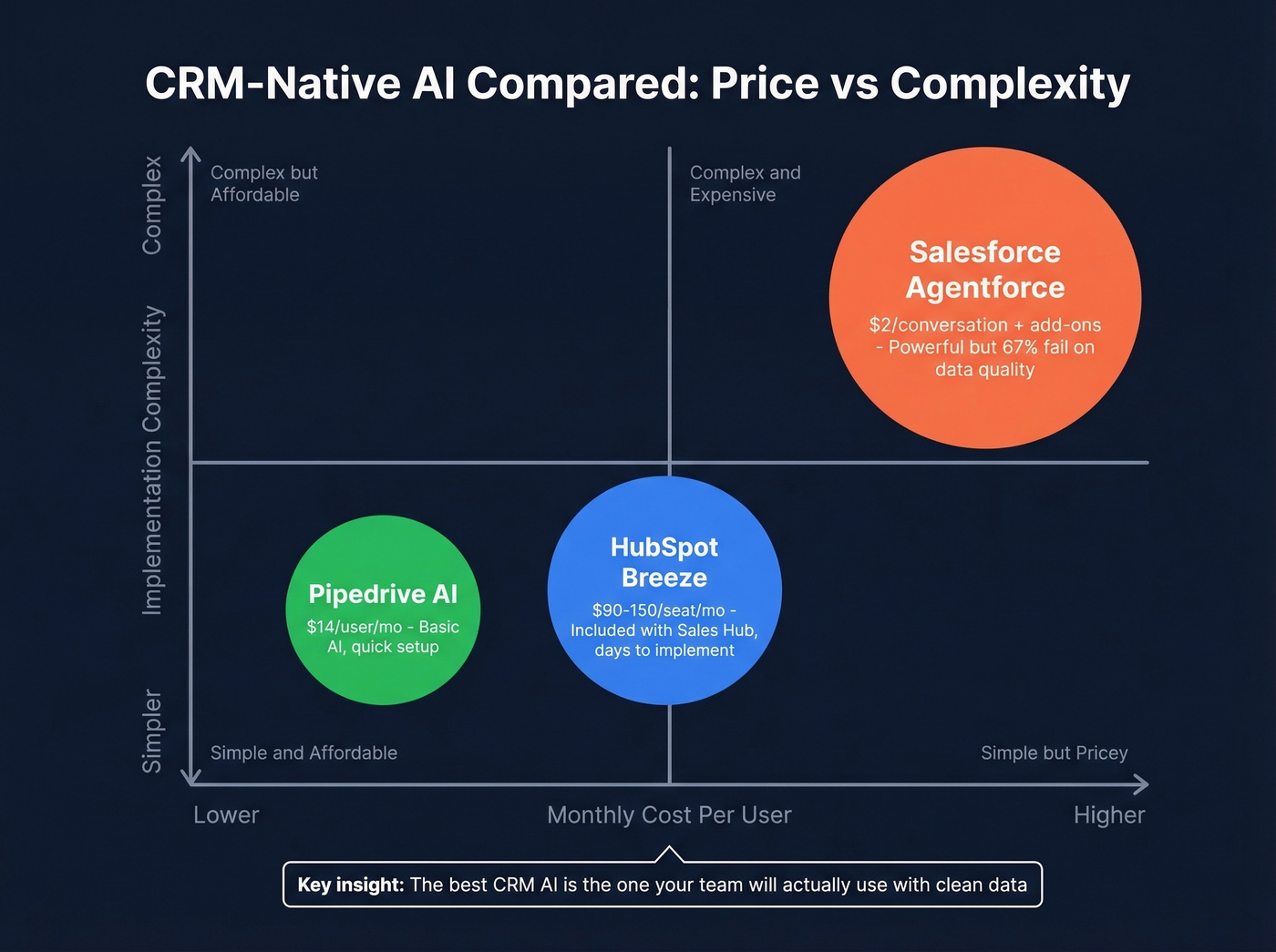
The pricing maze: a free Foundations tier with 200K Flex Credits, customer-facing conversations at $2 each, the Sales/Service add-on at $125/user/month for unmetered employee usage, Industries add-ons at $150/user/month, the full Agentforce 1 Edition at $550/user/month, and a $5/user/month license requiring separate Flex Credits at $500 per 100K. If that paragraph made your head spin, you're not alone.
One industry analysis pegged 67% of Agentforce implementations as failing due to data quality issues - which circles back to why your contact data infrastructure matters more than your AI layer. Gartner Peer Insights rates Salesforce Sales AI at 4.4/5 across 61 ratings. The AI itself is legitimately good at surfacing deal insights and predicting outcomes. But implementation costs can dwarf the subscription. For enterprise teams already on Salesforce, it's the obvious choice. For everyone else, the total cost of ownership deserves a serious conversation.
HubSpot Breeze
HubSpot Breeze is the mid-market sweet spot - the Breeze Prospecting Agent is included with Sales Hub Pro ($90/seat/month) and Enterprise ($150/seat/month). If you're already on HubSpot, Breeze adds AI-powered prospecting, email drafting, and deal insights without a separate line item. Less powerful than Agentforce, but implementation is measured in days, not months.
For teams between 5-50 reps on HubSpot, it's the path of least resistance. (If you’re still deciding on a CRM, use this framework on how to choose a CRM.)
Pipedrive AI
The budget pick. Pipedrive's AI features - deal scoring, email suggestions, activity recommendations - come baked into plans starting at $14/user/mo. For small teams that need a CRM with basic AI and don't want to spend $90+ per seat, Pipedrive delivers surprising value. The AI isn't enterprise-grade, and you're limited to Pipedrive's ecosystem, but the price-to-value ratio is hard to beat under 10 reps.
Conversation Intelligence & Coaching
Gong
Gong is the gold standard for conversation intelligence, and it's priced like it knows it. Ask on any sales ops community and Gong is the first name mentioned - the debate is always about whether the price is justified. A mid-market contract typically runs $30-60K/year.
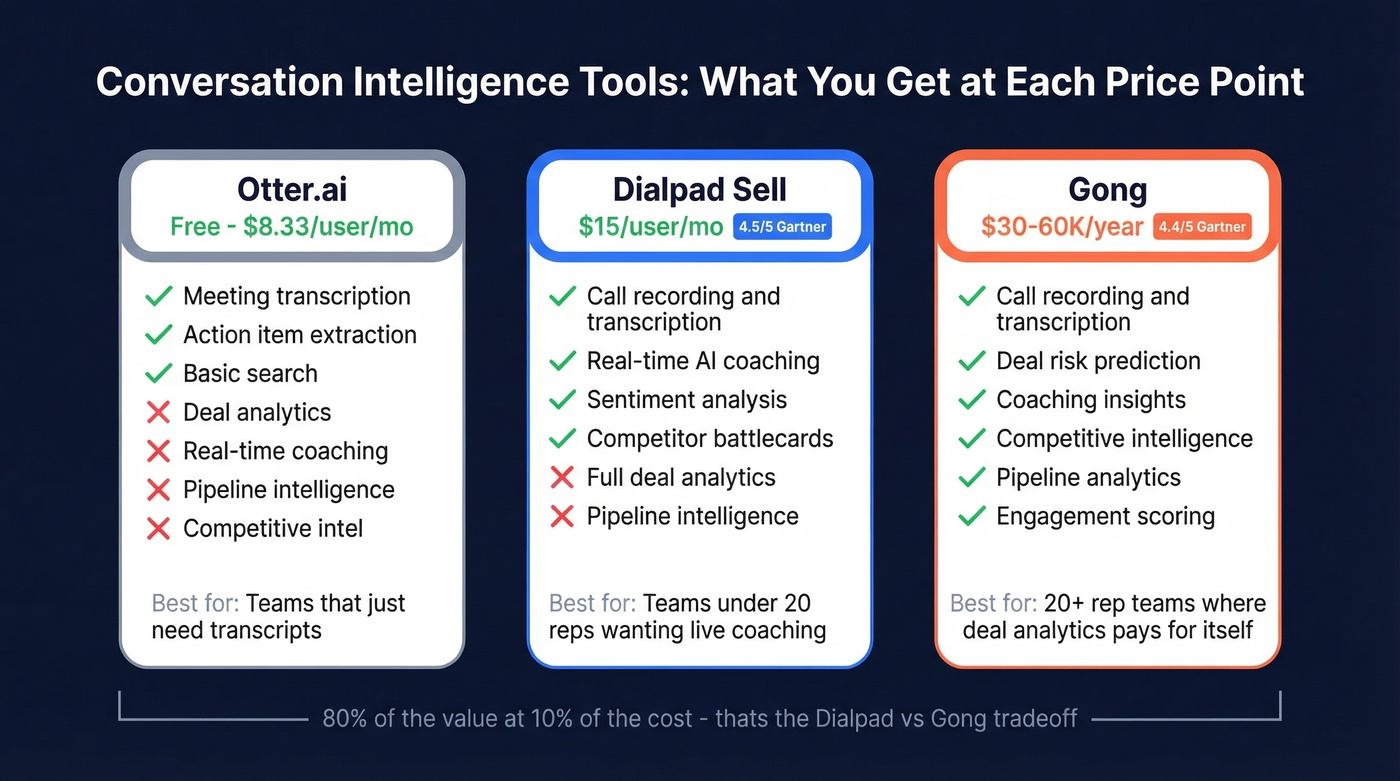
What you get: call recording and transcription, deal analytics that predict which opportunities are at risk, coaching insights that show managers exactly where reps lose deals, and competitive intelligence pulled from actual buyer conversations. The deal analytics alone - seeing which deals have gone quiet, which have single-threaded, which lack next steps - pays for itself if you're running 20+ reps. We've seen teams catch dying deals weeks earlier just from Gong's engagement scoring, and that alone can save a quarter's number.
Where Gong is overkill: teams under 20 reps, early-stage companies where deal volume is too low for the AI to find patterns, or orgs that just need basic call recording. For those teams, Dialpad or Otter.ai gets you 80% of the value at 10% of the cost.
Dialpad Sell
Real-time AI coaching during live calls is Dialpad's edge - it surfaces talk tracks, competitor battlecards, and sentiment analysis while the conversation is happening. Gartner Peer Insights rates it 4.5/5 (24 ratings), the highest score in the category. Starting at $15/user/month, it's dramatically cheaper than Gong. The tradeoff is scope: Dialpad focuses on the call itself rather than Gong's full deal analytics and pipeline intelligence. (To level up the human side, train the fundamentals in these phone sales skills.)
Otter.ai
Budget meeting transcription that works. Free tier gives you 300 minutes/month, paid plans start at $8.33/user/month. Good enough for teams that need transcripts and action items, not full coaching analytics.
Email Coaching & Workflow
Lavender
AI email coaching that scores and rewrites sales emails in real time. Free tier available, paid from $29/month. Narrow use case - it only helps with email copy - but it does that one thing well. (If you want copy you can deploy fast, start with an email blast template.)
Zapier Agents
Build custom AI sales workflows connecting 7,000+ apps. Free tier includes 400 activities/month, paid plans from $50/month. Not a purpose-built sales tool, but powerful for teams that want to automate specific handoffs without writing code.
Honorable mentions: Regie.ai (AI content generation), Avoma (meeting intelligence), and UserGems (job-change tracking) are all worth evaluating depending on your stack. For context on where the category is heading, Gartner places Emotion AI in the Trough of Disillusionment and "Digital Twin of a Customer" at the Innovation Trigger stage - both worth watching but not ready for your 2026 stack.

Every AI sales assistant in this list depends on one thing: accurate contact data. Feed your sequencers, CRM AI, and coaching tools 98% verified emails from 300M+ profiles - refreshed every 7 days, not every 6 weeks. At $0.01 per email, your entire AI stack finally works.
Stop sending AI-crafted messages to dead inboxes.
Pricing Comparison
The fact that Gong and several enterprise tools hide their pricing tells you everything about how they view the buying process.
| Tool | Starting Price | Model | Free Tier? |
|---|---|---|---|
| Prospeo | $0 (75 emails/mo) | Per credit | Yes |
| Instantly | $37/mo | Per plan | No |
| Pipedrive AI | $14/user/mo | Per user | Trial only |
| Dialpad Sell | $15/user/mo | Per user | No |
| Lavender | $29/mo | Per plan | Yes |
| Otter.ai | $8.33/user/mo | Per user | Yes (300 min) |
| Zapier Agents | $50/mo | Per plan | Yes (400 acts) |
| Clay | $149/mo | Per credit | No |
| HubSpot Breeze | $90/seat/mo | Per seat | No |
| Artisan (Ava) | ~$1K-3K/mo | Custom | No |
| Agentforce | $2/conversation | Usage-based | Yes (200K credits) |
| ZoomInfo Copilot | ~$15-50K/yr | Annual contract | No |
| Gong | ~$30-60K/yr | Annual contract | No |
AI SDR vs. Human SDR
The elephant in the room: can AI replace your SDR team?
| Metric | AI SDR | Human SDR |
|---|---|---|
| Cost per qualified lead | ~$39 | ~$262 |
| Response speed | <1 minute | ~42 hours |
| Daily capacity | 200-500+ touches | 30-50 touches |
| Revenue per opportunity | $56K | $147K |
| Meeting show rate | 52% | 71% |
AI wins on cost and speed by massive margins - 54x cheaper per qualified lead, near-instant response times. But humans win where it matters most: revenue quality. Human-sourced opportunities generate nearly 3x the revenue per deal, and meetings booked by humans show up at a 71% rate versus 52% for AI.
The answer isn't either/or. 45% of teams already run hybrid models, using AI for initial outreach and qualification while humans handle high-value conversations and complex deals. Let's be honest - the "fully autonomous AI SDR" pitch sounds incredible until you realize your biggest prospect just got a generic three-sentence email that reads like it was written by a bot. Hybrid is where the smart money is. (For a deeper tool shortlist, see our ranking of AI SDR software.)
Why Most Implementations Fail
Sellers spend roughly 25% of their time actually selling. A well-implemented AI sales assistant should fix that. But most implementations don't, because teams make the same five mistakes:
Dirty data in, garbage out. This is the #1 blocker and it's frustrating how often it gets ignored. If your CRM has stale emails and disconnected numbers, you're automating failure at scale. A 7-day data refresh cycle versus the six-week industry average is the difference between AI that works and AI that sends perfectly crafted emails to inboxes that don't exist. (If you’re rebuilding your data layer, start with the best B2B database benchmarks.)
Fragmented workflows. Buying five AI tools that don't talk to each other creates more complexity, not less. Map your workflow before you buy anything. (This RevOps tech stack blueprint helps keep it lean.)
Skipping change management. Reps won't use tools they don't trust. Budget time for training, not just licenses. This one sounds obvious, but we've watched teams blow $40K on Gong contracts only to find half the reps never opened the dashboard three months in.
Rushing implementation. CRM-native AI needs 60-90 days of clean data before insights become actionable. Teams that expect magic in week one abandon tools that would've worked by month three.
Overreliance on AI output. AI drafts need human review. AI scoring needs human calibration. The "fully autonomous" pitch sounds great until a bot sends a tone-deaf email to your biggest prospect's CEO.
Snyk's 50 AEs cut bounce rates from 35% to under 5% and grew AE-sourced pipeline 180%. The difference wasn't a better AI assistant - it was better data underneath it. 143M+ verified emails, 125M+ mobile numbers, 30+ search filters including buyer intent.
Build the data foundation your AI sales stack actually needs.
How to Build the Right Stack
You don't need 20 tools. You need three, max.
Solo or startup (under $100/month): Prospeo for data + Instantly for outbound + Otter.ai for meetings. Total: ~$50/month. Verified contacts, automated email sequences with warmup, and meeting transcripts - a complete outbound motion for less than most teams spend on lunch. (If you need more ways to fill the top of funnel, use these pipeline generation ideas.)
Growth team, 5-20 reps ($100-500/month): Add Clay for enrichment orchestration + HubSpot Breeze for CRM AI + Lavender for email coaching. Total: ~$300-500/month. You're adding workflow sophistication and CRM intelligence without jumping to enterprise pricing.
Enterprise, 50+ reps ($2K+/month): Your data backbone + Salesforce Agentforce for CRM AI + Gong for conversation intelligence. Clean data feeding CRM predictions feeding coaching insights. At this tier, an AI-powered sales stack isn't a nice-to-have - it's table stakes. Expensive, but the ROI math works at scale.
The data layer is the one constant across all three tiers. Get that wrong and nothing else matters.
FAQ
What is an AI sales assistant?
An AI sales assistant is software that automates sales tasks like prospecting, outreach, CRM updates, coaching, and forecasting using machine learning and natural language processing. Gartner defines these tools as entities that "perceive, decide, and act" in digital sales environments. They range from simple email drafters to autonomous AI SDRs that book meetings independently.
How much do these tools cost?
Costs range from free to $550/user/month for Salesforce Agentforce's top edition. Most SMB teams spend $50-500/month total across their stack. Enterprise teams running Gong plus a CRM AI layer typically land in the $3-8K/month range.
Can AI replace human SDRs?
Not yet. AI SDRs are 54x cheaper per qualified lead but produce lower revenue per opportunity ($56K vs. $147K) and lower meeting show rates (52% vs. 71%). The best results come from hybrid models - 45% of teams already use them - where AI handles volume and humans handle value.
What's the best budget option for solo reps?
Prospeo (free, 75 verified emails/month) paired with Instantly ($37/month) and Otter.ai (free, 300 minutes/month) covers prospecting, sequencing, and call notes at roughly $50/month total. That combination addresses the three biggest time sinks for individual reps without enterprise pricing.
How long before I see ROI?
Data enrichment tools show results within days - cleaner data means fewer bounces immediately. CRM AI and conversation intelligence platforms typically need 60-90 days of data accumulation before their insights become actionable. Don't pull the plug early.