

8 AIDA Model Examples You Can Copy (Plus KPIs & Framework Comparisons)
A framework from 1898 shouldn't still be the backbone of modern marketing copy. But AIDA is - because it maps how humans decide to buy things, and that hasn't changed in 2026. What has changed is how most guides teach it: vague definitions, zero usable templates, and no measurement advice.
We've pulled together 8 worked AIDA model examples across cold email, landing pages, social ads, SaaS homepages, and classic brand campaigns - plus a KPI table and an AIDA vs PAS comparison so you can pick the right framework for the job.
What AIDA Actually Means
The AIDA model is a four-stage framework describing the cognitive journey a buyer takes before purchasing:
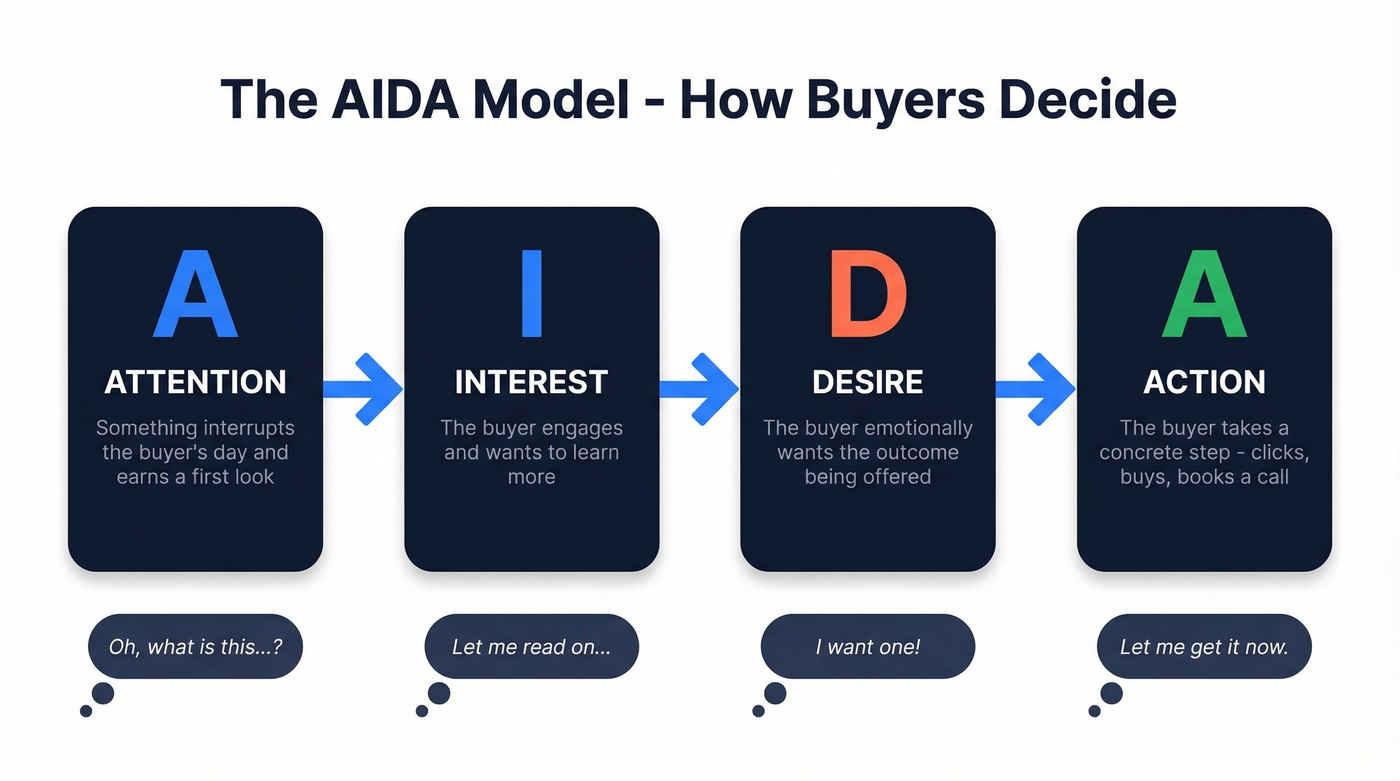
- Attention - Something interrupts the buyer's day and earns a first look.
- Interest - The buyer engages with the message and wants to learn more.
- Desire - The buyer emotionally wants the outcome being offered.
- Action - The buyer takes a concrete step (clicks, buys, books a call).
Coined by E. St. Elmo Lewis) in 1898, AIDA frames the buyer's internal monologue: "Oh, what is this...?" then "Let me read on..." then "I want one!" then "Let me get it now."
The 4 Stages Explained (With the Desire Fix)
Attention is the most expensive stage - and the one most marketers underinvest in. 47% of email recipients open based on the subject line alone, and 69% mark emails as spam based on nothing but the subject line. In paid media, the stakes are just as high: when Coca-Cola cut its marketing budget in 2020, sales declined 11% while Pepsi maintained spend and grew 5%. Attention isn't optional.
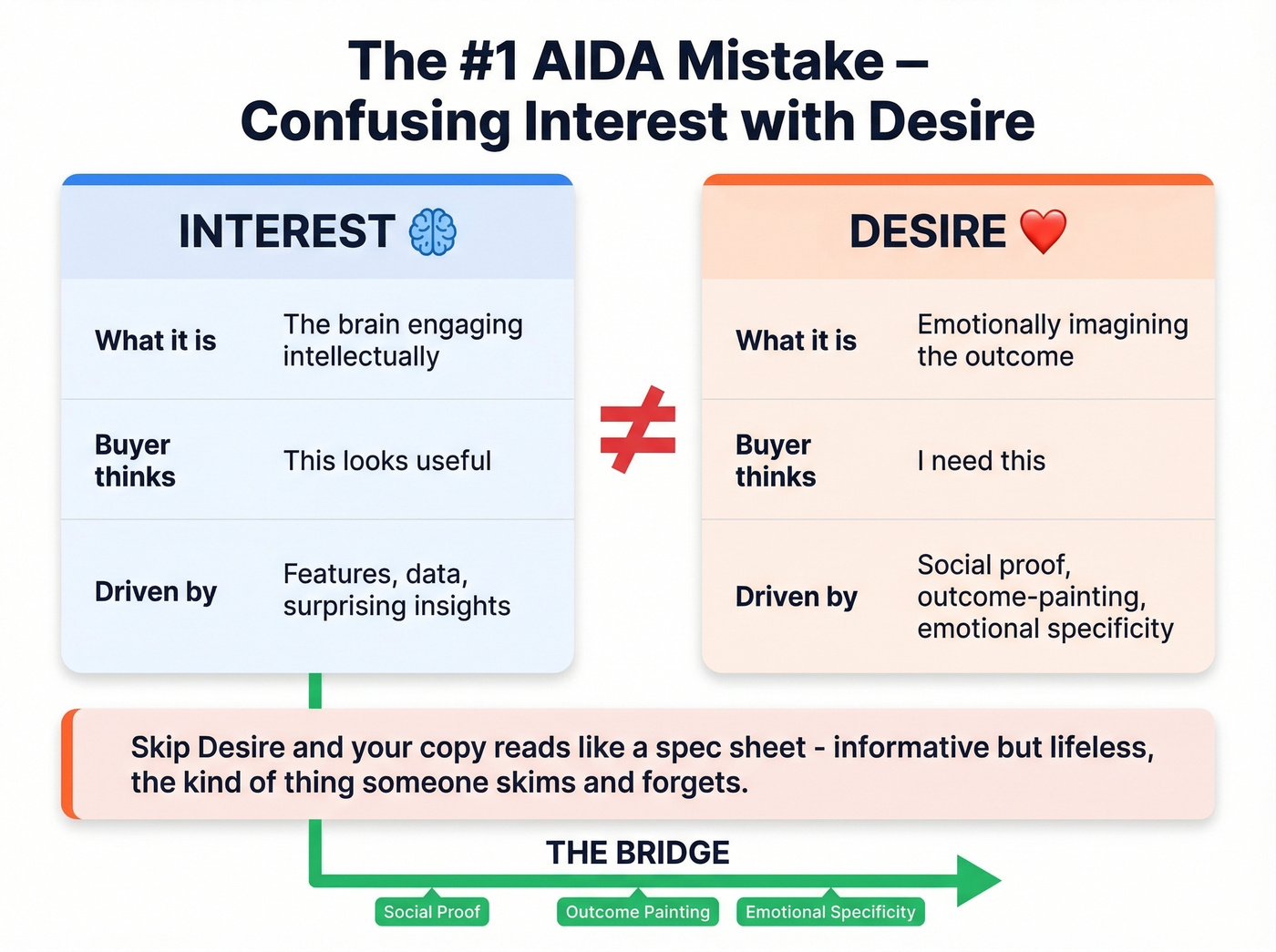
Interest is where you earn the right to keep talking. You've hooked them; now deliver substance - features, data, a surprising insight, anything that makes the buyer think "This is relevant to me." Interest is intellectual. It's the brain engaging.
Desire is where most marketers fall apart. Here's the thing: the #1 AIDA mistake - and we see it constantly on r/copywriting - is treating Desire and Interest as the same stage.
They're not. Interest means the prospect is reading and curious. Desire means they're imagining themselves using your product and feeling the outcome. Interest is "this looks useful." Desire is "I need this." You bridge the gap with social proof, outcome-painting, and emotional specificity. Skip Desire and your copy reads like a spec sheet - informative but lifeless, the kind of thing someone skims and forgets.
Action is the CTA - but it's also where friction kills conversions. "Schedule a 30-minute demo" is a high-friction ask. "Would it make sense to send you 2-3 ideas?" is low-friction. The best Action stages reduce perceived risk: free trials, no-credit-card signups, money-back guarantees.
8 AIDA Framework Examples Across Every Format
1. Cold Email ($27K Case Study)
A poster on r/coldemail closed $27K in new business over two months after restructuring cold emails around AIDA. Let's break down what they did.
Attention: Subject line targets a specific pain - "Struggling with 30% cart abandonment?" No cleverness, no clickbait. Just a problem the recipient recognizes instantly. (If you want more swipeable hooks, start with these subject lines.)
Interest: The opening line references a specific insight about the prospect's business. Per GMass's breakdown, personalization should be problem recognition, not creepy data recitation. Don't say "I noticed you posted on Tuesday." Say "I noticed your checkout flow doesn't have exit-intent recovery." (More on doing this well: personalized outreach.)
Desire: Paint the outcome with proof - "We helped [similar company] increase monthly revenue by 18% with three changes to their abandonment sequence." (If you need a system for this stage, use lead scoring to prioritize the accounts most likely to convert.)
Action: Low-friction CTA - "Would it make sense to send you 2-3 ideas?" The softer ask converts better because it costs the recipient almost nothing. (If you want more options, steal from these sales follow-up templates.)
None of this works if your email bounces. Before sending any AIDA-structured outreach, verify your list with a tool like Prospeo's email finder - 98% accuracy on 300M+ professional profiles, with a free tier of 75 emails per month to test your first campaign. (For the deliverability side, see our email bounce rate guide.)
2. Landing Page (CRO Tips)
Map your landing page layout directly to AIDA stages:
Attention: Hero section - bold headline focused on benefits, a product visual, and bullet points. One counterintuitive finding: odd numbers of bullet points convert better than even.
Interest: Feature breakdown with supporting visuals. Adding visuals to landing pages increases engagement by up to 94%.
Desire: Social proof above the fold - testimonials, star ratings, logos. The moment someone leaves your page to Google reviews, you've probably lost them.
Action: One clear CTA. Not three. In our tests, single-CTA pages consistently outperform multi-CTA layouts. Personalize the button copy - "Get Mine Now" outperforms "Submit" every time.
3. SaaS Homepage
Every effective SaaS homepage follows AIDA structure, whether the designer knows it or not. Here's a pattern from ReadStoLeads:
Attention: "Your SaaS website is stopping you from doubling your MRR." Bold, specific, slightly confrontational.
Interest: "I can help you change that." Short pivot that promises a solution without over-explaining.
Desire: "I help SaaS businesses convert visitors into customers through conversion-focused redesigns that have generated $2M+ in pipeline." Now the prospect is imagining their own results.
Action: "Book a free Clarity Call now." Named CTA, zero cost, low commitment.
Each line does exactly one job. Most SaaS homepages cram Interest and Desire into the same paragraph and end up doing neither well. (If you want a stage-by-stage funnel view, compare it to an AIDA sales funnel.)
4. Meta/Instagram Ad
Social ads compress AIDA into seconds. You've got 0.5 seconds to hook someone mid-scroll.
| Stage | Element | Example |
|---|---|---|
| Attention | Visual + headline | Before/after image: "This $12 serum replaced my $90 routine" |
| Interest | Body copy, line 1 | "We tested 200 serums and found 3 ingredients that actually work" |
| Desire | Social proof | "Join 12,000+ people who ditched overpriced skincare. Here's what Sarah said..." |
| Action | Engagement CTA | "Comment 'YES' for the free guide!" |
Comment/DM CTAs often outperform traditional link clicks on Meta because the algorithm rewards engagement and the reply creates a conversation thread.
5. YouTube Pre-Roll Ad
You have 5 seconds before the skip button appears. That's your entire Attention budget.
The best pre-roll ads follow a ruthless structure: open with a shock hook - "You're wasting $400 a month on groceries. Here's proof." - no logo, no brand intro. Deliver the insight between seconds 5 and 15: "The average family throws away 30% of what they buy. We built an app that plans meals around what's already in your fridge." Show the result from 15 to 25 seconds - a family using the app, a monthly savings number on screen. Close with three words: "Download free. Link below." Viewers won't remember a URL, but they'll tap a link in the description.
6. Google Search Ad
Google Ads are AIDA compressed into character limits. Every word earns its place or gets cut.
Attention: Headline mirrors the search keyword exactly - "Best Project Management Tool for Remote Teams." If the headline doesn't match intent, the click never happens.
Interest: Description delivers the differentiator - "Used by 5,000+ remote teams. Integrates with Slack, Notion, and Jira in one click."
Desire: Ad extensions do the heavy lifting - star ratings, promotional sitelinks like "Free 14-Day Trial," and structured snippets showing features without burning description space.
Action: "Start Free - No Credit Card." For SaaS search ads, the last objection is almost always commitment. Eliminate it.
7. Classic Brand Campaign: Apple iPhone Launch
Steve Jobs didn't label his 2007 keynote "AIDA." He didn't need to - the structure was instinctive.
He opened by telling the audience Apple was about to reinvent the phone. That's Attention. He built curiosity by walking through the idea and positioning multiple "devices" that turned out to be one - that's Interest. Then came the live demos, the moment that makes people want to touch the product. Desire. And the Action? A clear availability date. Not "learn more." Not "sign up for updates." A date. It remains one of the most studied marketing presentations in history.
8. Small Business: Local Restaurant
Before AIDA: "Grand opening this Saturday! Come check us out. 123 Main Street." Generic, no hook, no reason to care.
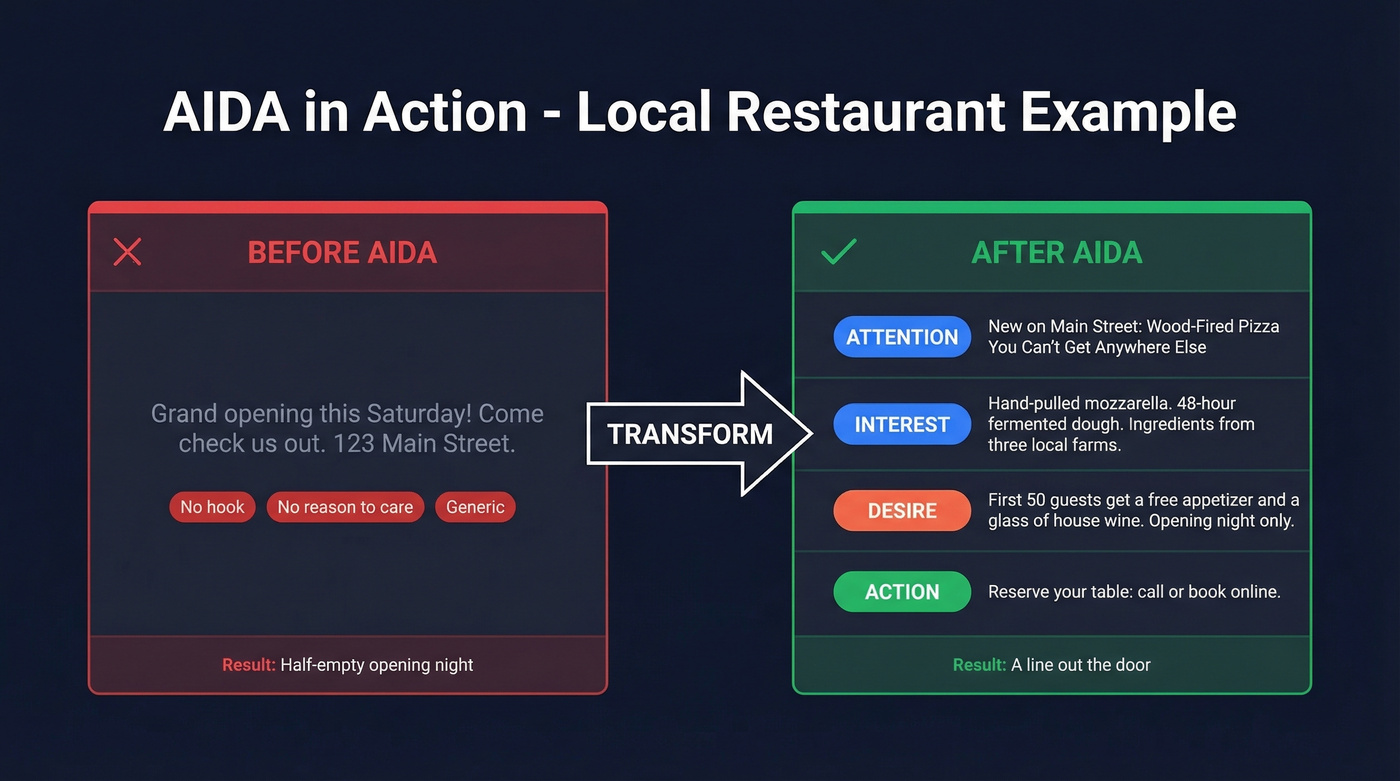
After AIDA: A striking food photo on Instagram with "New on Main Street: Wood-Fired Pizza You Can't Get Anywhere Else" grabs Attention. Menu highlights build Interest - "Hand-pulled mozzarella. 48-hour fermented dough. Ingredients from three local farms." A limited-time offer creates Desire - "First 50 guests get a free appetizer and a glass of house wine. Opening night only." Scarcity plus generosity. And the Action is frictionless: "Reserve your table: [phone number] or book online."
The difference between those two versions is the difference between a half-empty opening night and a line out the door.

The best AIDA cold email won't close $27K if it bounces. Prospeo's 98% email accuracy and 300M+ verified profiles mean your Attention-grabbing subject lines actually reach inboxes - not spam folders.
Nail every AIDA stage by starting with data that actually delivers.
How to Measure AIDA (KPIs by Stage)
Most teams run AIDA intuitively but never measure it by stage. That's a mistake, because Attention metrics become vanity metrics fast if they aren't tied to conversions. Here's a KPI framework adapted from ON24's research:
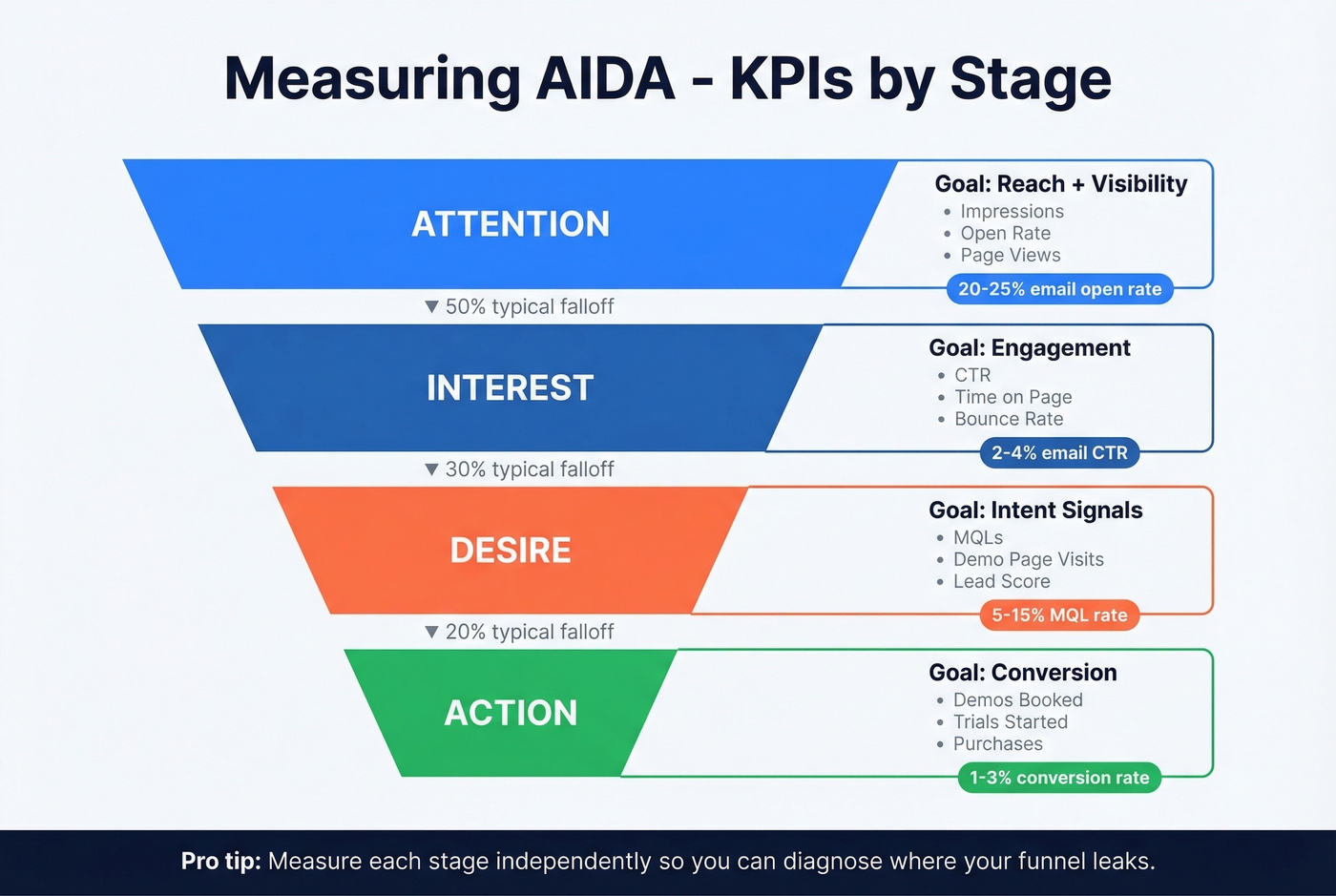
| Stage | Goal | Key Metrics | Benchmarks |
|---|---|---|---|
| Attention | Reach + visibility | Impressions, open rate, page views | 20-25% email open rate |
| Interest | Engagement | CTR, time on page, bounce rate | 2-4% email CTR |
| Desire | Intent signals | MQLs, demo page visits, lead score | 5-15% MQL rate |
| Action | Conversion | Demos booked, trials started, purchases | 1-3% conversion rate |
Your numbers will vary by channel and audience. The point is to measure each stage independently so you can diagnose where your funnel leaks. Segmented email lists generate dramatically higher open rates - some benchmarks cite up to 94% - which means segmentation makes the Attention stage work harder without spending more. (If you're building dashboards, track funnel metrics alongside stage KPIs.)
A warning: don't over-index on Attention metrics. Impressions and open rates feel good in dashboards but mean nothing if Interest and Desire stages aren't converting. Measure the full funnel or you'll optimize for vanity.
AIDA vs PAS - Which Framework When?
AIDA's biggest competitor is PAS (Problem, Agitate, Solution). Same scenario - selling a marketing audit service:
AIDA version: "Your website traffic doubled last quarter" then "But conversion rate dropped 15%" then "Our audit identifies the 3 highest-impact fixes - clients average 22% conversion lift" then "Book a free 30-minute audit."
PAS version: "Your traffic is up but revenue is flat" then "Every day without fixing your conversion funnel costs you $2,000 in lost revenue" then "Our marketing audit pinpoints exactly where you're leaking - book a free session."
Real talk: PAS is the better framework for most marketers. It's simpler, it hits harder, and it works in every short-form format - subject lines, social posts, CTAs. AIDA is better when you're guiding someone through a longer journey like a landing page or email sequence. Master both and you've covered 90% of marketing situations. They aren't competitors - they're complements. Skip PAS if you only write long-form content, but for anyone doing cold outreach or social ads, learn it first. (If you're doing outbound, pair this with sales prospecting techniques.)
AIDA only works when you're reaching real buyers. Prospeo gives you 30+ filters - intent data, technographics, job changes - so your Desire stage hits prospects already in-market. At $0.01 per email, testing AIDA variations costs almost nothing.
Stop writing perfect copy for the wrong people.
When AIDA Breaks Down
AIDA is powerful, but it has real blind spots - especially in B2B SaaS.
The biggest: AIDA stops at Action. For SaaS companies, the sale is just the beginning. Revenue depends on retention, expansion, and referral - none of which AIDA addresses. That's why frameworks like AARRR (the Pirate Funnel) exist: Acquisition, Activation, Retention, Referral, Revenue. If your business model depends on monthly renewals, AIDA alone won't cut it. (To go deeper on retention math, start with renewal rate.)
The second blind spot is linearity. Real buyers don't move neatly from Attention to Action. They bounce between stages, get influenced by peer reviews mid-funnel, and circle back to Desire after reading a case study three weeks later. BCG's research replaces linear funnels entirely with "influence maps" that track non-linear buyer journeys. Omnichannel reminder systems - SMS, push notifications, chatbot follow-ups - increase conversion rates by 15-20% precisely because they re-engage buyers who've fallen out of the linear path.
AIDA is 128 years old and still the first framework every marketer learns. That's not because it's perfect - it's because it's useful. Use it as a diagnostic tool for your copy, not as a rigid pipeline. When you need post-purchase thinking, layer in AARRR. For short-form punch, switch to PAS. The AIDA model is the foundation, not the whole building.
FAQ
Does AIDA actually work or is it just theory?
AIDA works because it maps how humans make decisions - and the data backs it up. The $27K cold email case study used explicit AIDA structure. Email behavior stats show 47% of opens depend on the subject line (Attention), and landing page CRO data confirms social proof placement (Desire) directly impacts conversion. It's 128 years old because it reflects psychology, not trends.
What's the difference between Interest and Desire?
Interest means the prospect is intellectually engaged - they're reading and curious. Desire means they're imagining themselves using your product and feeling the outcome. You bridge the gap with social proof, outcome-painting, and emotional specificity. Skip Desire and your copy reads like a spec sheet instead of a sales pitch.
What tools help execute an AIDA email campaign?
You need a sequencing tool like Instantly, Lemlist, or Smartlead for sending, and an email verification tool to keep your list clean. Prospeo verifies emails at 98% accuracy across 300M+ profiles with a 7-day data refresh cycle - the free tier gives you 75 emails per month. Pair it with a sequencer and you've got a full AIDA outreach stack for under $100/month.