

The AIDA Model in Marketing: A Practitioner's Guide to Actually Using It
The AIDA model in marketing is a four-stage communication framework - Attention, Interest, Desire, Action - that structures how you move a prospect from noticing you to taking a specific next step. Created in 1898, it's still the most practical checklist for writing cold emails, ads, and landing pages.
You sent 500 cold emails last quarter. Three replies. One was "please remove me from your list." The problem wasn't your product, your timing, or even your list - it was your message structure. AIDA won't fix bad targeting, but it'll fix the copy that's killing your conversion before anyone reads past the subject line.
What Is the AIDA Framework?
Elias St. Elmo Lewis introduced AIDA in 1898) as a framework for structuring persuasive communication. It sits within the hierarchy-of-effects tradition - the idea that people move through cognitive stages before acting. The model has survived for more than a century not because it's scientifically perfect, but because it forces you to think about your message in the right order.

| Stage | Goal | Description | Example Tactic |
|---|---|---|---|
| Attention | Stop the scroll | Earn the first glance with a hook | Pattern-interrupt subject line |
| Interest | Earn 10 more seconds | Make the reader stay with relevance | Relevant stat or case reference |
| Desire | Create emotional pull | Shift from "interesting" to "I need this" | Before/after outcome |
| Action | Get the next step | Make the CTA low-friction and obvious | Single soft-ask CTA |
Here's the key distinction: AIDA describes how to structure a message, not how every buyer actually decides. Modern buyers loop, skip stages, and research in parallel. That's fine. AIDA's value is in the writing, not the theory.
The Four Stages (With Examples)
Attention - Earn the First Glance
In a cold email, that's the subject line. On social, it's the first frame. Duolingo nails this on Instagram - a giant green owl mascot doing a trending dance stops the thumb before anyone processes what's being sold.
For cold email, specificity beats cleverness every time. "Struggling with 30% cart abandonment?" outperforms "Quick question" because it signals you know the reader's world. The subject line isn't about your product. It's about their problem. (If you want more tested hooks, see these cold email subject line examples.)
Interest - Make Them Stay
Attention gets the glance. Interest earns the next 10 seconds. This is where you prove you're worth reading - Duolingo's "learn a language in 5 minutes a day" hook works because it's specific, achievable, and immediately relevant to anyone who's ever wanted to pick up Spanish but assumed it'd take hours.
For content marketing, interest-stage tactics include question-based queries, long-tail SEO that matches awareness-stage search intent, and content hub architecture - building themed resource clusters with strong internal linking so visitors stay in your ecosystem rather than bouncing to a competitor. For cold email, interest means a quick insight or result that proves you've done homework. Not a paragraph about your company history.
Desire - Where 90% of Marketers Fail
Most marketers treat Interest and Desire as the same stage. They're not.
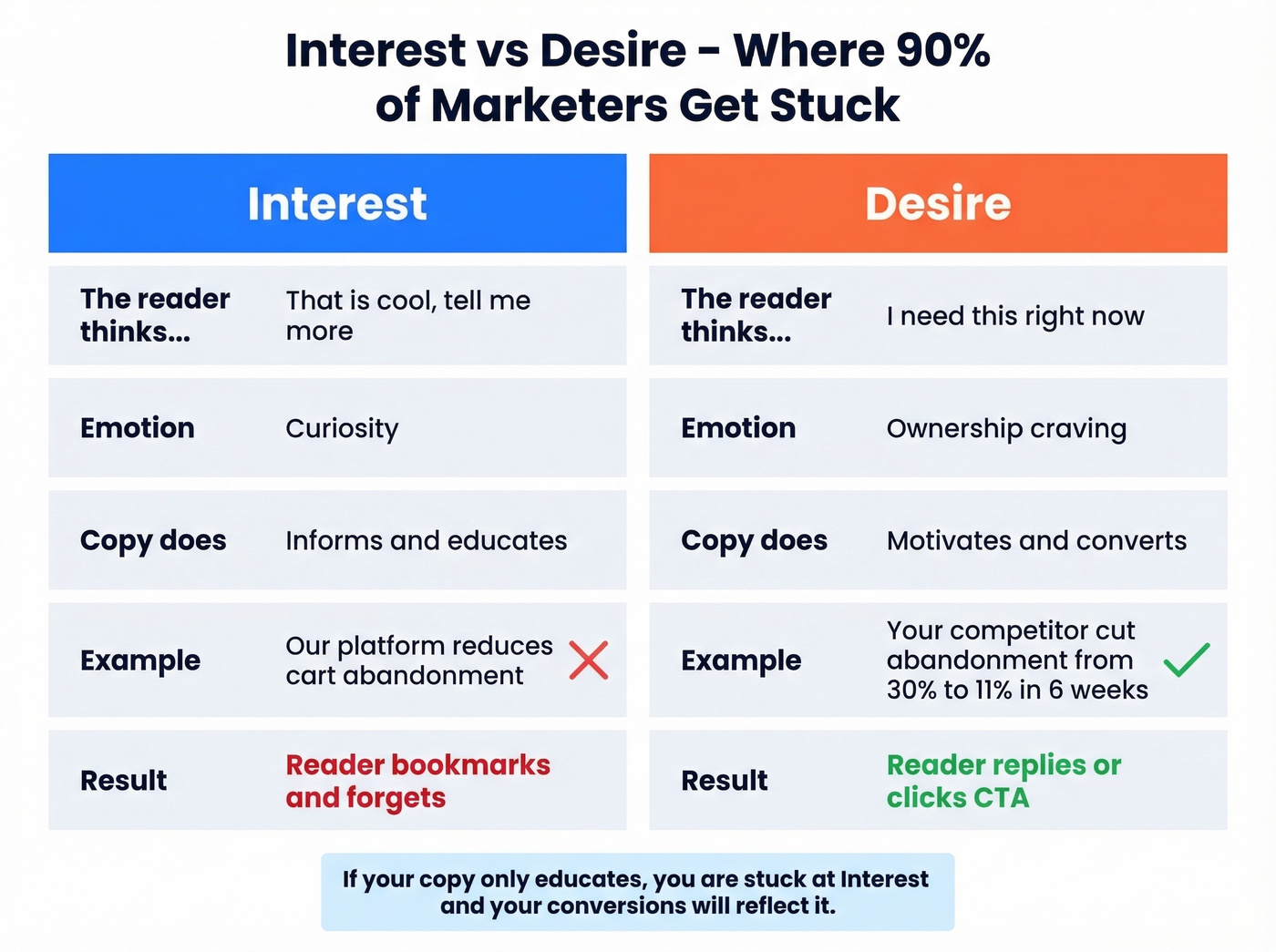
Confusing them is the single biggest reason AIDA-structured copy underperforms. A useful analogy from r/copywriting: imagine walking past a storefront. The sign catches your Attention. The window display holds your Interest. But Desire is the moment you see yourself owning that jacket - you picture wearing it Friday night. That's the shift from intellectual curiosity to emotional ownership craving.
How is Desire different from Interest? Interest says "that's cool, tell me more." Desire says "I need this." Interest informs. Desire motivates. If your copy only educates, you're stuck at Interest and your conversion numbers will reflect it.
Before/after copy is the fastest way to trigger Desire. Instead of "our platform reduces cart abandonment," write "your competitor cut cart abandonment from 30% to 11% in six weeks - here's the playbook." Duolingo builds Desire through social proof: comments filled with successful learners showing real results. Calendly does it with case studies showing DMACC saved $170K last year.
Action - Low-Friction or No Friction
The Action stage is where good copy goes to die - usually because the CTA asks for too much. A 30-minute demo call is a massive commitment from someone who just read four sentences.
Do this:
- Use low-friction CTAs: "Would it make sense to send you 2-3 ideas?"
- Offer a free trial or lead magnet as a bridge step
- Place CTAs where the reader's momentum is highest - right after the Desire peak
Don't do this:
- Ask for a 30-minute call in a first-touch cold email
- Bury the CTA below three paragraphs of company boilerplate
- Use vague CTAs like "Let's connect" with no clear next step
Netflix's free trial is the textbook Action-stage example - zero friction, instant gratification. Nerdwallet uses dual CTAs (compare rates vs. read the guide) to catch prospects at different readiness levels, which is a smart move when you can't predict where someone is in their decision process.
AIDA in Action: A $27K Cold Email
A practitioner on r/coldemail shared that restructuring cold emails around AIDA closed $27K in new business over two months. The approach was dead simple.
| Stage | What to Write | Example Line |
|---|---|---|
| Attention | Pain-specific subject line | "Struggling with 30% cart abandonment?" |
| Interest | Relevance hook + quick proof | "We helped [similar brand] fix this in 6 weeks" |
| Desire | Concrete outcome | "They increased monthly revenue by 18%" |
| Action | Low-friction CTA | "Would it make sense to send you 2-3 ideas?" |
No company history. No feature list. No "I noticed you went to Stanford" opener. Four sentences, each doing one job. This is AIDA email marketing at its most effective - stripped down, outcome-focused, and structured to earn a reply. (For more reply-focused patterns, use these emails that get responses.)

How to Measure Each AIDA Stage
If you can't measure each stage, you're not using AIDA - you're hoping. Here's the channel-by-stage matrix:

Email, Organic, and Paid Channels
| Stage | Organic/SEO | Paid | |
|---|---|---|---|
| Attention | Open rate, delivered | Page views, impressions | Impressions, CTR |
| Interest | CTR, engaged contacts | Bounce rate, return visits | Engagement rate |
| Desire | MQL score, BOFU clicks | High-intent page visits | Lead form fills |
| Action | Reply rate, meetings | Conversion rate | Cost per acquisition |
Social and Events
| Stage | Social | Events |
|---|---|---|
| Attention | Reach, followers | Registrations |
| Interest | Shares, comments | Attendance rate |
| Desire | DM inquiries | CTA clicks, polls |
| Action | Sign-ups | Demo bookings |
Most teams only track Attention (open rates) and Action (conversions) and ignore everything in between. That's like measuring the first and last mile of a marathon. The Interest and Desire metrics tell you where your funnel actually breaks - and that's where the real optimization happens. (If you want a broader KPI set, start with funnel metrics.)

AIDA structure gets replies - but only if your emails reach real inboxes. That $27K cold email example? It fails at the Attention stage if 35% of your list bounces. Prospeo's 98% verified emails and 7-day data refresh mean your perfectly structured AIDA copy lands where it should - in front of actual decision-makers, not dead addresses.
Stop perfecting copy that bounces. Fix the data first.
AIDA in the AI Era
88% of marketers use AI tools daily in 2026, and the AI marketing industry sits at $47.32B. AIDA hasn't been replaced by AI. It's been supercharged by it.
Attention targeting gets sharper with predictive lead scoring that identifies who's most likely to engage before you write a word. You're not blasting 10,000 contacts - you're reaching the 800 who match your ICP signals. (If you need a scoring baseline, see lead scoring.)
Interest and Desire copy scales through generative AI that produces dozens of variants in minutes. AI-generated subject lines increase open rates by up to 22%, but the key is testing variants, not trusting the first output. In our experience, the third or fourth AI-generated version usually outperforms the first by a wide margin once you've refined the prompt with real performance data. (Related: AI cold email outreach.)
Action optimization happens through multi-armed bandit algorithms that test CTAs in real time, shifting traffic to winners without waiting for a traditional A/B test. And post-Action nurture engines determine whether a converted lead gets a case study, a demo invite, or a pricing page - automatically.
Companies using AI-driven marketing report 544% ROI over three years. The framework is more than a century old. The execution toolkit is brand new.
Common Mistakes to Avoid
Confusing Interest with Desire. This is the #1 mistake. If your email educates but doesn't create emotional pull toward a specific outcome, you've stopped at Interest. Desire requires the reader to picture themselves with the result - not just understand the concept.
"Cyberstalk" personalization. AI makes it easy to scrape someone's bio and open with "I see you went to Michigan and love hiking." That's not personalization - it's creepy. The best personalization recognizes a prospect's specific business problem, not their hobby list. GMass has written about this extensively, and the consensus on r/sales backs it up: business-relevant beats personal-trivia every time. (More on this: personalized outreach.)
Treating AIDA as a rigid linear funnel. Buyers don't move neatly from A to I to D to A. They loop, skip, and revisit. Use AIDA to structure your message, not to model your buyer's brain. HubSpot's buyer journey research confirms that modern purchase paths look more like a pinball machine than a straight line.
High-friction Action steps. "Let's schedule a 30-minute call" in a first-touch cold email is the conversion killer I see most often. "Would it make sense to send you 2-3 ideas?" converts dramatically better because it asks for almost nothing. (If you want CTA patterns, see email call to action.)
AIDA vs. Other Frameworks
AIDA isn't the only option. Here's how it stacks up:
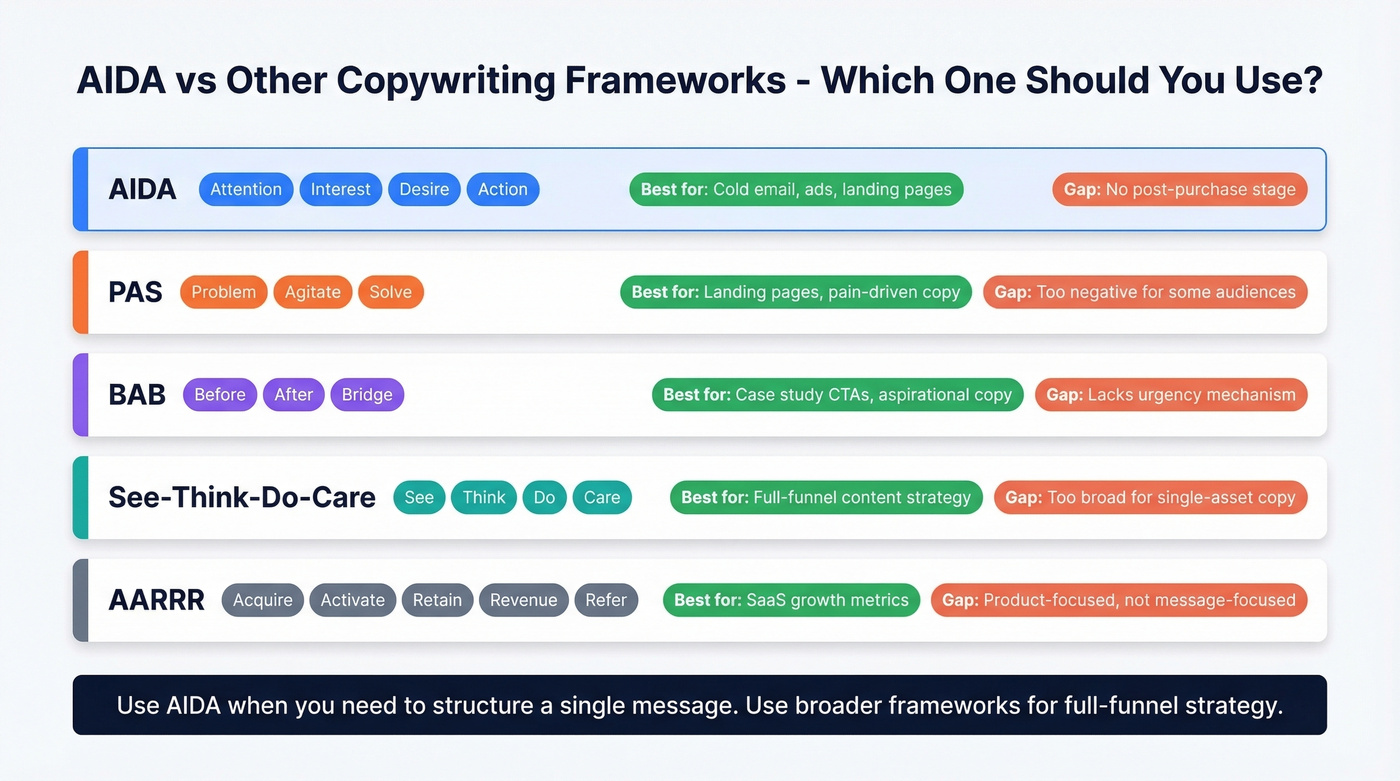
| Framework | Best For | Stages | Weakness |
|---|---|---|---|
| AIDA | Cold email, ads, landing pages | Attention - Interest - Desire - Action | No post-purchase stage |
| PAS | Landing pages, pain-driven copy | Problem - Agitate - Solve | Too negative for some audiences |
| BAB | Case study CTAs, aspirational copy | Before - After - Bridge | Lacks urgency mechanism |
| See-Think-Do-Care | Full-funnel content strategy | See - Think - Do - Care | Too broad for single-asset copy |
| AARRR | SaaS growth metrics | Acquire - Activate - Retain - Revenue - Refer | Product-focused, not message-focused |
ANC (Attention - Need - Close) is a compressed variant that works for short-form social copy where you don't have room for four distinct stages. AIDAR adds a Retention stage after Action - AIDA's natural evolution for subscription businesses and SaaS. (If you want the expanded version, see the AIDA sales funnel.)
Let's be honest about framework selection: start with AIDA for outbound and PAS for landing pages. Everything else is a variant. Master two frameworks deeply rather than dabbling in six.
Skip the multi-framework approach entirely if your average deal size is under $5K. You don't need a sophisticated content strategy. You need one AIDA-structured cold email that's four sentences long, sent to verified contacts, with a CTA that asks for almost nothing. Frameworks don't close deals. Messages do.
Does AIDA Still Work in 2026?
The r/advertising thread asking "is there any evidence AIDA works?" reflects a legitimate concern. There's no randomized controlled trial proving AIDA causes conversions.
They're right - as a theory of buyer behavior. They're wrong if you're using AIDA as a writing checklist. The practitioner who closed $27K in two months didn't prove AIDA is scientifically valid. He proved it's practically useful. That's a different standard, and frankly a more important one. Across sales and marketing applications, teams that structure their outreach around the four stages consistently outperform teams that wing it. Copyblogger's analysis of the framework's longevity reaches the same conclusion: it endures because it works as a writing tool, not because it's a perfect model of human cognition.
Understanding the AIDA model in marketing takes 5 minutes. Implementing it well takes a career. (To tighten the actual writing, use this email copywriting guide.)
The Action stage needs low-friction CTAs - but it also needs the right audience. Prospeo gives you 30+ filters including buyer intent, technographics, and job changes so your AIDA emails target prospects already in-market. At $0.01 per verified email, you can run high-volume AIDA campaigns without burning your budget or your domain reputation.
Target in-market buyers and let your AIDA copy do the rest.
FAQ
What does AIDA stand for?
AIDA stands for Attention, Interest, Desire, Action - a four-stage framework for structuring persuasive marketing communication. Elias St. Elmo Lewis created it in 1898, making it one of the oldest and most widely used models in advertising and copywriting.
Is the AIDA model still relevant in 2026?
Yes, as a message-structuring checklist. Modern buyers don't move linearly through stages, so it's less useful as a literal journey model. But for writing cold emails, ads, and landing pages, the framework remains the most practical approach - 88% of marketers using AI tools still rely on AIDA to organize copy before scaling variants.
What's the difference between Interest and Desire?
Interest is intellectual curiosity - "that's cool, tell me more." Desire is emotional ownership craving - "I need this." The storefront analogy helps: the window display holds your Interest, but Desire is picturing yourself wearing that jacket Friday night. Most underperforming copy stalls at Interest because it educates without creating emotional pull.
How do I measure AIDA stages?
Map KPIs to each stage by channel: open rates measure Attention, CTR tracks Interest, MQL scores gauge Desire, and conversion rate captures Action. Tracking all four reveals where your funnel actually breaks - most teams only measure the first and last stage, missing the real problem entirely.
What tools help execute AIDA for cold email?
You need accurate prospect data, a sequencing tool like Instantly or Lemlist, and a CRM to track stage progression. Bad data kills AIDA before it starts - if your emails bounce, the best copy never gets read. Prospeo verifies emails at 98% accuracy across 143M+ contacts and pairs with most major outbound platforms.