

Always Be Closing (ABC): The Most Misunderstood Phrase in Sales
The discovery call went great. The prospect asked smart questions, nodded along, even laughed at your joke about their competitor's landing page. Then came the moment of truth, and your rep said: "Great chatting - I'll send over some info!" The prospect said "sounds good," and neither of them ever spoke again.
That deal didn't die because of bad product-market fit. It died because nobody followed the oldest rule in sales - always be closing.
"Always Be Closing" is the most famous phrase in sales, and most salespeople can't agree on what it actually means. One Reddit thread from an experienced rep put it bluntly - they'd been selling for years and didn't actually know what "closing" meant. The edit was even better: "Didn't realize there's not a single answer to this." Every sales training deck quotes the ABC mantra and moves to the next slide. Nobody teaches you what closing actually looks like in a real conversation.
The Short Version
ABC doesn't mean pressure-close everyone. It means never leave a conversation without advancing toward a decision - even if that decision is "not now."
Old-school ABC ignores modern buyers. 60-70% of B2B research happens before a prospect talks to you. Modern ABC is about responsiveness, verified data, and micro-commitments - not manipulation.
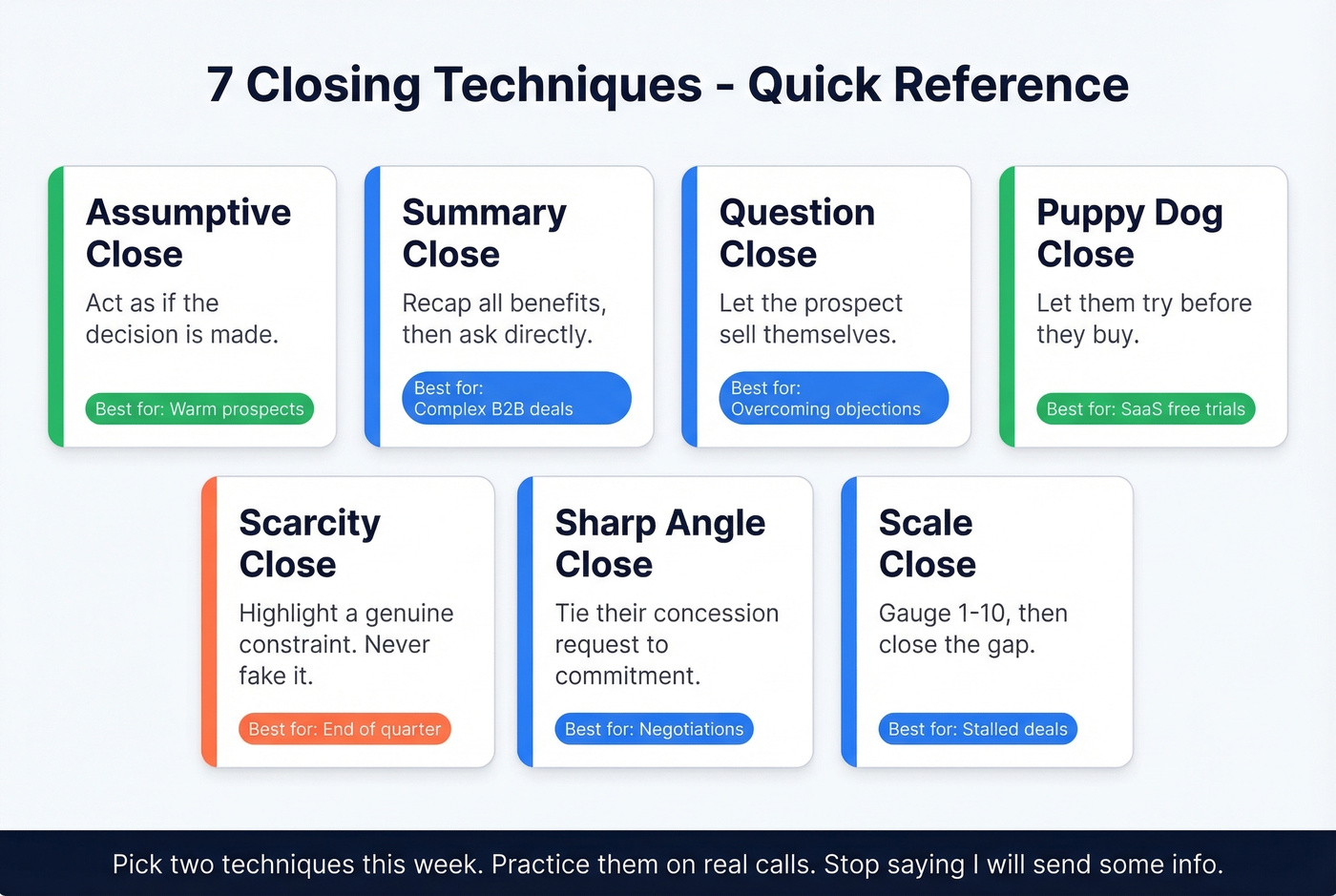
The seven closing techniques below give you word-for-word scripts. Pick two, practice them this week, and stop ending calls with "I'll send some info."
What Does ABC Mean in Sales?
The confusion starts with the word "closing." It means at least three different things depending on who you ask.
Interpretation one: closing means asking for the order. Sign here. Swipe your card. This is the Glengarry Glen Ross version - the one that makes people uncomfortable.
Interpretation two: closing means advancing to the next step. Every interaction should end with a concrete commitment - a booked meeting, a signed NDA, a scheduled demo. You're not asking for the deal every time. You're asking for forward motion.
Interpretation three: closing is a posture, not a moment. You maintain closing intent throughout every interaction - steering toward a decision even when you're listening, qualifying, or educating. Scott Leese put it differently: ABC is really about "all the little steps that lead up to a deal." Not one dramatic ask at the end. A series of small commitments that make the final yes feel inevitable.
The ABC Matrix
Here's a framework we've never seen anyone else lay out, but it captures the four modes every salesperson falls into:
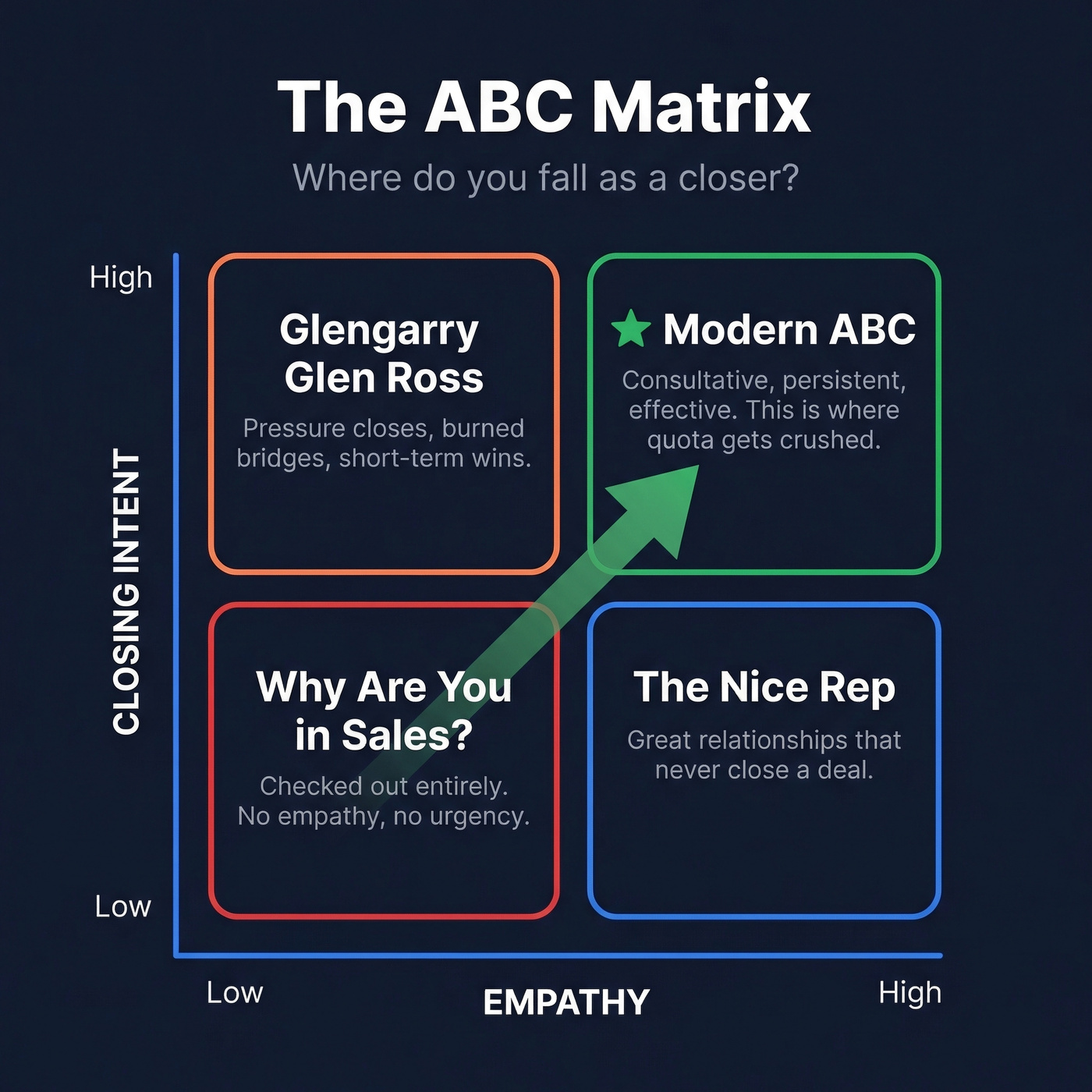
| High Empathy | Low Empathy | |
|---|---|---|
| High Closing Intent | Modern ABC - consultative, persistent, effective | Glengarry Glen Ross - pressure closes, burned bridges |
| Low Closing Intent | "Relationship building" that never closes a deal | Why are you in sales? |
Most reps live in one of the bottom two quadrants. They're either so focused on being liked that they never ask for the business, or they've checked out entirely. The top-left quadrant - high empathy plus high closing intent - is where quota gets crushed.
Every technique in this article aims to put you there.
The Scene That Made ABC Famous
David Mamet drew from his experience managing an unscrupulous real estate office in Chicago in the late 1960s. He said the play "toned down the chicanery" compared to what he actually saw. That experience became Glengarry Glen Ross, which won the Pulitzer Prize in 1984.
Here's the detail most people miss: Alec Baldwin's character doesn't exist in the original play. Mamet added him - and the entire ABC monologue - when he adapted the script for the 1992 film. The scene everyone quotes was invented for Hollywood. Baldwin's Blake walks into a room of demoralized real estate salesmen and lays out a sales contest: first prize, a Cadillac Eldorado (base price $19,334 in 1984 - about $44,780 in today's dollars); second prize, a set of steak knives; third prize, you're fired. "Coffee is for closers only."
On the chalkboard behind him, Baldwin writes AIDA - Awareness, Interest, Desire, Action).
Modern critics, including BCG's "influence maps" argument, point out that linear funnels oversimplify how B2B buyers actually decide. Buyers loop, stall, consult committees, and ghost you for three weeks before replying at 11 p.m. on a Sunday.
The scene is a cautionary tale, not a training video. Every character in that room is miserable, unethical, or both. Mamet wasn't celebrating the ABC philosophy. He was showing what happens when it's the only tool in the box.

ABC only works when you're closing the right people. Prospeo gives you 300M+ verified profiles with 30+ filters - buyer intent, job changes, technographics - so every conversation starts with a qualified prospect, not a cold guess.
Stop closing blind. Start closing buyers who are already in-market.
Why Old-School ABC Fails
The pressure-cooker version was built for a world where the salesperson controlled the information. That world is gone.
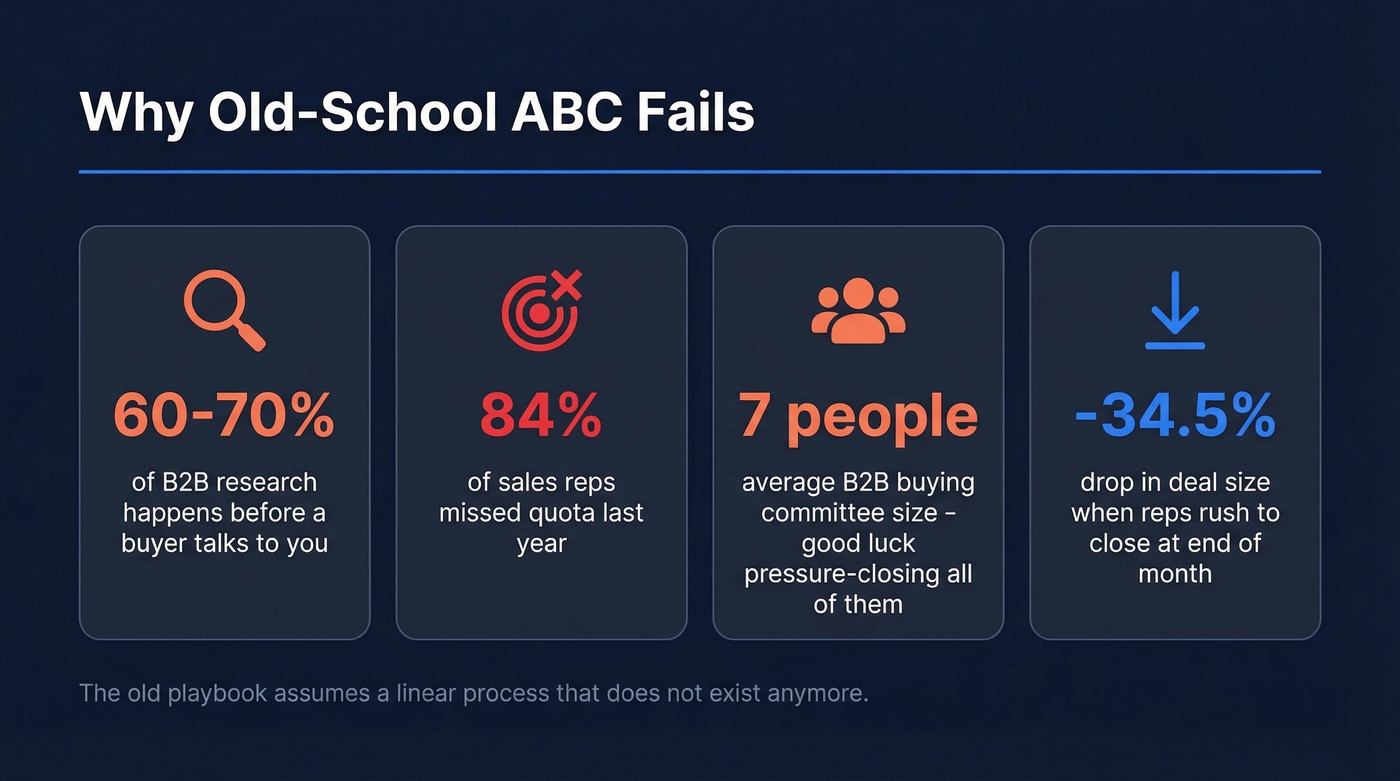
Today's B2B buyers complete 60-70% of their research before they ever talk to your team. 80% of B2B sales interactions happen in digital channels, and 57% of sales leaders believe buyers are less dependent on salespeople than they were five years ago. You're selling to a committee of around 7 people that's already read your G2 reviews and compared your pricing page to three competitors.
Here's the number that should keep every sales leader up at night: 84% of reps missed quota last year. That's not because reps forgot to close. It's because the old playbook assumes a linear process that doesn't exist anymore.
A solar rep on Reddit framed the tension perfectly: "Am I supposed to control customers or educate them?" Pressure creates unhappy customers and long-term reputation risk. Reps close 3x more deals at end of month, but deal size drops 34.5%. That's old-school ABC in action - more closes, worse deals.
Why ABC Still Matters (Reframed)
A door-to-door pest control rep shared a story on Reddit that nails the other side of this debate. A previous salesperson had visited two women, given them the full pitch, handed them a flyer, and walked away. Those women were ready to buy - he just never asked. The Reddit poster showed up, used a simple assumptive scheduling close ("Does 10 a.m. sound good?"), and got the deal.
That's the real argument for ABC. Not pressure. Prevention. You're preventing deals from dying because nobody asked for the next step.
The modern reframes all point in the same direction. "Always Be Connecting" focuses on responsiveness - nearly 30% of scheduled callbacks get missed, and one real estate company saw a 35% booking increase just by tracking and returning missed calls. "Always Be Helping" shifts the frame to consultative, value-first selling. The best closers blend all three: responsive, helpful, empathetic - and they still ask for the business.
Let's be honest about something. If your average deal size is under five figures, you probably don't need a sophisticated closing methodology. You need speed-to-lead, verified contact data, and a two-call close. Overcomplicating the process at low deal values kills more revenue than bad technique ever will.
ABC By the Numbers
| Industry | Close Rate |
|---|---|
| Finance | 19% |
| Software | 22% |
| Electronics | 23% |
| Business & Industrial | 27% |
| Avg B2B close rate | 29% |
| Proposal-stage win rate | 47% |
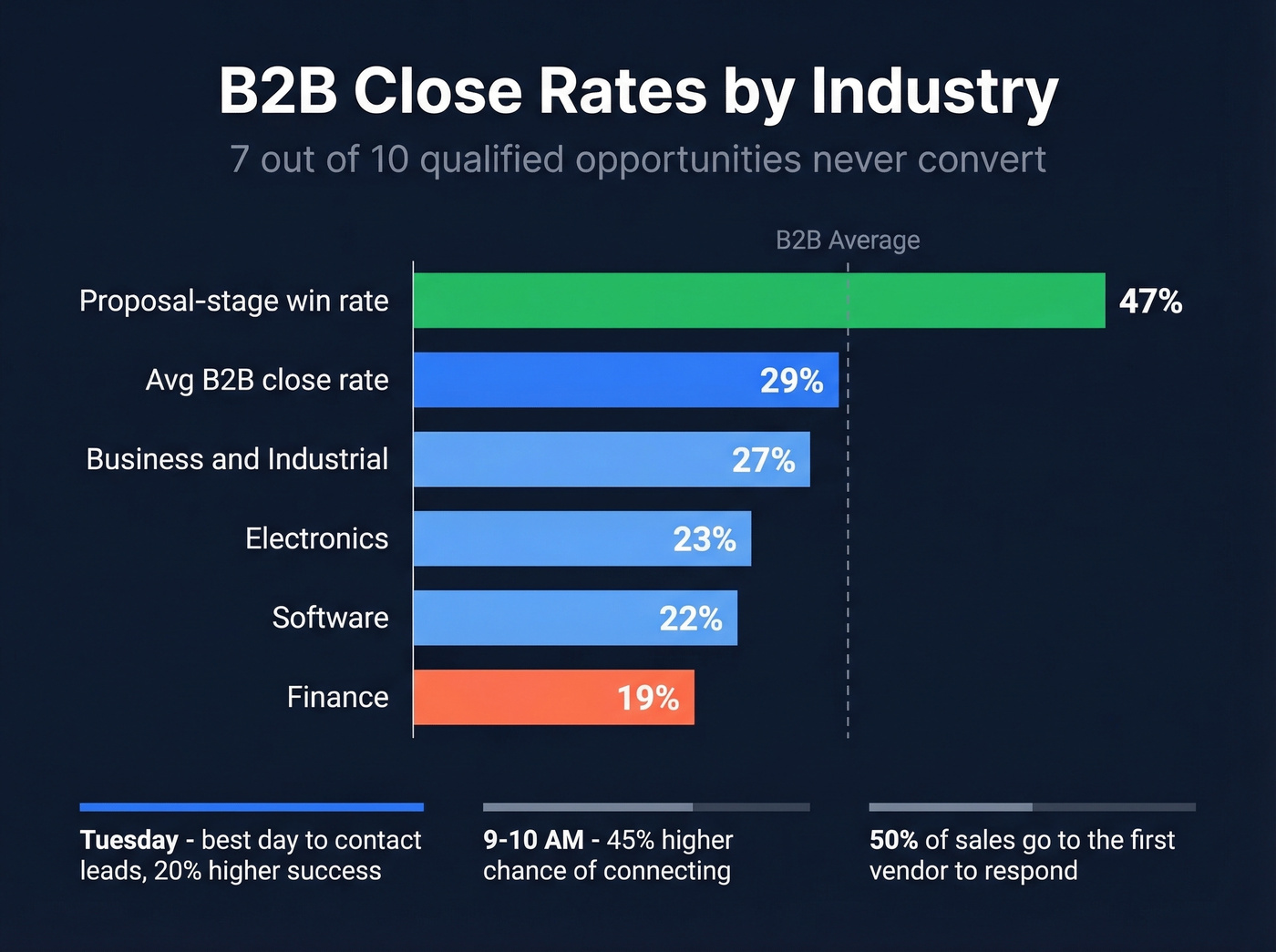
The average B2B close rate sits at 29%, meaning roughly 7 out of 10 qualified opportunities don't convert. Some are bad fits. But plenty die from inaction - missed follow-ups, stalled conversations, reps who "sent some info" and never circled back. If you want a clean framework for forward motion, use these steps to close a sale to keep deals from stalling.
Tuesday is the best day to contact leads, with success rates running almost 20% higher than average. Calling between 9-10 a.m. yields a 45% higher chance of success. 50% of sales go to the first vendor to respond, and most deals require 5-12 touchpoints. Speed and persistence aren't aggressive - they're table stakes. If you're building an outbound cadence, the best time to send cold emails data helps you stack the odds.
7 Closing Techniques With Scripts
The Assumptive Close
Skip the "would you like to move forward?" and act as if the decision's already made. "What day next week works best for our onboarding kickoff?" Best for warm prospects who've already signaled intent. Can backfire if used prematurely - read the room.
The Summary Close
Recap every benefit you've discussed, then ask directly. "So we've covered [benefit 1], [benefit 2], and [benefit 3]. Are you ready to move forward?" This is the safest close for complex B2B deals with multiple stakeholders because it reminds the prospect why they showed up in the first place, and it gives the internal champion language to sell the deal upward.
The Question Close
Turn the close into a question that lets the prospect sell themselves. "In your opinion, does what I've shown you today solve your problem?"
We've watched reps use this one and turn a dead-end objection into a 20-minute discovery conversation. If they say no, you haven't hit a wall - you've opened a door. If you need more talk tracks like this, borrow a few talk track examples and adapt them to your ICP.
The Puppy Dog Close
Let them try it before they buy it. "Start a free 14-day trial - no credit card required. If it doesn't work, no hard feelings." SaaS-native and low-pressure. The product does the closing for you.
The Scarcity Close
Highlight a genuine constraint - limited seats, end-of-quarter pricing, implementation timeline. Never fabricate urgency. Buyers smell fake scarcity instantly, and it destroys trust faster than any bad pitch ever could.
The Sharp Angle Close
When a prospect asks for a concession, tie it to commitment. "If I can get that included, are you prepared to sign today?" Turns a negotiation into a close. Only works when you actually have the authority to make the concession. (If you want to go deeper on the psychology, this is basically anchor in negotiation in action.)
The Scale Close
Gauge where they stand and close the gap. "On a scale of 1 to 10, how close are you to moving forward? What would get you to a 10?" This surfaces hidden objections without confrontation. Whatever they say the gap is - that's your closing agenda.
Here's the thing none of these techniques fix: your SDR team sent 2,000 cold emails, 340 bounced, and zero closed. You can't close a dead inbox. Verify your contact data before you dial. Tools like Prospeo run 98% email accuracy on a 7-day refresh cycle, which means you're never wasting a sharp angle close on an address that doesn't exist. If you're comparing vendors, start with these data enrichment services to see what "verified" really means.
The New ABCs of Selling
Most "ABC is dead" articles are written by people who've never carried a quota. The consultative-selling crowd sometimes uses "relationship building" as an excuse to avoid asking for the business. The mantra isn't dead. It just needs guardrails.
Listen more than you pitch. The best closers ask great questions. You can't close someone whose problem you don't understand. If your discovery is weak, tighten it with better discovery questions.
Qualify before you close. Don't waste closing energy on bad fits. A disqualified prospect isn't a lost deal - it's time saved for a real one. Skip this step if you enjoy spending three weeks nurturing someone who was never going to buy. (A simple ideal customer profile rubric makes this easier.)
Use data to time your outreach. Tuesday mornings, 9-10 a.m. That's not superstition - it's what the benchmarks show.
Verify your contact data before you reach out. We've seen teams cut bounce rates from 35% to under 4% just by running lists through email verification before hitting send. At roughly $0.01 per email, it's the cheapest insurance your domain reputation and pipeline will ever get. If you're troubleshooting deliverability, start with email bounce rate benchmarks and fixes.
Follow up relentlessly but respectfully. Most deals require 5-12 touchpoints. One email and a shrug isn't a sales process - it's a lottery ticket. When you need language that doesn't sound desperate, use these sales follow-up templates.
And remember: ABC as a management philosophy needs the same nuance as ABC on the phones. A motivation speech only works if you understand what motivates each rep. Blanket pressure from leadership without context creates the Glengarry Glen Ross nightmare, not a high-performing team.
84% of reps missed quota last year. The ones who didn't? They had verified direct dials and emails that actually connected. Prospeo delivers 98% email accuracy and 125M+ verified mobiles with a 30% pickup rate - at $0.01 per email.
Always be closing starts with always be connecting to real buyers.
FAQ
Is "Always Be Closing" outdated?
The pressure-cooker version is dead - buyers have too much information to be bullied. But always advancing toward a decision is more relevant than ever when 84% of reps miss quota. Modern ABC means micro-commitments and verified outreach, not manipulation.
What movie is the ABC sales speech from?
Glengarry Glen Ross (1992), adapted from David Mamet's Pulitzer-winning play. Alec Baldwin's character and the ABC monologue were added for the film - they don't appear in the original stage version.
What does AIDA stand for?
Awareness, Interest, Desire, Action - the marketing funnel Baldwin writes on the chalkboard. Modern critics argue any linear funnel oversimplifies how B2B buyers actually decide, loop back, and involve committees.
What's a good B2B close rate?
The average B2B close rate is 29%. Finance runs 19%, Software 22%, Business & Industrial 27%. If you're consistently above 30%, you're outperforming most teams. Proposal-stage win rates average 47%.
How do I close without being pushy?
Use the question close or scale close - both surface objections without confrontation. Confidence replaces pressure when you know your prospect is real and reachable. Verify contacts before outreach so you're never guessing whether someone's actually on the other end.