

Email Appending: How It Works, What It Costs, and Why Most B2B Teams Should Skip It
You just exported 20,000 contacts from your CRM and realized half of them don't have email addresses. Someone suggests an email append service - upload the file, pay a few cents per record, get emails back. Simple enough. Except the match rates are brutal, the data's often stale, and one bad batch can torch your sender reputation for months.
Before you append an email to a single record, read this.
What Does Email Appending Mean?
Email appending takes existing customer records - usually a name and postal address - and matches them against a third-party database to fill in missing email addresses. You upload a file, the vendor runs it against their records, and you get back whatever matches they find.
Don't confuse it with related practices. Data enrichment adds attributes like job title or company size to existing contacts. Data enhancement is verification and hygiene - cleaning what you already have. Appending is narrower: you have a record without an email, and you want one added. If you're comparing approaches, see data enrichment options built for B2B teams.
What You Need (Quick Version)
- Large consumer/postal database needing emails - Traditional batch append can make sense. Expect $0.03-0.12 per record, with match rates that vary widely based on your inputs.
- B2B sales or marketing team - Skip batch appending entirely. Real-time email finding tools deliver far better accuracy and match rates. (If you're evaluating tools, start with email search tools and email ID finder comparisons.)
- Either route - Verify every single address before you send. No exceptions. Use a dedicated email deliverability guide to avoid preventable reputation damage.
How to Append an Email
The process follows three steps. You submit your records to the append vendor. The vendor matches those inputs against their proprietary database or a network of data partners to find a corresponding email address. Then the vendor sends a test message to confirm the address is live before adding it to your file.
Experian's methodology is typical: name plus postal match, test email, then append. Some vendors offer real-time append at the point of data entry, but most teams encounter the batch variant - upload a CSV, wait, download results.
Three main flavors exist. B2B email appending targets business contacts. Consumer email appending handles individuals. And reverse email append works the other direction, starting with an email and filling in fields like name, phone, or address. For a vendor-by-vendor breakdown, see our guide to email append vendors.
Why Your Database Is Decaying
Even if you never lose a single record, your database is rotting right now. HubSpot's research puts the annual decay rate at 22.5% - roughly 2.1% of contacts go stale every month. People change jobs, abandon addresses, and opt out. Gartner estimates poor data quality costs organizations an average of $12.9 million per year, and most of that damage is invisible until you hit send.
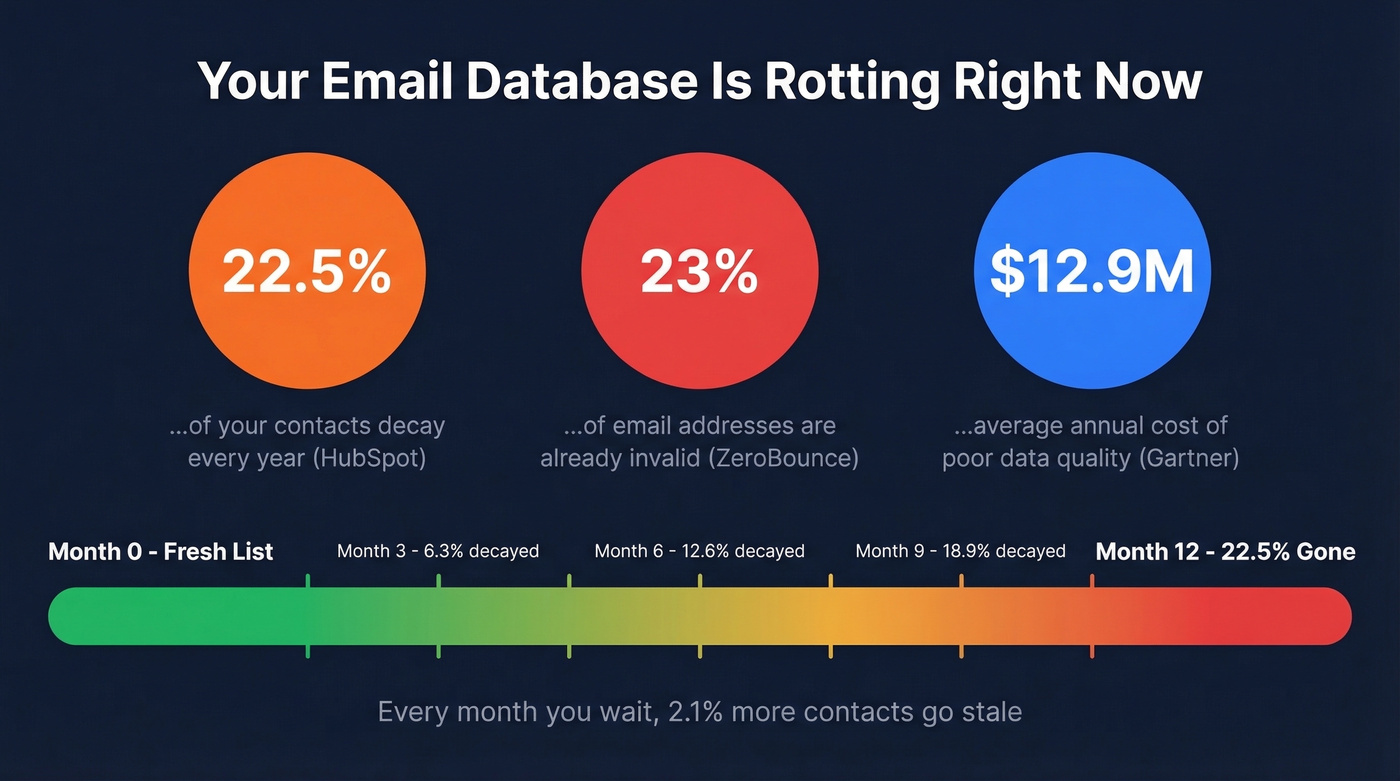
ZeroBounce's analysis of 11B+ verified emails paints an even grimmer picture: 23% of addresses were invalid, 9%+ were catch-all domains that can still bounce, and 0.01% were spam traps. That last number sounds tiny until you realize a single spam trap hit can blacklist your sending IP.

This decay is exactly why teams turn to email appending. The impulse is right. The execution is where things fall apart.

Batch append services charge $0.10-0.12 per record and return 30% match rates - meaning you pay $0.35 per usable email. Prospeo delivers an 83% enrichment match rate with 98% email accuracy at $0.01 per lead. Every address runs through 5-step verification with spam-trap removal before it ever hits your list.
Stop paying 35x more for emails that wreck your sender reputation.
Risks Nobody Mentions
A marketer on r/Emailmarketing bought roughly 10,000 contacts and sent four newsletters over eight months. The result? Even one-to-one replies started landing in spam. Their domain reputation was gone. Rebuilding took months. If you're already in this situation, follow a step-by-step plan to improve sender reputation.
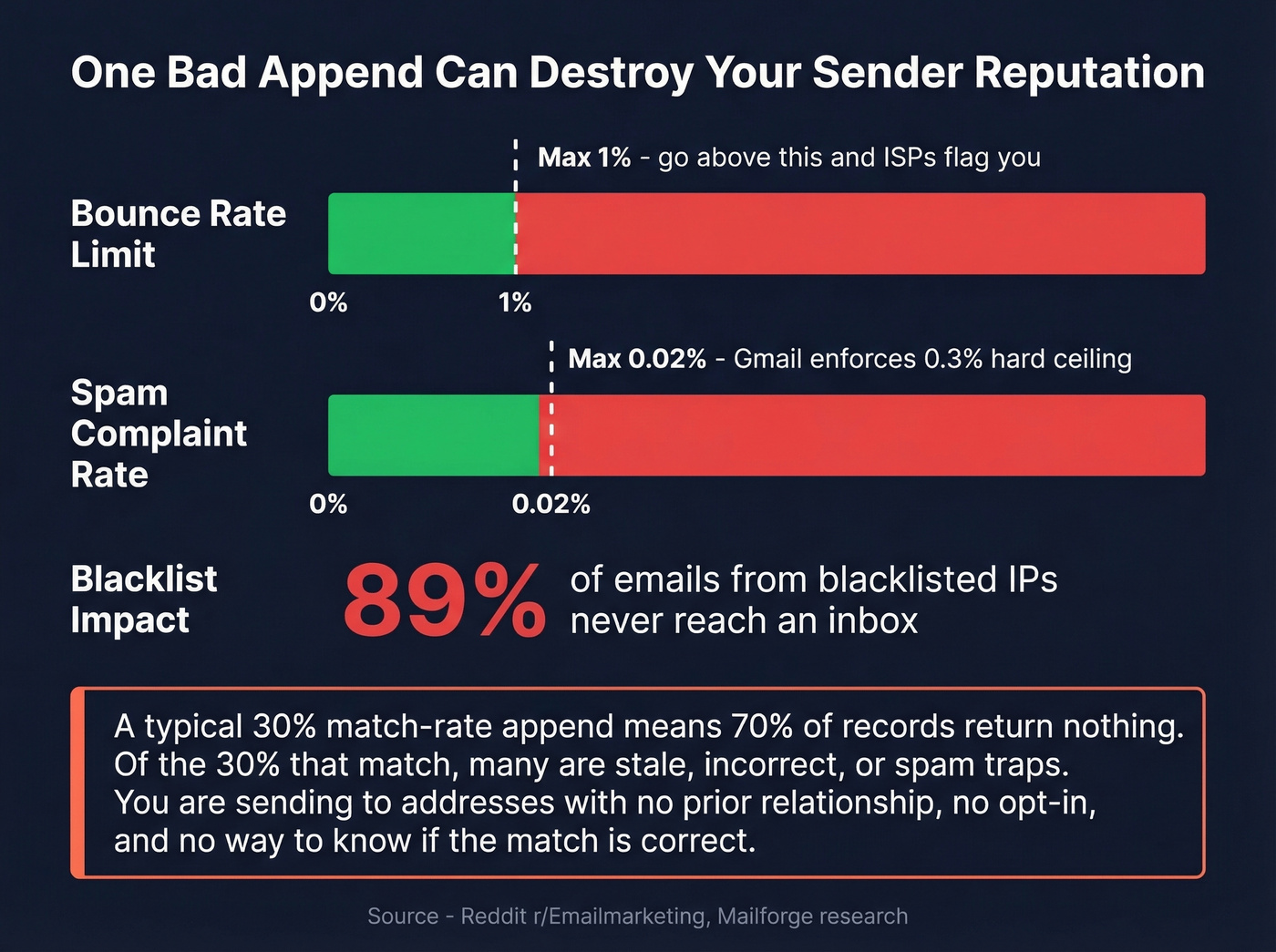
Here's the thing: the math works against you even in moderate scenarios. Industry guidance says keep bounce rates below 1% and spam complaints below 0.02%. Gmail enforces a hard ceiling at 0.3% complaint rate, and 89% of emails sent from blacklisted IPs never reach an inbox. (If you need deeper benchmarks and fixes, see email bounce rate and email reputation tools.)
Now apply this to a typical 30% match-rate append. You're sending to addresses you've never contacted, with no prior relationship, no opt-in, and no way to know if the match is correct. One practitioner on r/marketing reported only 25% of scraped business records matched with emails - and that's before factoring in accuracy. In our experience, the effective "good email" rate from a batch append is shockingly low.
Legal Compliance by Region
| Regulation | Consent Required? | Opt-Out Window | Max Penalty |
|---|---|---|---|
| CAN-SPAM (US) | No prior consent | 10 business days | $43,792/email |
| GDPR (EU/UK) | Explicit or legit interest | Immediate | 20M EUR or 4% revenue |
| CASL (Canada) | Express or implied | 60 days functional | $10M/violation |
CAN-SPAM is the most permissive - no prior consent needed, but you must include a physical address, honor opt-outs within 10 business days, and avoid deceptive headers. GDPR requires explicit consent or documented legitimate interest; for cold B2B outreach, legitimate interest can work if you keep records. CASL is the strictest - express or implied consent required before sending, with penalties up to $10M per violation. If you're unsure where the line is, read Is It Illegal to Buy Email Lists?.
What It Actually Costs
| Provider | Pricing | Notes |
|---|---|---|
| Melissa Data | $0.10-0.12/record | $300 minimum |
| Datazapp | $0.03/append | No minimum listed |
| BIGDBM | $0.04-0.07/match | Pay per match |
| Versium REACH | $3,600/year | Annual subscription |
| Experian | Enterprise - contact sales | Not public |
| Data Axle | Enterprise - contact sales | Not public |
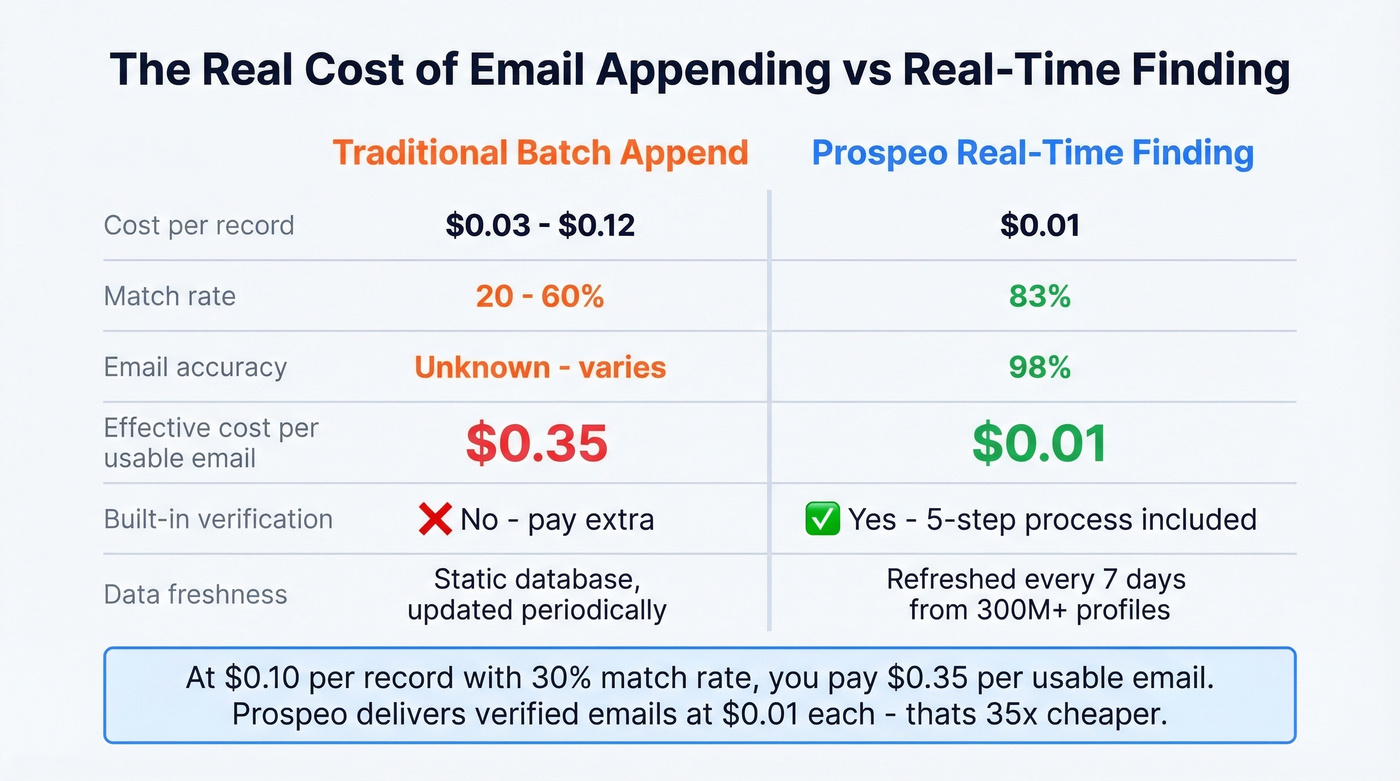
Let's break down the real math. At Melissa's rate of $0.10/record with a 30% match rate, your effective cost per usable email is around $0.33. Add verification at $0.005-0.01 per address - which you absolutely need - and you're approaching $0.35 per email that actually delivers.
If your average deal size sits below five figures, traditional email appending is almost certainly a money pit. The cost-per-usable-email math only works at scale with high-value consumer databases, not B2B prospecting. For more modern list-building options, compare email list providers and outbound lead generation tools.
The Better Path for B2B
Batch appending doesn't make sense for B2B anymore. Low match rates, stale data, and no built-in verification all stem from the same root cause - static databases matched in batch.
Prospeo flips this model. Instead of matching against a stale database, it searches 300M+ professional profiles in real time, verifies emails through a proprietary 5-step process with catch-all handling and spam-trap removal, and refreshes data every 7 days. We've seen this translate to an 83% enrichment match rate versus 20-60% from traditional append, 98% email accuracy, and an effective cost of roughly $0.01 per lead. If you're building outbound systems, pair this with proven sales prospecting techniques.
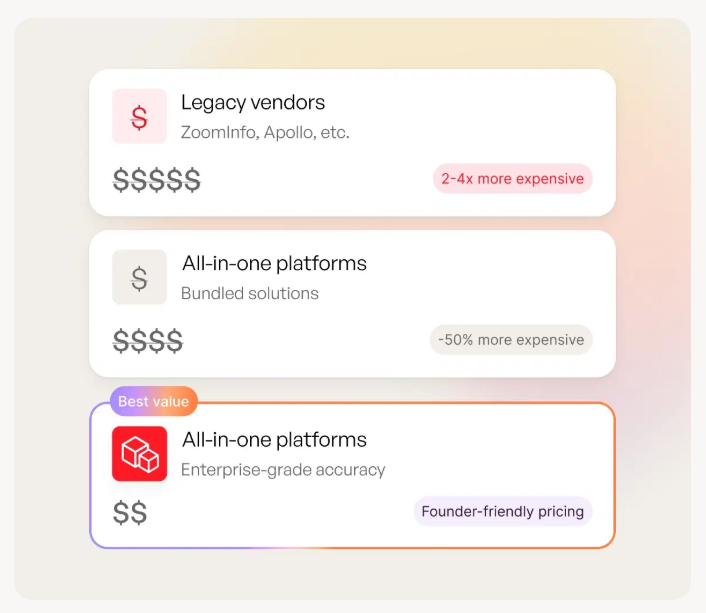
The workflow mirrors batch append - upload a CSV, get emails back - but with real-time verification baked in. You never pay for an invalid address. For teams whose domain reputation has already taken a hit from bad data, that distinction matters more than any feature comparison.
Your database decays 22.5% per year. Traditional append vendors match against static lists that rot just as fast. Prospeo refreshes 300M+ profiles every 7 days - not every 6 weeks - so the emails you get back are live, verified, and safe to send.
Upload your CSV and get verified emails back in minutes, not days.
Best Practices If You Do Append
If you're committed to traditional appending - maybe you're working with a large consumer database where it still makes sense - here's how to protect your sender reputation.
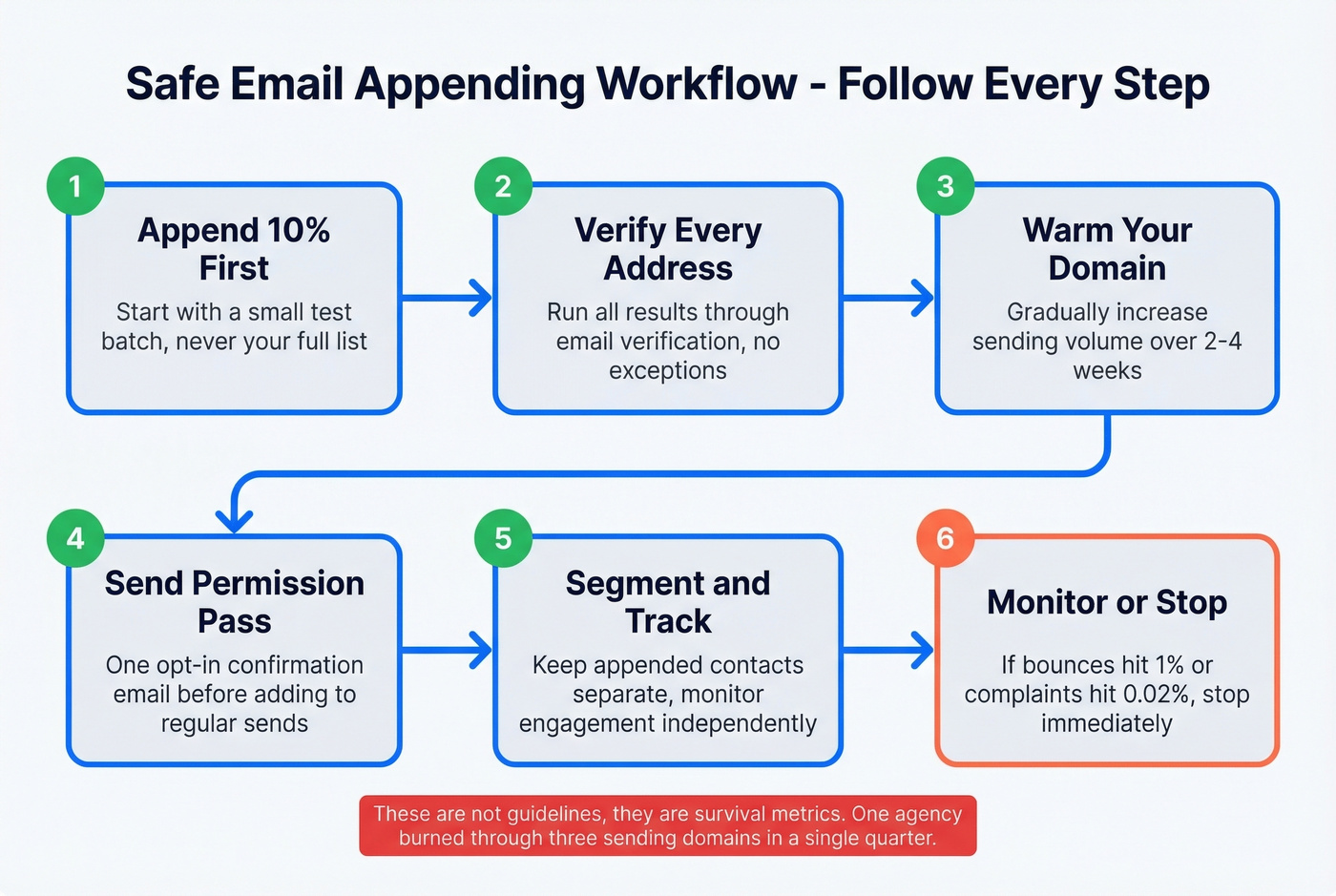
Start with a phased rollout: append and send to 10% of your list first, monitoring bounce and complaint rates before scaling. Verify every address before sending. No exceptions.
Warm up your sending domain over 2-4 weeks rather than blasting 50,000 appended contacts on day one. Run a permission-pass campaign - a single opt-in confirmation email - before adding appended contacts to your regular cadence. Segment appended contacts separately and track their engagement independently so you can isolate problems fast.
If your bounce rate crosses 1% or complaints exceed 0.02%, stop immediately. These aren't guidelines - they're survival metrics. One agency we spoke with burned through three sending domains in a quarter before learning this lesson the hard way.
FAQ
Is email appending legal?
Yes in the US under CAN-SPAM, which doesn't require prior consent for commercial emails. GDPR demands explicit consent or documented legitimate interest, and CASL requires express or implied consent before sending. Compliance depends entirely on jurisdiction and whether you're targeting consumers or businesses.
What match rate should I expect?
Traditional batch append services return 20-60% depending on input data quality. Most B2B teams land closer to 25%, especially with thin records. Full name plus postal address yields the best results; name-only inputs drop match rates significantly.
How does email finding differ from appending?
Appending matches your existing records against a static database in batch. Email finding tools locate and verify addresses in real time from live professional profile data - delivering fresher results, higher accuracy, and significantly better match rates than traditional append vendors.
How long does the process take?
Turnaround depends on the vendor and file size. Melissa lists a 24-hour standard turnaround for its Consumer Email Append pricing tiers. Real-time email finding tools return verified results in seconds per record, making them faster for smaller, targeted lists.