

How to Write an Appointment Request Email That Actually Gets a Reply
You wrote the perfect appointment request. Clear, polite, professional. And then - nothing. No reply, no calendar invite, just silence. With roughly 392.5 billion emails sent daily in 2026, your appointment request email isn't competing with a few dozen others. It's competing with hundreds. The difference between "read and replied" and "skimmed and archived" comes down to a handful of structural choices most people get wrong.
What You Need (Quick Version)
Every appointment request email that gets a reply nails three things:
- Specific purpose - why you want to meet, in one sentence
- 2-3 time options with time zone and duration
- Subject line under 50 characters
Keep the body under 100 words. An analysis of 40M+ emails found response rates peak at 51% in the 75-100 word range and trend downward as emails get longer. We've found the 75-100 word range isn't just optimal - it forces you to cut the fluff that was never helping you anyway.
The 6-Part Framework
Every effective request follows the same skeleton, whether you're emailing a CEO or a therapist.
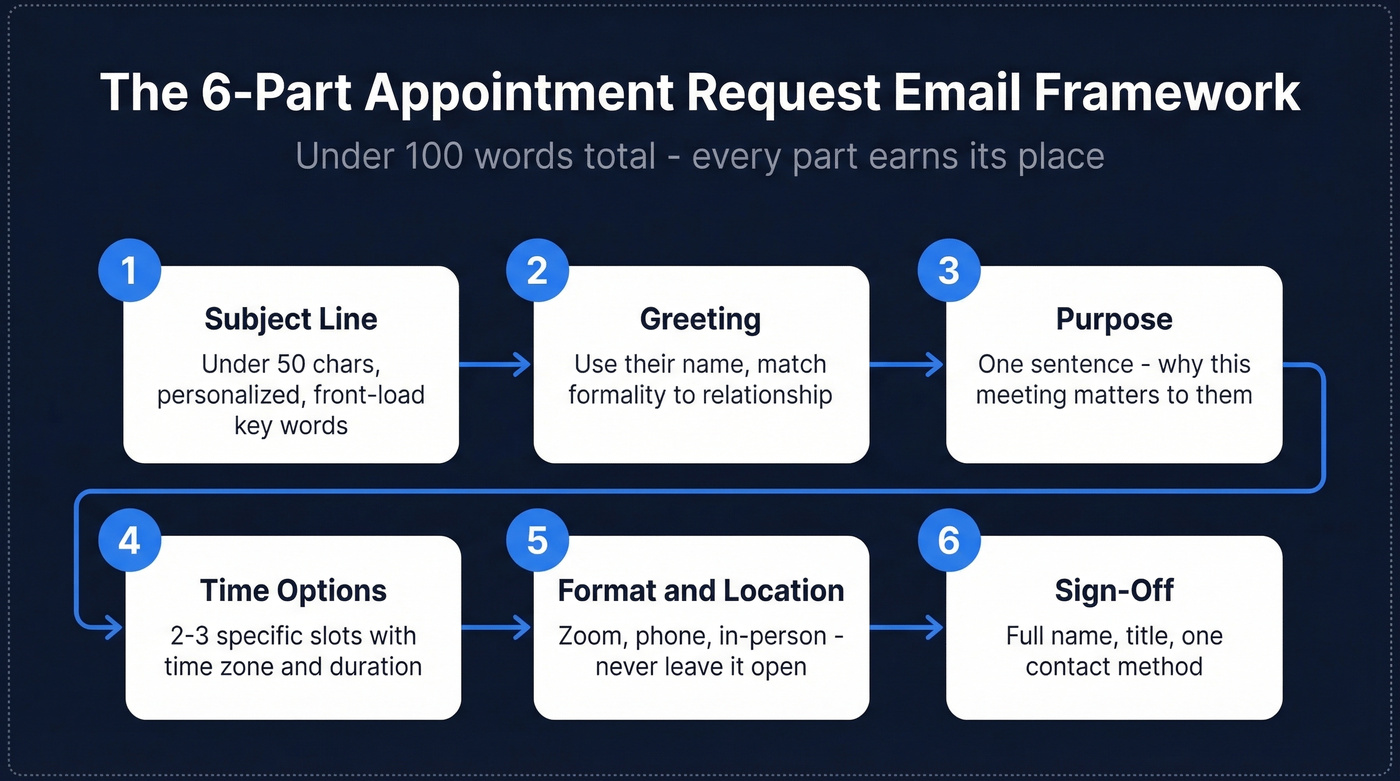
- Subject line. Your open-or-delete moment - 47% of recipients decide whether to open based on the subject line alone.
- Greeting. Use their name. "Hi Dr. Chen" or "Hi Sarah" - match the formality to the relationship.
- Purpose. One sentence explaining why you want to meet. Not what you do, not your company's mission statement - why this meeting matters to them. (If you need help tightening this, borrow a few patterns from email copywriting.)
- Time options. Offer 2-3 specific slots with time zone and duration. Never write "when are you free?" That shifts the scheduling burden onto the recipient.
- Meeting format and location. Zoom, phone, in-person, coffee shop. Don't leave this open.
- Sign-off. A simple close with your full name, title, and one contact method.
Six parts, under 100 words. Now let's talk subject lines, because that's where most emails die.
Subject Lines That Get Opened
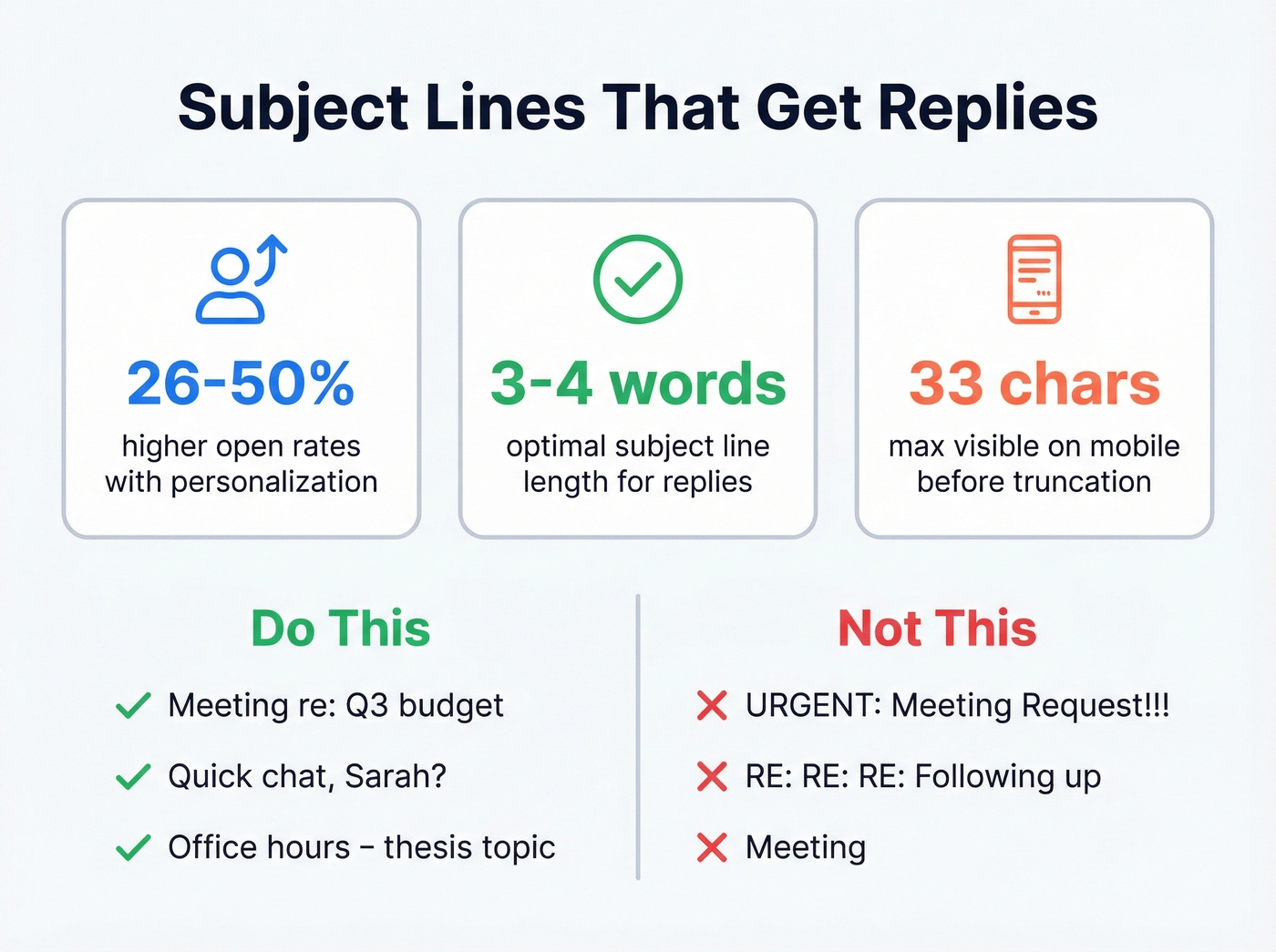
Personalized subject lines deliver 26-50% higher open rates than generic ones, and 3-4 word subject lines get the highest response rates. On mobile, only about 33 characters display before truncation - front-load the important words. For more options, swipe a few from these email subject line examples or use a subject line tester.
| Scenario | Example Subject Line | Characters |
|---|---|---|
| Business | Meeting re: Q3 budget | 21 |
| Cold outbound | Quick chat, [first name]? | 24 |
| Academic | Office hours - thesis topic | 27 |
| Medical | New patient appointment | 23 |
| Executive | [Mutual contact] suggested we talk | 35 |
| Internal | Sync on launch timeline | 23 |
Avoid ALL CAPS, fake "RE:" threads, and urgency words like "Urgent" or "Act now." These trigger spam filters and erode trust. A subject line that reads like a real person wrote it will always outperform one that reads like a marketing blast.

Writing the perfect appointment request email means nothing if it bounces. Prospeo verifies emails against 143M+ addresses with 98% accuracy - so your carefully crafted request actually reaches the inbox. The free tier covers 75 verifications per month.
Stop crafting emails that bounce. Verify every address before you hit send.
Templates for Every Scenario
Each template below is copy-paste ready. Swap the bracketed placeholders and send.
Business Meeting Request
Subject: Meeting re: [topic]
Hi [Name],
I'd like to discuss [specific topic/decision] and align on next steps. Are any of these times available?
- [Day, Date, Time, TZ]
- [Day, Date, Time, TZ]
- [Day, Date, Time, TZ]
Happy to meet via [Zoom/in-person at your office]. Should take about [15/30] minutes.
Best, [Your name]
Cold Outbound Request
This is where most appointment emails fail. You're asking a stranger for time, so you need a reason that's about them, not you. If you're building a repeatable system, pair this with a solid B2B cold email sequence.
Subject: Quick question, [Name]
Hi [Name],
Noticed [company] is [hiring for X / expanding into Y / just raised a round] - congrats. We've helped similar teams [solve specific problem] and I'd love to share what's working.
Would a 15-minute call make sense this week?
- [Day, Time, TZ]
- [Day, Time, TZ]
Either way, no pressure.
[Your name]
Tie the request to a specific trigger - a new hire, a funding round, a product launch. A study of 16.5M cold emails found that 6-8 sentence emails hit a 6.9% reply rate, the highest of any length bracket. That template sits right in the sweet spot.
Here's the thing: before you send a cold outreach email, verify the address. A single bounce damages your sender reputation for every future message. Prospeo's email verification checks against 143M+ verified addresses with 98% accuracy, and the free tier covers 75 verifications per month. (If you're troubleshooting bounces, start with email bounce rate and then work through this email deliverability guide.)
Client Check-In Request
Subject: Check-in on [project/account]
Hi [Name],
I'd like to review [project milestone / quarterly results / upcoming renewal] and get your feedback. Do any of these work?
- [Day, Date, Time, TZ]
- [Day, Date, Time, TZ]
30 minutes, [Zoom/your office]. Let me know.
Best, [Your name]
Academic / Professor Request
Subject: Office hours - [specific topic]
Dear Professor [Name],
I'm [Your name], a [year/program] student in your [course name] class. I'm working on [specific assignment/thesis topic] and have questions about [specific aspect].
Could I visit your office hours on [Day] or [Day]? I expect it would take about 15 minutes.
Thank you, [Your name]
Professors routinely ignore requests that don't state the exact topic. "Can we meet to discuss the class?" gets deleted. "Can we meet to discuss my approach to the regression analysis in Assignment 3?" gets a reply. The consensus on r/Professors is blunt: do the prep work before you ask for the meeting.
Medical / Therapy Request
Subject: New patient appointment request
Dear [Practice name / Dr. Name],
My name is [Your name] and I'd like to schedule an initial [therapy session / consultation / appointment]. I'm available [mornings/afternoons] on [days of the week].
Could you also let me know the cost per session and whether you offer sliding-scale options?
Thank you, [Your name] [Phone number]
People on Reddit frequently ask how to email a therapist for the first time without it feeling awkward. It's not awkward - providers expect every question in that template, including the one about cost. They'd rather answer it upfront than have you cancel after the first visit.
Executive / C-Suite Request
Subject: [Mutual contact] suggested we connect
Hi [Name],
[Mutual contact] mentioned you're [dealing with X challenge / exploring Y]. We helped [similar company] [specific result] and I think 15 minutes would be worth your time.
[Day, Time] or [Day, Time] work?
[Your name]
Extreme brevity wins here. Executives scan, they don't read. Without a mutual connection or a specific trigger, you're just another cold email - and cold emails to C-suite without a hook have near-zero reply rates.
Vendor / Service Provider Request
Subject: Quote for [service needed]
Hi [Name],
We're looking for [specific service] for [brief context - e.g., our 50-person team / our Q3 launch]. Could we schedule a 20-minute call to discuss scope and pricing?
Available [Day] or [Day], [Time range, TZ].
Thanks, [Your name]
Internal Team Meeting
Subject: Sync on [project/topic]
Hey [Name/team],
Need 30 minutes to align on [specific decision or deliverable]. Proposing [Day, Time] - I've checked calendars and it looks open.
Agenda: [1-2 bullet points].
Let me know if that works.
[Your name]
Skip the "let's catch up" framing. Even internal emails need a purpose statement - vague requests get deprioritized every time.
How to Follow Up
Most appointment requests need a follow-up. Campaigns with one follow-up reach a 27% response rate versus 16% without. That's 11 percentage points you're leaving on the table by sending once and giving up. If you want ready-to-send options, use these sales follow-up templates.
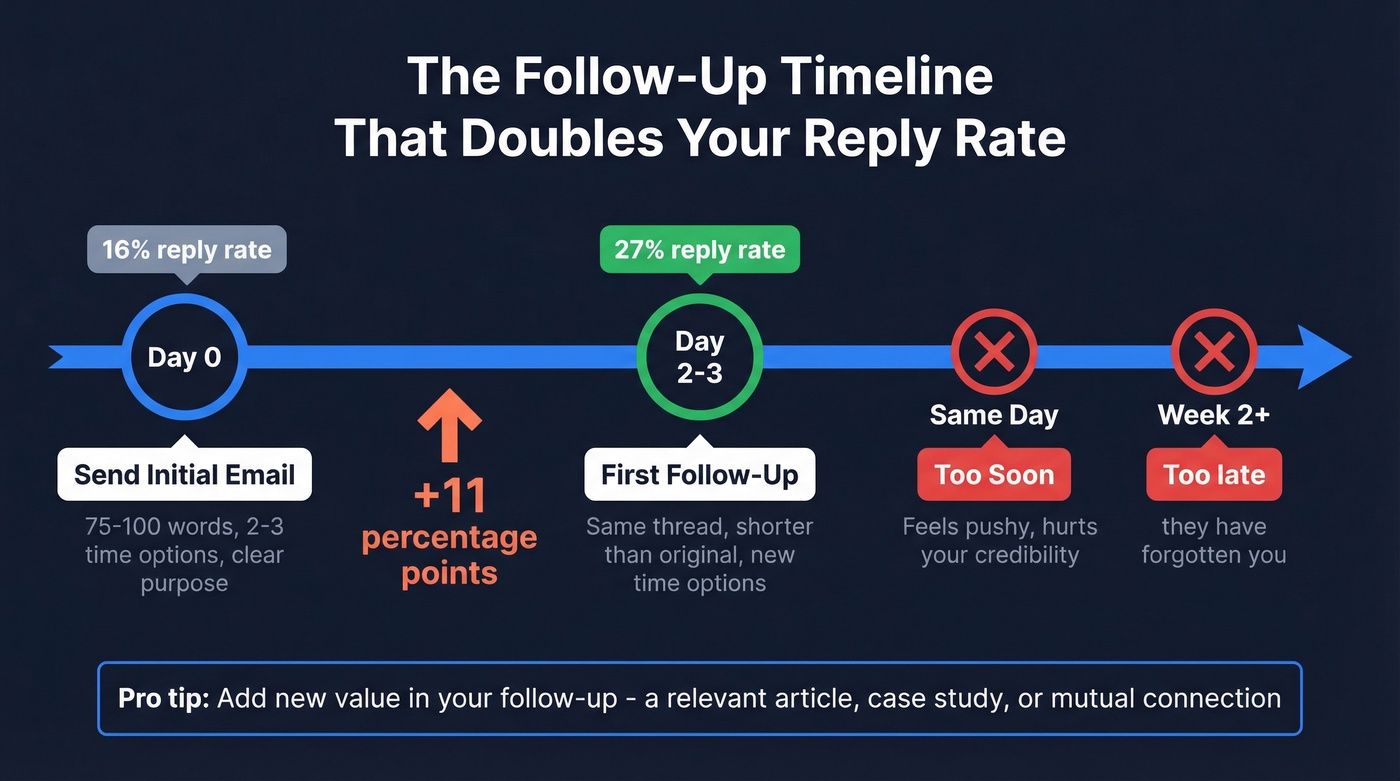
Send your first follow-up within 2-3 business days. Not the same day - that feels pushy. Not two weeks later - they've forgotten you exist. Reply in the same thread if the topic hasn't changed and the thread isn't too long; otherwise, start fresh with a new subject line.
Subject: Re: [original subject line]
Hi [Name],
Just circling back - I know things get buried. Would [Day, Time] or [Day, Time] work for a quick [15/30]-minute [call/meeting]?
Happy to adjust if another time is better.
[Your name]
Keep the follow-up shorter than the original. You're reminding, not re-pitching. We've seen response rates double with a single well-timed follow-up - and triple when the follow-up adds a new piece of value like a relevant article, a case study, or a mutual connection.
Mistakes That Kill Your Reply Rate
No topic specified. Professors, executives, and busy professionals all share the same reflex: if you don't tell them why you want to meet, they won't reply.
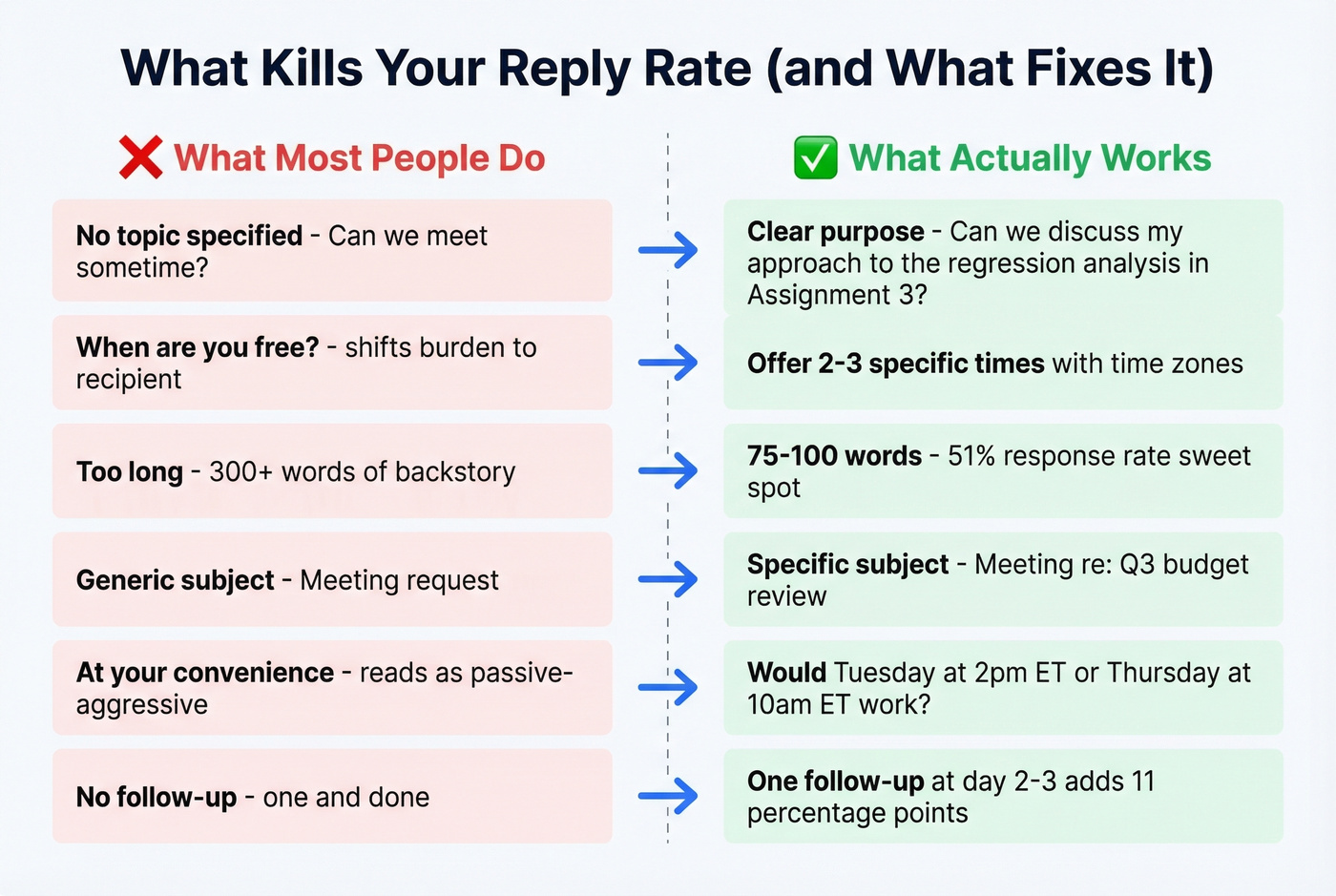
"When are you free?" This shifts the entire scheduling burden onto the recipient. Offer 2-3 specific times instead. You're making it easy to say yes.
Too long. That 40M-email analysis shows 51% response rates in the 75-100 word range, while 500-word emails drop to 44%. The gap is real. Cut the backstory.
Generic subject line. "Meeting request" tells them nothing. "Meeting re: Q3 budget review" tells them everything.
"At your convenience." Drop this phrase entirely. In many contexts it reads as passive-aggressive or dismissive. Offer specific times instead - it's more respectful of everyone's calendar.
No follow-up. You're leaving 11 percentage points of response rate on the table. One follow-up at day 3 is the single highest-ROI thing you can do after hitting send. (If you want the deeper why + benchmarks, see the importance of follow-up in sales.)
Best Day and Time to Send
Look, when you send matters more than most people think, but less than what you send. That said, the data gives you a real edge. A study of 16.5M emails found Thursday delivers the highest reply rate at 6.87%. Monday is the worst at 5.29% - people are buried in weekend catch-up. For a more detailed breakdown, compare it with this best time to send cold emails playbook.
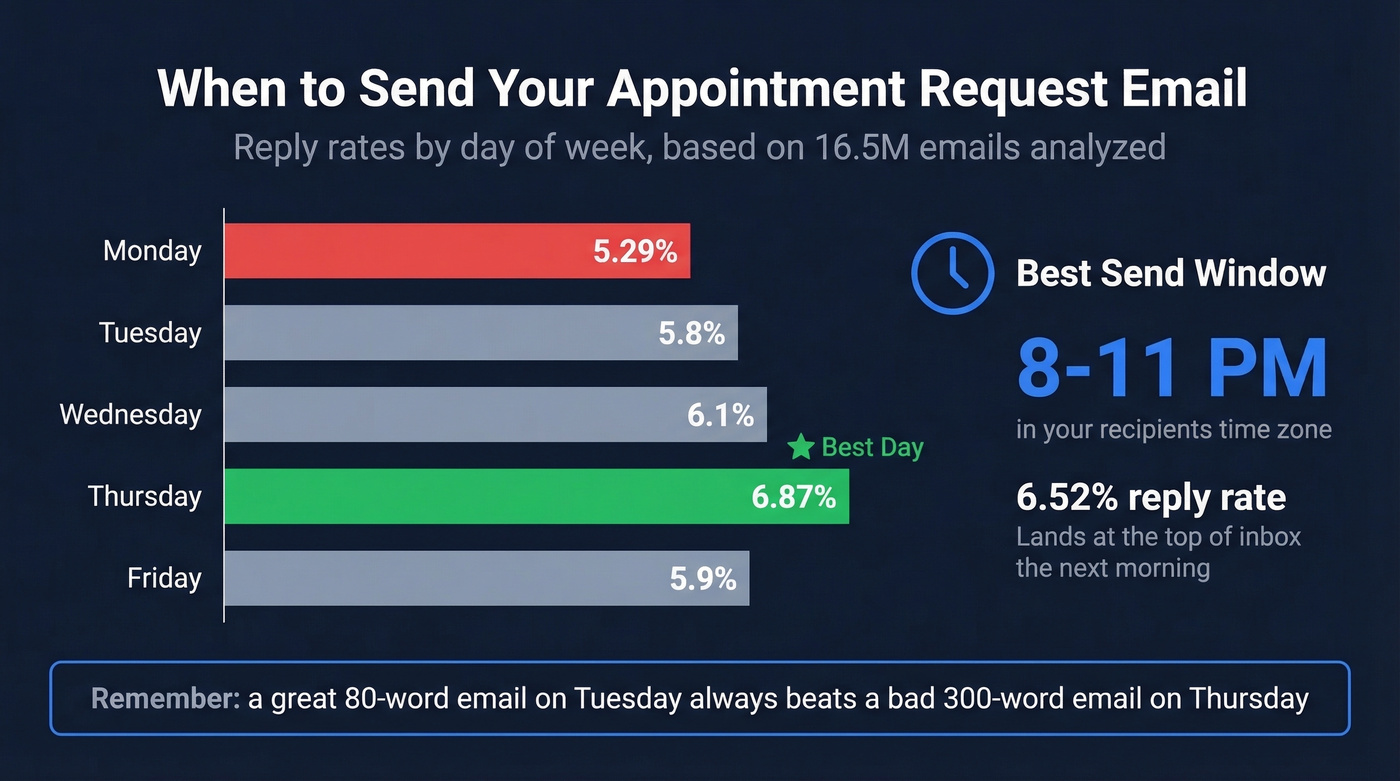
The 8-11 PM window peaked at 6.52% reply rate, likely because emails sent late evening land at the top of the inbox the next morning. For teams scheduling sends, aim for Thursday evening in your recipient's time zone. But a well-written 80-word email sent on a Tuesday will always beat a sloppy 300-word email sent on a Thursday.
Cold outbound appointment requests need a verified email and a real trigger. Prospeo's database of 300M+ profiles with 30+ filters - including job changes, funding rounds, and hiring signals - gives you both the contact and the hook.
Find the right contact, verify the email, and send - all for $0.01 per lead.
FAQ
How long should an appointment request email be?
75-100 words hits the sweet spot. An analysis of 40M+ emails found response rates peak at 51% in this range and drop after 125 words. Write your draft, then cut it in half.
How soon should I follow up if I don't get a reply?
Wait 2-3 business days. One follow-up raises response rates from 16% to 27%. Silence usually means they missed your message, not that they're ignoring you.
How do I request an appointment with someone I've never met?
Tie your request to a specific trigger - a new hire, funding round, or published content - and propose a 15-minute call with two time options. Verify the email address before sending so your message actually arrives; bounced emails damage your sender reputation for every future send.
What's the best subject line for requesting an appointment?
Name the topic and keep it under 50 characters. "Meeting re: Q3 budget" beats "Meeting request" every time. On mobile, only about 33 characters show before truncation, so front-load the most important words.
What do I do after the appointment is confirmed?
Send a brief confirmation email restating the date, time, time zone, and meeting link. Then send a reminder the day before. Confirmation and reminder emails reduce no-shows significantly and show professionalism.
Start with the 6-part framework, pick the appointment request email template closest to your scenario, and keep it under 100 words. That's the whole game.