

The Best Automated Email Senders for Every Use Case in 2026
"Automated email sender" means three completely different things depending on who's asking. A DTC brand running abandoned cart flows, a SaaS app firing password resets, and an SDR blasting cold sequences all need automation - but if they pick the same tool, at least two of them are going to have a bad time.
Here's the thing: mixing cold outreach and marketing email on one platform can push 80%+ of your messages to spam. That's not a scare tactic. It's what happens when you send unsolicited prospecting emails from the same domain and IP as your opted-in newsletter. The platforms are different, the compliance rules are different, and the deliverability mechanics are different. Let's break down all three categories, name the best tools in each, and give you real pricing so you can build the right stack without wasting a month on trials.
Our Top Picks
The short version, after we tested and tracked these tools across dozens of client setups:
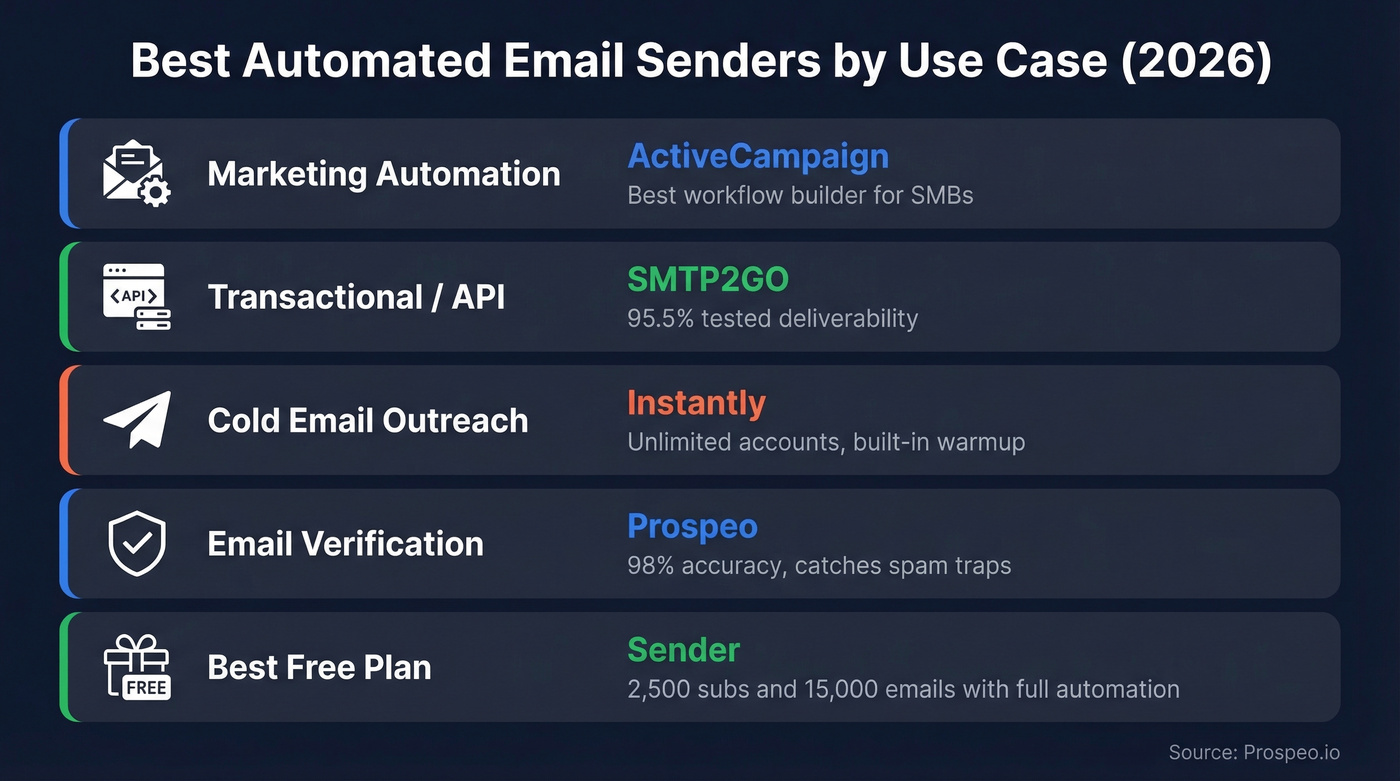
| Use Case | Top Pick | Why |
|---|---|---|
| Marketing automation | ActiveCampaign | Best workflow builder for SMBs |
| Transactional / API | SMTP2GO | 95.5% tested deliverability |
| Cold email | Instantly | Unlimited accounts, built-in warmup |
| Email verification | Prospeo | 98% accuracy, catches spam traps |
| Best free plan | Sender | 2,500 subs / 15,000 emails, full automation |
Now let's get into the details.
Why Automate? The Numbers
Automation isn't a nice-to-have anymore - it's where the revenue lives. Klaviyo's benchmark dataset across 183,000+ customers tells the story clearly: automated flows account for just 5.3% of total email send volume but generate roughly 41% of total email revenue. That's 18x higher revenue per recipient than standard campaigns.
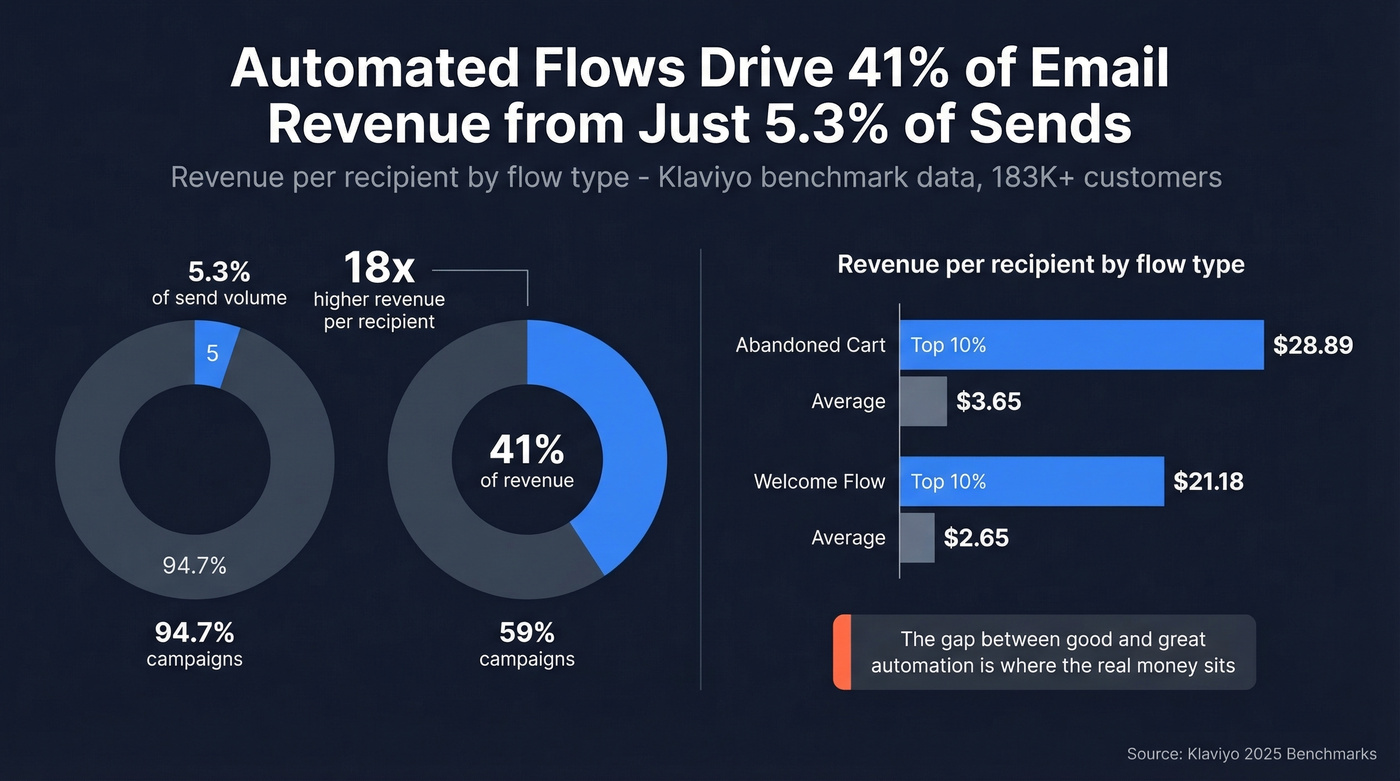
The top 10% of abandoned cart flows generate $28.89 per recipient. Welcome flows hit $21.18. Even average abandoned cart flows still pull $3.65 per recipient, and average welcome flows hit $2.65. The gap between "has automation" and "doesn't" is enormous, but the gap between good automation and great automation is where the real money sits.
The marketing automation market is projected to reach $13.97B by 2030 at a 12.8% CAGR. That growth isn't driven by hype - it's driven by the math above.
Deliverability in 2026: What Changed
A widely shared practitioner breakdown in r/smallbusiness described Gmail starting to reject non-compliant emails at the SMTP level in late 2025 - bounces instead of spam folder placement - with Outlook following by fully retiring Basic Auth. Whether you felt the shift directly or not, the practical outcome is the same: if your authentication and list hygiene aren't solid, your emails don't just land in spam. They fail to land at all.
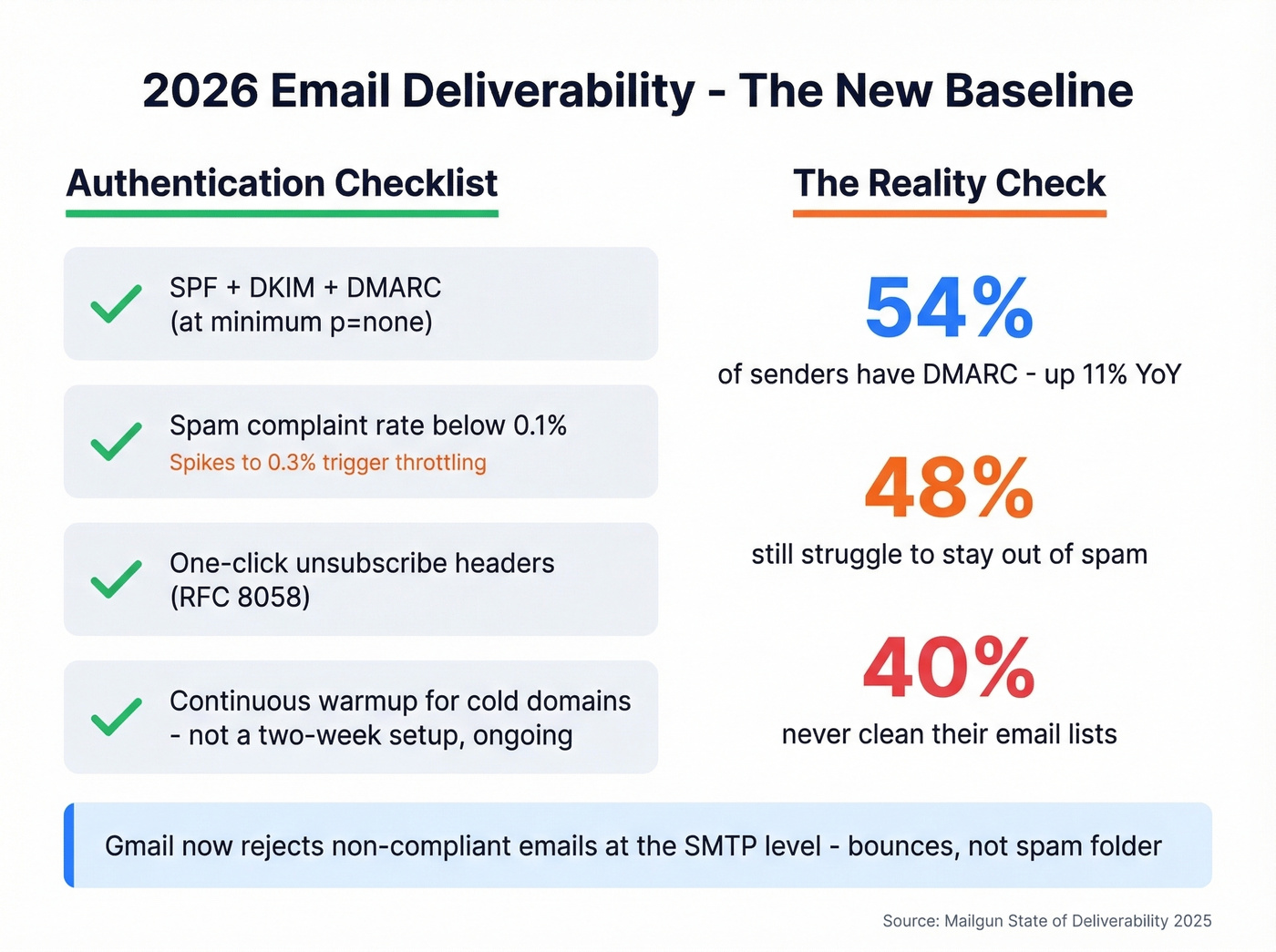
Authentication checklist - the new baseline:
- SPF, DKIM, and DMARC authentication (at minimum
p=none) - see DMARC alignment and SPF record examples - Spam complaint rate below 0.1% - spikes to 0.3% trigger throttling
- One-click unsubscribe headers (RFC 8058) for bulk senders
- Continuous warmup for cold email domains - not a two-week setup, an ongoing process (see email velocity and unlimited email warmup)
DMARC adoption hit 54% across all senders in 2025, up 11% year-over-year, but that still means nearly half of senders are flying without it. A Mailgun survey of 1,100+ senders found that 78.5% rate deliverability importance at 8/10 or higher, yet 48% still struggle to stay out of spam. The disconnect? Only 60% regularly clean their email lists, and 70% aren't even using free tools like Google Postmaster Tools to monitor sender reputation.

Automated senders live or die on list quality. If 48% of senders struggle with spam, bad data is the root cause. Prospeo's 5-step verification delivers 98% email accuracy with spam-trap removal and catch-all handling - so your automation actually reaches inboxes.
Stop feeding bad data into good automation. Verify before you send.
Best Marketing Email Automation Platforms
Here's the pricing landscape for the major marketing platforms:
| Tool | Entry Price | Free Plan | Key Limit |
|---|---|---|---|
| ActiveCampaign | $19/mo | 14-day trial | 5 actions/automation (Starter) |
| Brevo | $9/mo | 9K emails/mo, 300/day | Brevo branding on free |
| Sender | $0 (free) | 2,500 subs, 15K emails | Full automation included |
| Omnisend | $16/mo | 250 subs, 500 emails | Automations included |
| Klaviyo | $20/mo | 250 subs, 500 emails | Limited sends on free |
| MailerLite | $15/mo | 500 subs, 12K emails | - |
| GetResponse | $19/mo | 30-day trial | No free plan |
| Mailchimp | $13/mo | 500 subs | No automations on free |
ActiveCampaign
Use this if you need the most powerful visual workflow builder at the SMB level. ActiveCampaign's automation editor is genuinely best-in-class - conditional splits, wait steps, CRM pipeline triggers, lead scoring, and site tracking all feed into workflows that feel like they were designed by someone who actually runs email campaigns. The Plus plan at $49/mo is where it gets good.
Skip this if you're on a tight budget and plan to start on the Starter tier. ActiveCampaign limits Starter automations to five actions per workflow. That sounds fine until you realize a basic welcome sequence with a conditional branch already burns through three. It's a tier trap - you'll upgrade within a month. Budget for Plus from the start, or pick a tool with fewer artificial limits.
Brevo
Brevo is the Swiss Army knife of email platforms: email, SMS, chat, CRM, all under one roof. None of those features are best-in-class individually, but the combination at $9/mo is hard to beat for bootstrapped teams. The free plan gives you 9,000 emails per month across up to 100,000 contacts, capped at 300 sends per day. The automation builder handles welcome sequences, abandoned carts, and basic segmentation without drama.
Where Brevo falls short is advanced conditional logic and deep ecommerce integrations. If you need Shopify revenue attribution per email or complex branching workflows, ActiveCampaign or Klaviyo will serve you better.
Sender
The best free option for most small businesses. Full stop.
Sender's free tier includes 2,500 subscribers, 15,000 emails per month, and - critically - full access to automation workflows. That last part matters because Mailchimp's free plan doesn't include automations at all. Sender's does. Skip this if you're scaling past 10K subscribers and need advanced reporting or deep integrations. It's a fantastic starting point, not an enterprise solution.
Quick Mentions
- Omnisend - Built for ecommerce. Pre-built workflows for cart recovery, browse abandonment, and post-purchase. From $16/mo. The free plan is tight at 250 subs but includes automations.
- Klaviyo - The ecommerce data powerhouse. Revenue attribution per email, predictive analytics, deep Shopify/WooCommerce integration. From $20/mo. Overkill if you're not in ecommerce.
- MailerLite - The simplest option on this list. Clean editor, straightforward automation, from $15/mo. Great for creators and small businesses who don't need complexity.
- GetResponse - Unique angle: built-in webinar hosting alongside email automation. From $19/mo. Worth a look if webinars are part of your funnel.
- Mailchimp - From $13/mo. The free plan no longer includes automations, making it a poor choice for automated workflows. Better options exist at every price point on this list (see Mailchimp deliverability issues).
Best Transactional Email Services
Transactional email is a different animal. These are password resets, order confirmations, shipping notifications - messages your users expect instantly. Deliverability matters more here than anywhere else, because a delayed password reset email means a lost customer.
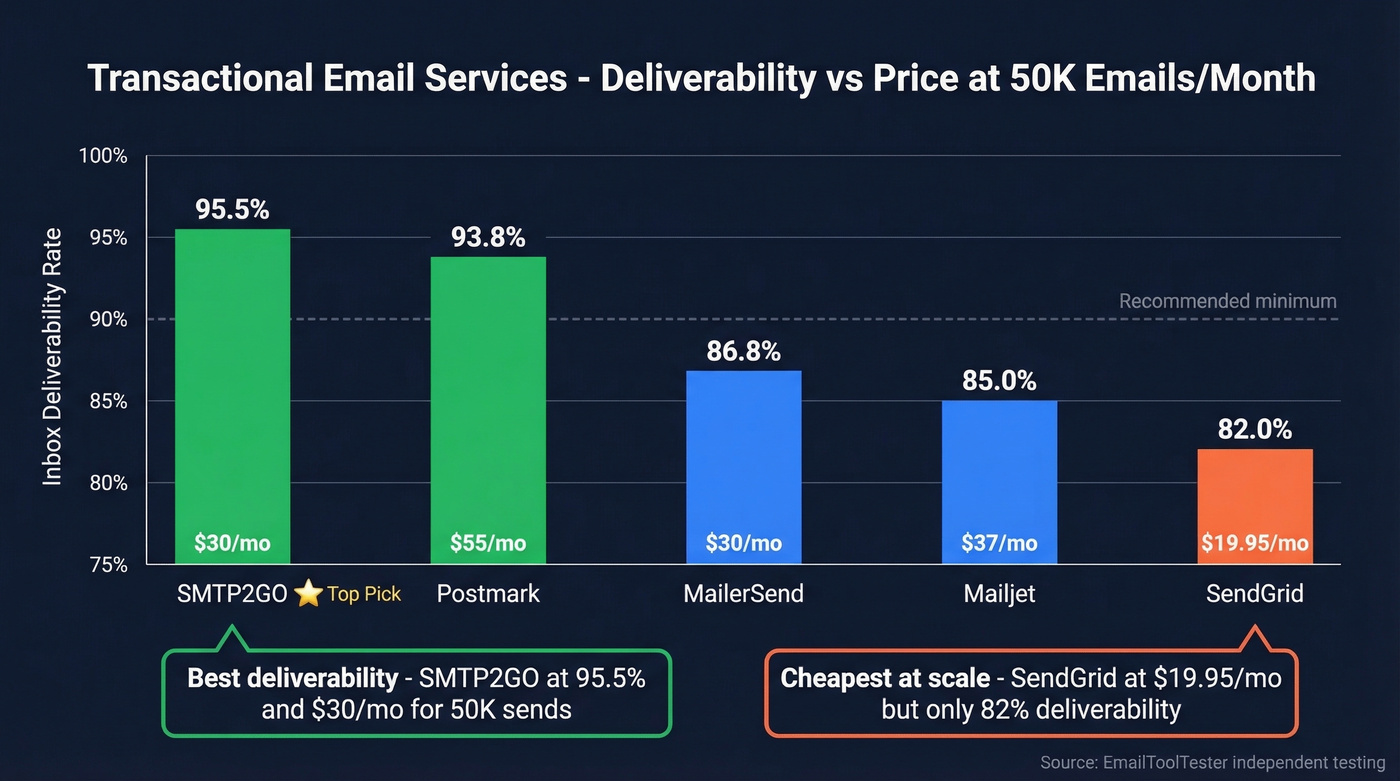
Here's how the major transactional providers stack up based on independent deliverability testing:
| Tool | Deliverability | Free Tier | 10K/mo | 50K/mo | 100K/mo |
|---|---|---|---|---|---|
| SMTP2GO | 95.5% | 1K emails | $15/mo | $30/mo | $75/mo |
| Postmark | 93.8% | None | $15/mo | $55/mo | $115/mo |
| MailerSend | 86.8% | 500 emails | ~$12/mo | $30/mo | $60/mo |
| Mailjet | 85.0% | 6K (200/day) | ~$15/mo | $37/mo | $105/mo |
| SendGrid | 82.0% | 100/day | ~$15/mo | $19.95/mo | $34.95/mo |
SMTP2GO
This is the transactional email service nobody talks about, and it consistently outperforms the ones everyone recommends. SMTP2GO hit 95.5% in independent testing - a meaningful gap over every competitor. Pricing is reasonable: free for 1,000 emails, $15/mo at 10K, $30/mo at 50K. The dashboard gives you real-time delivery tracking, bounce analytics, and reputation monitoring without requiring a developer to interpret the data.
Skip this if you need the absolute cheapest option at high volume. SendGrid undercuts SMTP2GO on price at scale - you just pay for it in deliverability.
Postmark
Postmark's 93.8% deliverability is strong, and their developer experience is arguably the best in the category. They separate transactional and marketing streams by design, which protects your transactional reputation. At 10K emails it's $15/mo - identical to SMTP2GO. But at 50K it jumps to $55/mo and at 100K to $115/mo, roughly double SMTP2GO's rates. Best for developer teams that value clean APIs and excellent documentation. Not ideal for anyone who's price-sensitive at scale.
Quick Mentions
- SendGrid - The cheapest at scale ($19.95/mo for 50K) but the lowest tested deliverability at 82%. Popular because of Twilio's ecosystem, but we've seen teams switch away after noticing inbox placement issues.
- MailerSend - Middle of the pack at 86.8% deliverability and $30/mo for 50K. Free tier of 500 emails is barely enough for testing. Decent option if you're already in the MailerLite ecosystem.
- Mailjet - 85% deliverability, free tier of 6,000 emails with a 200/day cap. The daily limit makes it impractical for anything beyond low-volume testing.
Best Cold Email Automation Tools
Cold email is where deliverability gets personal - literally. You're sending from your domain, to people who didn't ask to hear from you, and Gmail is watching every signal. The tools in this category exist specifically to manage warmup, rotation, and sending limits so your domain doesn't get burned (see email deliverability and email spam checker).
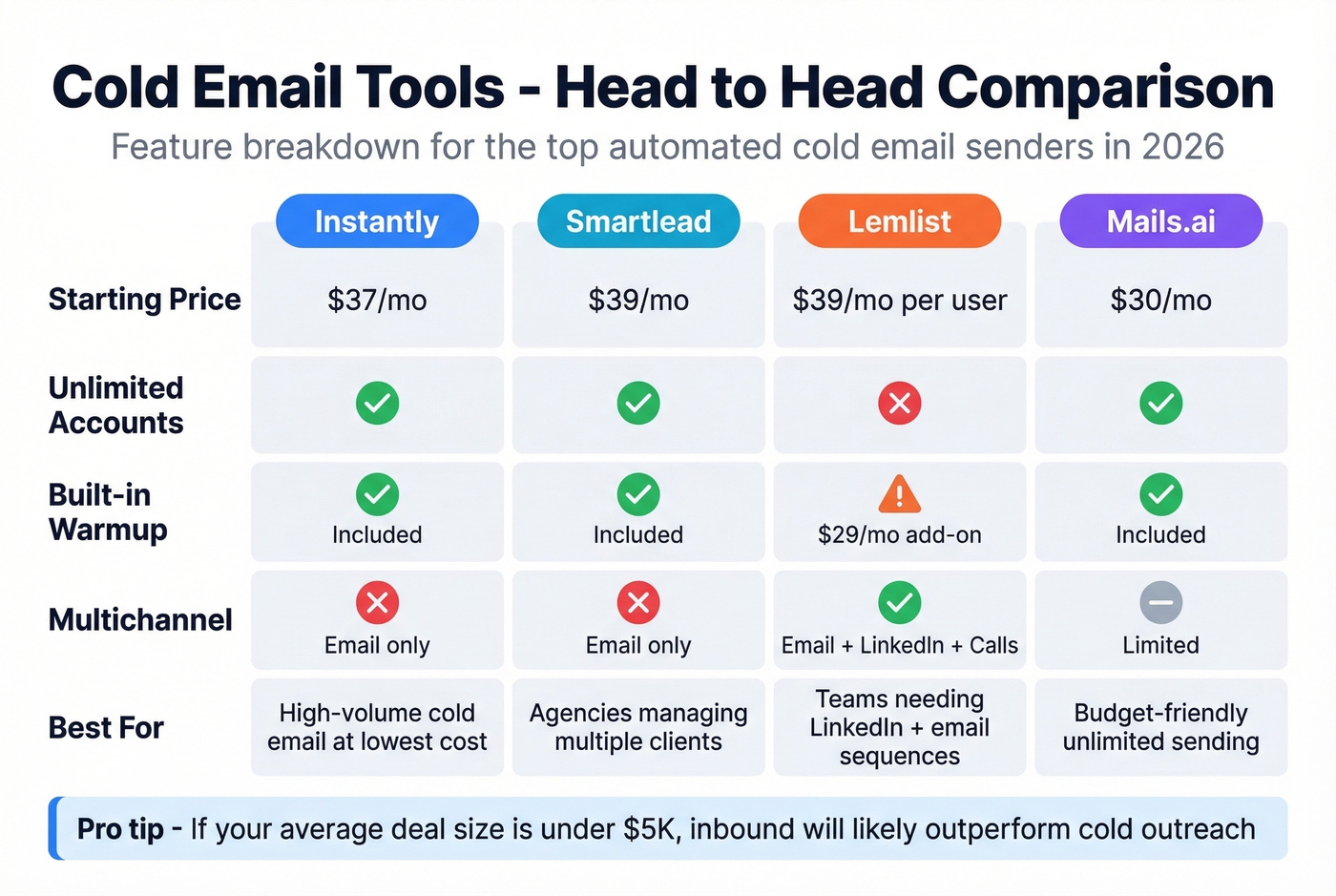
Look, I'll be blunt: if your average deal size is under $5K, you probably don't need a cold email tool at all. The ROI math only works when the deals you're closing justify the infrastructure cost of domains, warmup, and verification. Below that threshold, content marketing and inbound will outperform outbound every time.
| Tool | Starting Price | Unlimited Accounts | Built-in Warmup | Multichannel |
|---|---|---|---|---|
| Instantly | $37/mo | Yes | Yes | No |
| Smartlead | $39/mo | Yes | Yes | No |
| Lemlist | $39/mo per user | No | $29/mo add-on | Yes |
| Mails.ai | ~$30/mo | Yes | Yes | No |
| WarmySender | $4.99/mo | No | Yes | Yes (LinkedIn) |
Instantly
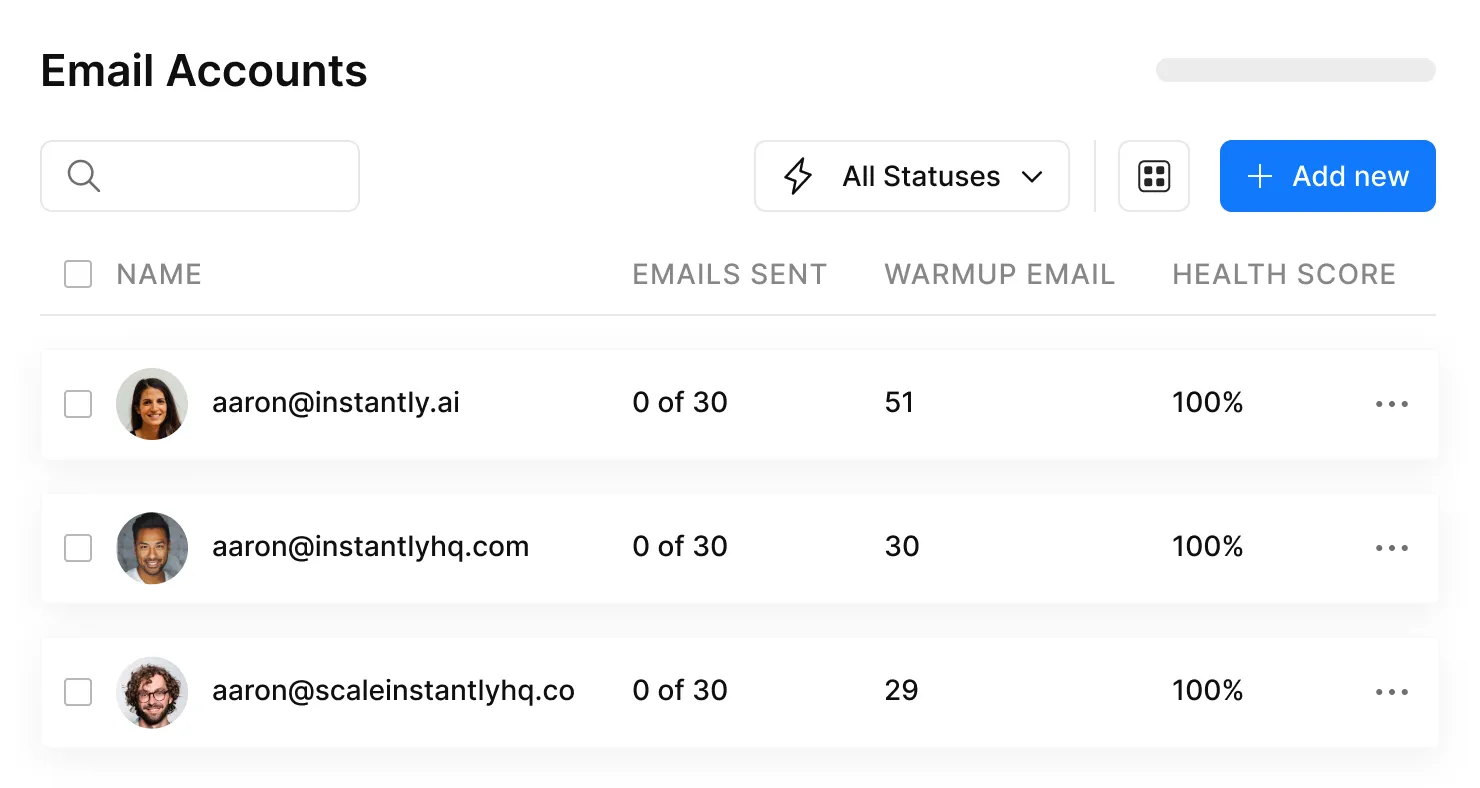
Instantly is the default recommendation in cold email communities for teams getting started with outbound, and it's earned that reputation. Starting at $37/mo, you get unlimited email accounts on every paid plan. The built-in warmup lets you focus on specific providers like Gmail or Outlook and runs continuously - not just during a two-week onboarding window. The interface is clean, the warmup works, and the unlimited accounts model means you can scale sending volume by adding inboxes rather than paying per-seat fees.
One critical step before loading contacts into any cold email tool: run your list through email verification. Prospeo's 5-step verification process catches spam traps and honeypots with 98% accuracy, preventing the kind of bounces that undo weeks of warmup progress. It integrates natively with Instantly, so verified contacts flow directly into your campaigns.
Skip this if you're an agency managing 20+ client accounts and need unified inbox management across all of them. Smartlead handles that workflow better.
Smartlead
Smartlead is Instantly's main competitor, and the choice between them comes down to one question: are you managing campaigns for multiple clients? If yes, Smartlead wins. Its Unibox consolidates replies across all connected accounts into one view, and its auto-rotation feature automatically pulls flagged accounts out of sending sequences before they damage your domain. Plans run $39-$94/mo depending on volume.
For a solo operator running a single campaign, Smartlead's power features are overkill and the interface has a steeper learning curve.
Lemlist
Use this if you want true multichannel sequences - email, phone calls, and social touches in one workflow. Lemlist runs $39-$99/mo per user. Lemwarm, their standalone warmup tool, costs $29/mo per email address and works even if you're not on Lemlist.
Skip this if per-user pricing doesn't fit your budget. A five-rep team on the $99/mo plan is $500/mo before you've sent a single email.
Quick Mentions
- Mails.ai - 3.7/5 on Trustpilot from 33 reviews, and the split is stark. Positive reviews praise the pricing and background warmup. Negative reviews cite nonexistent support, warmup that doesn't work, emails that don't send, and cancellation friction that forced users to go through Stripe directly. The company hasn't replied to negative reviews. Pricing runs $30-$100/mo. Proceed with caution, or just use Instantly.
- WarmySender - Budget option starting at $4.99/mo with basic warmup plus email and LinkedIn sequences. Not as feature-deep as Instantly or Smartlead, but worth a look if you're testing cold outreach on a shoestring.
How to Choose the Right Platform
The decision framework is simpler than most people make it:
- You send newsletters, promotions, or drip sequences to opted-in subscribers - marketing automation platform (ActiveCampaign, Brevo, Sender)
- Your app sends receipts, password resets, or notifications - transactional API (SMTP2GO, Postmark)
- You prospect cold, outbound to people who haven't opted in - cold email tool (Instantly, Smartlead, Lemlist) - see cold email marketing
- You do two or three of these - you need separate tools on separate domains
Don't try to run cold outreach through Mailchimp. Don't send marketing campaigns through Instantly. And don't use your transactional sending domain for anything promotional. That 80%+ spam rate from mixing categories isn't theoretical - we've watched teams learn this the hard way, burning months of domain reputation in a single campaign. Budget $50-$150/mo for a complete stack across categories, and add a verification layer underneath everything. Clean data is the foundation; the sending tool you pick matters less than the list quality you feed it (see email bounce rate and spam trap removal).
Cold outreach tools like Instantly handle the sending - but they can't fix bad contact data. Prospeo gives you 143M+ verified emails refreshed every 7 days, not the stale lists that spike your bounce rate to 35%. At $0.01 per email, clean data costs less than one bounced send.
Bounce rates drop under 4% when you start with verified data.
FAQ
What's the difference between email marketing and cold email automation?
Email marketing sends designed campaigns to opted-in subscribers through platforms like ActiveCampaign or Sender. Cold email sends plain-text sequences to prospects who haven't opted in, using tools like Instantly or Smartlead. Mixing them on one platform risks domain blacklisting because compliance rules and reputation signals are fundamentally different.
Can I use a free automated email sender for my business?
Yes. Sender offers 2,500 subscribers and 15,000 emails per month with full automation workflows included at no cost. Brevo's free plan gives you 300 emails per day across up to 100,000 contacts. For cold outreach, Instantly's free warmup tier helps you get started, and Prospeo offers 75 free email verification credits per month to keep your list clean.
Why are my automated emails landing in spam?
Most likely you're missing SPF, DKIM, or DMARC authentication, your spam complaint rate exceeds 0.1%, or you're bouncing off invalid addresses. Gmail and Yahoo now enforce strict bulk-sender requirements including one-click unsubscribe headers. Authenticate your domain, verify your list, and monitor Google Postmaster Tools - that combination solves the problem for most senders.
How much does a complete email automation stack cost?
Marketing platforms start at $0-$19/mo for small lists. Transactional APIs run $15-$75/mo for 10K-100K emails. Cold email tools start at $37-$39/mo. A complete stack covering two or three categories typically runs $50-$150/mo for small teams, plus $20-$50/mo for email verification.