

B2B Account Based Marketing Examples That Actually Shipped
ABM delivers a 137% average ROI across 771 marketers surveyed. Yet 56% of teams run it without a dedicated platform, stitching together CRM, intent data, and outbound tools. That gap between results and resources is where the real opportunity lives.
Here are seven b2b account based marketing examples teams can actually replicate - with real metrics, the failure modes nobody talks about, and a lean playbook for teams spending under $500/month.
Here's the thing: most teams don't need a $60K ABM platform. They need better account selection, verified contact data, and the discipline to align sales and marketing on the same list.
ABM Adoption in 2026
Adoption hit 71.2% in the latest benchmark, with nearly half of respondents saying ABM delivers their highest ROI. The impact numbers are hard to argue with: 64.1% cite increased revenue, 51.5% report higher win rates, 34.8% see larger deal sizes.
The execution gap tells a different story. Only 15.3% use a dedicated ABM platform. Cost is the top barrier (48%), followed by limited resources (34.2%) and implementation complexity (31.6%). The examples below reflect both ends - teams with full-stack platforms and teams running lean.
Seven ABM Campaigns With Real Metrics
A 3.17x Conversion Lift From Contact-Level Ads
StarTree synced CRM data to their ad platform to serve contact-level ads to named prospects inside target accounts - not just account-level targeting, but the specific people already in open opportunities. Conversion rates jumped 3.17x versus cold outreach.
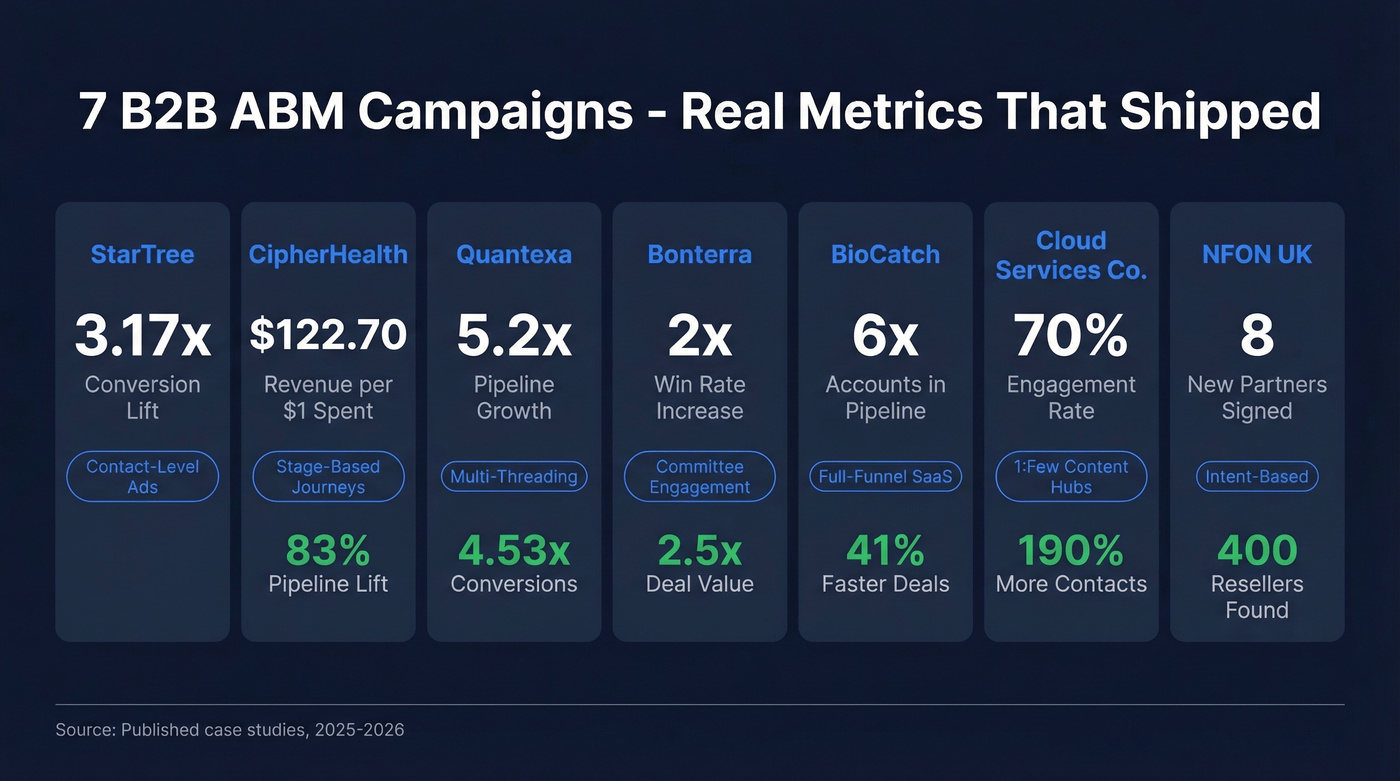
What to steal: sync your CRM audience to ads so reps and display hit the same humans simultaneously. In terms of pure conversion lift from a single tactical change, this is one of the strongest cases we've come across.
Stage-Based Ad Journeys at CipherHealth
CipherHealth built separate ad journeys for top-, mid-, and bottom-funnel contacts - not accounts. They reached 51% of executive champions across their target list and generated $122.70 in influenced revenue per $1 spent. Pipeline lifted 83%.
The takeaway is dead simple: one generic ABM ad is lazy. Build stage-specific creative that matches where each contact sits in the buying process.
Multi-Threading the Buying Committee
Quantexa and Bonterra both cracked this in 2025. Quantexa ran multi-threaded outreach across buying committees, combining ads with direct seller engagement - pipeline grew 5.2x, conversions jumped 4.53x. Bonterra focused on engaging multiple committee members rather than just the primary champion: win rates doubled, deal values grew 2.5x.
Single-threaded ABM (one contact per account) leaves money on the table. Enterprise committees can run 12 people deep. Thread accordingly.
BioCatch - Full-Funnel SaaS ABM
BioCatch pulled 6x more accounts into pipeline and accelerated deal velocity by 41%. The standout metric: 100% of late-stage deals had at least one engaged contact from the ABM program. That's the proof point - not top-of-funnel vanity metrics, but late-stage influence. While BioCatch operates in fraud prevention, the full-funnel structure they used is a template any SaaS team can adapt.
1:Few Content Hubs for Manufacturing
A large cloud services company ([via Inverta](https://www.inverta.com/resources/the-power-of-precision - building-effective-abm-campaigns-a-case-study)) targeted 50 enterprise manufacturing accounts using personalized content hubs tailored by sub-vertical. They hit a 70% engagement rate and a 190% increase in successful contacts.
This is 1:few ABM at its best - grouping similar accounts by industry pain point rather than building fully custom campaigns for each. The same approach applies to financial services, where sub-vertical segmentation (wealth management vs. commercial banking vs. insurance) drives dramatically better engagement than generic messaging.
NFON UK - Intent-Based Partner Acquisition
NFON UK used intent data to identify resellers actively researching cloud telephony. In six months: 400 high-intent resellers surfaced, 8 new channel partners signed. ABM isn't just for direct sales. Intent-driven motions work for partner recruitment too.
Why Most ABM Campaigns Fail
I've watched teams burn six figures on ABM programs that produced nothing. The tools weren't the problem. The decisions made before anyone touched a platform were.
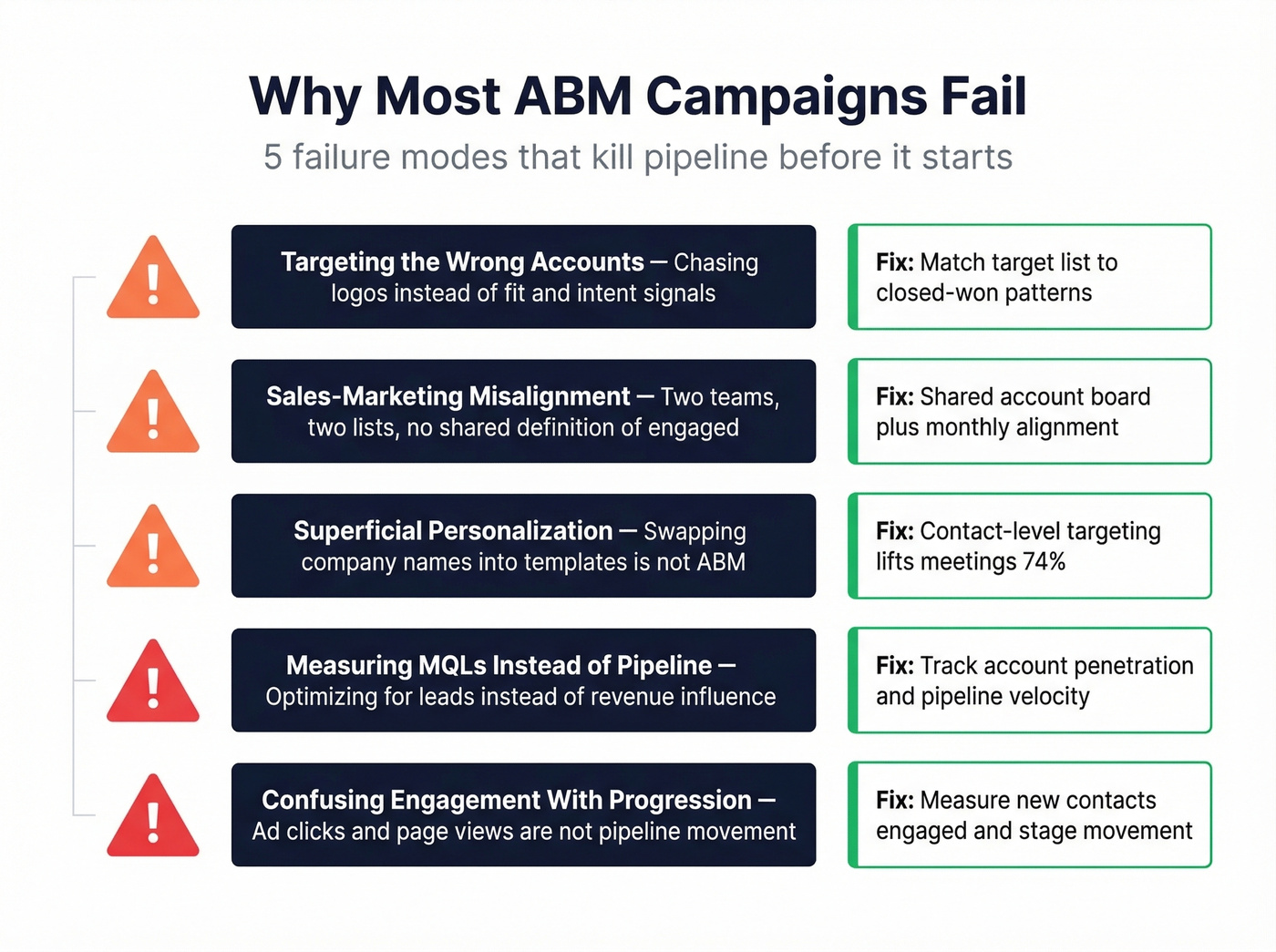
Targeting the wrong accounts. Logo chasing - picking dream accounts based on brand recognition rather than fit and intent - is the most common mistake. Smaller, well-researched lists outperform long lists of non-in-market accounts every single time.
Sales-marketing misalignment. Marketing targets one set of accounts, sales works another. Nobody agrees on what "engaged" means. A shared account board and monthly alignment meetings are the bare minimum, and even that's often not enough without a single owner who holds both teams accountable.
Superficial personalization. Swapping a company name into a template isn't ABM. Contact-level targeting increases conversion to meetings by up to 74% and lifts pipeline conversion by 118%.
Measuring MQLs instead of pipeline movement. If your ABM dashboard tracks leads instead of account penetration, pipeline velocity, and revenue influence, you're optimizing for the wrong thing.
Confusing engagement with progression. Account activity - ad clicks, page views - isn't account progression. New contacts engaged and stage movement are what matter. A program that generates impressive engagement dashboards but zero pipeline movement is a content marketing program with an ABM label slapped on it.

Every ABM example above has one thing in common: they reached the right contacts with verified data. Prospeo gives you 300M+ profiles with 98% email accuracy, intent data across 15,000 topics, and 30+ filters to build target account lists that match your closed-won patterns - all for roughly $0.01 per email.
Stop running ABM campaigns on bad data. Start with contacts that connect.
The Lean ABM Playbook
Use the FIRE framework for account selection: Firmographic fit, Intent signals, Recency of engagement, Engagement depth. Pull 12-18 months of closed-won deals, identify the patterns (industry, headcount, tech stack, deal trigger), and build a target list of 50-100 accounts that match.
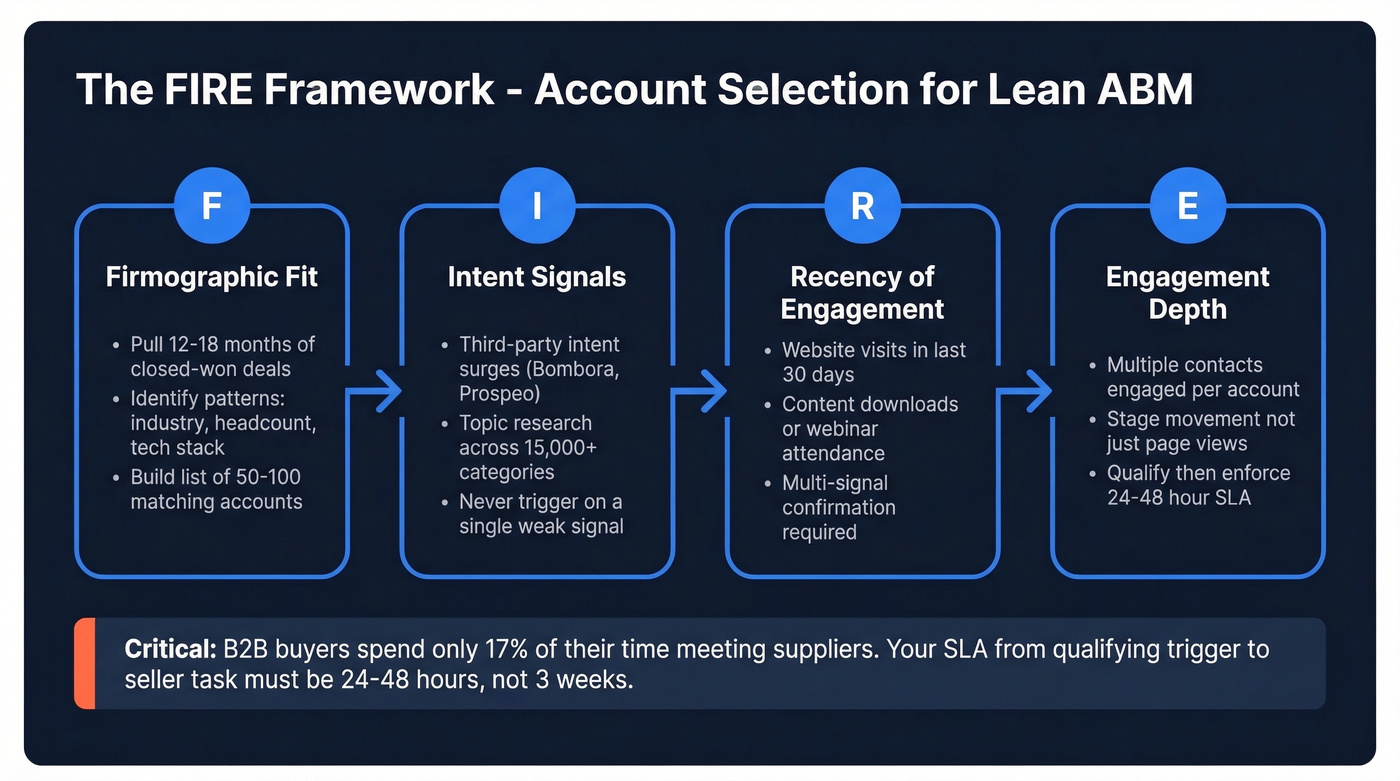
Never trigger outreach on a single weak signal. Require multi-signal confirmation - a third-party intent surge plus a website visit plus content engagement. Then enforce a 24-48 hour SLA from qualifying trigger to seller task. In our experience, this SLA is where most teams break down completely. Per Gartner research, B2B buyers spend only 17% of their time meeting suppliers. You need to be in front of them during that window, not three weeks later.

The lean stack: CRM (free HubSpot or existing Salesforce), Prospeo for verified contacts at roughly $0.01/email with 98% accuracy plus intent data, and an outbound tool like Instantly or Smartlead at $30-97/mo. Total cost: under $500/month for a team of 2-3.
If you're still building your list manually, a repeatable workflow like Clay list building can help you move faster without sacrificing targeting quality.
ABM Metrics That Matter
Stop counting MQLs. Two formulas tell you if ABM is working:
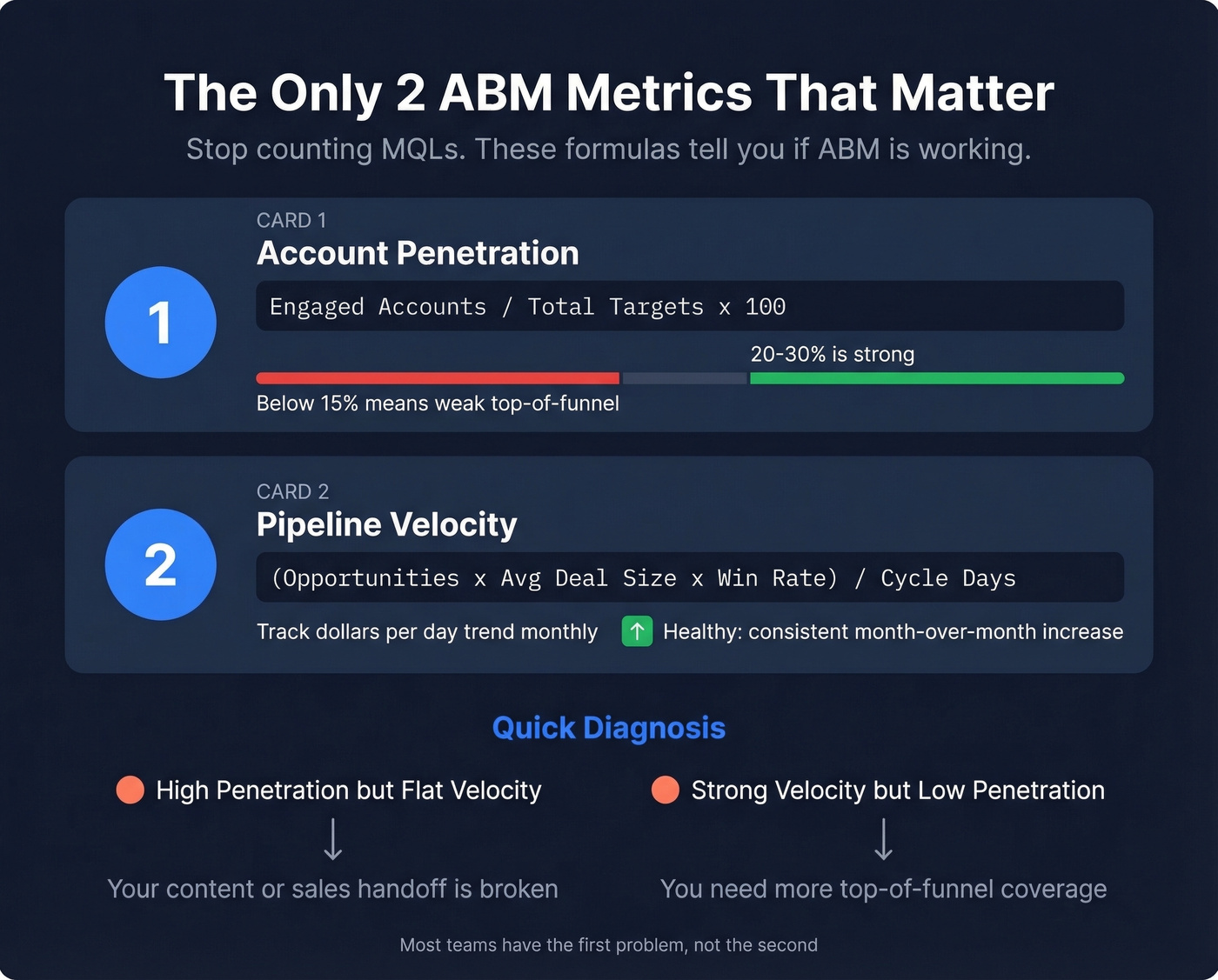
| Metric | Formula | Benchmark |
|---|---|---|
| Account Penetration | Engaged accounts / total targets x 100 | 20-30% is strong |
| Pipeline Velocity | (Opps x avg deal x win rate) / cycle days | Track $/day trend monthly |
If penetration is high but velocity is flat, your content or sales handoff is broken. If velocity is strong but penetration is low, you need more top-of-funnel coverage. Let's be honest - most teams we talk to have the first problem, not the second. Reviewing the account-based marketing case studies above can help you benchmark both numbers against realistic targets.
If you want a deeper diagnostic, map these to broader pipeline health indicators so you can see where deals stall.
What a Lean ABM Stack Costs
| Platform | Typical Monthly Cost | Best For |
|---|---|---|
| Prospeo | Free tier; paid ~$0.01/email | Verified contacts + intent data |
| Demandbase | $2K-$25K/mo | Enterprise full-stack ABM |
| 6sense | ~$4.9K/mo median | Predictive ABM + intent |
| Bombora (standalone) | ~$2K-$5K/mo | Third-party intent only |
| RollWorks | ~$1K-$2K/mo | Mid-market ABM ads |
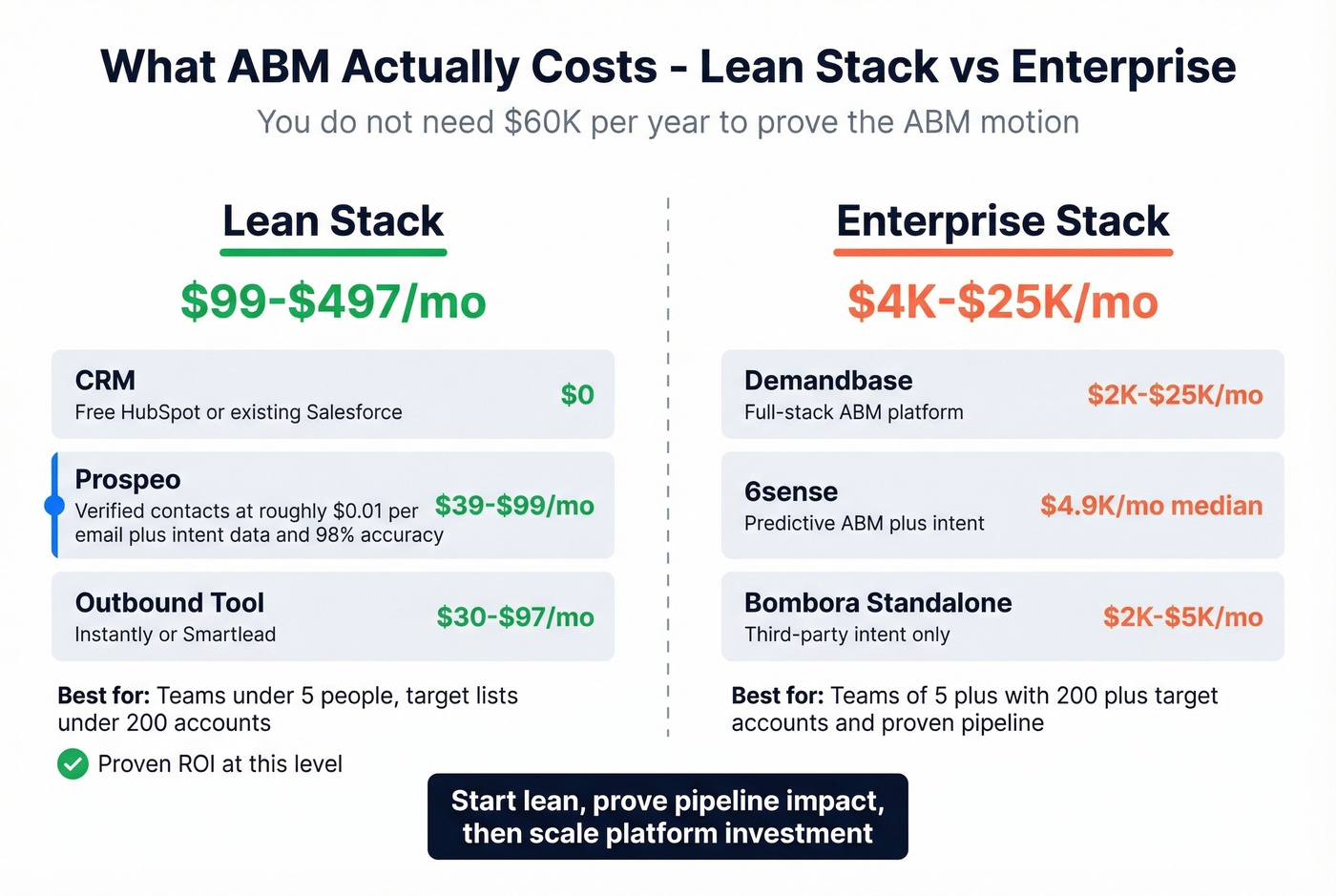
You don't need $60K/year. We've seen teams prove the entire ABM motion on a lean stack before scaling platform investment. Skip the enterprise platforms entirely if your target account list is under 200 and your team is under five people - the ROI math simply doesn't work at that scale.
If you're pairing outbound with ABM, tighten your messaging with proven sales follow-up templates and a consistent B2B cold email sequence.
Also, treat deliverability as a first-class metric: monitor email bounce rate and follow a real email deliverability guide before you scale volume.
Multi-threading buying committees doesn't work when half your emails bounce. Prospeo's 7-day data refresh and 5-step verification keep bounce rates under 4% - exactly what teams like Snyk and Stack Optimize use to scale outbound without burning domains. Pair verified contacts with Bombora intent signals to nail the FIRE framework.
Build your lean ABM stack for under $500/month. Verified contacts included.
FAQ
What's the difference between 1:1, 1:few, and 1:many ABM?
1:1 targets individual accounts with fully custom campaigns. 1:few groups 5-15 similar accounts by industry or pain point. 1:many uses intent signals and automation to reach 50-200+ accounts with lighter personalization. Start with 1:many, prove pipeline impact, then layer up to 1:few for your highest-value segments.
How long does ABM take to show results?
Engagement metrics appear within weeks, but pipeline movement and revenue influence take 3-6 months. Most programs that get killed at 60 days never had a chance to influence a single closed deal. Set a 90-day minimum before evaluating pipeline impact.
Can you run ABM without a dedicated platform?
Yes - 56% of ABM teams do. A CRM, an intent data source, a verified contact tool, and an outbound platform can cost under $500/month combined. Account selection and sales-marketing alignment matter more than software.
What are the most effective account-based marketing plays?
The examples in this article point to a few repeatable plays: contact-level ad targeting synced to CRM data, stage-based creative journeys, multi-threaded committee engagement, and intent-triggered outbound with a tight SLA. The common thread is coordinating multiple channels around the same contacts rather than blasting a single message to an account-level audience.