

The Anatomy of a B2B Deal: From First Touch to Signed Contract
It's week 14 of a deal you forecasted to close in week 8. Your champion's gone quiet, legal just redlined your MSA for the third time, and someone from procurement you've never spoken to is now asking for a security questionnaire. Recent Salesforce data shows only 16% of reps hit quota, and 86% of B2B purchases stall somewhere in the buying process. The B2B deal isn't broken - but the way most teams run them is.
The Short Version
Three things measurably accelerate B2B deals:
- Multi-thread across the buying committee. Deals with 3+ contacts engaged close 2.4x faster. Single-threading into one champion is how deals die in committee.
- Send proposals same-day. Delivering a proposal within 24 hours of a demo closes deals 35% faster. Every day of delay is a day for momentum to evaporate.
- Use verified contact data. Every touch in your cadence needs to reach a real person. Bounced emails and wrong numbers don't just waste time - they kill trust before it starts.
What Is a B2B Deal?
A B2B deal is a commercial transaction between two businesses. That sounds simple, but the mechanics differ from B2C in almost every way: longer cycles, higher stakes, more stakeholders, and decisions driven by committee consensus rather than impulse. The global B2B eCommerce market sits at $32.11 trillion as of 2025.
| Characteristic | B2B Deal | B2C Sale |
|---|---|---|
| Cycle length | 14 days to 12+ months | Minutes to days |
| Deal size | $3K-$500K+ ACV | $5-$5,000 |
| Stakeholders | 6-13+ per deal | 1-2 |
| Decision driver | ROI, consensus, risk | Emotion, convenience |
| Contract complexity | MSA, SOW, SLA, DPA | Terms of service |
How B2B Buying Has Changed
The window where sellers actually have influence is shrinking fast. Buyers now define their requirements 83% of the time before they ever talk to a salesperson, and they spend only about 17% of their purchase time engaging vendors. You're fighting for a sliver of attention across a crowded evaluation.
There's a counterintuitive bright spot. Per 6sense's most recent data, average sales cycle length dropped from 11.3 months in 2024 to 10.1 months in 2025 - economic pressure pushed buyers to engage sellers roughly 6-7 weeks earlier than the year before. Don't confuse shorter cycles with easier ones, though. Sales cycles have still lengthened 22% since 2022 when you zoom out, and 81% of buyers end up dissatisfied with the provider they ultimately choose.
Two shifts are reshaping how deals move. First, digital sales rooms and recorded demos now let buyers evaluate asynchronously - your best "meeting" might be a Loom video the CFO watches at 11 PM. Second, cycles aren't longer because buyers are more careful. They're longer because sellers single-thread into committees of 13 and hope one champion does all the internal selling. That's not a buying problem. It's a selling problem.
How Long Does a B2B Deal Take?
The median B2B SaaS sales cycle runs 84 days across a dataset of 939 companies. But that median hides enormous variance.
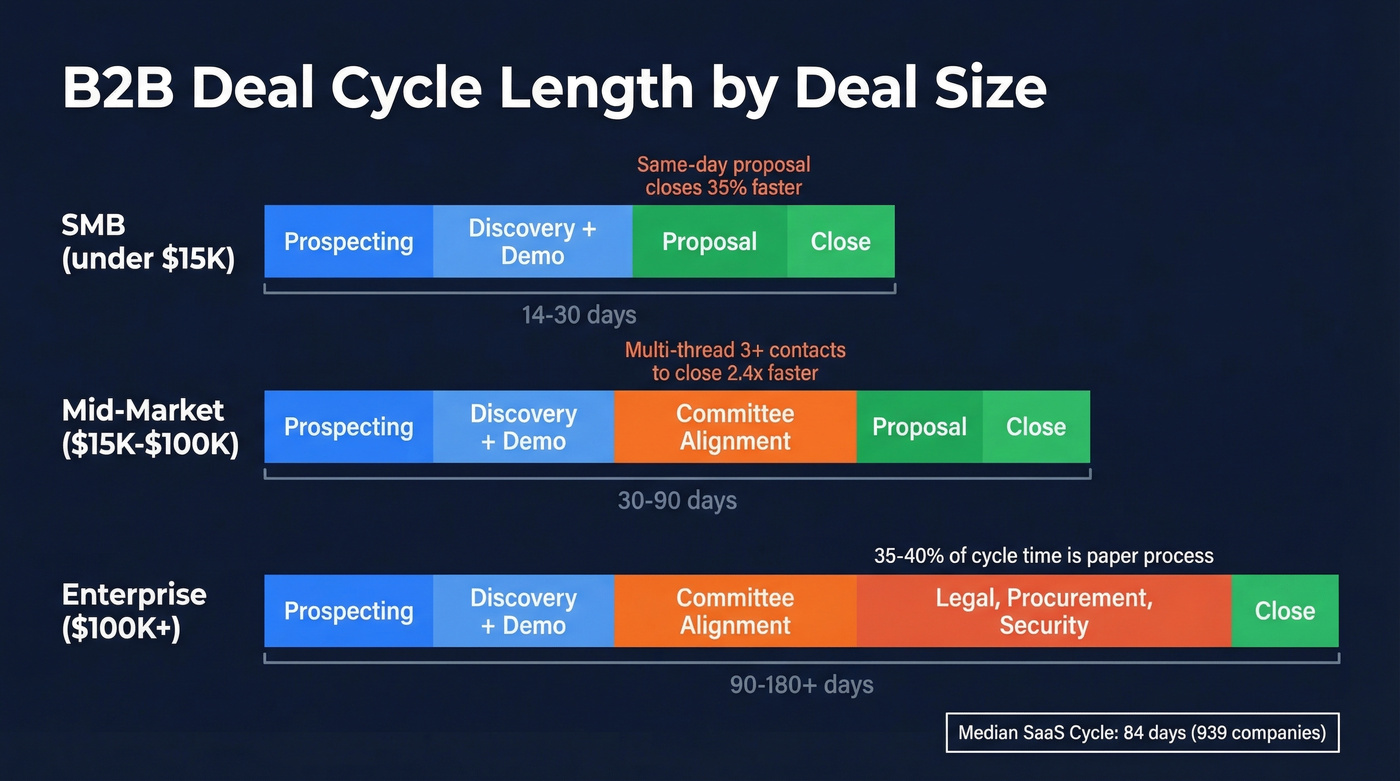
| ACV Range | Typical Cycle | Key Bottleneck | Acceleration Lever |
|---|---|---|---|
| <$15K (SMB) | 14-30 days | Champion authority | Same-day proposal |
| $15K-$100K (Mid) | 30-90 days | Committee alignment | Multi-threading |
| $100K+ (Enterprise) | 90-180+ days | Legal/procurement | Paper process prep |
The enterprise number deserves a closer look. Negotiation through close consumes 35-40% of total cycle time on enterprise deals - not the demo, not the discovery, but legal redlines, procurement questionnaires, and security reviews. Teams that pre-build their paper process (MSA templates, SOC 2 reports, DPA ready to go) shave weeks off this phase. In our experience, the teams that have their paper process templated before the first enterprise demo save 3-4 weeks minimum.
Same-day proposal delivery - getting a proposal in the buyer's hands within 24 hours of a demo - closes deals 35% faster. The team that moves fastest after a strong demo wins, because momentum compounds and delays compound in the opposite direction.
The Buying Committee
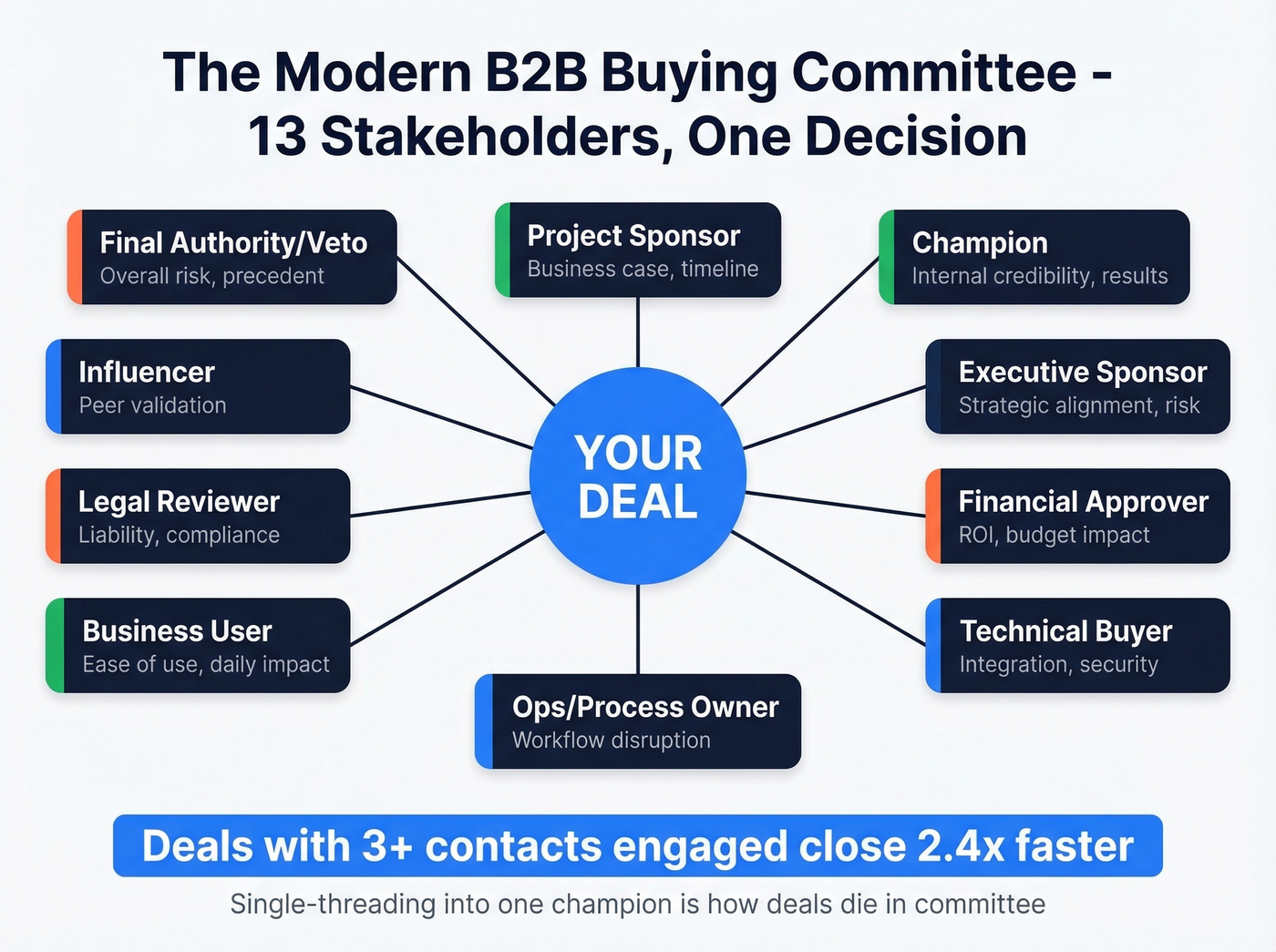
The average B2B purchase now involves 13 stakeholders, with 89% of buying decisions crossing multiple departments.
Thomas V. Bonoma's classic HBR buying center model - initiators, influencers, deciders, purchasers, users, gatekeepers - still holds, but modern deals have expanded the taxonomy considerably:
| Role | What They Care About |
|---|---|
| Project Sponsor | Business case, timeline |
| Champion | Internal credibility, results |
| Executive Sponsor | Strategic alignment, risk |
| Financial Approver | ROI, budget impact |
| Technical Buyer | Integration, security, scale |
| Ops/Process Owner | Workflow disruption, adoption |
| Business User | Ease of use, daily impact |
| Legal Reviewer | Liability, compliance, IP |
| Influencer | Peer validation, reputation |
| Final Authority/Veto | Overall risk, precedent |
Deals with 3+ contacts engaged close 2.4x faster. That single stat should reshape how you run every deal. The practical consensus tactic that works: create a shared source of truth - a centralized workspace or document every stakeholder can reference, so you're not playing telephone through your champion.
To multi-thread effectively, you need verified contact data for each stakeholder. Prospeo surfaces emails and direct dials across the full committee with 98% email accuracy, so you're not stuck waiting for your champion to CC the right people.

Multi-threading closes deals 2.4x faster - but only if your contact data actually reaches the committee. Prospeo gives you verified emails and direct dials for all 13 stakeholders, not just your champion. 98% email accuracy. 125M+ verified mobiles. $0.01 per email.
Stop single-threading into buying committees. Reach every stakeholder directly.
How to Qualify a B2B Deal
If you're still using BANT for enterprise deals, you're qualifying with a framework from the 1950s. IBM built BANT when a single buyer controlled the budget and made the decision alone. That world doesn't exist anymore.
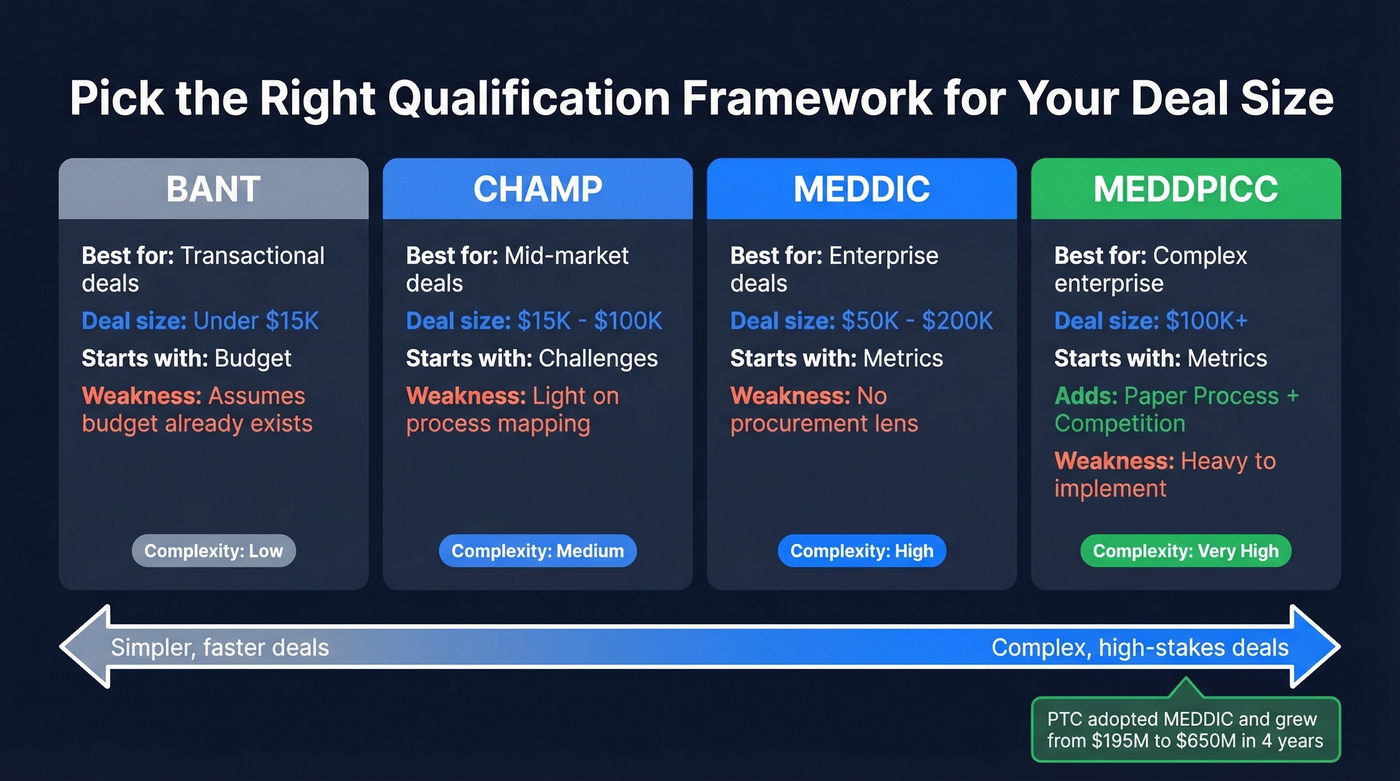
Here's the thing: most teams over-qualify small deals and under-qualify big ones. A $10K transaction doesn't need MEDDPICC. A $200K opportunity absolutely does. Match the framework to the deal size.
| Framework | Best For | Starts With | Weakness |
|---|---|---|---|
| BANT | Transactional (<$15K) | Budget | Assumes budget exists |
| CHAMP | Mid-market ($15K-$100K) | Challenges | Light on process |
| MEDDIC | Enterprise ($50K-$200K) | Metrics | No procurement lens |
| MEDDPICC | Complex enterprise ($100K+) | Metrics | Heavy to implement |
MEDDPICC adds Paper Process and Competition to the original MEDDIC framework - reflecting the reality that procurement and legal are where modern enterprise deals go to die. PTC adopted MEDDIC in the 1990s and grew revenue from roughly $195M to $650M in four years.
The minimum qualification bar before you invest serious time: you need Metrics (what success looks like in the buyer's own numbers), the Economic Buyer (the person who actually signs), Pain (the cost of inaction), and a Champion who's doing internal work on your behalf. A "champion" who won't introduce you to other stakeholders or bring detractors into the conversation isn't a champion - they're a friendly contact.
The Follow-Up Cadence That Wins
The sweet spot is 17-21 days with 8-12 touchpoints. RAIN Group data shows meetings require roughly 8 touches on average. Yet 44% of reps quit after one follow-up, and at least 80% of sales need five or more follow-ups to close.
Timing heuristics that work: emails between 9-11 AM, calls between 4-5 PM, with 2-3 day spacing between touchpoints. Phone calls should make up 20-30% of your touches - they're the highest-impact channel even though reps avoid them.
"Just checking in" is the worst follow-up in B2B sales. Every touch needs to add value: a relevant case study, an industry insight, a competitive benchmark, a POV on a problem the buyer mentioned. A 10-year B2B sales practitioner on Reddit put it bluntly - deals over $5K often require 5-8 value-adding touches before they move forward. They also described an 11-month journey from first conversation to signed contract.
McKinsey data shows systematic sales engagement processes drive 10-20% pipeline improvements through better prioritization and consistent execution. But a cadence only works if every touch reaches a real person. Bounced emails and outdated numbers silently destroy your entire sequence.
If you want plug-and-play messaging, start with these follow-up templates that get replies.
How to Negotiate a B2B Deal
Here's the uncomfortable truth: 40-60% of qualified opportunities end in no decision. Not a competitor win - just silence. And 72% of new B2B sales opportunities stall mid-to-late stage, meaning no customer action for 60+ days.
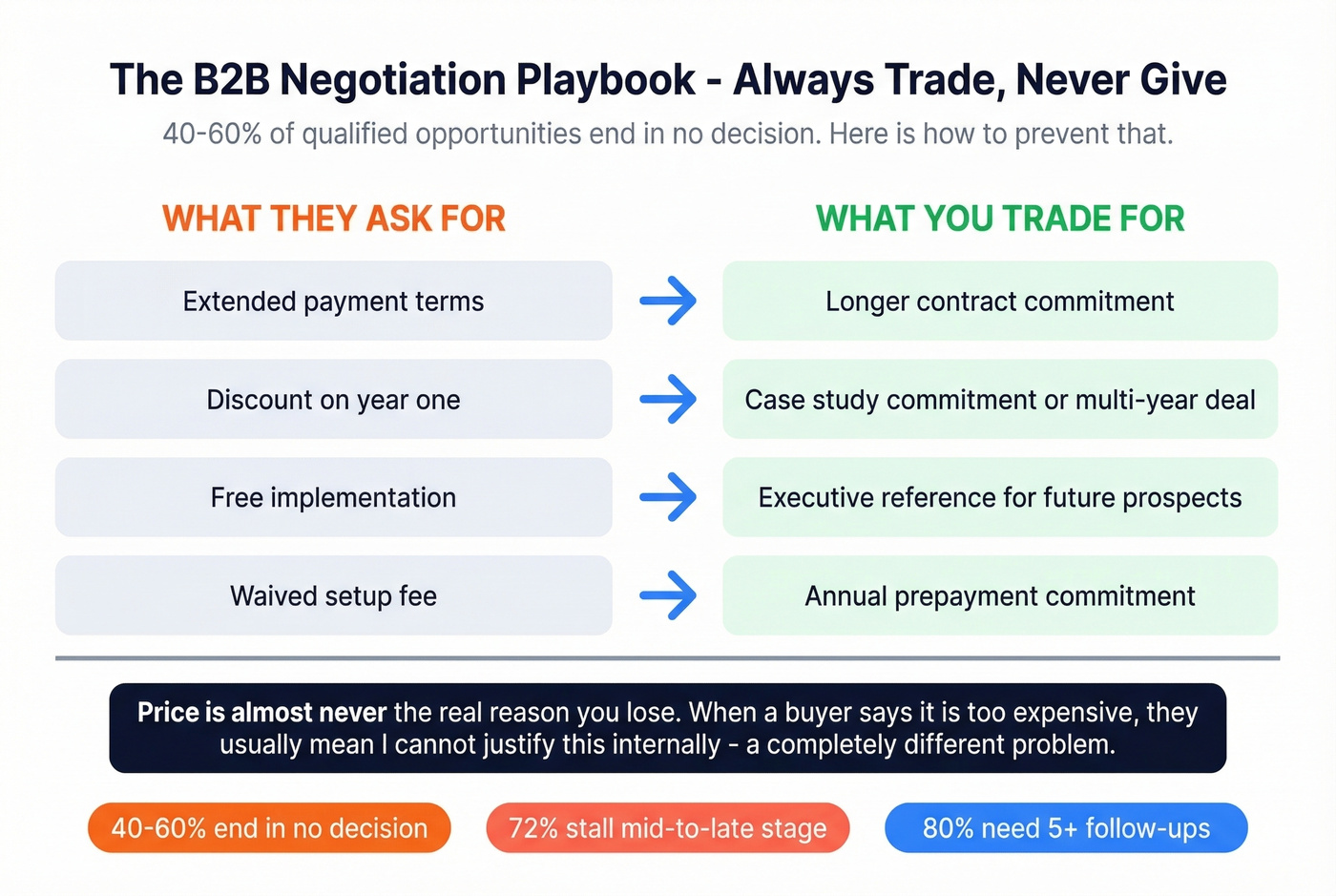
Price is almost never the real reason you lose. The consensus on r/b2b_sales is clear: price is a scapegoat for weak value, missing stakeholders, lack of trust, or bad timing. When a buyer says "it's too expensive," they're usually saying "I can't justify this internally" - which is a different problem entirely.
The BATNA framework should be your foundation. Before any negotiation, align internally - sales, RevOps, finance, and legal need to agree on discount ceilings and clause escalation paths. We've seen deals blow up because a rep offered a discount that finance wouldn't honor.
If you want a deeper playbook on pricing posture, use an anchor early and define your walk-away point.
The golden rule: always trade, never give. Keep this concession playbook ready:
- Extended payment terms - trade for a longer contract
- Discount on year one - trade for a case study commitment or multi-year deal
- Free implementation - trade for an executive reference
- Waived setup fee - trade for annual commitment
Contract Terms and Red Flags
This section alone might save you from a six-figure mistake.
Limitation of liability is non-negotiable. Cap general breach at 1x annual contract value. Cap cybersecurity breaches at 2-5x ACV, higher if you're processing significant personal data. Fraud, willful misconduct, death, and breach of law can remain uncapped. Everything else needs a ceiling.
Indemnification catches founders off guard - it's essentially a blank check for the other party's losses. The only standard indemnity in B2B SaaS is IP infringement. Indemnity for contract breach or data breach should be resisted or heavily capped.
IP ownership is the third rail. The vendor retains underlying IP; the client owns outputs like reports and other customer-specific deliverables. Watch for language that turns product work into "custom deliverables" - that can accidentally transfer your core IP.
Skip the 40-page MSA review if you're dealing with a sub-$15K annual contract. For deals under that threshold, a standard order form with basic terms of service is usually enough. Save the legal firepower for six-figure commitments where the risk actually justifies the cost.
From Proposal to Signed Contract
87% of sales opportunities face moderate-to-high customer indecision. The enemy isn't a competitor - it's the status quo. 60% of stalled opportunities are caused by overwhelming choice or unclear next steps.
Let's be honest: nobody reads your proposals. They skip to the pricing page. A 10-year B2B sales veteran on Reddit said it best, and it matches everything we've observed. Keep proposals to 2-3 pages with pricing upfront. The executive summary and pricing table are the only pages that get read; everything else is appendix material.
Closing techniques that actually work:
- If-then close: "If we can hit your go-live date of March 1, can we get signatures by Friday?" Trade a concession for a commitment.
- Option close: Reduce choice overload by presenting 2-3 packages, not an open-ended quote.
- ROI alignment: Restate the cost of inaction in the buyer's own metrics. "You told me this costs you $40K/month in manual work."
- Scale close: "On a scale of 1-10, how ready are you to move forward?" Anything below 8 surfaces the real blocker.
If you're standardizing your close, map this to a repeatable sales process so reps don't freestyle late-stage.
Tools That Accelerate B2B Deal Management
Reps spend only 28-30% of their time actually selling. The rest is admin, data entry, and tool juggling. The right stack eliminates friction at each stage.
CRM: Salesforce or HubSpot. HubSpot's free tier works for early-stage teams; Salesforce typically runs $75-$165+/user/month depending on edition. If you're comparing options, here are real examples of a CRM with pricing.
Sales engagement: Outreach or Salesloft, usually ~$100-$200/user/month. These automate your multi-touch cadences and track engagement signals. If you're rolling one out, follow a 90-day plan for implementing a sales engagement platform.
CPQ: For complex pricing, DealHub or Salesforce CPQ eliminate the "let me check with finance" delay that kills momentum. Expect ~$50-$150/user/month depending on configuration.

Data and prospecting: This is where most deals quietly fail before they even start. To multi-thread across a 13-person buying committee, you need verified contact data for every stakeholder - not just the champion who took your first call. Prospeo covers 300M+ professional profiles with 143M+ verified emails, 98% email accuracy, and 125M+ verified mobile numbers. Data refreshes every 7 days, compared to the 6-week industry average. Self-serve pricing starts free. When Snyk deployed Prospeo across 50 AEs, bounce rates dropped from 35-40% to under 5%, and AE-sourced pipeline jumped 180%. If you're evaluating vendors, start with these data enrichment services and sales prospecting databases.
Every day between demo and proposal is a day for your deal to stall. Prospeo's Chrome extension lets you find verified contact data for the financial approver, technical buyer, and legal reviewer in one click - so you can multi-thread the same day you demo, not three weeks later.
Your deal dies in committee when you can't reach the committee. Fix that now.
FAQ
What's the average B2B deal cycle length?
The median B2B SaaS sales cycle is 84 days across 939 companies. SMB deals under $15K ACV close in 14-30 days, mid-market deals run 30-90 days, and enterprise deals above $100K typically take 90-180+ days.
Why do most B2B deals stall?
86% of B2B purchases stall during the buying process, and the number-one cause isn't a competitor - it's "no decision." Committees averaging 13 stakeholders can't reach consensus when sellers single-thread into one champion who lacks the political capital to drive internal alignment.
How many follow-ups does it take to close?
Research shows 8-12 touchpoints over 17-21 days is the sweet spot, yet 44% of reps quit after a single follow-up. Each touch has to actually reach the right person - bounced emails silently destroy cadence effectiveness.
What qualification framework works best?
Use BANT for transactional deals under $15K, CHAMP for mid-market opportunities up to $100K, and MEDDPICC for complex enterprise engagements above $100K. Match framework complexity to deal size. Over-qualifying small deals wastes time, while under-qualifying large ones loses revenue.