

B2B Direct Sales: How to Build a Motion That Actually Closes
A RevOps lead we know ran a three-tool bake-off last quarter. The "best" database flooded Salesforce with duplicates in five days. The cheapest tool had better phone connect rates. The lesson wasn't about tools - it was about building a B2B direct sales motion on a foundation that doesn't crack under pressure.
Selling directly to other businesses remains one of the highest-return growth channels for companies with complex products. But buyers are more informed, committees are bigger, and the average rep is missing quota. Here's what actually works in 2026.
The Short Version
- Direct sales only makes sense above ~$25K ACV. Below $10K, go product-led. In between, run a hybrid motion.
- Up to 70% of reps missed quota in 2024. Fix targeting and data quality before hiring more bodies.
- Pick one methodology and enforce it. SPICED for mid-market SaaS, MEDDIC for enterprise. Don't let reps freelance their discovery calls.
What Does Direct Sales Mean in B2B?
Direct sales in modern B2B means your team owns the full transaction cycle - from prospecting through close - without intermediaries. The word "direct" refers to ownership of the relationship, not whether your reps are in a room or on a Zoom call.
Three confusions come up constantly. Founders use "direct sales" to mean "we don't have channel partners." Sales leaders use it to mean "AEs are closing deals." And some people confuse it with consumer direct selling - think Avon or Tupperware. None of those are quite right. In B2B, the direct sales model is narrower and more strategic: your organization controls every stage of the buyer journey, from first touch to signed contract. Your team targets, qualifies, pitches, negotiates, and closes. You trade reach for control, and that control gives you a faster learning loop on what's working and what isn't.
Why It Still Matters in 2026
Forrester projects US B2B e-commerce will hit $3T by 2027 at a 10.7% CAGR. That's the digital transaction layer growing - and direct sales teams are the ones guiding buyers through it.
McKinsey's "rule of thirds" still holds: at any stage of the buying process, roughly one-third of buyers prefer in-person, one-third prefer remote, and one-third prefer digital self-serve. Direct sales covers the first two thirds. Gartner projects that 80% of B2B sales interactions now happen through digital channels.
Buyers are more digital than ever, but complex deals still need a human to navigate procurement, legal, and multi-stakeholder politics. That's where a direct selling approach earns its keep.
Direct Sales vs. PLG vs. Hybrid
The ACV decision framework is the single most important strategic choice in your GTM motion. Get this wrong and no amount of hiring or tooling saves you.
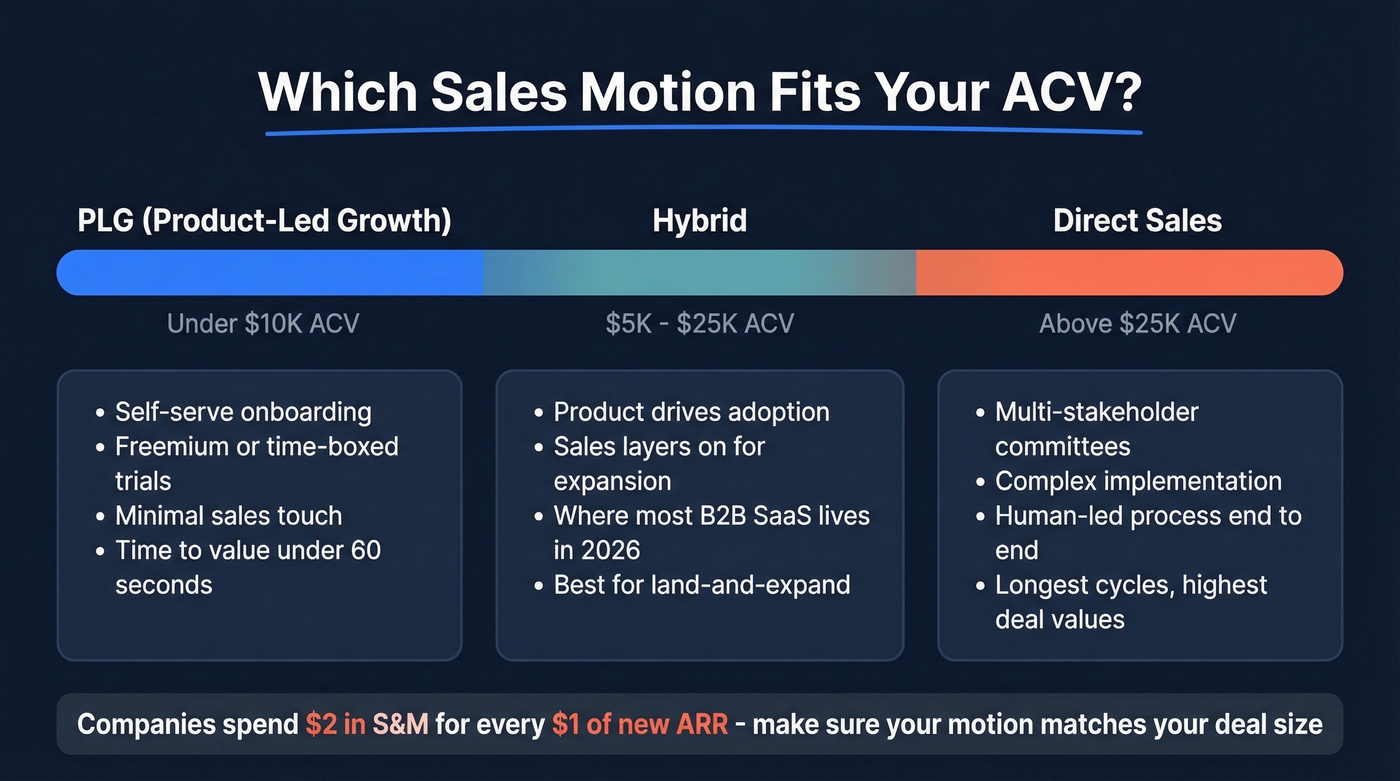
PLG (under $10K ACV): Self-serve onboarding, freemium or trial-led, minimal sales touch. PLG expectations are tightening - time-to-value is moving toward under 60 seconds, and free tiers are shifting from indefinite freemium to time-boxed trials with usage caps. 91% of SaaS companies are investing more in PLG, and Menlo Ventures found that 27% of AI application spend already flows through PLG channels.
Direct sales (above $25K ACV): Multi-stakeholder buying committees, complex implementation, and long evaluation cycles all demand a human-led process.
Hybrid ($5K-$25K): Let the product generate adoption, then layer sales on top for expansion and enterprise deals. This is where a lot of B2B SaaS lives in 2026.
The unit economics tell the same story. Companies are spending $2 in S&M for every $1 of new ARR - up 14% since 2024. If your LTV:CAC ratio isn't hitting 3:1 or better, your motion is leaking money regardless of which model you pick.
I've watched startups burn through $500K in SDR salaries trying to close $7K deals that should've been self-serve. The math never works. Save the human-led motion for deals where the contract value justifies the cost.
Direct Sales vs. Channel Sales
| Factor | Direct Sales | Channel Sales |
|---|---|---|
| Who sells | Your team | Partners/resellers |
| Control | Full | Partial |
| Feedback loop | Fast, direct | Slower, filtered |
| CAC | Higher (B2B SaaS avg ~$702) | 10-30% lower |
| Reach | Limited by headcount | Scales via partners |
| Time-to-first-revenue | Immediate | 60-90 days (partner ramp) |
Channel sales is growing fast. Iconiq Capital's State of GTM report found B2B SaaS companies now derive 20%+ of revenue from channel partners. Rising CAC is pushing teams toward partners who already own trust and distribution in their markets.
Here's the thing: it's not either/or. Many companies above $10M ARR run both. A direct model gives you control and a tight feedback loop on messaging, pricing, and product gaps. Channel gives you reach without proportional headcount growth. The question is which one leads your GTM motion, and that depends on your ACV and market density.

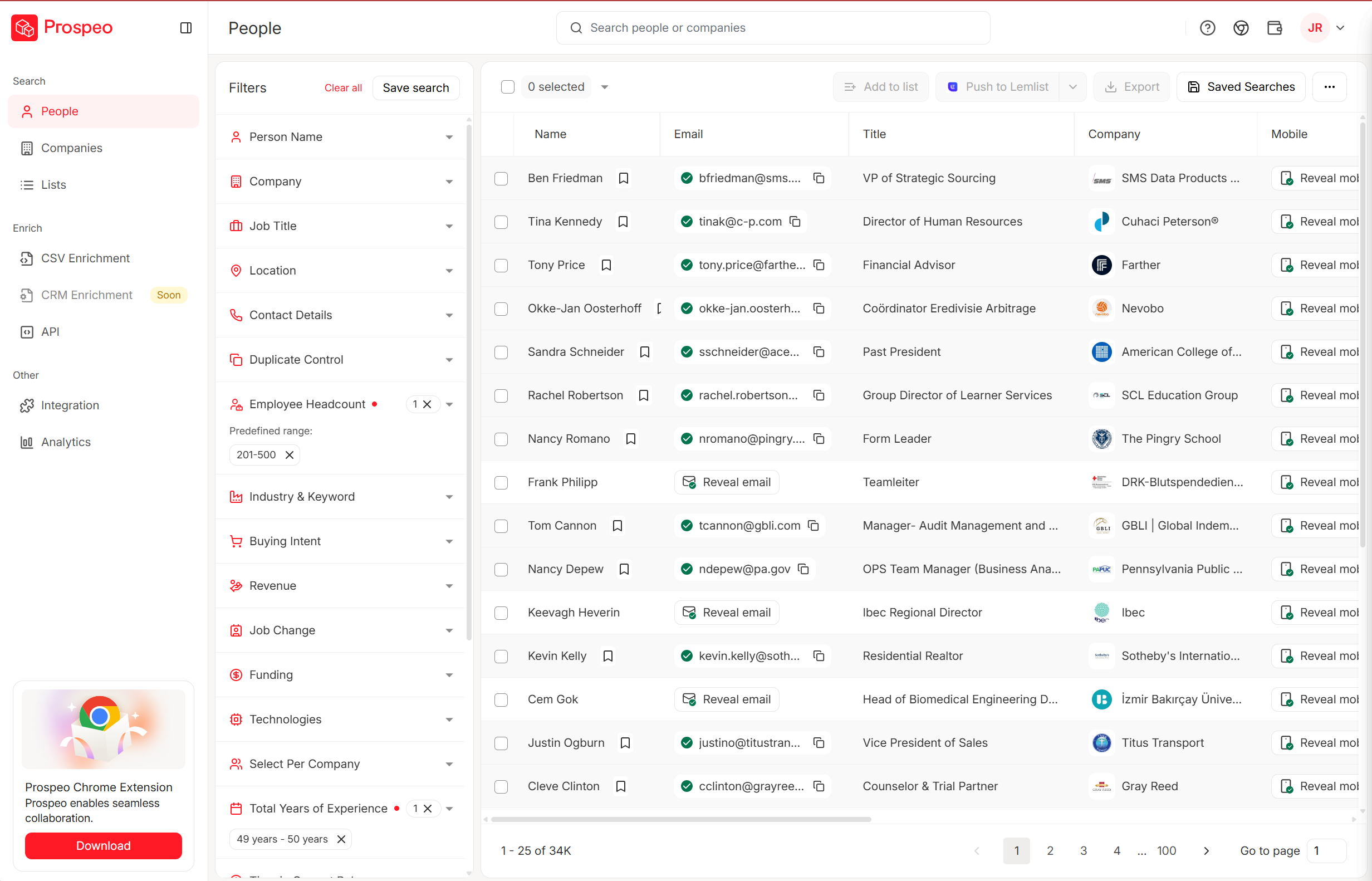
Up to 70% of reps miss quota - and bad targeting is the #1 reason. Prospeo's 30+ search filters (buyer intent, technographics, job changes, headcount growth) let you build direct sales lists that match your ICP precisely. 98% email accuracy means your reps spend time selling, not bouncing.
Stop hiring more reps. Start giving them data that actually connects.
The B2B Direct Sales Process
Buyers now use 10 channels on average during a purchase (up from 5 in 2016), and 89% report a stalled deal in the past year. They spend only 17% of their buying time actually meeting with suppliers. Your process needs to make every interaction count.
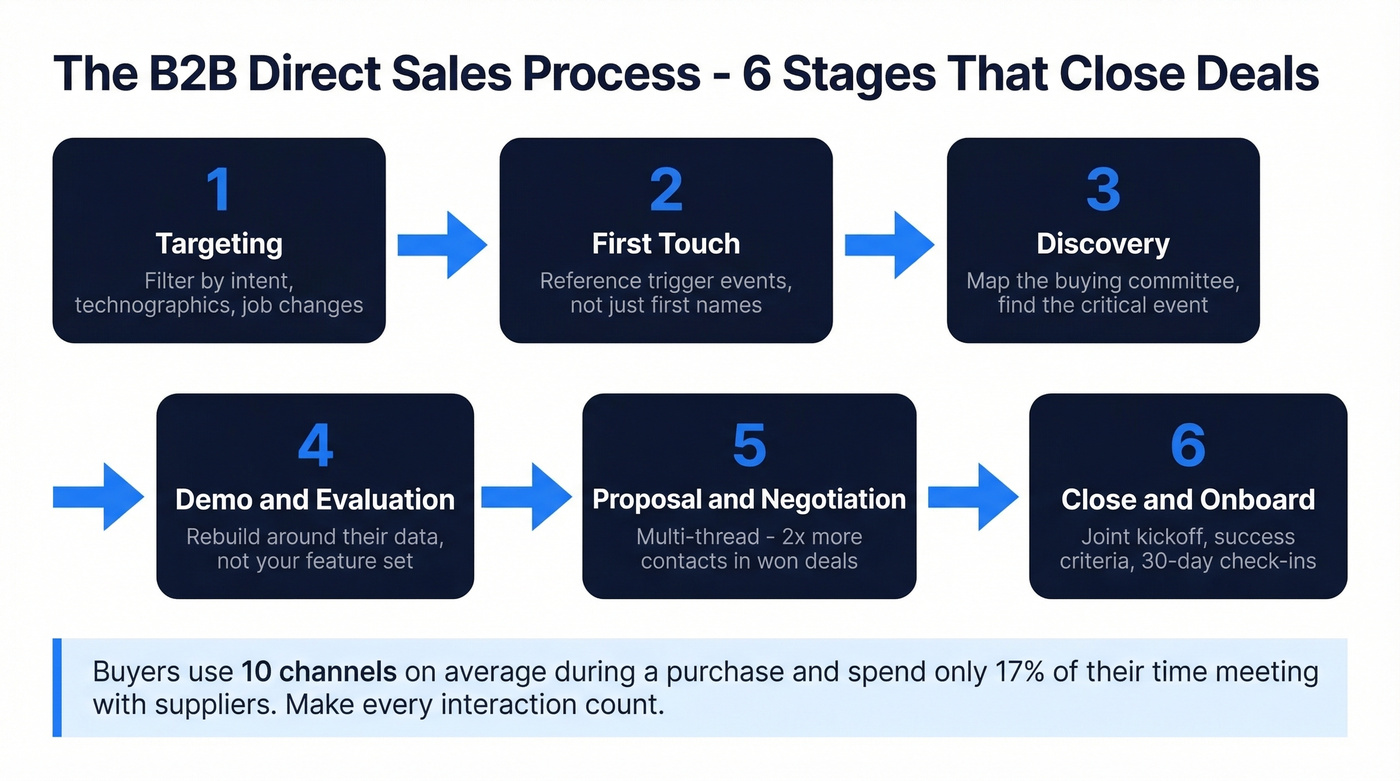
Targeting
Your outbound motion lives or dies on list quality. Filter by buyer intent, technographics, job changes, and headcount growth to build lists of accounts that actually match your ICP. A simple ideal customer profile makes this step measurable instead of opinion-based. We've seen teams cut their disqualification rate dramatically just by adding intent signals to their targeting criteria. Prospeo's 30+ search filters and 98% email accuracy make this step fast - SDRs spend time selling, not cleaning spreadsheets.
First Touch
The first outreach sets the tone for the entire deal. Cold email, cold call, or warm intro through a mutual connection - pick based on your buyer's channel preference. Personalize beyond the first name: reference a specific trigger event, a recent company announcement, or a pain point common to their role. Generic "just checking in" messages get deleted. If you need copy that doesn't sound templated, keep a few sales follow-up templates on hand.
Discovery
This is where deals are won or lost. Use your chosen methodology to uncover the real pain, map the buying committee, and identify the critical event driving urgency. Listen more than you talk. A tight set of discovery questions helps reps stay structured without sounding scripted.
Demo and Evaluation
Tailor the demo to the pain points surfaced in discovery. Generic product tours kill deals. The best AEs rebuild the demo around the prospect's own data and workflow, turning a presentation into a proof of concept. Show the buyer their world, not your feature set. Use a product demo checklist to keep the evaluation stage consistent across reps.
Proposal and Negotiation
Multi-thread aggressively here. Closed-won deals involve roughly 2x more buyer contacts than lost deals. For deals above $50K, multi-threading boosts win rates by 130%. If negotiation keeps stalling, revisit your anchor in negotiation before you send the next redline.
Close and Onboard
The close isn't the finish line - it's the starting line for retention. A smooth handoff to customer success means a joint kickoff call, documented success criteria, and a 30-day check-in cadence. Get this right and you set up the expansion revenue that funds your next quarter.
Building Your Sales Team
The standard direct sales pod: SDRs prospect and qualify, AEs run discovery through close, CSMs own retention and expansion, and a sales manager keeps the machine running.
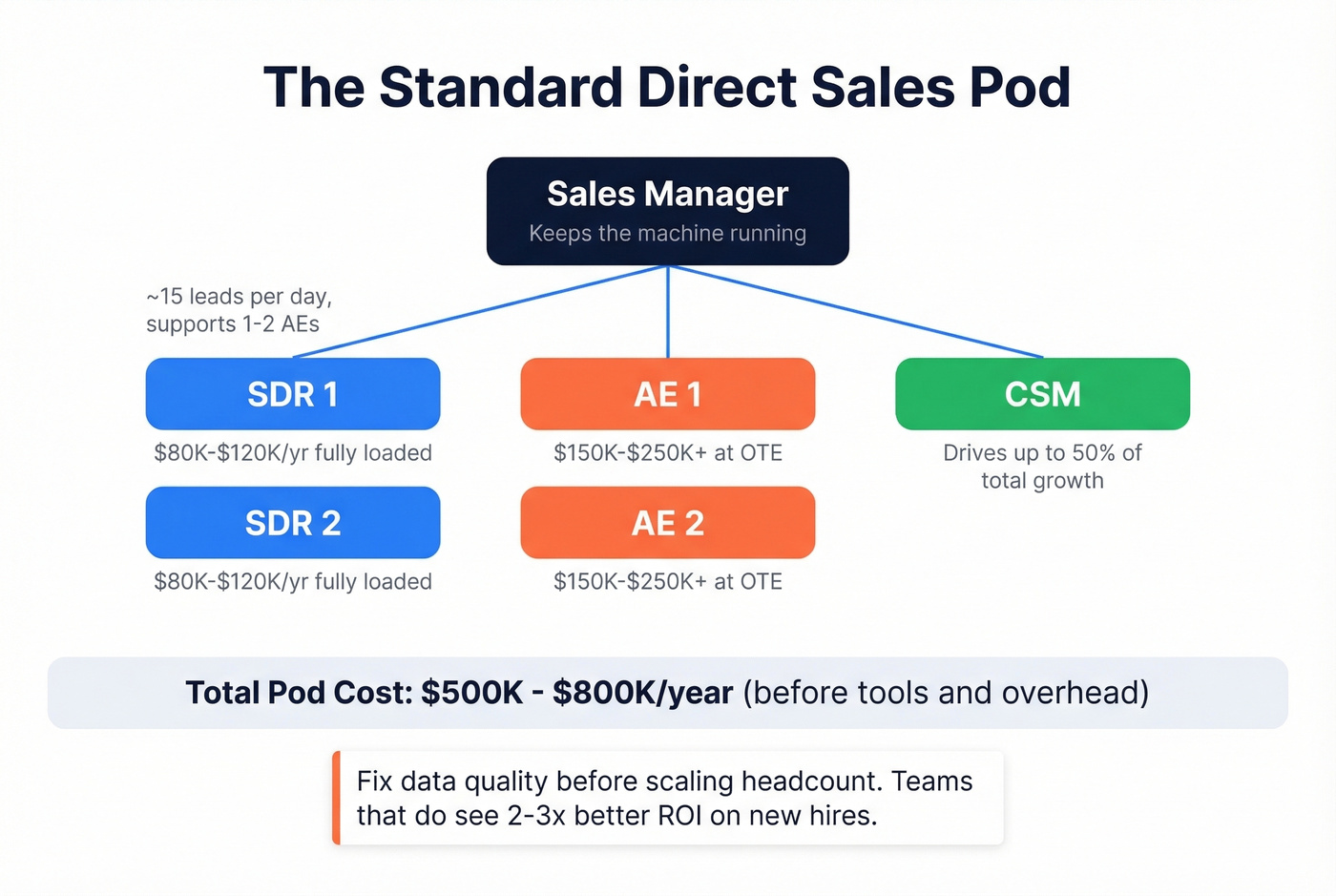
A typical SDR handles around 15 leads per day and supports 1-2 AEs in an outbound-heavy motion. Customer success can drive up to 50% of total growth through renewals and upsells - which is why smart companies invest in CS early, not as an afterthought.
Let's be honest about the costs. A fully loaded SDR runs $80-120K/year. An AE costs $150-250K+ at OTE. A five-person pod (2 SDRs, 2 AEs, 1 CSM) costs $500K-$800K/year before tools and overhead. In our experience, teams that fix data quality before scaling headcount see 2-3x better ROI on new hires. You can't afford to burn expensive rep time on bad leads.
Methodologies That Close
| Methodology | Best For | ACV Range |
|---|---|---|
| BANT | High-volume qualification | Under $15K |
| SPIN | Consultative discovery | $15K-$75K |
| SPICED | Mid-market SaaS | $10K-$50K |
| MEDDIC/MEDDPICC | Enterprise | $50K+ |
| Challenger | Complex, status-quo sales | Any (style overlay) |
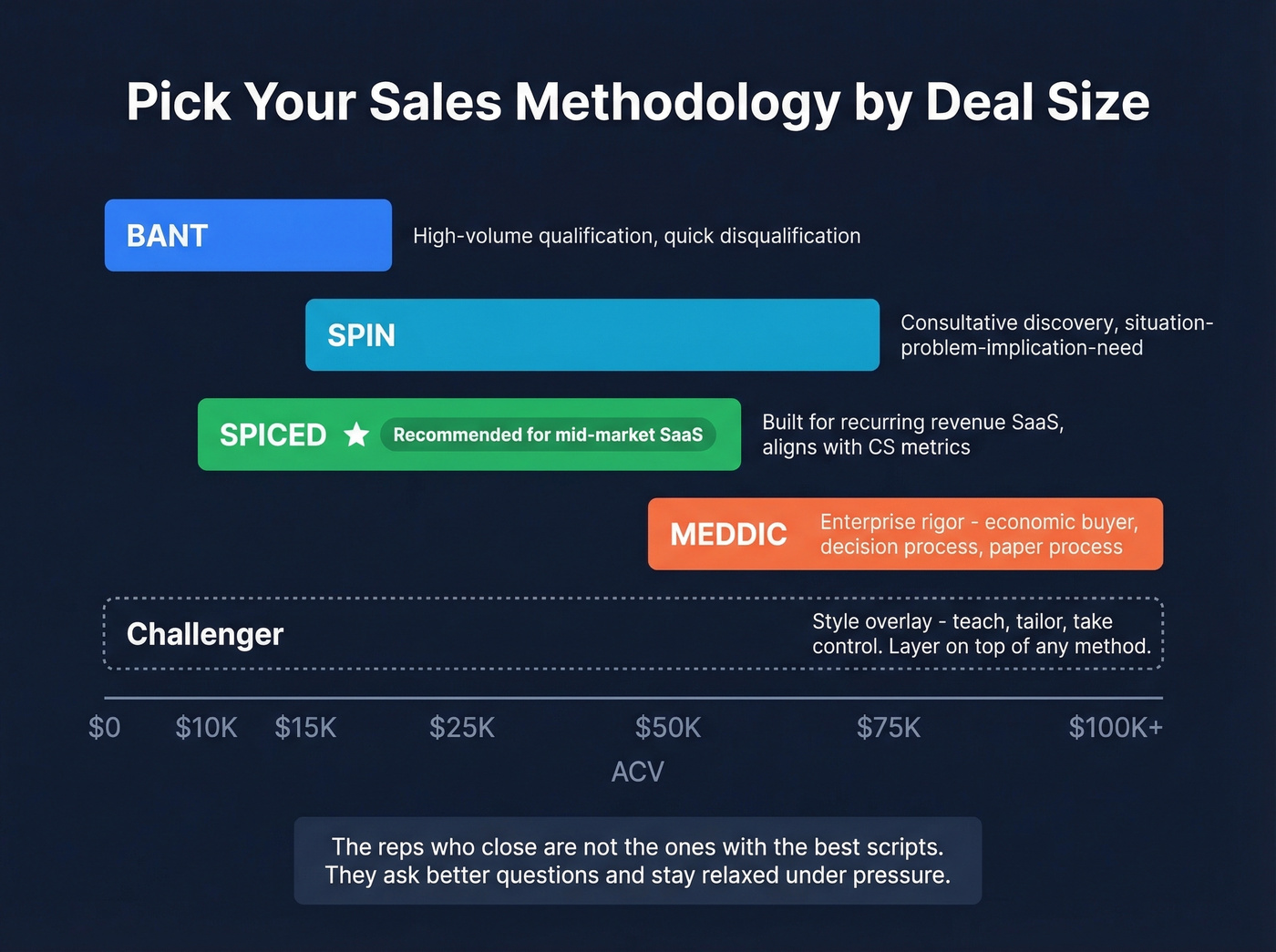
Start with SPICED for mid-market SaaS. Winning by Design built it specifically for recurring revenue businesses, and it aligns discovery with the metrics that matter: Situation, Pain, Impact, Critical Event, and Decision Criteria.
For enterprise deals above $50K, MEDDIC forces rigor around the economic buyer, decision process, and paper process - the three things that kill enterprise deals when you skip them. Skip this if your average deal is under $30K; the overhead isn't worth it at that scale.
Challenger is worth studying regardless. The original CEB research across 6,000+ reps found that the "teach, tailor, take control" approach outperformed relationship-building in complex sales. Layer it on top of your primary methodology as a selling style.
One common thread across sales communities and r/sales discussions: the reps who close aren't the ones with the best scripts. They're the ones who ask better questions and stay relaxed under pressure. Methodology gives you structure, but curiosity and composure are what make discovery calls actually work.
2026 Benchmarks
| Metric | Benchmark |
|---|---|
| Win rate | 20-21% avg, 30%+ top |
| Quota attainment | 28-43% |
| Cycle length | 1-3 months (6-12+ for $100K+) |
| Buying committee | 6-10+ stakeholders |
| Multi-threading lift | 130% win rate boost (>$50K) |
| Marketing conversion | 2.9% avg (qualified lead) |
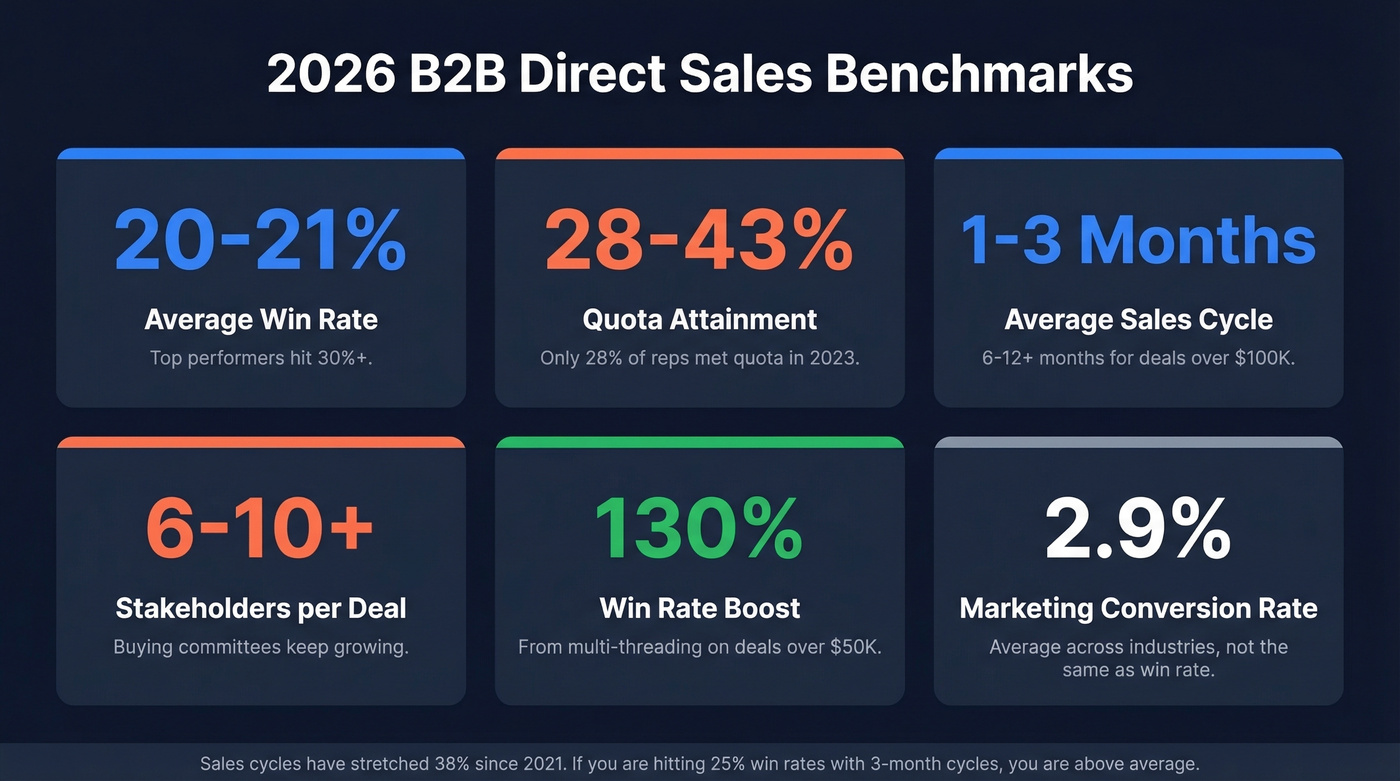
The quota attainment numbers are brutal. Only 28% of reps met quota in 2023. By late 2024, average attainment had climbed to around 43% - better, but still painful.
Sales cycles have stretched 38% since 2021, driven by larger buying committees and more digital touchpoints. If your team is hitting 25% win rates with 3-month cycles, you're actually performing above average. Don't confuse marketing conversion - 2.9% average across industries per Ruler Analytics' 100M+ data point study - with sales win rates. They measure different things at different funnel stages.
The Tech Stack
Four categories matter. Everything else is optional. Expect to spend $50-150/user/month for CRM, $50-200/seat/month for sequencing tools, and $100-200/seat/month for conversation intelligence.
CRM: Salesforce for mid-market and enterprise. HubSpot for teams under 50 reps who want faster implementation. Non-negotiable - you can't run a direct motion without a system of record. If you're still evaluating options, these examples of a CRM can help you sanity-check fit.
Prospecting and Data: This is where most teams leak money. We've seen companies spend $30K+ per year on legacy data contracts and still fight duplicates, stale records, and deliverability issues. Prospeo covers the core data layer at a fraction of the cost: 143M+ verified emails, 125M+ verified mobiles with a 30% pickup rate, intent data tracking 15,000 topics via Bombora, and a 7-day refresh cycle. Pricing starts free and scales to roughly $0.01 per email - 90% cheaper than legacy platforms that lock you into annual contracts. If you're comparing vendors, start with a shortlist of data enrichment services and work backward from your required fields and refresh rate.
Engagement: Smartlead, Instantly, or Lemlist for email sequences. Pick based on your volume and deliverability needs. If you're building a modern outbound stack, this list of SDR tools is a good reference point.
Analytics: Gong or Chorus for conversation intelligence. These pay for themselves by showing you exactly where reps lose deals in discovery and negotiation.
Multi-threading boosts win rates by 130% on deals above $50K - but only if you can reach the full buying committee. Prospeo gives you 143M+ verified emails and 125M+ verified mobile numbers with a 30% pickup rate, refreshed every 7 days. That's every stakeholder, every direct dial, always current.
Reach the entire buying committee, not just the gatekeeper.
7 Mistakes That Kill Deals
- Selling on price, not value. Lead with the business outcome, not the discount.
- Talking more than listening. Discovery should be buyer-led.
- Failing to qualify early. An unqualified pipeline wastes AE time and inflates forecasts. If this keeps happening, fix your sales pipeline challenges before you add more top-of-funnel.
- Skipping objection prep. Every deal has predictable objections. Drill them.
- Pitching the wrong stakeholder. Map the economic buyer early - champions who can't sign checks are a trap.
- Using jargon buyers don't understand. Match your language to your audience.
- Not multi-threading. Deals above $50K see a 130% win rate boost when you engage multiple stakeholders. Single-threaded deals die when your champion goes on vacation.
FAQ
What's the difference between B2B direct sales and channel sales?
Direct sales means your team owns the full cycle from prospecting to close. Channel sales uses partners, resellers, or affiliates who sell on your behalf. Direct gives you control and faster feedback; channel lowers CAC by 10-30% and scales via partner networks. Most companies above $10M ARR run both.
How long is a typical B2B sales cycle?
Standard deals close in 1-3 months. Enterprise contracts above $100K typically take 6-12+ months. Cycles have stretched 38% since 2021 because buying committees now include 6-10+ stakeholders and buyers engage across 10 channels before deciding.
What tools do direct sales teams actually need?
At minimum: a CRM (Salesforce or HubSpot), a prospecting platform for verified emails and direct dials, a sequencing tool (Smartlead, Instantly, or Lemlist), and conversation intelligence (Gong or Chorus). Prospeo is a strong starting point for the data layer - 75 free verified emails per month, 98% accuracy, and no contracts.
What's the best sales methodology for mid-market deals?
SPICED works best for mid-market SaaS deals in the $10K-$50K range. Winning by Design designed it for recurring revenue businesses, and it structures discovery around Situation, Pain, Impact, Critical Event, and Decision Criteria. For enterprise deals above $50K, switch to MEDDIC.