

The Best B2B Email Marketing Tools for 2026 (And What Every Other Guide Gets Wrong)
Your marketing ops person just pulled the quarterly email report and deliverability dropped 12 points. Nobody changed the ESP. Nobody touched the templates. The problem isn't the tool - it's the data feeding it.
Most guides ranking B2B email marketing tools obsess over automation builders and template libraries. They skip the thing that actually determines whether your campaigns work: data quality. Email marketing still returns $36-$42 for every $1 spent, but that ROI assumes your emails actually reach inboxes. Here's the number that should worry you: 98.16% of B2B emails get "delivered," but only 84.3% land in the inbox. That 14-point gap is where your pipeline leaks - and cold outreach reply rates dropping from 6.8% to 5.8% over the past two years means every wasted send hurts more than it used to.
We've spent months testing these platforms across real campaigns. This guide starts with the fix.
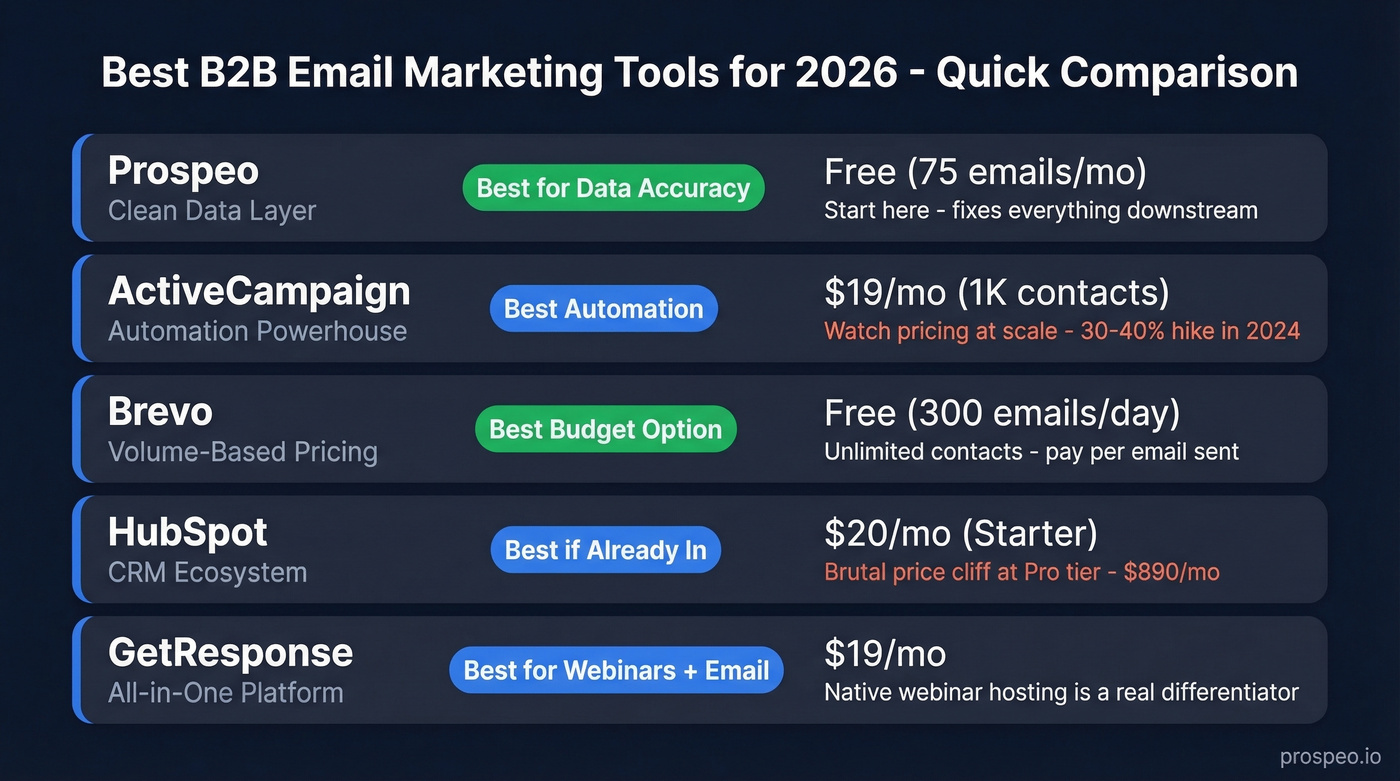
Our Picks (TL;DR)
| Tool | Best For | Starting Price | Our Take |
|---|---|---|---|
| Prospeo | Data accuracy + list building | Free (75 emails/mo) | Best data layer. Start here. |
| ActiveCampaign | Automation-heavy B2B teams | $19/mo (1K contacts) | Top automation. Pricey at scale. |
| Brevo | Budget teams with large lists | Free (300 emails/day) | Unlimited contacts. Underrated. |
| HubSpot | Teams already in HubSpot | $20/mo (Starter) | Great CRM sync. Steep price cliff. |
| GetResponse | Webinar + email teams | $19/mo | Email + webinars in one platform. |
The Best B2B Email Marketing Software, Reviewed
Prospeo - Clean Data Before You Send
Use this if: You're building lists from scratch, inheriting a stale database, or seeing bounce rates above 3%.
Skip this if: You already have a verified, recently cleaned list. But let's be honest - you probably don't.
Your ESP doesn't verify the addresses you import. It just sends and lets bounces happen. Prospeo sits upstream of every tool on this list, ensuring the data going into your sequences is valid before a single email fires.
The platform covers 300M+ professional profiles with 98% email accuracy, powered by a proprietary 5-step verification process that catches spam traps, honeypots, and catch-all domains. That accuracy number isn't marketing fluff - we've seen it hold up across campaigns with tens of thousands of sends. If you're comparing vendors, start with email verification and the data layer.
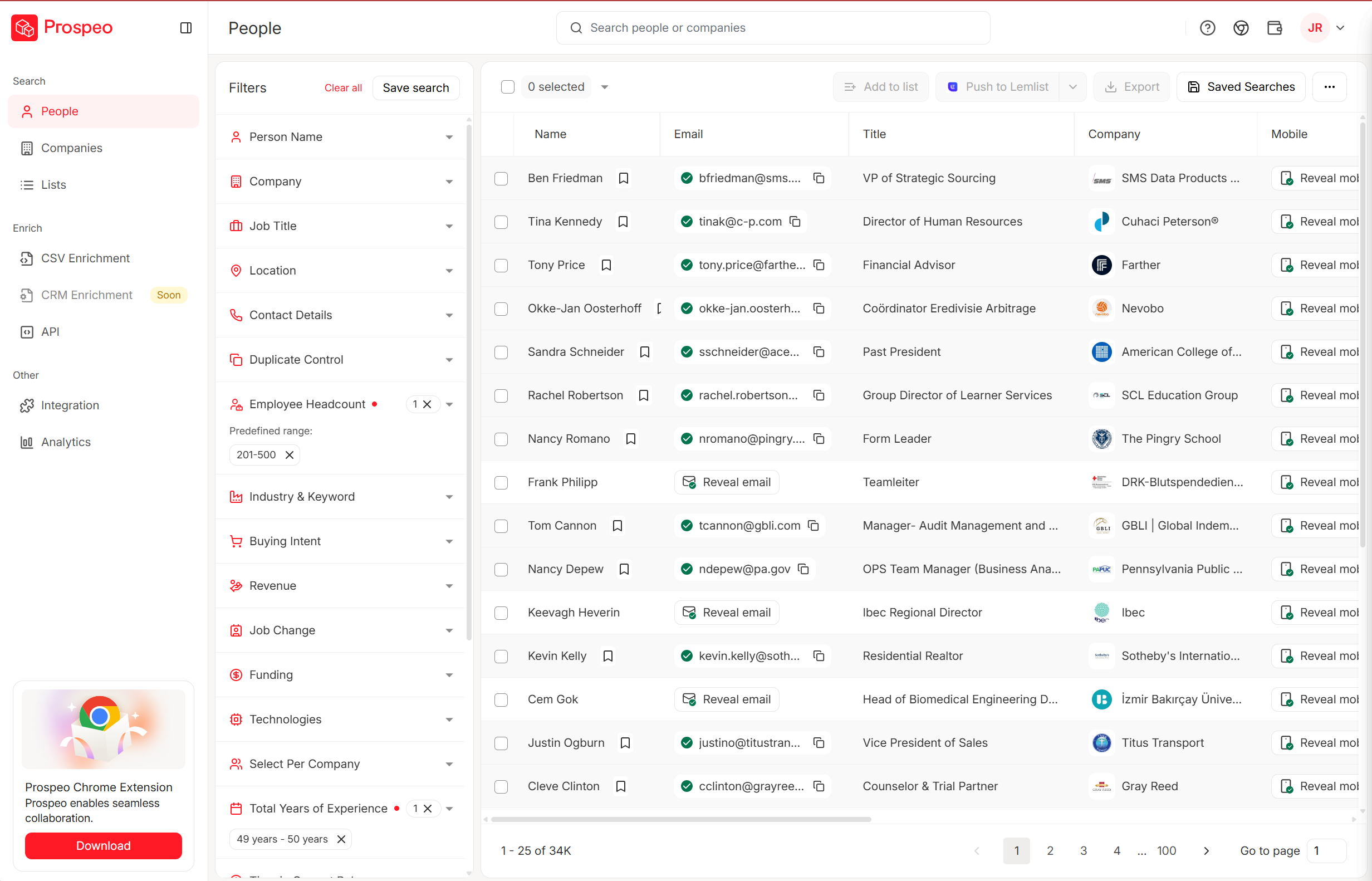
The 7-day data refresh cycle is the real differentiator. The industry average is six weeks, and B2B contact data decays roughly 30% per year, so that gap matters enormously. The free tier gives you 75 verified emails per month, with credit-based pricing at about $0.01 per email after that.
Native integrations with HubSpot, Salesforce, Instantly, Lemlist, and Smartlead mean verified contacts flow straight into whatever ESP or sequencer you already use. If you're building lists from scratch, pair this with a repeatable lead generation workflow so data stays clean end-to-end. Stack Optimize built from $0 to $1M ARR on Prospeo data, maintaining 94%+ deliverability and under 3% bounce rates across all their clients.
ActiveCampaign - Best for Automation
Use this if: Complex automation workflows are central to your B2B strategy - lead nurturing, behavioral triggers, multi-step sequences.
Skip this if: You're under 1,000 contacts. It's overkill.
ActiveCampaign is the automation king. No other tool here matches the depth of its workflow builder - conditional logic, split testing within automations, site tracking triggers, lead scoring that actually works. It also offers AI-powered predictive sending, which optimizes delivery times per contact based on their engagement history.
The catch: ActiveCampaign hit users with a 30-40% price hike in 2024, and those prices haven't come back down.
You're looking at $19/mo for 1,000 contacts, $189/mo at 10,000, and $1,199/mo at 100K. No free plan - just a 14-day trial. Model your costs at 10K+ contacts before you commit, because the sticker shock at scale is real.
Brevo - Best for Large Lists on a Budget
Use this if: You have a large contact database but don't email it daily. Budget matters.
Skip this if: You need automation depth rivaling ActiveCampaign.
Here's the thing: most B2B teams with 10K+ contacts are overpaying for email by 50% or more. Brevo is the reason I can say that with a straight face.
Instead of charging per contact, Brevo charges per email sent. Store unlimited contacts and pay based on volume. The free plan gives you 300 emails per day. Starter plans begin at $9/mo for 5,000 emails. A/B testing and advanced reporting unlock on the Standard tier.
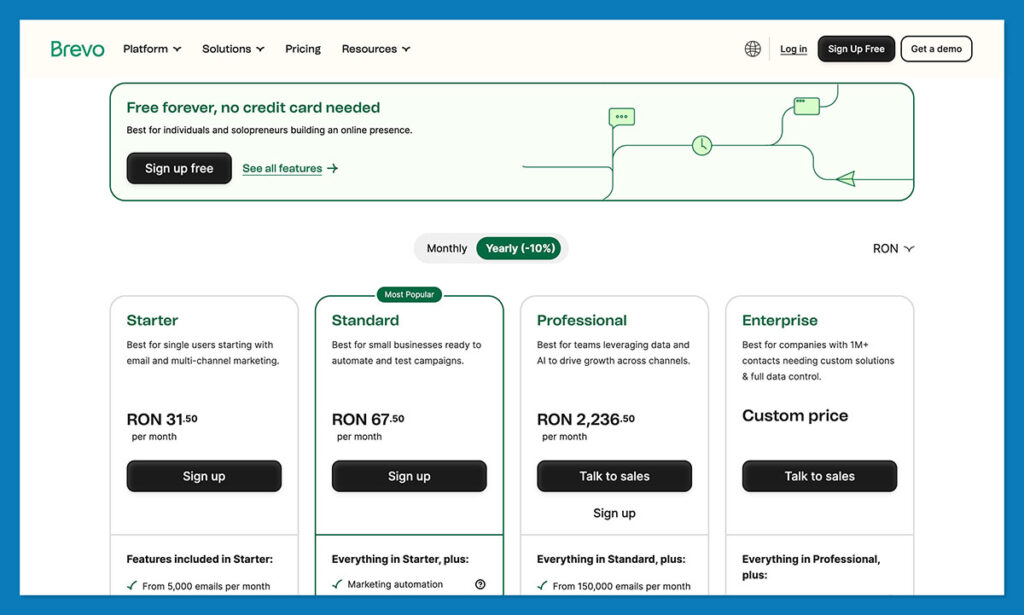
For teams that don't email their full database every week, volume-based pricing can be dramatically cheaper than contact-based platforms as your list grows. We've seen teams cut their email spend by 60% just by switching pricing models - not platforms.
HubSpot - Best If You're Already In
Use this if: You're already paying for HubSpot CRM and want email in the same ecosystem.
Skip this if: You're evaluating email platforms independently of CRM. HubSpot's pricing makes zero sense standalone.
HubSpot's Starter plan runs $20/mo per seat with solid templates, basic automation, and tight contact sync. The free plan offers 2,000 emails/month with HubSpot branding.
But the pricing cliff is brutal. Professional jumps to $890/mo plus a $1,500 onboarding fee, and Enterprise hits $3,600/mo. HubSpot pricing frustration is one of the most common threads on r/sales and B2B marketing communities - and for good reason. If you're already deep in the ecosystem, Starter is worth it. Otherwise, look elsewhere.
GetResponse - Best All-in-One
GetResponse is one of the few mainstream email platforms with native webinar hosting - if webinars drive your B2B pipeline, that's a genuine differentiator that saves you from duct-taping Zoom to your email tool.
The free tier covers 500 contacts and 2,500 emails/month. Paid plans start at $19/mo for 1,000 contacts with automation, landing pages, AI content generation, and conversion funnels. It won't match ActiveCampaign's automation depth, but for teams that need email + webinars + landing pages in one platform, it's a clean solution.
MailerLite - Best for Small Teams
Free plan available, paid from $13.50/mo. Clean drag-and-drop builder you can learn in an afternoon. But limited automation means you'll outgrow it fast once your sequences get more complex than a three-step drip.
Mailchimp - The B2C Default
Fine for newsletters. Weak for B2B demand gen. Free plan covers up to 500 contacts and 1,000 emails/month, paid from $13/mo. Minimal lead scoring, and contact-based pricing punishes list growth. Skip it if you're doing anything beyond a monthly roundup. If you're troubleshooting performance, start with Mailchimp deliverability issues before you blame creative.
Honorable Mentions
We also evaluated Omnisend (strong for ecommerce), Constant Contact (solid for events and nonprofits), and Zoho Campaigns (best if you're in the Zoho ecosystem). None made our top picks for general B2B demand gen.
What These Tools Cost at Scale
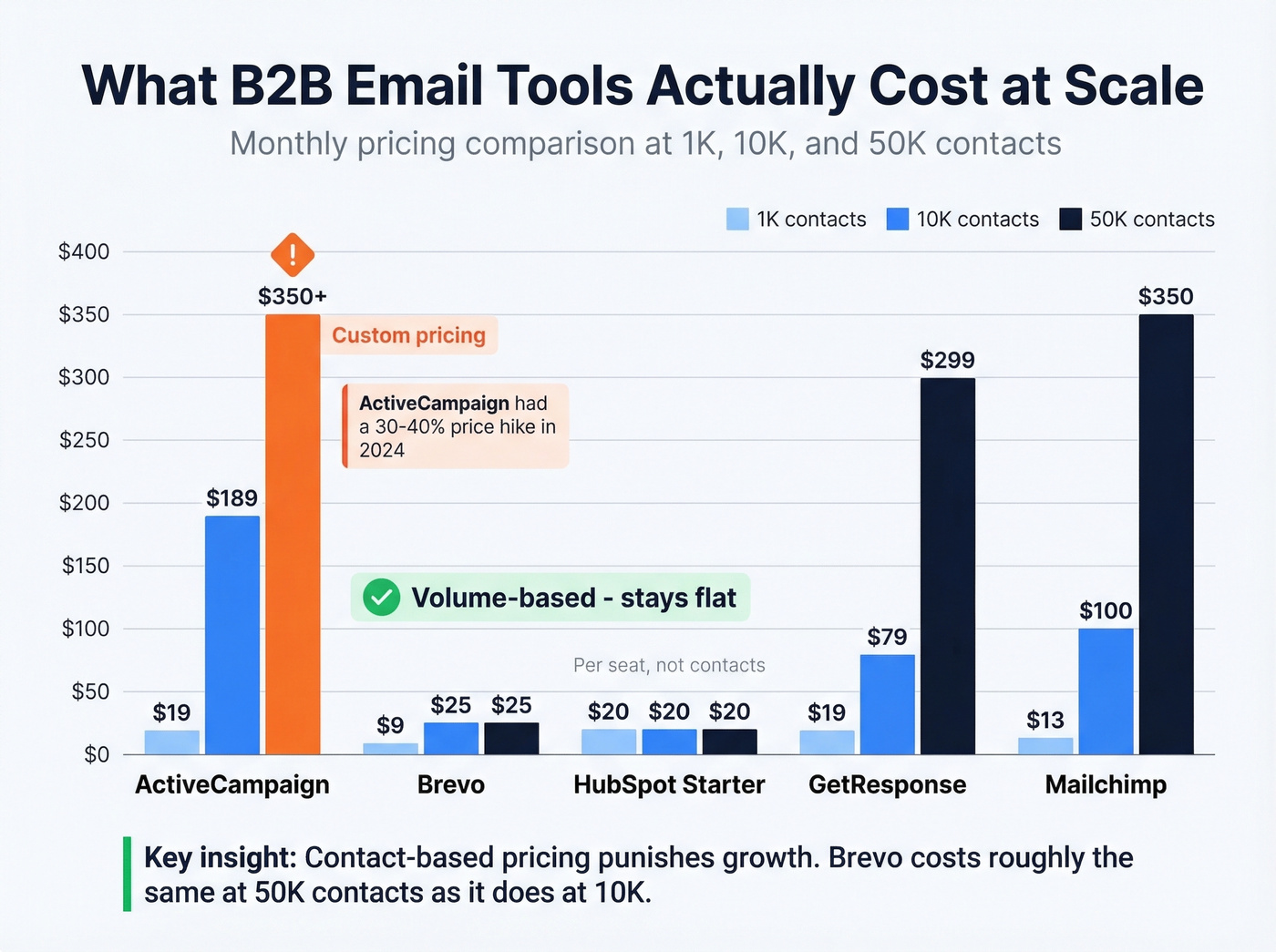
Pricing looks reasonable at 1,000 contacts. It gets ugly fast.
| Tool | 1K contacts | 10K contacts | 50K contacts | Model |
|---|---|---|---|---|
| ActiveCampaign | $19/mo | $189/mo | Custom pricing | Contact-based |
| Brevo | Free-$9/mo | $9-$25/mo | $25+/mo | Email volume |
| HubSpot Starter | $20/mo | $20/mo | $20/mo | Per seat |
| HubSpot Pro | $890/mo | $890/mo | $890+/mo | Contact + seat |
| GetResponse | $19/mo | ~$79/mo | ~$299/mo | Contact-based |
| Mailchimp | $13/mo | ~$100/mo | ~$350/mo | Contact-based |
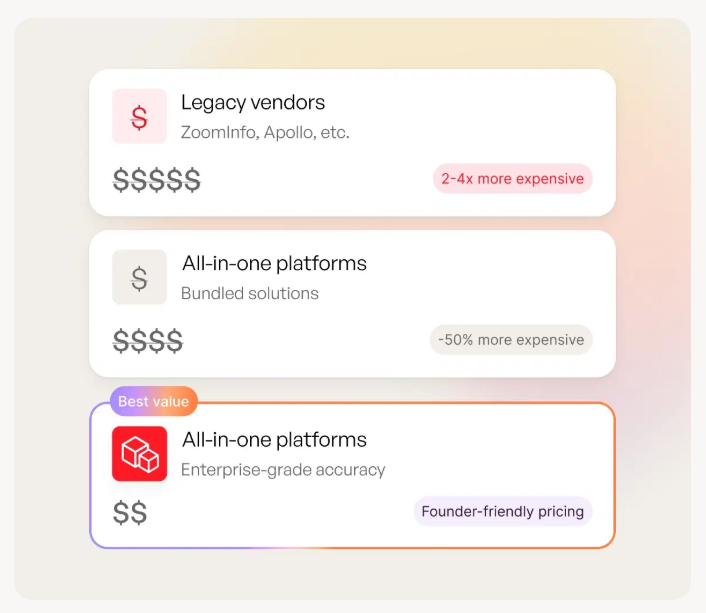
The biggest takeaway: contact-based pricing punishes growth. If your list is expanding and you don't email every contact weekly, volume-based pricing (Brevo) or per-seat pricing (HubSpot Starter) will save you thousands annually. If you're sending at scale, keep an eye on email velocity so you don't trip provider limits.

That 14-point gap between delivered and inboxed? It starts with bad data. Prospeo's 5-step verification and 7-day refresh cycle keep your lists clean so your ESP can do its job. 98% email accuracy at $0.01/email.
Fix your data before you blame your email marketing tool.
Why Your ESP Isn't the Problem
B2B contact data decays at roughly 30% per year. People change jobs, companies get acquired, domains go dark. If you imported a list 12 months ago and haven't cleaned it since, nearly a third of those addresses are dead weight - or worse, spam traps that actively damage your sender reputation. If you need a deeper playbook, follow an email deliverability guide and treat it like infrastructure, not a one-off fix.
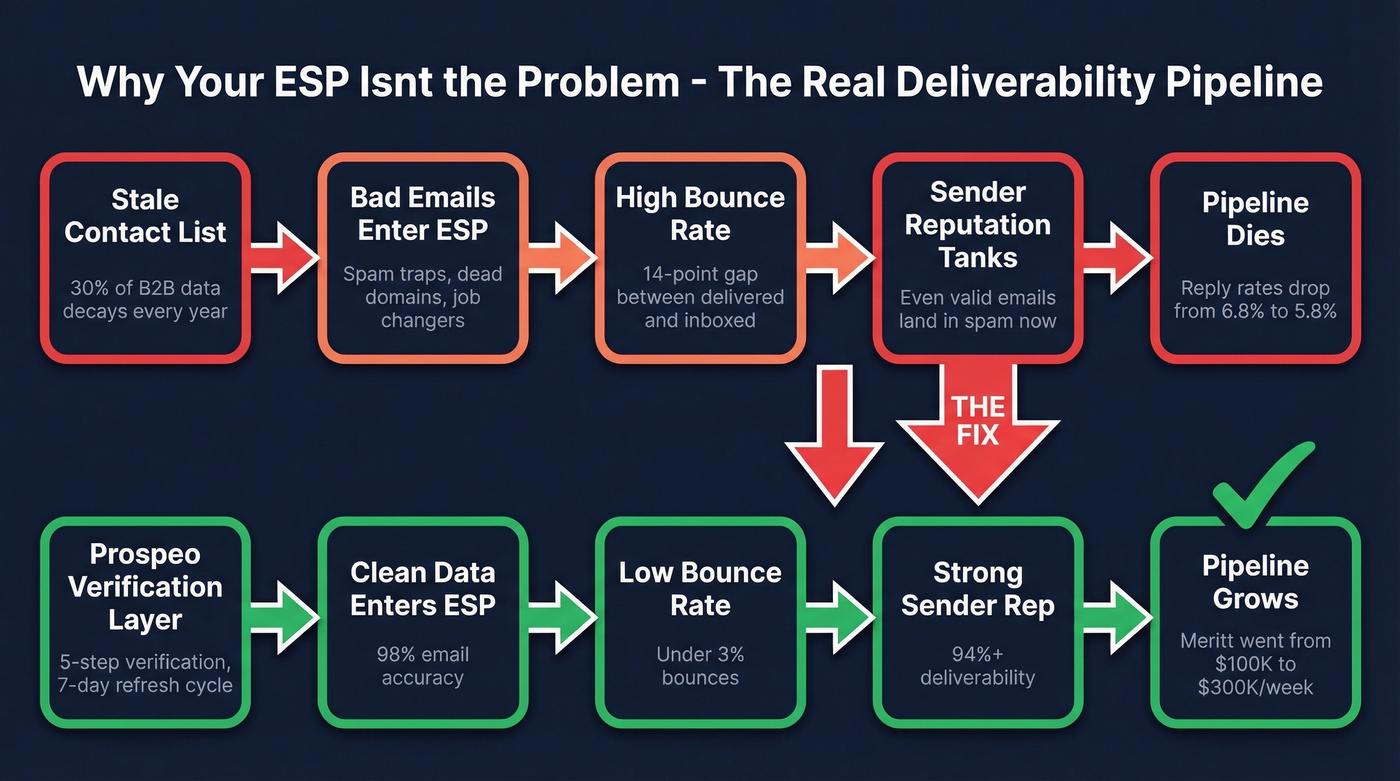
High bounce rates destroy that reputation, and once your domain tanks, even valid emails land in spam. The fix isn't switching ESPs. It's cleaning your data upstream. If you're already seeing issues, prioritize improve sender reputation before you scale volume.
A verification layer that refreshes records every 7 days isn't just list cleaning - it's ongoing hygiene. Meritt dropped their bounce rate from 35% to under 4% after switching to verified data, tripling their pipeline from $100K to $300K per week. That's not a marginal improvement. That's a completely different business.
Authentication matters too - make sure SPF, DKIM, and DMARC are properly configured. But authentication without clean data is like locking the front door while the back wall is missing. If you want the technical checklist, start with DMARC alignment.
Tools like GlockApps let you test inbox placement across Gmail, Outlook, and Yahoo, though seed tests tend to underestimate real-world results since they lack engagement history.
Stack Optimize built a $1M agency on Prospeo data - 94%+ deliverability, under 3% bounce rates, zero domain flags. Native integrations push verified contacts straight into HubSpot, ActiveCampaign, Instantly, and Lemlist.
Clean data in, pipeline out. Every tool on this list works better with Prospeo upstream.
B2B Email Benchmarks Worth Knowing
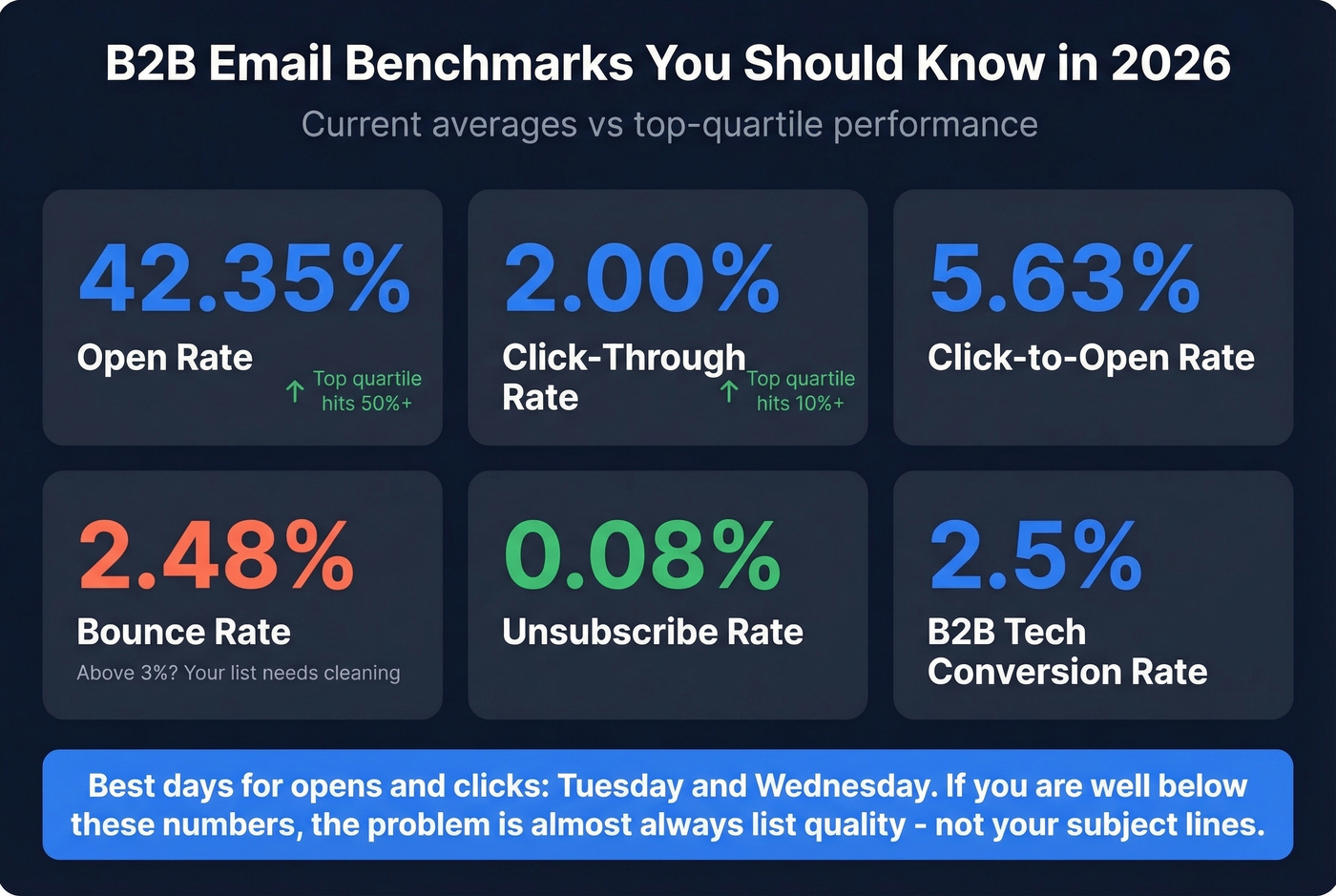
Before you evaluate any tool, know what "good" looks like. These are current B2B averages.
| Metric | B2B Average |
|---|---|
| Open rate | 42.35% |
| Click-through rate | 2.00% |
| Click-to-open rate | 5.63% |
| Bounce rate | 2.48% |
| Unsubscribe rate | 0.08% |
| B2B tech conversion | 2.5% |
Best days for opens and clicks: Tuesday and Wednesday. Top-quartile programs with strong segmentation and deliverability optimization can hit 50%+ opens and 10%+ CTR. If you're well below those numbers, the problem is almost always list quality or segmentation - not your subject lines. For quick wins, borrow proven email subject line examples once your list is clean.
Mistakes That Kill B2B Email ROI
Blasting your entire list without segmentation. The average office worker receives 120+ emails per day. Segment by role, buying stage, and engagement level at minimum. Unsegmented sends are the fastest way to train Gmail that you're noise. If you need a framework, use intent based segmentation.
Ignoring list hygiene. Verify before importing, clean quarterly. Every invalid address chips away at sender reputation. This is the single highest-leverage fix most teams skip, and it's frustrating how many guides don't even mention it. If you're cleaning up after the fact, follow a spam trap removal process.
Over-sending. More emails don't equal more pipeline. Most B2B teams see best results at 1-2 emails per week. Test cadence against unsubscribe rates, not just opens.
Leading with product, not problems. One team split a long newsletter into 3 shorter, problem-focused emails and saw a 27% lift in CTR. Your prospects don't care about your features. They care about their problems.
FAQ
What's the difference between B2B and B2C email marketing?
B2B targets decision-makers with longer sales cycles, smaller lists, and relationship-driven content. B2C targets consumers with promotional offers and high-volume sends. B2B platforms need stronger CRM integration, lead scoring, and account-based segmentation - features consumer-focused tools treat as afterthoughts.
How often should I email my B2B list?
Most B2B teams see best results with 1-2 emails per week. Frequency matters less than relevance - test cadence against unsubscribe rates. A high open rate with climbing unsubscribes means you're burning your list.
Why are my B2B emails going to spam?
Usually poor sender reputation from high bounce rates, missing authentication (SPF/DKIM/DMARC), or spam-trigger language. The fix starts upstream: verify your list before sending to catch invalid addresses, spam traps, and honeypots before they damage your domain.
Do I need email verification alongside my ESP?
Yes, if your bounce rate exceeds 2-3%. Most ESPs don't verify addresses at import - they send and let bounces accumulate. A dedicated verification layer prevents reputation damage before it starts, which is far cheaper than rebuilding a burned domain.
How do I choose the right B2B email marketing tool?
Start with list size and sending volume - these determine whether contact-based or volume-based pricing makes sense. Then evaluate automation depth, CRM integrations, and deliverability features. Most importantly, make sure you have a clean data layer feeding whichever platform you pick. Even the best email software underperforms when it's sending to stale or invalid addresses.