

B2B Email Segmentation: Fix Your Data Before You Build Segments
Your last campaign went to 10,000 contacts and got 47 replies. That's not a segmentation problem - it's a data quality problem. You've read five guides that all say the same thing: segment by industry, segment by role, segment by behavior. None of them mention that a meaningful chunk of your sends never reach the inbox before segmentation even matters.
Here's a number worth sitting with: 15.8% of emails go missing or get caught by spam filters. Segmenting bad data just creates smaller piles of bad data.
Well-segmented campaigns do see 10-30% higher CTR than batch-and-blast sends. But you only get that lift if the emails actually land.
What You Need (Quick Version)
- Verify your list first. Run it through a verification tool before you touch a single segment. If a quarter of your addresses are invalid, no amount of personalization saves you.
- Use 3-5 segments max. Firmographic + role + behavioral, plus one advanced dimension like intent signals or trigger events. More than that and you're slicing groups too thin to test anything.
- Stop optimizing for open rates. Apple Mail Privacy Protection inflated open rates by roughly 18 points across 80,000+ accounts. Track click-to-open rate (CTOR) instead.
2026 Benchmarks Worth Tracking
Open rates look great on paper. They're also lying to you.
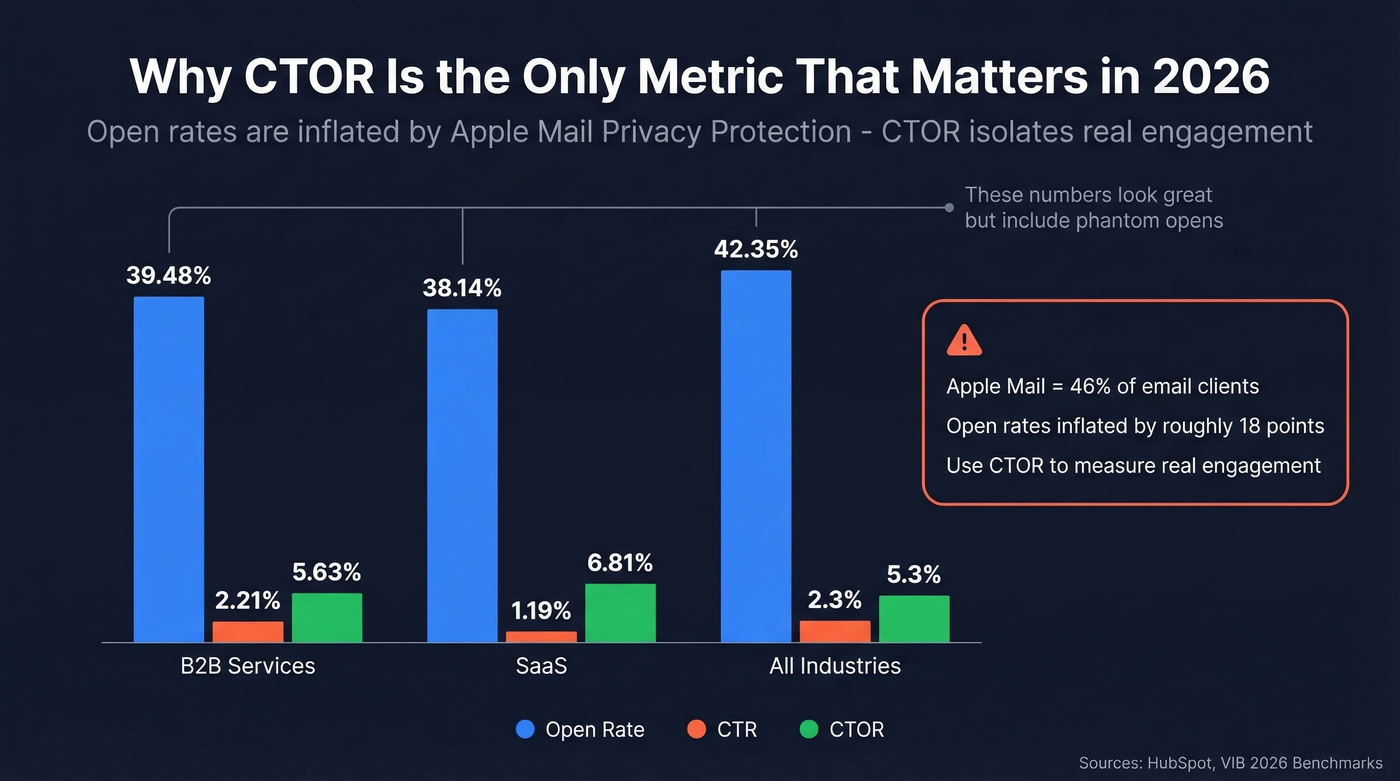
Apple Mail represents about 46% of email clients, and its Mail Privacy Protection feature pre-fetches emails - inflating opens whether anyone reads them or not. HubSpot's latest benchmark data for B2B tells the story:
| Vertical | Open Rate | CTR | CTOR | Bounce |
|---|---|---|---|---|
| B2B Services | 39.48% | 2.21% | 5.63% | 0.5% |
| SaaS | 38.14% | 1.19% | 6.81% | 0.5% |
| All Industries | 42.35% | 2.3% | 5.3% | 2.48% |
For contrast, VIB's benchmarks report a 20.8% open rate and 3.2% CTR. The gap between these two datasets is exactly why CTOR matters - it isolates engagement among people who actually opened, stripping out the noise.
7 Segments That Move Revenue
If you can't articulate a different message for a segment, the segment doesn't exist. Every split below earns its place because it changes what you say, not just who you say it to.
1. Firmographic - Industry, company size, revenue band. A 50-person startup and a 5,000-person enterprise need completely different messaging, even if they share the same pain point. (If you need a tighter definition, see firmographic filters.)
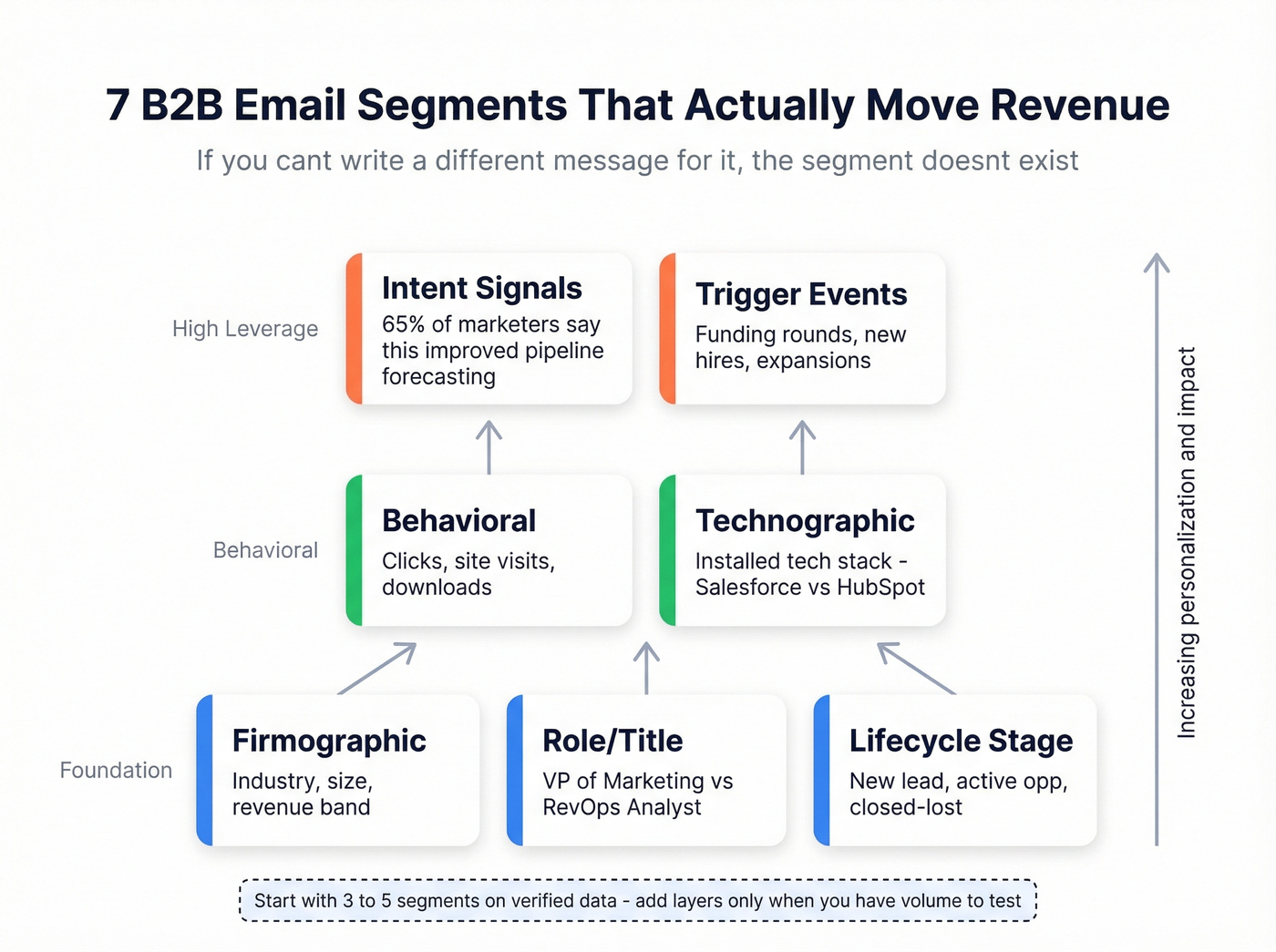
2. Role/Title - Your email to a VP of Marketing shouldn't read like the one you sent to a RevOps analyst. The difference is tone, proof points, and the problem you lead with.
3. Behavioral - Email clicks, site visits, content downloads, webinar attendance. Someone who downloaded your pricing PDF is in a different conversation than someone who read a blog post six months ago.
4. Lifecycle stage - New lead, active opportunity, closed-lost from last quarter. Sending nurture content to someone your AE is actively working is how you get an angry Slack message from sales.
5. Intent signals - First-party signals like site visits and email engagement, combined with third-party research activity across publisher networks, tell you who's actively in-market. 65% of marketers say intent data improved their pipeline forecasting accuracy. (More on intent segmentation.)
6. Technographic - Prospects grouped by installed tech stack. If you're selling a Salesforce integration, segment out the HubSpot shops - the message is fundamentally different. (Related: Firmographic and Technographic Data.)
7. Trigger events - Funding rounds, new executive hires, office expansions. A company that just raised a Series B has budget and urgency that didn't exist three months ago. (If you want a system for this, see how to track sales triggers.)

Intent signals, technographics, job changes, funding rounds - Prospeo's 30+ search filters let you pre-segment contacts before they ever touch your ESP. Every email is 98% verified on a 7-day refresh cycle, so your segments don't decay between sends.
Segment on verified data at $0.01 per email. Start free today.
Account-Based Segmentation
ABM flips the model from "segment leads" to "segment accounts." 87% of companies running ABM say it outperforms other campaigns in ROI, and ITSMA data shows ABM campaigns generate 208% more revenue than other marketing approaches. (If you're building the motion, start with account-based selling best practices.)
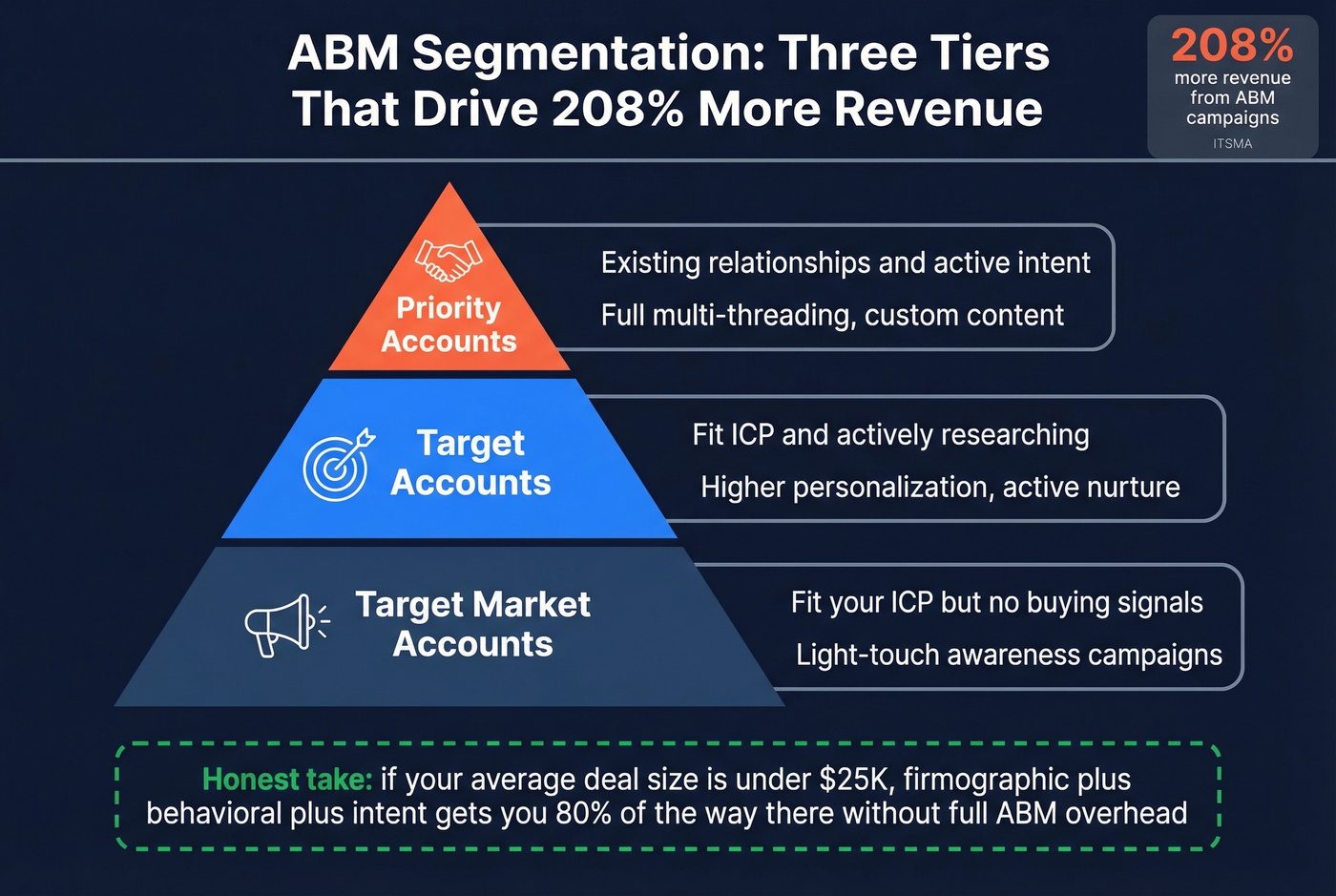
We've found three tiers work best:
- Target market accounts fit your ICP but aren't showing buying signals - light-touch awareness.
- Target accounts fit your ICP and are actively researching - higher personalization, active nurture.
- Priority accounts have existing relationships and active intent - full multi-threading, custom content, sales-marketing coordination.
Let's be honest: if your average deal size is under $25K, you probably don't need ABM-level segmentation. Firmographic + behavioral + intent gets you 80% of the way there at a fraction of the effort. Save the full ABM playbook for deals where the personalization investment actually pays back.
Mistakes That Kill Segmentation
| Don't | Do Instead |
|---|---|
| Create segments under 200 contacts | Keep segments large enough to A/B test subject lines and measure CTOR reliably |
| Send to your full list without exclusions | Exclude: soft-bounced in last 30 days, 3+ soft bounces ever, purchased within 7 days, open support tickets |
| Collect zero-party data and ignore it | If you asked about their biggest challenge on a form, use that answer in your segmentation |
| Build segments on unverified lists | Verify first, segment second - one practitioner on r/coldemail saw deliverability jump from 60% to 92% after adding verification |
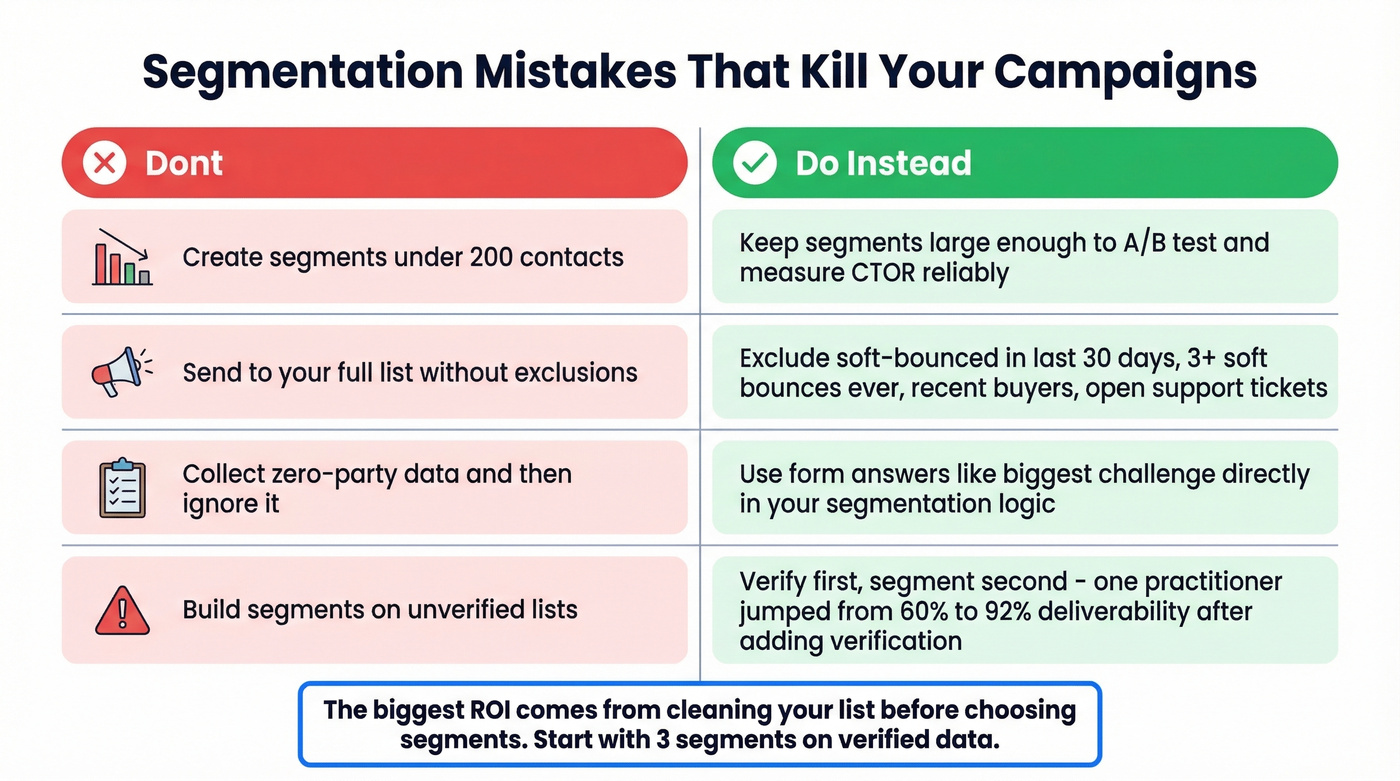
In our experience, the biggest ROI comes from cleaning your list before choosing segments. We've watched teams spend weeks building 15+ micro-segments only to realize none had enough volume to test anything meaningful. Start with three segments on verified data. You'll learn more in one send than you will from a month of theorizing. (If you're troubleshooting bounces, use this email bounce rate guide.)
Tools for B2B Email Segmentation
You need two layers: a data/verification tool to build clean lists, and an ESP to segment and send. Don't expect one tool to do both well.
| Tool | From | Best For |
|---|---|---|
| Prospeo | Free (75 verified emails/mo) | List building + verification |
| ActiveCampaign | $19/mo | Deep automations |
| Brevo | $9/mo | Best value, free tier |
| HubSpot | $20/mo | CRM ecosystem fit |
| Instantly.ai | $30-100/mo | Cold email + warmup |
Prospeo solves the upstream problem - building verified, segmentable lists at roughly $0.01/email with 98% accuracy. Its 30+ search filters (buyer intent, technographics, job changes, headcount growth, funding) let you pre-segment contacts before they ever hit your ESP, and data refreshes every 7 days versus the 6-week industry average, so your segments don't decay between sends. (Related: data enrichment services.)
ActiveCampaign has best-in-class automations, but users consistently note pricing ramps fast as your contact list grows. For teams under 1,000 contacts it's great; at 50,000 contacts, the bill stings.
Brevo is the budget pick with a generous free tier of 300 emails/day. If you're just starting out and need basic segmentation without a big commitment, it's hard to beat.
HubSpot makes sense if you're already in their CRM. Otherwise, you're paying for an ecosystem you won't use. Instantly.ai is purpose-built for cold outbound with built-in warmup - not marketing automation, so skip this if you're running inbound nurture sequences. (If you're doing outbound, build around a B2B cold email sequence.)
That practitioner who jumped from 60% to 92% deliverability? Verification is step one. Prospeo verifies 143M+ emails through a 5-step process with catch-all handling, spam-trap removal, and honeypot filtering - so every segment you build starts clean.
Verify your list first, then segment. 75 free emails to prove it.
FAQ
How many segments should a B2B email list have?
Three to five is the sweet spot for most teams. Fewer means you're batch-and-blasting; more means tiny groups with no statistical power. Add a new segment only when you can write a genuinely different message for it.
What's the most important B2B email metric in 2026?
Click-to-open rate (CTOR). Apple Mail Privacy Protection inflated open rates by roughly 18 points across 80,000+ accounts, making raw opens unreliable. CTOR isolates engagement among actual readers, giving you a signal you can act on.
How do I segment if my email data is bad?
Verify first, segment second - always. Run your list through a verification tool to remove invalid addresses, spam traps, and honeypots. Then segment the clean list by firmographic and behavioral criteria. Trying to segment dirty data is like organizing a filing cabinet full of blank folders.
Do I need intent data for email segmentation?
It isn't required, but it's the highest-leverage layer you can add. 65% of marketers report improved pipeline forecasting after layering in intent signals. If you're already nailing firmographic and behavioral segmentation, intent data is the natural next step - it tells you not just who fits your ICP, but who's actively researching your category right now.