

B2B Lead Generation Consulting: 2026 Buyer's Guide
84% of sales reps missed quota last year. The average B2B buying cycle now stretches 10.1 months, and 80% of B2B sales interactions happen through digital channels. The old playbook - hire reps, hand them a phone list, hope for the best - is dead. That's exactly why B2B lead generation consulting has become a booming category.
Here's the thing: most companies don't know what they're actually buying. Consultants, agencies, and outsourced SDR teams are wildly different services at wildly different price points, and picking the wrong one wastes months and tens of thousands of dollars. This guide breaks down what each model costs, what you get, and whether you need any of it.
Do You Actually Need a Consultant?
Before you read another 2,000 words, here's the decision tree:
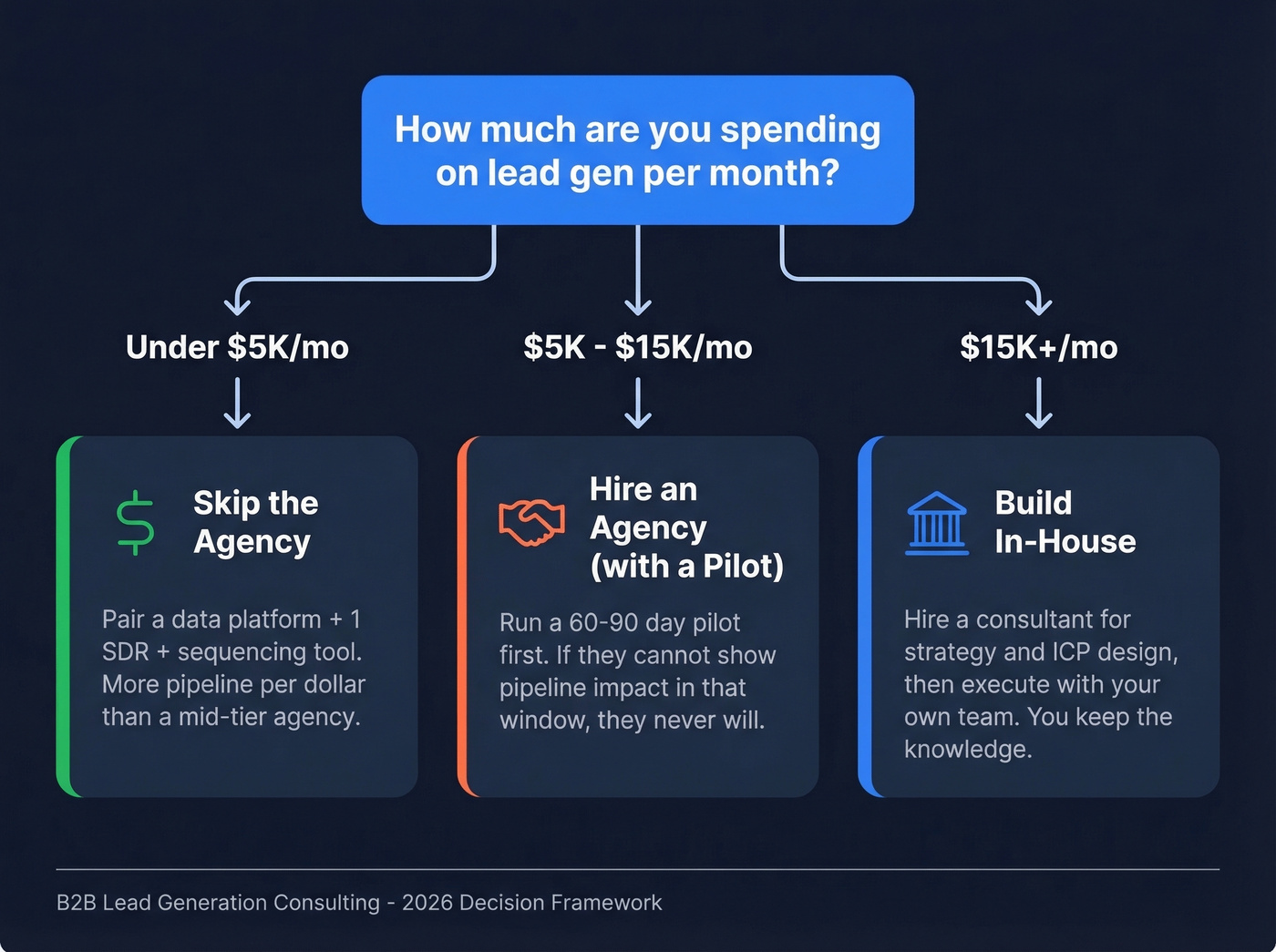
- Spending under $5K/month on lead gen? Skip the agency. Pair a solid data platform with one disciplined SDR and a sequencing tool. You'll get more pipeline per dollar than a mid-tier agency can deliver.
- Spending $5K-$15K/month? An agency makes sense - but run a 60-90 day pilot before signing anything longer. If they can't show pipeline impact in that window, they won't at month six either.
- Spending $15K+/month? Build in-house. Hire a lead generation consultant for strategy and ICP design, then execute with your own team. You retain the knowledge and the process.
Now let's get into the details.
What B2B Lead Generation Consulting Actually Covers
The term gets thrown around loosely. It covers at least four distinct models, and understanding the differences saves you from buying the wrong thing.
An independent consultant gives you strategy - ICP definition, process design, tech stack recommendations - and then you execute. They're the architect, not the builder. A full-service agency handles both strategy and execution: they send the emails, make the calls, run the social outreach. An outsourced SDR team is narrower - dedicated reps sending on your behalf, usually following a playbook you've agreed on. Then there's the mentorship model, where platforms like GrowthMentor give you unlimited access to vetted experts for $99/month.
| Model | What You Get | Typical Cost |
|---|---|---|
| Independent Consultant | Strategy, ICP, process design | $95-$315/hr |
| Full-Service Agency | Strategy + execution | $2K-$15K+/mo |
| Outsourced SDR Team | Dedicated reps sending for you | $5K-$15K+/mo |
| Mentorship Platform | On-demand expert calls | ~$99/mo |
The hourly consulting range ($95-$315/hr, or £75-£250/hr in the UK) reflects a wide spectrum. At the low end, you're getting a freelancer with a few years of outbound experience. At the top, you're getting someone who's built pipeline engines at multiple companies and can redesign your entire go-to-market motion in a few sessions.
What a Good Consultant Delivers
A good lead gen consultant doesn't hand you a list of accounts and wish you luck. They redesign how you think about your market.
If you need a starting point, use an Ideal Customer Profile Template before you pay anyone.
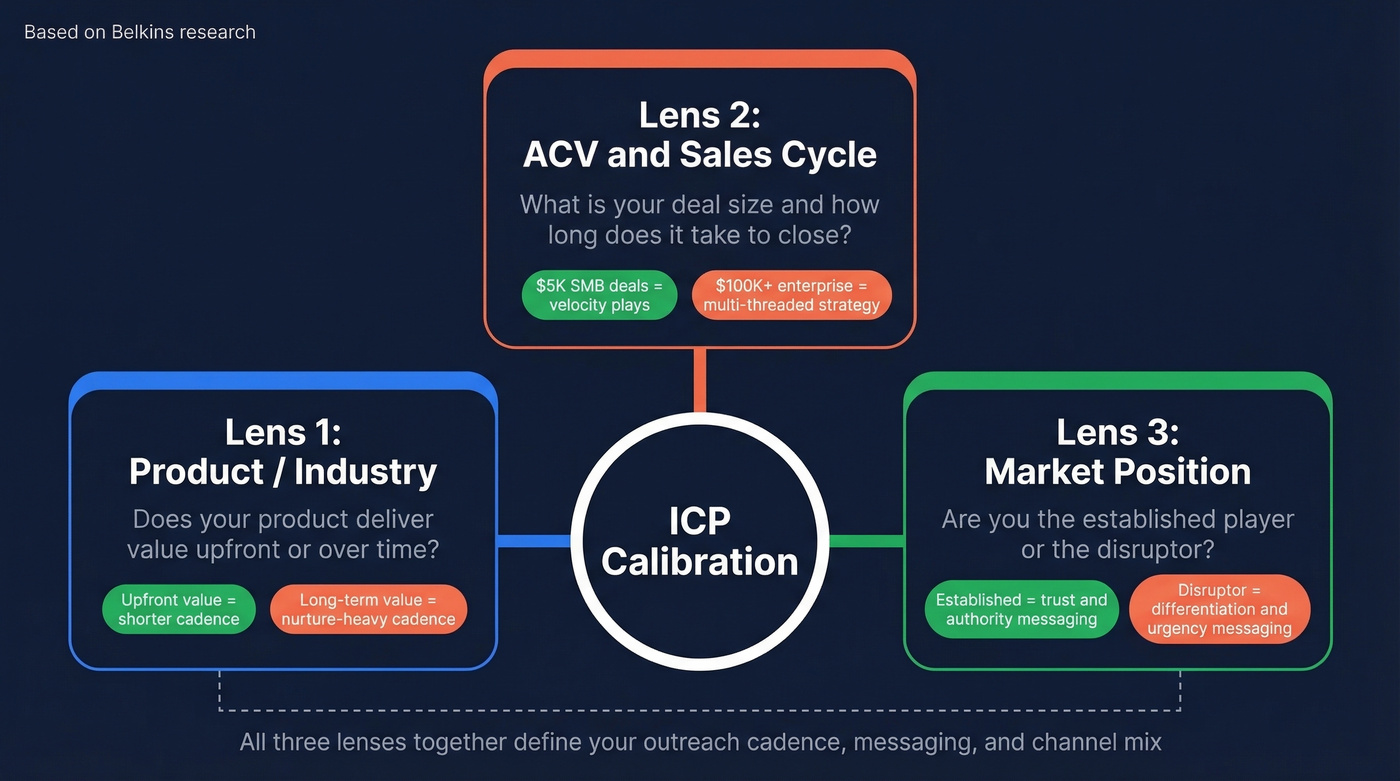
The best framework we've seen comes from Belkins' research, which breaks ICP calibration into three lenses. First, the product/industry lens - does your product deliver value upfront or over time? That changes your entire outreach cadence. Second, the ACV and sales cycle lens - selling $5K deals to SMBs requires velocity plays; selling six-figure enterprise contracts requires multi-threaded account strategies. Third, the market position lens - are you the established player or the disruptor? Your messaging and channel mix depend on the answer.
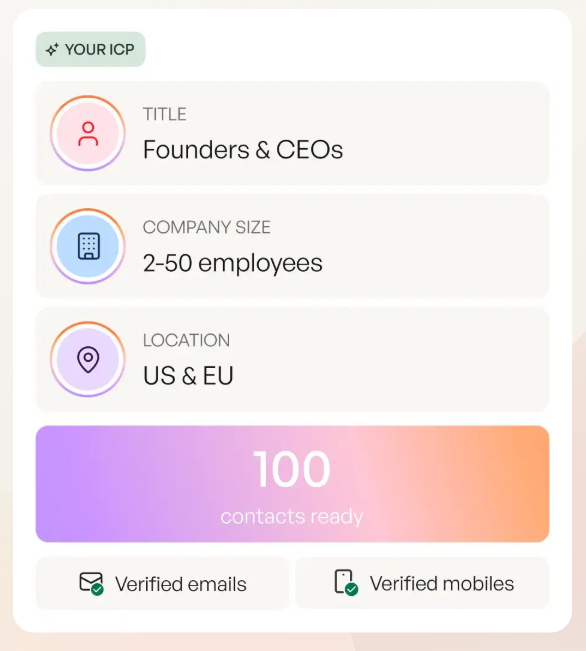
Beyond ICP, a consultant maps your buying committee - typically around five stakeholders - and identifies who influences, who blocks, and who signs. Buyers spend just 17% of their buying time meeting with potential suppliers, so every touchpoint has to count. The consultant builds messaging for each persona so none of those precious minutes are wasted.
It takes 70+ touchpoints across six channels to earn a modern buyer's trust. A consultant's job is to design the system that delivers those touchpoints consistently, not just fire off a batch of cold emails. The deliverables should include an ICP document, a channel strategy, a tech stack audit covering CRM, data, and sequencing tools, and a measurement framework. If your consultant isn't delivering all four, you're paying for opinions, not a system.
How Much Does It Cost in 2026?
Pricing varies dramatically by engagement model, geography, and target segment.
| Model | USD Range | GBP Range | Best For |
|---|---|---|---|
| Hourly consulting | $95-$315/hr | £75-£250/hr | Strategy audits, ICP workshops |
| Monthly retainer | $2K-$15K/mo | £3K-£10K/mo | Ongoing outbound programs |
| Enterprise retainer | $15K-$40K+/mo | £10K-£30K+/mo | Multi-channel, multi-market |
| Pay-per-lead | $50-$500/lead | £50-£500/lead | Performance-oriented |
| Pay-per-meeting (SMB) | $150-$500 | £150-£400 | SMB appointment setting |
| Pay-per-meeting (mid) | $300-$900 | £250-£700 | Mid-market |
| Pay-per-meeting (ent.) | $800-$2,500+ | £600-£2,000+ | Enterprise |
| Hybrid (base + per-mtg) | $2K-$5K + $100-$300 | £2K-£5K + £100-£300 | Shared-risk models |
The pay-per-meeting model looks attractive on paper, but it incentivizes quantity over quality. We've seen agencies book "meetings" that are really 15-minute discovery calls with unqualified contacts who had no idea why they were on the phone. If you go this route, define what counts as a meeting before you sign.
Multi-channel campaigns convert 40-60% higher than single-channel approaches, which is why the best agencies charge more for them. But that lift only materializes if the data underneath is clean.
Cost per Meeting by Industry (GBP)
| Industry | Cost per Meeting |
|---|---|
| SaaS | £200-£400 |
| Manufacturing | £200-£450 |
| Professional Services | £250-£500 |
| Fintech | £300-£600 |
| Cybersecurity | £350-£700 |
Cybersecurity and fintech run higher because the buyer personas are harder to reach and compliance requirements add friction to every touchpoint.

Most lead gen consultants charge $95-$315/hr just to tell you who to target. Prospeo gives you 300M+ profiles with 30+ filters - buyer intent, technographics, job changes, funding, headcount growth - so you can build your own ICP lists in minutes. At $0.01 per verified email with 98% accuracy, you'll spend less on data in a year than one month of agency retainer.
Stop paying consultants to build lists you can build in 10 minutes.
Consultant vs. Agency vs. In-House
Each model has real tradeoffs. The right choice depends on your stage, budget, and internal capabilities.
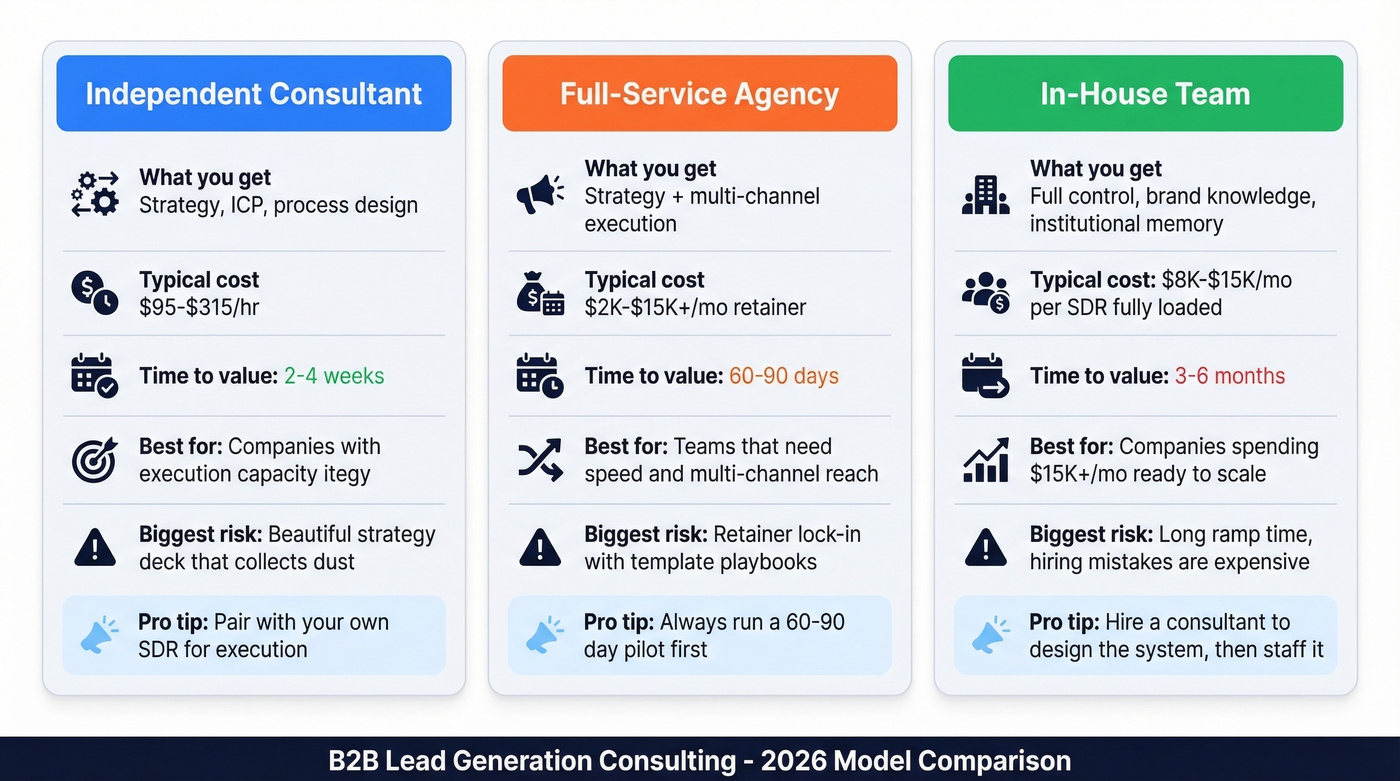
In-house gives you brand control and institutional knowledge. Your reps understand your product better than any outsourced team ever will. The downside: it takes 3-6 months to hire, ramp, and optimize. For a 15-person startup, that timeline can kill you. If you're building the function, a 30-60-90 day pilot plan keeps execution honest.
Agency gets you multi-channel execution fast. A good agency has playbooks, tools, and trained reps ready to go. The downside: retainer lock-in - retainers often come with 3-6 month minimums - and you're sharing their attention with a dozen other clients. The practitioner consensus on r/sales and r/b2bmarketing is clear: agencies work when they specialize in your vertical, and they fail when they treat you like a template.
Consultant gives you strategy clarity. They'll tell you what to build and how to build it. But you still have to execute. If you don't have the team to run the plays, a beautiful strategy deck just collects dust.
Run a 60-90 day pilot with any model before committing long-term. If an agency or consultant pushes back on a pilot, that's a red flag.
Why Lead Gen Programs Fail
Before you spend a dollar on consulting, understand the five ways these programs break down.
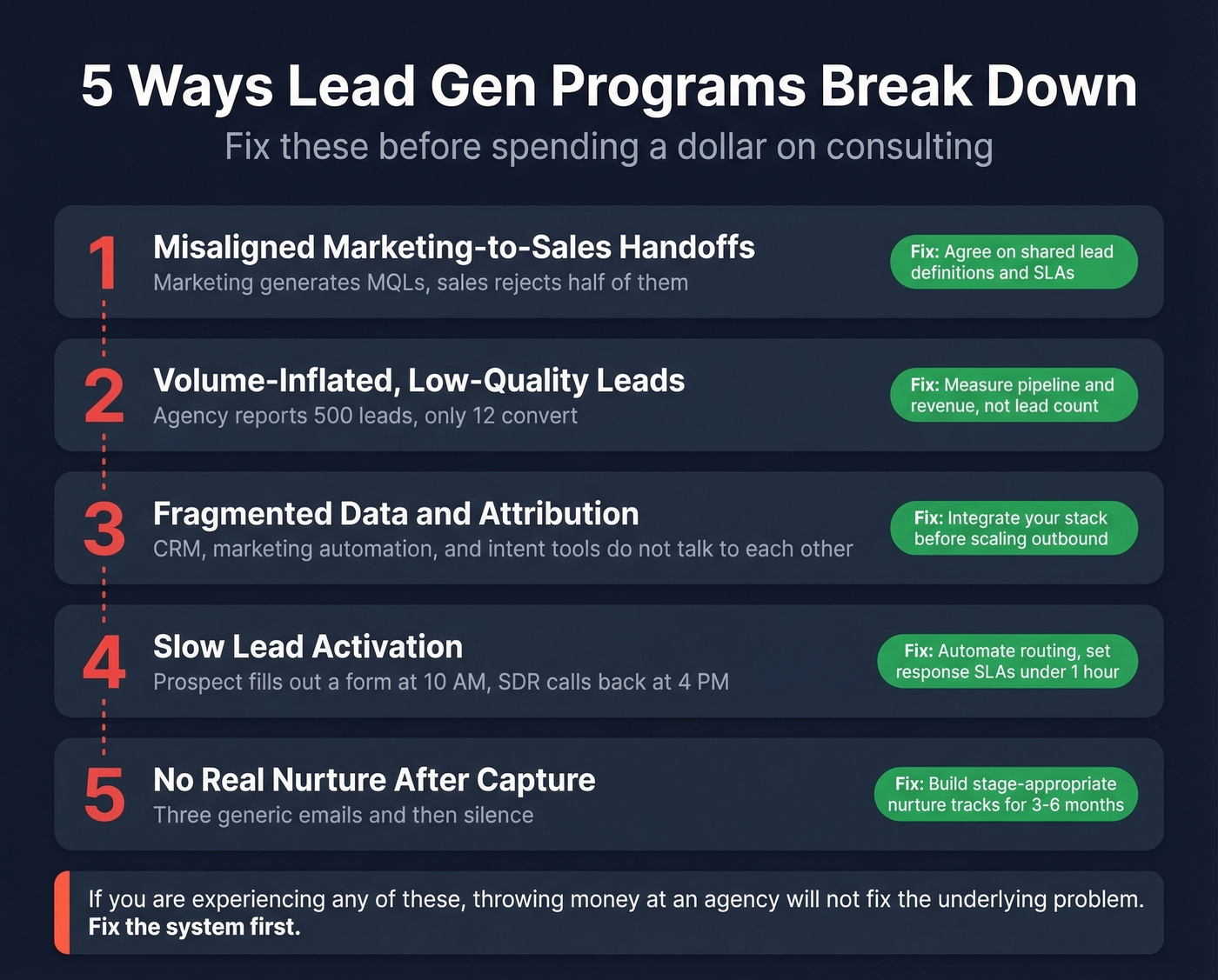
Misaligned Marketing-to-Sales Handoffs
Marketing generates MQLs. Sales rejects half of them. Nobody agreed on what "qualified" means. Agree on shared lead definitions and SLA documents before any campaign launches. If you need a baseline, align on lead scoring and a shared lead status model.
Volume-Inflated, Low-Quality Leads
The agency reports 500 leads this month. Twelve convert. The top of funnel looks great; everything downstream collapses. Measure pipeline and revenue, not lead volume.
Fragmented Data and Attribution
Your CRM, marketing automation platform, and intent data tool don't talk to each other. You can't tell which channel produced which deal. Integrate your stack before scaling outbound. A clean lead generation workflow makes attribution problems obvious fast.
Slow Lead Activation
A prospect fills out a form at 10 AM. Your SDR calls back at 4 PM. By then, a competitor already had the conversation. Automate routing and set response-time SLAs under an hour.
No Real Nurture After Capture
The prospect wasn't ready to buy today. Instead of a thoughtful nurture sequence, they get three generic emails and silence. Build stage-appropriate nurture tracks that add value over 3-6 months.
If you're experiencing any of these symptoms, throwing money at an agency won't fix the underlying problem. Fix the system first.
The Data Quality Problem
Your SDR team sends 500 emails a week and gets three replies. Before hiring an agency, check your bounce rate.
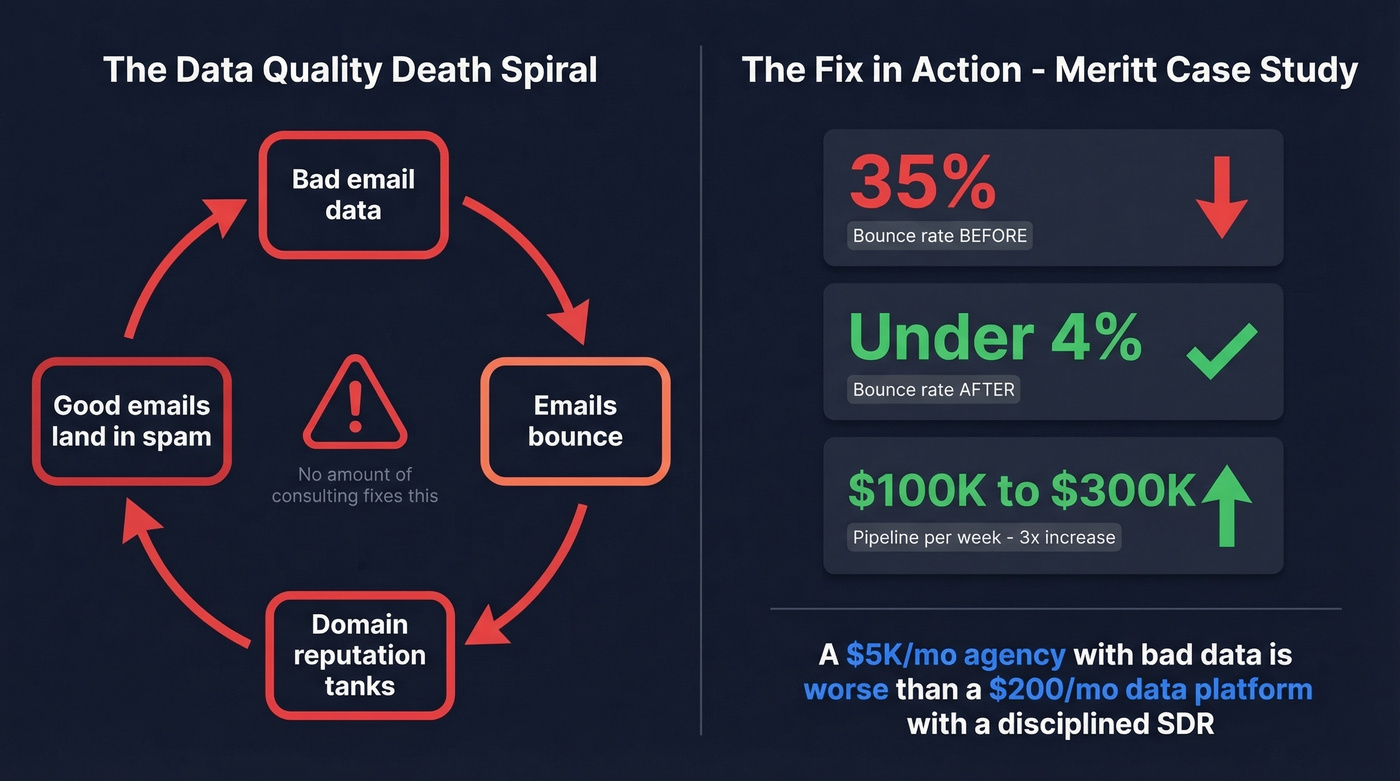
The #1 reason outbound programs underperform isn't strategy or messaging - it's data. Bad emails bounce. Bounced emails tank your domain reputation. A tanked domain means even your good emails land in spam. It's a death spiral, and no amount of consulting fixes it. If you're diagnosing this, start with Email Bounce Rate benchmarks and an Email Deliverability Guide checklist.
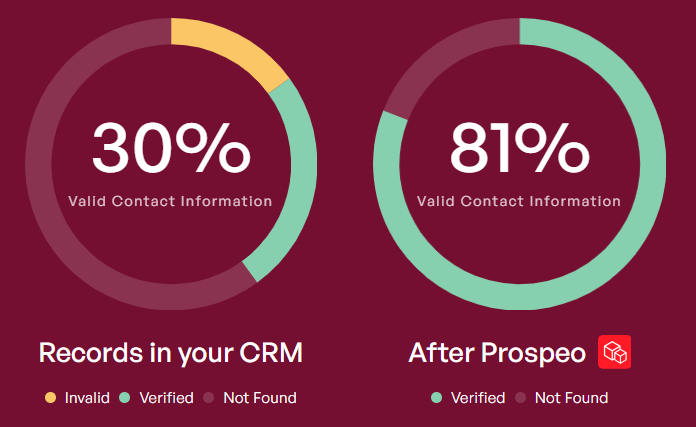
We ran into this ourselves when evaluating data providers. Prospeo's email finder runs a 5-step verification process with proprietary infrastructure - no reliance on third-party email providers, which is where most data quality issues originate. Email accuracy sits at 98%, and the database refreshes every 7 days versus the 6-week industry average. That freshness matters because people change jobs constantly, and stale data means bounced emails.
The proof is in the results. Meritt, a sales consultancy, was running a 35% bounce rate before switching their data provider. After the switch, bounces dropped under 4%, and their pipeline tripled from $100K to $300K per week. That's not a marginal improvement - that's the difference between a struggling outbound program and a thriving one.
A $5,000/month agency retainer with bad data is worse than a $200/month data platform with a disciplined SDR. Fix the data layer first, then decide if you need help with strategy and execution.
The article is clear: agencies only work when the data underneath is clean. Prospeo's 5-step verification, 7-day refresh cycle, and proprietary email infrastructure deliver 98% email accuracy and under 3% bounce rates - the same data quality that helped Stack Optimize build a $1M agency with zero domain flags. Whether you hire a consultant or go in-house, start with data that actually connects.
Clean data is the foundation. Everything else is overhead.
How to Measure Results
Most agencies report "meetings booked" as their primary metric. That's a vanity metric. The winning vendor is on the buyer's Day One shortlist 95% of the time. If your lead gen program isn't building early awareness, you're fighting for the 5%.
A well-run outbound program targeting mid-market accounts should produce 100-300 qualified meetings per year, depending on ICP breadth and channel mix. Here's how to track whether you're on pace:
| Metric | Target |
|---|---|
| MQA rate (target accounts) | 10-20% |
| Meetings per 100 surging accounts | 5-10 |
| Data enrichment rate (key fields) | 80%+ |
| MQL-to-SQL conversion | 25-35% |
| Average close rate | ~29% |
| Win rate | ~21% |
The enrichment rate is one most teams overlook. If you can't fill in industry, revenue, and company size for 80%+ of your target accounts, your segmentation and personalization will suffer. The MQL-to-SQL conversion rate tells you whether marketing and sales agree on what "qualified" means - if it's below 25%, you've got an alignment problem, not a volume problem. To tighten reporting, track lead generation metrics and basic funnel metrics consistently.
Questions to Ask Before Hiring
If you do bring on a consultant or agency, use this vetting checklist drawn from MarketJoy's hiring framework and our own experience evaluating providers.
- How do you define a qualified lead? If they can't articulate the MQL/SQL difference in your context, walk away.
- Who owns ICP refinement? The best providers iterate monthly based on conversion data.
- What are your data sources, and how often do you refresh them? Ask for their bounce rate - anything above 5% is a red flag.
- What channels do you use, and how do you sequence them? Single-channel agencies leave 40-60% of potential conversions on the table.
- How do you handle compliance? GDPR, CCPA, and CAN-SPAM requirements should be baked into their process, not an afterthought.
- What metrics do you report? "Leads generated" isn't enough. You need pipeline contribution, conversion rates, and cost per qualified meeting.
- What's the contract minimum? Anything longer than 3 months without a performance clause is a bad deal.
- Can we run a 60-90 day pilot first? If they refuse, they aren't confident in their own results.
Red flags: unrealistic volume guarantees like "50 meetings in month one," dodging questions about data sources, and obsessive focus on quantity over quality. The best providers talk about pipeline and revenue. The worst talk about "leads delivered."
FAQ
How long before a lead gen program produces results?
Plan for 60-90 days minimum. Most programs need a 30-60 day optimization window before performance stabilizes. Anyone promising qualified meetings in week one is overselling - the ramp period is non-negotiable.
What's the difference between pay-per-lead and pay-per-meeting?
Pay-per-lead charges for contact details matching your ICP ($50-$500 each) - you still convert them yourself. Pay-per-meeting charges when a qualified prospect agrees to a call ($150-$2,500). Meetings cost more per unit but carry less conversion risk.
Can I run outbound without an agency?
Yes. A data platform like Prospeo with 75 free verified emails per month, a sequencing tool, and one disciplined SDR can outperform a mid-tier agency - especially when your total budget is under $5K/month. Build the muscle internally first.
What bounce rate should I expect from a good provider?
Under 5% is the benchmark. If your agency's emails bounce above 10%, their data quality is the root problem, not your messaging. Ask for bounce rate reporting before signing any contract.
Is B2B lead generation consulting worth it for small teams?
A 2-3 hour strategy session ($200-$900) often delivers more ROI than a $5K/month retainer for teams under ten people. Get ICP clarity and a documented process first, then decide if you need ongoing execution help.