

B2B Lead Generation Trends That Actually Matter in 2026
92% of B2B buyers start their evaluation with at least one vendor already in mind. Another 67% prefer a completely rep-free experience, according to a 646-buyer survey from late 2025. The winning vendor sits on the buyer's "Day One shortlist" 95% of the time.
Here's what that means for your outbound motion: if you're not on that list before the evaluation starts, you're fighting gravity. These are the B2B lead generation trends that determine whether you make the shortlist - and whether your pipeline math works once you do.
AI SDRs: The Hybrid Model Wins
Use AI SDRs for high-volume inbound qualification. The cost math is real: $39 per qualified lead vs. $262 for a human SDR, with sub-minute response times vs. 42 hours. 81% of sales teams are already experimenting. If you're evaluating tooling, start with a ranked list of SDR tools that fit your motion.
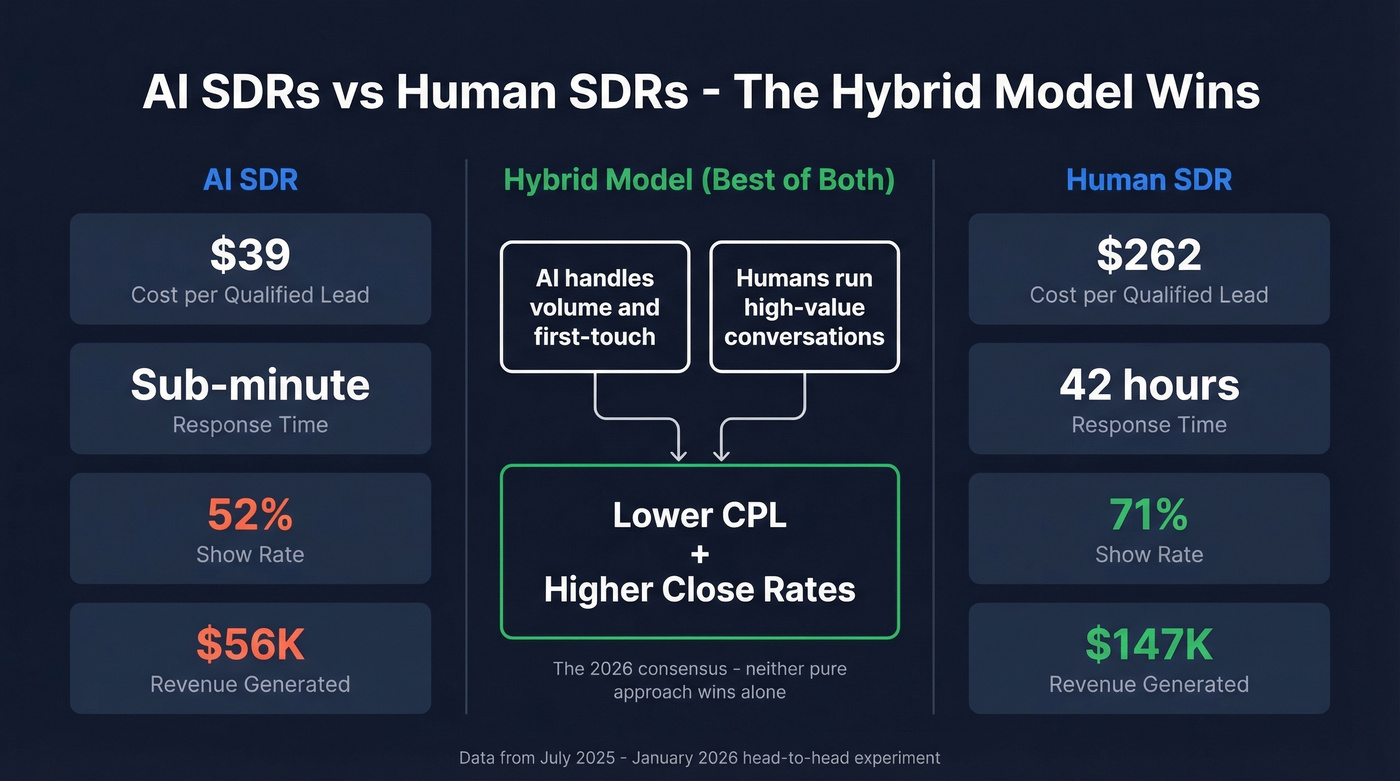
But skip pure AI SDRs if you care about revenue per lead. In a head-to-head experiment running from July 2025 through January 2026, human SDRs generated $147K in revenue vs. $56K for AI. Show rates: 71% for humans, 52% for AI. The consensus on r/b2bmarketing is blunt - "around 90% of AI emails will still be garbage."
Let AI handle volume and first-touch. Let humans close the gap on show rates and deal quality. Compared to the full-automation plays teams relied on in 2024, the hybrid model is the clear evolution - and the teams we've spoken with who run it well are seeing both lower CPL and higher close rates than either pure approach.
Signal-Based Outreach Replaces Spray-and-Pray
Generic cold email is dying a slow, measurable death. Signal-personalized outreach - messages triggered by intent data, job changes, funding events, or tech stack shifts - pulls 15-25% reply rates vs. 3-5% for batch-and-blast.
Only about 25% of B2B businesses use intent data today, but 70% plan to increase spending on it. That gap is your window. This is ABM done right: targeting accounts showing real buying signals across the entire buying committee, not just matching firmographic criteria and hoping for the best. If you need a practical framework, use a lead scoring model to rank signals by conversion impact.
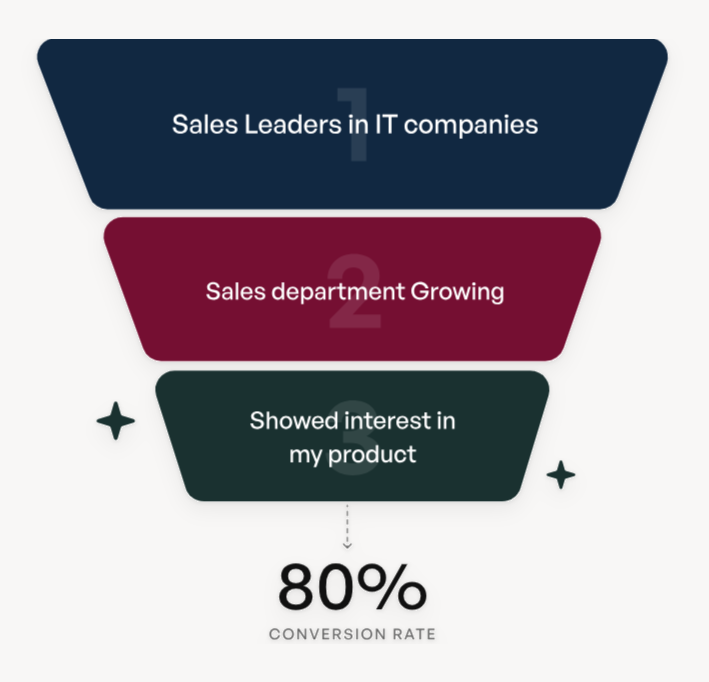
The practical challenge is layering these signals without drowning in noise. You need a data source that combines intent topics with firmographic and technographic filters in a single workflow - otherwise you're stitching together three tools and losing half your signals in the handoff. (More on firmographic and technographic data if you're building this stack.)
Zero-Click Search Is Gutting Inbound
Your inbound funnel assumes people click through to your site. They increasingly don't.
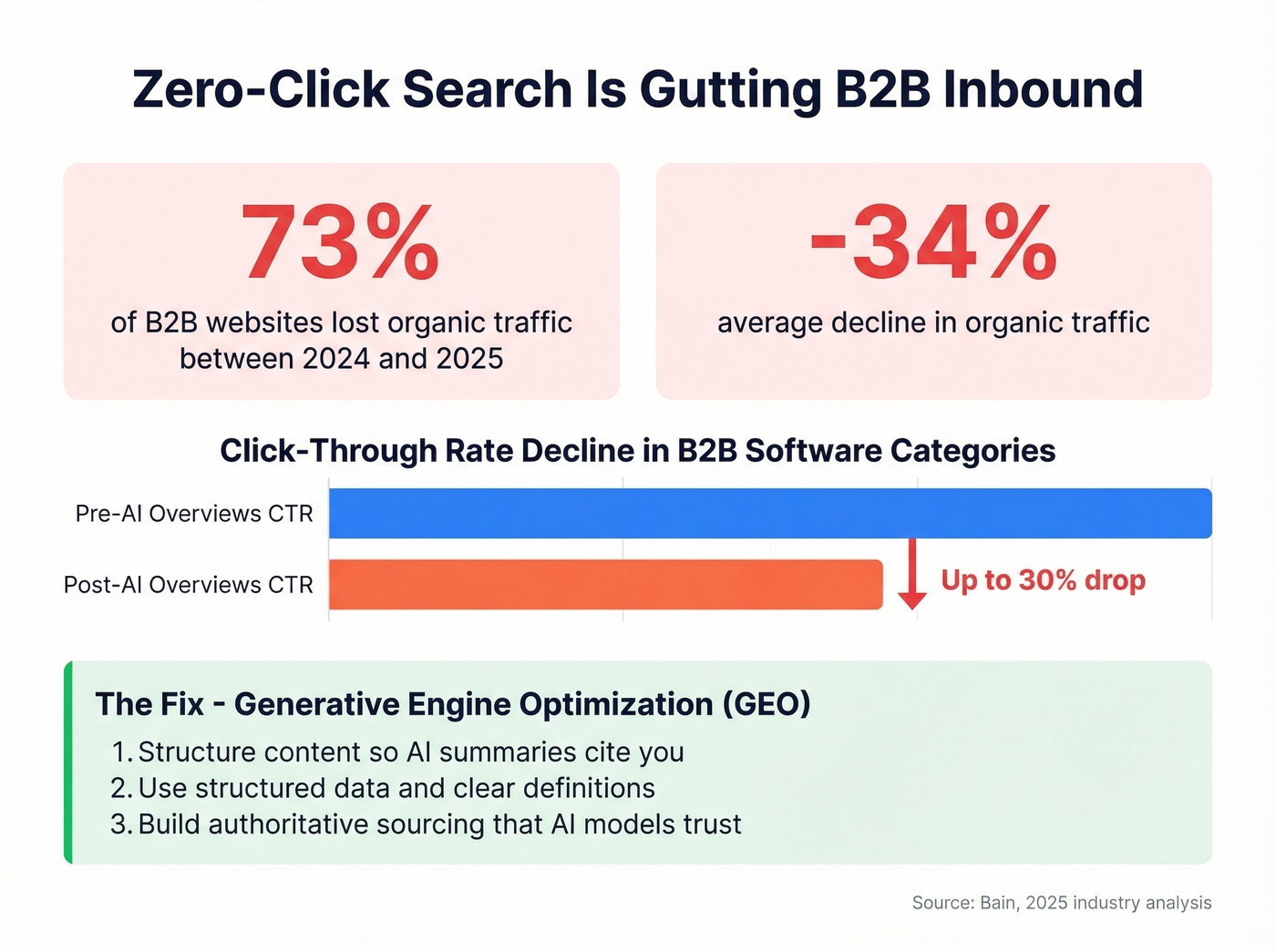
Bain reports CTR declines of up to 30% in B2B software categories since Google introduced AI-generated summaries. One industry analysis found that 73% of B2B websites lost organic traffic between 2024 and 2025, with an average decline of 34%. That's not a blip. That's structural.
The response isn't to abandon content. It's to optimize for Generative Engine Optimization - structuring content so AI summaries cite you, not just index you. Think structured data, clear definitions, and authoritative sourcing. If your brand doesn't show up in the AI answer, you're invisible before the buyer starts evaluating. HubSpot's research on AI search confirms that brands appearing in AI overviews capture disproportionate mindshare even when clicks decline.

Signal-based outreach only works when your signals connect to verified contacts. Prospeo layers 15,000 Bombora intent topics with 30+ filters - technographics, job changes, funding, headcount growth - in one search. No stitching tools. 98% email accuracy. $0.01 per lead.
Stop layering signals on top of bad data. Fix the foundation.
Data Quality Is the New Moat
Bad data is the silent killer of every trend on this list. Signal-based outreach doesn't work when your list is full of dead addresses. AI SDRs look terrible when they're emailing invalid contacts. Your domain reputation erodes with every bounce. If you're diagnosing issues, start with email bounce rate benchmarks and root causes.
We've seen this pattern repeatedly: a team invests in a sequencer, buys a database, launches campaigns, and watches deliverability crater within weeks. Meritt experienced exactly this - bounce rates at 35% before switching to Prospeo, which dropped them under 4%. Their pipeline tripled from $100K to $300K per week. That's not a marginal improvement; it's the difference between a pipeline that compounds and one that stalls.

Let's be honest: most teams spend 10x more on sequencers and copy tools than on data quality. That's backwards. A $200/month sequencer running on bad data will always lose to a $50/month sequencer running on verified contacts with a 7-day refresh cycle. Fix the foundation first. If you're comparing vendors, see the current landscape of data enrichment services and how they handle refresh + verification.
Privacy Compliance as a Competitive Edge
As of January 1, 2026, CCPA regulations require businesses to honor Global Privacy Control signals - no longer discretionary. Opt-out processes must take the same or fewer steps as opt-in, and an executive must attest to the accuracy of risk assessments for certain data processing.
New state privacy laws kicked in January 1 in Indiana, Kentucky, and Rhode Island. California has reached multiple $1M+ settlements. The "fix it later" era is over.
Teams that build compliant outbound infrastructure now earn trust from privacy-conscious buyers who actually check. And increasingly, they do check. GDPR-compliant data sources with enforced opt-outs aren't just a legal checkbox - they're a selling point when your prospect's legal team reviews your outreach. (If you're unsure where the line is, Is It Illegal to Buy Email Lists? breaks down the practical risk.)
What Every Channel Actually Costs
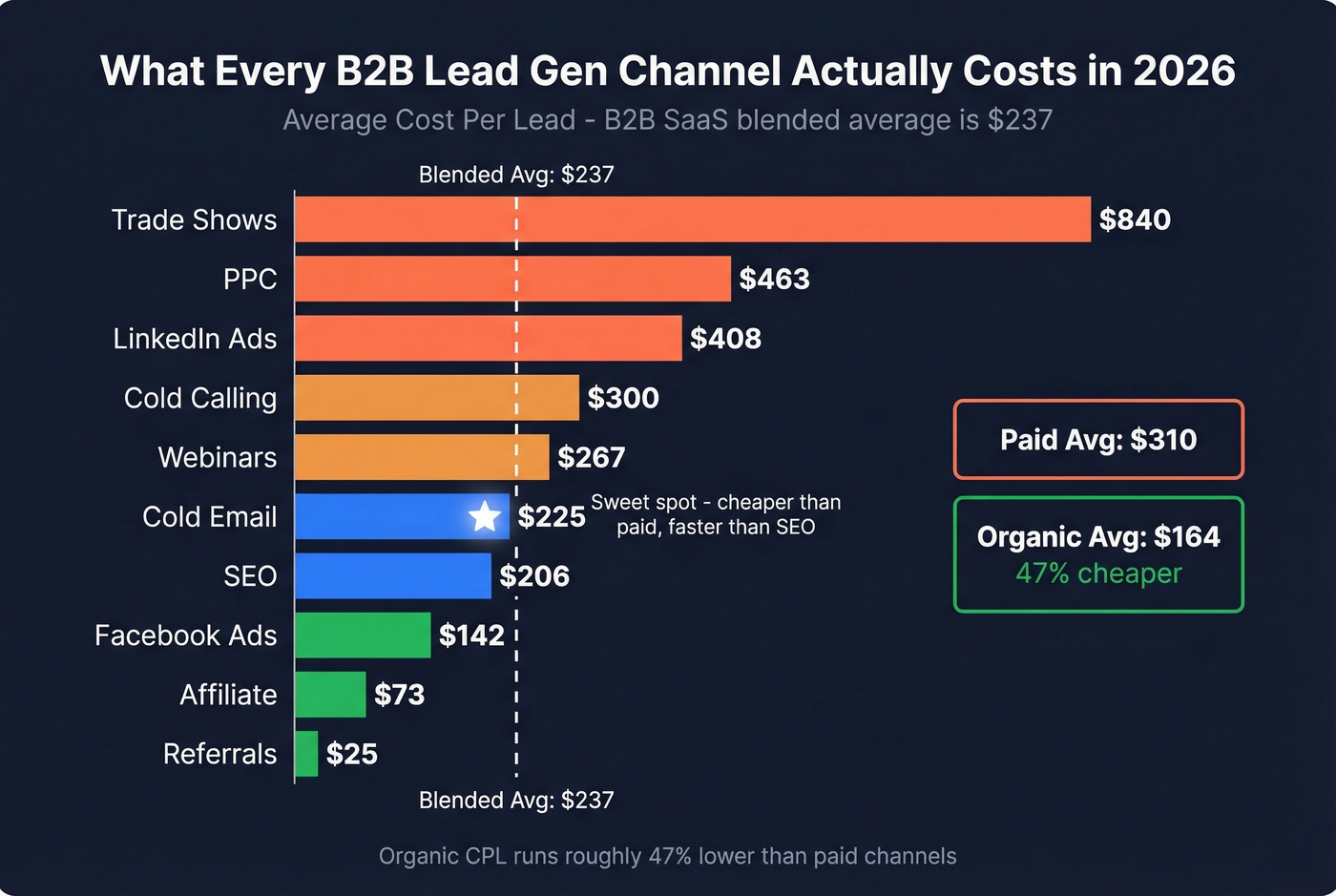
The CPL spread across channels is enormous. I find most teams never benchmark against it, which is why they overspend on the wrong channels.
| Channel | Avg CPL | Range |
|---|---|---|
| Trade shows | $840 | $180-$1,500+ |
| PPC | $463 | $175-$751 |
| LinkedIn ads | $408 | $15-$800+ |
| Cold calling | $300 | - |
| Webinars | $267 | $33-$500 |
| Cold email | $225 | $150-$300 |
| SEO | $206 | $14-$397 |
| Facebook ads | $142 | $102-$182 |
| Affiliate | $73 | $54-$92 |
| Referrals | $25 | - |
For B2B SaaS, the blended average is $237 - paid channels at $310, organic at $164. That means organic CPL runs about 47% lower than paid. On Reddit, SEO gets framed as an equity channel that compounds, while paid ads feel like "paying to reset" every month. Both observations are fair, but the real insight is that cold email at $225 average CPL sits in a sweet spot - cheaper than most paid channels, faster feedback loops than SEO, and scalable if your data is clean. If you want more benchmarks, track the average B2B lead conversion rate alongside CPL.
Three Anti-Patterns Burning Pipeline Right Now
42% of B2B companies already cite lead quality as a top marketing challenge. These habits make it worse:
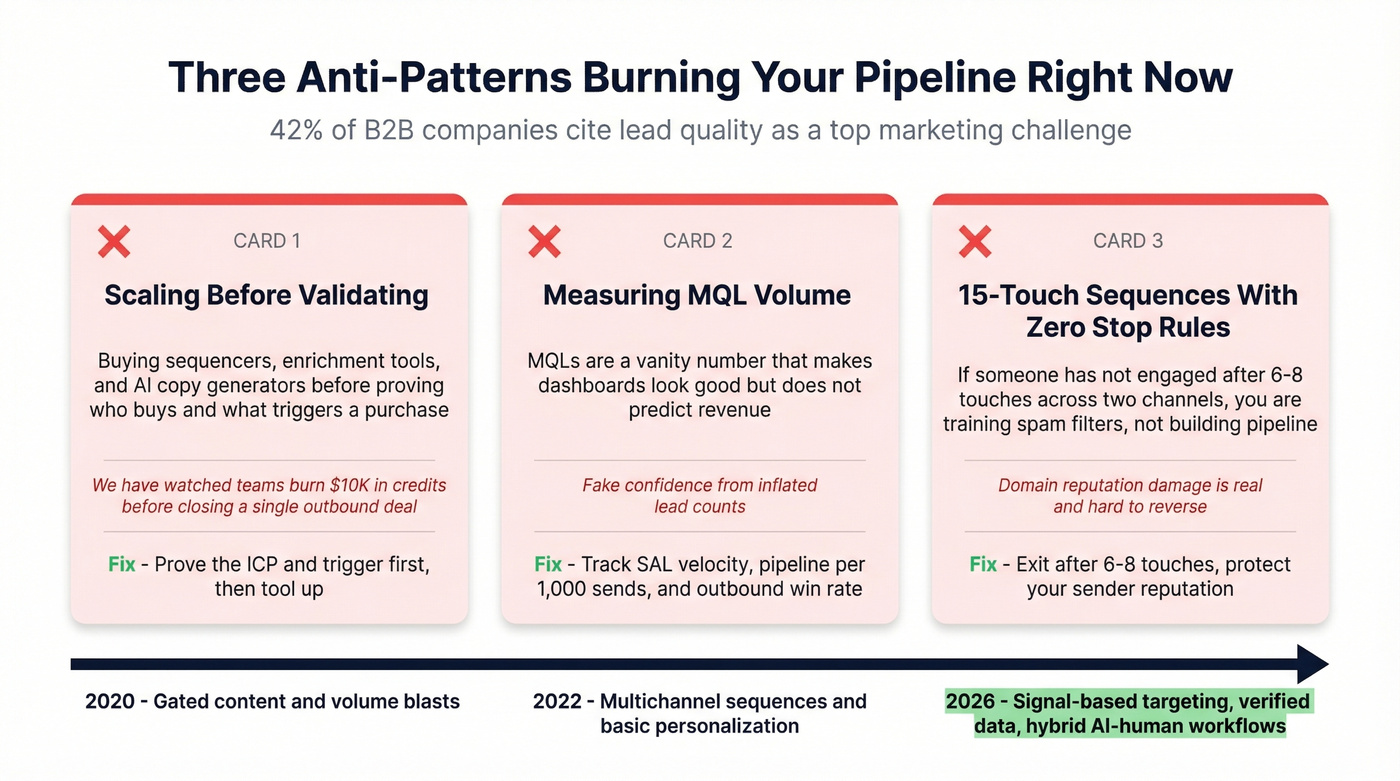
Scaling before validating. Teams buy sequencers, enrichment tools, and AI copy generators before proving who buys and what triggers a purchase. Tool-first lead gen creates fake confidence. We've watched teams burn through $10K in credits before they've closed a single deal from outbound. Use a simple lead generation workflow to validate ICP → list → message → channel before scaling.
Measuring MQL volume. MQLs are a vanity number. Track SAL velocity, pipeline per 1,000 sends, and win rate on outbound-sourced opportunities instead. If you need a clean KPI set, start with lead generation metrics.
15-touch sequences with zero stop rules. If someone hasn't engaged after 6-8 touches across two channels, exit them. You're training spam filters, not building pipeline. (If you're rebuilding sequences, a B2B cold email sequence framework helps.)
The shift is stark year over year. In 2020, the playbook centered on gated content and high-volume email blasts - tactics that still worked because inboxes were less crowded and AI overviews didn't exist. By 2022, teams had shifted toward multichannel sequences and basic personalization at scale. Now, the 2026 playbook demands signal-based targeting, verified data, and hybrid AI-human workflows as table stakes. If your stack hasn't evolved past the 2022 version, you're already behind.
Meritt's bounce rate dropped from 35% to under 4% and pipeline tripled to $300K/week. The difference wasn't a better sequencer - it was verified data refreshed every 7 days, not the 6-week industry average. At $0.01 per email, clean data costs less than one bounced campaign.
Your cold email CPL means nothing if half your list bounces.
FAQ
What's the biggest B2B lead generation trend in 2026?
Signal-based outreach is the dominant shift. Teams using intent data and buyer signals to target in-market accounts see 15-25% reply rates vs. 3-5% for generic cold email. Only 25% of B2B companies use intent data today, so early adopters still have a real edge.
How much does a B2B lead cost in 2026?
The B2B SaaS blended average is $237 per lead. Referrals are cheapest at $25, trade shows most expensive at $840. Organic channels cost roughly 47% less than paid - $164 vs. $310 on average.
What tools do I need for modern lead generation?
Three core tools: a verified data source for accurate contacts and intent signals, an intent platform like Bombora or 6sense, and a sequencer like Instantly or Lemlist. Prioritize data quality spend over sequencer spend - it's the single highest-leverage budget decision you'll make.
Are AI SDRs replacing human reps?
Not yet. In a 2025-2026 head-to-head test, human SDRs generated $147K in revenue vs. $56K for AI, with 71% show rates vs. 52%. The winning model is hybrid: AI handles volume and first-touch qualification, humans run high-value conversations. Skip this trend if your average deal size is under $5K - the ROI on the hybrid setup won't justify the tooling cost at that price point.