

B2B Marketing Data: What It Costs, How to Use It, and What Actually Works
A RevOps lead we know audited a client's prospect list last quarter. The result: 40-50% of contacts were outdated - wrong titles, dead emails, generic inboxes nobody checks. Their summary was blunt: "We were basically paying reps to email ghosts." After remapping decision-makers, verifying emails, and segmenting by industry and region, reply rates jumped from 2% to 11% in eight weeks. That's not a data problem. That's a revenue problem hiding in your CRM.
Poor data quality costs organizations $12.9M per year on average. Meanwhile, 67% of the B2B purchase journey happens digitally and buying committees average 11+ stakeholders. You're not just emailing one person - you're trying to reach a moving committee through data that's decaying by the month.
We've spent years inside these tools and stacks. What follows is what actually holds up in practice.
What B2B Marketing Data Actually Is
B2B marketing data is any information that helps you identify, reach, and convert business buyers - contact details, company attributes, technology stacks, buying signals, and behavioral patterns. Most teams conflate "more data" with "better data." They're not the same thing, and the confusion costs real money.
The critical distinction is first-party vs. third-party. First-party data comes from your own channels: website visits, form fills, CRM records, product usage. It's accurate but limited in scale. Third-party data is purchased from external providers who aggregate professional profiles, intent signals, and firmographics - it fills the gaps, but quality varies enormously between providers. When both sources work together, your marketing data becomes a unified asset that drives pipeline rather than just filling spreadsheets.
One thing most guides skip: under GDPR, a professional email like john.smith@company.com counts as personal data because it identifies an individual. That has real compliance implications we'll cover below.
The 6 Data Types That Matter
| Type | What It Is | Example | When to Use |
|---|---|---|---|
| Contact | Names, emails, phones, titles | VP Sales, verified email | Direct outreach |
| Firmographic | Company attributes | 200 employees, Series B, SaaS | ICP filtering |
| Technographic | Tech stack info | Uses Salesforce + Marketo | Solution selling |
| Intent | Topic research signals | Surging on "CRM migration" | Timing outreach |
| Trigger/Chronographic | Events and changes | New VP hired, funding round | Personalization hooks |
| Behavioral | Engagement patterns | Visited pricing page 3x | Lead scoring |
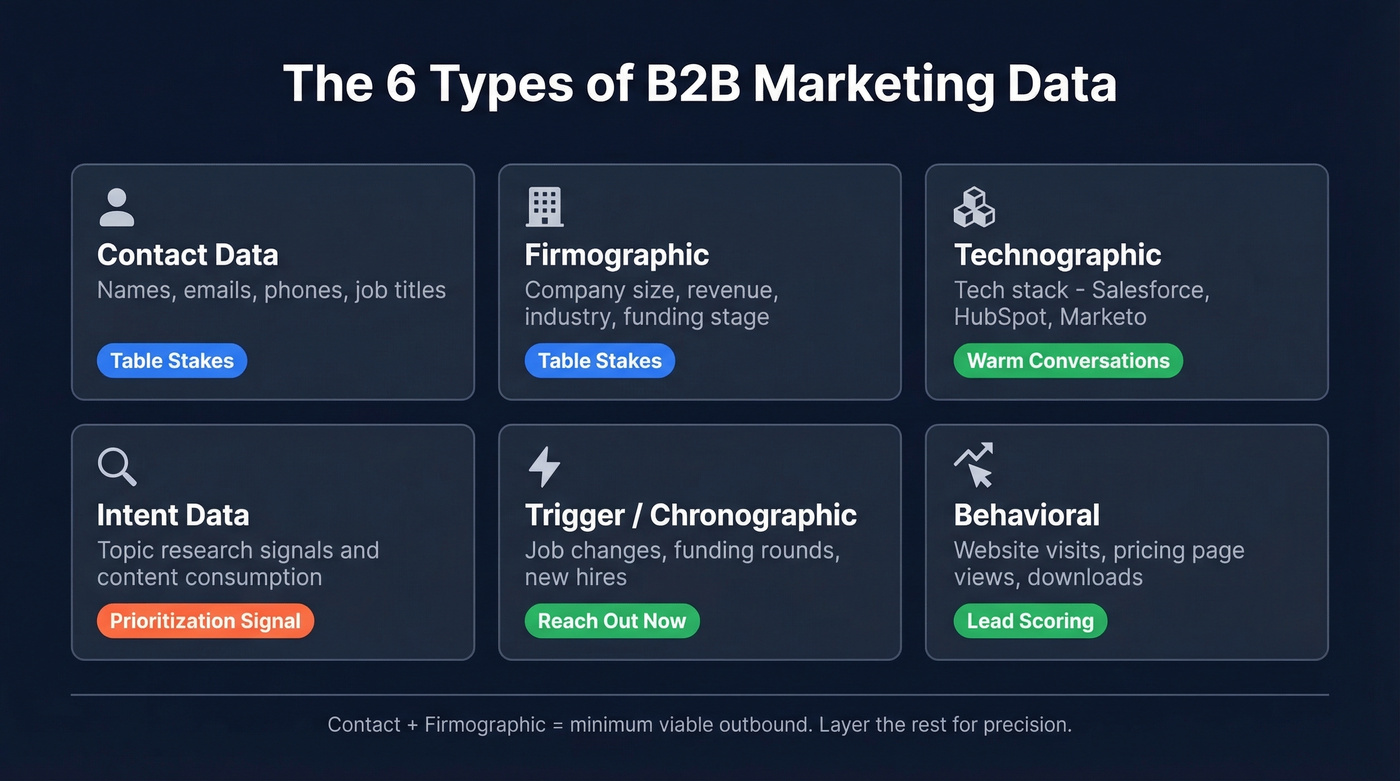
Contact and firmographic data are table stakes - you can't do outbound without them. Technographic data gets interesting when you're selling into a specific stack; if a prospect runs HubSpot and you integrate with HubSpot, that's a warmer conversation from the first touch.
If you're building your sourcing motion from scratch, start with a shortlist of the best B2B databases and work backward from accuracy and refresh cycles.
Trigger data like job changes and funding rounds gives you a reason to reach out right now.
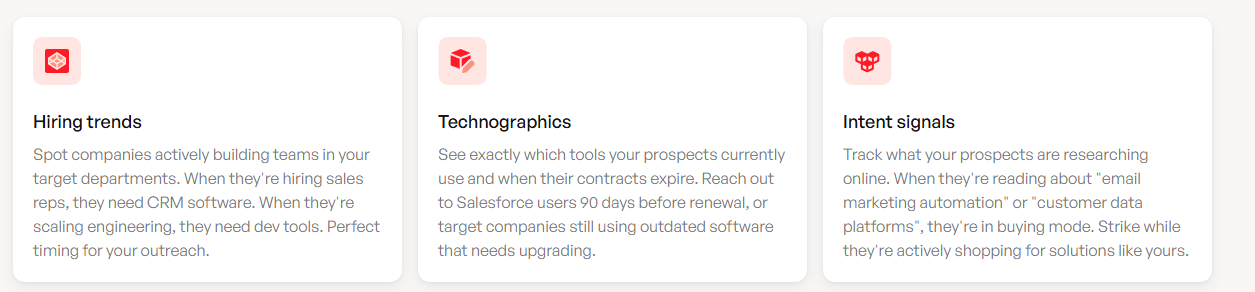
Intent data deserves a longer conversation. Providers like Bombora aggregate content consumption across a network of B2B publishers, classifying activity into roughly 12,000+ topic taxonomies. The concept is powerful: find companies actively researching your category before they talk to a competitor.
Here's the thing, though - intent data is wildly oversold. It measures topic interest, not purchase readiness. A "surge" on "cloud security" could be a CISO evaluating vendors, a journalist writing a trend piece, or a grad student working on a thesis. The numbers back this up: 92% of buyers already have a shortlist before formal evaluation, and 61% prefer not to engage with sales at all. Intent data is most useful for confirming you're on that shortlist, not for getting on it. Use it as a prioritization signal, not a buying signal.
If you want to go deeper on how to interpret these signals, see our guide on buyer intent signals.
Where Data Comes From (And Why It Decays)
B2B data originates from public records, professional profiles, publisher networks, web scraping, and first-party analytics. Providers aggregate these sources, match them to company records, and package them for search and export.
If you're evaluating sources, it helps to compare B2B list providers vs. enrichment-first tools.
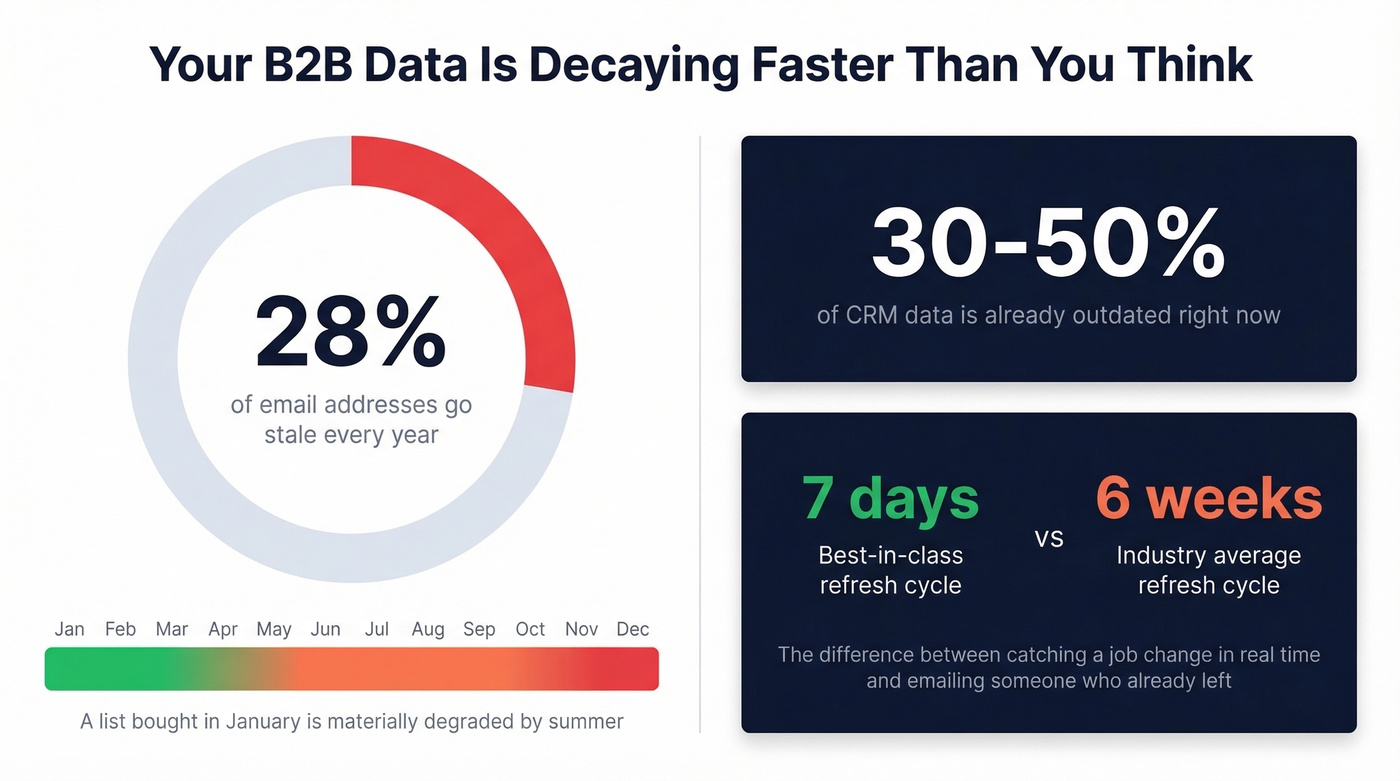
The problem is decay. 28% of email addresses in B2B databases become outdated annually - people change jobs, companies rebrand, domains expire. A list you bought in January is materially degraded by summer. And 30-50% of CRM data is already outdated at any given time.
Refresh cycles are the differentiator most buyers overlook. The industry average for data refresh is roughly six weeks. The difference between a 7-day and a 6-week refresh is the difference between catching a job change in real time and emailing someone who left the company a month ago.
How to Activate Your Data
Buying data isn't the hard part. Activating it without destroying your domain reputation is. We've seen teams cut bounce rates in half just by adding a verification step - and we've seen teams torch their sender reputation in a single week by skipping it.
If you're trying to systematize this end-to-end, a lean RevOps tech stack matters more than adding yet another tool.
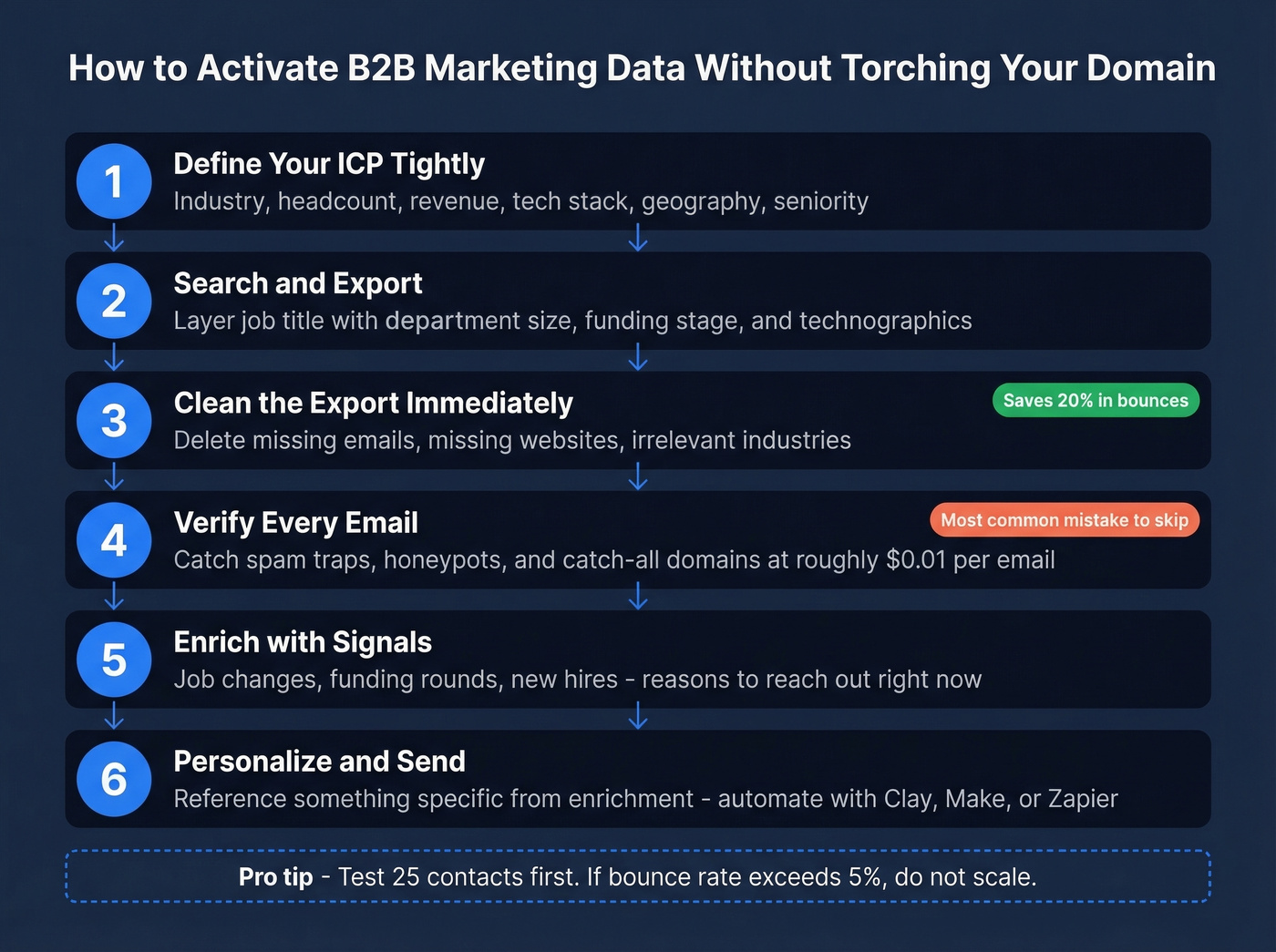
1. Define your ICP tightly. Industry, headcount, revenue range, tech stack, geography, seniority. Vague ICPs produce vague lists. (If you need a framework, use an Ideal Customer Profile template and score it.)
2. Search and export from your database. Job title alone isn't enough. Layer in department headcount, funding stage, and technographics to narrow the list.
3. Clean the export immediately. Delete rows with missing emails, missing company websites, or irrelevant industries. This step alone saves roughly 20% in bounce rates downstream.
4. Verify every email. Skipping verification is the single most common mistake in outbound. It's also the easiest to fix - email verification at roughly $0.01/email catches catch-all domains, spam traps, and honeypots before they wreck your deliverability. If you’re comparing options, start with the best email verifier tools.

5. Enrich with signals. Layer in trigger data - job changes, funding rounds, new hires, company news. A VP of Sales who started three weeks ago is actively building their stack. This is where the benefits of data enrichment show up in reply rates, not theory.
6. Personalize and send. Use enrichment signals to write openers that reference something specific. Automation tools like Make.com, Zapier, or Clay can orchestrate this at scale. (If you want a playbook, use AI email personalization to scale without sounding templated.)
One critical concept: waterfall enrichment. Relying on a single data source typically leaves 40-60% of qualified prospects unreachable. Running contacts through multiple providers sequentially - first for verified emails and mobiles, then a second source for firmographic gaps - closes that gap significantly.
Before committing to any provider, export 25 contacts and run a test campaign. Check bounce rates, reply rates, and data completeness. If bounce rates exceed 5%, the data isn't worth scaling. This 30-minute test saves thousands in wasted spend.
Generic benchmarks are useless here - a 5% reply rate in cybersecurity is very different from 5% in HR tech. Measure against your own vertical.
If you need help tightening the actual messaging layer, keep a set of proven email blast templates on hand for testing.

Bad B2B marketing data costs $12.9M/year on average. Prospeo's 5-step verification delivers 98% email accuracy, 7-day refresh cycles, and 30+ filters - so you build lists that actually convert instead of emailing people who left the company last month.
Replace decaying data with contacts verified this week.
What It Actually Costs in 2026
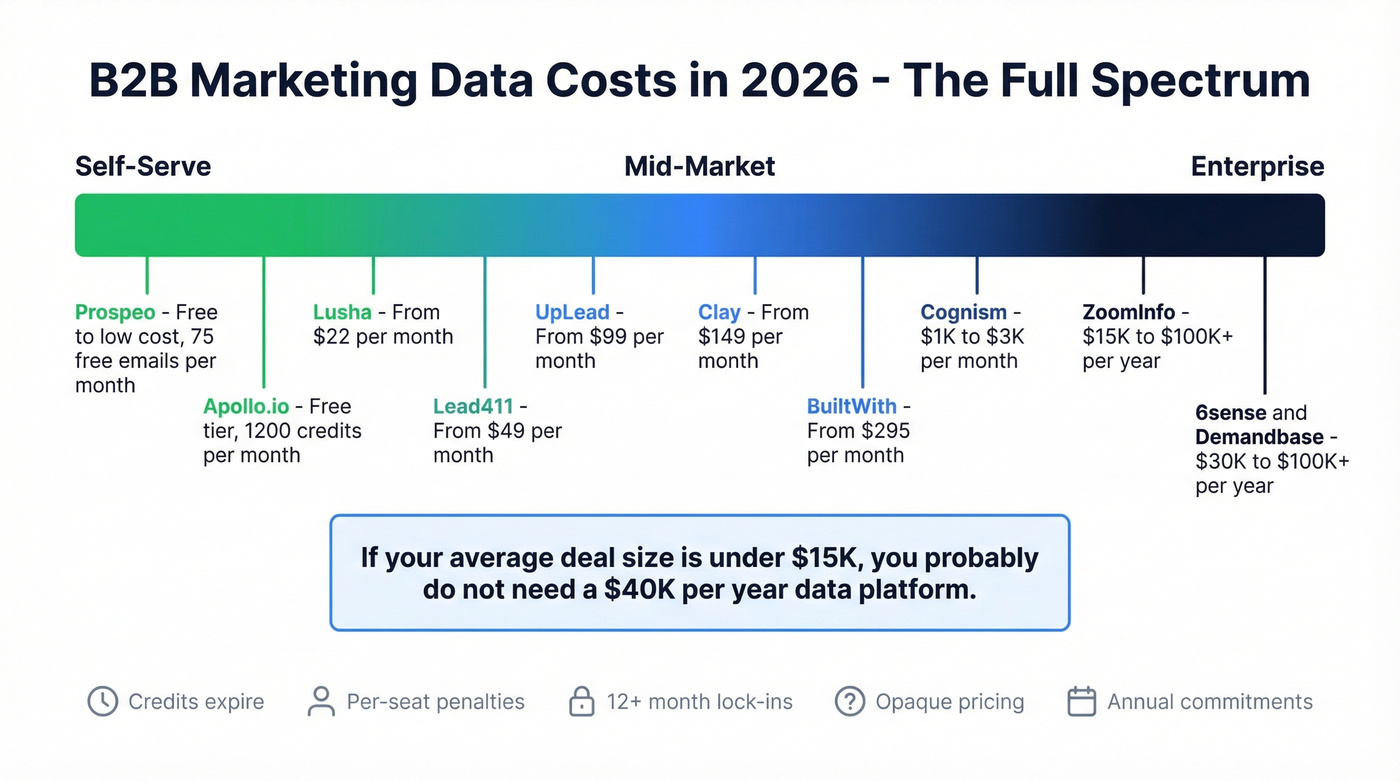
The range is enormous - from free tiers to six-figure enterprise contracts.
| Tool | Starting Price | Pricing Model | Best For |
|---|---|---|---|
| Prospeo | Free (75 emails/mo) | Credits, no contracts | Verified emails + mobiles |
| Apollo.io | Free (1,200 credits/mo) | Credits + per seat | All-in-one on a budget |
| Lusha | Free (40 credits/mo); paid from ~$22.45/mo | Credits | Quick lookups |
| Lead411 | From $49/mo | Credits | SMB prospecting |
| Coresignal | From $49/mo | Subscription / API | Raw data via API |
| UpLead | From $99/mo | Credits | Mid-market prospecting |
| Clearbit/Breeze | $30-$700/mo | Credit packs | HubSpot enrichment |
| Clay | From $149/mo | Subscription | Waterfall workflows |
| BuiltWith | From $295/mo (annual) | Subscription | Technographic intel |
| Cognism | ~$1,000-$3,000/mo | Custom | European coverage, DNC |
| ZoomInfo | $15K-$100K+/yr | Custom enterprise | Large enterprise ABM |
| 6sense / Demandbase | $30K-$100K+/yr | Custom enterprise | Enterprise ABM + intent |
Five pricing models dominate: monthly credits, per-seat licensing, flat-fee subscriptions, pay-as-you-go, and custom enterprise quotes. Each has traps. Credits expire at many tools - if you don't use them, you lose them. Per-seat pricing punishes growing teams. Enterprise contracts lock you in for 12+ months with pricing that's deliberately opaque.
Look, if your average deal size is under $15K, you don't need a $40K/year data platform. Self-serve tools with transparent pricing deliver equal or better accuracy for most teams. Enterprise data platforms charging $15K-$100K+/year with hidden pricing are a relic of a market that hadn't caught up to self-serve alternatives.
If you're still comparing categories, this breakdown of database providers helps clarify what you’re actually buying.
Boost Campaign Reach with Audience Segmentation
Targeted B2B marketing data only works if it reaches the right people at the right time. Many teams buy accurate lists but still underperform because they treat every contact the same way. The fix is segmentation - slicing your verified contacts into cohorts based on firmographics, intent signals, and engagement history before a single email goes out.
Start by separating high-intent accounts from cold prospects. Route high-intent accounts to sales for direct outreach; route cold prospects into nurture sequences. This simple split routinely doubles reply rates because reps spend time on accounts that are actually in-market, while marketing warms the rest. The consensus on r/sales is that most teams skip this step entirely and wonder why their outbound feels like shouting into a void.
If you want more ways to turn clean data into meetings, use these pipeline generation ideas as a testing backlog.
Compliance Checklist
Data quality doesn't matter if you're using it illegally.
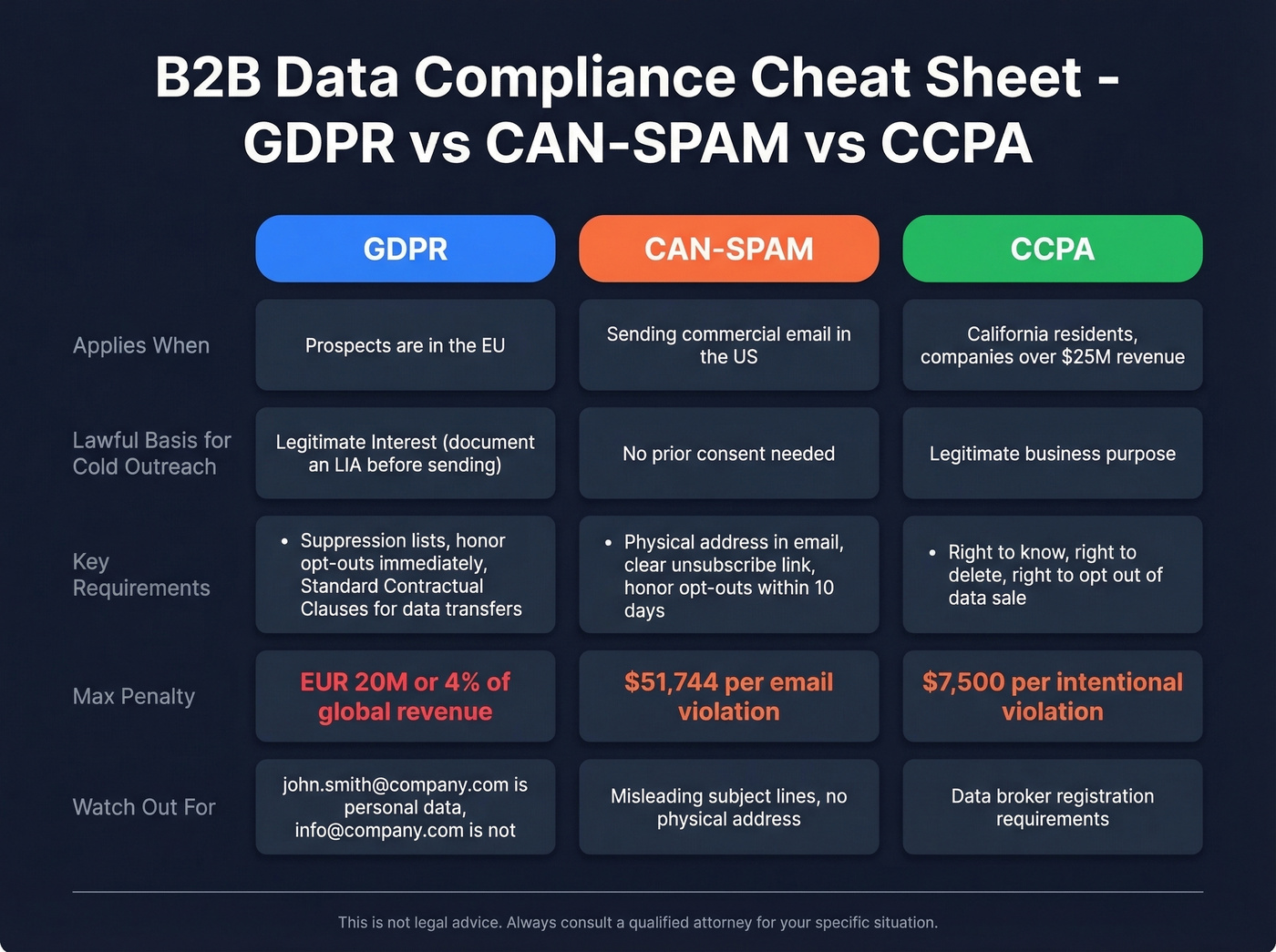
GDPR applies when your prospects are in the EU. Professional emails identifying an individual are personal data; generic addresses like info@company.com aren't. Most B2B cold outreach uses legitimate interest as the lawful basis - not consent - but you must document a Legitimate Interest Assessment before sending. Maintain suppression lists and honor opt-outs immediately. For EU data stored outside the EU, use Standard Contractual Clauses. Maximum penalties reach EUR 20M or 4% of global revenue, whichever is higher. In one case, a company was fined EUR 85,000 for lacking lawful basis documentation.
CAN-SPAM governs US email. Include a physical mailing address and working unsubscribe mechanism in every email. Use truthful subject lines. Honor opt-outs within 10 business days. No prior opt-in is required for B2B email in the US - this surprises people, but it's the law.
CPRA in California carries statutory damages of $100-$750 per violation for data breaches involving personal information. At scale, that adds up fast.
Vendor vetting questions you should be asking: Can the provider prove lawful basis for their data? How do they handle suppression lists? Are they registered as a data broker where required? If your vendor can't answer these clearly, that's your risk, not theirs.
Building Your Data Stack
You need 2-3 tools, not 10.
For teams where accuracy is the top priority - and it should be - Prospeo is where we'd start. 300M+ profiles, 98% email accuracy, 125M+ verified mobiles, and a 7-day refresh cycle. One outbound agency using verified data from the platform saw bounce rates drop from 35% to under 4% and built from $0 to $1M ARR on 94%+ deliverability. Start with the free tier and scale from there.
Skip Apollo's paid plans unless you need a built-in sequencer. The free tier is generous and covers most SMB outbound needs, but data accuracy is noticeably lower. For teams already stitching together a sending tool and a data tool, you're better off with higher-accuracy data and a separate sequencer.
For European coverage, Cognism is worth the premium. DNC screening, a GDPR-first approach, and strong mobile coverage in EMEA. Expect to pay $1,000-$3,000/mo - but if you're selling into Germany or France, the compliance layer alone justifies it.
In our experience, most teams overbuy on data tools. 6sense and Demandbase at $30K-$100K+/year make sense when you have 20+ reps, a dedicated ABM program, and the ops team to activate the data. If you're under 50 employees, skip them entirely.
The decision framework is simple: what regions do you sell into, how many reps need access, and what's your monthly outbound volume? Match those answers to the tools above and you'll land on the right stack without overbuying.
You just read that skipping email verification is the #1 outbound mistake. Prospeo catches catch-all domains, spam traps, and honeypots at $0.01/email - and teams using it cut bounce rates from 35%+ to under 4%.
Run your first 75 emails free and see the difference yourself.
FAQ
What's the difference between first-party and third-party B2B data?
First-party data comes from your own channels - website visits, form fills, CRM records - while third-party data is purchased from providers who aggregate professional profiles, intent signals, and firmographics. First-party is more accurate but limited in scale; third-party fills the gaps for outbound and ABM campaigns.
How often should I clean my B2B database?
Quarterly for high-velocity outbound teams, biannually at minimum. With 28% of email addresses decaying annually, a list purchased in January is materially degraded by summer. Providers with weekly refresh cycles reduce manual hygiene, but CRM deduplication still needs a regular cadence.
Is cold B2B email legal under GDPR?
Yes, if you use legitimate interest as your lawful basis, document a Legitimate Interest Assessment before sending, include a working opt-out, and maintain suppression lists. Professional emails identifying an individual count as personal data - the key is documentation and honoring every unsubscribe immediately.
How much should a small team budget for data tools?
$50-$300/month covers most SMB needs. Free tiers from self-serve providers let you start at zero cost. Avoid enterprise platforms unless you have 20+ reps actively using the data daily. For most teams under 10 people, a verification-first provider plus your CRM is the entire stack.