

The B2B Marketing Strategy Guide With Actual Numbers (2026)
It's Q1 planning. Your CEO wants a strategy deck by Friday. You open five guides and get the same recycled advice: "know your buyer persona," "create valuable content," "use social media." Zero budget benchmarks. Zero CPL data. Zero conversion rates you can actually plan against. Meanwhile, 92% of buyers already have a vendor in mind before they start evaluating. If you're not on that shortlist, your strategy is already losing.
This guide has actual numbers. Budget benchmarks from 402 CMOs, cost-per-lead by industry, conversion rates by vertical, and executable workflows you can implement this quarter.
What You Need (Quick Version)
Three things matter before you build anything:
Know your numbers. Marketing budgets average 7.7% of revenue. B2B SaaS CPL runs $237 blended. Your website converts visitors to leads at roughly 1-2%. If you don't know these baselines for your industry, you're planning blind.
Invest in brand early. 95% of your market isn't buying today. The vendor on the Day One shortlist wins 95% of the time. Brand spend isn't a luxury - it's how you get on that list.
Execute three interlocking motions. Build a content ecosystem that generates organic demand. Run signal-based outbound with verified data. Layer ABM retargeting on top of what's already working. These three motions compound. None of them work in isolation.
Benchmarks Nobody Else Shares
Budget Allocation
Marketing budgets have stabilized at 7.7% of company revenue, according to Gartner's CMO Spend Survey of 402 CMOs. That's the headline number, but it hides meaningful variation.
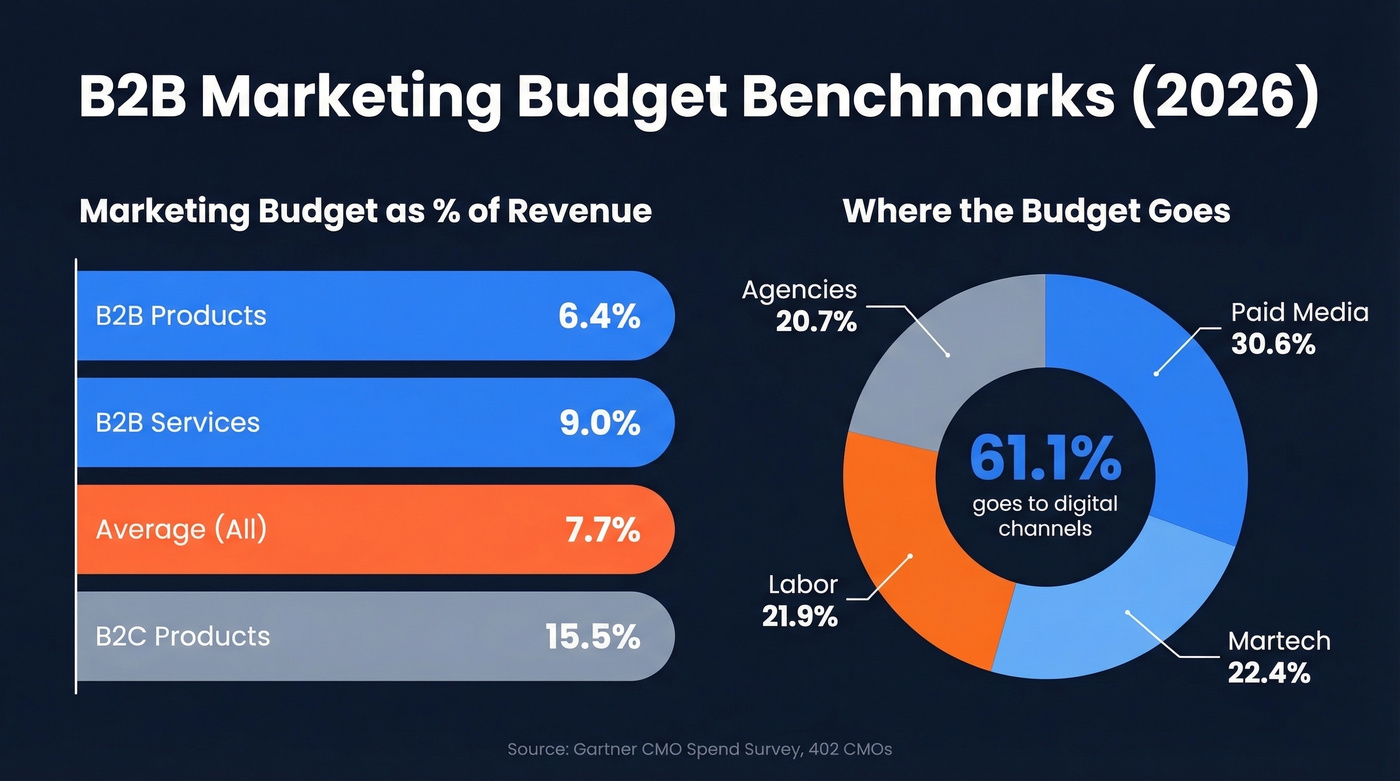
| Business Type | % of Revenue |
|---|---|
| B2B Products | 6.4% |
| B2B Services | 9.0% |
| B2C Products | 15.5% |
Where that money goes matters more than the total:
| Category | % of Budget |
|---|---|
| Paid media | 30.6% |
| Martech | 22.4% |
| Labor | 21.9% |
| Agencies | 20.7% |
Digital channels now absorb 61.1% of total spend - the highest since 2013. If you're still splitting evenly between digital and offline, you're behind.
Cost Per Lead by Industry
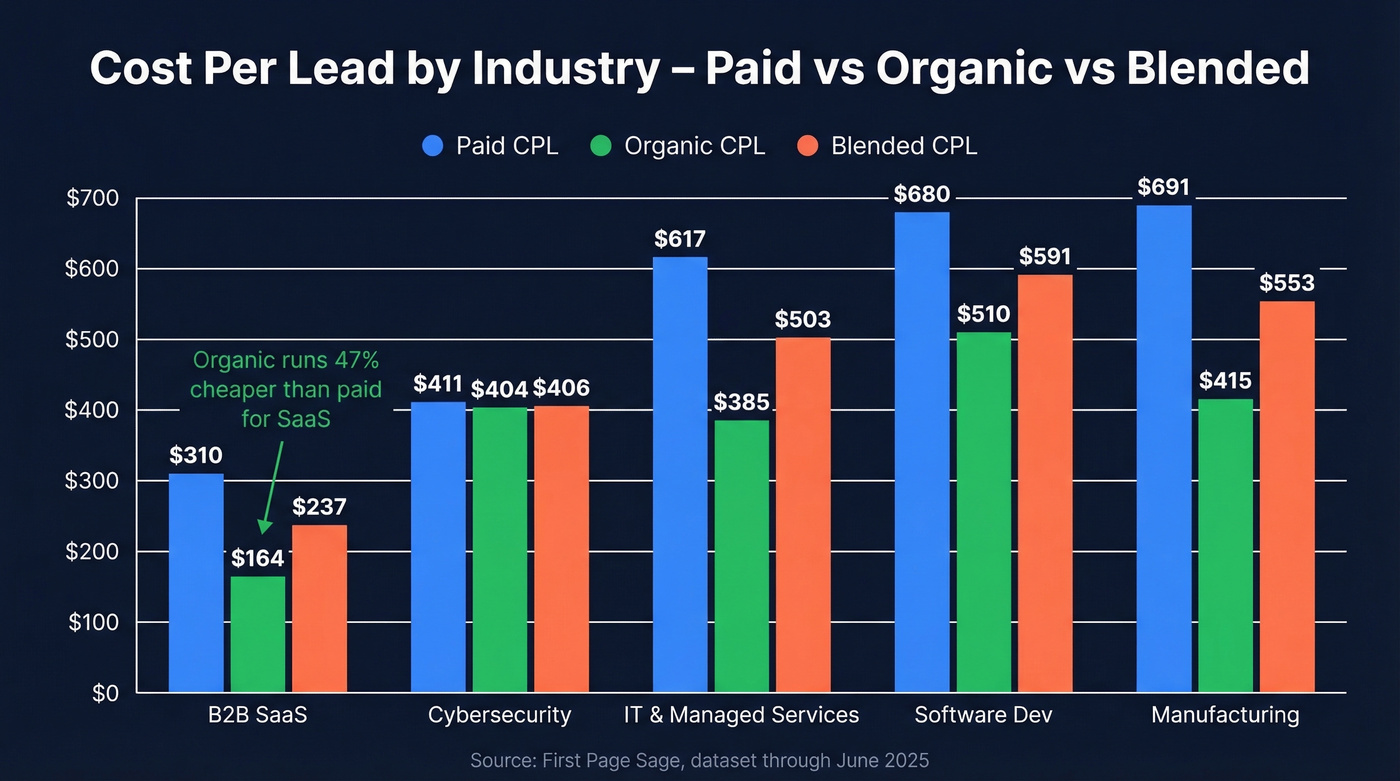
These numbers set expectations for what you'll actually pay to fill your pipeline. CPL varies wildly by vertical, and organic consistently runs cheaper than paid - which is why content investment compounds over time.
| Industry | Paid CPL | Organic CPL | Blended |
|---|---|---|---|
| B2B SaaS | $310 | $164 | $237 |
| Cybersecurity | $411 | $404 | $406 |
| IT & Managed Services | $617 | $385 | $503 |
| Software Dev | $680 | $510 | $591 |
| Manufacturing | $691 | $415 | $553 |
First Page Sage CPL benchmarks, dataset through June 2025. If your blended CPL is significantly above these ranges, your channel mix or targeting needs work - not your budget.
Website Conversion Benchmarks
"Conversion" here means visitor to lead: form fill, demo request, or content download. These are site-level benchmarks, not lead-to-opportunity rates.
| Industry | Conversion Rate |
|---|---|
| B2B SaaS | 1.1% |
| IT & Managed Services | 1.5% |
| Manufacturing | 2.2% |
| Industrial IoT | 2.6% |
| Legal Services | 7.4% |
If your B2B SaaS site converts at 1.1%, that's not broken - that's normal. The implication is clear: you need serious traffic volume to generate pipeline from inbound alone, which is exactly why outbound and ABM exist alongside content.
The 95:5 Rule Changes Everything
Here's the single most important concept behind any effective B2B marketing strategy, and most guides bury it or skip it entirely.
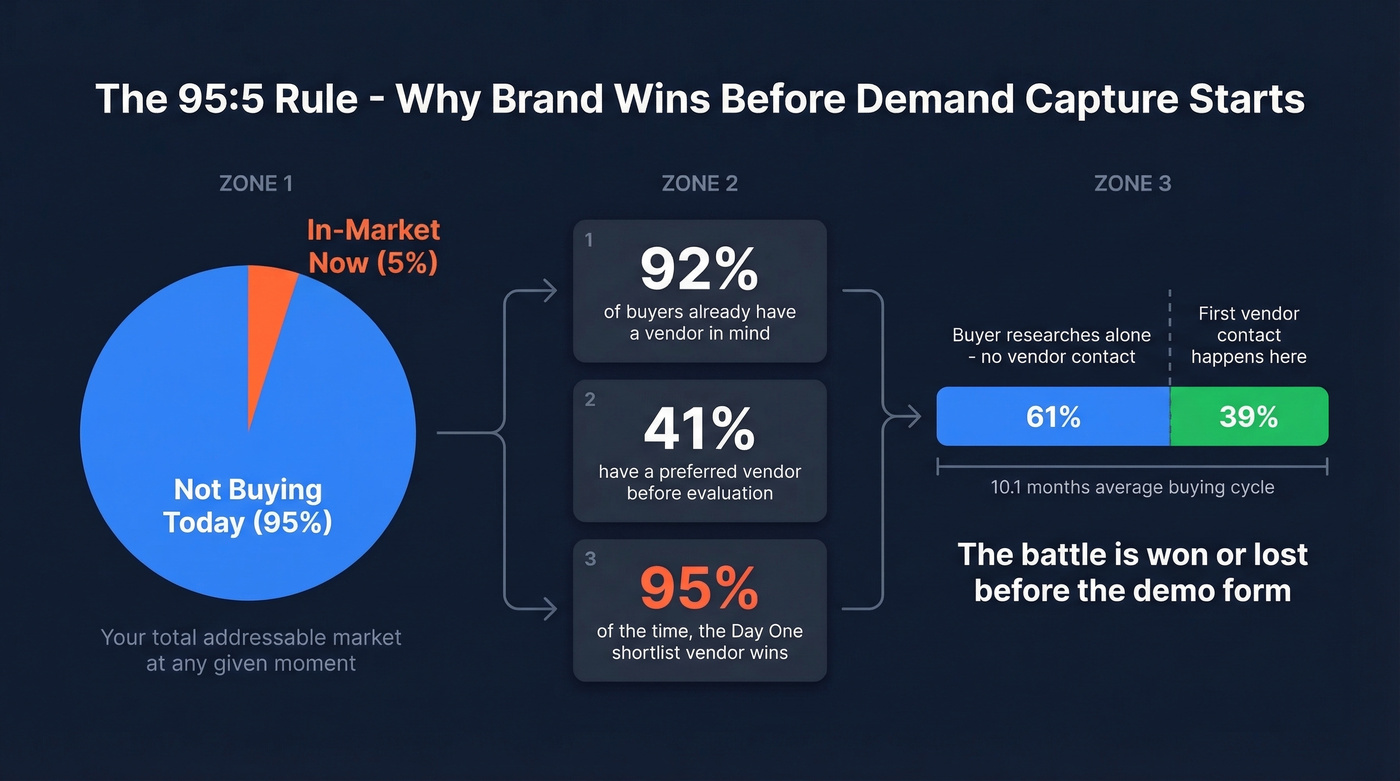
The Ehrenberg-Bass Institute and the LinkedIn B2B Institute popularized the 95:5 rule: at any given time, only about 5% of your total addressable market is actively buying. The other 95% won't be in-market for months or years. Every dollar you spend on "demand capture" only reaches that 5%. Brand investment reaches the other 95% - the people who'll eventually buy.
The downstream data makes this even more stark. 92% of B2B buyers start their evaluation with at least one vendor already in mind. 41% have a preferred vendor before formal evaluation even begins. The winning vendor appears on the Day One shortlist 95% of the time.
If you're not on the shortlist when the buying process starts, you're fighting for the 5% of deals where the frontrunner stumbles. That's not a strategy - that's a prayer.
The average B2B buying cycle runs 10.1 months, and first contact with a vendor doesn't happen until 61% of the journey is complete. By the time a prospect fills out your demo form, they've already formed opinions, compared options, and probably shortlisted two or three vendors. The battle was won or lost months earlier, when they were consuming content, hearing your name from peers, or seeing your brand in their feed. This is why "more MQLs" isn't a strategy. Getting on the shortlist is.
Brand vs. Demand: The Budget Split
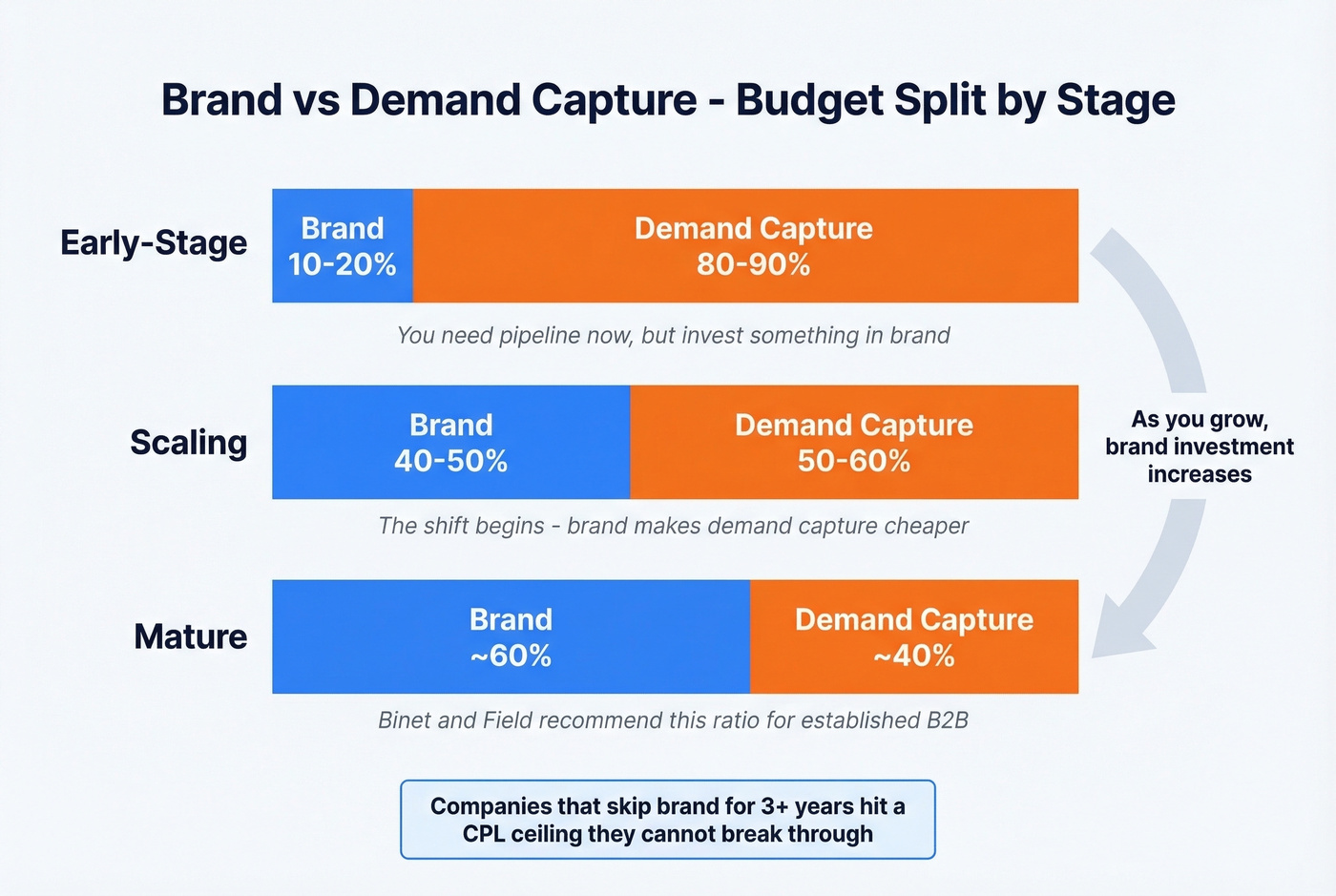
The 95:5 rule creates a practical question: how much do you spend on brand versus demand capture? Binet & Field's updated research recommends a 50/50 split for B2B, but that's a mature-company benchmark. Your stage matters.
| Company Stage | Brand | Demand Capture |
|---|---|---|
| Early-stage | 10-20% | 80-90% |
| Scaling | 40-50% | 50-60% |
| Mature | ~60% | ~40% |
Early-stage companies need pipeline now. You can't afford to spend 60% on brand when you're trying to hit your first $1M ARR. But even at 10-20%, you should invest something - a podcast, a newsletter, a consistent presence that builds recognition before the buying window opens.
As you scale, the ratio shifts. We've watched companies that skipped brand investment for three years hit a CPL ceiling they couldn't break through. The ones that invested early find their demand capture gets cheaper over time because prospects already know who they are.
Where does AI fit? Most AI spend - now about 9% of budgets, up from 7% in 2024 - flows into demand-side activities like content production, analytics, and personalization. But the teams getting the most from AI are using it to scale brand activities too: generating thought leadership variations, personalizing ABM creative, and analyzing brand lift.

Signal-based outbound only works when your contact data actually connects. Prospeo delivers 98% email accuracy and 30% mobile pickup rates on a 7-day refresh cycle - so your pipeline numbers match reality, not benchmarks from stale databases.
Stop planning against bad data. Start building pipeline that converts.
Seven Strategies That Drive Pipeline
1. Content Ecosystem (RARE Framework)
Content isn't a tactic - it's the operating system your other strategies run on. The RARE framework gives you a filter for what to create: content should be Recognizable (consistent format and voice), Actionable (the reader can do something with it), Repeatable (serialized, not one-off), and Engaging (earns attention, doesn't just fill a calendar).
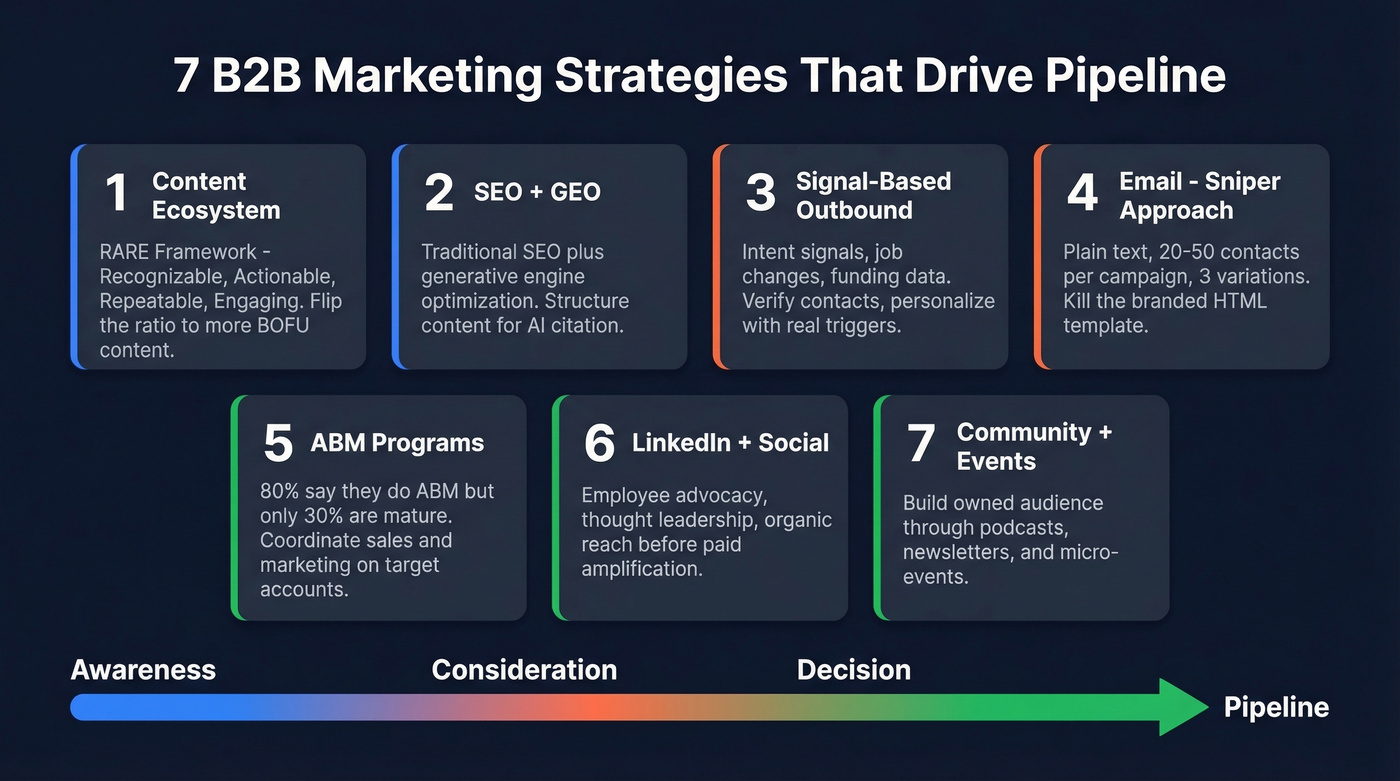
Map content to funnel stages and you stop producing random blog posts. At the awareness stage, SEO-driven top-of-funnel content and thought leadership bring strangers in. At consideration, bottom-of-funnel content like comparison pages and "alternatives" hubs do the heavy lifting - Cognism's alternatives hub is a textbook example. At the decision stage, product marketing and case studies close the gap.
The mistake most teams make is producing 80% awareness content and 5% BOFU. Flip that ratio and watch pipeline respond.
2. SEO + Generative Engine Optimization
Traditional SEO still drives the majority of organic pipeline for B2B companies, but 2026 adds a critical layer: generative engine optimization. AI-powered search surfaces entity-based answers, not just keyword-matched pages. Your content needs to be structured so AI models can extract and cite it.
This doesn't replace keyword strategy - it layers on top. The teams winning at GEO are already producing substantive, well-structured content. Here's what to do right now: structure key definitions in question-answer format, implement schema markup on every page, and include entity-rich summaries at the top of each article. These are the signals AI models use to select citation sources. If your SEO foundation is solid, GEO is an incremental lift, not a rebuild.
3. Signal-Based Outbound
This is where outbound stops feeling like spam and starts generating real pipeline.
Define your ICP tightly. Not "VP of Marketing at a tech company." More like "VP of Marketing at a cybersecurity company, 50-200 employees, US-based, recently hired a demand gen manager." (If you need a scoring rubric, start with an ICP template.)
Build your list with intent and signal filters. Use a platform like Prospeo's B2B database to search across 300M+ profiles with 30+ filters - buyer intent powered by 15,000 Bombora topics, job change signals, headcount growth, technographics, and funding data.
Verify before you send. Even with high-accuracy data, run verification. Catch-all handling and spam-trap removal cut bounce rates dramatically.
Enrich with real signals. Scrape company news, job postings, and funding announcements. Use Make.com or Clay to summarize these into personalized icebreakers via LLM. (If you're building in Clay, this Clay list building workflow helps.)
Personalize with a signal-based structure. Icebreaker referencing their specific signal, one-sentence offer, social proof, low-friction CTA. For more examples, see personalized outreach.
Teams we've worked with drive 4-8 new customers per month with signal-based outbound when the ICP, offer, and data quality are dialed in. The workflow originated from a practitioner who shared results on r/b2bmarketing, and it's become the standard playbook for a reason.

4. Email - The Sniper Approach
Branded HTML templates and generic newsletters are dying in B2B. The consensus on r/b2bmarketing is clear - plain-text, conversational emails outperform designed templates by a wide margin. One practitioner who sent 17M+ emails called it the "sniper approach," and the results back it up.
Do this: Send to 20-50 contacts per campaign, not 2,000. Write three variations per cohort. One clear message, one CTA. Plain text. Conversational tone. (If you need copy patterns, start with emails that get responses.)
Stop doing this: Mass blasts to 5,000 contacts with a branded template, three CTAs, and a stock photo header. Your recipients archive these without reading. Your deliverability suffers. And your domain reputation takes a hit that compounds over months.
Sending to 50 people three times with tailored variations beats one blast to 5,000 every time.
5. ABM - The Reality Check
Here's the thing: 80% of B2B organizations say they have ABM programs, but only 30% describe them as mature. The gap between "we do ABM" and "we actually run coordinated, account-level campaigns" is enormous. As one r/b2bmarketing commenter put it, most ABM is just "lead gen with a fancy label."
Real ABM requires account-level measurement instead of lead-level tracking, buying committee mapping across 7-13 stakeholders per deal, and coordinated outreach across content, ads, email, and sales touches. It also requires knowing which accounts are actually in-market - which is where intent data tracking thousands of topics layered with company growth signals becomes essential. (If you want the sales-side version, use these account-based selling best practices.)
Skip full ABM if your average deal size is under $15K. A well-executed signal-based outbound motion will get you further, faster, and cheaper.
6. Paid Media - Retargeting Wins
Retargeting is typically the highest-ROI paid media motion in B2B because you're paying to reach people who already engaged.
| Approach | Typical CPL | Typical Conversion Rate | Best For |
|---|---|---|---|
| Cold audience prospecting | $300-$600+ | 0.5-1.5% | Brand awareness at scale |
| Retargeting warm visitors | $50-$150 | 3-8% | Pipeline acceleration |
Layer paid on top of organic content that's already performing. If a blog post drives 5,000 visits per month, retarget those visitors with a case study or demo offer. You're spending on warm audiences with demonstrated interest, not cold impressions that disappear into the void.
7. Partnerships and Referrals
SAP's "Inspire the Future" campaign included partner co-investment with Capgemini, which amplified reach and credibility simultaneously. You don't need SAP's budget to replicate the principle.
For companies under $50M ARR, the playbook is straightforward: find complementary vendors whose customers overlap with your ICP, build co-marketing motions like joint webinars and shared content, and create mutual referral incentives. A structured referral program with existing customers will outperform any single paid channel on a cost-per-opportunity basis.
In our experience, referrals are the most underinvested channel in any growth-stage go-to-market plan. It's not glamorous. But it works.
Data Quality as a Strategic Foundation
Your outbound team sent 10,000 emails last month. 2,200 bounced. That's not a data hygiene problem - that's a strategic failure.
Every bounced email degrades your domain reputation, which means your good emails start landing in spam too. The compounding damage is brutal: even your best sequences start underperforming because inbox providers have flagged your domain.
Real talk: if your bounce rate is above 5%, fix your data before you fix your messaging. The best copy in the world doesn't matter if it never reaches the inbox. (Start with email bounce rate benchmarks and fixes.) Meritt tripled pipeline from $100K to $300K per week after switching to verified data, with bounce rates dropping from 35% to under 4%. Stack Optimize built from $0 to $1M ARR while maintaining 94%+ deliverability, sub-3% bounce rates, and zero domain flags across all clients.
Measuring B2B Marketing ROI
Most B2B marketing teams report the wrong metrics. MQLs feel good in a dashboard but tell you almost nothing about revenue impact.
| Metric Type | What Most Teams Track | What Actually Matters |
|---|---|---|
| Lead volume | MQLs generated | Pipeline $ generated |
| Efficiency | CPL | CAC by channel |
| Attribution | Last-touch | Multi-touch + self-reported |
| Engagement | Email open rate | Reply rate + meetings booked |
| ROI | Marketing-sourced leads | Marketing-influenced revenue |
Multi-touch attribution is common but, as 6sense's survey of 600+ marketers found, often incomplete and wildly inaccurate. It captures visible interactions - clicks, form fills, page views - but misses the podcast episode that built trust, the peer recommendation at a conference, or the post that planted the seed six months ago.
The fix isn't abandoning attribution. It's combining model-based attribution with self-reported data. Add "How did you hear about us?" to your demo form. Report pipeline velocity, CAC, CLV, CPL by channel, and revenue attribution to leadership. Everything else is vanity.
Case Studies With Real Numbers
SAP - EUR 924M in Pipeline
SAP's "Inspire the Future" campaign drove 48% higher engagement than other SAP social campaigns, attracted 22,000+ podcast listeners (top 2% benchmark is 18,000), and generated 10,000+ YouTube views for industry videos within 30 days. The pipeline impact: EUR 924.4M generated, with EUR 266.15M in projected revenue. SAP expanded the campaign globally and secured partner co-investment from firms like Capgemini, turning a marketing initiative into a revenue engine with ecosystem reach.
Snyk - 180% Pipeline Increase
Snyk had 50 AEs each spending 4-6 hours per week on prospecting. Their bounce rates ran 35-40%, which meant a huge chunk of that effort was wasted on bad data. After implementing Prospeo for prospecting data, bounce rates dropped to under 5%. AE-sourced pipeline jumped 180%, and the team generated 200+ new opportunities per month. The lesson isn't just about data quality - it's about what happens when you remove friction from your best revenue-generating activity.
Your CPL drops when emails land and phones get answered. Teams using Prospeo book 26% more meetings than ZoomInfo and 35% more than Apollo - at $0.01 per verified email. That's how you beat the blended CPL benchmarks above.
Lower your CPL with data that actually reaches decision-makers.
FAQ
How much should B2B companies spend on marketing?
The average is 7.7% of revenue based on Gartner's survey of 402 CMOs. B2B product companies average 6.4%, while B2B services companies spend closer to 9.0%. Early-stage companies often allocate 15-20% to build initial awareness and pipeline.
What's the difference between B2B and B2C marketing?
B2B involves longer sales cycles averaging 10+ months, buying committees of 7-13 stakeholders, and ROI-driven purchase decisions. B2C targets individual consumers making faster, emotion-driven purchases. B2B has to influence multiple decision-makers across months; B2C can often convert in a single session.
How do you measure B2B marketing ROI?
Track pipeline generated, pipeline velocity, CAC by channel, and revenue attribution - not just MQLs. Combine multi-touch attribution with self-reported data by asking "how did you hear about us?" on demo forms. Report marketing-influenced revenue to leadership.
What tools do you need for B2B outbound prospecting?
A verified data provider for high email accuracy, a sequencing tool like Instantly or Lemlist, and a CRM such as HubSpot or Salesforce. Signal enrichment via Clay or Make.com adds personalization at scale. Start with data quality - everything else depends on it.