

8 B2B Marketing Strategy Examples With Real Pipeline Numbers
37.7% of B2B marketers face pressure to deliver MQLs regardless of quality. Over a quarter say leads are their only success metric. One widely cited demand gen vs. lead gen breakdown shows content leads closed at 0.2% while direct inbound inquiries closed at ~20%. The MQL machine isn't broken - it was never the right machine.
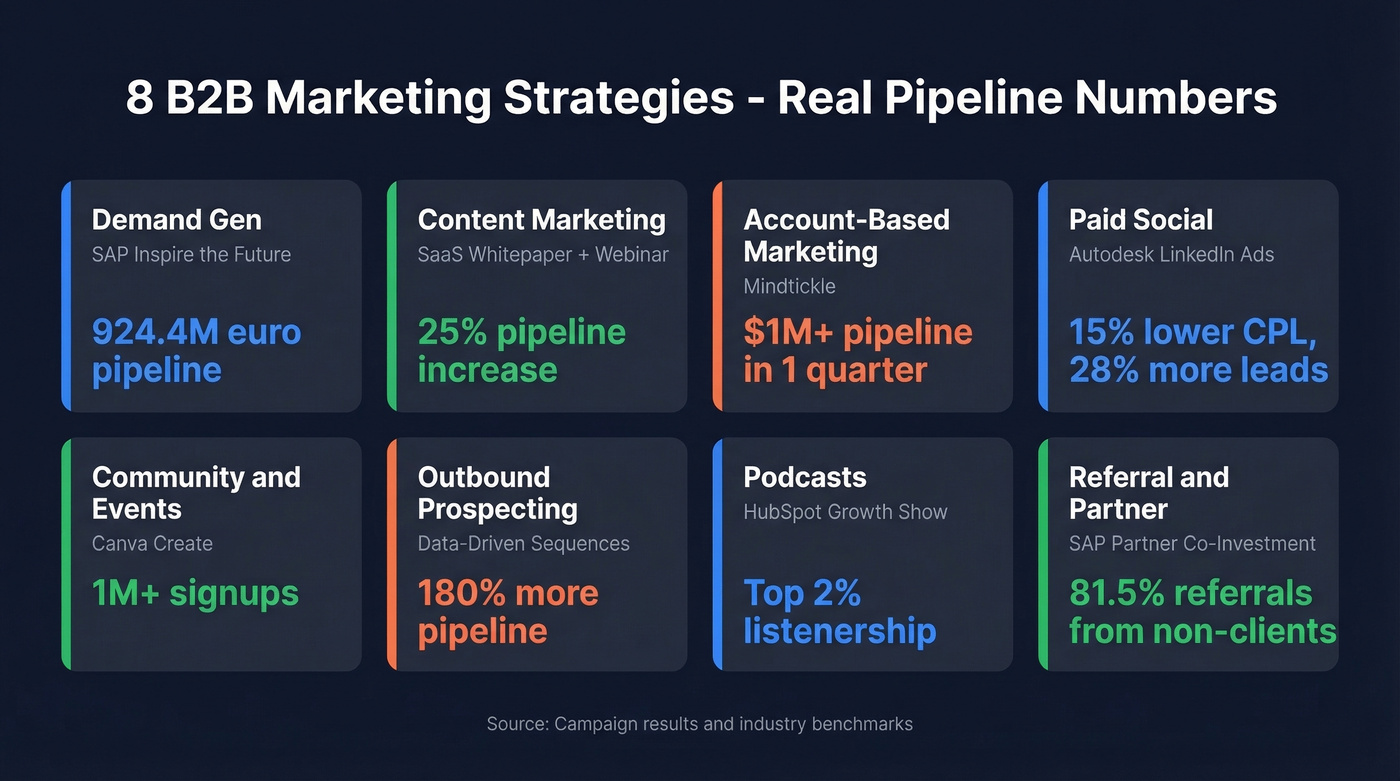
Most B2B marketing strategy examples hand you a channel menu: "try content marketing, try ABM, try paid social." That's not strategy. Strategy is execution with receipts. Here are eight examples with real pipeline numbers so you can steal what actually worked. Pick two or three, not all eight.
B2B Buying Has Changed
The old playbook assumed buyers would talk to you. They won't - at least not early. Gartner projected 80% of B2B sales interactions would be digital by 2025, and that number has only climbed since. Buyers now use roughly 10 channels during a purchase cycle and spend just 17% of their buying time meeting suppliers.
Meanwhile, 46% of B2B buyers use generative AI for preliminary research before ever visiting your site. Up to 50% of sales go to the first vendor to respond. Speed and multi-channel presence aren't optional anymore. They are the strategy.
8 Strategies That Built Pipeline
Demand Generation - SAP "Inspire the Future"
€924.4M in pipeline. €266.15M in projected revenue. Those aren't aspirational targets - they're results from SAP's "Inspire the Future" campaign, which led with brand storytelling instead of lead forms. Their podcast hit 22,000+ listeners, above the ~18,000-listener benchmark for top 2% podcasts, and social engagement ran 48% above SAP's other campaigns.
The takeaway isn't "launch a podcast." It's that demand gen at scale requires earning attention before asking for pipeline. SAP didn't gate a single piece of content in this campaign. They built an audience first and let pipeline follow.
Content Marketing - SaaS Whitepaper + Webinar Funnel
A B2B SaaS company ran persona-driven whitepapers promoted via LinkedIn Ads, Google Display, and email outreach, feeding into a webinar series with email nurture and retargeting. Over six months: 40% more qualified leads, 50% of webinar attendees converting to high-quality leads, and a 25% increase in sales pipeline.
The nurture sequence did the heavy lifting - not the whitepaper itself. We've seen this pattern across dozens of campaigns: the asset gets the click, but the follow-up sequence determines whether that click becomes pipeline.
Account-Based Marketing - Mindtickle
$1M+ in new pipeline in a single quarter. Mindtickle got there by shifting from lead-based marketing to data-driven ABM - defining ICP tightly, aligning sales and marketing on target accounts, and personalizing outreach at every touchpoint. Engaged 1:1 ABM accounts were 15x more likely to create opportunities.
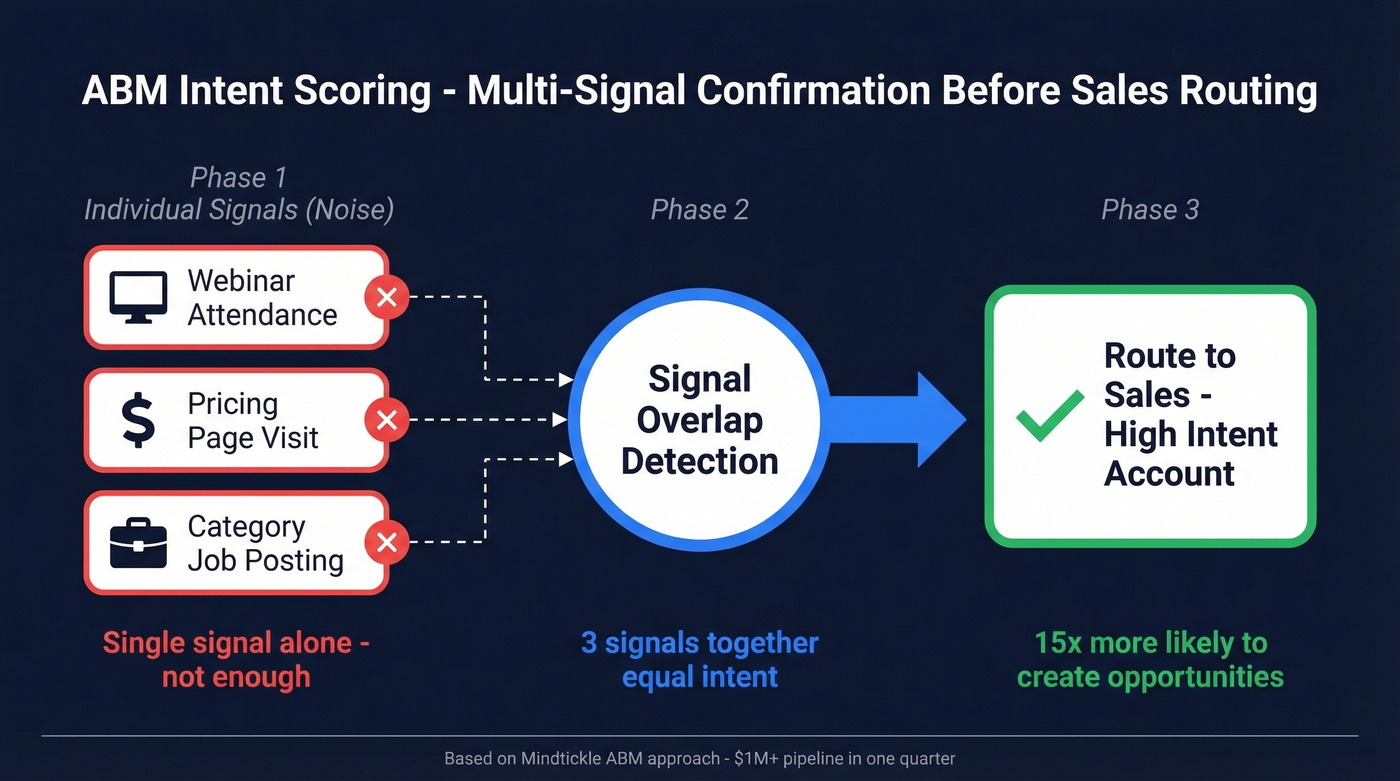
Here's the operational detail most teams miss: require multi-signal confirmation before routing to sales. Webinar attendance plus pricing page visit plus a category job posting. Any single signal alone is noise. Three signals together are intent.
Paid Social - Autodesk LinkedIn Conversation Ads
Autodesk used LinkedIn Conversation Ads with retargeting to drive eBook downloads for their construction line - 15% improvement in cost-per-lead and 28% more form submissions. At an average LinkedIn CPL of $110+, that efficiency gain is real money.
Conversational ad formats outperform static sponsored content when you're targeting a specific persona with a clear next step. Skip this format if your offer is vague or your audience is too broad - the interactive elements only work when the choices feel relevant.
Community & Events - Canva Create
Canva turned a product launch into a community event, pulling in over 1M signups. This wasn't a trade show booth. It was a product experience wrapped in community.
For B2B, the principle translates directly: events that give attendees something to use outperform events that give them something to watch. If your "event strategy" is a 45-minute webinar with 10 minutes of Q&A, you're competing in the wrong category.
Outbound Prospecting - Data-Driven Sequences
Outbound isn't dead. Bad data is.
Sending 200 emails to a clean list beats sending 1,000 to a list with 30% bounce rates, because bad bounces tank your domain reputation and kill deliverability for every future campaign. Snyk's sales team cut bounce rates from 35-40% to under 5% after switching to Prospeo for verified contact data, and AE-sourced pipeline jumped 180% with 200+ new opportunities per month. With 98% email accuracy and a 7-day data refresh cycle, clean data isn't a nice-to-have for outbound - it's the entire foundation. The consensus on r/sales backs this up: threads about outbound failure almost always trace back to list quality, not messaging.
If you're rebuilding this motion, start with an outbound lead generation strategy and lock down domain reputation before scaling volume.

Podcasts - HubSpot "The Growth Show"
You don't need millions of downloads. You need the right 5,000 listeners who happen to be your ICP. HubSpot's "The Growth Show" built a long-form interview format that positioned the brand as a peer to its audience, not a vendor selling to it.
The bar for B2B podcast success is lower than most teams think. And the compounding effect of weekly episodes on brand trust is something paid channels simply can't replicate.
Referral & Partner Marketing - SAP Partner Co-Investment
SAP expanded globally through partner co-investment, working with firms like Capgemini to co-fund campaigns in LATAM, India, and APAC. Hinge Marketing research shows 81.5% of referrals come from non-clients. Your best growth channel is likely partners and adjacent vendors, not your own marketing team.
If you're formalizing this channel, build it like a system: B2B partner programs with clear co-marketing motions and shared pipeline definitions.

Snyk's 180% pipeline jump didn't come from better messaging - it came from cutting bounce rates to under 5% with verified data. Prospeo's 98% email accuracy and 7-day refresh cycle give your outbound sequences the foundation every strategy on this list demands.
Bad data kills pipeline before your strategy gets a chance to work.
Demand Gen vs. Lead Gen
Let's be honest about the shift that's happening. Cognism is a good example of the broader move away from gated content and MQL-chasing toward ungated demand creation. Their inbound pipeline grew from $2M to $13M. The 95/5 rule explains why: only 5% of your market is buying right now. The other 95% is your future pipeline, and they won't fill out a form.
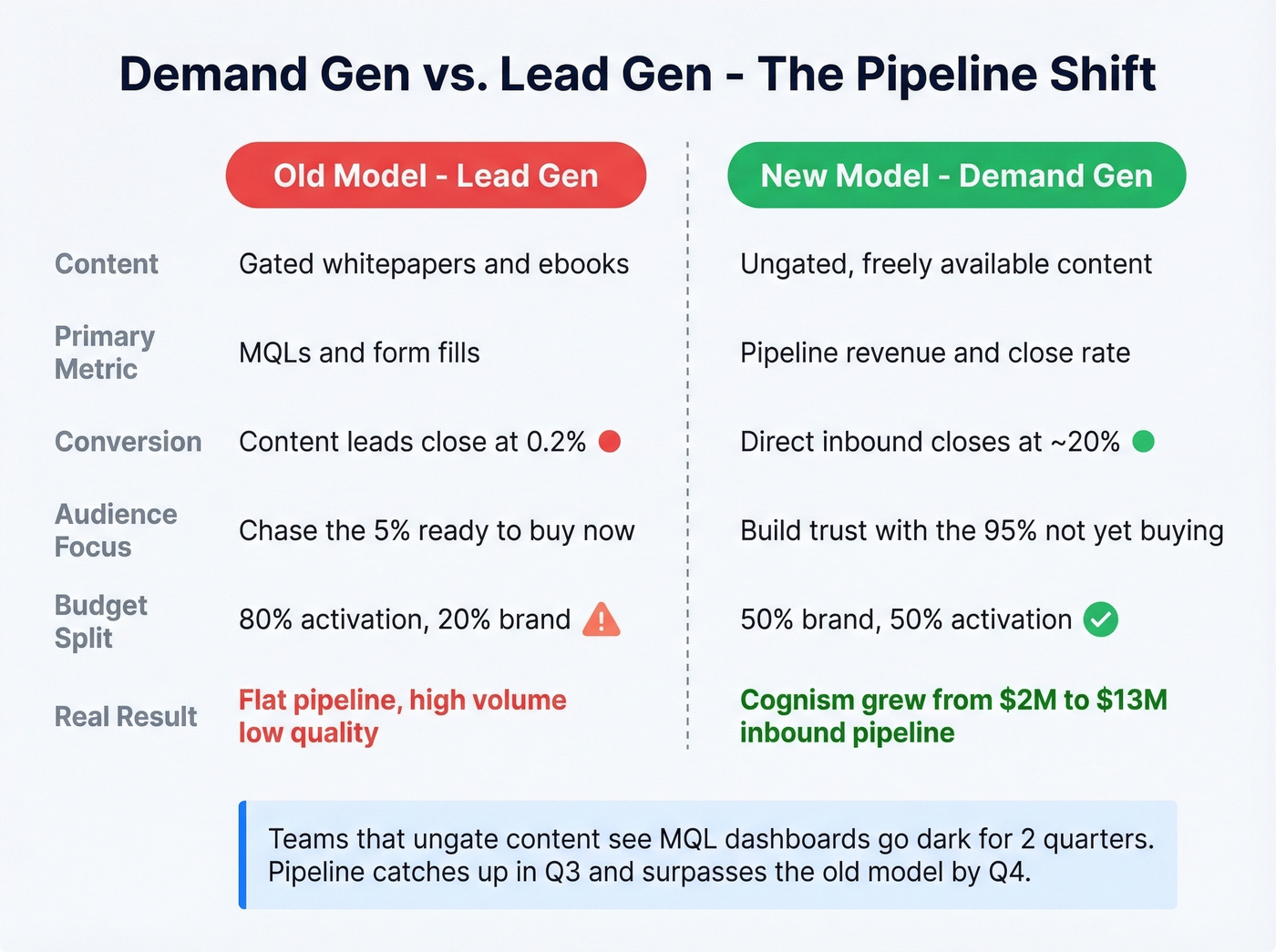
In our experience, teams that ungate content panic for two quarters because MQL dashboards go dark. Pipeline catches up in quarter three and surpasses the old model by quarter four. LinkedIn B2B Institute guidance points to a 50/50 split between brand building and activation. Most teams run 80/20 toward activation and wonder why pipeline is flat.
Hot take: If your average deal is a mid-four-figure contract, you probably don't need a complex ABM motion. Run ungated demand gen, pair it with clean outbound data, and let inbound do the qualifying. Save ABM for the accounts where the math justifies the effort.
B2B Marketing Benchmarks for 2026
| Metric | Benchmark |
|---|---|
| Avg B2B CPL | $84 across channels |
| Google Ads CPL | $70.11 |
| LinkedIn CPL | $110+ |
| Avg conversion rate | 2.9% |
| Avg close rate | 29% |
| Marketing budget | 7.7% of revenue (Gartner CMO Survey) |
| LTV:CAC target | 3:1 |
| Sales cycle | 1-3 months avg; 8% of high-value deals exceed 5 months |
| Touchpoints to close | 5-12 across channels |
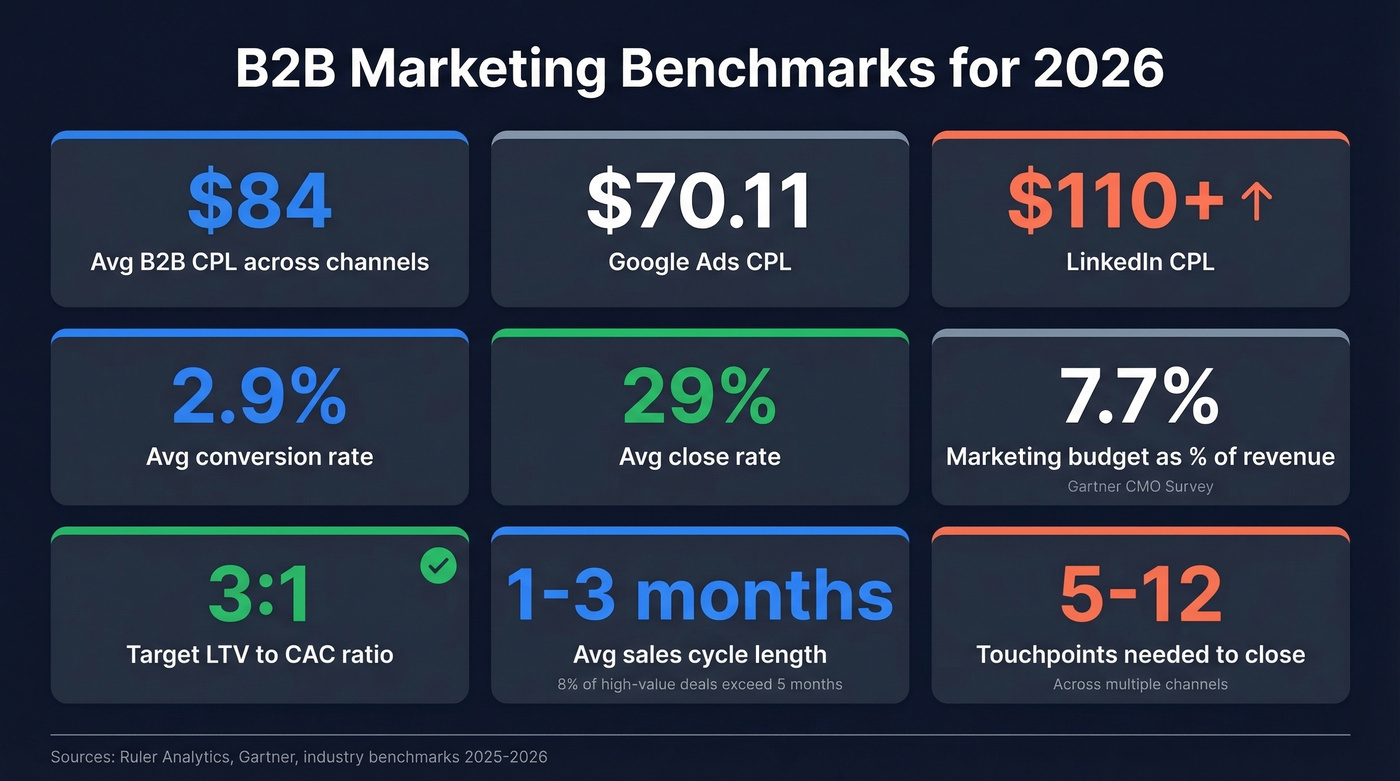
Benchmarks are only useful if you can tie them back to pipeline attribution and a consistent B2B marketing measurement model.
ABM, demand gen, outbound - pick your strategy, but none of them work if you can't reach decision-makers. Prospeo gives you 300M+ profiles with 30+ filters including buyer intent, technographics, and headcount growth so you build lists that actually convert.
Stop feeding great strategies with garbage data. Start with 75 free emails.
FAQ
What are the most effective B2B marketing strategies right now?
Ungated demand generation paired with ABM for top accounts delivers the strongest pipeline in 2026. Cognism grew inbound pipeline from $2M to $13M by making this shift. Cover the 95% out-of-market with brand content and the 5% ready to buy with targeted ABM and clean outbound sequences.
How much should a B2B company spend on marketing?
The Gartner CMO Spend Survey puts the average at 7.7% of revenue. Split roughly 50/50 between brand building and activation, with about 61.1% of total spend going to digital channels. Companies below a 3:1 LTV:CAC ratio should reallocate toward higher-intent channels first.
How do you build an outbound list that actually converts?
Start with verified data - 98% email accuracy on 143M+ verified addresses with a 7-day refresh cycle is the baseline you should expect from any provider. Layer in buyer intent and technographic filters to target accounts actively in-market. Teams using this approach, like Snyk, see bounce rates drop below 5% and pipeline jump 180%.
Pick Your Two
You don't need all eight strategies. The B2B marketing strategy examples above share a common thread: they prioritize pipeline quality over lead volume. Pick the two that match your stage - demand gen plus outbound if you're building pipeline from scratch, ABM plus partner marketing if you already have brand awareness. Execute with real data, measure pipeline not MQLs, and iterate quarterly.