

How to Build a B2B Ideal Customer Profile That Actually Works
Your SDR team just spent a month working 500 accounts and booked 3 meetings. Three. The reps aren't lazy - they're aiming at the wrong targets. CAC rose 40-60% between 2023 and 2025, and outbound CAC now sits around $1,980 per acquired customer. When every dollar costs more, pointing those dollars at the wrong accounts is existential.
The fix isn't more activity. It's a sharper B2B ideal customer profile.
What You Need (Quick Version)
Your ICP should fit on one slide and live in your CRM as scoring fields - not a 20-page doc nobody opens. Build it from closed-won data. Analyze 50-100 wins and you'll find 3-5 traits that repeat in 70-80% of deals. Then activate it with a scoring rubric and a verified target account list so your SDRs stop prospecting on vibes.
What Is an Ideal Customer Profile?
An ideal customer profile is a company-level description of the organizations most likely to buy your product, get value from it, and stick around. It's not a buyer persona. A buyer persona describes an individual - the VP of Marketing who reads First Round Review and worries about pipeline attribution. An ICP describes the company that VP works at: the industry, revenue range, tech stack, growth stage, and buying dynamics that make that company a fit.
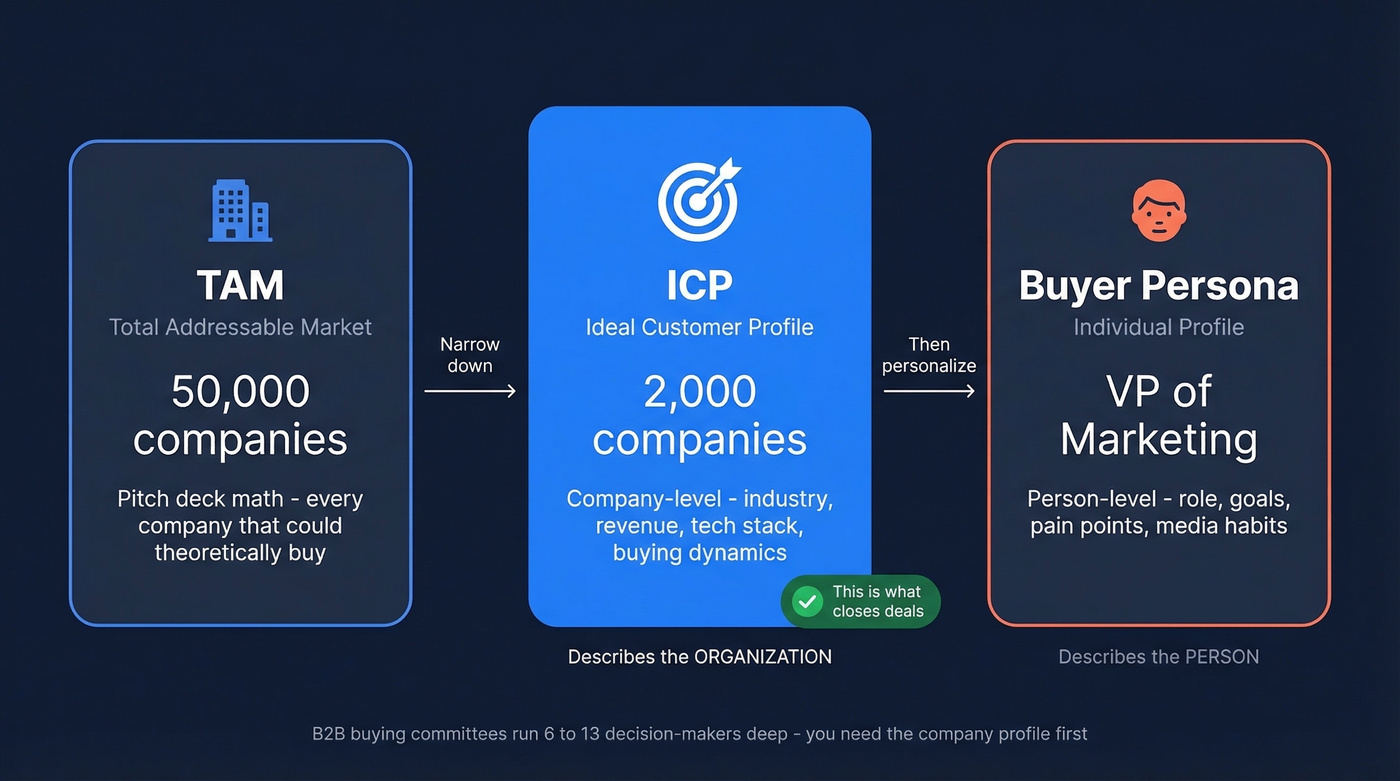
The distinction matters because B2B buying committees run 6 to 13 decision-makers deep. You're not selling to a person. You're selling to an organization, and the ICP tells you which organizations to target before you ever think about who to email.
Don't confuse ICP with TAM, either. TAM is pitch-deck math - your total addressable market might be 50,000 companies. Your ideal customer profile narrows that to the 2,000 that actually close at a reasonable cost and don't churn in six months. TAM gets you a slide in the board deck. ICP gets you revenue.
Why Your ICP Matters in 2026
Let's be honest: most teams treat their ICP like a strategy offsite artifact. It gets built in a workshop, pasted into Notion, and never referenced again. That's a mistake backed by hard numbers.
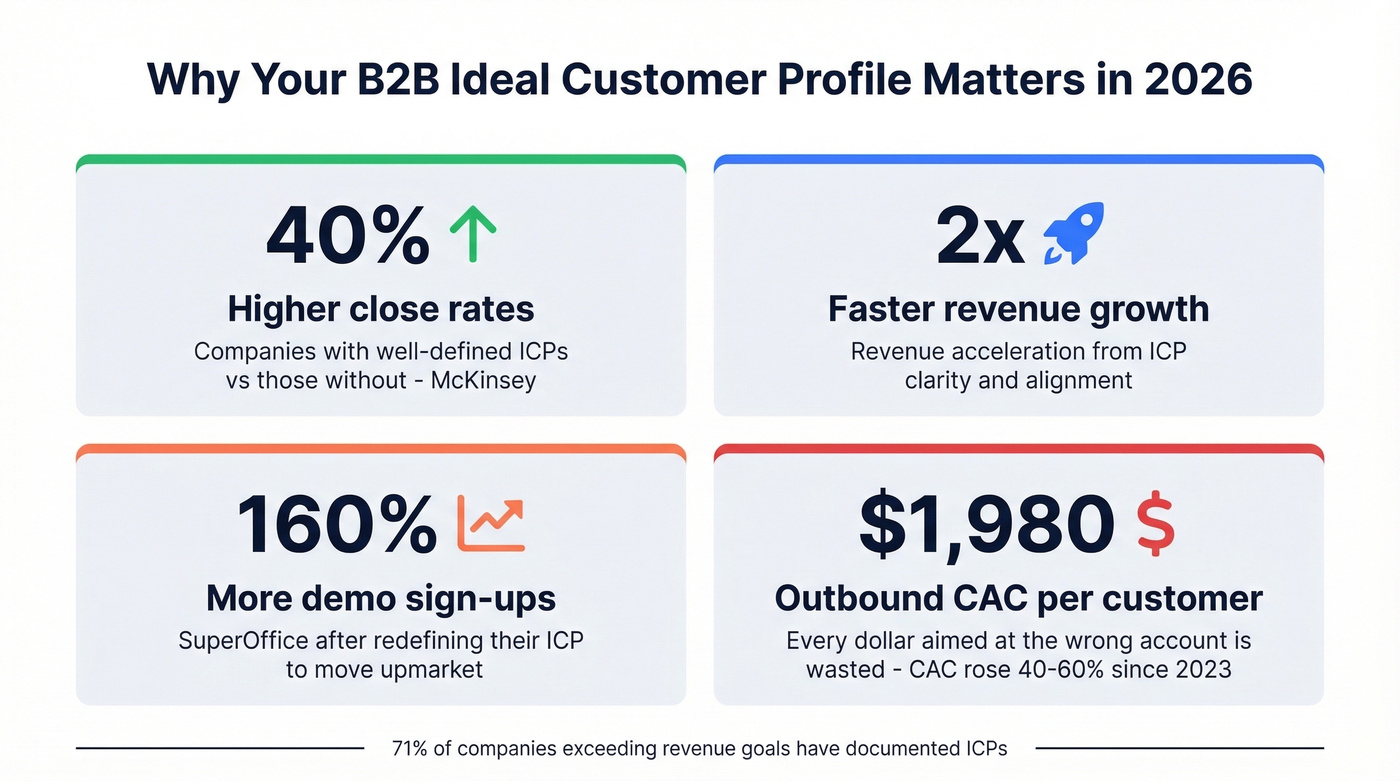
McKinsey's benchmark is blunt: companies with well-defined ICPs see 40% higher close rates and 2x faster revenue growth. Another widely cited figure - ICP clarity drives 68% higher account engagement. And 71% of companies that exceed their revenue and lead goals have documented ICPs. The correlation is hard to ignore.
The most compelling case study we've come across is SuperOffice. After redefining their ICP to move upmarket, they saw a 160% increase in demo sign-ups, 47% larger average deal sizes, and an 80% improvement in customer churn. That's not marginal. That's a different business.
Here's one that's even more actionable: a B2B SaaS company refined their profile from "500+ employees" to "SaaS firms with 200-1,000 employees using HubSpot and showing rapid hiring growth." CAC dropped 30%, win rates doubled, and expansion revenue increased 25%. The ICP didn't change their product. It changed where they pointed it.
The uncomfortable reality is that at least 50% of your prospects aren't a good fit. Every hour an SDR spends on a bad-fit account is an hour not spent on one that would've closed. Companies where fewer than 10% of customers fit the ICP are 50% less likely to survive the next five years. With LinkedIn paid social CAC at $982 and outbound CAC at $1,980, the math gets ugly fast.
The #1 complaint on r/b2bmarketing about ICPs? They become "fairytale personas" - documents built without customer or sales input that nobody opens after the strategy offsite.
When to Define Your ICP
Not every company is ready for a formal ICP. If you're pre-product-market fit, a rigid firmographic profile can actually hurt you by narrowing your learning surface too early.
A useful heuristic: if fewer than 30% of your customers come from referrals, you probably don't have PMF in a segment yet. Look for NPS scores of 9+ among referral customers as an additional signal. Pre-PMF, focus on jobs-to-be-done and psychographic patterns - why people buy, not who they are on paper. Once you've got 50+ customers showing clear patterns, shift to firmographic and technographic criteria.
One rule we enforce with every team we advise: if your ICP doesn't fit on a single slide, it's too complex for adoption. Too strict and your target list shrinks to nothing. Too broad and you're back to spray-and-pray. The slide test keeps you honest.
Watch out for the three mistakes that kill ICPs before they launch: building from gut instinct instead of closed-won data, making the profile so broad it describes half your TAM, and treating it as a one-time exercise instead of a living document.
What to Include in Your B2B Ideal Customer Profile
Most ICP templates list 47 fields. That's a research project, not a targeting tool. Pick the 8-12 fields that actually predict closed-won deals in your business.
| Category | Fields | Why It Matters |
|---|---|---|
| Firmographics | Industry, sub-industry, employee count, revenue, location, funding stage | Core targeting filters |
| Technographics | Tech stack, maturity, infrastructure | Compatibility signals |
| Business Context | Challenges, goals, growth rate | Timing indicators |
| Buying Committee | DM, champion, blocker, gatekeeper, end user | Maps your sales motion |
| JTBD | Jobs-to-be-done, responsibilities, objections | Messaging alignment |
| Channels | Podcasts, communities, conferences, newsletters | Reach strategy |
The buying committee mapping deserves special attention. For a mid-market security tool, your ICP might specify VP of Ops as the primary decision maker, Security Director as the likely blocker, and Finance Manager as the ROI gatekeeper. Knowing these roles before you prospect changes how you sequence outreach and what content you lead with.
Here's the thing: most teams over-index on firmographics and ignore buying committee dynamics entirely. The consensus on r/b2bmarketing is that ICPs fail when they're built like B2C demographic profiles - missing the complexity of how organizations actually buy.

Your ICP is only as good as the data you activate it with. Prospeo gives you 30+ search filters - buyer intent, technographics, headcount growth, funding stage - so you can turn your ideal customer profile into a verified target account list. 300M+ profiles. 98% email accuracy. $0.01 per lead.
Stop building ICPs that live in Notion. Start building lists that book meetings.
How to Build Your ICP Step by Step
Step 1: Mine your closed-won data. Pull 50-100 deals from the last 12 months. Sort by ACV, sales cycle length, and retention. You'll find that 70-80% share 3-5 common traits - industry, company size, tech stack, or growth stage. These patterns are your ICP foundation, and they're hiding in your CRM right now.
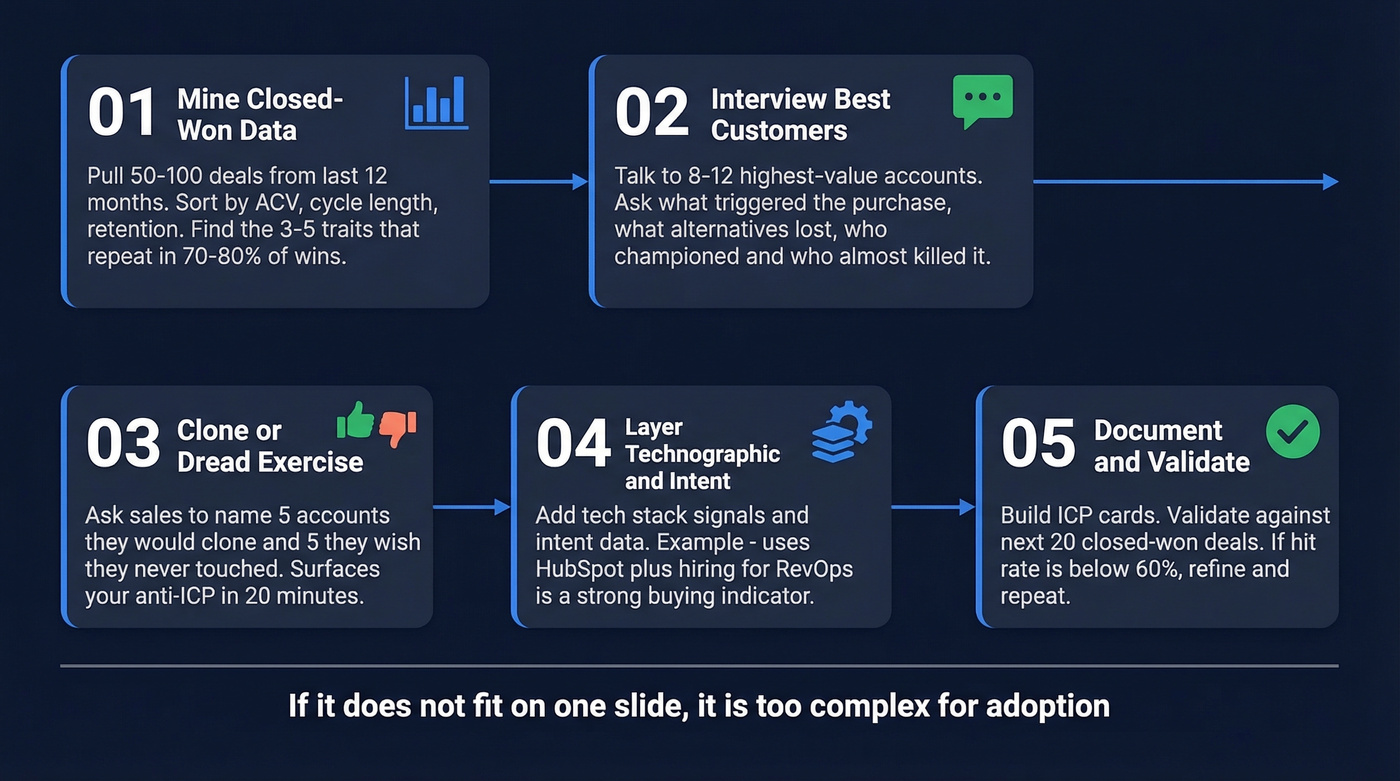
Step 2: Interview your best customers. Talk to 8-12 of your highest-value accounts. Frame these as learning conversations, not sales calls - you're there to understand their buying process, not pitch. The questions that matter most:
- What triggered the purchase? Was there a specific event or pain point?
- What alternatives did you evaluate, and why did they lose?
- Who internally championed the deal, and who almost killed it?
- What would have made you walk away?
This is where you avoid the "fairytale persona" trap - building profiles without customer input produces documents that collect dust.
Step 3: Run the "clone or dread" exercise with sales. Sit down with your reps and ask two questions: "Name five accounts you'd clone if you could" and "Name five you wish you'd never touched." Don't overthink the format - a whiteboard session works. The patterns that emerge are often more honest than any data analysis because reps feel the friction of bad-fit accounts every day. One sales leader told us this exercise surfaced their anti-ICP in 20 minutes flat.
Step 4: Layer in technographic and intent signals. Raw firmographics aren't enough. Look for tech stack signals - "uses HubSpot + hiring for RevOps" is a strong buying indicator for many tools - and intent topics that suggest active evaluation. This is where your ICP moves from static document to dynamic targeting criteria. (If you want a deeper framework, see firmographic and technographic data and identifying buying signals.)
Step 5: Document and validate. Turn your findings into a concrete ICP card. Here's a filled-in example for a mid-market SaaS company:
| Field | Value |
|---|---|
| Company Size | 252 employees |
| Location | San Francisco, CA |
| Revenue | $10M ARR |
| Stage | Series B |
| Pricing Model | Subscription, per-seat |
| Decision Maker | VP of Operations |
| Blocker | Security Director |
| ROI Gatekeeper | Finance Manager |
| Tech Stack | HubSpot CRM + Segment |
That's a single-company snapshot, not a range. Ranges come from aggregating 20-30 of these cards. Validate against your next 20 closed-won deals - if the hit rate is below 60%, refine.
ICP Scoring Rubric
Defining your profile is half the job. The other half is turning it into a scoring model your CRM can enforce. Without scoring, your ICP is a suggestion. With scoring, it's a routing engine.
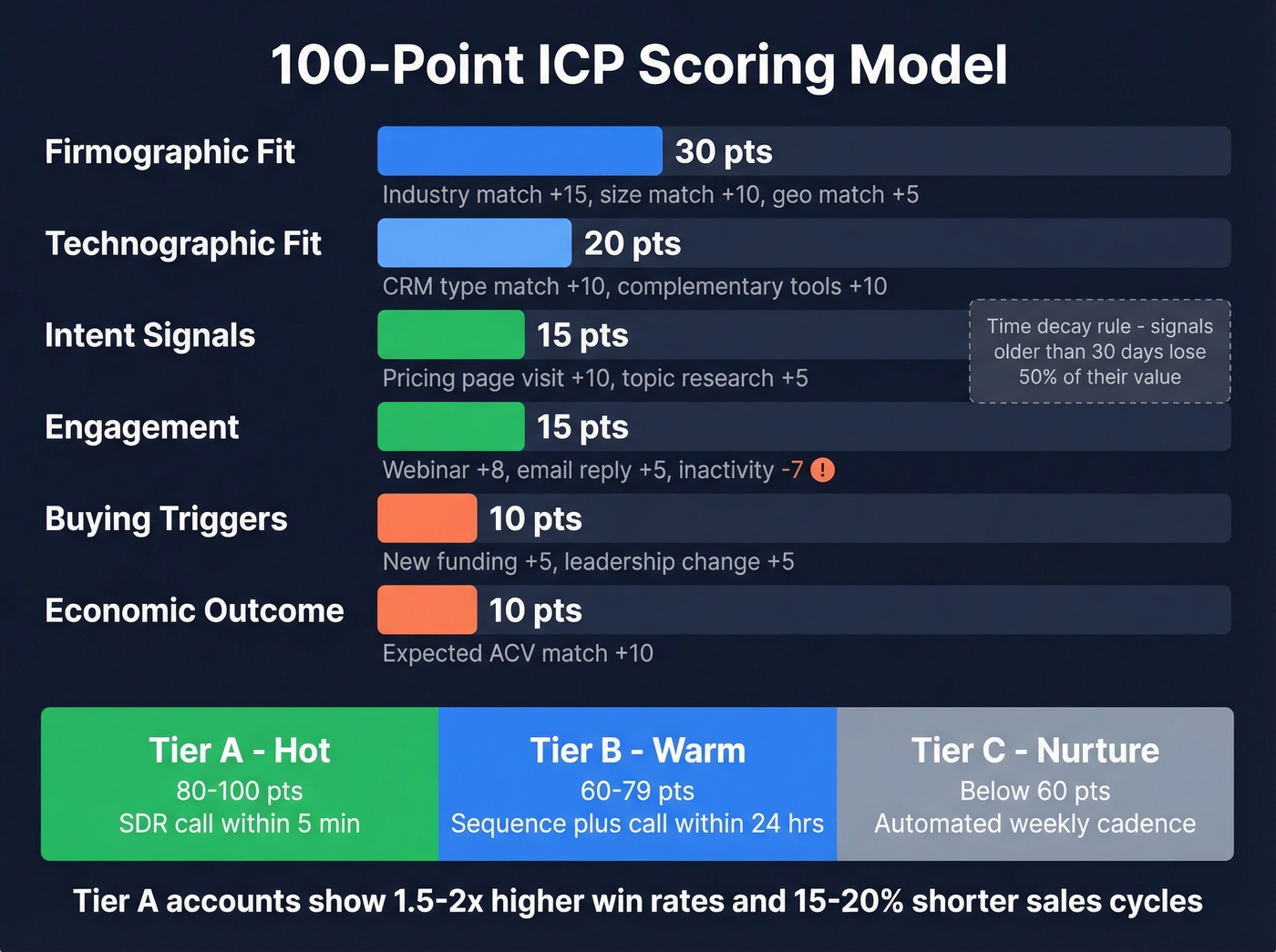
We've seen the best results with a 100-point model across six dimensions:
| Dimension | Weight | Example Criteria | Points |
|---|---|---|---|
| Firmographic Fit | 30% | Industry match +15, size match +10, geo match +5 | 0-30 |
| Technographic Fit | 20% | CRM type match +10, complementary tools +10 | 0-20 |
| Intent Signals | 15% | Pricing page visit +10, topic research +5 | 0-15 |
| Engagement | 15% | Webinar +8, email reply +5, inactivity -7 | -7 to 15 |
| Buying Triggers | 10% | New funding +5, leadership change +5 | 0-10 |
| Economic Outcome | 10% | Expected ACV match +10 | 0-10 |
Apply a time-decay rule: signals older than 30 days lose 50% of their value. A pricing page visit from yesterday is gold. The same visit from six weeks ago is noise.
Once scored, route accounts by tier:
| Tier | Score | Action | SLA |
|---|---|---|---|
| A (Hot) | 80-100 | SDR call | Within 5 minutes |
| B (Warm) | 60-79 | Sequence + call | Within 24 hours |
| C (Nurture) | Below 60 | Automated nurture | Weekly cadence |
Tier A accounts show 1.5-2x higher win rates and 15-20% shorter sales cycles.
One important distinction: this is account scoring, not lead scoring. Lead scoring tracks individual engagement. Account scoring evaluates organizational fit. In B2B, where buying committees run 6-13 people deep, account-level scoring is what actually predicts deals.
Define Your Anti-ICP
Every team has a story about the "big logo" they chased for months, only to realize the account was never going to close - or worse, it closed and churned immediately, burning the team's reputation in-market.
Your anti-ICP is the mirror image of your ICP - the accounts you should actively disqualify. Build it by mining your worst accounts: highest churn, lowest ACV, longest sales cycle, worst NPS. Run the "clone or dread" exercise with your CS team too, not just sales. The patterns are usually obvious once you look. (If you need a framework, start with churn analysis.)
Skip accounts that match your anti-ICP even if they raise their hand. The short-term pipeline hit is worth the long-term efficiency gain.
Hot take: If your average deal size is under $10K, you probably don't need a 13-person buying committee map. A tight ICP with 5 fields and a verified email list will outperform a bloated profile with 47 fields that nobody references. Sophistication isn't complexity - it's knowing which few things matter.
How to Activate Your ICP
A perfect ICP is worthless if your target account list is full of stale data. B2B contact data decays roughly 2.1% per month - that's 22-25% annually. People change jobs, companies get acquired, phone numbers go dead.
Relying on a single data provider typically leaves 40-60% of qualified prospects unreachable. That's where waterfall enrichment comes in - instead of accepting one database's gaps, you query Provider A, then Provider B for any misses, then Provider C, stacking coverage until you've verified every contact. If you're comparing options, see data enrichment services.
For the intent signals dimension of your scoring rubric, you need a data source tracking active buying behavior. Prospeo tracks 15,000 intent topics via Bombora, and its 30+ search filters map directly to ICP dimensions - buyer intent, technographics, job changes, headcount growth, funding, revenue range. Define your ICP criteria, plug those same criteria into the filters, and build a target list from 300M+ profiles. The 98% email accuracy and 7-day data refresh cycle mean you're not sending sequences to dead addresses. (For more on list ops, see how to automate target account lists.)
| Tool | Starting Price | Best For |
|---|---|---|
| Prospeo | Free tier; ~$0.01/email | Accuracy, self-serve, ICP activation |
| ZoomInfo | ~$14,995/year | Large orgs, US depth |
| Apollo | $49/user/month | SMB prospecting + sequences |
| Clay | $149/month | Workflow automation |
You just mapped your buying committee - now you need direct lines to every decision maker, champion, and blocker. Prospeo surfaces verified emails and 125M+ mobile numbers with a 30% pickup rate, refreshed every 7 days so your outreach hits real inboxes, not dead ends.
Reach every stakeholder in your ICP accounts with data that's never more than a week old.
Keep Your ICP Alive
An ICP isn't a one-time exercise. Set a quarterly review cadence and assign ownership to RevOps or marketing ops - not "everyone," which means no one. Both marketing and sales should contribute to each review so the profile reflects pipeline reality, not just top-of-funnel assumptions. (If you're formalizing ownership, see RevOps Manager.)
Trigger an immediate revision when you launch a new product, win rates drop more than 10% below baseline, you notice a cluster of churned accounts sharing traits, or a competitor shift changes your positioning.
For companies with enough data, AI-driven clustering is worth exploring. Feed customer and non-customer data into embeddings, then let clustering algorithms surface patterns humans miss. It won't replace manual ICP work, but it's strong for identifying Tier 2 segments you didn't know existed. Most companies need 1-3 ICPs. If you've got more than 3, your segmentation is probably too broad.
Building a B2B ideal customer profile isn't a strategy offsite deliverable - it's an operational asset that should drive every prospecting decision your team makes. Get the data right, score ruthlessly, and cut the accounts that don't fit. If you want to go deeper on execution, use these sales prospecting techniques to turn your ICP into meetings.
FAQ
What's the difference between an ICP and a buyer persona?
An ICP is a company-level profile - firmographics, technographics, revenue range, and organizational traits that define your best-fit accounts. A buyer persona describes an individual role within the buying committee, including their goals, pain points, and decision-making influence. Define the ICP first, then build personas for key roles within those target companies.
How many ICPs should a company have?
Most companies need one to three. Start with one built from your strongest closed-won patterns. Add a second only when you have clear evidence - different win patterns, different use cases, different buying motions - that a distinct segment exists. More than three usually means your primary ICP needs tightening.
How often should you update your ICP?
Review quarterly at minimum. Trigger an immediate revision if win rates drop 10%+, you launch a new product, or you expand into a new market. B2B data decays 22-25% annually, so your target account list needs the same refresh cadence as your ICP criteria.
What's the fastest way to build a target list from an ICP?
Use a B2B database with filters matching your ICP dimensions - intent signals, technographics, headcount growth, and funding stage. Export to your CRM or sequencer and start outreach the same day.
Can you build an ICP without product-market fit?
You can draft one, but it'll be hypothesis-based rather than data-driven. If fewer than 30% of your customers come from referrals, focus on jobs-to-be-done research first. Refine the ICP once you have 50+ customers showing clear firmographic and technographic patterns.