

The Outbound Lead Generation Strategy Playbook for 2026
Your SDR team launched three weeks ago. Emails are bouncing at 25%, the primary domain just got flagged by Google, and the reply rate is hovering around 1%. The CEO wants to know what went wrong. You skipped the infrastructure and jumped straight to "send cold emails." Building an outbound lead generation strategy that actually works requires getting the foundation right first - and almost nobody does.
84% of reps missed quota last year. Most outbound fails not because the strategy is bad, but because the foundation - data quality, deliverability, compliance - was never built. Every guide tells you to "define your ICP and write compelling emails." None of them cover the hard parts that actually determine whether those outbound leads land in an inbox or a spam folder.
This playbook covers the hard parts first.
What You Need Before Sending Anything
If you read nothing else, do these five things before sending a single outbound email:
- Define your ICP at the buying-committee level. Not just "VP of Marketing at SaaS companies" - map the 10+ people involved in a typical B2B purchase. (If you need a starting point, use an ICP template.)
- Start with verified data. Bad data poisons everything downstream. If your contacts aren't verified within the last week, assume they're stale. (See email bounce rate benchmarks to sanity-check your lists.)
- Set up deliverability infrastructure. SPF, DKIM, DMARC on a dedicated sending domain. Warm it up for 4-6 weeks before you send anything.
- Build a multichannel cadence. Email alone won't cut it. Layer in calls, video, and social touches across 7-10 business days. (More sales prospecting techniques here.)
- Know the compliance rules. TCPA, CAN-SPAM, GDPR, and the FCC's one-to-one consent rule will cost you six figures if you ignore them.
Outbound Benchmarks for 2026
Before building anything, you need to know what "good" looks like:
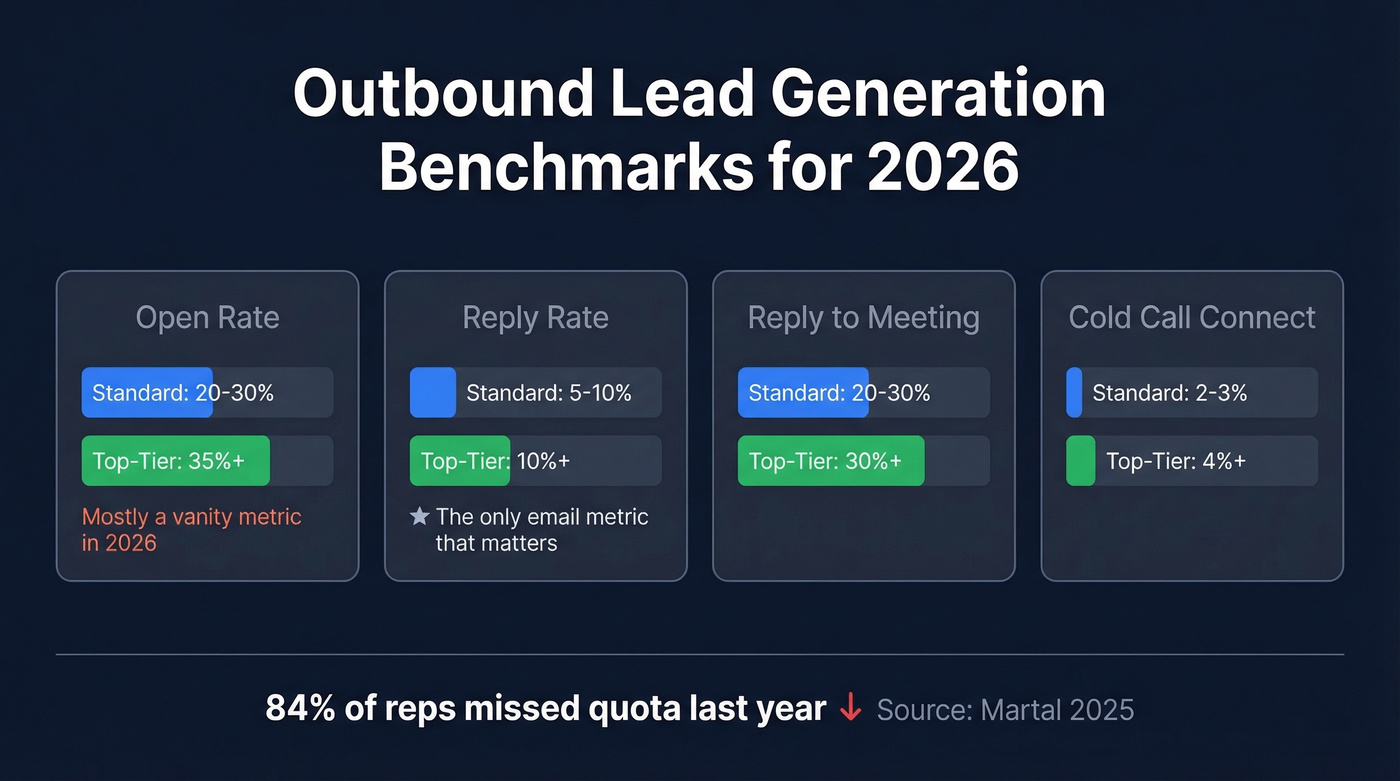
| Metric | Standard | Top-Tier |
|---|---|---|
| Open rate | 20-30% | 35%+ |
| Reply rate | 5-10% | 10%+ |
| Reply to meeting | 20-30% | 30%+ |
| Cold call connect | 2-3% | 4%+ |
Open rates are a vanity metric in 2026. Apple Mail Privacy Protection and Gmail's spam filters have made them nearly meaningless - your "45% open rate" is probably inflated by bots pre-fetching images. Reply rate is the only email metric that matters. (If you still want open-rate context, use this good email open rate guide.)
80% of B2B sales interactions now happen in digital channels. Buyers use roughly 10 interaction channels on average, up from 5 in 2016. Reply rates dropped 12% year-over-year. Multichannel outreach increases response rates 30-50% vs single-channel, which means email-only outbound is leaving pipeline on the table.
Build Your ICP and Buying Committee
Every outbound guide tells you to "define your ICP" as step one, then moves on like it's a five-minute exercise. It's not. A lazy ICP is the single biggest reason outbound campaigns underperform.
Start with firmographics - industry, headcount, revenue, geography. Then layer technographics: what tools does your ideal customer already use? A company running Salesforce and Outreach has a fundamentally different buying profile than one on HubSpot free tier. Finally, add intent signals: are they hiring for roles your product supports? Did they just raise a round? (If you want a system for this, use firmographic and technographic data plus identifying buying signals.)
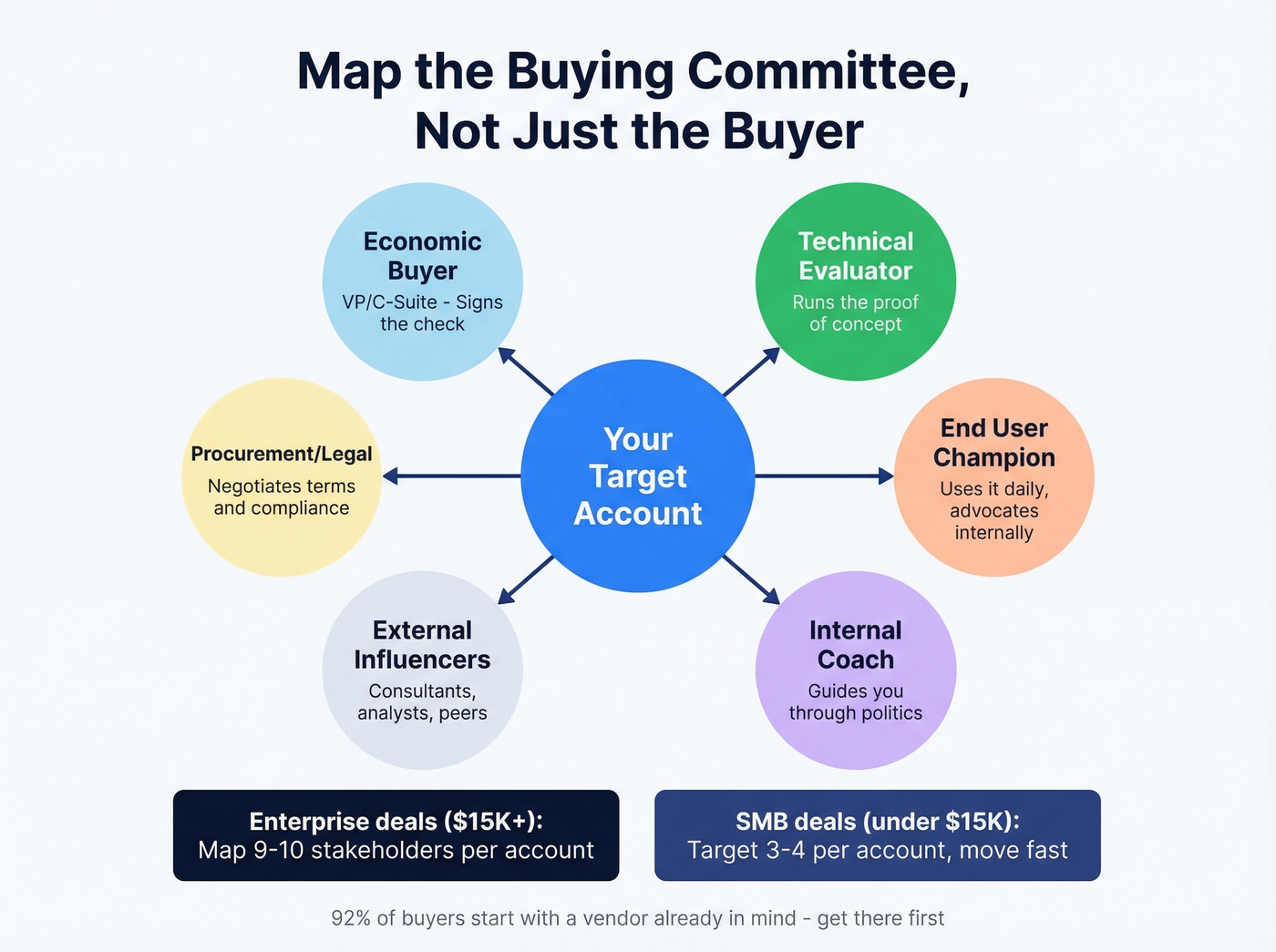
Here's where most teams stop too early. The average B2B buying group is 10-11 people, and when you count external influencers, that number climbs past 20. 92% of buyers start with at least one vendor already in mind. If you're only emailing the VP, you're missing the other 9 people who influence the decision.
The best outbound teams multithread aggressively. This is account-based prospecting in practice: 90% of top-performing BDRs reach roughly 9 people per account. Your ICP isn't a single persona - it's a buying committee map. Build lists that include the economic buyer, the technical evaluator, the end user champion, and the internal coach. (For a deeper playbook, see account-based selling best practices.)
If your average contract value is under $15K, you probably don't need to map 10 stakeholders. Target 3-4 per account and move fast. Multithreading matters most on enterprise deals where consensus kills momentum.
One more thing that separates good outbound from great: use inbound signals to prioritize outbound targets. Someone downloaded your whitepaper or hit your pricing page? That account jumps to the top of your outbound list. A hybrid inbound-outbound approach reduces lead costs by 31% compared to running either channel in isolation.
Data Quality Is the Strategy
Your outbound program is only as good as your data. B2B contact data decays 22-70% annually. People change jobs, companies restructure, email domains rotate. If your data provider can't tell you when a record was last verified, assume it's stale. (If you're evaluating vendors, start with email list providers and data enrichment services.)
We've seen the pattern dozens of times. Finance is asking why you're paying for three data tools and your bounce rate is still 25%. The answer is usually that the "verified" contacts were verified six months ago and nobody's re-checking them.
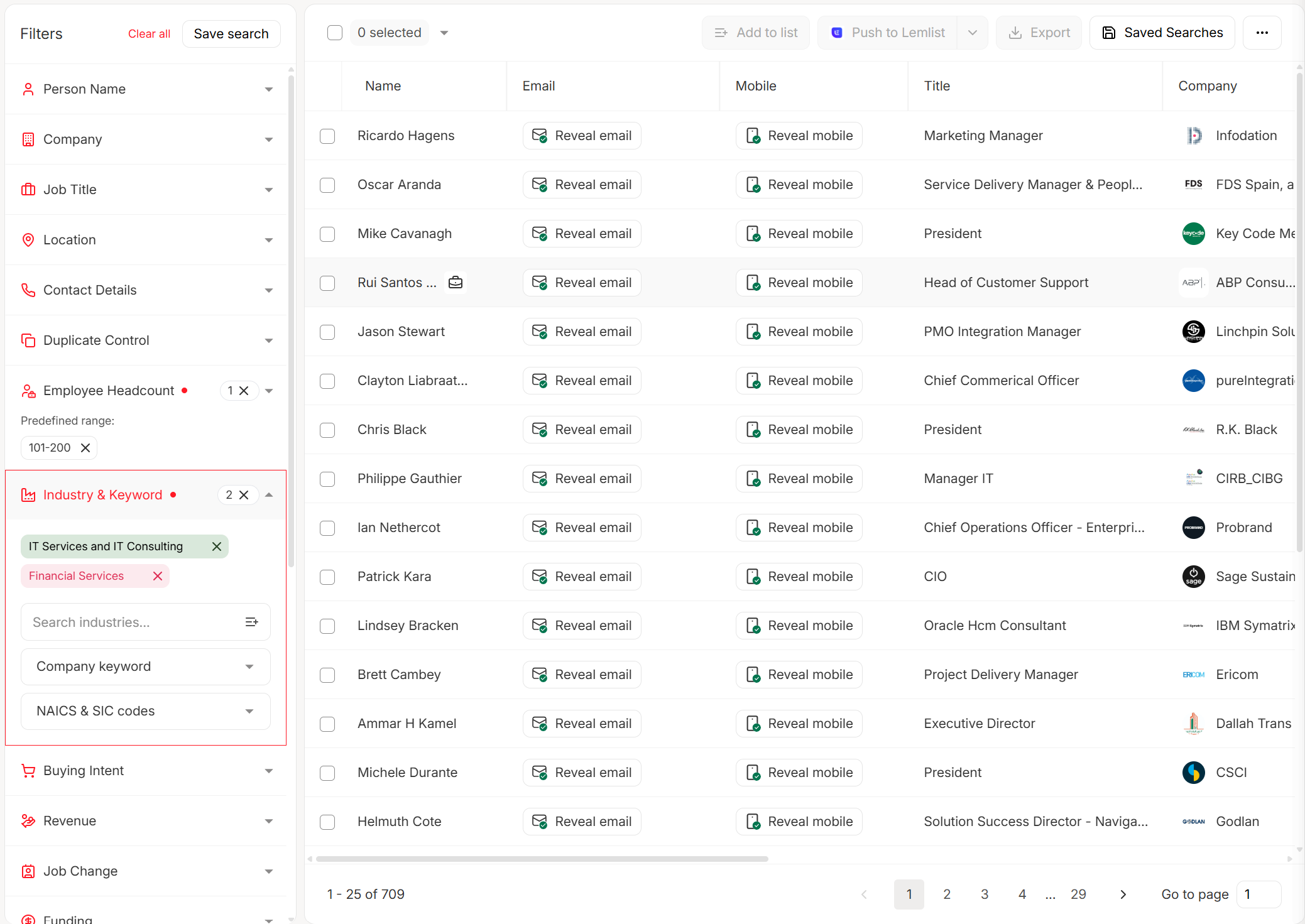
The Reddit consensus on data quality is clear: use at least two verifiers, and don't trust any single provider's "verified" label without testing it yourself. Export a tight ICP list of ~1,000 contacts, verify separately, and measure actual bounce rates before scaling.
Email Deliverability Setup
Look, outbound without a deliverability foundation is just spam with a strategy deck. This section is the biggest gap in most outbound guides, and it's the reason most SDR teams flame out in the first month.
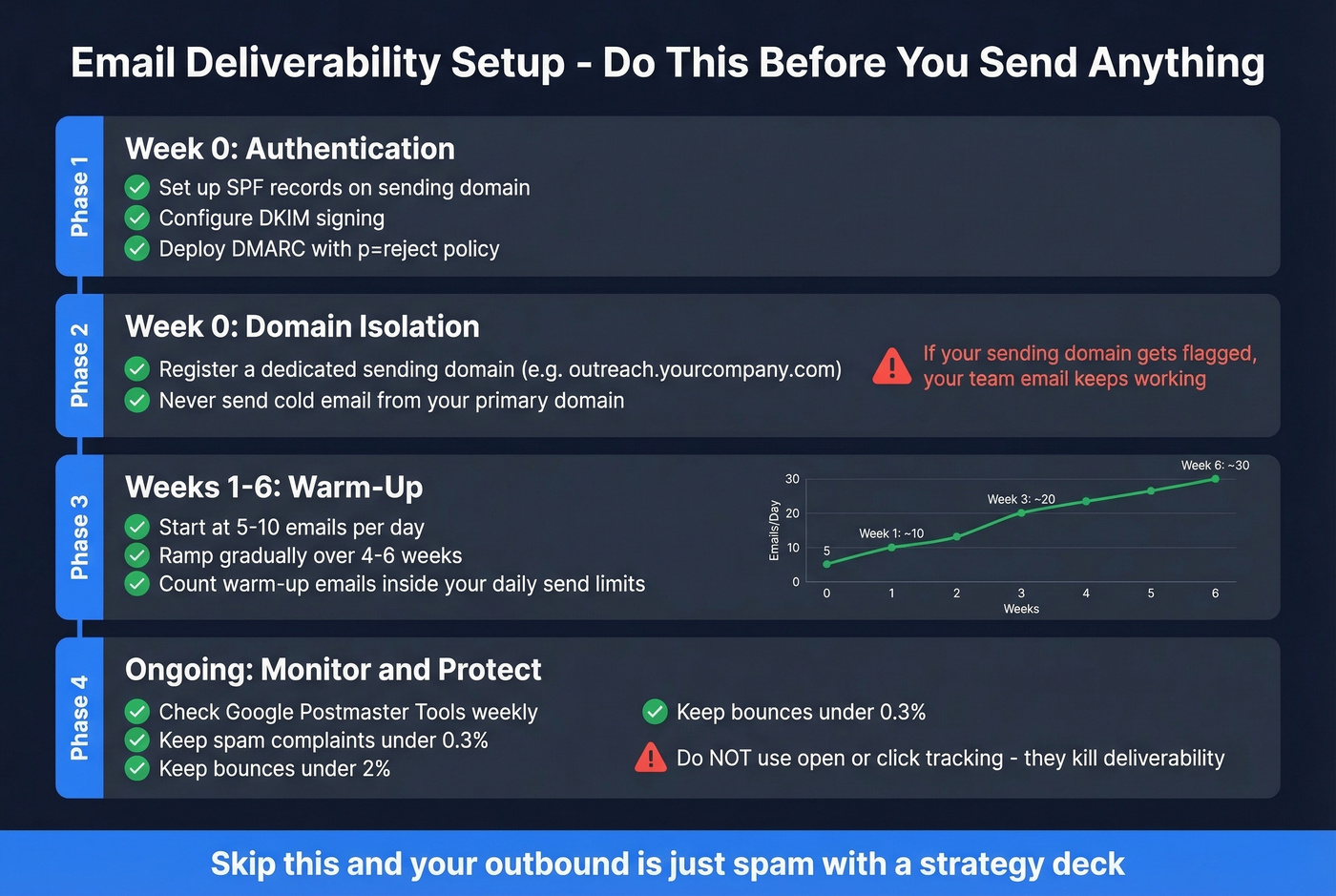
Authentication is non-negotiable. Set up SPF, DKIM, and DMARC on every sending domain. DMARC with p=reject is fast becoming the standard - anything less signals to inbox providers that you're not serious about email security. (If you want to go deeper, see our email deliverability guide.)
Use a dedicated sending domain. Never send cold email from your primary domain. Register a subdomain or a separate domain (e.g., outreach.yourcompany.com) and isolate your cold email reputation from your corporate email. If the sending domain gets flagged, your team's day-to-day email keeps working.
Warm up properly. Start new domains at 5-10 emails per day and ramp over 4-6 weeks. Count warm-up emails inside your daily send limits - if your total capacity is 30/day, that's 25 outreach emails and 5 warm-up, not 30 plus warm-up on top. (Use email velocity to set safe sending limits.)
Monitor continuously. Google Postmaster Tools and Microsoft SNDS give you real-time visibility into domain reputation and delivery rates. Check them weekly.
2026 Bulk Sender Rules (Google/Yahoo/Microsoft)
- Spam complaints: under 0.3%
- Bounces: under 2%
- Authentication: SPF + DKIM + DMARC with domain alignment
- One-click unsubscribe: RFC 8058 headers required (List-Unsubscribe + List-Unsubscribe-Post)
One more thing that practitioners on r/LeadGeneration consistently flag: don't use open or click tracking. Tracking pixels and link wrapping will kill your deliverability. Inbox providers treat them as spam signals. Reply rate is your metric - you don't need to know who opened if nobody's responding. (If you want the technical why, see email tracking pixels.)

B2B contact data decays up to 70% per year. Prospeo refreshes every record on a 7-day cycle - not the 6-week industry average. With 98% email accuracy and 5-step verification that catches spam traps and honeypots, your bounce rate stays under 2% where inbox providers want it.
Stop poisoning your deliverability with stale data.
Build Your Multichannel Outbound Cadence
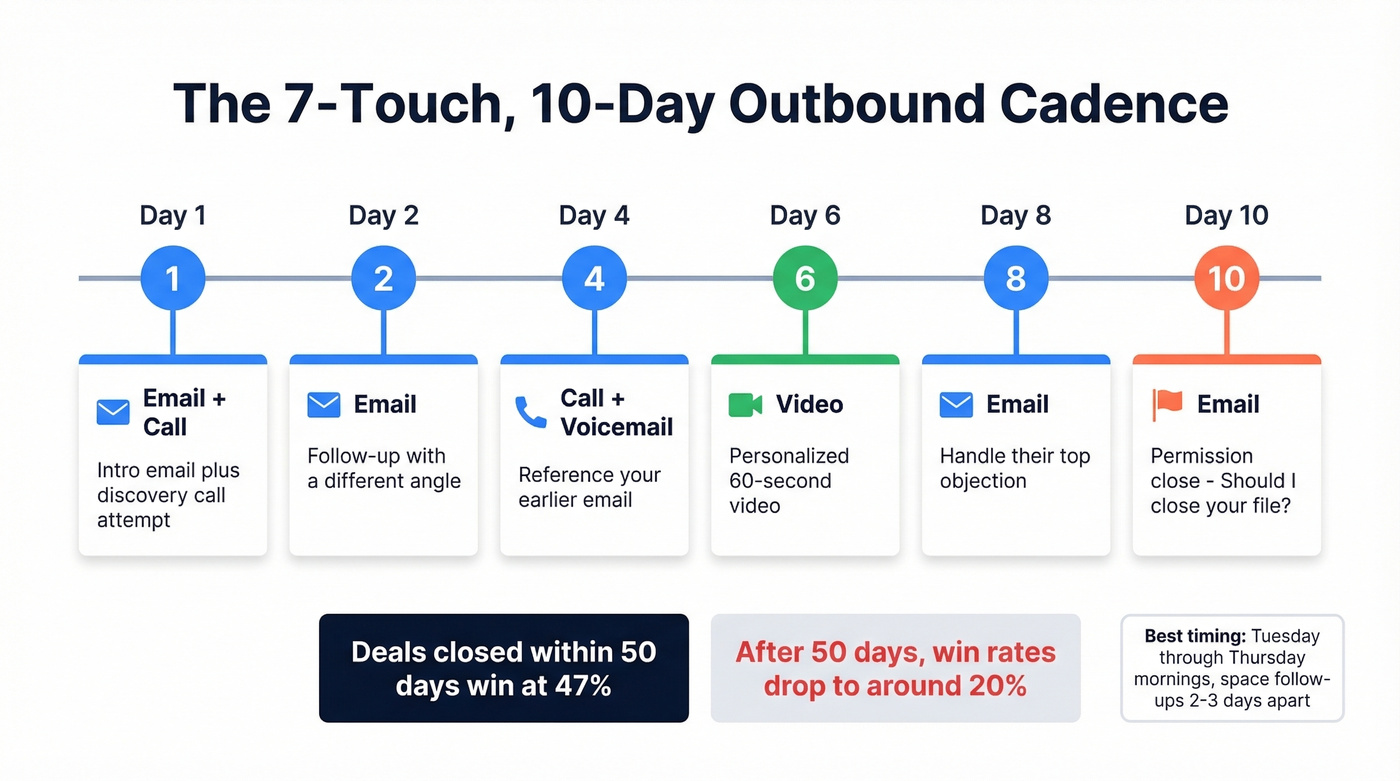
The 7-touch, 10-day cadence is the framework we've seen work most consistently across different industries and deal sizes. Every touch has a specific job - a new angle, proof point, or ask. Delete "just checking in" from your vocabulary. (If you need language alternatives, see how to say just checking in professionally.)
| Day | Channel | Purpose |
|---|---|---|
| 1 | Email + Call | Intro email + discovery call attempt |
| 2 | Follow-up with different angle | |
| 4 | Call + VM | Voicemail referencing email |
| 6 | Video | Personalized 60-sec video |
| 8 | Objection-handling email | |
| 10 | Permission close ("Should I close your file?") |
Top-performing BDRs average roughly 21 attempts per contact across a mix of ~8 calls, ~8 emails, and ~5 social touches. That's across multiple cadence cycles, not a single sequence.
Here's the urgency driver: opportunities closed within 50 days win at 47%. After 50 days, win rates drop to ~20% or lower. Front-load your effort. Route replies to a booking link immediately - delays between reply and meeting kill conversion.
Timing matters. Initial touches land best midweek mornings, Tuesday through Thursday. Space follow-ups 2-3 days apart - daily emails feel desperate, weekly emails lose momentum. (More data in best time to send cold emails.)
For teams just starting out, a simpler 5-touch cadence works fine: social connect on Day 1 (no pitch), personalized cold email on Day 2, follow-up with a resource on Day 4, cold call plus voicemail on Day 7, and a social message referencing their recent content on Day 10. Scale to the 7-touch version once your team has the infrastructure to support it.
Cold Email That Gets Replies
The best-performing cold email template we've seen on Reddit claimed a consistent 30% reply rate. It's five sentences.
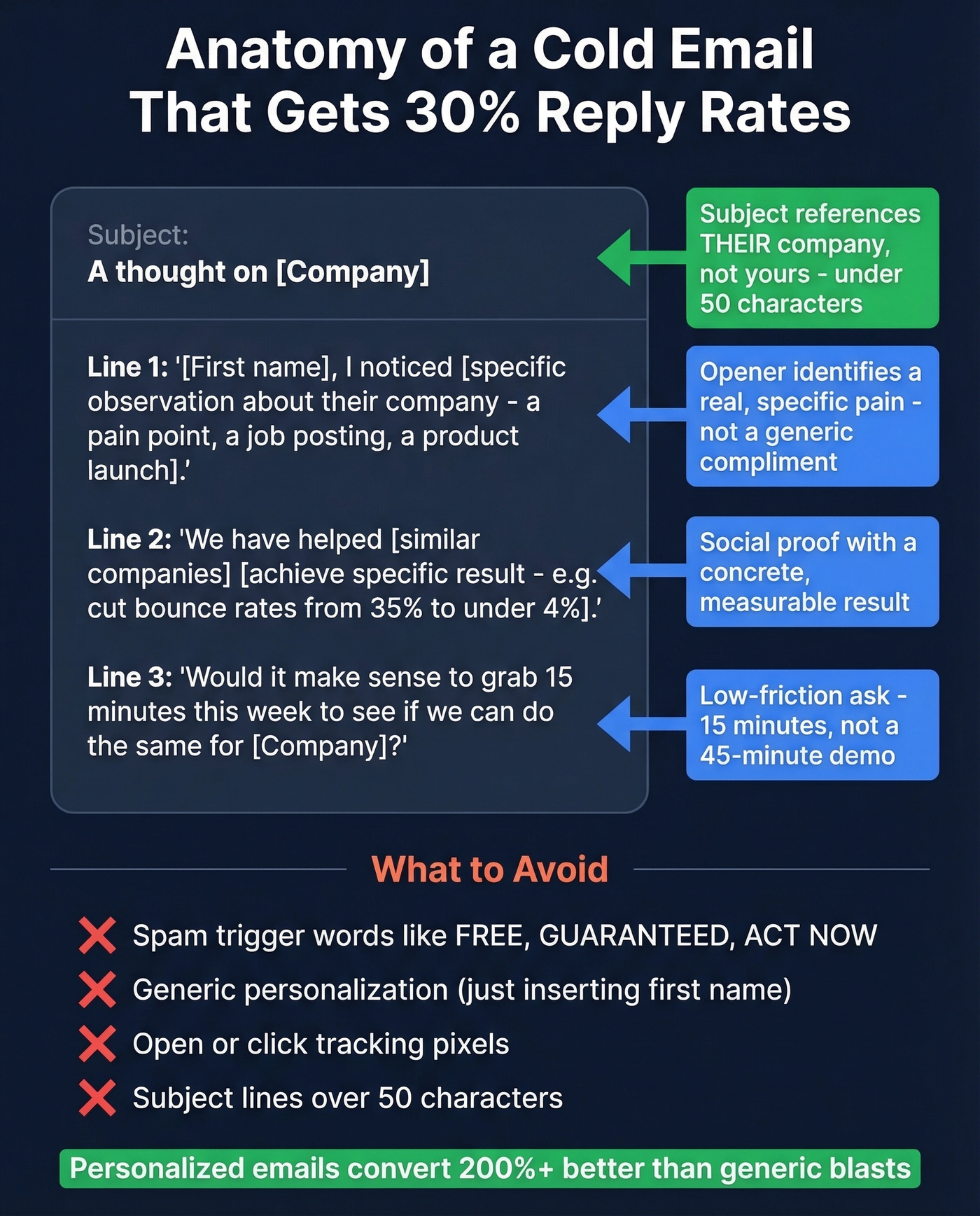
Subject: A thought on [Company]
[First name], I noticed [specific observation about their company or role - a pain point, a job posting, a product launch].
We've helped [similar companies] [achieve specific result - e.g., "cut bounce rates from 35% to under 4%" or "increase pipeline 140%"].
Would it make sense to grab 15 minutes this week to see if we can do the same for [Company]?
The structure works because it's prospect-first. The subject references their company, not yours. The opener identifies a real pain. The body provides social proof with a concrete result. The ask is low-friction - 15 minutes, not a 45-minute demo.
Here's a second variant that works well for warm accounts - prospects who've visited your site or engaged with content:
Subject: Quick question, [First name]
Saw [Company] has been researching [topic/category]. Curious whether [specific challenge] is on your radar this quarter.
Happy to share what we're seeing work for [similar companies] if useful. Worth a quick chat?
This one works because it signals you know they're in-market without being creepy about it. Keep it under four sentences.
Operational rules that protect your reply rate:
- Keep subject lines under 50 characters (use these cold email subject line examples if you need ideas)
- Avoid spam trigger words: "FREE," "GUARANTEED," "LIMITED TIME," "ACT NOW"
- Personalization means referencing a specific pain or trigger event - not just inserting
{{first_name}}. Personalized emails convert 200%+ better than generic blasts. - Segment by role and company size - the email to a CFO should read differently than the one to a Director of Sales
- Verify every list before sending - a 25% bounce rate will tank your domain reputation in a single campaign
What to Track Weekly
Setup without measurement is just hope. Here's what to review every Monday morning.
Reply rate by segment. Break this down by persona, industry, and company size. If Directors of Engineering reply at 12% but VPs of Sales reply at 3%, your messaging for the sales persona needs work - not your entire strategy.
Bounce rate by list source. Track which data source produces the cleanest contacts. If one provider consistently bounces above 5%, stop using it. This single metric will save you thousands in wasted sends and domain reputation damage.
Meetings booked per 100 contacts. This is your north star. Industry average is 2-3 meetings per 100 contacts reached. Top teams hit 5+. If you're below 2, diagnose whether the problem is data quality (high bounces), deliverability (low inbox placement), or messaging (low reply rate).
Domain reputation score. Check Google Postmaster Tools and Microsoft SNDS weekly. A reputation drop from "High" to "Medium" means your emails are heading to spam. Pause sending and investigate before it gets worse. (If you need a checklist, see how to improve sender reputation.)
AI-powered tools can accelerate this feedback loop. Predictive lead scoring helps teams reach 3-5x more accounts without sacrificing relevance, and AI personalization at scale - dynamically adjusting messaging based on persona, industry, and intent signals - is quickly becoming table stakes for teams running more than 500 contacts per month.
Your Outbound Tech Stack
You don't need 10 tools. You need 3-4 that integrate cleanly. (If you want a broader shortlist, see best outbound lead generation tools.)
| Category | Top Pick | Alternative | Price Range |
|---|---|---|---|
| Enrichment | Clay | Clearbit | ~$150-500/mo |
| Cold Email | Smartlead | Instantly | ~$39-94/mo |
| Social Automation | HeyReach | Expandi | ~$79-199/mo |
| Intent Signals | Trigify | UserGems | ~$200-600/mo |
| CRM | HubSpot (free) | Salesforce | Free-$75/user/mo |
A key distinction in the data category: Apollo is widely described as user-populated, and many teams still run separate verification on Apollo exports. Prospeo runs its own email-finding infrastructure with a 5-step verification process, which is why the accuracy gap is significant - 98% vs 79%.
For context, a 10-seat ZoomInfo contract with intent data and mobile numbers typically runs $15-40K/year. Most teams under 50 reps don't need it. The "under $200/month" stack - Prospeo plus Smartlead plus HubSpot free - covers data, sending, and CRM for around $200/month. That's less than a single ZoomInfo seat.
Let's be honest about enrichment: Clay is expensive but worth it. The consensus on r/sales is that it's the best enrichment tool available, even if the credit costs add up. Use it to layer on technographic and firmographic data after your initial pull and verification.
Compliance You Can't Ignore
These are the rules with real dollar amounts attached. Skip this section at your own risk.
- TCPA: $500 per violation, up to $1,500 for willful violations. Send 1,000 texts without proper consent and you're looking at $500K-$1.5M in exposure. No calls before 8 a.m. or after 9 p.m. local time.
- CAN-SPAM: Up to $50,120 per email. Requires truthful headers, a physical mailing address, and opt-out processing within 10 business days.
- GDPR: 4% of global annual revenue or EUR 20M, whichever is higher. Applies to any EU resident you contact, regardless of where your company is based.
- FCC One-to-One Consent (in effect since January 2025): This is the rule most teams don't know about. The FCC closed the "lead generator loophole" - you now need separate Prior Express Written Consent for each seller. No more blanket consent across multiple partners. No pre-checked boxes. If you buy or share leads across partners, this rule changed everything.
SMS has its own layer: opt-out keywords like "STOP" must be processed immediately, and you need explicit opt-in before sending any marketing text.
Compliance rules are getting stricter, not looser. Build consent collection into your lead capture forms now, before a class action lawsuit does it for you.
Multithreading 9+ contacts per account means you need a database that actually covers the full buying committee. Prospeo gives you 300M+ profiles with 30+ filters - buyer intent, technographics, job changes, headcount growth - so you build lists that match your ICP at the committee level, not the persona level.
Map the entire buying committee at $0.01 per verified email.
FAQ
How many touches before giving up on a prospect?
21 attempts across calls, emails, and social is the benchmark for a full outbound lead generation strategy. Start with a 7-touch minimum over 10 business days. Opportunities closed within 50 days win at 47% - after that, win rates crater to ~20%.
What's a good reply rate for cold outbound?
5-10% is standard; above 10% is top-tier. Below 3%, don't tweak your copy - check your deliverability setup and data quality first. A high bounce rate suppresses replies regardless of how good your messaging is.
How do I keep cold emails out of spam?
Set up SPF, DKIM, and DMARC with p=reject on a dedicated sending domain. Warm up for 4-6 weeks. Verify every contact list before sending - keep bounces under 2%. Kill tracking pixels and link wrapping entirely. Monitor Google Postmaster Tools weekly.
What's the best free tool for outbound prospecting data?
Prospeo's free tier includes 75 verified emails and 100 Chrome extension credits per month - enough to test a campaign on a tight ICP list. Apollo and Hunter also offer free tiers, but we've found the accuracy difference matters more than the credit count when you're protecting a new domain's reputation.
What matters most in an outbound lead generation strategy?
Data quality. Everything else - your cadence, your copy, your tech stack - depends on reaching real people at valid email addresses. A brilliant email that bounces or lands in spam generates exactly zero pipeline.