

The Best B2B Marketing Tools in 2026: What They Cost and When You Need Them
There are 15,384 martech solutions on the market - a 100X increase since 2011. The average B2B org runs 12-20 of them, 62.1% of marketing pros report using more tools than two years ago, and 61% cite cost as their top concern. That's not a tools problem. That's a decision-making problem.
We've spent years helping teams build and audit their stacks, and the pattern is always the same: companies overspend on platforms they half-use and underspend on the data layer that makes everything else work. Meanwhile, AI-native features - from HubSpot's Breeze agents to Demandbase's Agentbase - are reshaping what these platforms can do on their own. The tools are smarter than ever. The buying decisions aren't. Let's fix that.
Our Picks
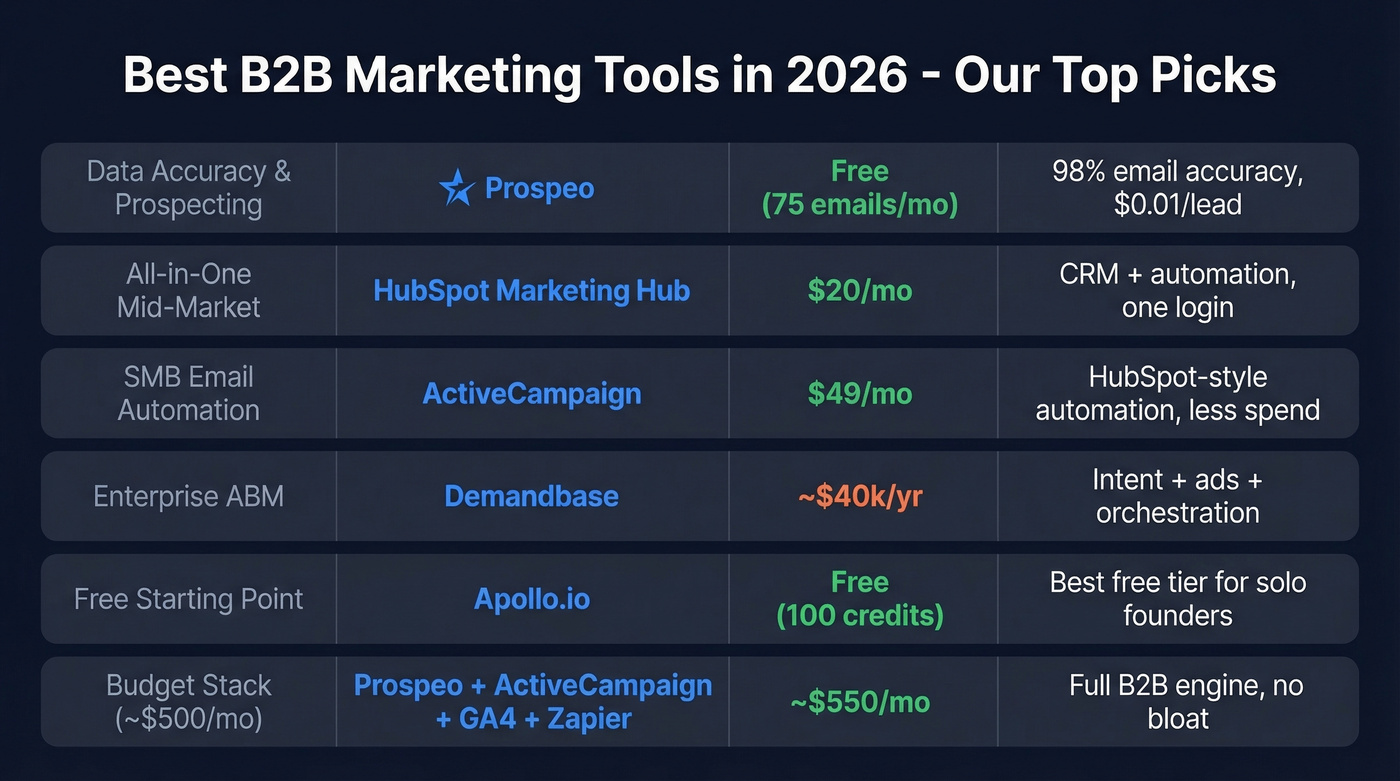
| Use Case | Tool | Starting Price | One-Line Verdict |
|---|---|---|---|
| Data accuracy & prospecting | Prospeo | Free (75 emails/mo) | 98% email accuracy, $0.01/lead |
| All-in-one mid-market | HubSpot Marketing Hub | $20/mo | CRM + automation, one login |
| SMB email automation | ActiveCampaign | $49/mo | HubSpot-style automation, less spend |
| Enterprise ABM | Demandbase | ~$40k/yr | Intent + ads + orchestration |
| Free starting point | Apollo.io | Free (100 credits) | Best free tier for solo founders |
| Budget stack (~$500/mo) | Prospeo + ActiveCampaign + GA4 + Zapier | ~$550/mo | Full B2B engine, no bloat |
Top B2B Marketing Tools by Category
Data & Enrichment Tools
Here's a stat that should change how you think about your data layer: an independent benchmark of 15 email verification tools testing 3,000 real emails found the best performer scored just 70% accuracy. That's the ceiling for most of the market. The gap between "good enough" data and actually-verified data is where pipeline goes to die.
If you're evaluating vendors in this category, start with a clear definition of data enrichment (and what it should return per record), then compare providers on refresh cycles and match rates - not just database size.
Prospeo
Use this if you need verified emails and direct dials that actually connect - and you don't want to negotiate a five-figure annual contract to get them.
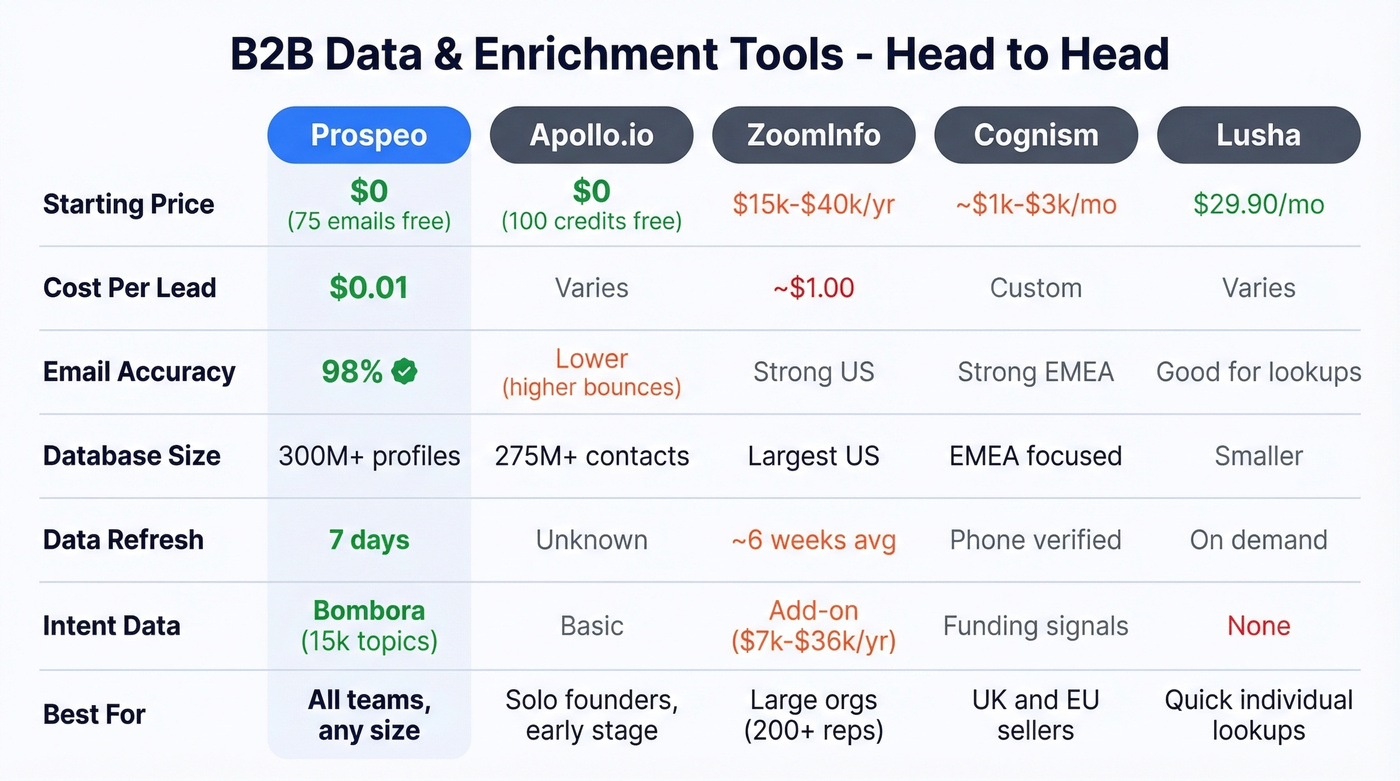
Prospeo covers 300M+ professional profiles with 98% email accuracy, 143M+ verified emails, and 125M+ verified mobile numbers. The 7-day data refresh cycle matters more than most teams realize: the industry average is about 6 weeks, which means you're emailing people who changed jobs a month ago. Prospeo catches those changes in days.

The search filters go deep - 30+ options including buyer intent powered by Bombora across 15,000 topics, technographics, job changes, headcount growth, and funding signals. The Chrome extension has 40K+ users and works across company websites and CRMs. For enrichment, the API returns 50+ data points per contact at a 92% match rate.
Real-world proof: Snyk's team of 50 AEs was running bounce rates of 35-40% before switching. After Prospeo, bounces dropped under 5%, AE-sourced pipeline jumped 180%, and they're generating 200+ new opportunities per month.
Pricing is transparent and self-serve. About $0.01 per email, 10 credits per mobile number. Free tier gives you 75 emails and 100 Chrome extension credits per month. No contracts, no sales calls required.
Pair with Instantly, Lemlist, or Outreach if you also need sequence management and a dialer.

Your marketing stack is only as good as the data feeding it. Prospeo gives you 300M+ profiles with 98% email accuracy, 7-day refresh cycles, and intent signals across 15,000 topics - at $0.01/email. Snyk's 50-person sales team cut bounce rates from 40% to under 5% and grew pipeline 180%.
Stop overspending on platforms and underspending on the data layer.
Apollo.io
Apollo is the obvious starting point for founders and early-stage teams who need to start prospecting today with zero budget. The free tier gives you 100 credits per user per month, and the 275M+ contact database is surprisingly solid for a free product.
Paid plans run $59/user/month (Basic) and $99/user/month (Professional). Where Apollo falls short: data accuracy on mobile numbers, enterprise-level intent signals, and email verification - bounce rates run noticeably higher in our testing, especially on mid-market domains. If you're sending more than a few hundred emails per week, those bounces add up fast.
If you're building outbound from scratch, it helps to standardize your sales prospecting techniques before you add more tools.
ZoomInfo
ZoomInfo is the incumbent for a reason - the US database depth is unmatched, and the platform does everything from intent to chat to workflow automation. But that breadth comes at a cost. A mid-market contract typically runs $15k-$40k/year, and the intent add-on tacks on another $7.2k-$36k/year.
Here's my honest take: ZoomInfo is still the best all-in-one GTM platform for large orgs. But most teams don't need all-in-one. At roughly $1/lead versus $0.01/lead from a dedicated data provider with higher email accuracy, you're paying 90x more per contact for features you'll never touch. ZoomInfo makes sense for 200+ person sales orgs that need the full GTM suite. For everyone else, the ROI math doesn't hold.
Cognism
Cognism is the EMEA specialist - GDPR-first compliance, phone-verified mobile numbers, and strong European coverage. Their own data shows companies that recently raised funding are 2.5x more likely to buy, which makes their funding signal filters particularly useful. Custom pricing typically lands at ~$1k-$3k/month. Best for teams selling into the UK and EU who need compliant direct dials.
Lusha
Lusha is the quick-lookup tool. Pro at $29.90/month, Premium at $69.90/month. Good for individual reps who need a phone number right now, less useful as a full prospecting platform.
Marketing Automation Platforms
HubSpot Marketing Hub
Let's be direct about HubSpot's pricing, because the gap between the marketing and the reality is enormous.
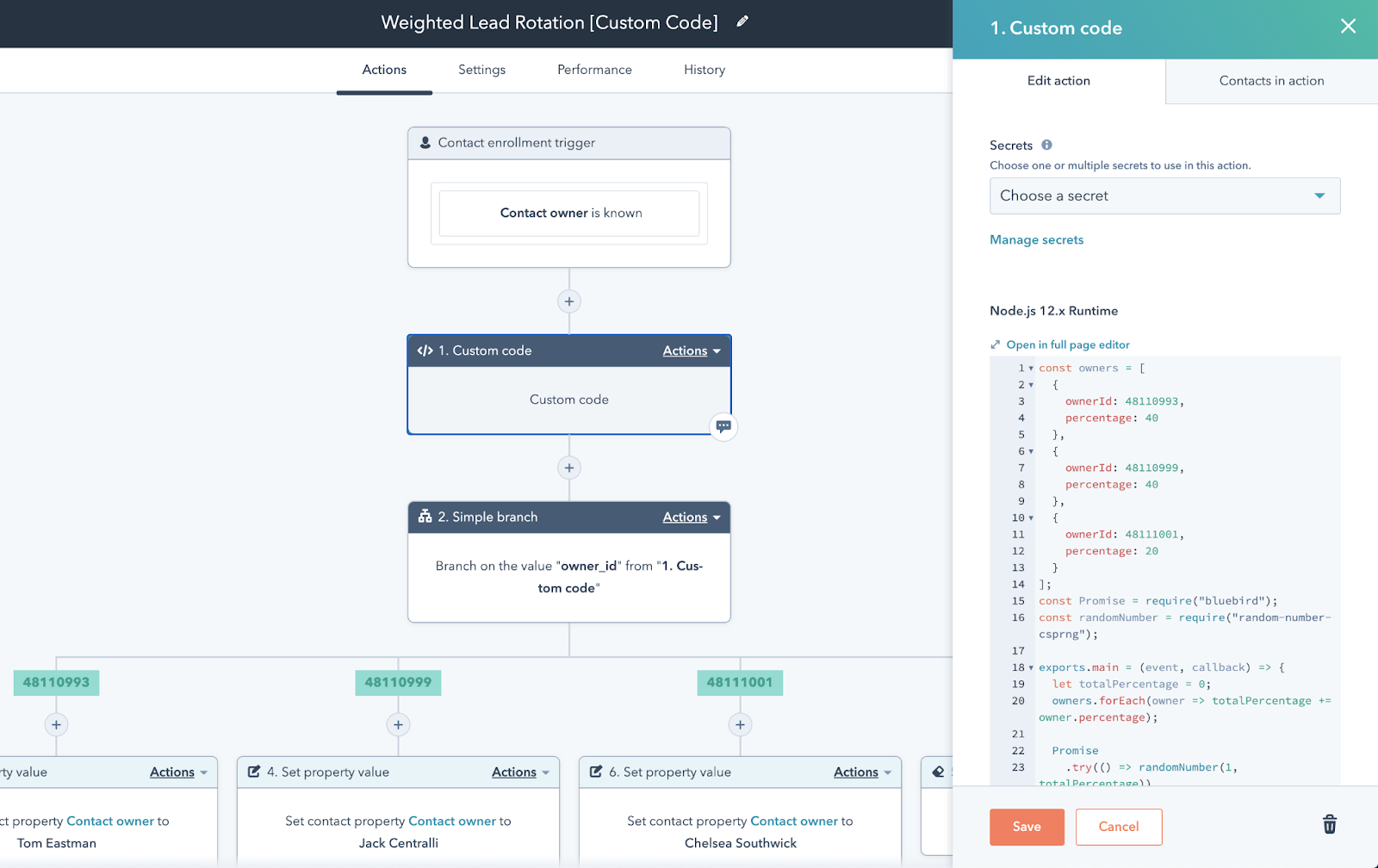
HubSpot is a genuinely excellent all-in-one platform. CRM, automation, reporting, landing pages, email - one login, one data model. Gartner rates it 4.4/5 across 2,180 ratings, and G2 reviewers consistently praise the simplicity. The ecosystem of integrations is unmatched. The new Breeze AI tools can draft emails and summarize records inside HubSpot. For mid-market teams that want simplicity, it's hard to beat.
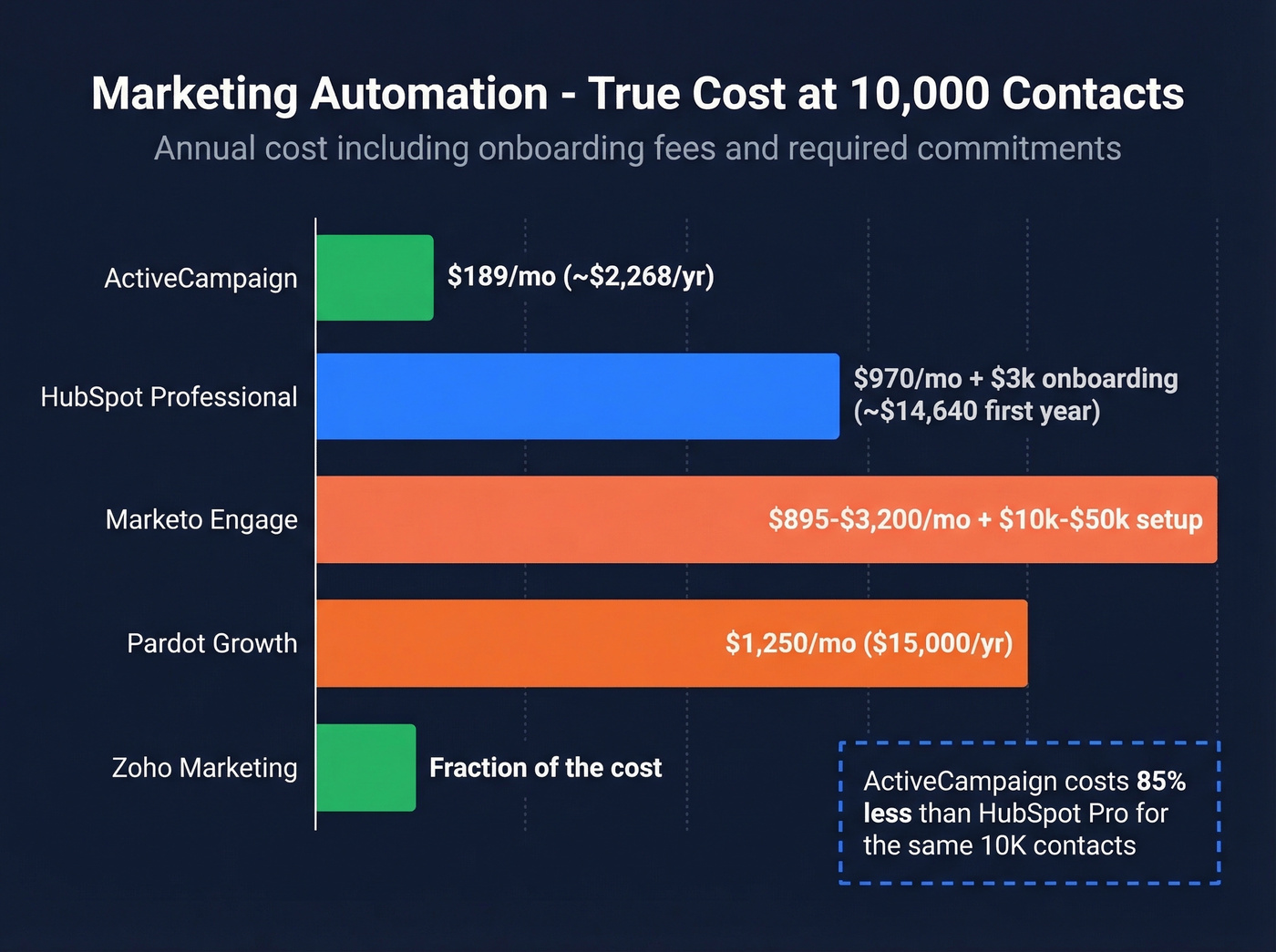
But the $20/month Starter plan is a lead magnet, not a marketing automation platform. Real automation starts at Professional: $890/month plus a mandatory $3,000 onboarding fee plus an annual commitment. Scale to 10K contacts and you're at ~$970/month. Enterprise runs $3,600/month. G2 reviewers flag this cliff repeatedly - the jump from Starter to Professional is the steepest in B2B SaaS pricing.
The TCO reality: Budget $15k-$20k/year minimum for a team that actually uses HubSpot's automation. Worth it if you need CRM and automation in one platform. Overkill if you just need email sequences.
ActiveCampaign
ActiveCampaign is the answer to "I want HubSpot's automation without HubSpot's price tag." At $49/month for 1K contacts, you get sophisticated automation workflows, conditional logic, lead scoring, and solid deliverability.
Scale to 10K contacts and you're at $189/month - compared to HubSpot's ~$970/month for the same volume. The tradeoff is clear: no real CRM (there is one, but it's basic), no landing page builder at lower tiers, and a smaller integration ecosystem. Monthly billing runs ~25% higher than annual, so commit if you can. For SMBs running email-heavy campaigns, ActiveCampaign is the best value in the category.
Marketo Engage
Marketo is the enterprise workhorse - Gartner Customers' Choice with a 4.4/5 rating across 599 reviews. Pricing starts around $895-$3,200/month depending on tier, with implementation running $10k-$50k and taking 60-90 days. You need a dedicated admin. This isn't a self-serve tool; it's a platform investment. If you're already in the Adobe ecosystem, it's the natural choice. If you're not, the onboarding cost alone should give you pause.
Pardot (Salesforce MCAE)
Growth tier at $1,250/month, Plus at $2,500/month, Advanced at $4,000/month - all for 10K prospects. Only makes sense if you're already deep in Salesforce and need native integration. Otherwise, HubSpot or ActiveCampaign will do more for less.
Zoho CRM + Marketing
Worth a mention for budget-conscious teams: Zoho is consistently positioned as a lower-cost ecosystem, and Gartner rates Zoho CRM 4.3/5 across 831 ratings. The all-in-one Zoho ecosystem covers email, social, CRM, and analytics. The tradeoff is a less polished UX and a smaller integration ecosystem than HubSpot. Best for teams under 20 people who want everything from one vendor at a fraction of the cost.
ABM & Intent Platforms
Demandbase
Demandbase is the full-stack ABM platform: intent data, programmatic advertising, account orchestration, and analytics in one suite. The Agentbase AI layer automates account scoring and next-best-action recommendations, which cuts the manual ops work that makes ABM platforms so resource-intensive.
If you're building ABM motions, align your targeting with account-based selling best practices so the platform doesn't become shelfware.
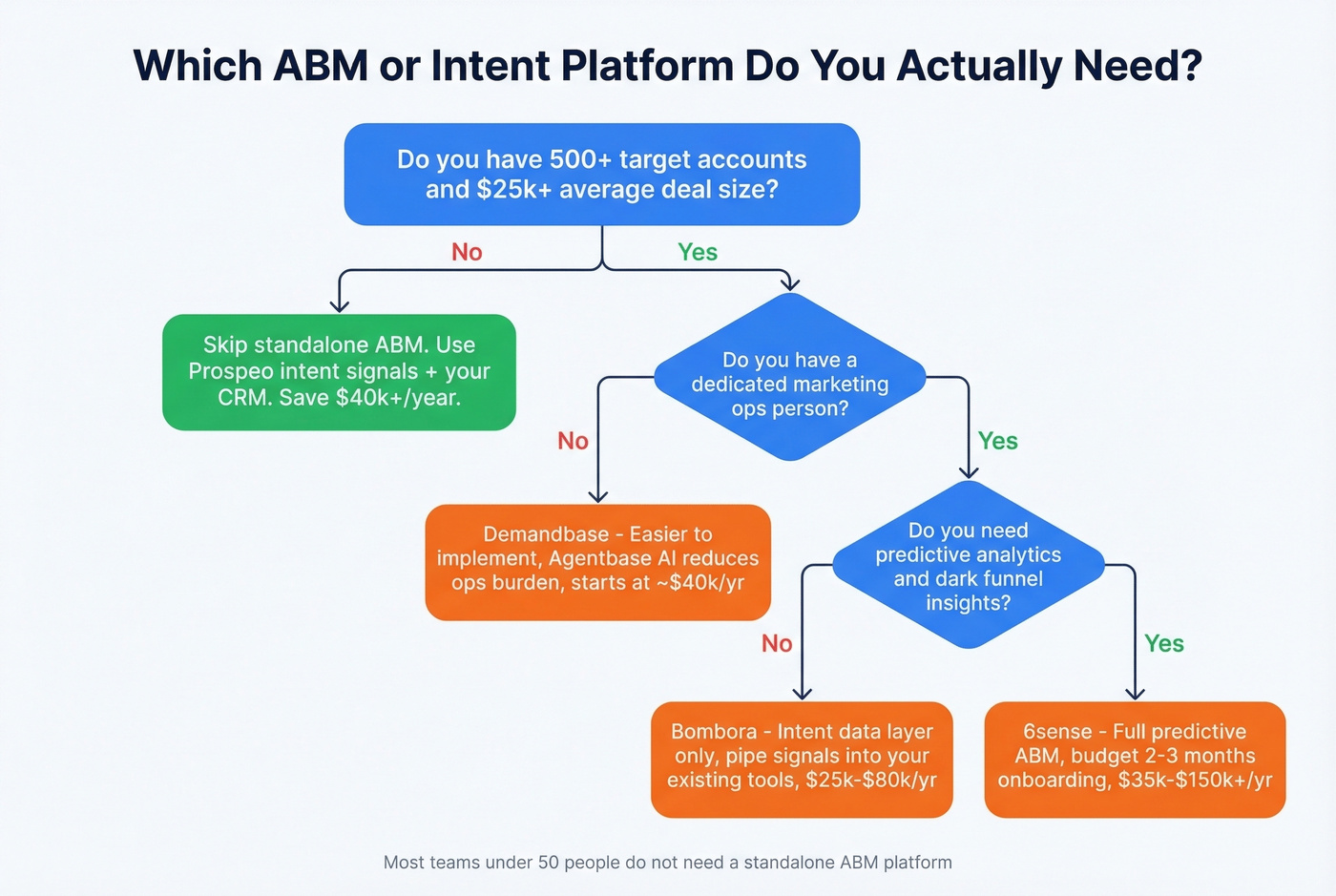
Starting price sits around $40k/year, scaling to $120k/year for full deployments. The advertising module is a key differentiator - especially if you want to run account-targeted display alongside intent and orchestration in one place. The catch: at $40k+ minimum, you need enough target accounts and deal size to justify the spend. Skip this if your average deal is under $25k or your target account list is under 500 companies.
6sense
6sense's predictive analytics genuinely surface in-market accounts before they fill out a form. G2 rates it 4.3/5 across 1,317 reviews. The "Dark Funnel" concept - identifying anonymous buying signals - is powerful when the models have enough data to work with.
The downside is real: G2 flags complexity in 146 separate reviews. Budget 2-3 months for onboarding. Full deployments run $35k-$150k+/year. If your team is under 50 people, you'll spend more time configuring 6sense than actually using it. The platform rewards organizations with dedicated ops resources and enough pipeline volume to train the predictive models. A "$35k" 6sense contract is really a $42k-$44k first-year commitment once you factor in implementation, topic configuration, and CRM integration.
Bombora
Bombora is the intent data layer that feeds other platforms. Their Data Co-op spans 5,000+ B2B websites with 12,000+ intent topics, and 70% of the dataset is exclusive to Bombora. Pricing runs $25k-$80k/year. Best used as a signal source piped into your CRM, ABM platform, or prospecting tool rather than as a standalone product.
SEO & Content Tools
Surfer SEO
Surfer turns SEO from guesswork into a checklist. Essential plan at $89/month, Scale at $129/month, Scale AI at $219/month. The content editor scores your draft against top-ranking competitors in real time. It's not a keyword research tool - pair it with Ahrefs or Semrush for that - but it's the best in class for on-page optimization.
Jasper
Jasper is the AI writing assistant built for marketing teams, not individuals. Creator at $39/user/month, Pro at $59/user/month, and Business is custom-priced. The brand voice controls are the differentiator - train it on your style guide and it maintains consistency across writers. Best for teams producing 20+ pieces of content per month who need to scale without sacrificing brand coherence.
Workflow, Analytics & Conversational
Zapier
Zapier is the duct tape holding most B2B stacks together. That's not a compliment - it means your tools don't talk to each other natively. Free tier handles 100 tasks/month, Professional runs $19.99/month, Team at $69/month. Essential for connecting tools that lack native integrations, but every Zap you build is a potential point of failure. Use it strategically, not as your entire integration strategy.
If you're trying to reduce breakage, prioritize tools that can connect outreach tool to CRM without brittle workarounds.
Quick Mentions
Customer.io starts at $100/month for event-driven messaging - ideal for product-led growth companies triggering emails based on user behavior rather than marketing calendars.
Drift (now part of Salesloft) handles conversational marketing and chatbots. Pricing is custom. The Salesloft acquisition muddied the standalone value proposition, but the chatbot-to-meeting booking flow is still best-in-class.
Dreamdata runs $500-$2,500/month for B2B attribution. If you're spending $10k+/month on paid channels and can't tell which ones drive pipeline, Dreamdata pays for itself fast.
Google Analytics 4 is free and table-stakes. You should already have it. If you don't, stop reading this article and go set it up.
Intercom blends conversational support with marketing - useful for SaaS companies that want chat, help docs, and product tours in one platform. Plans start in the low hundreds per month for small teams, scaling significantly with seat count and usage.
Metadata.io automates paid campaign execution across Facebook, LinkedIn, and display. Pricing typically starts around $3,000-$5,000/month. Worth evaluating if you're running $20k+/month in paid spend and want to automate audience testing and budget allocation.
What These Tools Actually Cost
The gap between "starting price" and "what you'll actually pay" is where most teams get burned. Here's the honest breakdown.
| Tool | Starting Price | Realistic Annual Cost | Hidden Costs |
|---|---|---|---|
| HubSpot Pro | $890/mo | $15k-$20k/yr | $3K onboarding, contact scaling |
| ActiveCampaign | $49/mo | $600-$2.5k/yr | 25% premium for monthly billing |
| Marketo | ~$895/mo | $15k-$50k/yr | $10k-$50k implementation |
| Pardot | $1,250/mo | $15k-$48k/yr | Salesforce dependency |
| 6sense | ~$35k/yr | $35k-$150k+/yr | 2-3 month onboarding |
| Demandbase | ~$40k/yr | $40k-$120k/yr | 15-25% above license |
| Prospeo | Free-$39+/mo | $0-$1,000/yr | None |
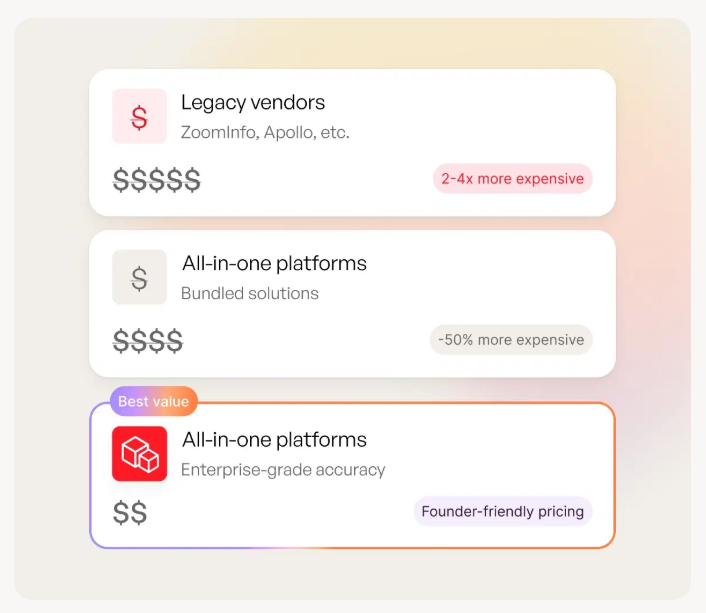
The fact that Marketo, 6sense, and Demandbase all hide pricing behind "contact sales" tells you everything about their sales motion. Transparent, self-serve pricing isn't just convenient - it's a signal about how a company treats customers.
For intent data platforms specifically, budget 15-25% above the license fee for implementation, topic configuration, and CRM integration.
The best B2B marketing tools can't fix bad data. At 6-week refresh cycles, most providers serve you contacts who already changed jobs. Prospeo refreshes every 7 days, verifies emails in 5 steps, and returns 50+ data points per contact at a 92% match rate - no contracts, no sales calls.
Build your entire stack on data that actually connects.
How to Build Your Stack by Stage
47% of B2B teams allocate 20-40% of their marketing budget to tools, and 92% keep their stack at 20 tools or fewer. But 32% admit they aren't using full capabilities. You don't need 20 tools. You need 5-7 that actually integrate.
Startup (~$500/month):
- Prospeo for prospecting and verified data ($39/mo or free tier)
- ActiveCampaign for email automation ($49/mo)
- GA4 for analytics (free)
- Zapier free tier for glue (free)
- Total: ~$90-$550/month depending on volume
This is the stack we recommend to early-stage teams who ask us what to buy first. It covers outbound, nurture, analytics, and integration for under $600/month with zero enterprise contracts.
Mid-Market ($2k-$5k/month): The most common mid-market stack - HubSpot + LinkedIn Ads + Google Analytics - is used by 28.5% of mid-market teams. That's a solid foundation, but it leaves a data accuracy gap. A stronger version:
- HubSpot Professional for CRM + automation ($890/mo)
- A dedicated data provider for enrichment and prospecting
- Surfer SEO for content optimization ($89-$129/mo)
- Intent signals for buying triggers
- Dreamdata for attribution ($500+/mo)
Enterprise ($10k-$20k+/month):
- Marketo or Pardot for automation
- Demandbase or 6sense for ABM + intent
- ZoomInfo or a specialized data provider depending on budget and accuracy needs
- Dreamdata or HockeyStack for attribution
- Intercom for conversational marketing
Choosing the Right Platform
Picking the right software isn't about chasing feature lists - it's about matching the tool to your stage, deal size, and team capacity. A solo founder and a 200-person marketing org have fundamentally different needs, even if they're evaluating the same category.
Before adding any new platform to your stack, run through three filters. Does it integrate natively with your CRM? Will more than one person on the team use it weekly? And does the annual cost stay under 5% of the pipeline it's expected to influence? If the answer to any of those is no, walk away. We've seen teams sink $40k into ABM platforms that sit idle because nobody had the bandwidth to configure them - and that's $40k you can't claw back.
Mistakes That Kill Your B2B Stack
Using your CRM as a dumping ground. Buying a list of 50,000 contacts and importing them into Salesforce doesn't build pipeline - it destroys your buyer journey data. Every junk record pollutes your scoring, your routing, and your reporting.
Investing in intent data before fixing email bounce rates. If your emails bounce at 15%+, spending $35k on 6sense is lighting money on fire. Fix your data foundation first - get bounce rates under 5% - then layer intent signals on top. (If you need benchmarks and fixes, start with email bounce rate.)
Optimizing for reach instead of conversion. If your average deal size is under $15k, you probably don't need ZoomInfo-level data or programmatic display ads. Niche B2B with fewer than 5,000 target accounts gets more from manual list building than lookalike audiences. When your total addressable market fits in a spreadsheet, precision beats scale every time.
Ignoring integration friction. 65.7% of marketing teams report data integration difficulties. Before buying any tool, ask one question: does it push data into my CRM without Zapier? If the answer is no, factor in the maintenance cost of keeping that connection alive. The consensus on r/sales and r/b2bmarketing is that integration headaches cause more churn than bad features do - and we'd agree.
FAQ
What's the average cost of a B2B martech stack?
A lean startup stack runs ~$500/month; mid-market stacks typically cost $2,000-$5,000/month; enterprise stacks with ABM and intent data run $10,000-$20,000+/month. Roughly 47% of B2B teams allocate 20-40% of their marketing budget to technology.
How many tools does a B2B team actually need?
Most organizations use 12-20 tools, but 32% admit they aren't using full capabilities. Aim for 5-7 well-integrated platforms rather than 15+ with overlapping features. Fewer tools with deeper adoption beats a bloated stack every time.
What's the most important tool to get right first?
Your data layer. Every downstream platform - automation, ABM, outbound sequences - depends on accurate contact data. When the best independent email verifiers top out at 70% accuracy, the difference between a mediocre provider and one running at 98% cascades through your entire stack.
Is HubSpot worth it for B2B marketing?
At Professional tier ($890/month plus $3,000 onboarding), yes - if you need CRM and automation in one platform and have the budget. At Starter ($20/month), you're getting a glorified email tool. ActiveCampaign at $49/month offers more automation capability for a fraction of the cost.
When should a B2B team invest in intent data?
Only after your email deliverability is above 95% and your CRM data is clean. Intent platforms cost $25,000-$150,000/year and amplify whatever data quality you already have - good or bad. Get the foundation right first.