B2B Revenue Marketing: What It Actually Is and How to Do It
84% of sales reps missed quota last year. Meanwhile, marketing teams celebrated record lead volume. That disconnect is the entire case for B2B revenue marketing - and most teams still haven't made the shift.
They're running demand gen and calling it revenue marketing. Here's the difference, the framework, and the lean stack you need to actually close the gap. 55% of companies don't even know their CAC. If you can't calculate acquisition cost, your "revenue marketing" program is demand gen in disguise.
The CMO vs. CRO Disconnect
The CMO walks into the QBR with a slide showing record MQL volume. The CRO follows with pipeline down 20%. Both are telling the truth using their own metrics, and the CEO is left wondering why two leaders with the same revenue goal can't agree on what's working.
This isn't a communication problem. It's a structural one. When marketing optimizes for leads and sales optimizes for revenue, you get two teams pulling in slightly different directions - and 67% of reps don't expect to hit quota. We've seen this play out at companies of every size, and the pattern is always the same: marketing declares victory, sales declares failure, and the board loses confidence in both.
What Is B2B Revenue Marketing?
Revenue marketing is an operating model where marketing owns full-funnel accountability - from first touch through closed deal, retention, and expansion. Not leads. Not MQLs. Revenue.
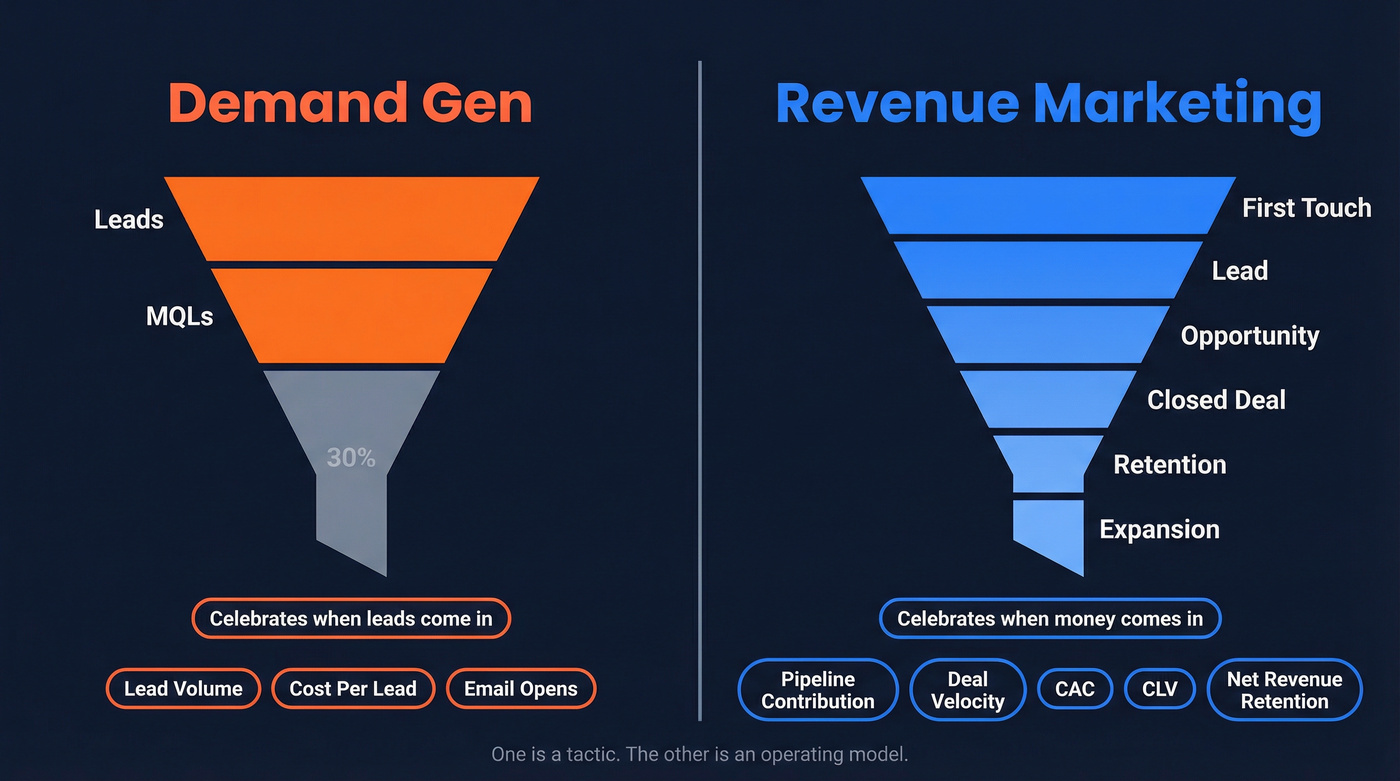
Demand gen celebrates when leads come in. Revenue marketing celebrates when money comes in.
That's not a semantic difference. Demand gen is a subset that fills the top of the funnel. Revenue marketing owns the entire journey, including handoff quality, deal velocity, and customer lifetime value. If your CMO still reports MQLs to the board as a primary KPI, you haven't adopted this model. You've adopted demand gen with better branding.
Why Revenue-Accountable Marketing Matters Now
80% of B2B sales interactions now happen in digital channels. Buyers use an average of 10 channels per purchase journey, buying committees average 7 people, and buyers spend only 17% of their time meeting potential suppliers. You can't hand sales a list of names and call it pipeline when the buyer has already consumed 12 pieces of content across 6 channels before talking to a rep.
The pressure is compounding. 49% of marketers report declining traditional search traffic as AI-generated answers siphon clicks, and over 50% of B2B buyers will switch suppliers if the cross-channel experience isn't smooth. Single-channel, lead-count marketing is a liability now.
Here's the upside: teams with strong sales-marketing alignment see 38% higher win rates, 67% higher efficiency in closing deals, and 208% higher marketing-generated revenue. In our experience, teams that make this shift typically see marketing-influenced pipeline jump 15-40% and sales cycles compress 10-25%. That's not incremental improvement. It's a different operating reality.

You just did the reverse-funnel math. Now ask: how many of those 160 monthly leads have real, deliverable emails? If your bounce rate is above 5%, your pipeline math is fiction. Prospeo verifies 300M+ profiles on a 7-day refresh cycle with 98% email accuracy - so every lead entering your revenue waterfall is a real person you can actually reach.
Stop building pipeline forecasts on bounced emails.
The Revenue Marketing Framework
The Forrester Revenue Waterfall gives you a shared language. Most modern implementations layer in buying groups and account-level signals instead of treating the journey like a single linear lead path. Here are benchmark conversion rates:
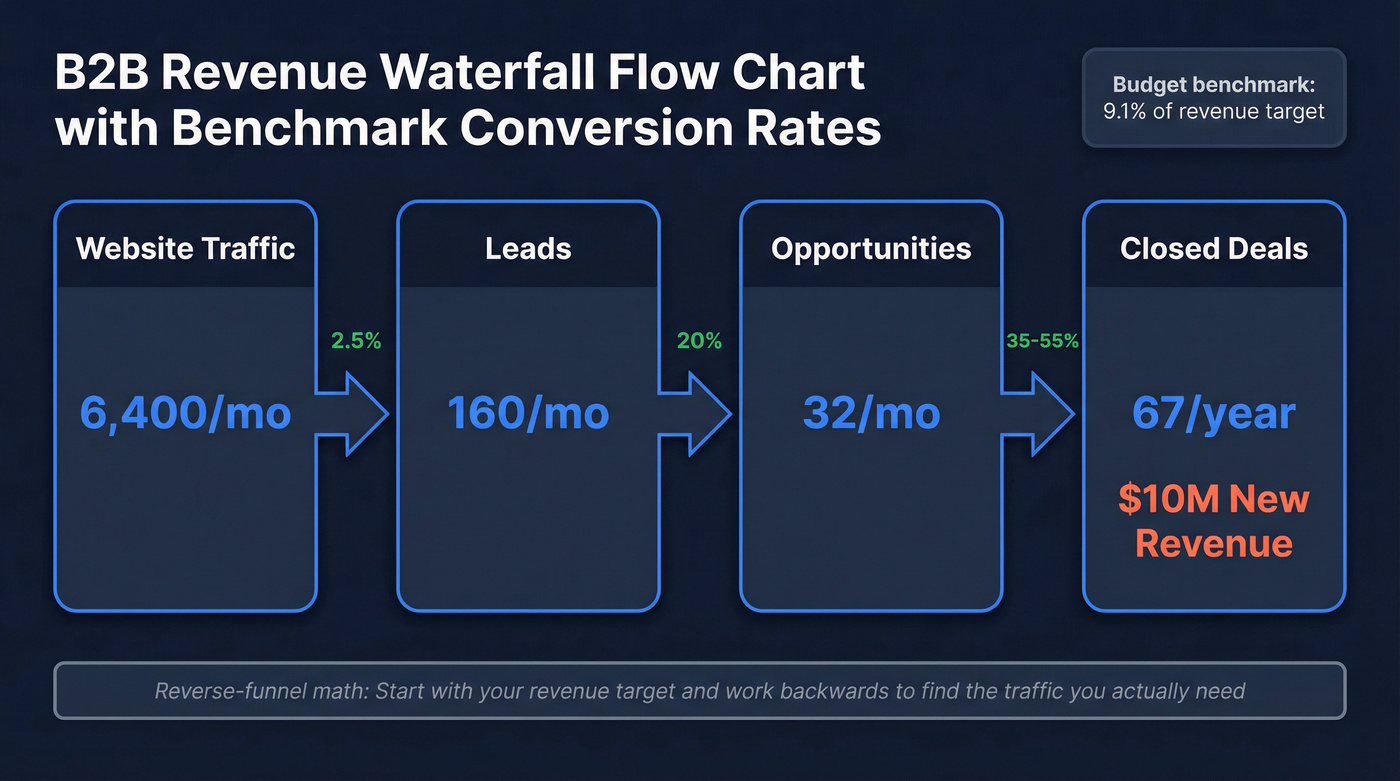
| Stage | Benchmark Rate |
|---|---|
| Web traffic to Lead | 2.5% |
| Lead to Opportunity | 20% |
| Opportunity to Closed | 35-55% |
Reverse-funnel math: Say your revenue target is $50M, with 80% from existing customers. You need $10M in new business. At $150K average first-year revenue per customer, that's roughly 67 new customers. With a 5% lead-to-customer rate, you need about 160 new leads per month. At a 2.5% visitor-to-lead conversion, that's around 6,400 monthly visitors just to hit the number.
Budget benchmark: B2B companies spend on average 9.1% of their revenue target on marketing. Many underspend at 2-3% and wonder why pipeline is thin.
Strategies That Drive Pipeline, Not Vanity Metrics
The average B2B organization runs 16 tools across marketing and sales - that's bloat. Worse, only 11% of companies have effective handoffs between those systems. More tools usually means more integration gaps and dirtier CRM records.
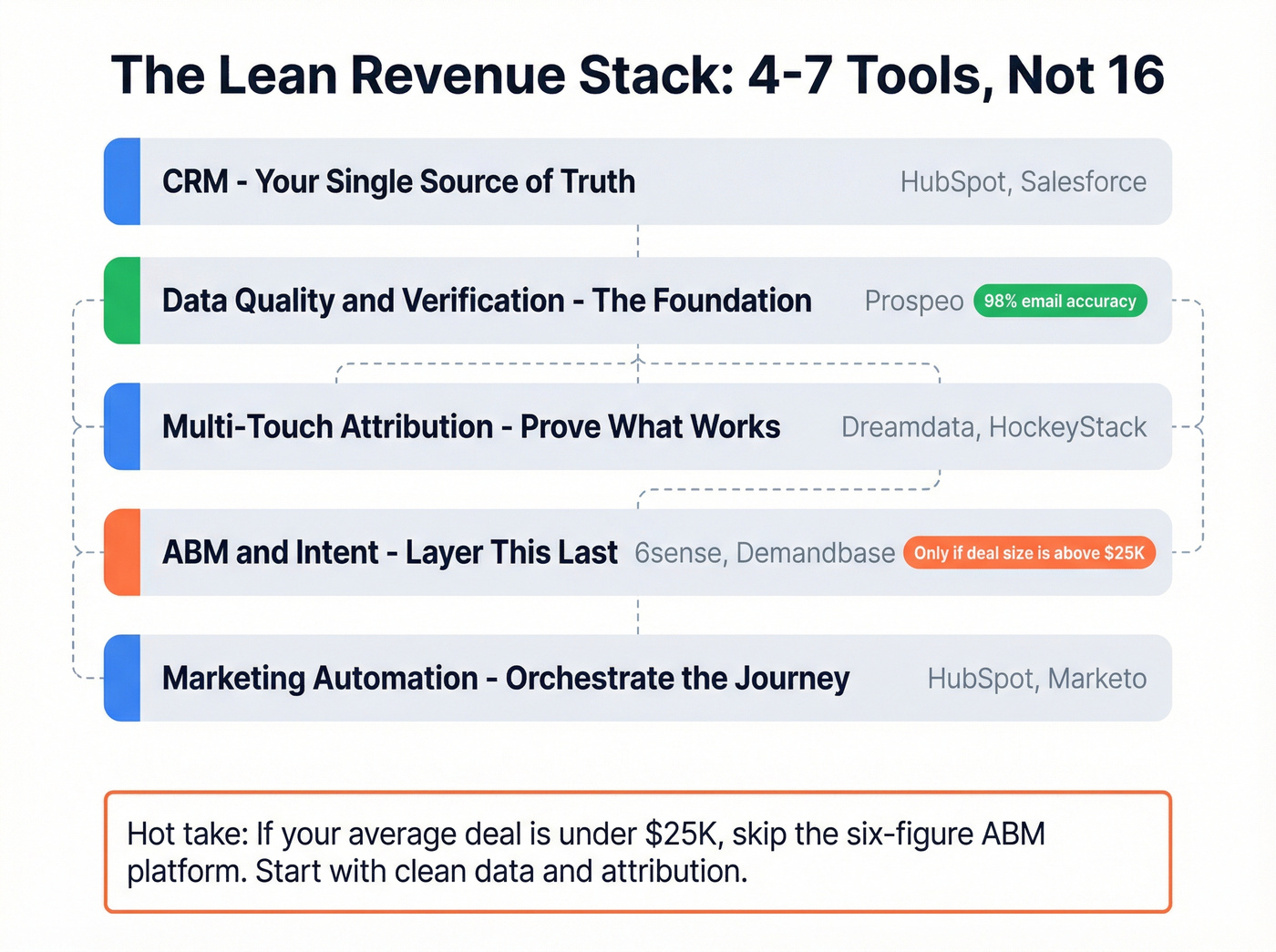
Let's be honest: most RevOps teams we talk to are drowning in tools and starving for clean data. A lean revenue stack runs 4-7 integrated tools:
| Category | Tool Examples | Approx. Pricing |
|---|---|---|
| CRM | HubSpot, Salesforce | Free to ~$330/user/mo |
| Data Quality & Verification | Prospeo | Free (75 emails/mo); paid ~$0.01/email |
| Attribution | Dreamdata, HockeyStack | Free tier; from ~$500-$1,500/mo |
| ABM / Intent | 6sense, Demandbase | $30-100K+/year |
| Marketing Automation | HubSpot, Marketo | ~$800-$3,200/mo |
Your attribution model is only as good as your CRM data. Ask any RevOps leader what broke their attribution model and the answer is almost always dirty contact records. If your CRM bounce rate is above 5%, every metric downstream - attribution, pipeline contribution, CAC - is built on sand. Fix the foundation first. Prospeo verifies and enriches contacts across 300M+ professional profiles with 98% email accuracy on a 7-day refresh cycle, so pipeline metrics reflect real contacts instead of bounced emails.
Hot take: If your average deal size is under $25K, you almost certainly don't need a six-figure ABM platform. Start with clean data and multi-touch attribution. Layer intent signals later once you've proven the model works.
Revenue Attribution - Pick a Model
Attribution isn't optional in a revenue-accountable marketing org. It's the entire point. Without it, you're back to arguing about which channel "deserves" credit based on gut feeling.
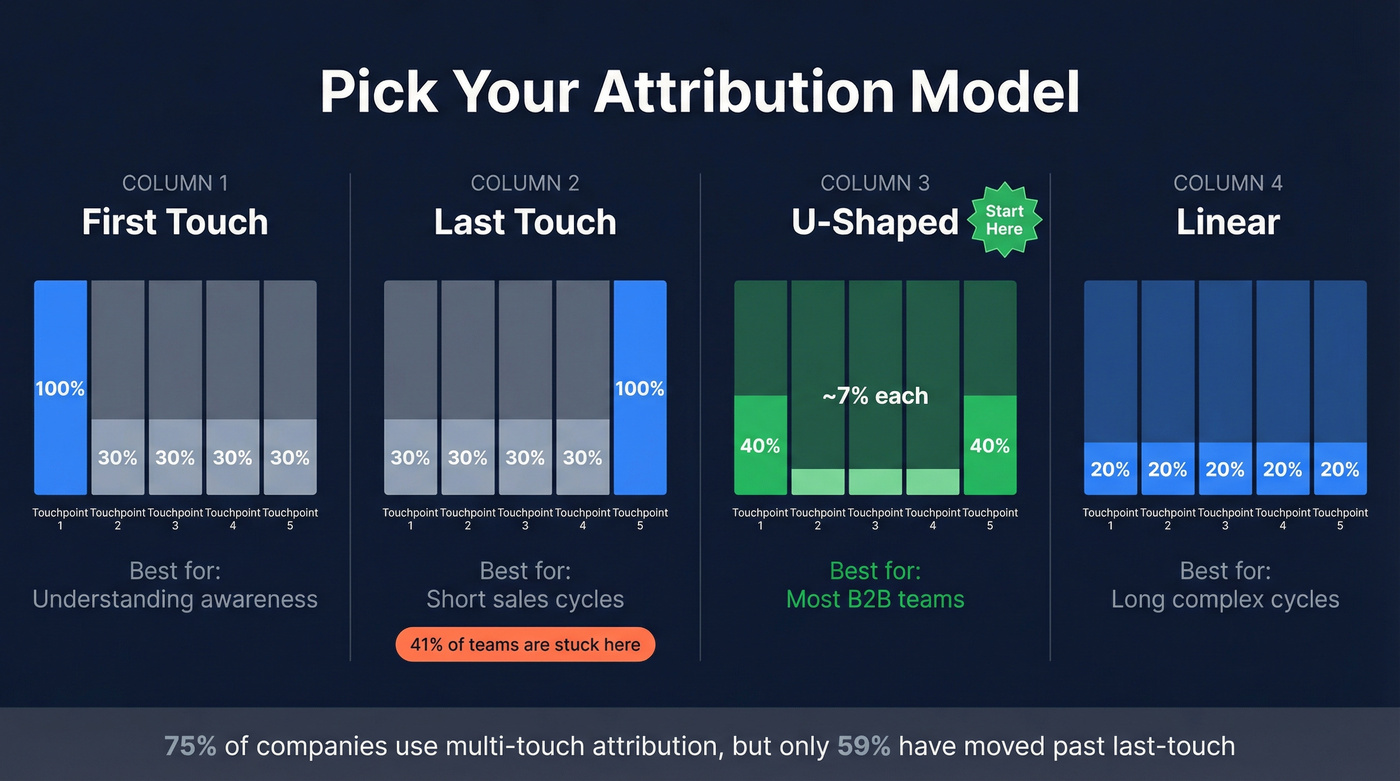
| Model | How It Works | Best For |
|---|---|---|
| First-touch | 100% credit to first interaction | Understanding awareness |
| Last-touch | 100% credit to final interaction | Short sales cycles |
| U-shaped | 40% first / 40% last / 20% middle | Most B2B teams - start here |
| Linear | Equal credit across all touches | Long, complex cycles |
75% of companies now use some form of multi-touch attribution, but 41% still default to last-touch. The U-shaped model is the best starting point for most B2B teams because it respects both the awareness and conversion moments while giving middle touches proportional credit.
For teams in the 40% without attribution tools, step one is auditing your contact data. Garbage data produces garbage attribution - no model can fix that.
How to Make the Shift
Most B2B revenue marketing strategies fail not because of bad ideas but because of poor execution sequence. Here's the order that works:
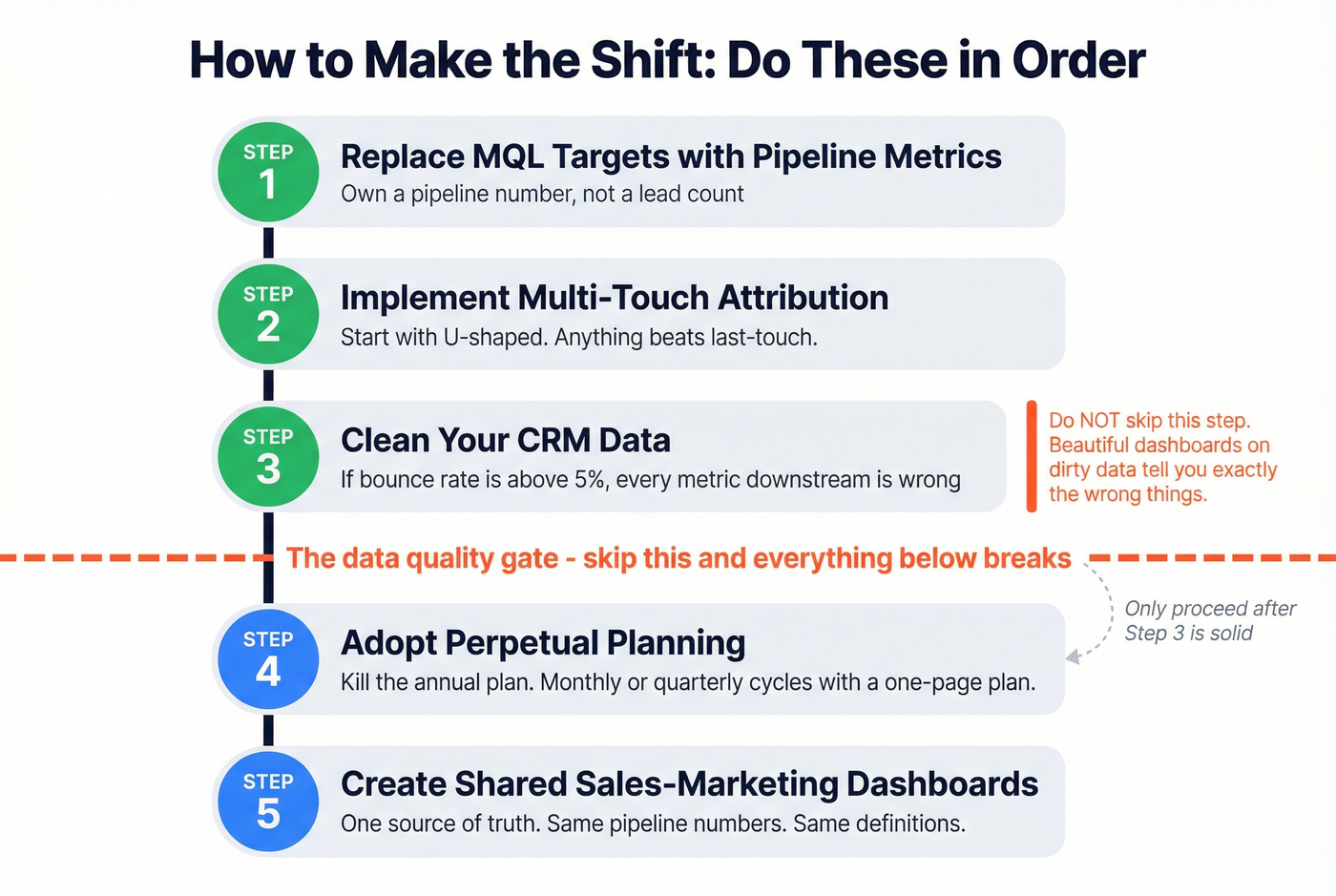
Replace MQL targets with pipeline contribution metrics. Marketing should own a pipeline number, not a lead count. Measure marketing-sourced pipeline, deal velocity, and influenced revenue.
Implement multi-touch attribution. Start with U-shaped. Anything beats last-touch for complex B2B sales cycles.
Adopt perpetual planning. Kill the annual marketing plan. Move to monthly or quarterly cycles with a one-page plan that covers your revenue target, top 3 pipeline bets, and the metrics that trigger a pivot. Nothing more.
Create shared sales-marketing dashboards. One source of truth. Same pipeline numbers. Same definitions of "qualified." If sales and marketing can't agree on what an opportunity is, nothing else matters.
Skip steps 4 and 5 if you haven't nailed step 3. We've watched teams build beautiful dashboards on top of CRM data that's 30% stale - the dashboards looked great and told them exactly the wrong things. The consensus on r/sales and r/revenueoperations is the same: data quality is the boring prerequisite nobody wants to do and everybody regrets skipping.
Your attribution model is only as reliable as the contacts in your CRM. Dirty records break every metric downstream - CAC, pipeline contribution, marketing-sourced revenue. Prospeo enriches contacts with 50+ data points at a 92% match rate for ~$0.01 per email. No six-figure contract. No sales call required.
Fix attribution by fixing the data underneath it.
FAQ
What's the difference between revenue marketing and demand generation?
Demand gen fills the top of the funnel and measures leads. Revenue marketing owns the full funnel - pipeline, deal velocity, and closed revenue. One is a tactic; the other is an operating model that holds marketing accountable to the same number sales carries.
What metrics should a revenue marketing team track?
Track pipeline contribution, sales velocity, CAC, customer lifetime value, and net revenue retention. Drop MQLs as a primary KPI - they measure activity, not outcomes. Most high-performing teams report on marketing-sourced pipeline as the single north-star metric.
What's the first step to start revenue marketing?
Audit your CRM data and implement multi-touch attribution. If your contact data bounces at 10%+, every downstream metric is unreliable. Fix the foundation before layering strategy on top.
Do small B2B teams need ABM tools for revenue marketing?
No. Teams with deal sizes below $50K should start with clean CRM data, multi-touch attribution, and a shared pipeline dashboard. A data verification tool plus a free-tier attribution platform like Dreamdata covers the essentials at under $100/month. Add ABM platforms only after you've proven the model generates measurable pipeline.