

B2B Sales Intelligence: The 2026 Practitioner's Guide
Finance just flagged $47K in annual sales tool spend. Your reps use maybe three features across five platforms. And the "verified" contact list you bought last quarter? It bounced 23% on the first sequence. The average B2B salesperson spends just 28% of their week actually selling - the rest disappears into admin, research, and fighting bad data. That's not a tools problem. It's a B2B sales intelligence problem, and most teams are solving it wrong.
Here's the practitioner's guide to getting it right: what sales intelligence teams actually need, how to build a stack that doesn't bleed money, and which platforms earn their price tag in 2026.
What You Need (Quick Version)
Before we go deep, here's the short answer based on what you're optimizing for:
- Enterprise depth: ZoomInfo has the deepest org charts and the broadest feature set - if you've got $40K+ and the RevOps headcount to run it.
- Budget SMB, all-in-one: Apollo.io gives you contacts, sequencing, and a dialer for $49/mo per seat. Accuracy is lower (88% emails in independent testing), but the value-per-dollar is hard to beat for early-stage teams.
What Does B2B Sales Intelligence Mean?
B2B sales intelligence is the practice of collecting, analyzing, and applying external data to help sales teams find, prioritize, and close the right accounts. It's not one tool - it's a category spanning four core components. Contact data covers emails, phones, and org charts. Firmographics includes company size, revenue, and tech stack. Intent signals reveal who's actively researching your category. And engagement tracking shows how prospects interact with your content and outreach.
The market hit an estimated $5.37B in 2026, up from $4.85B in 2025, and is projected to reach $12.45B by 2034 at an 11.10% CAGR. North America accounts for 42.3% of that spend. 87.5% of the market is software rather than services, and 61.3% is cloud-deployed - this is overwhelmingly a SaaS category.
Where teams get confused is conflating sales intelligence with adjacent categories:
| What it does | What it doesn't do | Examples | |
|---|---|---|---|
| Sales Intelligence | External prospect data & signals | Replace your CRM or run sequences | ZoomInfo, 6sense |
| CRM | Internal customer records & deals | Discover prospects or provide intent | Salesforce, HubSpot |
| Lead Generation | Captures inbound interest | Provide verified data or buying signals | Marketo, Unbounce |
Sales intelligence feeds your CRM and amplifies your lead gen. It doesn't replace either.
Why It Matters More in 2026
The old outbound playbook - buy the biggest database, blast the most contacts, hope for replies - is dying. Three shifts are killing it.
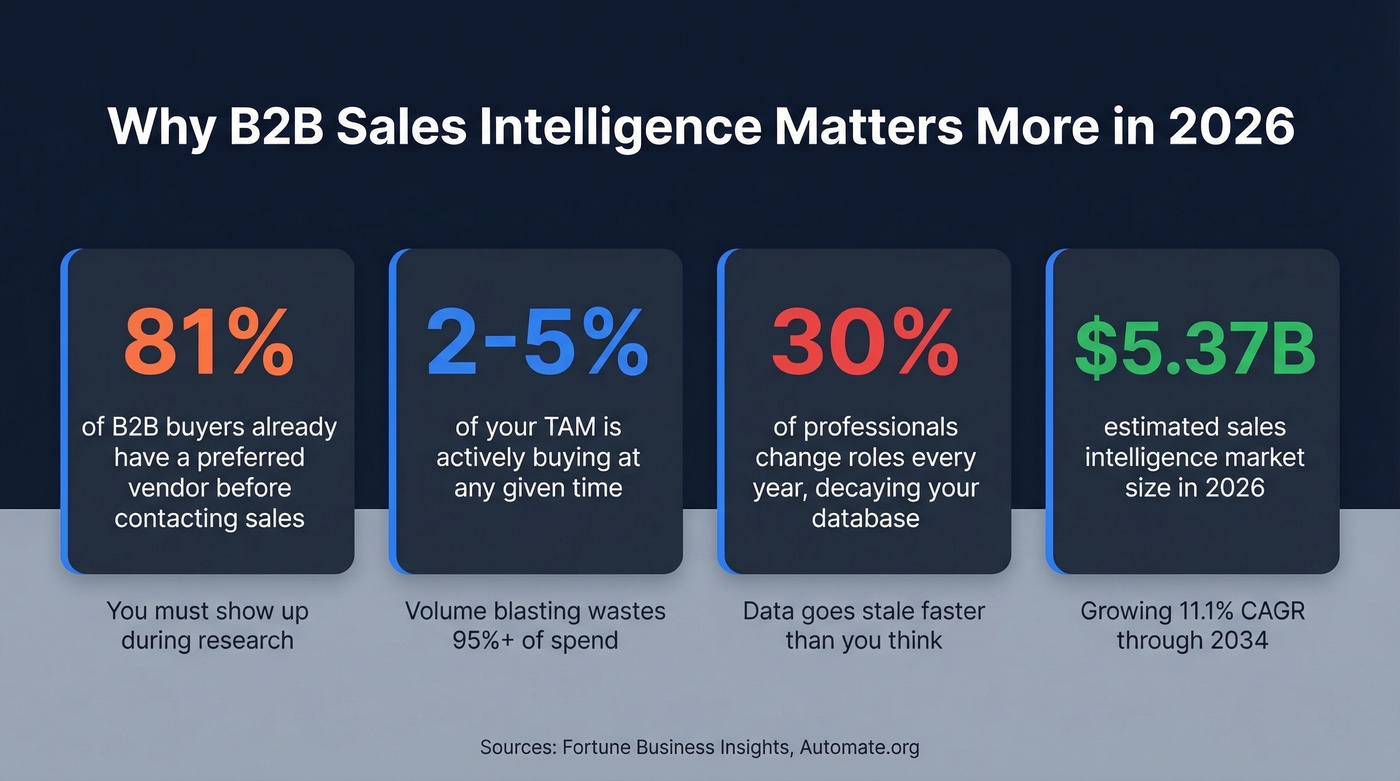
First, buyers are doing the work themselves. 81% of B2B buyers already have a preferred vendor before they ever reach out to sales. They complete up to 80% of their decision-making before talking to a rep. If you're not showing up during that research phase with relevant, well-timed outreach, you're not in the consideration set.
Second, only 2-5% of your total addressable market is actively buying at any given moment. Blasting 50,000 contacts when 48,500 of them aren't in-market doesn't just waste money - it damages your domain reputation and burns your brand with future buyers. Lead costs balloon from $40 to $300+ when you're chasing low-intent audiences. This is where reliable prospect data separates high-performing teams from everyone else.
Third, data decays faster than most teams realize. B2B contact data degrades at about 2% per month, and around 30% of professionals change roles annually. A database that was 90% accurate in January is below 80% by summer. One popular thread on r/b2bmarketing argued that big lead databases are fundamentally broken because they serve outdated contacts, generic emails, and overused prospects your competitors are already hammering. One commenter put it bluntly: "70% of phone numbers are wrong" in major databases.
This matters even more outside SaaS. Manufacturing deals can stretch 379 days with 6-13 stakeholders on the buying committee. When your sales cycle is that long and that complex, every stale contact or missed intent signal compounds into months of wasted effort. Intelligence-driven prioritization isn't a nice-to-have in those environments - it's survival.
The shift is from volume to intelligence. Better signals, fresher data, tighter ICP targeting.
The Four-Layer Stack
Most teams don't need more tools. They need fewer tools that cover more layers without overlap. We've found the average B2B sales team's stack breaks down into four layers:
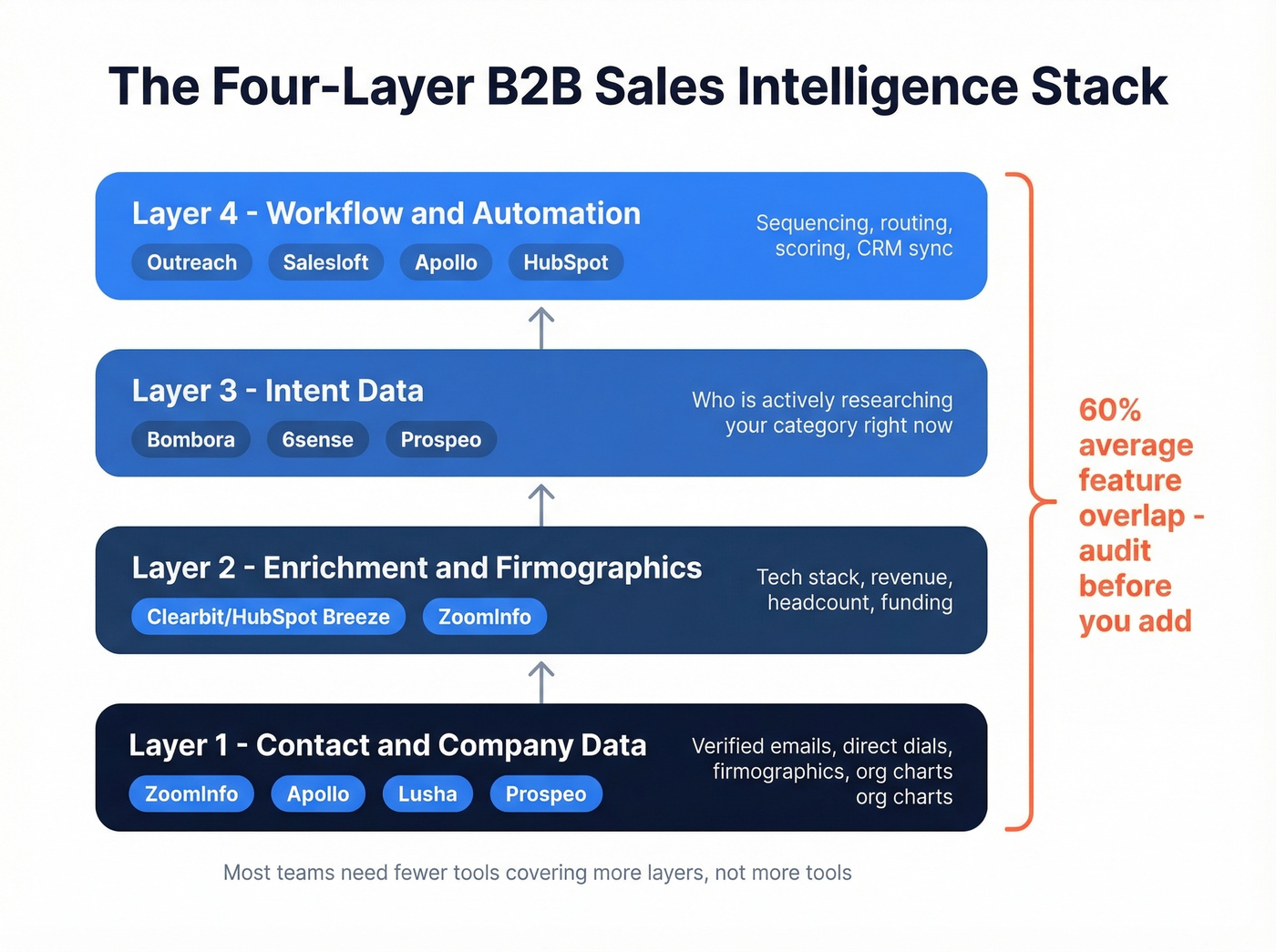
Layer 1 - Contact & Company Data. The foundation. Verified emails, direct dials, firmographic details. This is where ZoomInfo, Apollo, and Lusha live. Without accurate contact data, nothing downstream works.
Layer 3 - Intent Data. Signals that tell you which accounts are actively researching topics related to your product. Bombora and 6sense are primary providers. The best setups layer intent with contact data in a single workflow rather than toggling between platforms.
Layer 4 - Workflow & Automation. Sequencing, routing, scoring, and CRM sync. This is where Outreach, Salesloft, HubSpot, and Apollo's built-in sequencer live. (If you're comparing workflow tools, start with CRM automation software.)
A stack audit of a typical B2B team found 60% feature overlap across their tools. One team was paying $52,000/year and using 40% of what they'd bought. A disciplined audit saved $23,000 annually by eliminating redundancy. Before you add another platform, map what you already have against these four layers.
Data Accuracy: The Numbers Nobody Shares
Database size is a vanity metric. What matters is how many of those contacts are accurate, current, and reachable. Most vendors won't share independent accuracy data, so let's look at what's available.
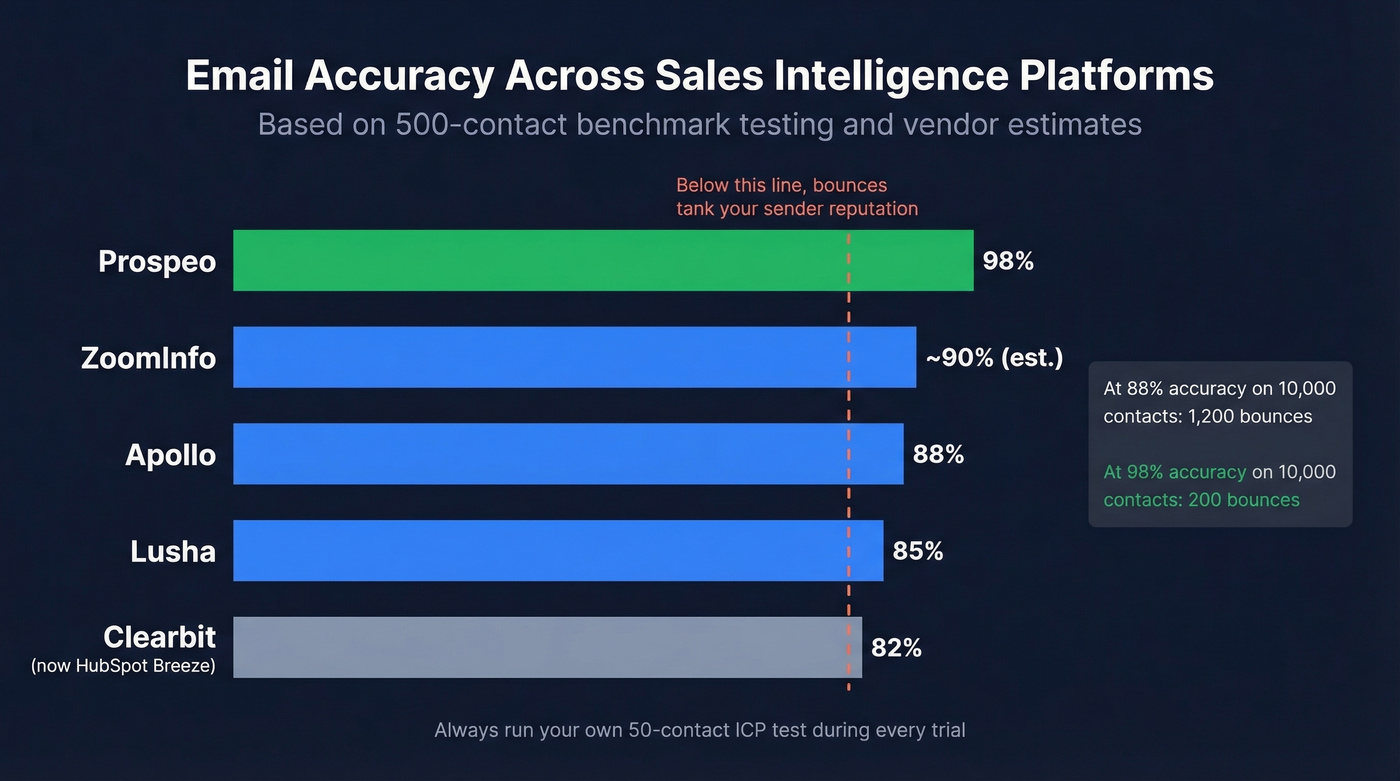
A 500-contact benchmark test across providers produced these results:
| Tool | Email Accuracy | Phone Accuracy | Job Title Current | Refresh Cycle |
|---|---|---|---|---|
| Apollo | 88% | 71% | 76% | ~4-6 weeks (est.) |
| Lusha | 85% | 79% | 72% | ~4-6 weeks (est.) |
| **Clearbit*** | 82% | 68% | 69% | ~4-6 weeks (est.) |
| ZoomInfo | ~90% (est.) | Varies widely | Strong in US | ~4-6 weeks (est.) |
Clearbit is no longer available for new standalone subscriptions - it's now part of HubSpot Breeze Intelligence. If you're evaluating Clearbit data, you're evaluating HubSpot.
The accuracy gap matters more than it looks. At 88% accuracy, 1 in 8 emails bounces. Run a 10,000-contact campaign and you're looking at 1,200 bounces - enough to tank your sender reputation. At 98%, that same campaign produces around 200 bounces. That's the difference between a healthy domain and one that lands in spam.
Don't take anyone's word for it, including ours. Run your own 50-contact ICP test during every trial. Pull 50 contacts that match your ideal customer profile, verify the emails independently, call the phone numbers, and check the job titles on professional profiles. That 30-minute test tells you more than any vendor demo ever will. (If you need a shortlist first, see the best verified contact databases.)

The article above shows data decaying at 2% per month. Prospeo refreshes every 7 days - not the 4-6 week industry average. With 98% email accuracy, 125M+ verified mobiles, and intent data across 15,000 Bombora topics, you get all four stack layers without the $47K overlap problem.
Stop paying for stale data that bounces. Start with 75 free emails.
Top 8 Platforms Compared
Here's how the major platforms stack up:
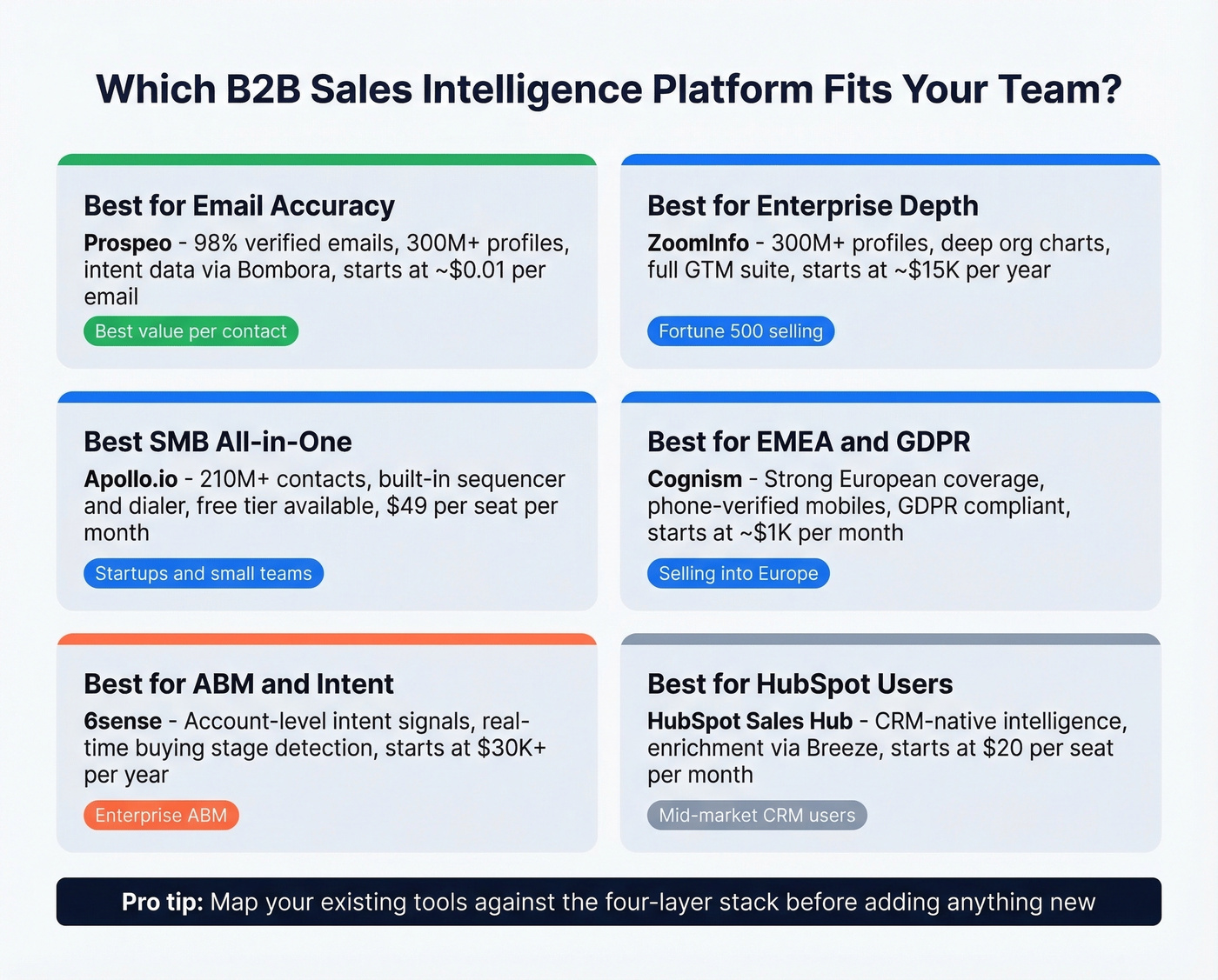
| Tool | Database Size | Email Accuracy | Starting Price | Data Refresh | G2 Rating | Best For |
|---|---|---|---|---|---|---|
| ZoomInfo | 300M+ profiles | ~90% (est.) | ~$15K/year | ~4-6 weeks | 4.5/5 (8,875) | Enterprise org charts & intent |
| Apollo.io | 210M+ contacts | 88% | Free; $49/seat/mo | ~4-6 weeks | 4.7/5 (9,250) | SMB all-in-one |
| Cognism | - | Not published | ~$1K/mo | ~4-6 weeks | 4.5/5 (1,200) | EMEA & GDPR compliance |
| 6sense | Account-level | N/A | $30K+/yr | Real-time signals | 4.3/5 (800+) | Enterprise ABM & intent |
| Lusha | 280M+ contacts | 85% | Free; $22.45/mo | ~4-6 weeks | 4.3/5 (1,566) | Quick individual lookups |
| Bombora | Intent only | N/A | ~$25K/year | - | - | Standalone intent layer |
| HubSpot Sales Hub | CRM-native | Varies | $20/seat/mo | CRM-dependent | 4.4/5 (12,000+) | Mid-market HubSpot users |
Now let's dig into each one.
Prospeo
Prospeo's database covers 300M+ professional profiles, 143M+ verified emails, and 125M+ verified mobile numbers. The 98% email accuracy comes from a proprietary 5-step verification process with catch-all handling, spam-trap removal, and honeypot filtering - no reliance on third-party email providers.

The 30+ search filters include buyer intent via 15,000 Bombora topics, technographics, job changes, headcount growth, and funding signals. Two proof points: Snyk deployed Prospeo across 50 AEs and watched their bounce rate drop from 35-40% to under 5%, with AE-sourced pipeline jumping 180% and generating 200+ new opportunities per month. Meritt tripled their pipeline from $100K to $300K per week while cutting bounce rates from 35% to under 4%.
Pricing runs ~$0.01 per email and 10 credits per mobile number. There's a free tier with 75 emails per month, no contracts, and self-serve onboarding. (If you’re comparing sources, see our ranked list of the best B2B databases.)
Use this if: email deliverability is the backbone of your outbound program and you want the highest accuracy available without enterprise pricing. Skip this if: you need deep org chart mapping for Fortune 500 accounts - that's ZoomInfo's territory.
That 500-contact benchmark test topped out at 90% email accuracy. Prospeo hits 98% across 300M+ profiles with proprietary 5-step verification - no third-party email providers, no recycled data. Teams using Prospeo book 26% more meetings than ZoomInfo users at 90% less cost.
Replace the accuracy gap in your sales intelligence stack today.
ZoomInfo
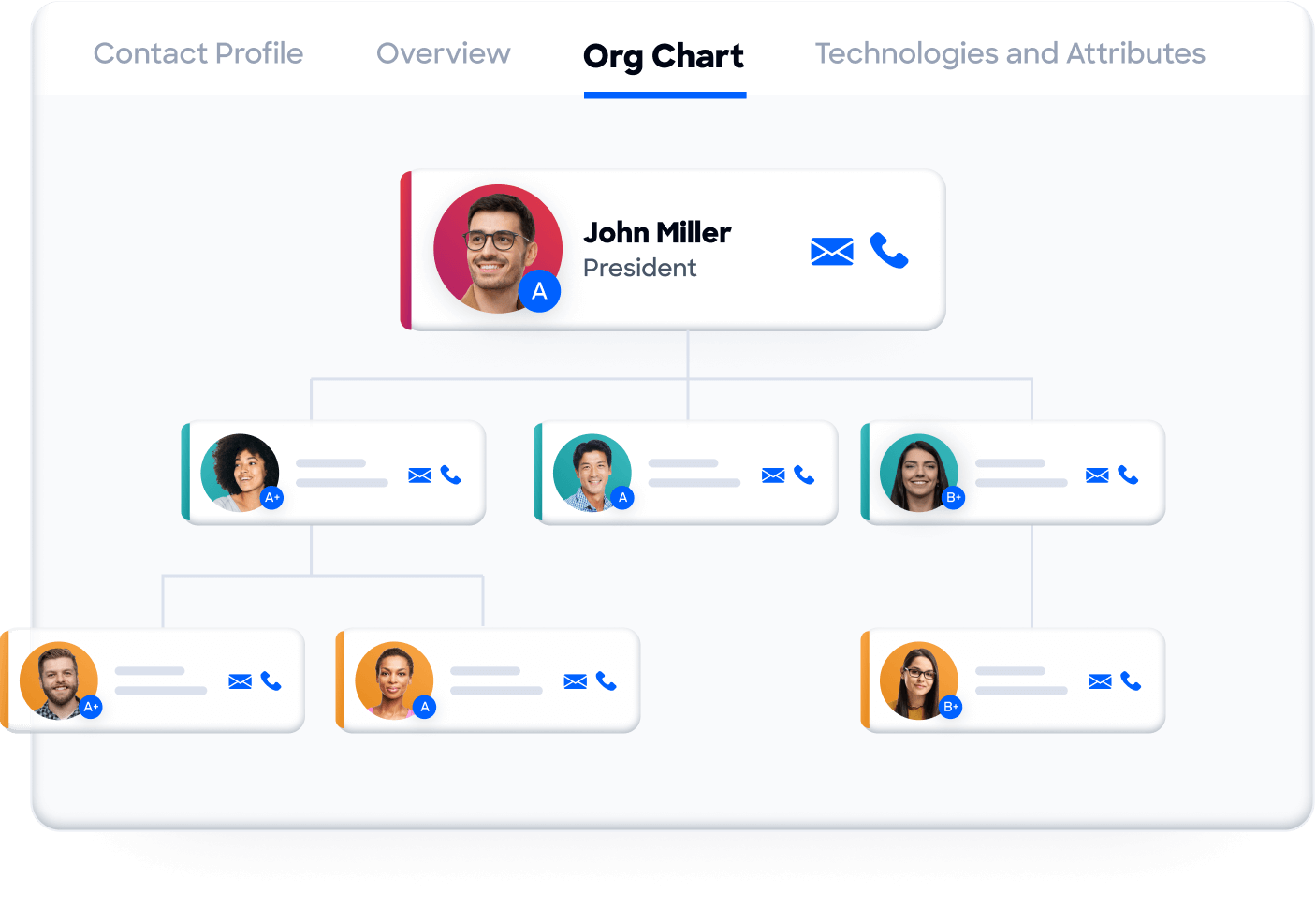
ZoomInfo is the enterprise benchmark for a reason. 300M+ profiles, deep org charts, direct dials, and a full GTM suite including intent data on Advanced plans, conversation intelligence, and workflow automation. If you're selling into Fortune 500 accounts with complex buying committees, the depth of ZoomInfo's company data is genuinely hard to match.
The cost is real, though. Professional starts at $15,000+/year. Advanced runs $24,000+/year. Elite hits $40,000+/year - and that's before add-ons. Extra credits cost ~$3,000 per 5,000. Global Data is $9,995. NeverBounce verification is another ~$3,000. Some teams end up at $50,000+/year all-in.
Watch the contracts: ZoomInfo pushes 2-3 year terms with 60-90 day auto-renewal windows. Miss that window and you're locked in.
G2: 4.5/5 (8,875 reviews).
Use this if: you're selling into enterprise accounts, have $40K+ budget, and need org chart depth plus intent data in one platform. Skip this if: you're an SMB, hate opaque pricing, or primarily need accurate contact data without the platform overhead.
Apollo.io
Apollo is the obvious starting point for most SMB teams, and it's not close. For $49/seat/month (Basic), $79/seat/month (Professional), or $119/seat/month (Organization, minimum 3 users), you get 210M+ contacts, a built-in sequencer, a dialer, and basic pipeline tracking. The free tier is genuinely usable for solo founders testing outbound.
G2: 4.7/5 (9,250 reviews) - one of the highest-rated platforms at scale.
The accuracy trade-off is real, though. In independent testing, Apollo's email accuracy came in at 88%, meaning about 1 in 8 emails bounces. For teams running high-volume sequences where a few percentage points of deliverability don't make or break the program, that's acceptable. For teams where domain reputation is critical - agencies, for example - it's a problem. Pair Apollo with a verification layer if you go this route.
Where Apollo wins over ZoomInfo: price, speed to value, and all-in-one convenience for teams under 20 reps. Where ZoomInfo still wins: enterprise data depth, org charts, and intent signal sophistication.
Use this if: you're an SMB selling to sub-5K employee companies and want everything in one tool on a budget. Skip this if: email deliverability is critical to your outbound program.
Cognism
Cognism is the EMEA compliance play. If you're selling into European markets where GDPR compliance isn't optional, Cognism's phone-verified Diamond Data and strong European coverage make it a default choice. Pricing is custom - typically $1K-$3K/month for small teams.
Where Cognism wins over ZoomInfo: European data quality and compliance infrastructure. Where ZoomInfo still wins: US database depth and breadth of platform features. G2: 4.5/5 (1,200 reviews).
6sense
6sense is an enterprise ABM platform, not a contact database. It excels at predictive analytics, account scoring, and intent data for large revenue teams running account-based programs with complex buying committees. The real product starts at $30K-$100K+/year.
Look, 6sense requires dedicated RevOps to extract value. We've seen teams buy it, fail to integrate it properly, and end up using it as an expensive account list. 44% of reps give up after one follow-up, and 80% of deals require 5+ touches - 6sense is built to orchestrate that multi-touch complexity, but only if someone owns the implementation full-time for the first quarter. If you don't have that person, skip it.
Lusha
Quick, lightweight, and good for individual reps who need fast contact lookups without committing to a platform. Lusha's Chrome extension is one of the best in the category for speed - click, get a number, move on. The database covers 280M+ contacts. Pricing starts free, with Pro at $22.45/month and Premium at $52.45/month on a credit-based model.
Lusha is an enrichment tool, not a full intelligence solution. It doesn't do intent, doesn't do sequencing, and the data accuracy of 85% email in independent testing is middle-of-the-pack. G2: 4.3/5 (1,566 reviews). Use it as a supplement, not a foundation.
Bombora
Standalone intent data layer tracking company-level topic surges across a co-op of B2B publisher sites. Contracts start ~$25K/year. Best for layering intent signals onto an existing contact data platform - not a standalone solution.
HubSpot Sales Hub
CRM-native intelligence for mid-market teams already on HubSpot. Starter at $20/seat/month, Professional at $100/seat/month, Enterprise at $150/seat/month. If you're already paying for HubSpot and want built-in prospecting without adding another vendor, it's the path of least resistance. HubSpot now includes Breeze Intelligence (formerly Clearbit), so you get basic enrichment baked in.
Pricing Reality Check
Let's talk about what you'll actually pay per usable contact, because sticker price is misleading.
| Tool | Starting Price | Cost/1K Verified Emails | Contract? | Hidden Costs |
|---|---|---|---|---|
| Prospeo | Free (75 emails/mo) | ~$10 | No | None - pay as you go |
| Apollo | Free; $49/seat/mo | ~$50-100 | No (monthly available) | Seat costs scale fast |
| Lusha | Free; $22.45/mo | ~$100-200 | No | Credits deplete quickly |
| ZoomInfo | ~$15K/year | ~$200-600 | Yes (2-3 year terms) | Add-ons, extra credits, seats |
| Cognism | ~$1K/mo | ~$150-300 (est.) | Yes (annual typical) | Diamond Data costs extra |
| 6sense | $30K+/yr | N/A (account-level) | Yes | Implementation + RevOps time |
The $47K average annual spend on sales intelligence tools isn't driven by any single platform - it's driven by stacking. A team running ZoomInfo for contacts, Bombora for intent, Outreach for sequences, and a separate data enrichment tool can easily hit $60K+ before they realize 60% of those features overlap.
The "true cost per usable contact" calculation matters more than any line item. At $0.01 per email with 98% accuracy, your cost per usable contact is essentially $0.01. At ZoomInfo's estimated $0.60-$3.00 per credit with ~90% accuracy, you're looking at $0.67-$3.33 per usable contact after accounting for bounces. Those differences compound fast when you're pulling 10,000+ contacts per quarter.
How to Evaluate a Platform
Don't trust demos. Don't trust vendor-supplied accuracy stats. Run this evaluation instead.
The 50-contact ICP test. Pull 50 contacts from each platform that match your ideal customer profile exactly. Verify the emails through an independent tool. Call the phone numbers. Check job titles against professional profiles. This takes 30 minutes per vendor and will save you months of regret.
Beyond the accuracy test, evaluate on five criteria:
- Accuracy on your ICP - not overall accuracy, but accuracy for the specific titles, industries, and company sizes you sell into. A tool can be 95% accurate overall and 70% accurate for VP-level contacts at mid-market SaaS companies.
- Refresh frequency - weekly is the standard to beat. Anything over 4 weeks means you're working with partially stale data.
- Credit economics - calculate your cost per usable contact, not cost per credit. Factor in bounces, duplicates, and contacts that don't match your ICP.
- Integration depth - does it push cleanly into your CRM and sequencer? ZoomInfo has the broadest integration ecosystem. Apollo has its own built-in sequencer. Self-serve platforms get you there in minutes.
- Time-to-first-value - how long from signup to first exported list? Self-serve platforms get you there in minutes, while enterprise platforms like ZoomInfo and 6sense can take weeks of implementation before you pull your first usable list.
Red flags during evaluation:
- No public pricing
- Mandatory annual contracts before you've tested accuracy
- Credit-based phone access with no refunds for wrong numbers
- Any vendor that won't let you run a free trial on your own ICP
When to skip sales intelligence entirely: if you're pre-product-market-fit, have fewer than 100 target accounts, or run a purely inbound motion, a dedicated platform is premature. Nail your ICP first, then invest.
5 Mistakes That Kill Your ROI
Buying for database size over accuracy. A 300M-contact database where 12% of emails bounce is worse than a 143M-contact database at 98% accuracy. Size is marketing. Accuracy is revenue.
Ignoring data decay. If your provider refreshes every 6 weeks and you're not supplementing with real-time verification, you're sending sequences to people who've already changed jobs. At 2% monthly decay, a Q1 list is 6% stale by Q2. That's hundreds of bounces on a 10,000-contact campaign.
Stacking overlapping tools. The 60% feature overlap problem is real. Before adding a new platform, map every tool you own against the four-layer stack. If two tools both do enrichment, cut one.
Buying intent data without workflow automation. One team used Bombora to prioritize outreach and triggered exactly 14 actions in 8 months - working out to about $1,200 per influenced call. Intent data without automated routing and sequencing is an expensive dashboard nobody checks.
Skipping compliance. GDPR fines run up to EUR 20M or 4% of global annual revenue. Even outside the EU, keep your bounce rate under 2% and spam complaint rate under 0.01%. These aren't suggestions - they're the thresholds that determine whether your emails reach inboxes or spam folders. (For a practical checklist, see B2B compliance.)
Use Cases That Drive Pipeline
The most common use cases fall into three categories, and understanding them helps justify the investment to whoever signs the check.
Outbound prospecting and ICP targeting. Teams use contact data, firmographics, and technographics to build hyper-targeted prospect lists instead of blasting generic databases. This is the foundational use case and where most teams start. In our experience, teams that layer at least three filters - job title, company size, and one signal like tech stack or funding - see 2-3x higher response rates than teams using title and industry alone. (If you want more plays, see these pipeline generation ideas.)
Account prioritization with intent signals. Layering intent data onto your target account list lets reps focus on the 2-5% of accounts actively in-market. Teams that combine intent with enrichment data consistently outperform those relying on static lists.
Deal acceleration and multi-threading. When a deal stalls, intelligence tools help reps identify additional stakeholders on the buying committee - mapping the org chart, finding direct contact information, and opening new threads to unblock the opportunity. One scenario we see often: a champion goes dark, the rep pulls three more contacts from the same account, and a VP-level thread reopens the conversation within a week.
Measuring ROI
Sales intelligence ROI isn't just "did we close more deals." It's a chain reaction that starts with leading indicators and flows into lagging ones.
Track the leading indicators first: email deliverability rate, phone connect rate, response rate, and meetings booked per rep per week. These move within 30 days of switching platforms. Then watch the lagging indicators: qualified pipeline generated, win rate by source, and revenue per rep.
Here's the math that makes the case to finance. A 15% lift in response rate from better data accuracy drives roughly a 20% increase in qualified pipeline. On a team generating $2M in quarterly pipeline, that's $400K in additional pipeline - measurable within one quarter. Organizations that implement strong measurement frameworks see 25-40% higher long-term value from their investments.
The key is establishing your baseline before you switch tools. Measure your current bounce rate, connect rate, and pipeline velocity for 30 days. Then run the same metrics on the new platform. Let the numbers make the argument.
FAQ
What's the difference between sales intelligence and a CRM?
A CRM stores internal customer data - deals, activities, notes. Sales intelligence brings in external data like verified contacts, firmographics, and intent signals to help you find and prioritize prospects before they enter your CRM. They're complementary: intelligence feeds the CRM, the CRM tracks what happens next.
How much does a B2B sales intelligence platform cost?
Most mid-market teams spend $5K-$20K annually, though enterprise tools like ZoomInfo Elite can exceed $40K/year. Budget based on cost per usable contact - Prospeo runs ~$0.01/email at 98% accuracy, while ZoomInfo averages $0.67-$3.33 per usable contact after accounting for bounces and credit costs.
How often should sales data be refreshed?
Weekly is the standard to beat. B2B contact data decays at roughly 2% per month, so a 4-6 week refresh cycle means you're always prospecting with partially stale information. Providers with 7-day refresh cycles minimize bounce rates and protect your sender reputation.
Can I build a full intelligence stack for under $15K/year?
Yes. Combine a high-accuracy contact provider at ~$0.01/email, intent signals layered into your search filters, and your existing CRM for workflow automation. Three layers, full coverage, well under $15K - and you'll likely outperform teams spending three times that on overlapping tools.
What's a good free option for small teams?
Prospeo's free tier includes 75 verified emails per month with full enrichment - enough for small teams validating outbound. Apollo.io also offers a generous free plan with built-in sequencing. Start with both, run the 50-contact ICP accuracy test, and commit to whichever performs better on your specific target market.