

B2B Salesperson: What the Job Actually Looks Like in 2026
A 10-seat sales team where only one or two reps consistently hit quota. That's not a hypothetical - it's the math when only 16% of reps attain their number. The average B2B salesperson faces longer sales cycles, bigger buying committees, and more tool sprawl than most teams were built for. Yet the career still offers one of the highest earning ceilings that doesn't require a specific degree.
Here's what the job actually looks like - the money, the skills, the daily grind, and the career path - with real numbers instead of recruiter spin.
What Is a B2B Salesperson?
A B2B salesperson sells products or services from one business to another. That's the simple version. The reality is messier: you're navigating buying committees that can involve up to 25 stakeholders, sales cycles stretching past six months, and deals where the wrong contact or a missed follow-up can kill months of work. B2B commerce is projected to reach $124T by 2028, so demand for skilled sales professionals in this space isn't going away.
The contrast with B2C selling is stark:
| Dimension | B2B | B2C |
|---|---|---|
| Avg. deal size | $5K-$500K+ | $10-$500 |
| Sales cycle | 3-9 months | Minutes to days |
| Decision-makers | 10-25+ | 1-2 |
| Relationship depth | High, multi-touch | Low, transactional |
| Comp structure | Base + commission | Hourly or flat salary |
Within B2B, the role fragments into several distinct jobs. SDRs and BDRs generate pipeline through outbound prospecting - they're the tip of the spear, measured on meetings booked and pipeline created. Account Executives run the full sales cycle from discovery through close. Account Managers own post-sale relationships and expansion revenue. Sales Engineers handle technical validation. Customer Success Managers protect and grow existing accounts.
Each role has a different daily rhythm, compensation model, and skill profile.
What You Need (Quick Version)
B2B sales pays well, but the headline OTE numbers are misleading. Only 16% of reps hit quota, which means most people earn significantly less than the "on-target" figure on their offer letter. Your actual earnings depend on role, company, vertical, and - bluntly - whether you're any good.
The fastest career path: SDR for 12-18 months, then AE, then mid-market or enterprise. High performers make the SDR-to-AE jump in 10-12 months. Master three skills - discovery, follow-up, and multi-threading - and you'll outperform most of your peers.
Your tech stack matters more than raw hustle. Verified contact data, a CRM you actually use, and a sequencing tool for automated outreach are non-negotiable. Bad data wastes the limited selling time you have. And with 89% of revenue organizations now using AI, the reps who ignore tooling aren't just inefficient - they're falling behind.
B2B Sales by the Numbers
These aren't aspirational benchmarks. They're the median reality.
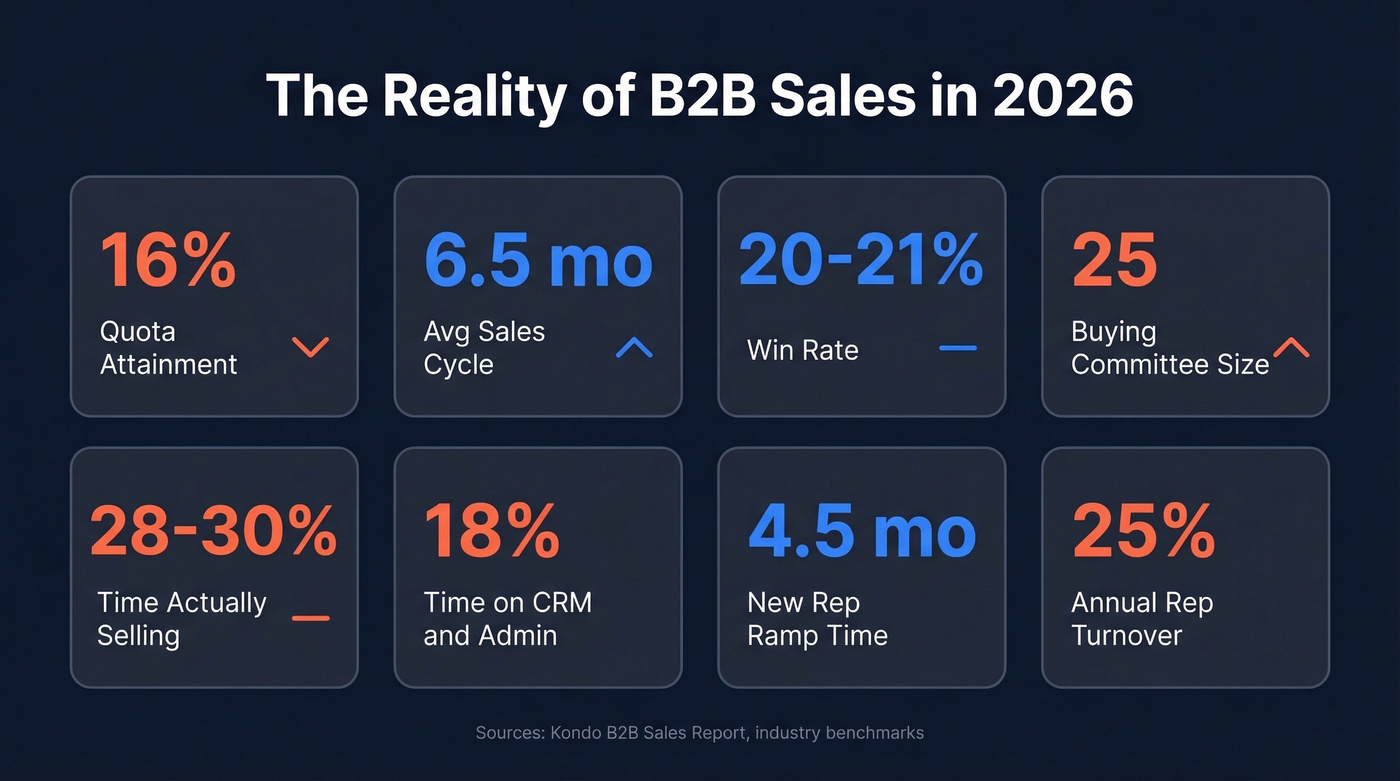
| Metric | Number | Trend |
|---|---|---|
| Quota attainment | 16% | Down from historical norms |
| Avg. sales cycle | 6.5 months | Up from 4.9 months (2019) |
| Win rate | 20-21% | Flat |
| Buying committee size | 25 people | Up from 16 (2017) |
| Time spent selling | 28-30% | Stubbornly low |
| Time on CRM/admin | ~18% | Stubbornly high |
| New rep ramp time | 4.5 months | - |
| Annual rep turnover | 25% | - |
The selling-time number should bother you most. Reps get about a day and a half per week to actually sell. The rest goes to CRM updates, internal meetings, prospecting research, and tool management. When 66% of reps say they feel swamped by tool fragmentation - and the average stack is ten tools - that's not whining. It's a structural problem eating into revenue-generating hours.
The cycle-length trend is equally important. Deals that closed in under five months in 2019 now take six and a half. Buying committees have ballooned from 16 to 25 stakeholders. Every additional stakeholder adds friction, and every month of cycle time adds risk. This is why multi-threading - building relationships across the buying committee, not just with your champion - has become the single most important tactical skill in B2B sales.
Salary and Compensation Data
Here's the 2026 compensation data from RepVue, aggregated from thousands of self-reported comp figures:
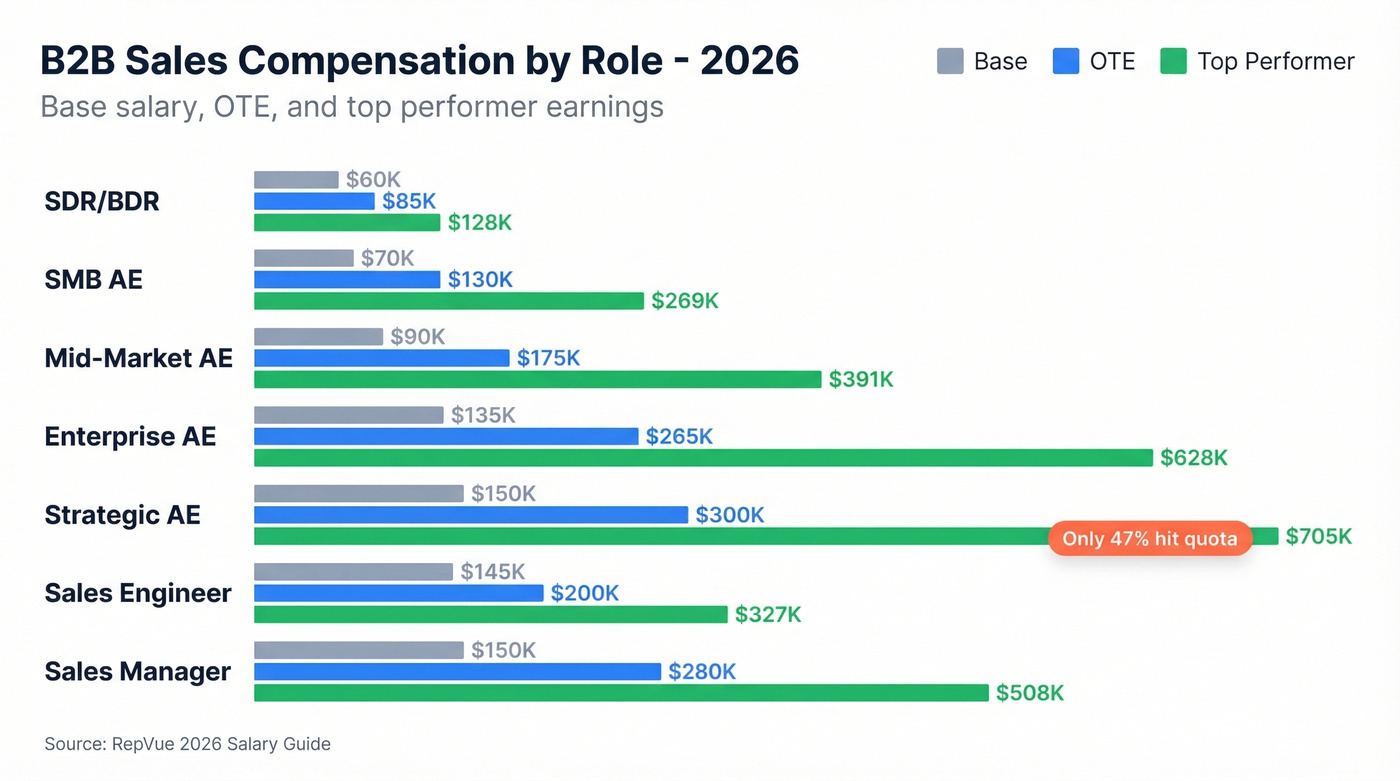
| Role | Base | OTE | Top Performer | Quota % |
|---|---|---|---|---|
| SDR/BDR | $60K | $85K | $128K | 57.3% |
| SMB AE | $70K | $130K | $269K | 44.8% |
| Mid-Market AE | $90K | $175K | $391K | 43.9% |
| Enterprise AE | $135K | $265K | $628K | 40.9% |
| Strategic AE | $150K | $300K | $705K | 47.0% |
| Sales Engineer | $145K | $200K | $327K | 56.8% |
| Sales Manager | $150K | $280K | $508K | 51.3% |
Here's the thing: OTE is what you earn if you hit 100% of quota. Most reps don't. Look at the quota attainment column - fewer than half of AEs at any level are hitting their number. The average rep earns somewhere between base and OTE, not at OTE.
For a first-year SDR, realistic take-home is closer to $65-75K, not the $85K OTE on the offer letter. That's still solid money for an entry-level role with no degree requirement, but go in with eyes open.
The top-performer column tells the other side of the story. A Strategic AE crushing quota can clear $700K. The ceiling is genuinely high, but the distribution is brutally skewed. And there's something counterintuitive buried in the data: SDRs hit quota at a higher rate (57.3%) than AEs at any level. SDR quotas are typically activity-based - meetings booked, pipeline generated - which is more controllable than revenue targets. Once you move to AE, your number depends on deal outcomes you can influence but can't fully control.
Daily Workflow by Role
The daily reality varies dramatically depending on where you sit.
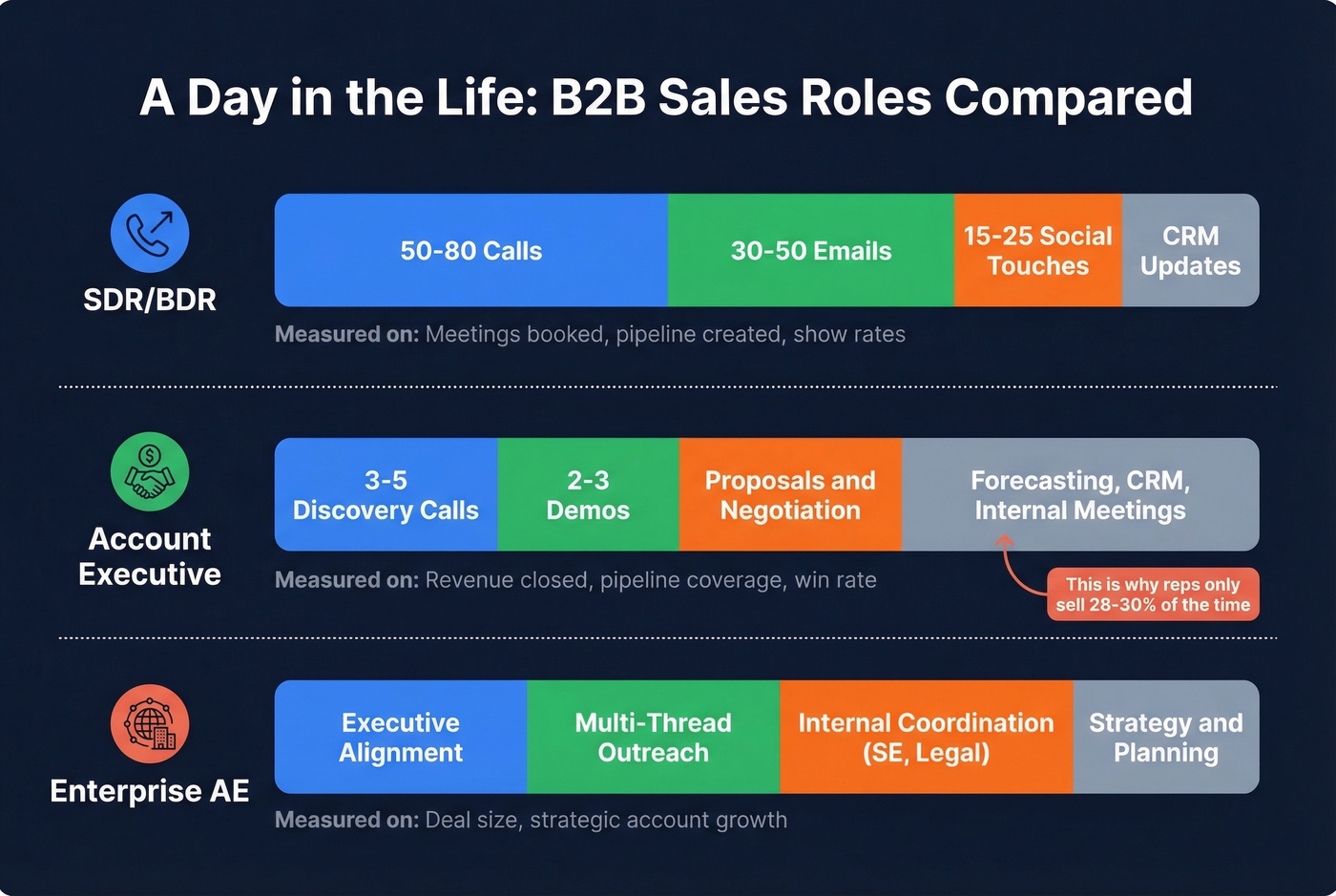
SDR/BDR (pipeline generation): Your day is high-volume outbound. Expect 50-80 calls, 30-50 personalized emails, and 15-25 social touches daily. The goal is booking qualified meetings for AEs. You're measured on meetings set, pipeline generated, and show rates. It's repetitive, rejection-heavy work - but it's the fastest on-ramp into a high-earning career if you treat it like a 12-18 month apprenticeship rather than a dead-end grind.
Account Executive (full-cycle sales): Discovery calls fill your mornings. Afternoons are demos, proposal reviews, and pipeline management. A mid-market AE might run 3-5 discovery calls and 2-3 demos per week while managing 15-25 active opportunities. You're juggling qualification, negotiation, and internal alignment simultaneously. The 28-30% selling-time stat hits AEs hardest - between forecasting calls, CRM updates, and cross-functional meetings, the actual selling window shrinks fast.
Enterprise AE (strategic deal management): Fewer deals, higher stakes. You might manage 5-10 opportunities at a time, each involving 10-25 stakeholders. Your day includes executive alignment meetings, multi-threaded outreach across the buying committee, and internal coordination with SEs, legal, and leadership. A single deal can take 6-12 months. The skill here isn't volume - it's orchestration.
Essential Skills That Separate Top Reps
Every sales training program lists 15 skills you need to master. That's overwhelming and mostly wrong. Master three, and everything else becomes a derivative.
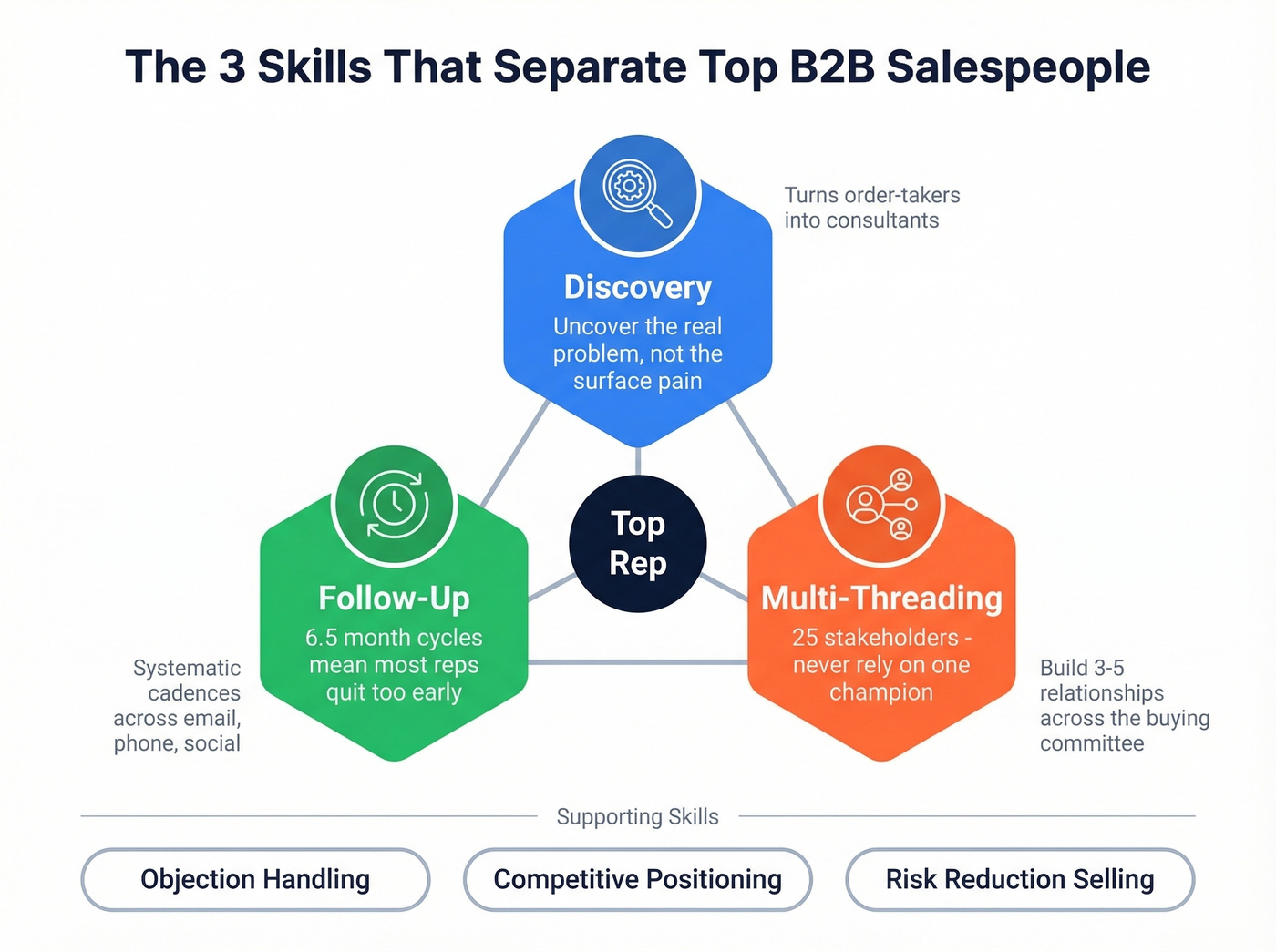
Discovery is the ability to run a conversation that uncovers the prospect's real problem - not the surface-level pain they'll admit to in the first five minutes, but the business impact that justifies a purchase. Great discovery separates order-takers from consultants. It's also the hardest skill to teach because it requires genuine curiosity, not just a list of questions. (If you want a tighter structure, use a discovery questions framework.)
Follow-up is where most reps fail. B2B sales cycles average 6.5 months. That's six and a half months of staying relevant, adding value, and keeping momentum without being annoying. Most reps give up after two or three touches. The ones who build systematic follow-up cadences - mixing email, phone, social, and content - win deals their competitors forgot about. (Steal a few sales follow-up templates and adapt them to your ICP.)
Multi-threading is non-negotiable with 25-person buying committees. Relying on a single champion is career suicide. Multi-threading means building relationships with 3-5 stakeholders across the buying committee: the economic buyer, the technical evaluator, the end user, and the internal champion. When your champion goes on vacation or leaves the company, your deal survives.
Beyond the core three, strong performers develop objection handling that feels like conversation rather than scripted rebuttals, competitive positioning that's honest about tradeoffs, and risk reduction selling - helping the buyer feel safe saying yes by removing implementation, integration, and ROI uncertainty.

Reps spend 18% of their time on admin and bad data cleanup. Prospeo gives you 98% verified emails, 125M+ direct dials, and 30+ filters to find the right stakeholders - so you can multi-thread buying committees instead of chasing bounced contacts.
Reclaim your selling time. Start with 75 free verified emails.
Methodologies and Frameworks
You'll encounter these in every B2B sales org:
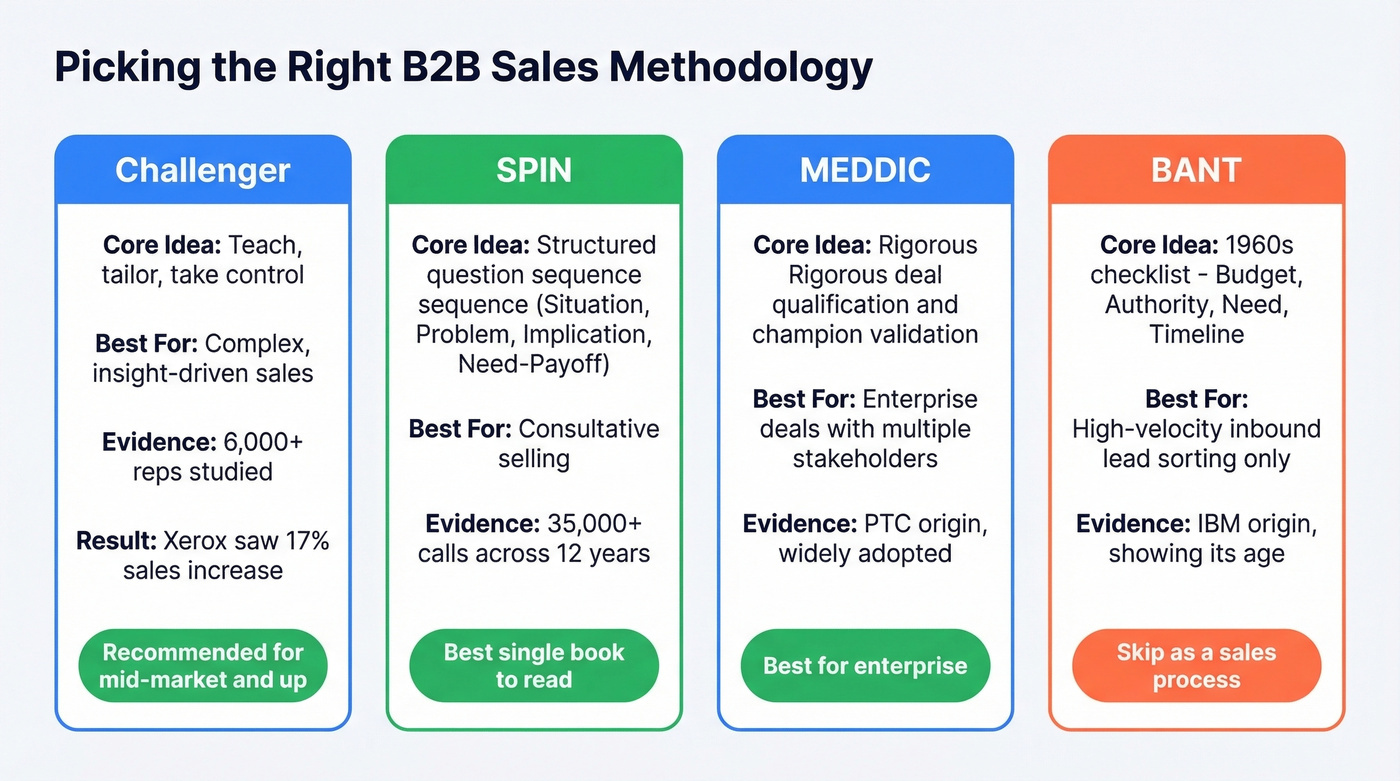
| Methodology | Core Idea | Best For | Research Basis |
|---|---|---|---|
| Challenger | Teach-Tailor-Take Control | Complex, insight-driven sales | 6,000+ reps studied |
| SPIN | Structured question sequence | Consultative selling | 35K+ calls, 12 years |
| MEDDIC | Rigorous deal qualification | Enterprise deals | PTC origin, widely adopted |
| Sandler | Buyer-led, pain-focused | Transactional to mid-market | Practitioner-developed |
The Challenger Sale came out of CEB's research across 6,000+ reps and found that the highest performers don't just build relationships - they challenge the customer's thinking. Xerox reported a 17% sales increase and $65M in contract value after implementing it.
SPIN Selling is the grandfather of consultative sales research: 35,000+ calls analyzed across 20+ countries over 12 years. If you only read one sales book, make it SPIN.
BANT (Budget, Authority, Need, Timeline) was created by IBM and it shows. It's a 1960s checklist, not a methodology. Asking about budget early often kills deals because buyers don't have defined budgets until value is established. Skip BANT as a sales process - it still works for high-velocity inbound lead sorting, but think of it as a bouncer, not a strategy.
MEDDIC is widely used in enterprise sales. It forces you to map the decision process, identify the economic buyer, and validate that you have a real champion. If you're selling complex deals with multiple stakeholders, MEDDIC is a strong default. In our experience, the teams that actually enforce MEDDIC qualification - rather than treating it as a checkbox exercise - close at measurably higher rates. (If you want to go deeper, see MEDDIC sales qualification.)
The Tech Stack That Matters
The average rep uses at least six different tools daily, and many teams run closer to ten. The sales tech market is projected to hit $104B by 2030. This isn't a fad; it's infrastructure.
Data Enrichment and Email Finding - This is your foundation. Bad contact data means bounced emails, burned sender domains, and wasted dials. Prospeo delivers 98% email accuracy across 300M+ professional profiles and 125M+ verified mobile numbers on a 7-day data refresh cycle, while the industry average sits at six weeks. The difference is measurable: Meritt cut their bounce rate from 35% to under 4% after switching, and their connect rate tripled. A free tier gives you 75 verified emails per month to test before committing, and paid plans start under $50/mo. (More options: data enrichment services.)

CRM - Salesforce for enterprise, HubSpot for everyone else. HubSpot's free CRM is genuinely good enough to get started. Don't overthink this choice early in your career. (If you want a quick landscape, see examples of a CRM.)
Sequencing - Outreach and Salesloft dominate mid-market and enterprise at roughly $100-150/user/mo. For SMB and startup teams, Instantly or Smartlead handle automated email sequences at a fraction of the cost (~$30-97/mo). (Related: sequence management.)
Conversation Intelligence - Gong and Chorus record and analyze sales calls. Reviewing your own call recordings is one of the fastest ways to tighten discovery, improve objection handling, and spot where deals stall. These are typically a company purchase, not something you buy individually.
Contract Management - PandaDoc and DocuSign handle proposals and e-signatures at roughly $25-60/user/mo. Table stakes for any AE.
The starter stack for someone breaking into B2B sales: HubSpot (free CRM), Prospeo (verified contact data, free tier), and Instantly or Smartlead for sequencing. That's under $100/mo total and covers 80% of what you need. (If you're building an outbound toolkit, start with these SDR tools.)
With buying committees ballooning to 25 stakeholders and sales cycles stretching to 6.5 months, every wrong number and bounced email costs you weeks. Prospeo's data refreshes every 7 days - not every 6 weeks - so you're always reaching real buyers at valid addresses.
Stop losing deals to stale data. Try Prospeo at $0.01 per email.
Career Path - SDR to VP
The standard trajectory: SDR, then AE, then Senior/Enterprise AE, then Sales Manager, then Director, then VP of Sales. But the timeline and branching paths matter more than the ladder itself.
SDR to AE (12-18 months). This is the make-or-break transition. High performers make the jump in 10-12 months. The promotion signals are specific: hit quota for three consecutive quarters, get positive feedback from AEs on lead quality, demonstrate self-driven improvement, and show you can run quality conversations - not just volume. If your AEs are telling your manager "I love getting meetings from this SDR," you're close. (A simple way to structure your ramp: a 30-60-90 day plan for sales reps.)
Four post-SDR paths. Not everyone should become an AE. The SDR role is a launchpad into multiple directions: Account Executive (full-cycle sales, OTE $120K-$180K at mid-market), Customer Success (relationship-focused, total comp $80-110K), Revenue Operations (analytical, total comp $90-130K), or Marketing/Demand Gen if you discover you're better at strategy than closing. If you hate the phone and love spreadsheets, skip the AE path and go straight to RevOps - you'll be happier and probably more effective. (More on the role: RevOps Manager.)
AE to Enterprise. The readiness signals shift from activity metrics to strategic thinking. You need to exceed quota consistently, explain your wins and losses clearly, manage multiple complex opportunities simultaneously, and forecast accurately. Enterprise selling is a different sport - it rewards patience, political savvy, and the ability to orchestrate across a 25-person buying committee. (If you're aiming there, read enterprise B2B sales.)
Enterprise to Leadership. Six figures within 2-4 years is realistic for strong performers. The VP of Sales path typically requires 8-12 years of progressive experience, but the comp ceiling is substantial - $280K+ OTE for Sales Managers, with VPs often clearing $400K+ at growth-stage companies.
The career path isn't always linear. Some of the best sales leaders we've worked with took detours through customer success or product marketing before coming back to run teams. The skills transfer. What matters is that you're building judgment, not just hitting numbers.
What Top Performers Do Differently
A Reddit post from a rep earning $1.3M in cash comp over nine years of B2B sales laid out an approach worth studying - not as a template, but as a window into how the top fraction thinks.
The biggest surprise: health as a performance lever. Working out, sleeping well, protecting mental health - because the marginal call at 4:30 PM on a Friday requires energy that most reps have already burned through. The consensus on r/sales backs this up: burnout kills more careers than lack of talent.
Relationship-building was the other throughline. Not the "add them on LinkedIn" version - the "remember they mentioned their kid's soccer game and ask about it three months later" version. Donut drops at a client's office. Casual invites to events around shared interests. Asking clients for advice as a trust-building tactic, then asking for introductions once the relationship is real.
The data backs up the relationship angle. Teams using social selling create 45% more opportunities and see 16% higher win rates. The top performers aren't just working harder - they're building networks that generate inbound opportunities while their peers are still cold-calling into the void.
How AI Is Reshaping the Role
89% of revenue organizations now use AI, up from 34% in 2023. That's not a gradual shift - it's a phase change. The performance gap is real: 83% of AI-using sales teams saw revenue growth versus 66% without.
AI excels at prospect research, follow-up cadence optimization, lead scoring, data enrichment, and inbound handling right now. These are the repetitive, data-heavy tasks that eat into that 28-30% selling window. AI handles them faster and more consistently than humans can. (If you're applying it to outreach, start with AI sales follow-up.)
Where humans still win: objections, relationship-building, negotiation, and nuance. The moment a deal gets complex - a skeptical CFO, a competitive bake-off, a champion who's losing internal support - AI can't navigate the politics. A skilled rep still has an irreplaceable edge here.
The AI SDR market tells the story in dollars: projected to grow from $4.12B in 2025 to $15.01B by 2030, a 29.5% CAGR. About 22% of organizations have fully replaced human SDR functions with AI. But roughly 55% are running augmented workflows - AI handles the research and initial outreach, humans take over when a conversation starts.
Let's be honest about what this means for new reps. If your average contract value is below $10K-$15K, a well-tuned AI SDR will outperform most human SDRs within two years. Above that threshold, the human advantage in relationship-building and deal navigation holds - but only if that human is actually skilled. Mediocre reps at any deal size are the most at risk.
If you're entering B2B sales in 2026, your competition isn't other reps. It's other reps with AI. The skill isn't using AI - that's table stakes. The skill is knowing when to override it.
Is a B2B Sales Career Worth It?
The honest answer: it depends on your tolerance for uncertainty and your willingness to invest in getting good.
The upside is real. High earning ceiling with no degree requirement. Transferable skills that work in almost any business context. Career mobility - you can go from SDR to six figures in 2-4 years, and the path to leadership is clear. Few careers offer this combination of accessibility and upside.
The downside is equally real. Only 16% of reps hit quota. Annual turnover runs 25%. OTE is a promise, not a guarantee, and most reps earn below it. Sales cycles averaging 6.5 months mean you can work a deal for half a year and lose it. The emotional toll of consistent rejection, quota pressure, and competitive intensity isn't for everyone.
Being a B2B salesperson rewards the prepared and the persistent. If you go in with realistic expectations - understanding that the first year is about learning, not earning - invest in the right skills, and build your tech stack around accurate data and efficient workflows, the ceiling is genuinely high. The reps who thrive aren't the ones with the most natural talent. They're the ones who treat sales as a craft worth mastering. (If you want broader context, see B2B sales explained.)
FAQ
How much does a B2B salesperson make?
Median OTE ranges from $85K for SDRs to $300K for Strategic AEs, per RepVue's 2026 data. But OTE assumes 100% quota attainment, and only 16% of reps hit that mark. Realistic first-year SDR earnings are closer to $65-75K. Top performers at the enterprise level can clear $600K+.
Do you need a degree for B2B sales?
No. A bachelor's degree is common but not required at most companies. Hiring managers care more about communication skills, coachability, and demonstrated hustle than where you went to school. Certifications from organizations like NASP can help but aren't necessary to land your first SDR role.
How long does it take to become an Account Executive?
Most SDRs transition to AE within 12-18 months. High performers can make the jump in 10-12 months by consistently hitting 90%+ quota for two or more consecutive quarters and earning strong feedback from the AEs they support.
What tools does a B2B salesperson need?
At minimum: a CRM (HubSpot's free tier works), a verified contact data platform like Prospeo with 75 free emails/month and 98% accuracy, and a sequencing tool such as Instantly or Smartlead. Most reps use six or more tools daily, but these three cover the foundation for under $100/mo.
Is B2B sales stressful?
Yes - only 16% of reps hit quota, annual turnover is 25%, and sales cycles average 6.5 months. But top performers earn well into six figures, the skills transfer to almost any business role, and the career path from SDR to leadership is one of the fastest in any profession.