

How to Run B2B Telemarketing Campaigns That Actually Book Meetings
A founder posted on r/b2bmarketing last year: tried LinkedIn ads, Facebook ads, Google Ads, cold email, and cold calls - nothing moved the needle. They were building lists in Apollo and grinding through calls and partnerships, wondering if outbound was even worth it anymore. That frustration is real, but the diagnosis is wrong. B2B telemarketing campaigns aren't dead. Lazy ones are.
Gartner found that 61% of B2B buyers prefer a rep-free experience, and 73% actively avoid suppliers that send irrelevant outreach. The bar has moved. You can't dial a purchased list with a generic pitch and expect results. But a well-targeted, well-timed phone call still converts higher than any other outbound channel when it's executed right - among all the types like appointment setting, lead qualification, market research, and event promotion, the campaigns that book meetings share the same DNA: precision targeting and relevant messaging.
What Every Campaign Needs
Every successful outbound calling effort comes down to three things: verified data so you're not dialing dead numbers, a structured script framework that guides without sounding robotic, and a multi-channel cadence because calls alone don't cut it anymore.
The baseline conversion rate for cold calling sits around 2.3% - roughly one meeting per 40-45 dials. But 82% of B2B buyers say they'll accept meetings at least occasionally when the outreach is tailored to them. The gap between 2.3% and the 5-8% that top teams hit? It's almost entirely data quality and call preparation.
Telemarketing Campaign Benchmarks
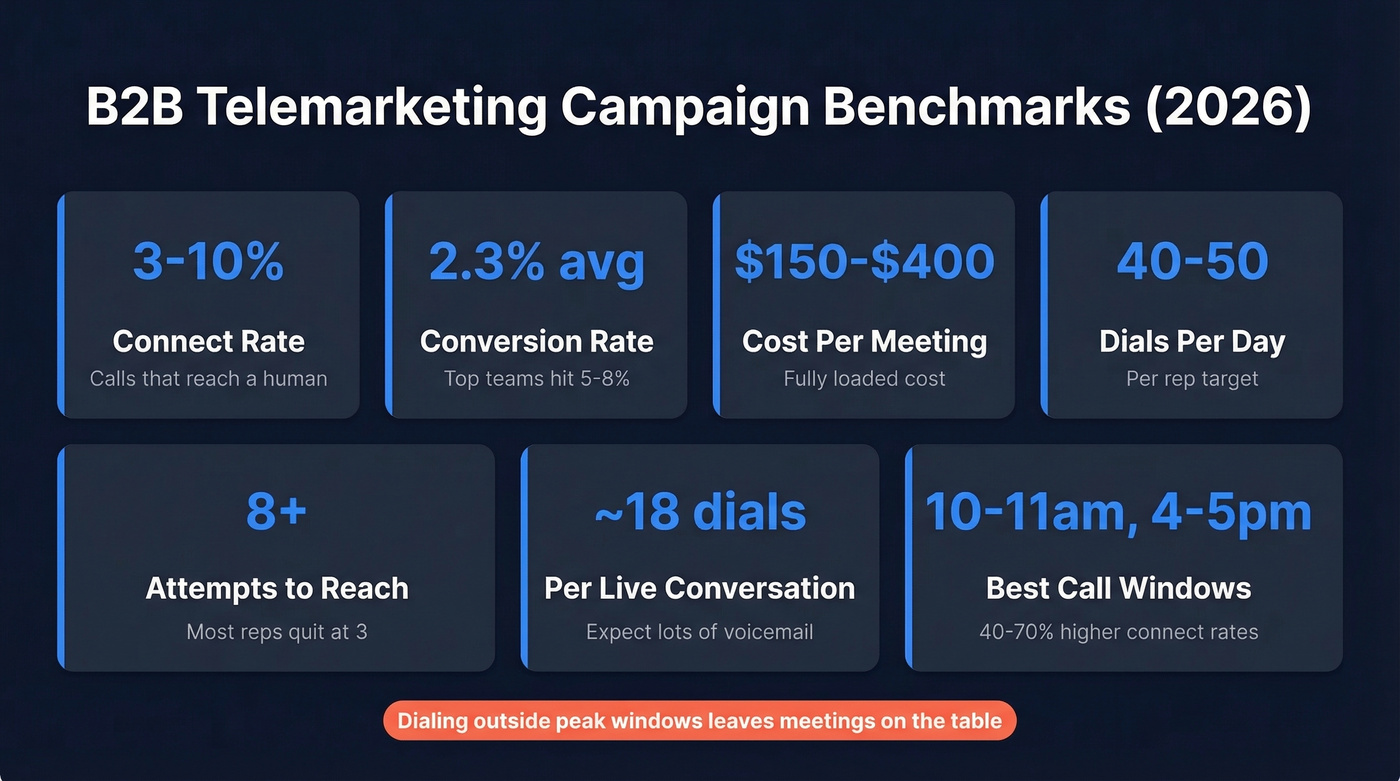
Before you build anything, calibrate your expectations:
| Metric | Typical Range |
|---|---|
| Connect rate | 3-10% |
| Conversion rate | 2.3% avg / 5-8% top |
| Cost per meeting | $150-$400 |
| Dials per day | 40-50 |
| Attempts to reach | 8+ |
| Dials per live conversation | ~18 |
| Best call windows | 10-11am, 4-5pm |
That call-window stat deserves emphasis. Dialing during peak windows - especially 8-9am or 4-5pm - lifts connect rates 40-70% compared to random times. If your reps spread dials evenly across the day, they're leaving meetings on the table. For comparison, a 1,000-contact email campaign runs roughly $2,200 in-house, but phone-based outreach books meetings at a higher rate when the data is clean.
The 6-Step Playbook
1. Define Your ICP
Not every product warrants a telemarketing campaign. Here's the heuristic that works: if your TAM is under 5,000 accounts or your average deal size exceeds $50K, calling wins. 57% of C-level and VP-level buyers prefer phone calls over other outreach channels. For high-value, low-volume selling, the phone is still the fastest path to a booked meeting.
If you need a tighter definition before you build lists, use an ICP scoring rubric so reps aren’t guessing who’s worth dialing.
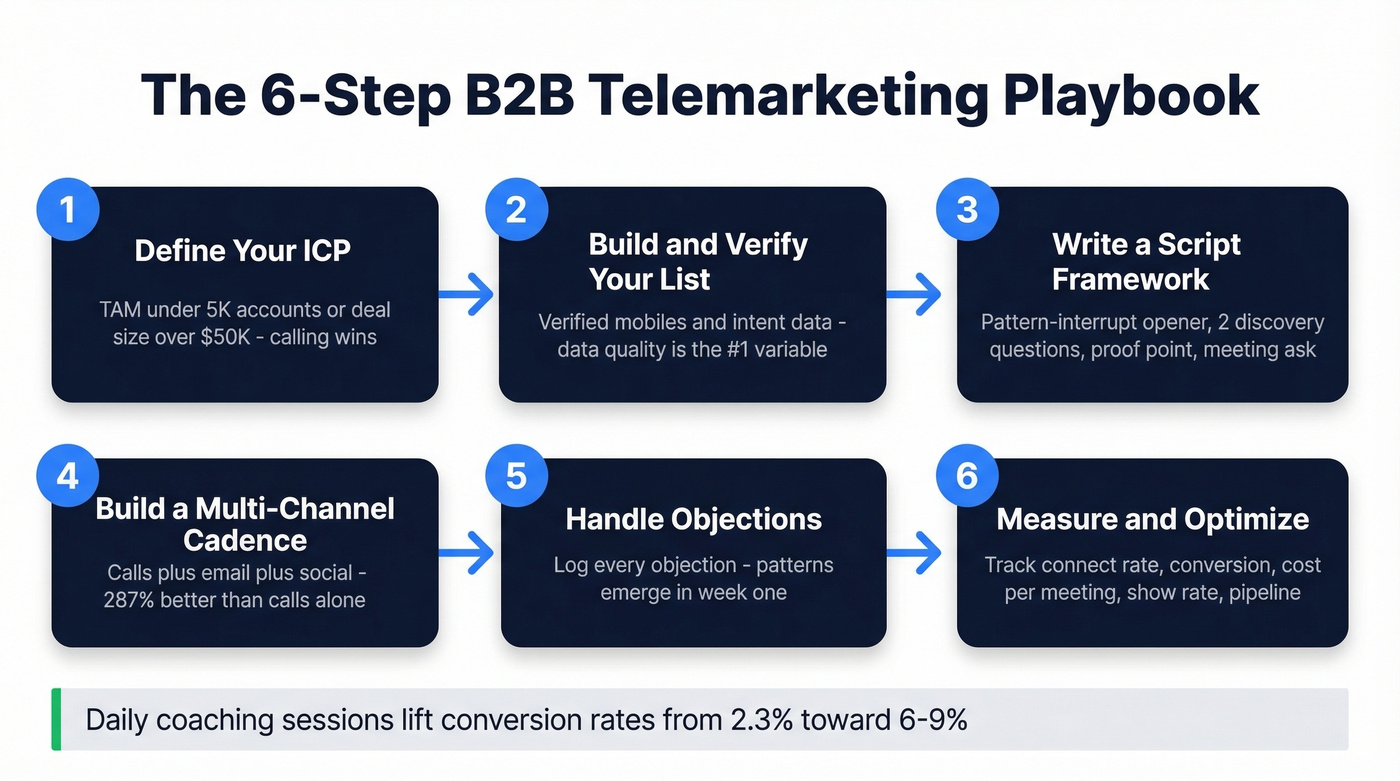
Here's the thing - if your average contract value sits below $10K and your addressable market spans 50,000+ accounts, skip telemarketing entirely. Email and paid channels will get you there cheaper. Telemarketing's ROI shines when the deal size justifies the cost per conversation.
2. Build and Verify Your List
Data quality is the single biggest variable in campaign performance. We've watched teams burn through entire budgets before realizing their list was the problem - wrong numbers, outdated titles, contacts who left the company six months ago.
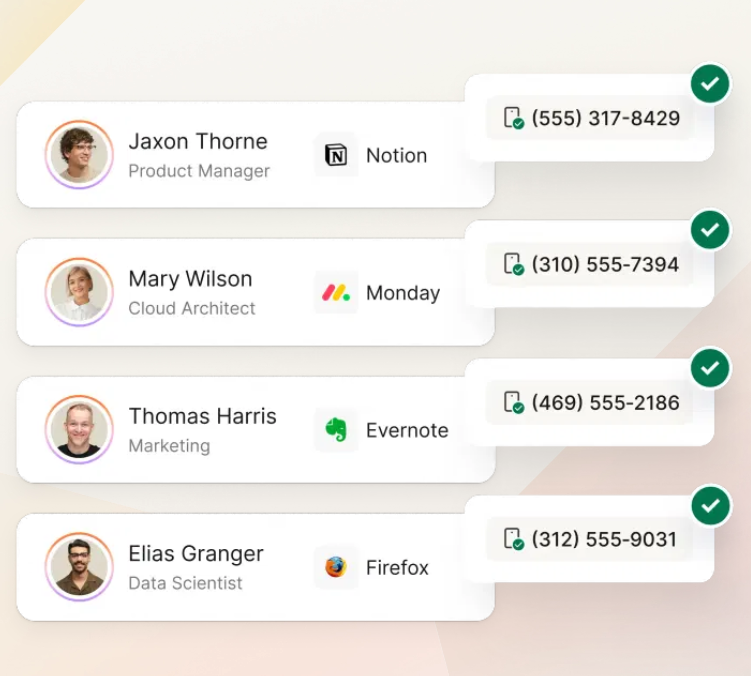
Run your list through Prospeo's database before launch. It covers 300M+ professional profiles with 98% email accuracy and 125M+ verified mobile numbers delivering a 30% pickup rate, with data refreshing every 7 days compared to the 6-week industry average. Layer in intent data to prioritize which contacts to call first - prospects actively researching your category pick up more often and convert faster. Meritt tripled their connect rate to 20-25% after switching to verified data, and their bounce rate dropped from 35% to under 4%.
If you’re enriching from multiple sources, compare data enrichment services and set a single “source of truth” for fields like title, seniority, and direct dial.
3. Write a Script Framework
Scripts are frameworks, not teleprompters. The structure that works: opener, two discovery questions, proof point, concrete meeting ask.
Two tactics deliver outsized impact. The pattern-interrupt opener ("How have you been?") boosts success rates 6.6x, and leading with a reason statement ("The reason for my call is...") delivers a 2.1x lift. Both are easy to implement and hard to argue with.
The flow in practice:
- Open with something unexpected
- State why you're calling within 10 seconds
- Ask two questions that surface pain
- Drop a relevant proof point
- Propose a specific time - "Does Tuesday at 2pm work for 15 minutes?" converts better than "Would you be open to a call sometime?"
If your reps struggle to keep it natural, pull a few talk tracks and adapt them to your ICP.
4. Build a Multi-Channel Cadence
Combining calls with email and social touches amplifies results by 287% versus calls alone:
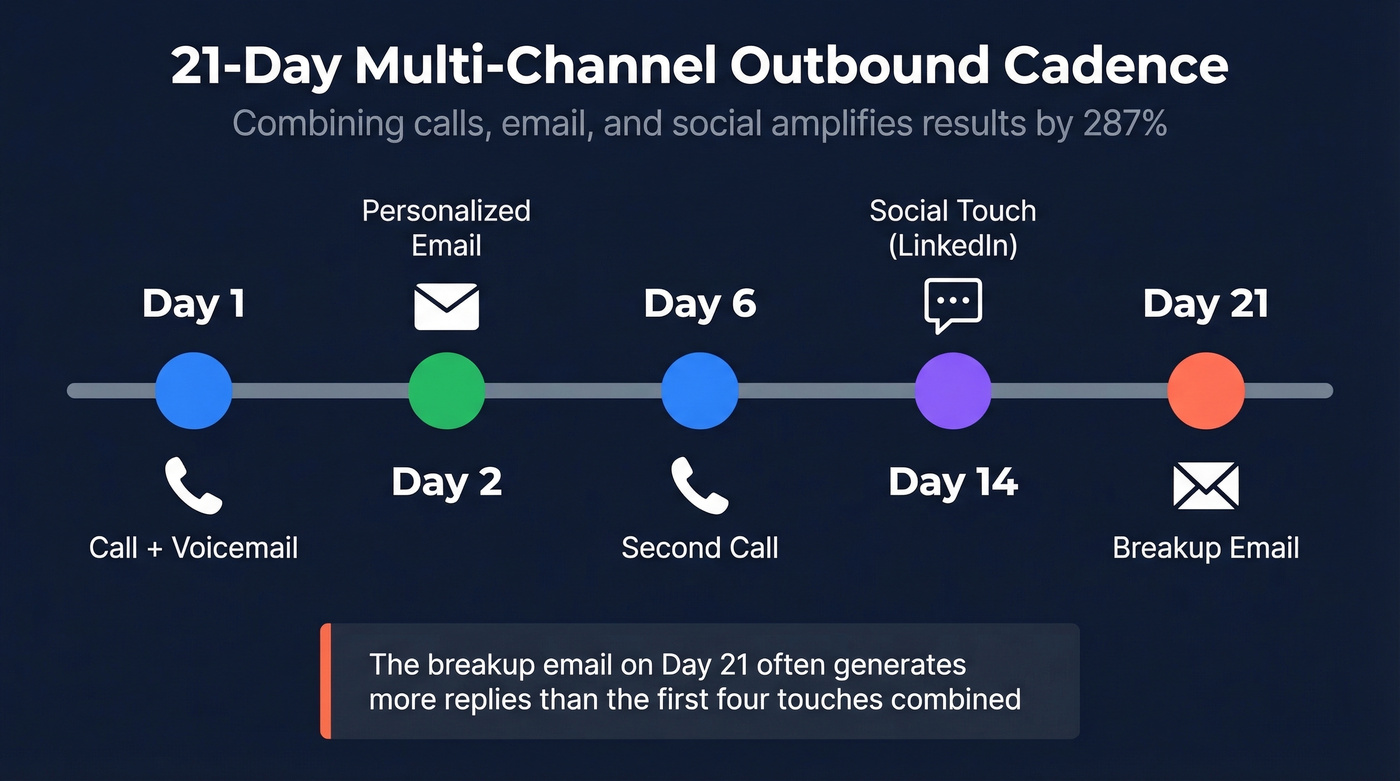
- Day 1: Call + voicemail
- Day 2: Personalized email
- Day 6: Second call
- Day 14: Social touch
- Day 21: Breakup email
We've found that the breakup email on Day 21 often generates more replies than the first four touches combined - people respond to the finality of it.
To tighten the email side, keep a few proven sales follow-up templates ready so reps don’t improvise under pressure.
5. Handle Objections
Log every objection your team hears. Patterns emerge within the first week, and those patterns become your playbook. For gatekeepers, use first names: "Is Sarah available?" works better than "Can I speak with the VP of Marketing?" Keep a permission-based tone on first calls. You're not closing a deal; you're earning 15 minutes.
If your team is getting shut down early, work on reducing objection rate with tighter positioning and better first-10-seconds control.
6. Measure and Optimize
Track five KPIs: connect rate, conversion rate, cost per meeting, show rate, and pipeline generated. Show rates land at 60-70%, but teams using confirmation workflows push above 80% by combining an email reminder with a text the morning of.
Daily coaching sessions lift conversion rates toward 6-9% - nearly triple the average. AI coaching tools now make this easier: real-time sentiment analysis flags when a rep is losing a prospect, and automated call summaries eliminate manual note-taking. If you're not reviewing calls daily, you're optimizing blind.
If you want a broader KPI set beyond calls, use these lead generation metrics to tie activity to pipeline.

The gap between a 2.3% and 8% conversion rate is almost entirely data quality. Prospeo gives your telemarketing team 125M+ verified mobile numbers with a 30% pickup rate - refreshed every 7 days, not every 6 weeks. Meritt tripled their connect rate to 20-25% after switching.
Stop burning dials on dead numbers. Start every campaign with verified data.
Choosing Your Tech Stack
You need three things: a dialer, a CRM, and a data platform.
| Category | Top Pick | Price Range |
|---|---|---|
| Dialer | RingCentral, CloudTalk | $20-$75/user/mo |
| CRM | HubSpot, Salesforce | Free-$75/user/mo |
| Data | Prospeo | Free tier, ~$0.01/email |
Progressive or power dialers are the sweet spot for B2B. Predictive dialers create that awkward "telemarketer delay" that kills trust instantly - you know the one, where you say "Hello?" twice before anyone speaks. Auto-dialers increase call capacity by 285%, but compliance risk scales with speed. Local presence dialing is non-negotiable since prospects are 4x more likely to answer a local number. RingCentral runs $20-$35/user/mo; CloudTalk starts at $25/user/mo on annual billing.
If you’re evaluating calling tools, start with a shortlist of SDR tools so your dialer, sequencing, and coaching don’t sprawl.
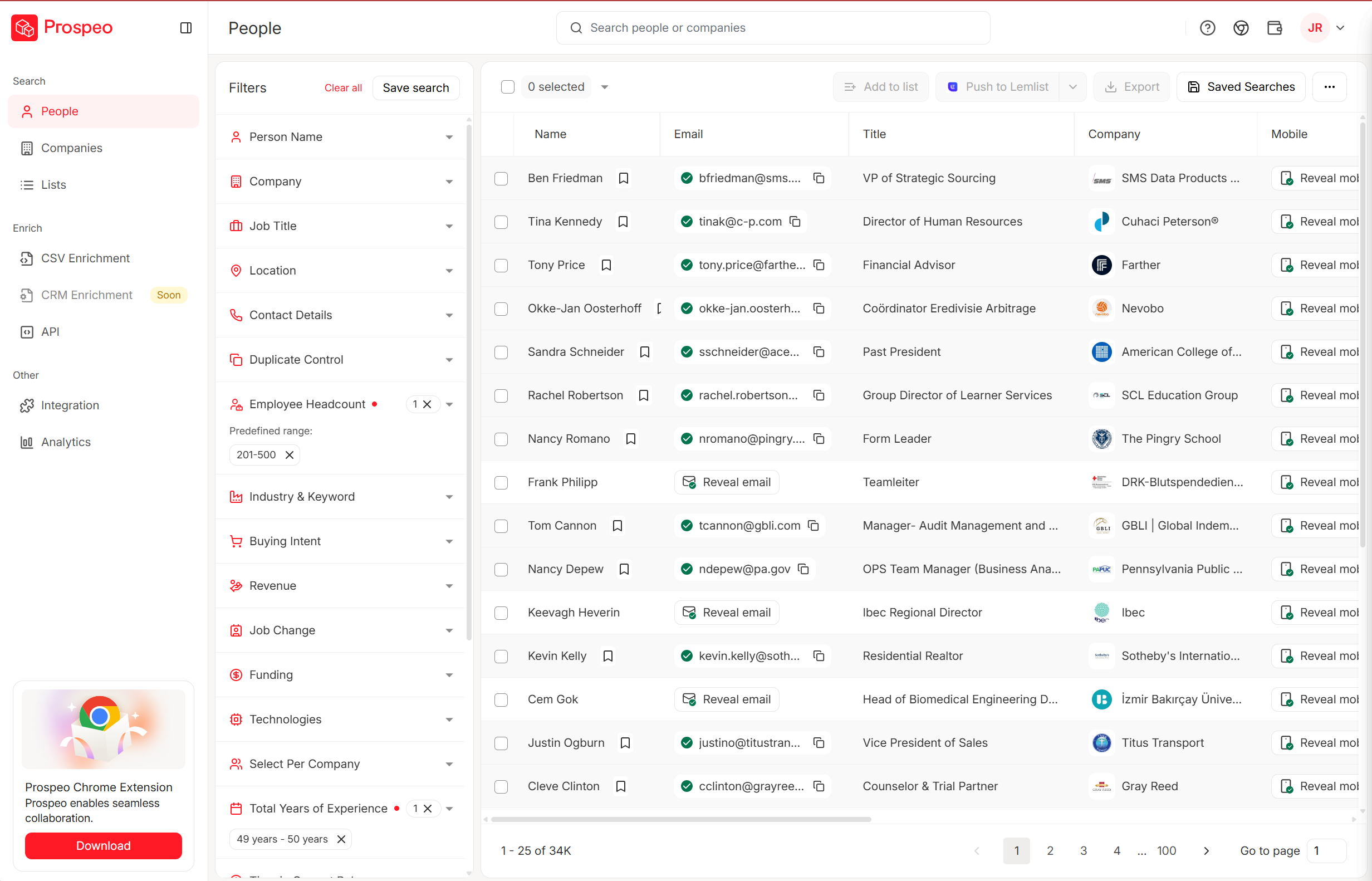
For pure telemarketing teams that don't need a full CRM, noCRM is worth a look at around $12-$30/user/mo. It's built specifically for outbound workflows rather than the bloated pipeline management most CRMs force on you.
Compliance You Can't Skip
B2B doesn't mean compliance-free. Here's what'll get you fined:
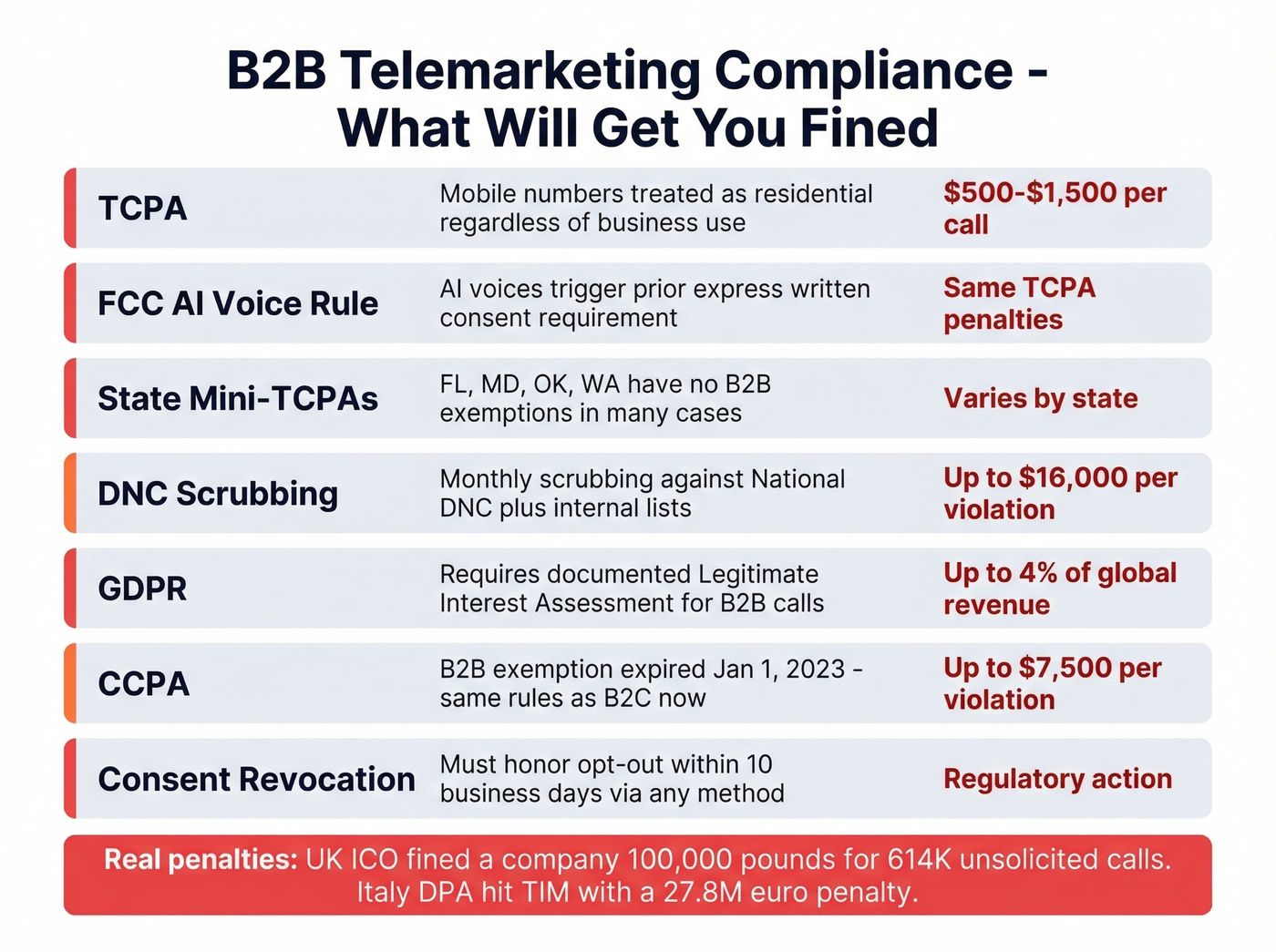
- TCPA: $500-$1,500 per call for violations. Courts treat mobile numbers as residential regardless of business use.
- FCC clarification: AI voices count as "artificial" under TCPA, triggering prior express written consent for marketing calls using artificial or prerecorded voice.
- State mini-TCPAs: Florida, Maryland, Oklahoma, and Washington have no B2B exemptions in many cases.
- DNC scrubbing: Monthly scrubbing against the National DNC registry plus internal suppression lists. Violations can hit up to $16,000 per violation.
- GDPR: B2B calling can rely on legitimate interest, but you need a documented Legitimate Interest Assessment.
- CCPA: The B2B exemption expired January 1, 2023. Same rules as B2C now apply.
- Consent revocation: Consumers can revoke consent via any reasonable method. Honor it within 10 business days.
These aren't theoretical risks. The UK ICO fined a company £100,000 for 614,342 unsolicited calls. Italy's DPA hit TIM with a €27.8M penalty. These rules apply equally whether you're running phone-based outreach in-house or outsourcing to an agency.
Five Mistakes That Kill Campaigns
Dialing without research. Thirty seconds of pre-call research on company size, tech stack, and recent news separates you from every other cold caller. The consensus on r/LeadGeneration echoes the same frustration from prospects - "they clearly knew nothing about my company."
If you need a repeatable system for this, borrow a few sales prospecting techniques and standardize what “research” means per ICP tier.
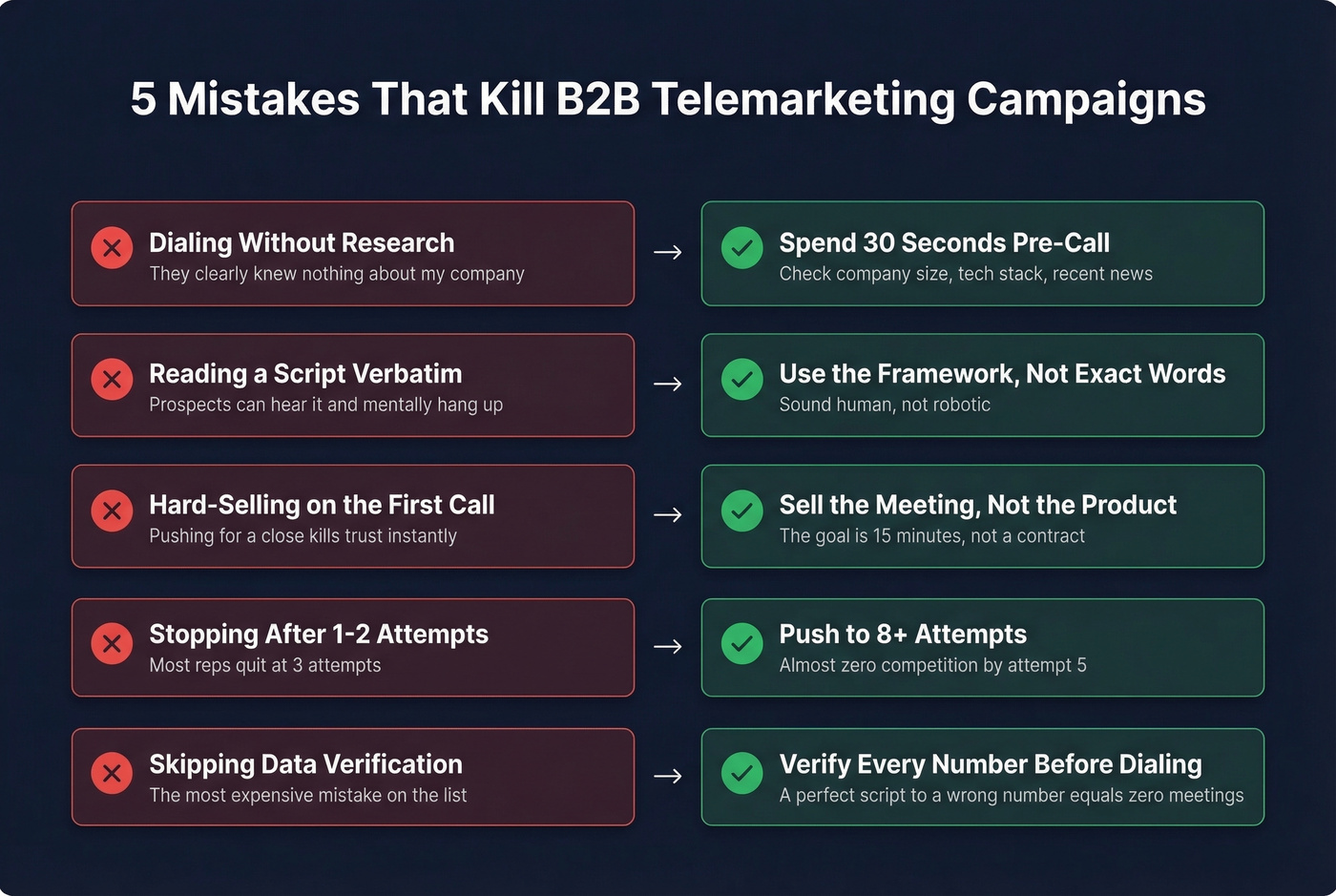
Reading a script verbatim. Prospects can hear it. Use the framework, not the exact words. Let's be honest: if your rep sounds like they're reading, the prospect has already mentally hung up.
Hard-selling on the first call. The goal is a meeting, not a close.
Stopping after 1-2 attempts. It takes 8+ attempts to reach a prospect. Most reps give up after three, which means the persistent callers face almost zero competition by attempt five.
Skipping data verification. A perfect script dialed to a wrong number produces zero meetings. This is the most expensive mistake on the list, and it's the easiest to fix.
B2B telemarketing campaigns still work in 2026 - but only when you pair verified data, a structured cadence, and disciplined follow-up. Nail those three, and you'll outperform the teams still grinding through stale lists and generic pitches.
At $150-$400 per booked meeting, every wrong number eats your margin. Prospeo's mobile data costs 10 credits per number - roughly $0.10 - and only charges when a verified number is found. Layer in intent data across 15,000 topics to call prospects already researching your category.
Dial prospects who are already in-market. That's how top teams hit 5-8%.
FAQ
Is B2B telemarketing legal in 2026?
Yes, with guardrails. TCPA, DNC scrubbing, and state mini-TCPAs all apply to business calls. Mobile numbers are treated as residential under federal law regardless of business use. Scrub your lists monthly and know your state-level rules before dialing.
How many calls should an SDR make per day?
Aim for 40-50 quality dials, yielding 4-6 live conversations. Auto-dialers push volume to 80-100 dials, but conversation quality drops. Prioritize connect rate over raw dial count - 50 well-researched dials beat 100 blind ones every time.
What's a good conversion rate for outbound calling?
The average is 2.3%. Top-performing teams hit 5-8% through verified data, daily coaching, and multi-channel cadences. If you're below 2%, your list quality or your opener needs work - start there before changing anything else.
What are the main types of B2B telemarketing?
The most common types are appointment setting, lead qualification, market research, and customer win-back. Appointment setting drives the highest direct pipeline value, while lead qualification calls help sales teams focus on prospects most likely to close.
What's a good free tool for building telemarketing lists?
Prospeo offers a free tier with 75 verified emails and 100 Chrome extension credits per month - enough to test a small campaign. Hunter gives 25 searches/month but caps enrichment. For teams running real outbound, 98% email accuracy and verified mobile numbers with a 30% pickup rate make a meaningful difference in connect rates from day one.