

The BANT Framework: A Practitioner's Guide to Sales Qualification
Your SDR books 15 meetings this week. The AE takes 3, rejects 12 as "not qualified," and the SDR starts updating their resume. This isn't a hiring problem or a pipeline problem - it's a qualification problem. 67% of lost sales trace back to poor qualification, and most of that waste happens because teams either don't have a shared framework or they're applying one badly.
BANT is the fix - when you use it right.
The Short Version
BANT stands for Budget, Authority, Need, Timeline. IBM created it in the mid-20th century, and it's still one of the most widely used qualification frameworks for a reason: it works for SDR and inbound triage on high-velocity deals with short sales cycles (under 30 days). It's not the right tool for enterprise, long-cycle deals - use MEDDPICC for those.
The framework isn't outdated; it's misapplied. Companies implementing it see a 59% increase in conversion rates. The rest of this guide shows you exactly how to run it, score it, and avoid the mistakes that turn a useful framework into a pipeline killer.
What Does BANT Actually Mean in Sales?
It's a four-criteria qualification framework where each letter maps to a question your SDR needs answered before passing a lead to an AE:
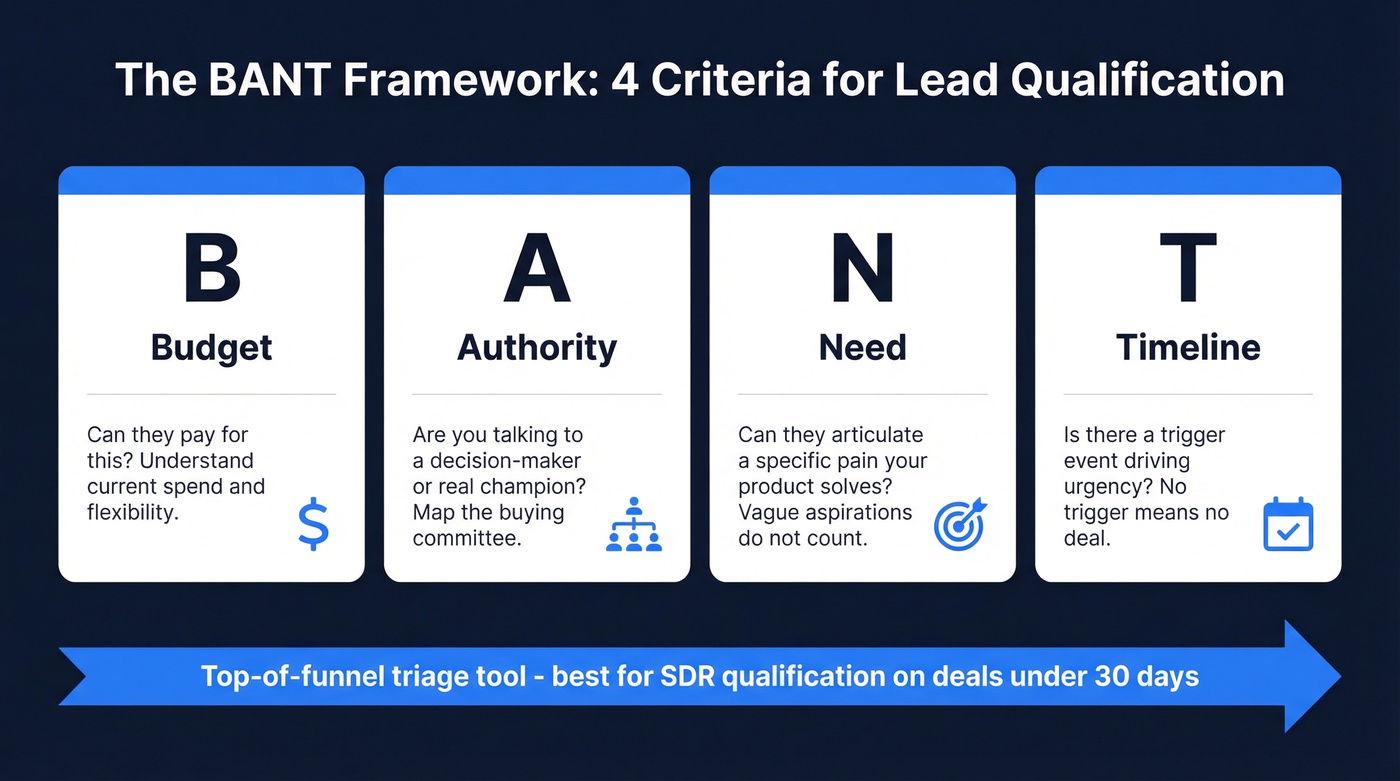
- B - Budget: Can they pay for this?
- A - Authority: Are you talking to someone who can make (or influence) the buying decision?
- N - Need: Do they have a real problem your product solves?
- T - Timeline: Is there urgency, or is this a "maybe someday" conversation?
Think of it as a top-of-funnel triage tool. It separates leads worth an AE's time from leads that aren't ready yet. It was never meant to be a full deal-qualification system for complex enterprise sales - that's where frameworks like MEDDPICC take over. The power here is speed and simplicity: four criteria, applied consistently, in the first one or two discovery calls.
If you want a ready-to-use call script, start with these BANT questions.
Qualification by the Numbers
The data makes a clear case for structured qualification. Companies implementing BANT see a 59% increase in conversion rates. SQL-to-Opportunity conversion runs 20-30%, compared to just 5-15% for MQLs that skip qualification entirely. The biggest funnel bottleneck sits at MQL-to-SQL (15-21%) - exactly where structured qualification lives.
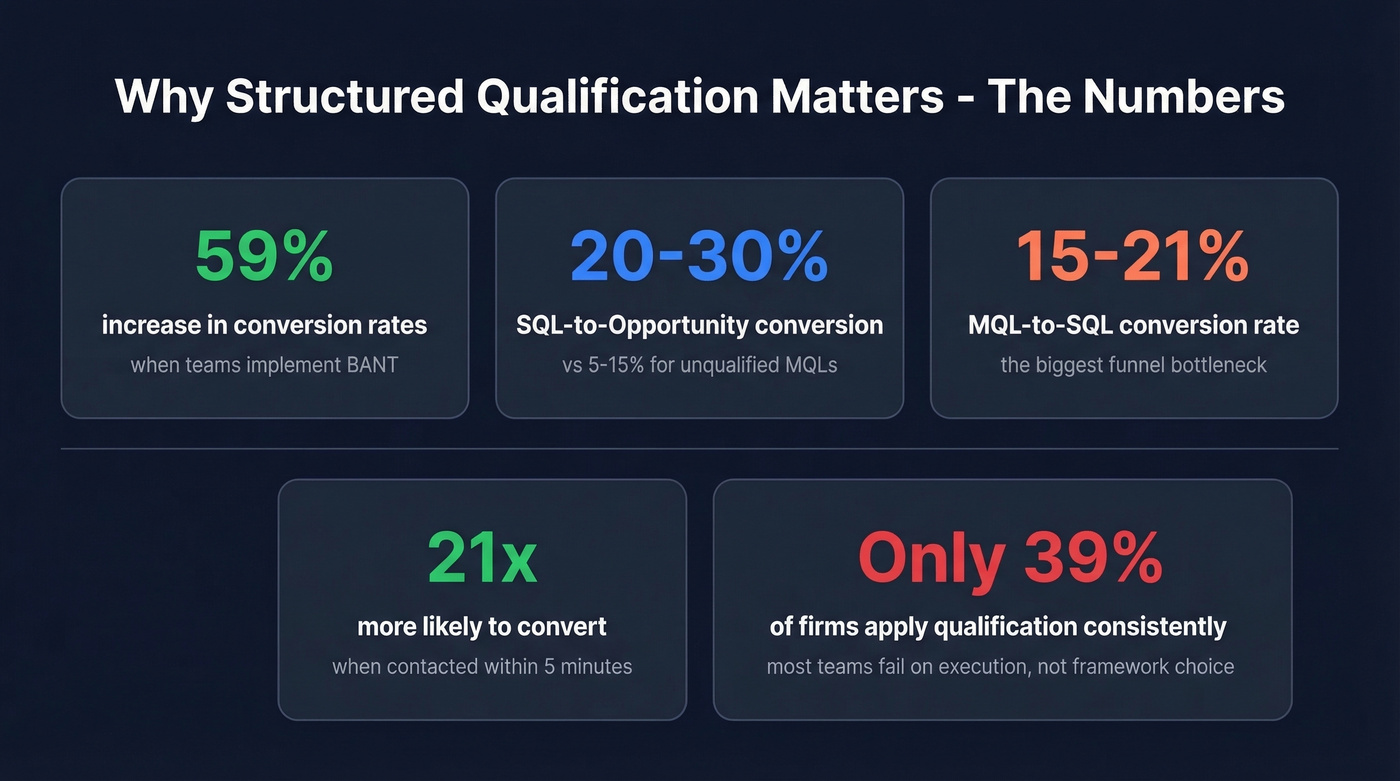
Improving your MQL-to-SQL conversion by just 5 percentage points can lift revenue up to 18%. Leads contacted within 5 minutes are 21x more likely to convert than those contacted after 30 minutes. And here's the kicker: only 39% of firms consistently apply qualification criteria at all.
If you want to tighten this stage specifically, use a dedicated lead qualification process and track it like a system.
That last stat is the real story. Most teams don't fail because they picked the wrong framework. They fail because they don't apply any framework consistently.
The Four Pillars Explained
Budget
Budget isn't a number - it's spending behavior. Asking "What's your budget?" in the first call is a rookie move that kills rapport and produces garbage data. Prospects either don't know yet, or they'll lowball you to anchor the negotiation.
Instead, understand how they're currently spending and what flexibility exists. The best SDRs we've worked with never ask about budget directly. They ask about the problem's cost: "How are you currently solving this, and what's that costing you?" They ask about process: "Have you allocated budget for this initiative, or would this need new approval?" They ask about inaction: "What's the cost of doing nothing for another 6 months?" And they ask about precedent: "When you've purchased similar tools, what did the approval process look like?"
If your team struggles to get clean budget signals, pair BANT with a simple deal qualification framework so reps know what “good” looks like.
Red flag: The prospect can't describe any current spend on the problem. If they're not spending anything to solve it today - not even time - it's probably not a real priority.
Authority
Here's the thing: authority hasn't meant "the one person who signs the check" in over a decade. Modern B2B buying decisions involve 6-10+ stakeholders, and your SDR needs to understand the committee, not just find a single decision-maker.
A real champion isn't just someone who likes your product. They have organizational influence, they'll spend political capital on your behalf, they share internal decks, and they'll map the org chart for you. If your "champion" can't tell you who else needs to be involved, they're not a champion - they're a fan.
Discovery questions for authority:
- "Who else would need to weigh in on a decision like this?"
- "Have you purchased tools in this price range before? Walk me through how that worked."
- "If you decided tomorrow that this was the right solution, what would happen next?"
- "Who would push back on this, and why?"
Red flag: Your contact keeps saying "I'll handle it internally" but can't name specific stakeholders. That usually means they don't have the influence they're implying.
Need
Need is the pillar most teams think they understand and most teams get wrong. The question isn't "do they need our product?" - it's "can they articulate the problem they're trying to solve?"
Lead with pain, not product. If a prospect can't describe their problem in their own words, they're not far enough along to qualify. You're looking for specificity: not "we need better data" but "our reps spend 3 hours a day researching accounts and still show up to calls with wrong information."
If you want more prompts that pull out real pain, use these sales qualifying questions.
| Vague Need (Not Qualified) | Specific Need (Qualified) |
|---|---|
| "We want to be more data-driven" | "Our reps waste 3 hours/day on manual research and still miss key stakeholders" |
| "We need better outbound" | "Our reply rate dropped from 4% to 1.2% after our data provider's accuracy tanked" |
| "We're exploring options" | "Our contract expires in 60 days and the renewal quote jumped 40%" |
Aspirations don't close deals. Pain does. When a prospect describes a vague aspiration, push for specifics: "What triggered you to look into this now?" and "What happens if you don't solve this in the next quarter?" If they can't get concrete, they belong in nurture, not on an AE's calendar.
If you’re sending these leads into nurture, build a real lead nurturing track instead of “check back next quarter.”
Timeline
Skip this prospect if: they say "maybe this year," they say "we're exploring options," and they can't name a single event driving the decision. Three strikes. Without a trigger event, deals drift into the nurture pile and die quietly.
Good trigger events include contract renewals, board mandates, new leadership, regulatory deadlines, or a competitor move. Your job is to find the trigger or confirm there isn't one:
- "Is there a specific date or event driving this decision?"
- "What happens if this isn't resolved by [quarter/date]?"
- "Are you evaluating other solutions right now, or is this early research?"
- "What would need to happen internally before you could move forward?"
I've watched teams carry 200 "opportunities" with a 3% close rate because nobody had the discipline to disqualify. Don't let your pipeline fill up with "someday" deals. If nothing bad happens when they delay, they will delay.
If your reps hate disqualifying, give them a playbook for how to disqualify leads without burning the relationship.

BANT only works when qualified leads have accurate contact data behind them. Prospeo gives your SDRs 300M+ profiles with 98% verified emails and 125M+ mobile numbers - so every lead that passes Budget, Authority, Need, and Timeline actually gets reached.
Stop losing BANT-qualified leads to bad emails and wrong numbers.
Scoring Leads in Your CRM
Qualification frameworks only work if you track them. Here's a scoring model you can build in HubSpot, Salesforce, or any CRM with custom fields - copy it directly, it takes 10 minutes to set up and pays for itself on the first deal it disqualifies:
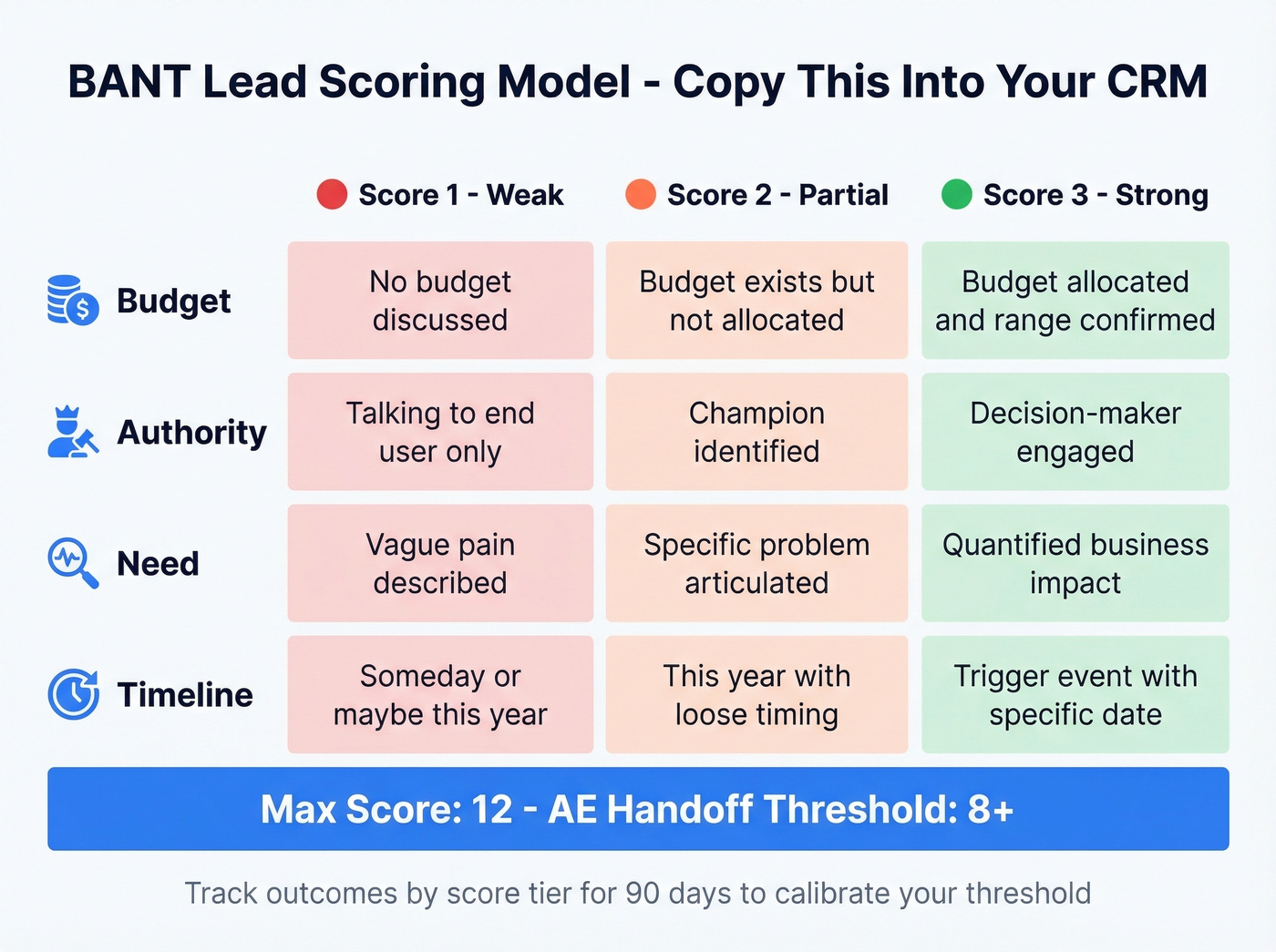
| Pillar | Score 1 (Weak) | Score 2 (Partial) | Score 3 (Strong) |
|---|---|---|---|
| Budget | No budget discussed | Budget exists, not allocated | Budget allocated, range confirmed |
| Authority | Talking to end user | Champion identified | Decision-maker engaged |
| Need | Vague pain | Specific problem articulated | Quantified business impact |
| Timeline | "Someday" | "This year" | Trigger event with date |
Maximum score: 12. Threshold for AE handoff: 8+.
Create these CRM fields for every opportunity: Budget Range (dropdown or currency), Decision Maker Identified (Y/N), Pain Articulated (text field - force the SDR to write it in the prospect's words), and Timeline Trigger Event (text field with date).
If you want to go beyond BANT and make scoring stick across teams, build a proper B2B lead scoring model and govern it with RevOps.
Then track outcomes against scores. After 90 days, you'll know your conversion rate by score tier, average deal size by score tier, and cycle length by qualification quality. That data lets you calibrate the threshold - maybe 7 is enough for your market, or maybe you need 9.
Is BANT Outdated?
Let's be honest about this one.
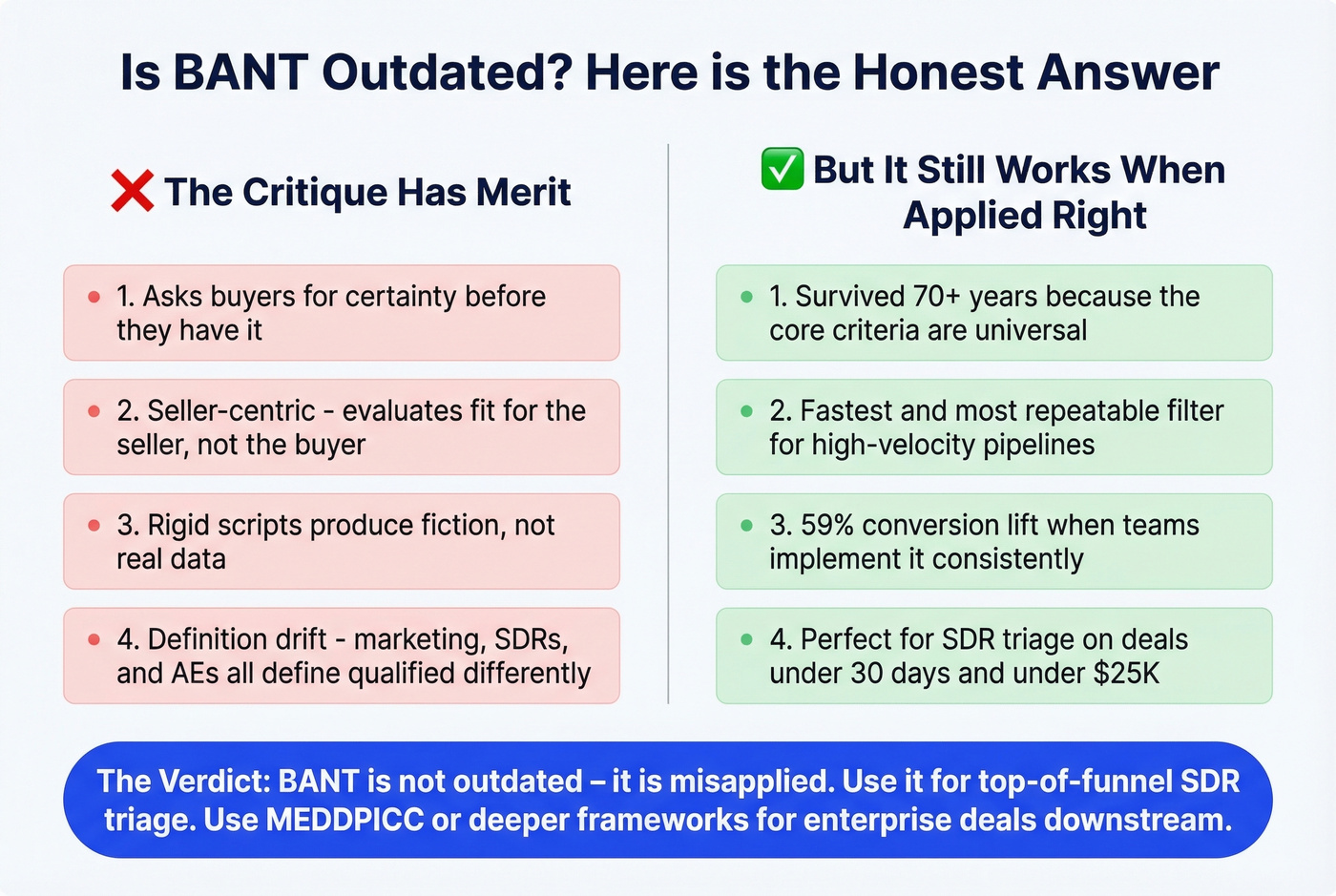
The critique has merit. The framework asks buyers for certainty before they have it. Early in a buying process, prospects genuinely don't know their budget, haven't mapped their stakeholders, and can't commit to a timeline. Critics also call it seller-centric - it evaluates whether the prospect fits the seller's criteria rather than exploring the buyer's world first. When you force answers through forms or rigid call scripts, you get fiction, not data. SDRs check boxes, AEs inherit "qualified" leads that aren't qualified at all, and everyone blames each other.
The deeper issue is definition drift: marketing defines "qualified" one way, SDRs define it another, AEs have their own standard, and RevOps is left reconciling three versions of reality in the CRM.
But the framework has survived 70+ years for a reason. Understanding what each pillar represents - and applying those four criteria with discipline - still gives SDRs the fastest, most repeatable filter for high-velocity pipelines. If you're handling 30 inbound leads a day for a product that sells in under 30 days, this gives you a reliable triage system.
The verdict: BANT isn't outdated - it's misapplied. Use it for top-of-funnel SDR triage. Use MEDDPICC or a deeper framework downstream for enterprise deals. The mistake is treating it as the only qualification layer across your entire pipeline.
BANT vs Other Frameworks
The consensus on r/sales is that all sales methodologies are basically the same - they all boil down to need, budget, stakeholders, and timeline. There's truth to that. But the packaging matters because it determines what your team focuses on first and how deeply they dig.
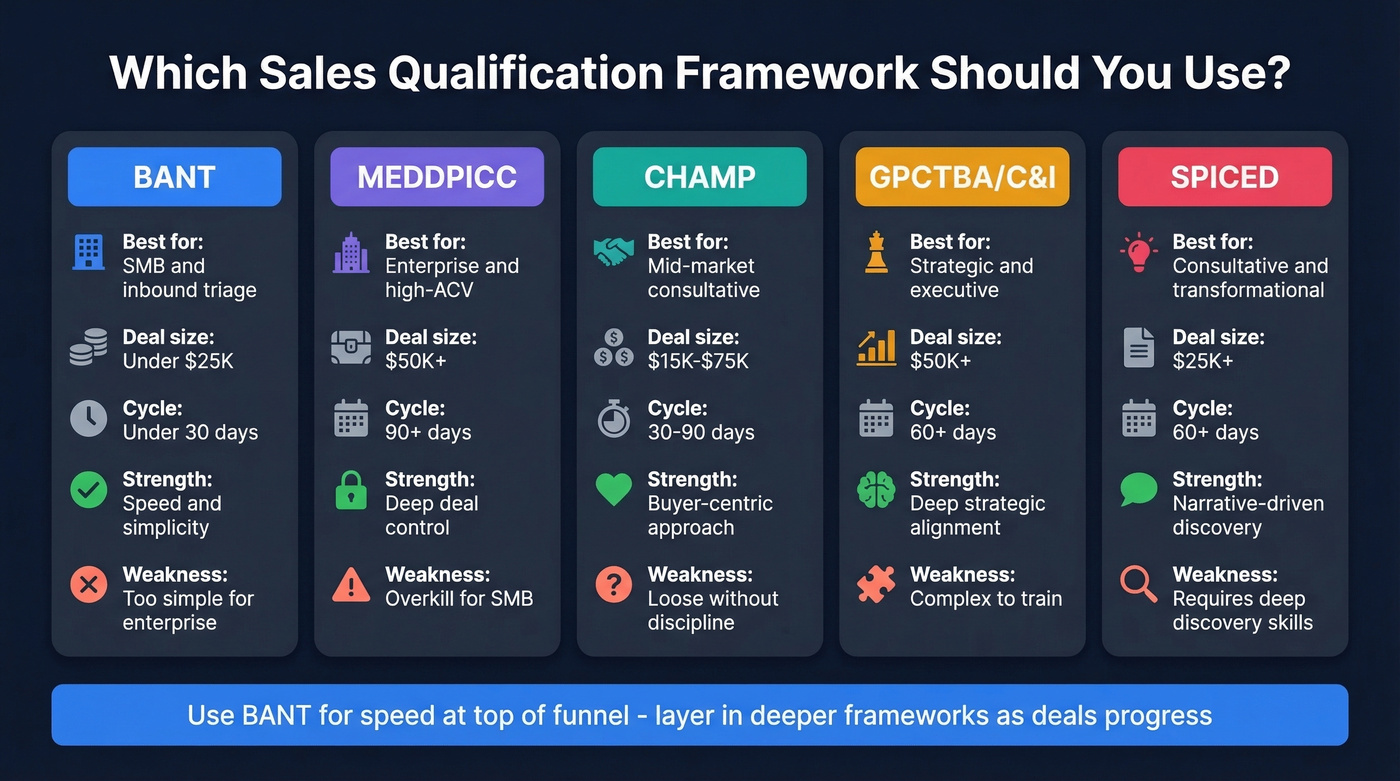
| Framework | Best For | Deal Size | Cycle | Key Weakness |
|---|---|---|---|---|
| BANT | SMB/inbound triage | <$25K | <30 days | Too simple for enterprise |
| MEDDPICC | Enterprise, high-ACV | $50K+ | 90+ days | Overkill for SMB |
| CHAMP | Mid-market consultative | $15K-$75K | 30-90 days | Loose without discipline |
| GPCTBA/C&I | Strategic/executive | $50K+ | 60+ days | Complex to train |
| SPICED | Consultative/transformational | $25K+ | 60+ days | Requires deep discovery |
MEDDPICC adds Metrics, Economic Buyer, Decision Criteria, Decision Process, Identify Pain, Champion, Paper Process, and Competition. One team reported that switching from BANT to MEDDIC improved forecast accuracy from 62% to 89%. That's the kind of lift enterprise deals get with proper rigor.
If you’re comparing frameworks for your motion, start with a broader sales qualification framework guide, then standardize one.
CHAMP flips the order - leading with pain instead of budget. Better fit for consultative mid-market sales where problem definition matters more than the price tag. GPCTBA/C&I is a HubSpot-preferred framework for strategic conversations: thorough but complex to train. SPICED works well for transformational sales where the prospect needs to understand the cost of inaction before they'll move.
Our hot take: if your average deal closes in under 30 days and your ACV is below $25K, you don't need MEDDPICC. You need Budget, Authority, Need, and Timeline applied with discipline. The teams we've seen waste the most time are the ones running enterprise-grade qualification on deals that should close in two calls. Pick the framework that matches your sales motion and execute it consistently for 90 days. The framework matters less than the discipline.
Common Mistakes to Avoid
Rigid gatekeeping. AEs use qualification scores as a weapon to reject SDR meetings. The SDR books 15 meetings, the AE takes 3, and morale craters. Fix this with shared definitions. Run weekly calibration sessions where SDRs and AEs review rejected meetings together and agree on what "qualified" actually means.
If this is a recurring issue, fix the process at the seam with a formal lead handoff definition and SLA.
Checklist interrogation. Running through B-A-N-T in order like a survey kills rapport and makes the prospect feel processed, not understood. Weave the criteria into natural discovery conversation instead. You can cover all four pillars without the prospect ever knowing you're using a framework.
Forcing early certainty. Prospects don't know their budget or timeline in the first call. Demanding answers produces lies, not data. Treat qualification as progressive across multiple touches - a lead can score 1 on Budget in call one and 3 by call three.
No shared definitions. Marketing says "qualified," SDR disagrees, AE disagrees again. Document your definitions in a one-page SLA: what score constitutes "qualified," what fields must be filled. Get Marketing, SDR, AE, and RevOps to sign off.
Implementing BANT in 2026
We've seen teams stare at a CRM full of "qualified" leads while dealing with an 8% connect rate and half their emails bouncing. Qualification starts before the first call - if your data is bad, your qualification process never gets off the ground.
Step 1: Build a clean prospect list. Data quality is the prerequisite for everything else. Prospeo provides 98% email accuracy and 125M+ verified mobile numbers on a 7-day data refresh cycle, so reps reach real people, not dead inboxes. Free tier gives you 75 emails/month to test it.
If you’re cleaning lists before outreach, you’ll also want a repeatable B2B lead enrichment workflow.

Step 2: Layer intent signals. Prioritize prospects showing buying intent - researching your category, visiting competitor pages, or engaging with relevant content. Intent data tracking 15,000 topics lets you filter for prospects who are actively in-market, so your SDRs spend their qualification conversations on people who already have a reason to buy.
Step 3: SDR runs triage. During the first discovery call, the SDR covers all four pillars through natural conversation. No checklist. No interrogation. Just good questions woven into a real dialogue.
If you need a tighter operating model for this role, standardize BANT appointment setting so meetings don’t get rejected downstream.
Step 4: Score and hand off. After the call, the SDR fills in the four CRM fields (60 seconds), and leads scoring 8+ get passed to the AE with a one-page summary: budget range, key stakeholders, pain in the prospect's words, and the trigger event. No more "I don't know why this meeting is on my calendar." For enterprise deals, the AE layers MEDDPICC on top of this foundation.
Your reps spend hours qualifying leads through BANT only to bounce emails and hit dead phone numbers. Prospeo's data refreshes every 7 days - not 6 weeks - so the contacts your SDRs pass to AEs are real people at real addresses. At $0.01 per email, bad data is no longer an excuse.
Qualify with BANT. Connect with Prospeo. Book 26% more meetings.
FAQ
What Does BANT Stand For?
Budget, Authority, Need, and Timeline - a sales qualification framework created at IBM to help reps quickly assess whether a prospect is worth pursuing. Each letter represents one criterion evaluated during discovery calls before an AE handoff.
Is BANT Still Relevant in 2026?
Yes - for SDR and inbound triage on short-cycle deals under 30 days, it's still the fastest way to separate real opportunities from tire-kickers. Companies using it report 59% higher conversion rates. For complex enterprise deals, layer MEDDPICC on top.
What's the Difference Between BANT and MEDDIC?
BANT is a four-criteria top-of-funnel triage filter best for deals under $25K. MEDDIC adds Metrics, Economic Buyer, Decision Criteria, Decision Process, Identify Pain, and Champion - designed for enterprise deals over $50K with 90+ day cycles. Teams switching to MEDDIC for enterprise report forecast accuracy jumping from 62% to 89%.
How Do You Score BANT Leads?
Rate each pillar 1-3 in your CRM (1 = weak, 2 = partial, 3 = strong) for a maximum of 12 points. Leads scoring 8+ are qualified for AE handoff. Track conversion rates by score tier for 90 days to calibrate your specific threshold.
What Tools Help With BANT Qualification?
You need a CRM for scoring (HubSpot or Salesforce) and a B2B data platform for verified contacts. Prospeo provides 98% email accuracy and 125M+ verified mobiles so SDRs actually reach the people they need to qualify. Intent data layered on top prioritizes who to call first.