

BANT: The IBM Sales Framework That Still Runs Pipeline in 2026
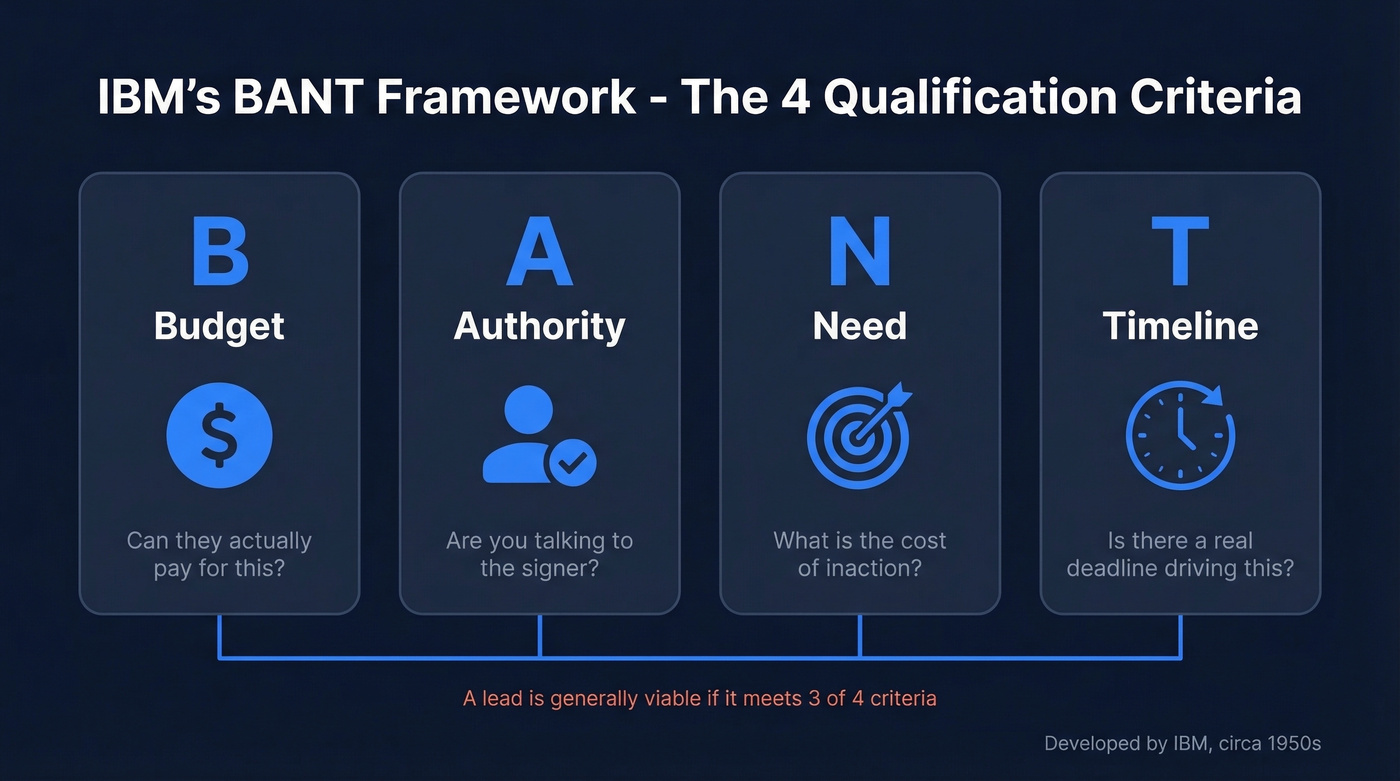
Every sales org argues about qualification frameworks. But the one most reps actually default to - the one IBM built decades ago - is BANT. Budget, Authority, Need, Timeline. It's simple, reliable, adequate. The Toyota Corolla of sales qualification.
BANT = Budget, Authority, Need, Timeline. It still works for fast-cycle sales. For enterprise deals with 6+ stakeholders, layer MEDDIC on top.
How IBM Created BANT
IBM developed BANT decades ago - commonly dated to the 1950s, though some sources place it in the 1960s. The exact year doesn't matter. What matters is that IBM needed a repeatable way to qualify leads across a massive sales force, and this framework was the answer. Thousands of reps selling complex technology to different industries, different company sizes, different buying structures - and management needed a common language to separate real pipeline from wishful thinking.
The strongest proof IBM still stands behind it? They host a BANT template PDF on their PartnerWorld portal to this day. Many partners submit a completed BANT form as part of opportunity registration.
The Four BANT Criteria
Think of these as a qualification filter, not a script. You're figuring out if a deal is real.
Budget
Can they pay for this? A lead is generally considered viable if it meets three of the four criteria, but budget kills deals silently. Ask: "What's the ballpark you've set aside for solving this?" Green flag: they name a number. Red flag: "We haven't discussed budget internally yet."
Authority
Are you talking to someone who can sign, or someone who'll "run it up the chain" and vanish? Ask: "Who else would need to weigh in before this moves forward?" A straight answer here saves you weeks of chasing ghosts.
Need
This is where most reps go wrong - they accept surface-level pain. Don't just confirm a problem exists; quantify the cost of inaction. What happens if they don't fix this next quarter? How are they solving it today, and what's breaking? A prospect who can't articulate the cost of their problem isn't qualified.
If you want a tighter way to structure this part of the call, use a set of discovery questions that force specificity.
Timeline
Is there urgency, or is this "maybe next year"? Ask: "Is there an event or deadline driving this?"
Framework Examples in Practice
Let's walk through two scenarios that show how context changes everything:
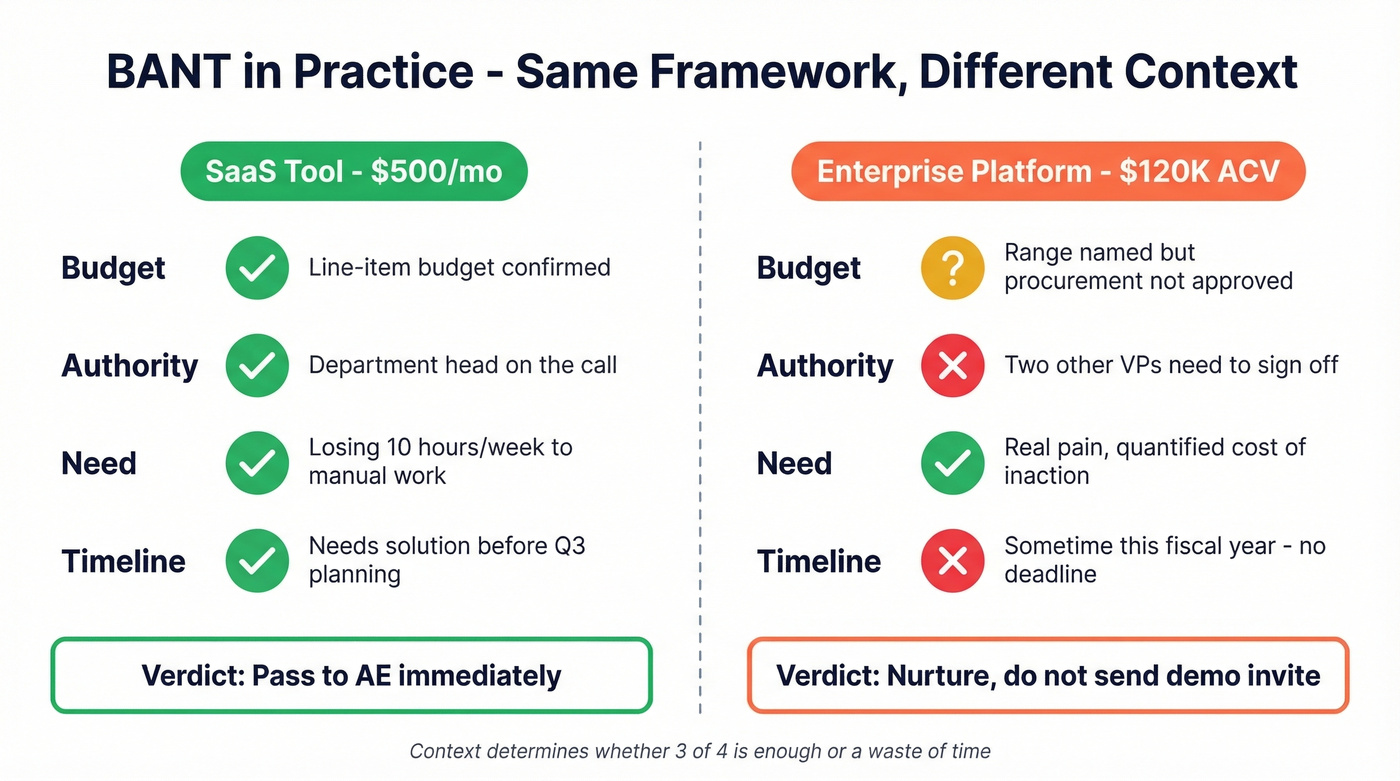
SaaS tool, $500/mo deal: On a 15-minute discovery call, the SDR confirms the prospect has a line-item budget, is the department head (authority), is losing 10 hours/week to manual work (need), and needs a solution before Q3 planning. All four criteria met - pass to AE.
Enterprise platform, $120K ACV: The champion names a budget range but admits procurement hasn't approved it. Two other VPs need to sign off. The pain is real but the timeline is "sometime this fiscal year." Only Need is solid. This deal needs nurturing, not a demo invite.
Rigid scoring fails here because context determines whether a partially qualified lead is worth pursuing or should stay in nurture. We've seen teams waste entire quarters chasing "three out of four" leads that were never going to close because the one missing criterion was Authority.
If your team is struggling to operationalize this, start by tightening your lead scoring definitions so reps aren’t guessing in the CRM.

You just read it: the best qualification framework can't save a garbage contact list. Prospeo gives you 98% email accuracy, 125M+ verified mobiles, and a 7-day data refresh - so your BANT conversations happen with real, reachable decision-makers.
Stop qualifying ghosts. Start qualifying buyers you can actually reach.
Is BANT Still Relevant in 2026?
A 2023 Gartner Digital Markets survey found that 52% of salespeople still find BANT reliable, 41% value its flexibility, and 36% say it helps them plan timeline. Solid numbers for a 70-year-old framework.
The flip side: the same survey found 33% of software buyers cite higher-than-expected total cost of ownership as a top driver of purchase regret. The "Budget" leg is often wrong - buyers underestimate what they'll spend, and sellers record whatever number they hear. Track your qualified-to-closed-won rate. If it's consistently low, your criteria are too loose.
To diagnose whether this is a process issue or a math issue, compare against your sales pipeline benchmarks and stage conversion rates.
Where the Framework Breaks Down
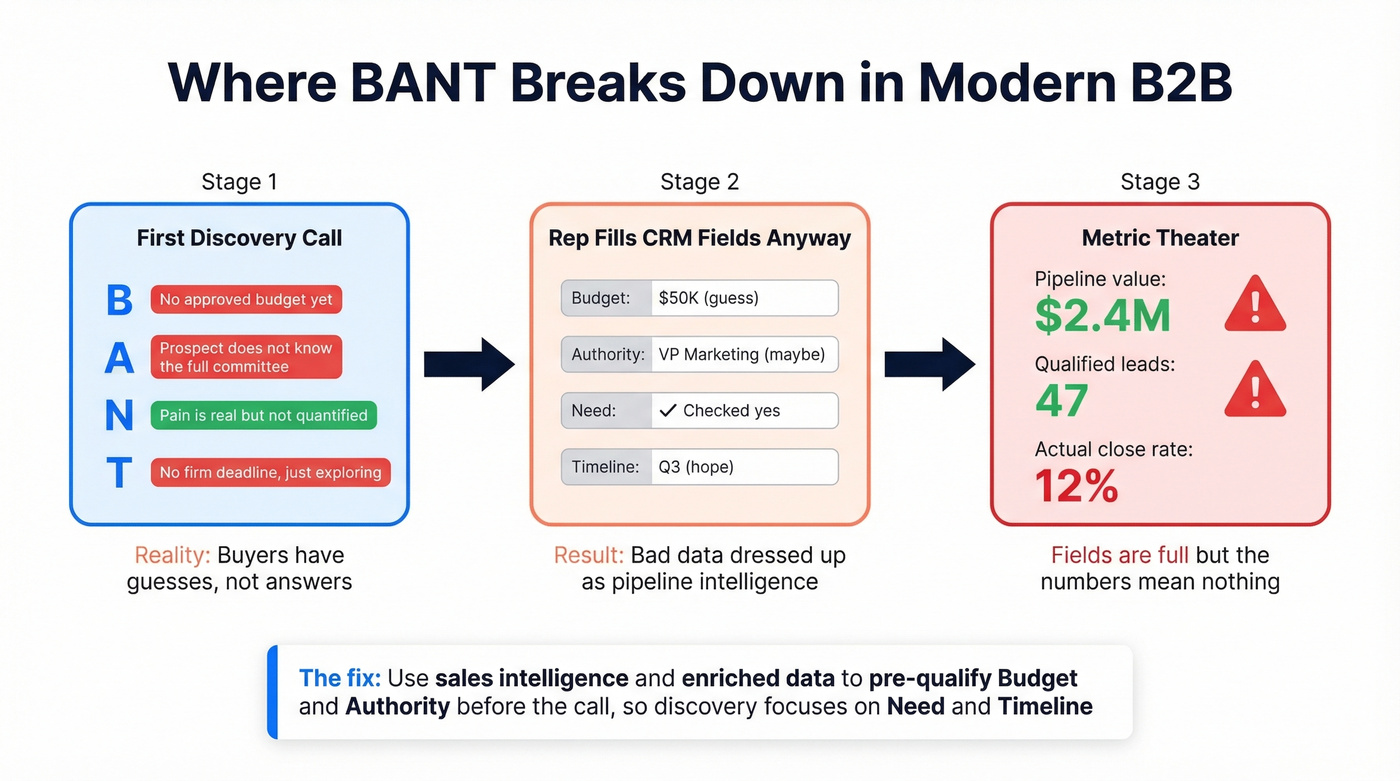
Here's the thing: BANT asks buyers for certainty before they have it. On a first discovery call, most prospects don't have approved budget, clear authority maps, or firm timelines. They have guesses. When you force those guesses into CRM fields, you get bad data dressed up as pipeline intelligence - metric theater where the fields are full but the numbers mean nothing.
The consensus on r/sales backs this up: most frameworks boil down to the same fundamentals, and the acronym matters less than whether your reps actually understand the deal.
Modern B2B purchases involve 6-10 decision-makers on average. The "Authority" criterion assumes you can identify the signer, but in reality you're navigating a committee where influence is distributed and political. This is where common objections surface most often - prospects push back not because they lack interest, but because they genuinely can't answer authority or budget questions on a first call.
If you’re seeing this show up as “stuck” deals, map it to common sales pipeline challenges so you can fix the root cause (not just the fields).
BANT vs. MEDDIC vs. CHAMP
| Framework | Best For | Key Weakness | Complexity |
|---|---|---|---|
| BANT | High-velocity SMB | Misses stakeholders | Low |
| MEDDIC | Enterprise, 6+ buyers | Slows deals if rigid | High |
| CHAMP | Mid-market, pain-first | Too loose without rigor | Medium |
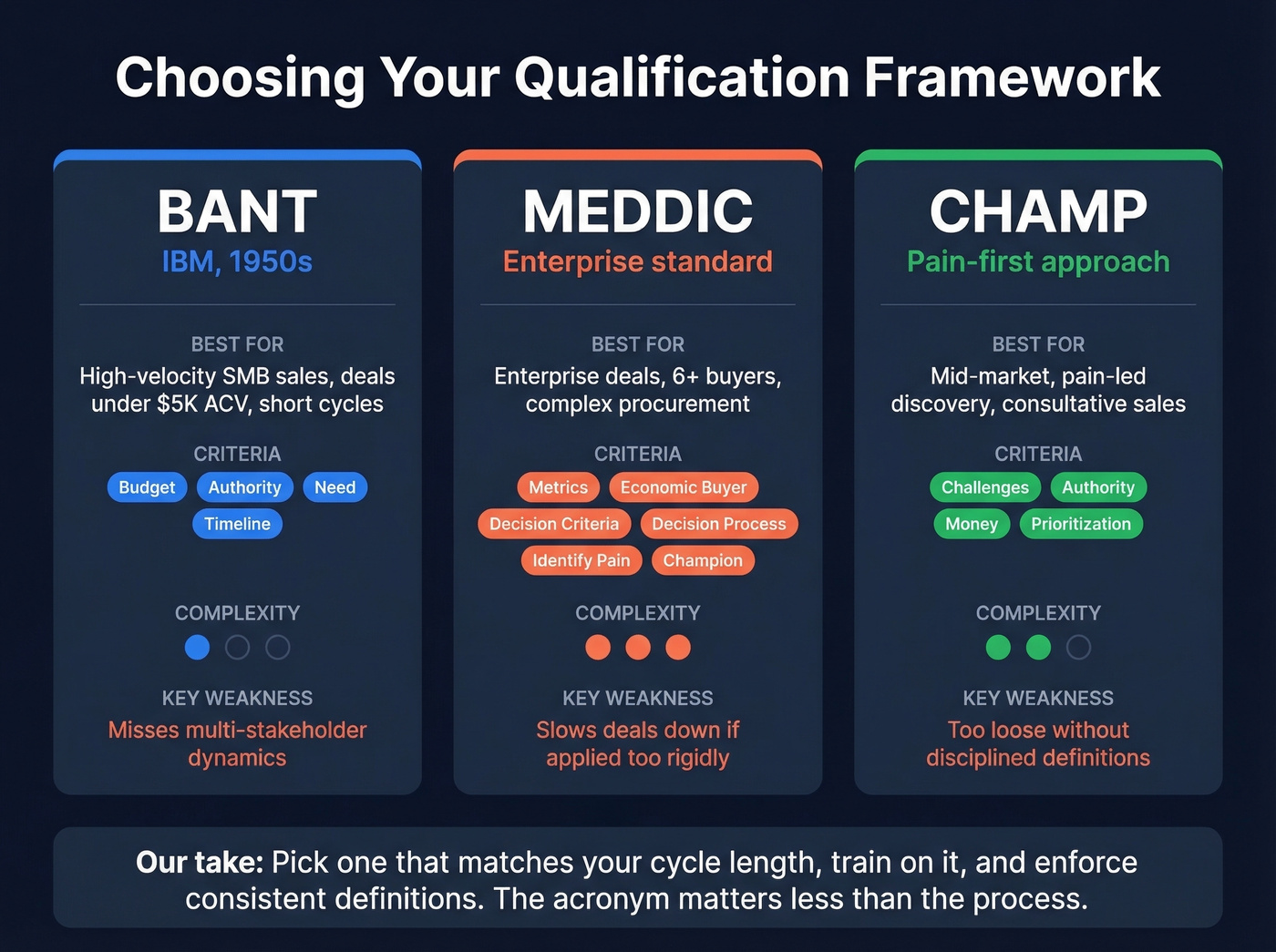
MEDDIC is often associated with higher forecast accuracy when teams standardize definitions and enforce the process. For short-cycle, high-volume deals, IBM's framework is the right starting point. For enterprise with multi-threaded buying committees, MEDDIC gives you the stakeholder mapping BANT lacks.
If you want to go deeper on the enterprise version, use a structured set of MEDDIC discovery questions to avoid “checkbox qualification.”
SPICED and ANUM exist too. Honestly - pick one that matches your cycle length, train on it, and enforce consistent definitions. That matters more than the acronym.
Our take: Most teams debating BANT vs. MEDDIC have a data problem, not a framework problem. The best qualification methodology in the world can't save you if half your contact records are stale.
Making BANT Work in 2026
Use BANT as a mental model, not a checklist your reps read off a screen. Teams that pair qualification with sales intelligence - firmographic data, technographic signals, intent data - get far better results than those relying on discovery calls alone. Enriched records let you pre-qualify Budget and Authority before you even pick up the phone.
If you’re building this into your stack, start with firmographic and technographic data and a repeatable lead enrichment workflow.
In our experience, clean data fixes more pipeline problems than any framework ever will. If you're qualifying a prospect whose email bounces or whose phone number is dead, you've wasted the entire exercise. We've watched teams run flawless BANT processes on garbage contact lists and wonder why nothing converts. Tools like Prospeo - with 98% email accuracy and a 7-day data refresh cycle - mean your qualification conversations happen with real, reachable people instead of ghosts in your CRM.
For teams running Salesforce, consider building a custom integration: fields for each BANT criterion on the Opportunity object, with validation rules that require at least three of four before a deal advances to Stage 3. This turns the framework from a mental model into an enforceable process. Skip this if your average deal cycle is under two weeks - the overhead isn't worth it for transactional sales.
If you’re standardizing this across the org, treat it as sales process optimization, not a one-off enablement doc.
Pre-qualify Budget and Authority before the first call. Prospeo's 30+ filters - including intent data, funding signals, and department headcount - let you run BANT before you even pick up the phone. All at $0.01 per email.
Enrich your pipeline with data that makes every framework work better.
FAQ
Did IBM Invent BANT?
Yes. IBM developed it decades ago and still hosts a BANT template on PartnerWorld. The methodology became the foundation that most modern qualification frameworks - MEDDIC, CHAMP, ANUM - build on or react against.
Is BANT Outdated?
Not for fast-cycle sales under $5K ACV. 52% of salespeople still find it reliable according to Gartner. For complex enterprise deals with 6+ stakeholders, layer MEDDIC on top for stakeholder mapping and metrics rigor.
What Tools Help With BANT Qualification?
Start with verified prospect data - accurate emails and direct dials - so your qualification conversations reach the right people. From there, pair contact data with intent signals to identify in-market buyers before the first call. The goal is to walk into every discovery conversation already knowing whether Budget and Authority are likely in play, so you can spend your time on Need and Timeline instead of basic fact-finding.