

BDR Meaning: What Business Development Reps Do in 2026
BDR stands for Business Development Representative - the outbound sales role responsible for finding prospects, qualifying them, and booking meetings for closers. If you're breaking into B2B sales or building a pipeline team, understanding what a BDR actually does day-to-day matters more than memorizing a textbook definition. A BDR doesn't close deals. They fill the top of the pipeline so Account Executives can focus on what they do best.
Quick version:
- BDR = Business Development Representative. Outbound prospecting role. You find leads, qualify them, book meetings for closers.
- 2026 median salary: $60K base / $85K OTE. Top performers hit $127,955.
- Typical path: BDR to Account Executive in 12-18 months.
BDR vs SDR vs AE
This question launches a thousand confused searches. Short answer: it depends on who you ask.
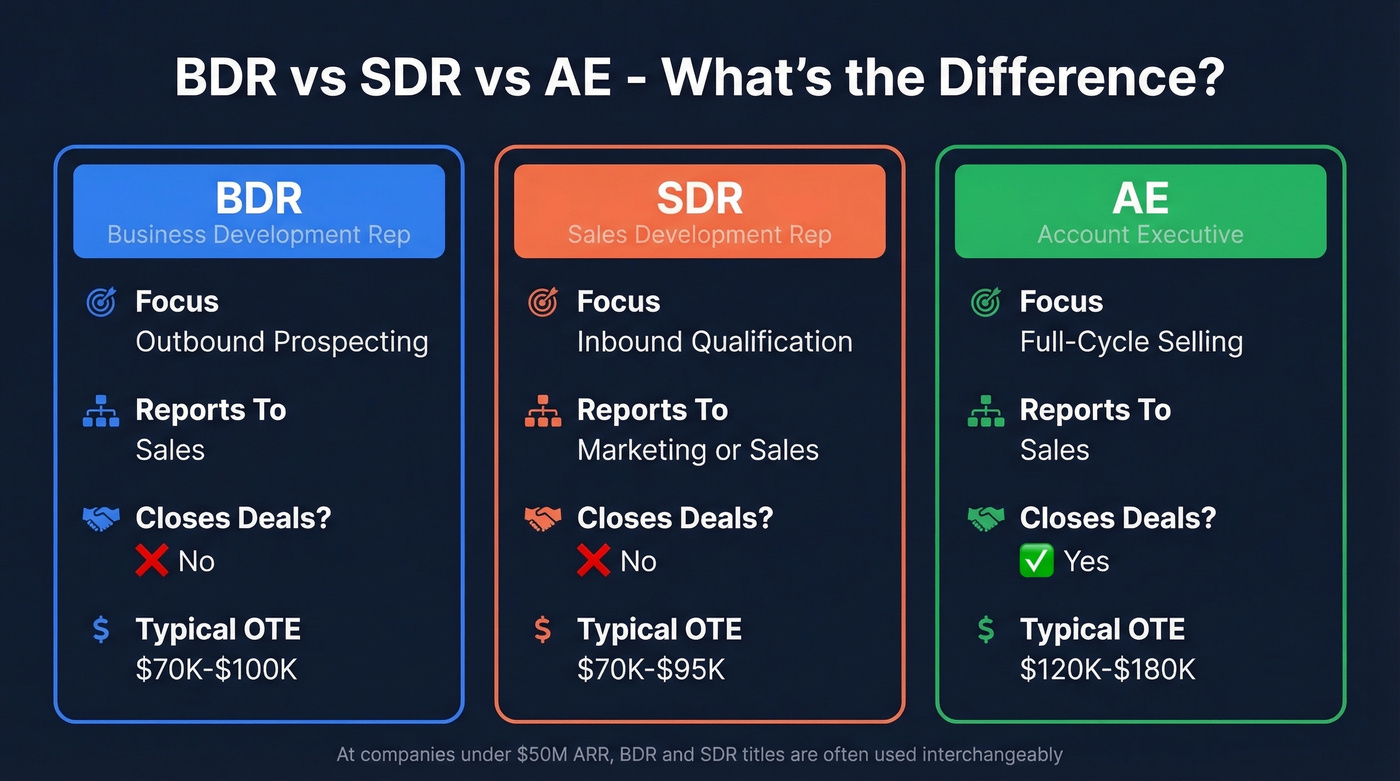
A T2D3 meta-analysis looked at the top results for "SDR vs BDR" and found that 6 of 8 sources define BDR as outbound prospecting and SDR as inbound qualification. Two sources flip it entirely. The most common convention - the one Salesforce originally popularized - maps like this:
| Role | Focus | Reports To | Closes Deals? | Typical OTE |
|---|---|---|---|---|
| BDR | Outbound prospecting | Sales | No | $70K-$100K |
| SDR | Inbound qualification | Marketing/Sales | No | $70K-$95K |
| AE | Full-cycle selling | Sales | Yes | $120K-$180K |
| MDR | Marketing-sourced leads | Marketing | No | $65K-$90K |
Here's the thing: for companies under $50M ARR, these titles are interchangeable. We've seen orgs where "BDR" means inbound, "SDR" means outbound, and nobody in leadership can explain why. As one AE put it on Reddit, the real-world gray area is massive - titles and responsibilities vary wildly between companies.
The SDR vs BDR debate is a waste of time. If you're interviewing, ask the hiring manager how they define the role. That's the only definition that matters for your day-to-day.
In some industries, the BDR acronym refers to roles focused on partnerships, vendor sourcing, or market expansion - but in tech sales, it almost always means outbound prospecting. You'll also see adjacent titles: ADR (Account Development Rep), LDR (Lead Development Rep), ISR (Inside Sales Rep). They're all variations on the same theme - someone who generates pipeline but doesn't carry a closing quota.
What Does a BDR Actually Do?
Strip away the jargon and a Business Development Representative's job boils down to six things:
- Prospecting: Researching target accounts, identifying decision-makers, building contact lists (see more sales prospecting techniques)
- Cold outreach: Calls, emails, and social touches to people who don't know you yet
- Qualifying: Determining if a prospect has the budget, authority, need, and timeline to buy
- Booking meetings: Getting qualified prospects on an AE's calendar
- CRM logging: Documenting every interaction so the AE has context before the first call
- AE handoff: Briefing the closer on what the prospect cares about and what's been discussed (use a clean handoff email template)
Typical daily KPIs at a mid-market SaaS company look something like 60 calls/day, 30 emails, 30 social touches, and 1-2 meetings booked per week. Those numbers vary by org, but that's a reasonable baseline for what you'll be measured on.
The ratio that matters most: a 2025 benchmark study across 351 B2B companies found an SDR-to-AE ratio of 1:2.4. You're feeding two to three closers. That's the job.
A Day in the Life
Most guides describe the role in abstract terms. Here's what a time-blocked day actually looks like:
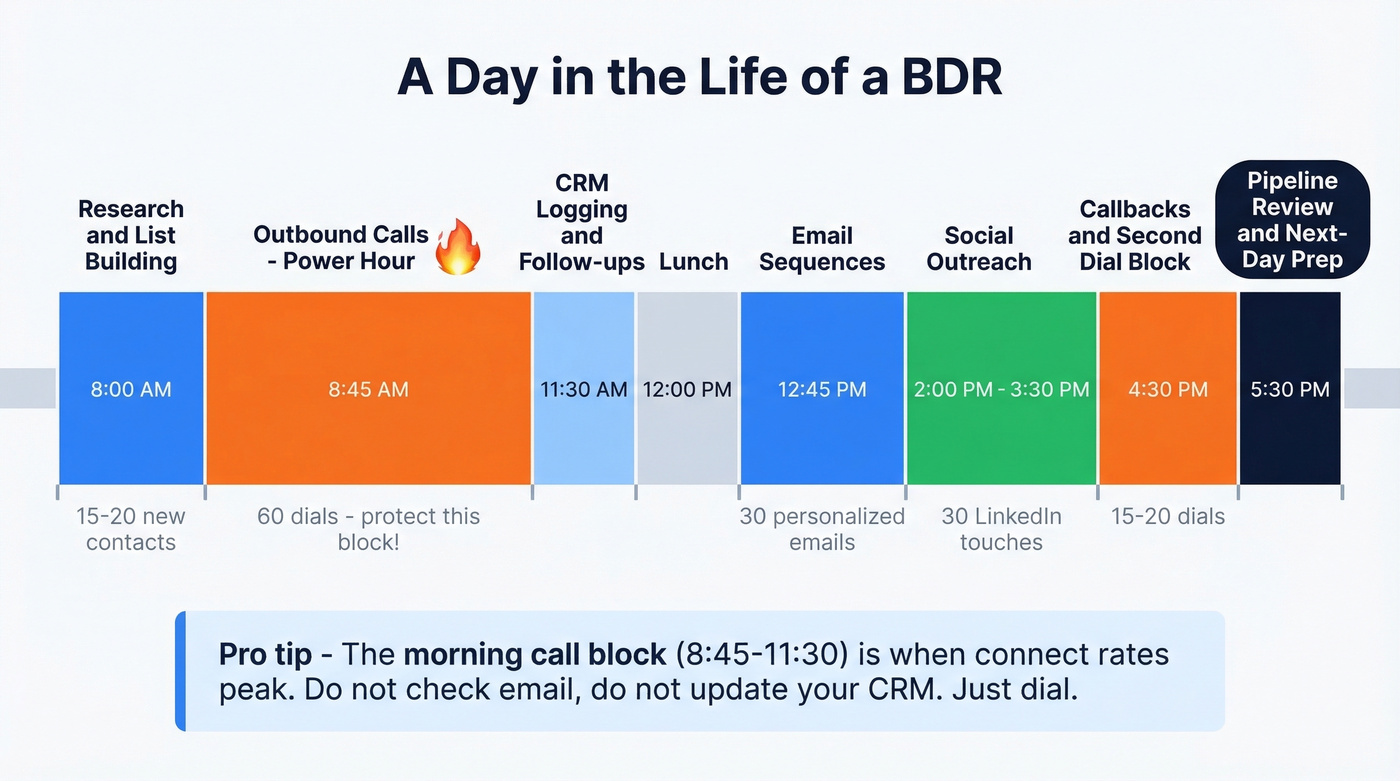
| Time Block | Activity | Target |
|---|---|---|
| 8:00-8:45 | Research & list building | 15-20 new contacts |
| 8:45-11:30 | Outbound calls | 60 dials |
| 11:30-12:00 | CRM logging & follow-ups | - |
| 12:00-12:45 | Lunch | - |
| 12:45-2:00 | Email sequences | 30 personalized emails |
| 2:00-3:30 | Social outreach | 30 touches |
| 3:30-4:30 | Callbacks & second dial block | 15-20 dials |
| 4:30-5:00 | Pipeline review & next-day prep | - |
The call block is sacred. That 8:45-11:30 window is when connect rates peak - don't check email, don't update your CRM, don't "just quickly" do anything else. Dial.
The afternoon shifts to async channels because that's when prospects are more likely to read than pick up. End-of-day prep matters more than most new reps realize. Spending 30 minutes building tomorrow's call list means you start the next morning already loaded. The people who consistently hit quota aren't more talented. They're more organized.
BDR Salary in 2026
Let's talk money.
Per RepVue's 2026 data, the median base salary is $60,000 with a median OTE of $85,000. Top performers earn $127,955. The sobering context: only 57.3% of reps hit quota. That means nearly half the people in this role earn closer to base than OTE.
Pay by Experience Level
Compensation scales predictably with tenure:
| Experience | OTE Range | Base/Variable Split |
|---|---|---|
| Entry (0-1 yr) | $70K-$75K | 70/30 |
| Mid (1-3 yrs) | $80K-$90K | 65/35 |
| Senior (3-5+ yrs) | $90K-$100K+ | 60/40 |
Notice the split shifting as you gain experience. New reps get more guaranteed base because they're still ramping. Senior reps take on more variable compensation because they've proven they can hit numbers consistently.
How Commission Works
Commission structures fall into three buckets, and they roughly correspond to how sophisticated the sales org is.
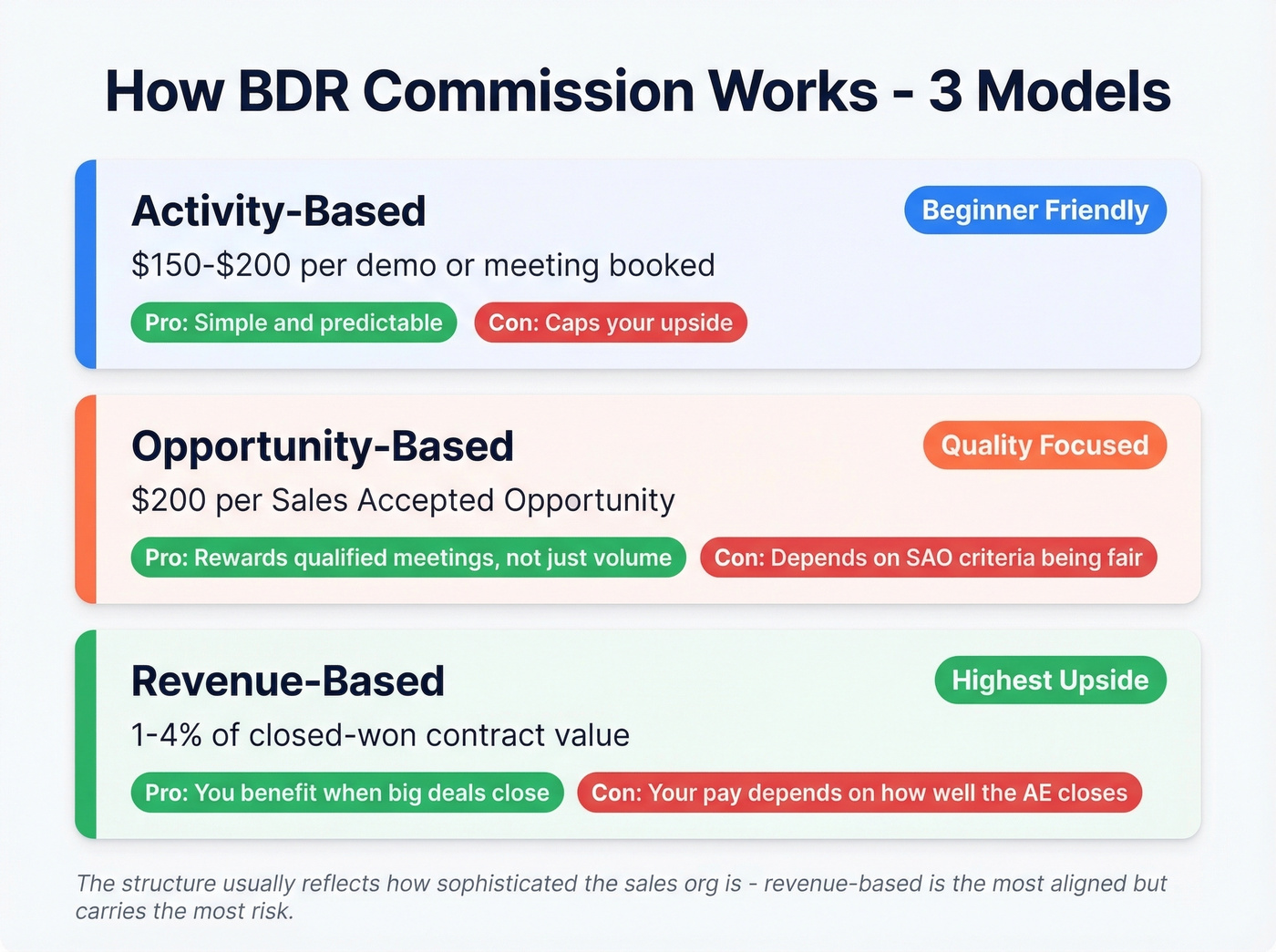
Activity-based is the simplest: you earn $150-$200 per demo or meeting booked. Common at high-volume shops where the goal is pipeline quantity. Beginner-friendly but caps your upside.
Opportunity-based pays around $200 per Sales Accepted Opportunity. The key difference: the meeting has to be qualified, not just booked. This rewards quality over volume.
Revenue-based ties your commission to closed-won revenue at 1-4% of contract value. This is the most aligned structure - you benefit when deals close. The catch? Your paycheck depends on how well the AE performs after the handoff. If your closer drops the ball on a deal you sourced, you eat the loss.
Highest-Paying Cities
Location still matters, even in a remote-friendly market:
| City | Annual Base Salary |
|---|---|
| San Jose, CA | $108,524 |
| San Francisco, CA | $108,091 |
| Washington, DC | $96,070 |
| New York, NY | $78,410 |
| Seattle, WA | $73,598 |
| Austin, TX | $57,115 |
| Charlotte, NC | $54,326 |
These are base salary before commission. Bay Area numbers look high because cost of living eats most of the premium.
One trend worth flagging: promotion timelines increased 28% post-pandemic, stretching from 12 months to 15-16 months. Companies got more cautious about promoting reps during the 2022-2023 downturn, and that caution hasn't fully unwound.

That 8:45 AM call block only works if you're dialing real numbers. Prospeo gives BDRs 125M+ verified mobiles with a 30% pickup rate and 98% accurate emails - so you spend your power hours connecting, not bouncing.
Stop wasting dials on dead data. Start every morning loaded.
BDR Career Path
The role is a launchpad, not a destination. Median tenure is 1.9 years, and the most common exit is a promotion - not a resignation.
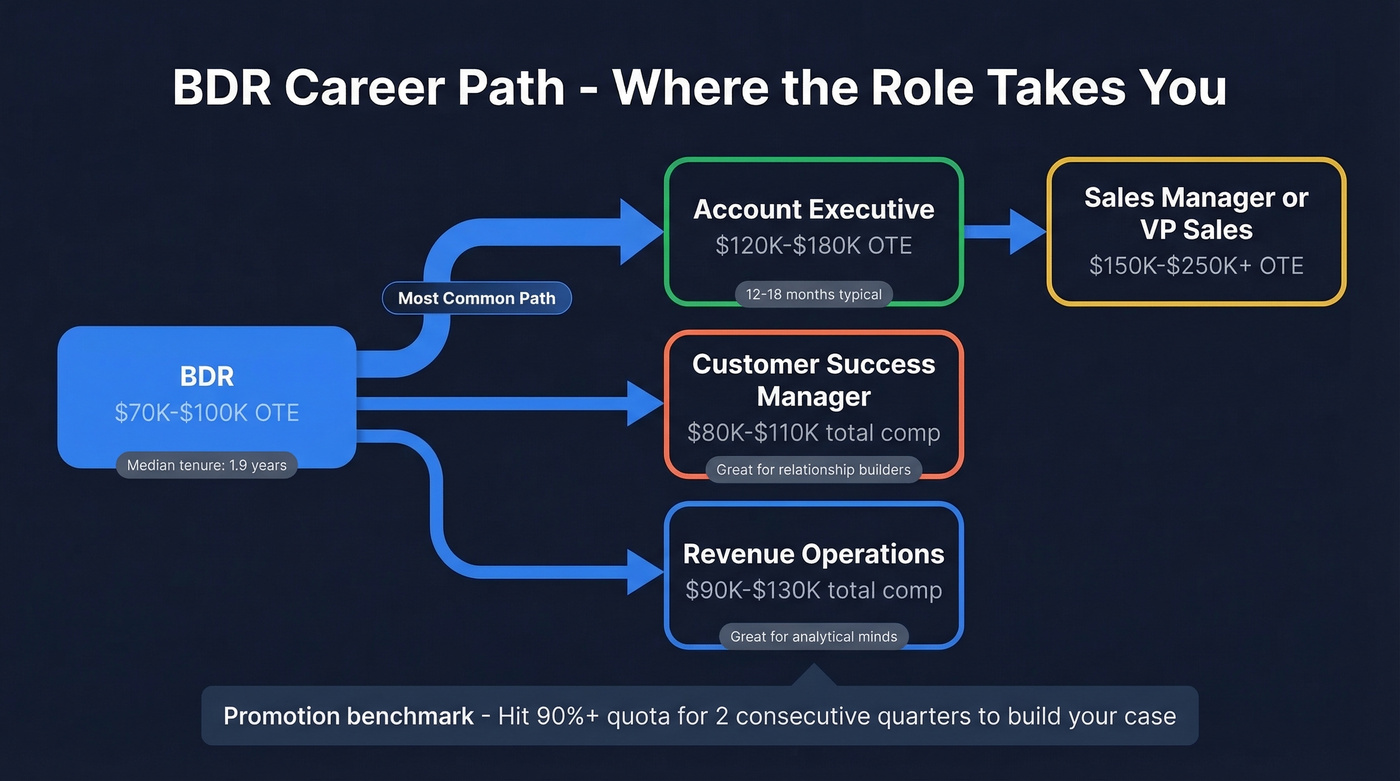
The classic path is BDR to Account Executive, and the pay jump is significant. Mid-market AEs earn $120K-$180K OTE, roughly double what a senior BDR makes. The typical timeline is 12-18 months, though high performers at startups can move in 6-12. The benchmark most managers use: hit 90%+ quota for two consecutive quarters and you've built your promotion case.
But AE isn't the only option. Customer Success Manager ($80K-$110K total comp) is a strong fit if you're more relationship-oriented than hunter-oriented. Revenue Operations ($90K-$130K total comp) appeals to the analytically-minded reps who geek out over CRM workflows and pipeline reporting (more on the role: RevOps Manager). Some pivot into Marketing or Demand Gen, using their frontline understanding of what messaging actually resonates with buyers.
Here's our hot take: if your company sells deals under $15K ACV, the AE path might not be worth the wait. At that deal size, AE comp is compressed and the role often looks like a glorified BDR with closing authority. You're better off finding a company selling $30K+ deals where the AE role actually pays differently.
The r/sales community consistently reinforces this: the role teaches you the fundamentals of B2B sales - objection handling, pipeline discipline, time management - in a compressed timeframe. Those skills transfer to every downstream role.
Skills That Separate Top Performers
Every job posting lists the same generic skills. Here's what actually separates quota-crushers from the reps who wash out in six months.
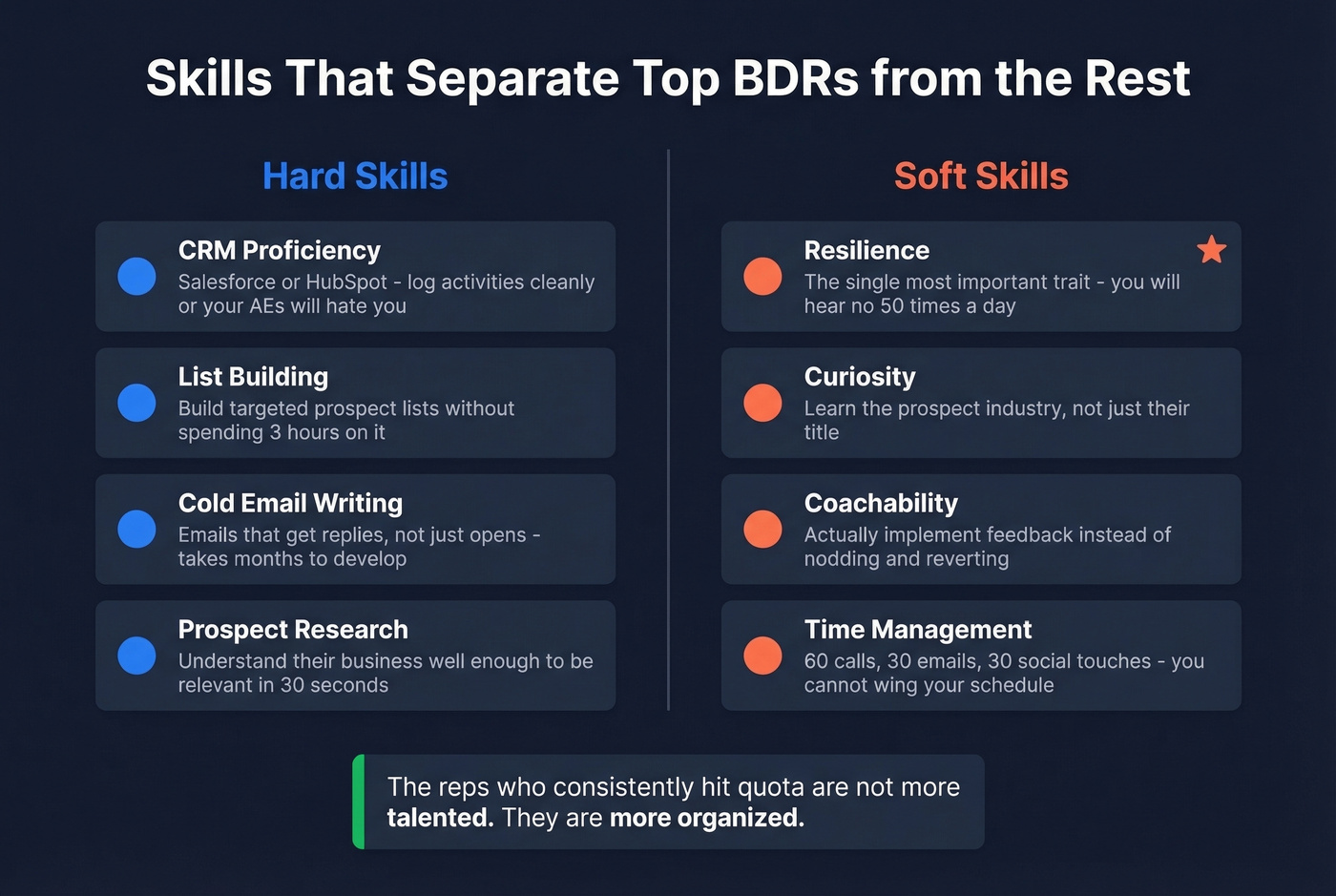
Hard skills: CRM proficiency in Salesforce or HubSpot is non-negotiable - if you can't log activities cleanly, your AEs will hate you. You need to know how to build a targeted prospect list without spending three hours on it. Writing cold emails that get replies, not just opens, is a skill that takes months to develop (use these email subject lines examples to speed up iteration). And research - understanding a prospect's business well enough to have a relevant conversation in 30 seconds - is what separates personalized outreach from spam.
Soft skills: Resilience is the single most important trait, and no amount of training replaces it (build it like a system: resilience in sales). You'll hear "no" 50 times a day and need to keep dialing. The best reps pair that resilience with genuine curiosity - they learn the prospect's industry, not just their title, and that depth shows up in every conversation.
Coachability separates fast risers from plateau reps. Your manager will give you feedback constantly. The reps who improve fastest actually implement it instead of nodding and reverting to old habits. Time management isn't optional when you're juggling 60 calls, 30 emails, and 30 social touches daily - you can't afford to wing your schedule.
Essential Tool Stack
For a Business Development Representative in 2026, the right tools aren't optional - they're the difference between hitting quota and burning out. If you're new, start with three: your CRM, a sales engagement platform, and a contact data tool. Everything else is optional until you've mastered these.
Data & Contact Intelligence
For verified contact data without an enterprise budget, Prospeo delivers 98% email accuracy and 125M+ verified mobile numbers with a 30% pickup rate, plus a free tier of 75 emails per month and paid plans at roughly $0.01 per email. The 7-day data refresh cycle means you're not calling people who changed jobs six weeks ago. No contracts, fully self-serve - a sharp contrast to ZoomInfo's $15K-$40K/year commitment.

Apollo offers a generous free tier and paid plans from $49-$99/mo per user. Strong for prospecting workflows but email accuracy runs lower. ZoomInfo is the enterprise standard ($15K-$40K/year) with the deepest US database, but it's overkill for most early-stage teams.
CRM
Salesforce ($25-$150/user/mo) is the default for mid-market and enterprise. HubSpot offers a free CRM with Sales Hub starting at $20/user/mo - a better fit for smaller teams. You won't choose the CRM at most companies, but knowing both platforms makes you more hireable (more examples: examples of a CRM).
Sales Engagement
Outreach (~$100-$150/user/mo) and SalesLoft (~$100-$150/user/mo) are the two dominant platforms for managing multi-step sequences across email, phone, and social. They're similar enough that the choice usually comes down to which one your company already uses. SalesLoft has a slight edge on usability; Outreach wins on advanced workflow customization (implementation guide: implementing a sales engagement platform).
Other Essentials
Gong (~$100-$150/user/mo) records and analyzes your calls - think of it as game film for sales reps. Calendly (free tier available) or Chili Piper (~$30-$150/user/mo) handles scheduling. For standalone email verification, NeverBounce (from ~$0.003/email) and ZeroBounce (from ~$0.006/email) work if you're using a different data source.
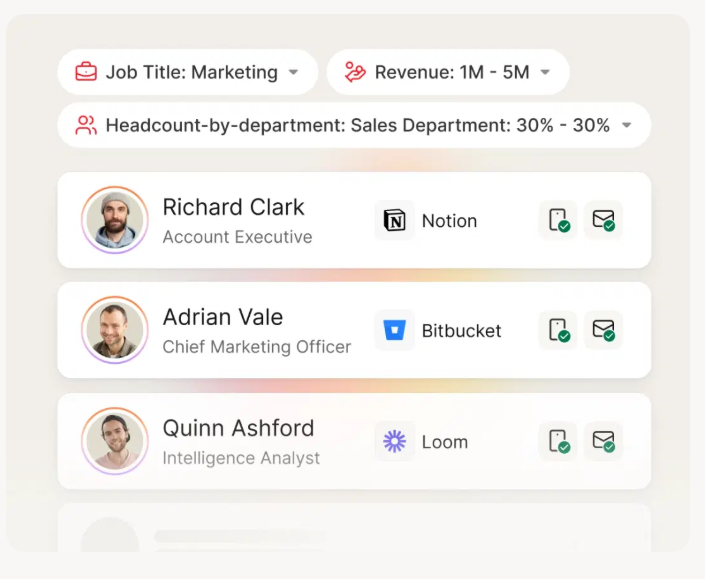
15-20 new contacts before 9 AM sounds great - until you're stuck researching LinkedIn for an hour. Prospeo's 30+ search filters and 300M+ profiles let BDRs build tomorrow's list in minutes, not hours. At $0.01 per verified email, even entry-level reps can prospect at scale.
Cut your list-building from 45 minutes to 5. Quota thanks you later.
Will AI Replace BDRs?
Look, the Bridge Group's 2025 sales development report is the first year "AI SDRs" even appear in the data. That tells you where we are: early.
The numbers from SaaStr's internal testing are striking. Their AI SDRs answered technical questions immediately 87% of the time versus 15% for humans. Time to technical qualification dropped from 8.3 days to 2.1 days. Those are real advantages for routine qualification tasks.
But the counterbalance is just as clear: only 7% of organizations have AI fully scaled across the enterprise, and just 13% cite headcount reduction as their primary AI objective. Meanwhile, 42% of B2B decision-makers are implementing genAI for buying and selling workflows - which means AI is being added alongside humans, not instead of them.
AI won't replace Business Development Representatives by 2027. It will replace those who don't use AI. The hybrid model - AI handling research, initial outreach, and follow-up scheduling while humans handle objections, relationships, and complex conversations - is where every serious sales org is heading. The reps who learn to use AI as a force multiplier will outperform those who ignore it by a wide margin.
Red Flags in Job Postings
Not all BDR roles are created equal. Skip these:
- 100+ dials/day on a minimum-wage base. One Reddit poster described exactly this setup - 100 daily dials, minimum wage, $50K-$100K deals. If a company expects that volume at that comp, run.
- Vague KPIs. "Drive pipeline growth" without specific activity or meeting targets means they don't know what good looks like. You'll be set up to fail (see sales activities examples).
- No clear promotion path. Ask directly: "How many reps were promoted to AE in the last 12 months?" If the answer is zero or a dodge, the role is a dead end.
- "Unlimited earning potential" without base salary disclosure. The base is almost certainly embarrassingly low.
- No ramp period. The industry benchmark is 3.0 months average ramp. If they expect full quota from week one, they don't understand the role (use a 30-60-90 day plan for sales reps to sanity-check expectations).
FAQ
What does BDR stand for in sales?
BDR stands for Business Development Representative - a frontline outbound sales role focused on prospecting and pipeline generation. The rep identifies potential customers, qualifies them through research and conversation, and books meetings for Account Executives to close. Median OTE in 2026 is $85,000.
Is BDR the same as SDR?
At most companies under $50M ARR, yes - the titles are interchangeable. The most common distinction is BDR for outbound prospecting and SDR for inbound qualification, but definitions vary wildly between organizations. Always ask during interviews how the specific company defines the role.
How long does it take to get promoted from BDR?
The average promotion timeline is 12-18 months, though high performers at startups can reach AE in 6-12 months. The benchmark most managers use: hit 90%+ quota for two consecutive quarters. Post-pandemic, timelines have stretched to 15-16 months as a realistic target.
What tools do BDRs need on day one?
A CRM (Salesforce or HubSpot), a sales engagement platform (Outreach or SalesLoft), and a contact data tool for verified emails and direct dials. Prospeo's free tier covers 75 verified emails per month - enough to start prospecting immediately without budget approval.
What's a good BDR quota?
Typical targets are 60 calls/day, 30 emails/day, and 1-2 meetings booked per week. Anything above 100 dials/day paired with a low base salary is a red flag. The 6sense benchmark report provides additional context on what top-performing teams expect.