

Best Cold Calling Scripts: Data-Backed Templates That Book Meetings in 2026
A HubSpot contributor logged 11,519 cold calls, booked 335 meetings, and closed $287K from cold outreach alone. That's not a motivational poster - it's a math problem. And the math says cold calling works when the inputs are right.
You don't need 25 scripts. You need 3 great ones, the ability to handle 5 common objections, and phone numbers that actually ring. Here are the best cold calling scripts ranked by performance data, not vibes.
The Playbook, Compressed
- 3 core scripts: opener, gatekeeper bypass, voicemail
- 5 objection rebuttals: "no time," "not interested," "send an email," "we have a vendor," "call me later" (see talk tracks for more variations)
- Clean phone data: if your connect rate is below ~5.5%, the problem is upstream of your script (use data enrichment to fix gaps)
- Compliance basics: TCPA, DNC, state mini-TCPA laws - skip this and you're gambling with $500+ per violation
Everything below expands on those four pillars.
Cold Calling Benchmarks for 2026
Let's set expectations before you pick up the phone.
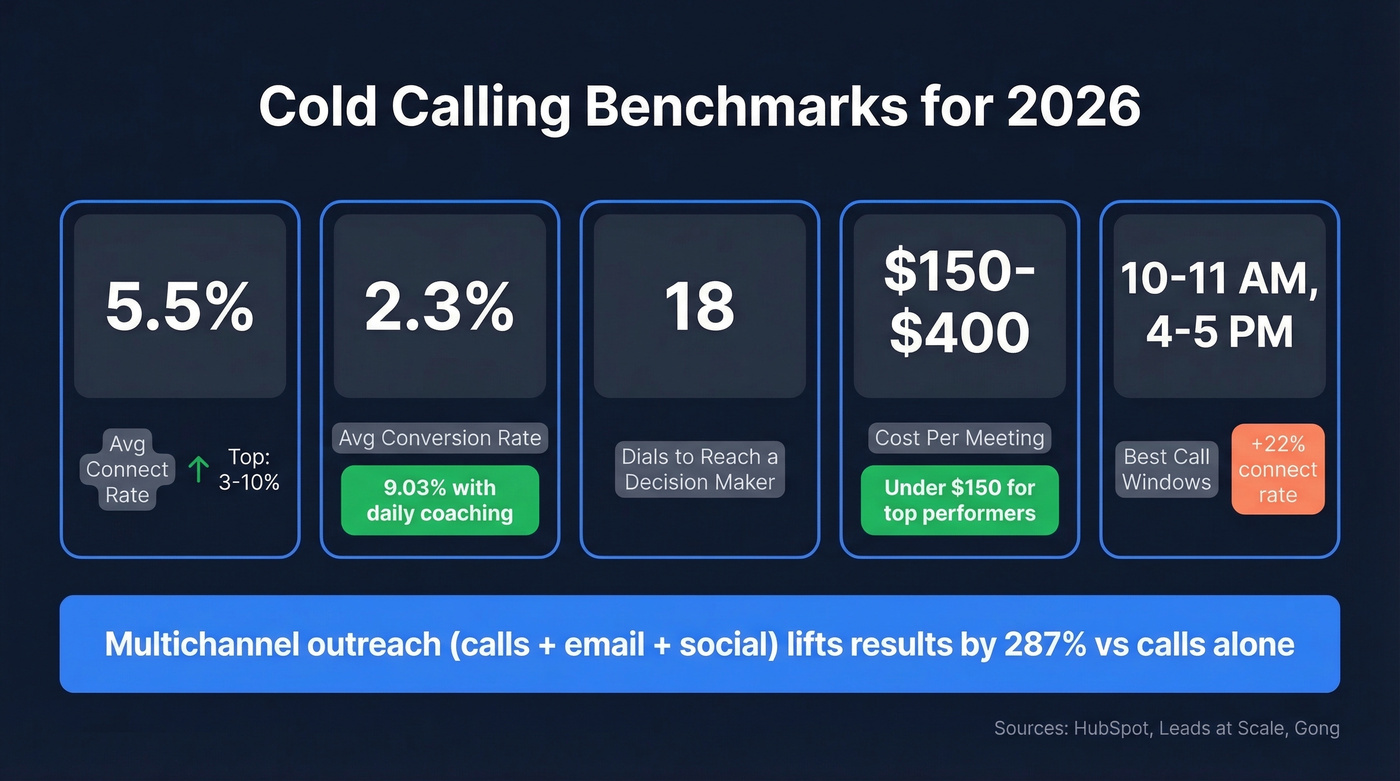
| Metric | Average | Top Performers |
|---|---|---|
| Connect rate | 5.5% | 3%-10% |
| Conversion rate | 2.3% | 9.03% (daily training) |
| Dials to reach DM | 18 | - |
| Cost per meeting | $150-$400 | Under $150 |
| Best call windows | Varies by list and industry | 10-11 AM, 4-5 PM |
Calling during the 10-11 AM or 4-5 PM windows improves connect rates by up to 22%. Combining calls with email and social touchpoints lifts results by 287% versus calls alone, according to multichannel outreach studies. That's not a rounding error - it's the difference between a pipeline and a prayer.
Industry matters too. Business services teams convert at 2.61%, while software companies sit at 0.95%. Selling a $500-$10K deal? Expect a 2.64% conversion rate. Seven-figure contracts? That drops to 1.16%. (If you want broader context, start with B2B sales benchmarks.)
Here's the stat that should change how you run your team: reps who receive daily coaching hit a 9% conversion rate - nearly 4x the average. At 200+ dials per day with a 5% connect rate, expect at least one meeting daily. That's your operating model.
If your connect rate is stuck below ~5.5%, the problem isn't your script - it's your phone data. Bad numbers mean wasted dials, and wasted dials mean your reps burn out before the math can work. When Meritt switched to verified mobiles through Prospeo, their connect rate tripled to 20-25%. We've seen that pattern repeat across dozens of teams: clean data is the single highest-leverage fix in cold calling. (This is also why teams invest in a repeatable cold calling system.)
Openers That Actually Work
Your opener is the most leveraged 10 seconds of the entire call. Get it wrong and nothing else matters.
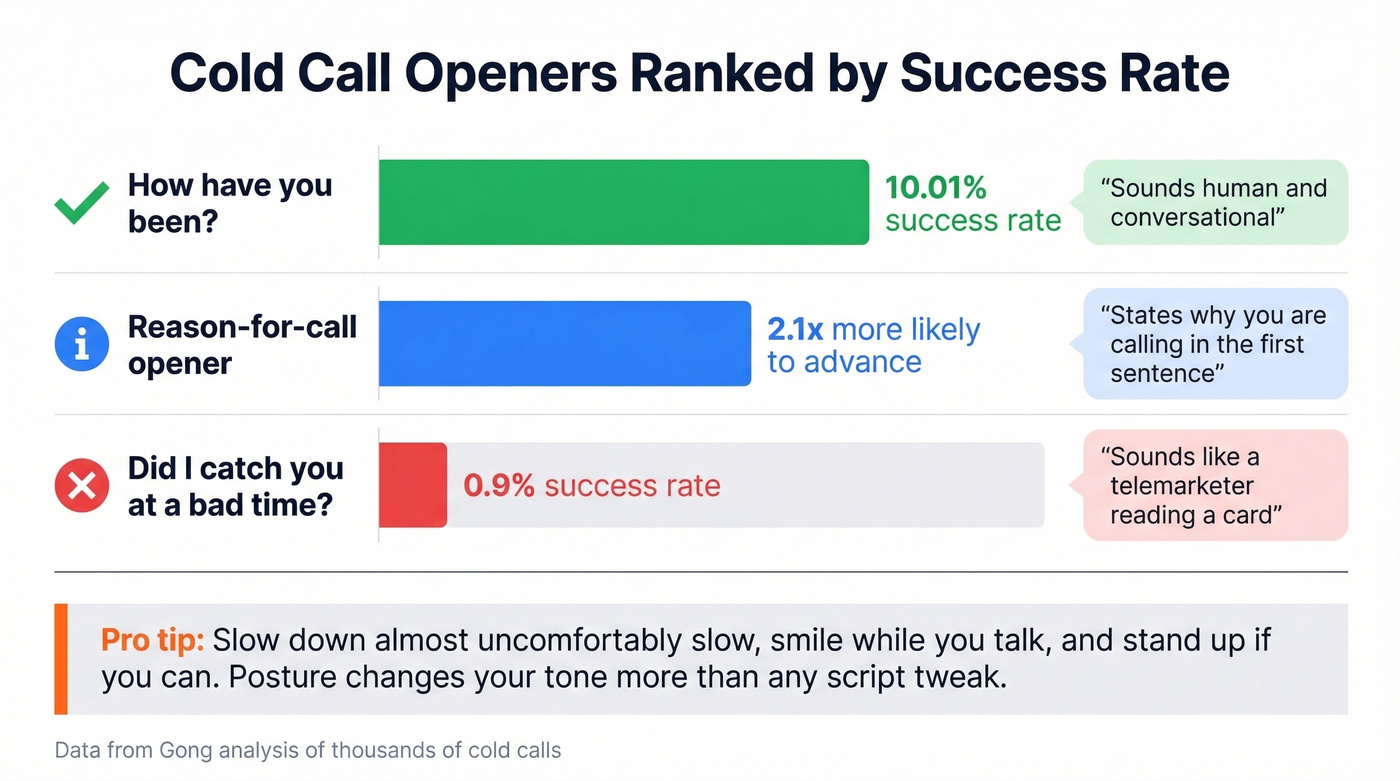
Gong's analysis of thousands of cold calls found that "How have you been?" produced a 10.01% success rate for advancing calls. "Did I catch you at a bad time?" cratered at 0.9%. The difference? The first sounds human. The second sounds like a telemarketer reading off a card.
Stating the reason for your call early lifts success roughly 2.1x. Don't bury the lead. (If you're building a full outbound motion, pair this with sales prospecting techniques.)
1. Permission-based opener (highest performer)
"Hi [First Name], it's [Your Name] - caught you out of the blue. You got a minute?"
In our testing, this consistently outperforms pattern interrupts. It works because it acknowledges the interruption without apologizing for it. A practitioner on r/sales who shared this approach emphasized delivery mechanics: slow down "almost uncomfortably slow," smile while you talk, and stand up if you can. Posture changes your tone more than any script tweak will.
2. Reason-for-call opener
"Hi [First Name], I'm [Your Name] with [Company]. The reason I'm calling is [one sentence of relevance]."
No tricks. No pattern interrupts. Just directness. This outperforms clever gimmicks because prospects respect honesty about why you're on their phone.
3. Context-driven opener (for warm-ish dials)
"Hi [First Name], I noticed [trigger event - funding round, new hire, expansion]. Wanted to see if that changes anything about how you're handling [relevant problem]."
Friday afternoons are gold for reaching VPs and C-suite. Gatekeepers leave early, executives are winding down, and the mood is lighter. Time your highest-value dials accordingly.
Templates by Scenario
Scripts are conversation frameworks, not teleprompter text. The rep who reads verbatim loses. Internalize the structure, then make it yours. Use this skeleton for any call: Opener -> Reason -> Question -> Value -> Close.
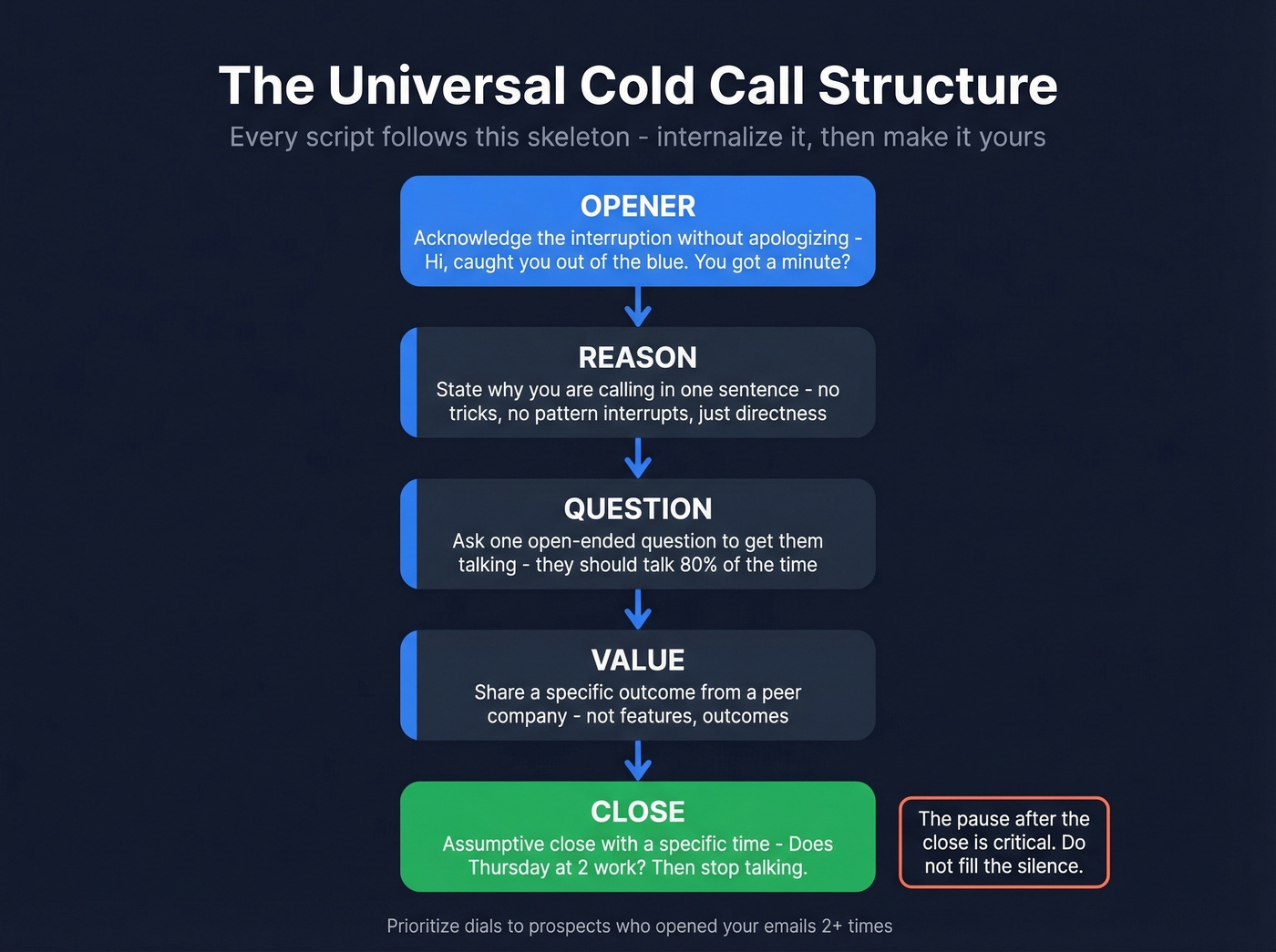
One more tip before the templates: prioritize dials to prospects who've opened your emails two or more times. They're already warm, and your connect-to-meeting rate will be dramatically higher. (For the email side, keep cold email follow-up templates handy.)
New B2B Prospect
"Hi [First Name], it's [Your Name] - caught you out of the blue. You got a minute?"
[Wait for response]
"We do [coolest feature] for companies in your space like [competitor or peer company]. I'd love to set aside a half hour later this week to show you how it works. Does [time] on [day] work?"
The pause after the close is critical. Don't fill the silence. An assumptive close with a specific time converts better than "would you be open to a call sometime?" This is the template every B2B rep should internalize first.
Warm Lead / Referral
Most reps treat referral calls the same as cold dials. That's a mistake.
Wrong approach: "Hi, I'm calling from [Company] and we help businesses with [generic pitch]..."
Right approach:
"Hi [First Name], [Referrer Name] suggested I reach out. They mentioned you're handling [specific responsibility] and thought we should connect. Do you have a quick minute?"
Name-dropping a mutual connection changes the entire dynamic. The prospect's guard drops because you've been pre-vetted. Keep the referrer's name in the first sentence - don't save it for later.
Trigger-Event Call
"Hi [First Name], I saw [Company] just [raised a round / opened a new office / hired 15 SDRs]. When companies hit that stage, [specific problem] usually becomes urgent. Is that on your radar?"
Two to three minutes of pre-call research - scanning their company news, recent hires, or tech stack changes - separates you from the 95% of callers who sound generic. Adapt the language for your vertical: a SaaS VP cares about pipeline velocity, a manufacturing director cares about supply chain costs, a property management team focuses on vacancy rates and tenant acquisition. Same structure, different vocabulary.
C-Suite / Executive
"Hi [First Name], I'll be brief. We work with [peer company CEO/CRO] on [specific outcome]. I wanted to see if it's worth 20 minutes to compare notes. Would [day] work?"
Executives respect brevity and peer proof. Don't pitch features. Pitch outcomes their peers are getting. Keep it under 30 seconds before the ask.
Selling Services
When you're selling a service rather than a product, the conversation needs to lead with outcomes, not deliverables.
"Hi [First Name], it's [Your Name]. We help [type of company] with [specific outcome - e.g., cut onboarding time in half, reduce churn by 30%]. I wanted to see if that's something worth a quick conversation. Got a minute?"
Service-based selling requires more trust upfront because there's no demo to show. Lean on case studies and specific results from similar companies to build credibility fast.
Lead Generation Script
For reps focused purely on lead generation rather than closing, the goal is qualification, not the pitch. Shift your close from "book a demo" to "confirm fit."
"Hi [First Name], it's [Your Name] at [Company]. We work with [industry] teams on [problem]. I'm not sure if it's relevant for you - mind if I ask a couple quick questions to find out?"
This low-pressure approach works well for top-of-funnel prospecting and keeps the conversation exploratory rather than adversarial.
Discovery / Qualification
Once a prospect engages, shift into diagnosis mode. They should talk roughly 80% during the first half of the conversation.
"Great - let me start by asking a few questions so I understand your situation. If it sounds like I can help, I'll explain how we work. Sound good?"
Then ask: "What prompted you to take this call?" and "Could you tell me a bit more about that?" These open-ended questions get prospects talking about their real problems, not your features. (If you want a deeper bank, use these discovery questions.)
When it's time to transition: "Would it be okay if I walk you through how I'd approach it?" This permission-to-pitch line keeps things collaborative. And don't dodge pricing - have 1-3 clear packages ready and anchor with a range early. For inbound calls, the same discovery framework applies; just replace the cold opener with a warm acknowledgment of their inquiry.

Meritt tripled their connect rate to 20-25% by switching to Prospeo's verified mobile numbers. 125M+ direct dials, 30% pickup rate, refreshed every 7 days. Your script can't fix a wrong number.
Stop burning dials on dead numbers. Start connecting.
Gatekeeper Scripts
The 30 Minutes to President's Club framework calls this the Triple Bypass, and it's the cleanest gatekeeper approach we've seen.
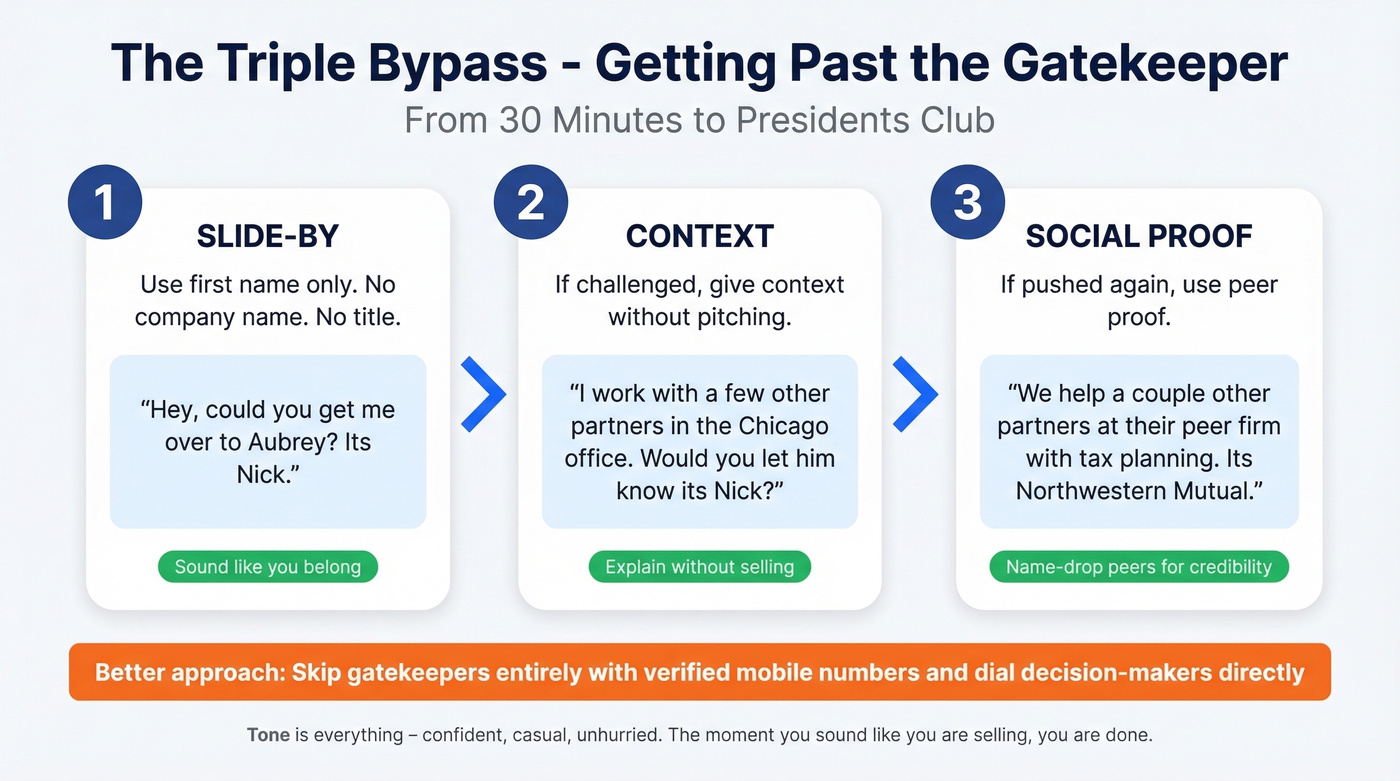
Step 1 - Slide-by. Use first name only. No company name. No title.
"Hey, could you get me over to Aubrey? It's Nick."
Sound like you belong. The gatekeeper's job is to filter strangers, so don't sound like one.
Step 2 - Context. If challenged, give context without pitching.
"I work with a few other [peers in their role] in the [city/office]. Would you let him know it's Nick?"
Step 3 - Social Proof. If pushed again, use peer proof.
"We help a couple other partners at [peer firm] with their tax planning. It's Northwestern Mutual."
Tone is everything here. Confident, casual, unhurried. The moment you sound like you're selling, you're done.
Here's the thing: if you keep hitting gatekeepers, skip them entirely. Verified mobile numbers let you dial decision-makers directly - no receptionist, no "let me check if they're available." That alone changes the economics of your entire call block.
Voicemail Scripts That Get Callbacks
You'll hit voicemail 80% of the time. A targeted voicemail lifts callbacks by up to 22%, so ignoring voicemail means ignoring 80% of your dials.
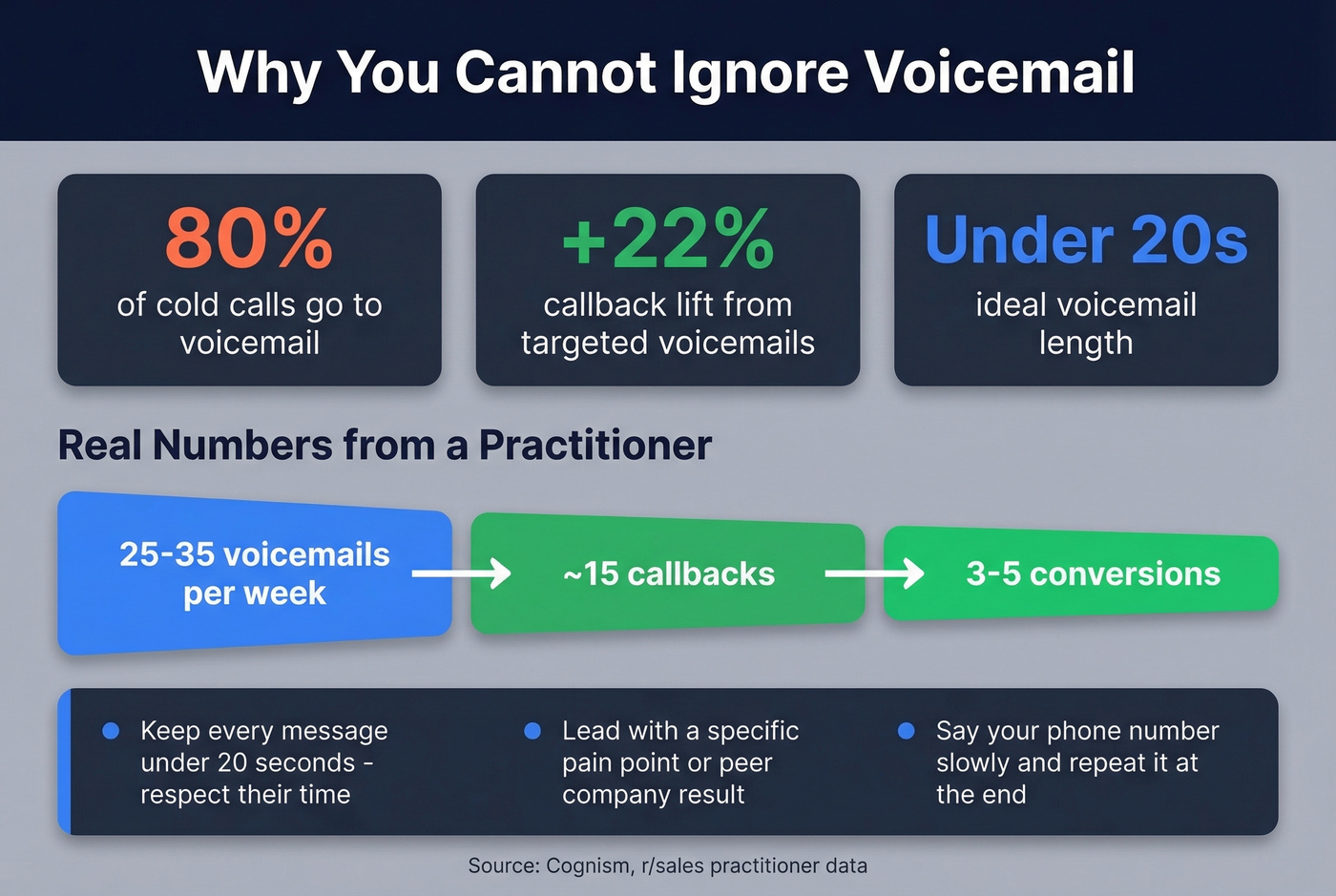
One practitioner on r/sales shared concrete numbers: 25-35 voicemails per week, roughly 15 callbacks, 3-5 conversions. The key? Research-driven targeting and keeping every message under 20 seconds. (To tighten the post-call workflow, use sales follow-up templates.)
Pain-point voicemail:
"Hi [First Name], it's [Your Name] at [Company]. I'm calling because [specific problem] tends to hit companies at your stage hard. I have a quick idea - call me back at [number]."
Social proof voicemail:
"Hi [First Name], [Your Name] here. We just helped [peer company] with [specific outcome]. Thought it might be relevant for your team. My number is [number]."
Ultra-short callback request:
"Hi [First Name], [Your Name], [number]. Calling about [one phrase]. Give me a ring back."
Here's a tactic most guides skip: when they call back, act slightly confused. "Remind me - what do you oversee again?" This flips the dynamic. Now they're explaining their role and responsibilities to you, which is exactly the discovery information you need.
Every voicemail should reference your cold email. "I also dropped you a note - check your inbox." This ties the cadence together and gives them a lower-friction way to respond.
Objection Handling Scripts
Objections aren't rejections. They're reflexes. The prospect is on autopilot - your job is to break the pattern without being combative. (If this is a recurring issue, see how to reduce sales objection rate.)
Use this five-step process: Listen -> Ask -> Solve -> Confirm -> Move on. Within each step, the LARA technique keeps you grounded: Listen to the full objection, Acknowledge it, Respond with value, then Ask a question to re-engage. Follow the 70/30 rule - the prospect should be talking 70% of the time, you 30%.
| They Say | You Say |
|---|---|
| "I don't have time" | "Totally fair - can I have 30 seconds? If it's not relevant, I'll hang up. Deal?" |
| "Not interested" | "Makes sense. Quick question - what are you currently using for [problem]?" |
| "Send me an email" | "Happy to. So I send something relevant - what's your biggest priority with [area] right now?" |
| "We have a vendor" | "Good to hear. Out of curiosity, what would need to change for you to evaluate alternatives?" |
| "Call me back later" | "Absolutely. When specifically works? I'll block it off." |
The "send me an email" objection is the most dangerous because it feels like progress. It's not. Reframe it into a micro-discovery question so your email actually lands with relevance. And when they say "call me back later," pin down a specific time - vague follow-ups die on the vine.
Common Mistakes to Avoid
- Not researching. Two to three minutes of pre-call research separates you from spam. Check their company news, recent hires, and tech stack before every dial.
- Generic pitch. "We help companies like yours" means nothing. Name their competitor, their industry, their specific pain.
- Sounding robotic. Scripts are frameworks, not teleprompter text. Internalize the structure, then deliver it conversationally. Record yourself and listen back - you'll hear the difference immediately.
- Pitching too early. Diagnose before you prescribe. Spend the first 60 seconds asking about them, not talking about you.
- Bad data. Every dial to a wrong number is a dial that could've been a conversation. This is the most expensive mistake on the list because it wastes every other investment you've made - rep time, coaching, script optimization, all of it down the drain.
- Giving up too early. It takes an average of 8 attempts to reach someone. Build an 8-touch cadence and trust the math. Most reps quit after 2-3 attempts.
- Not reviewing calls. Teams that train daily hit a 9.03% conversion rate. Teams that don't sit around 2.3%. Record every call, review two per rep per day, and coach on specific moments - not general advice.
Look, if your deal size is above $5K and you're not cold calling, you're leaving money on the table. Email-only outbound has a ceiling. The phone is where deals actually start, and the teams that figure this out in 2026 will outpace the ones still hiding behind sequences.
Compliance Checklist
Compliance isn't optional, and most cold calling guides irresponsibly skip it.
Federal requirements:
- Scrub lists against the National DNC Registry before every campaign
- Maintain an internal DNC list and honor opt-outs immediately
- Call only between 8 AM-9 PM in the prospect's local time zone (some states enforce tighter windows)
- Get written consent before using automated dialers or prerecorded messages on cell phones
- Keep documentation for safe harbor defense
Penalties are real. TCPA violations run $500 per call, $1,500 for willful violations. DNC violations can hit up to $43,792 per infraction. A 100-dial day with unscrubbed lists could generate $50,000+ in TCPA exposure.
Courts now treat mobile numbers on the National DNC Registry as residential regardless of business use. States like Florida, Maryland, Oklahoma, and Washington have enacted mini-TCPA laws - some with no B2B exemptions at all. Ringless voicemail and AI voice calls are treated as prerecorded messages requiring consent.
None of this should stop you from cold calling. Spend the 15 minutes to scrub your data and you're fine.
The best cold calling script in the world converts at 0% if you're dialing the wrong number. Prospeo gives you 125M+ verified mobiles with a 30% pickup rate - at $0.01 per lead. No contracts, no sales calls.
Fix your data and let your scripts do what they were built to do.
FAQ
What's the best opening line for a cold call?
Gong's analysis found "How have you been?" produces a 10.01% success rate - the highest-performing opener tested. Permission-based openers that acknowledge the interruption outperform gimmicky pattern interrupts. State your reason for calling within 15 seconds and lead with a human tone, not a rehearsed pitch.
How many calls does it take to book a meeting?
At the average 2.3% conversion rate, expect roughly 40-45 calls per booked meeting. With verified phone data, top reps cut this to 15-20. Daily coaching pushes conversion rates to 9%, which compresses the math even further.
Should you leave a voicemail?
Yes. You hit voicemail 80% of the time, so ignoring it means ignoring most of your dials. A targeted voicemail lifts callbacks by up to 22%. Keep it under 20 seconds and reference your cold email to tie the cadence together.
Is cold calling still legal in 2026?
Yes, but compliance requirements are tighter than ever. TCPA violations cost $500-$1,500 per call, and state-level mini-TCPA laws add restrictions. Scrub against the National DNC Registry, respect calling hours, and check your state requirements before dialing.
How do you get past a gatekeeper?
Use first-name-only requests ("Could you get me over to Aubrey? It's Nick."), provide context without pitching, and use social proof from peers in their industry. To bypass gatekeepers entirely, dial verified mobile numbers - that's the most reliable shortcut we've found.