

Best Email Automation Platform in 2026
Your welcome sequence fires. Three hundred new subscribers from last week's webinar hit the flow. By morning, 22% have bounced, your domain reputation's taken a hit, and the remaining emails land in spam. You just turned a growth moment into a deliverability crisis.
The gap between having automation and having automation that doesn't torch your sender reputation is where most teams bleed money. Choosing the best email automation platform isn't about feature checklists - the top 10% of email workflows generate $16.96 in revenue per recipient while the average sits at $1.94. The difference is the platform underneath, the data feeding it, and whether your emails reach inboxes at all.
We've tested these platforms across dozens of client deployments. The results aren't what most "best of" guides would have you believe.
Our Picks
| Category | Pick | Why | Starting Price |
|---|---|---|---|
| Automation depth | ActiveCampaign | Unlimited actions + branching on Plus+ (Starter is limited) | $19/mo (1K contacts) |
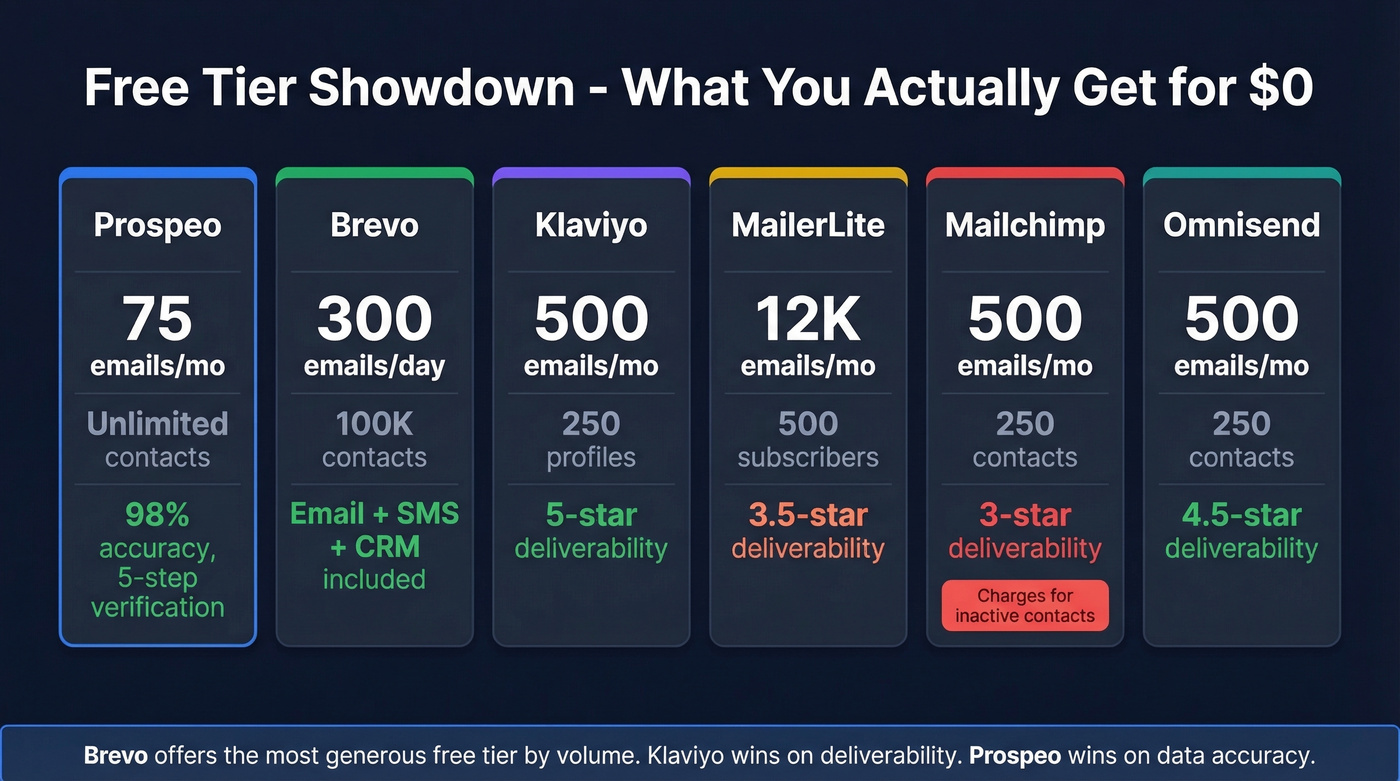
| Data accuracy | Prospeo | 98% email accuracy, 7-day refresh | Free (75 emails/mo) |
| Ecommerce | Klaviyo | Shopify native, predictive segmentation | Free (250 profiles) |
| Budget all-in-one | Brevo | Email + SMS + CRM, big free tier | Free (300 emails/day) |
| CRM-heavy teams | HubSpot | CRM workflows, steep price | $20/mo (Starter) |
| Simplicity | MailerLite | Clean UI, fast setup | Free (500 subs) |
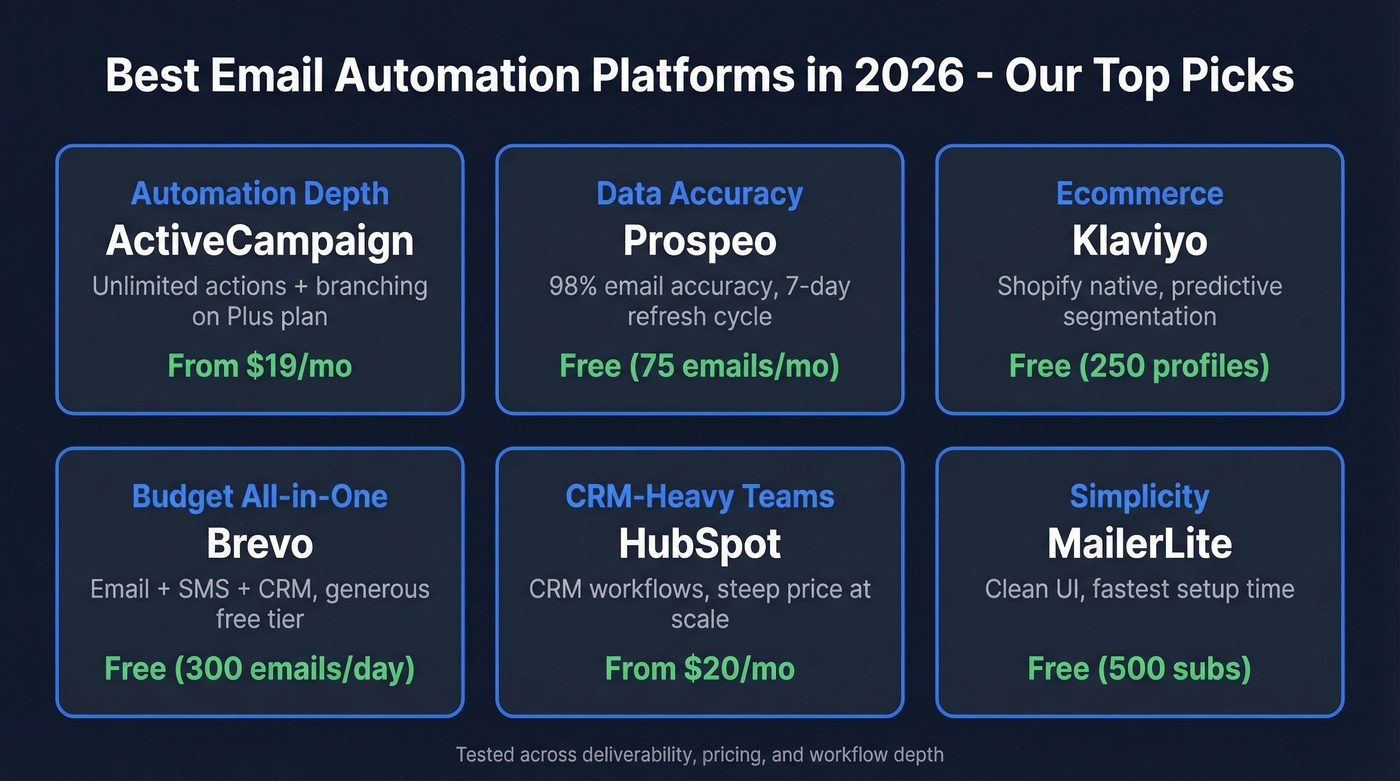
These aren't ranked by feature count. A solo founder running a newsletter needs something completely different from a 50-person SDR team running outbound sequences.
Email Marketing vs. Email Automation
Most "best email automation" guides are actually newsletter guides. They rank tools by template design and drag-and-drop editors - which is email marketing, not automation.
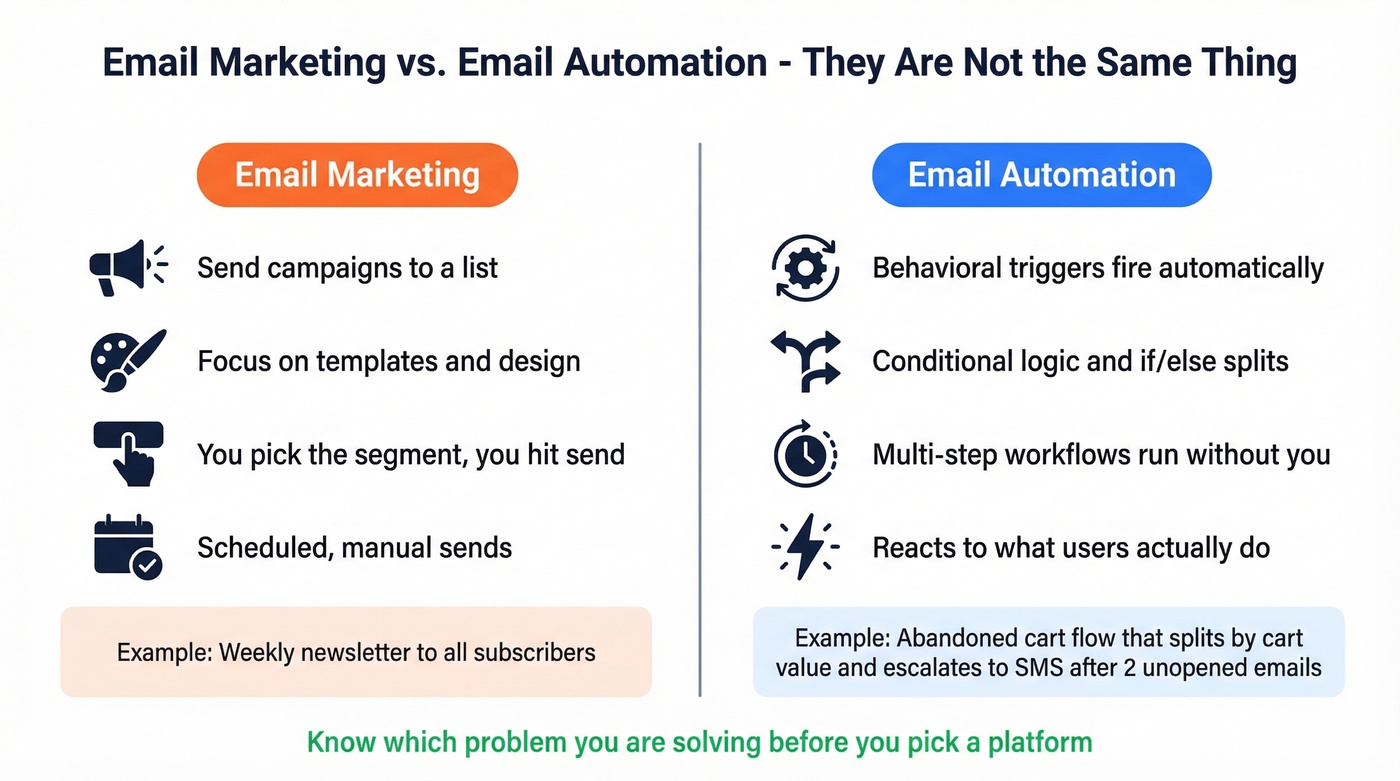
Email marketing is sending campaigns to a list. You write the email, pick the segment, hit send. Email automation is behavioral triggers, conditional branching, and multi-step workflows that run without you touching them. An abandoned cart flow that fires 45 minutes after someone leaves your checkout, splits based on cart value, and escalates to SMS if the first two emails don't convert - that's automation.
The distinction matters because the tools that excel at one aren't always great at the other. Mailchimp is fine for newsletters. It's mediocre for automation. ActiveCampaign is the opposite - powerful automation builder, but nobody's raving about its template library. Know which problem you're solving before you pick a platform.
Top Email Automation Platforms Reviewed
Prospeo - The Data Layer
Your automation platform sends the emails. Prospeo makes sure they reach real people. It's a B2B data platform that solves the problem killing automation ROI before a single workflow fires: bad data.
Use it if:
- You're running outbound sequences and need verified emails that won't torch your domain. The 5-step verification catches invalid addresses, spam traps, and honeypots before they enter your workflows.
- You need fresh data. The 7-day refresh cycle means you're not emailing people who changed jobs six weeks ago - most competitors refresh every six weeks.
- You want verified contacts flowing directly into your sequences via native integrations with HubSpot, Salesforce, Smartlead, Instantly, and Lemlist. The Chrome extension (40K+ users) makes prospecting from any website a one-click operation.
Snyk's 50-person AE team went from 35-40% bounce rates to under 5% after switching, generating 200+ new opportunities per month. Stack Optimize built from $0 to $1M ARR using Prospeo's data, maintaining 94%+ client deliverability with bounce rates under 3% and zero domain flags.
Pricing runs ~$0.01 per email with a free tier at 75 emails/month. No contracts, no sales calls.
ActiveCampaign - Deepest Workflows
ActiveCampaign has the most powerful automation builder in this category. Period. Conditional branching, wait steps, if/else logic, lead scoring - it's all there. The catch? Not on the Starter plan.
Pros:
- Unlimited automation actions on Plus and above. You can build complex multi-step workflows with branching logic that rivals enterprise tools.
- Built-in CRM that's usable for small teams. Not HubSpot-level, but functional. If you need a broader system, compare options in our guide to contact management.
- G2 rating of 4.4/5 across 14,607 reviews - the largest review base of any tool here.
Cons:
- Starter plan caps you at 5 actions per automation with no branching. That's barely automation - it's a glorified autoresponder.
- Pricing ramps fast. At 10K contacts: $189/mo (Starter) to $665/mo (Enterprise). Plus - the plan most teams actually need - runs $239/mo.
- New accounts are charged for all contacts, including unsubscribed and bounced. Older accounts are grandfathered on active-only billing. That's a meaningful cost difference nobody mentions upfront.
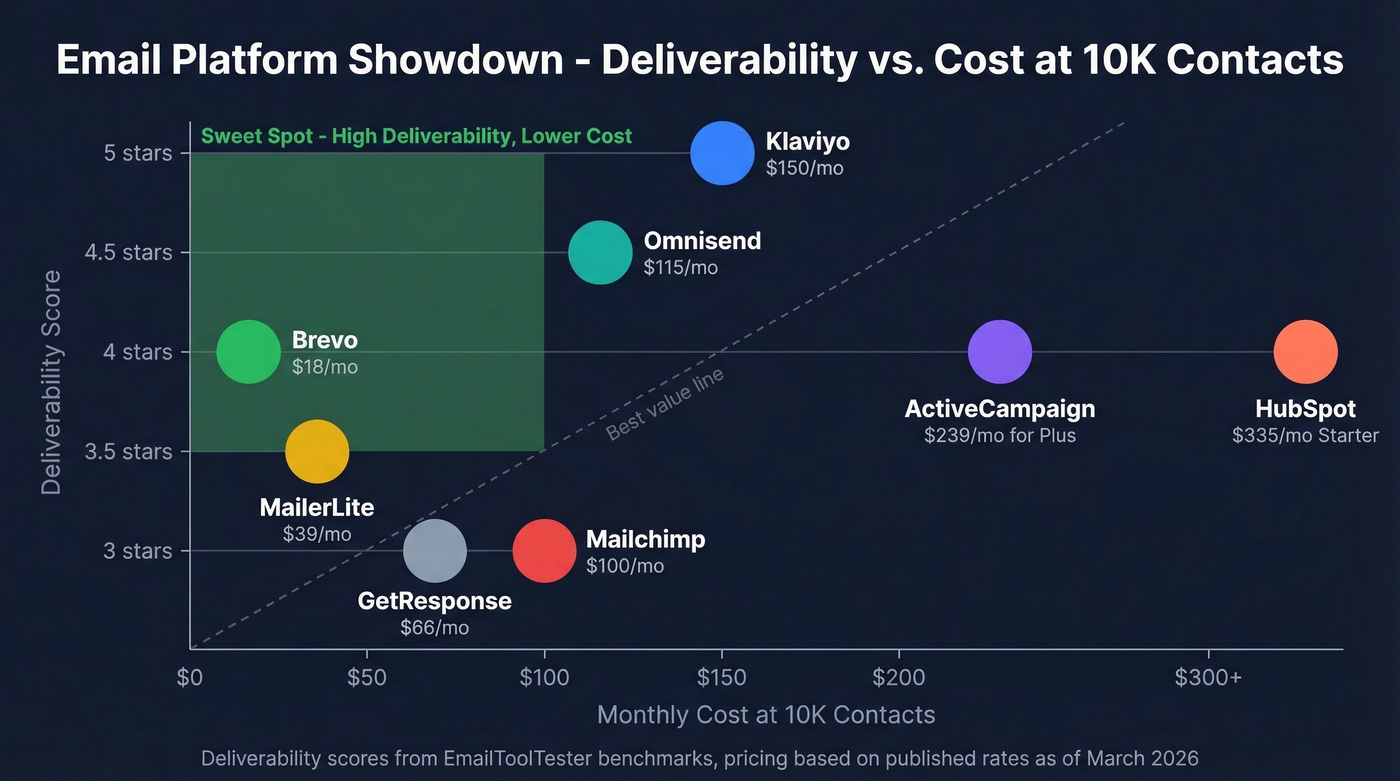
The consensus on r/MarketingAutomation is consistent: deep automations and behavioral targeting are best-in-class, but the learning curve is brutal and pricing surprises people at scale. Deliverability scores 4 stars in third-party testing - solid, not exceptional.
Klaviyo - Ecommerce Default
If you're running a Shopify or WooCommerce store, Klaviyo is the default for a reason. Ecommerce integrations pull in purchase history, browsing behavior, and cart data without custom setup. Abandoned cart flows, post-purchase sequences, and browse abandonment workflows come pre-built and work well out of the box.
Deliverability scores 5 stars in EmailToolTester's benchmarks. The free plan covers 250 profiles and 500 emails per month, enough to test properly.
The pricing warning: at 10K profiles, you're paying $150/mo for email only. Klaviyo bills on total active profiles - every subscribed contact counts, whether you email them or not. That shift (Feb 2025) caught many stores off guard. G2 rates it 4.6/5 (1,301 reviews), but "expensive" is the most common con tag. Here's the thing: Klaviyo is overpriced outside ecommerce. If you're not selling products with cart abandonment and post-purchase flows, you're paying a premium for integrations you'll never use.
Brevo - Best Value All-in-One
Use it if:
- You want email, SMS, and a light CRM in one platform without paying three separate bills. The free tier is generous - 300 emails per day to up to 100K contacts.
- Your budget is tight but you need real automation. Starter runs from $9/mo for 5K emails.
- You're a small team that values simplicity over power-user features.
Skip it if:
- You need advanced automation at scale. The free tier limits automation to 2K contacts, and the workflow builder doesn't match ActiveCampaign's depth.
- You care about template design. The editor and templates feel basic compared to Klaviyo or even Mailchimp. Reddit users consistently flag this as Brevo's weakest point.
G2 scores it 4.5/5 across 2,517 reviews. Deliverability scores 4 stars. For cost-conscious teams that need a functional all-in-one, Brevo is the obvious pick. Just don't expect it to compete on automation sophistication.
HubSpot - CRM-First, Email Second
HubSpot's email automation is powerful - if you can afford it.
The CRM integration is unmatched. When your sales and marketing teams already live in HubSpot, adding email automation creates workflows that span the entire funnel from first touch to closed deal. Starter at $20/mo gets you basic automation and 1K contacts. But each additional 1,000 contacts costs ~$35/mo. At 10K contacts, you're looking at $335/mo just for Starter - and that doesn't include full workflow automation, which requires Professional at $880/mo.
The "marketing contacts" model is confusing in practice. People regularly think Starter is cheap, then realize the contact add-ons make it significantly more expensive than expected. HubSpot is a CRM company that added email, not an email company that added CRM. If you're already paying for HubSpot's CRM, the email automation is a natural extension. If you're not, you're buying a mansion to use the guest bedroom. If you're evaluating CRMs, see real-world examples of a CRM.
Omnisend
Omnisend occupies the sweet spot between Klaviyo's power and a reasonable price tag. The free tier covers 250 contacts and 500 emails, with Standard starting at $16/mo for 500 contacts. Pre-built ecommerce workflows - cart abandonment, welcome series, order confirmation - work out of the box with Shopify and WooCommerce.
Deliverability scores a strong 4.5 stars, second only to Klaviyo. It's usually cheaper than Klaviyo for comparable ecommerce automation, which makes it the right pick for stores that don't need Klaviyo's predictive analytics but want solid automation without the premium.
MailerLite
MailerLite is the "good enough" pick for teams that want clean automation without a learning curve. The free plan covers 500 subscribers and 12K emails per month, and paid plans start at $9/mo. The UI is the cleanest in this category.
Where it falls short is deliverability, scoring just 3.5 stars in testing. That's a real weakness at volume. For a small list with straightforward welcome sequences and drip campaigns, it's excellent. For anything requiring complex branching or high-volume sends where inbox placement matters, look elsewhere. If you're sending at scale, monitor email velocity to avoid reputation hits.
Customer.io
Customer.io is the automation platform that most "best of" lists miss, and it's the one SaaS and product-led companies should evaluate first. It's event-driven - automations trigger based on what users do inside your product, not just email opens and clicks. The API is strong, the segmentation is behavior-first, and it handles complex multi-channel workflows (email, push, SMS, in-app) natively.
Essentials starts around $100/mo for up to 5K profiles, with Premium at $1,000+/mo. It's not cheap, and it's not for ecommerce or newsletters. But for product-led growth teams running onboarding and activation sequences tied to in-app events, nothing else in this list comes close.
Mailchimp
Free for 250 contacts and 500 emails per month. Essentials from $13/mo. Deliverability scores 3 stars - the worst in testing. Mailchimp charges for inactive contacts and limits free-plan automations to the point of uselessness. The Intuit Assist AI features generate passable email drafts, but AI copy doesn't fix a 3-star deliverability score. Mailchimp is coasting on brand recognition at this point. If you're stuck troubleshooting, start with Mailchimp deliverability issues.
GetResponse
Free for 500 contacts; automation starts on paid plans at $19/mo. Deliverability scores 3.5 stars. GetResponse is decent if you need landing pages and email in one tool, but the automation builder doesn't compete with ActiveCampaign or even Brevo at similar price points.
Moosend
A 30-day free trial and Pro at $9/mo for 500 contacts make Moosend the budget pick for simple automation. Deliverability scores 4 stars - surprisingly strong for the price. If you need basic workflows without complexity, it punches above its weight.

Every automation workflow starts with data. Bad emails mean bounces, domain damage, and wasted sequences. Prospeo's 5-step verification and 7-day refresh cycle keep your lists clean so your automations actually reach inboxes - at 98% accuracy and $0.01 per email.
Stop feeding bad data into good workflows. Fix the foundation.
Deliverability Benchmarks
Every platform promises "great deliverability." The numbers tell a different story.
Across 15 ESPs tested by EmailToolTester, the average inbox placement rate is 83.1%. That means 16.9% of emails don't reach the inbox - 10.5% land in spam, and 6.4% go missing entirely. Above 89% inbox placement is good, above 95% is excellent, and below 80% is a red flag.
| Platform | Rating | Note |
|---|---|---|
| Klaviyo | 5 stars | Best tested |
| Omnisend | 4.5 stars | Strong for ecommerce |
| ActiveCampaign | 4 stars | Solid, not top-tier |
| Brevo | 4 stars | Good for the price |
| Moosend | 4 stars | Surprising for budget |
| MailerLite | 3.5 stars | Weak spot |
| GetResponse | 3.5 stars | Middle of the pack |
| Mailchimp | 3 stars | Worst tested |
ISP-level data makes this even more interesting. Google inboxes accept 89.8% of tested emails, but Microsoft sits at just 77.4%. Yahoo lands at 87.3% and Apple at 82%. Together, these four providers process 77% of all email - so if your audience skews corporate and Outlook-heavy, deliverability matters even more than these averages suggest. In transactional ESP testing, Postmark hit 83.3% inbox placement while SendGrid managed just 61%, a reminder that provider choice matters even for non-marketing sends.
Your ESP accounts for roughly 30% of your deliverability. The rest comes from domain reputation, list hygiene, and content. Verifying emails before they enter your automation workflows - catching invalid addresses, spam traps, and honeypots - prevents the bounce-rate damage that tanks sender scores. The most sophisticated automation in the world can't fix a dirty list. For a deeper breakdown, use our email deliverability guide and track your email bounce rate.

Pricing at Scale
Pricing looks reasonable at 1K contacts. It gets interesting at 10K.
| Platform | 1K | 5K | 10K | 25K |
|---|---|---|---|---|
| ActiveCampaign Starter | $19/mo | $99/mo | $189/mo | N/A |
| ActiveCampaign Plus | $59/mo | $179/mo | $239/mo | $489/mo |
| Klaviyo (Email) | $30/mo | ~$70/mo | $150/mo | ~$400/mo |
| Brevo (Starter) | $9/mo | $9/mo | $18/mo | $29/mo |
| HubSpot (Starter) | $20/mo | ~$160/mo | ~$335/mo | ~$860/mo |
| Omnisend (Std) | $16/mo | ~$65/mo | ~$120/mo | ~$260/mo |
| MailerLite (paid) | $9/mo | $32/mo | $54/mo | ~$130/mo |
| Customer.io (Ess.) | $100/mo | $100/mo | $100/mo | ~$250/mo |
Three pricing traps to watch. First, ActiveCampaign charges new accounts for all contacts - including unsubscribed and bounced - not just active ones. Older accounts are grandfathered. Second, Klaviyo bills on total active profiles, not contacts you actually email. Your bill goes up even if you email fewer people. Third, HubSpot's marketing contacts model makes Starter look like $20/mo until you realize each additional 1K contacts costs $35/mo. We've seen teams triple their expected HubSpot spend within six months just from contact growth.
Automation Mistakes That Kill Results
We've seen teams set up beautiful automation workflows and still get terrible results. These five mistakes show up over and over, and even well-designed sequences can't compensate for them.
Missing the welcome window
Subscribers are at peak engagement in the first 15 minutes after opt-in. If your welcome email fires on a batch schedule instead of an instant trigger, you've already lost momentum. The top 10% of welcome flows generate $21.18 in revenue per recipient - set yours to trigger immediately.
Blasting the full list
Sending every email to every contact is the fastest way to spike unsubscribe rates and spam complaints. Segment by engagement, purchase behavior, or lifecycle stage. Even basic segmentation - active vs. inactive - makes a measurable difference. If you're building segments for outbound, start with an ideal customer profile.
Feeding bad data into workflows
This is the hardest to see and most expensive to fix. Invalid emails bounce, bounces hurt your sender reputation, and a damaged sender reputation means even your valid contacts stop seeing your emails. Verify before you automate. Always. If you need a broader vendor shortlist, compare data enrichment services.
Launch and forget
Automations aren't set-it-and-forget-it. Links break, offers expire, and engagement patterns shift. Audit your active workflows quarterly - click every link, check every offer, review conversion rates. One team we worked with discovered a welcome flow linking to a 404 page for three months before anyone noticed.
Email + SMS overload
If someone gets an email and an SMS within minutes of each other, you feel spammy. Build a 6-12 hour delay before the SMS follow-up, and only text people who didn't open the email.
Snyk cut bounce rates from 35-40% to under 5% and generated 200+ opportunities per month. Stack Optimize hit $1M ARR with zero domain flags. The difference wasn't the automation platform - it was the data feeding it.
Plug 98% accurate emails into your automation stack today.
How to Choose the Right Platform
Let's break this down by use case, because "best" depends entirely on what you're building.
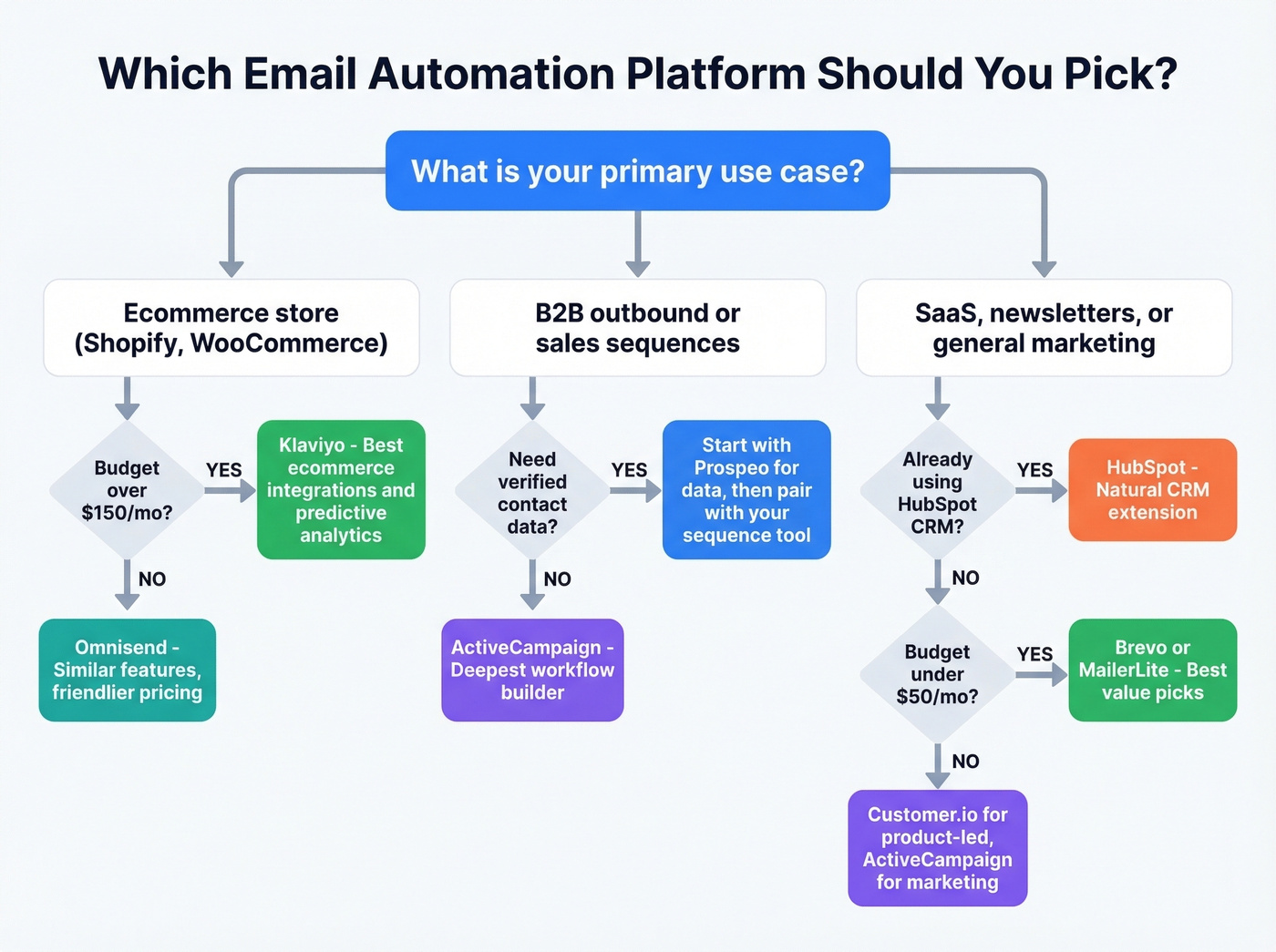
Selling products online? Klaviyo if you want the best ecommerce integrations and can stomach the pricing. Omnisend if you want 80% of the capability at a lower cost. The numbers back this up: abandoned cart flows generate $28.89 in revenue per recipient for the top 10% of performers, and browse abandonment adds another $7.21. These three workflows - abandoned cart, welcome series, and browse abandonment - account for 87% of all automation-driven orders.
Running B2B outbound? Pair Prospeo for verified data with ActiveCampaign or your sequencer of choice for the automation layer. In our experience, the data source matters more than the sending platform in outbound - a 98% accuracy rate means your sequences actually reach people. If you're building pipeline, borrow these sales prospecting techniques.
SMB that needs everything in one place? Brevo. Email, SMS, CRM, and automation for less than most tools charge for email alone.
Enterprise team already in HubSpot? Stay in HubSpot. The CRM integration value outweighs the pricing pain - just budget for it honestly.
SaaS with product-led growth? Customer.io. Event-driven automation based on in-app behavior is what you need, and most marketing platforms can't do it well.
Creator building an audience? Kit (formerly ConvertKit) deserves a look. It's free for up to 10,000 subscribers, with paid plans starting at $15/month for creators with fewer than 300 subscribers.
Our hot take: if your deals close under $15K, you probably don't need the most expensive platform on this list. You need one automation tool and one data source you trust. Not twelve tools from a listicle. Pick one from each column, integrate them properly, and focus on the workflows that drive revenue. Start with abandoned cart, welcome series, and browse abandonment - they account for the vast majority of automation-driven revenue.
FAQ
What's the difference between email marketing and email automation?
Email marketing is manually sending campaigns to a list - newsletters, promotions, announcements. Email automation uses behavioral triggers and conditional logic to send the right message at the right time without manual intervention. Most tools do both but are rarely equally strong at each.
Which platform has the best deliverability?
Klaviyo scores 5 stars in independent testing by EmailToolTester, the top performer. Omnisend follows at 4.5 stars, while Mailchimp scores worst at 3 stars. Your ESP only accounts for about 30% of deliverability - domain reputation and list hygiene matter more.
How much should I budget for email automation?
For under 5K contacts, expect $9-$100/mo depending on the platform and feature tier. At 10K contacts, budgets range from $18/mo (Brevo) to $335/mo (HubSpot Starter with contact add-ons). Always factor in contact-tier overages - they're the most common billing surprise.
Do I need a separate tool for email verification?
Yes, if you're doing outbound or your list includes contacts from lead magnets, events, or purchased data. A 5-step verification process that catches spam traps and honeypots removes bad addresses before they damage your sender reputation. At ~$0.01 per email, it's cheap insurance compared to a wrecked domain.
What's the best free email automation platform?
Brevo offers the most generous free tier - 300 emails per day to up to 100K contacts with basic automation. MailerLite's free plan covers 500 subscribers and 12K emails. Klaviyo's free tier is limited to 250 profiles but includes strong ecommerce workflows. For pure automation depth on free, Brevo wins.