

Best Lead Generation Software in 2026: 9 Tools That Actually Work
Dozens of lead generation tools are fighting for your budget right now. You need one, maybe two, plus an outreach layer. The problem isn't finding options - it's that 61% of marketers still say generating quality leads is their top challenge, even with all these tools available.
That stat hasn't budged in years, and the reason is simple: most teams pick tools based on feature lists and ignore the thing that actually matters - data quality. B2B contact records decay at roughly 30% per year. A third of your "verified" database is garbage by next January. You can have the slickest sequencing engine on the planet, but if you're feeding it stale emails and disconnected phone numbers, your pipeline math breaks before it starts.
We reviewed dozens of tools and narrowed to nine based on data quality, real-world user sentiment, pricing transparency, and integration depth. Here are the platforms worth your time - plus a framework for building a stack that doesn't collapse under its own weight.
Our Top Picks
| Tool | Best For | Starting Price |
|---|---|---|
| Prospeo | Data accuracy + freshness | Free; ~$0.01/email |
| Clay | Enrichment workflows | $134/mo |
| Apollo.io | All-in-one for SMBs | $59/mo |
| HubSpot | Inbound capture + CRM | $15/seat/mo |
| Hunter.io | Lightweight email finder | $49/mo |
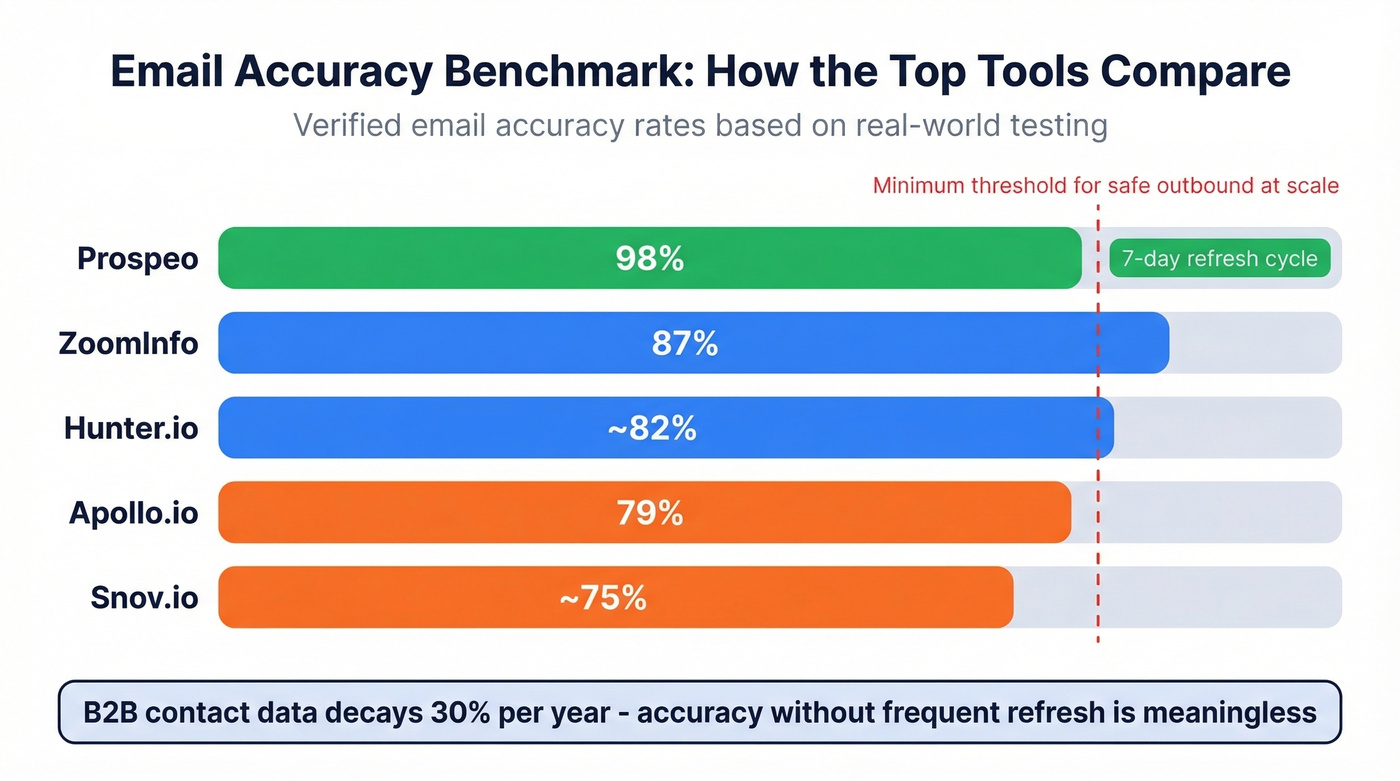
Prospeo wins on raw data quality - 98% email accuracy on a 7-day refresh cycle, compared to 87% at ZoomInfo and 79% at Apollo. Clay is the enrichment powerhouse for teams that want to waterfall across 50+ data sources. Apollo is the obvious starting point if you want database, sequencing, and CRM in one seat. HubSpot owns inbound capture. Hunter is the utility knife you keep in your back pocket.
What Lead Gen Software Means in 2026
Lead generation software isn't one tool. It's a stack with four layers. Capture gets leads into your system through forms, chatbots, and landing pages. Enrich makes those leads actionable with verified contact data, firmographics, and intent signals. Outreach actually reaches them across email, phone, and social. Measure tells you what worked.
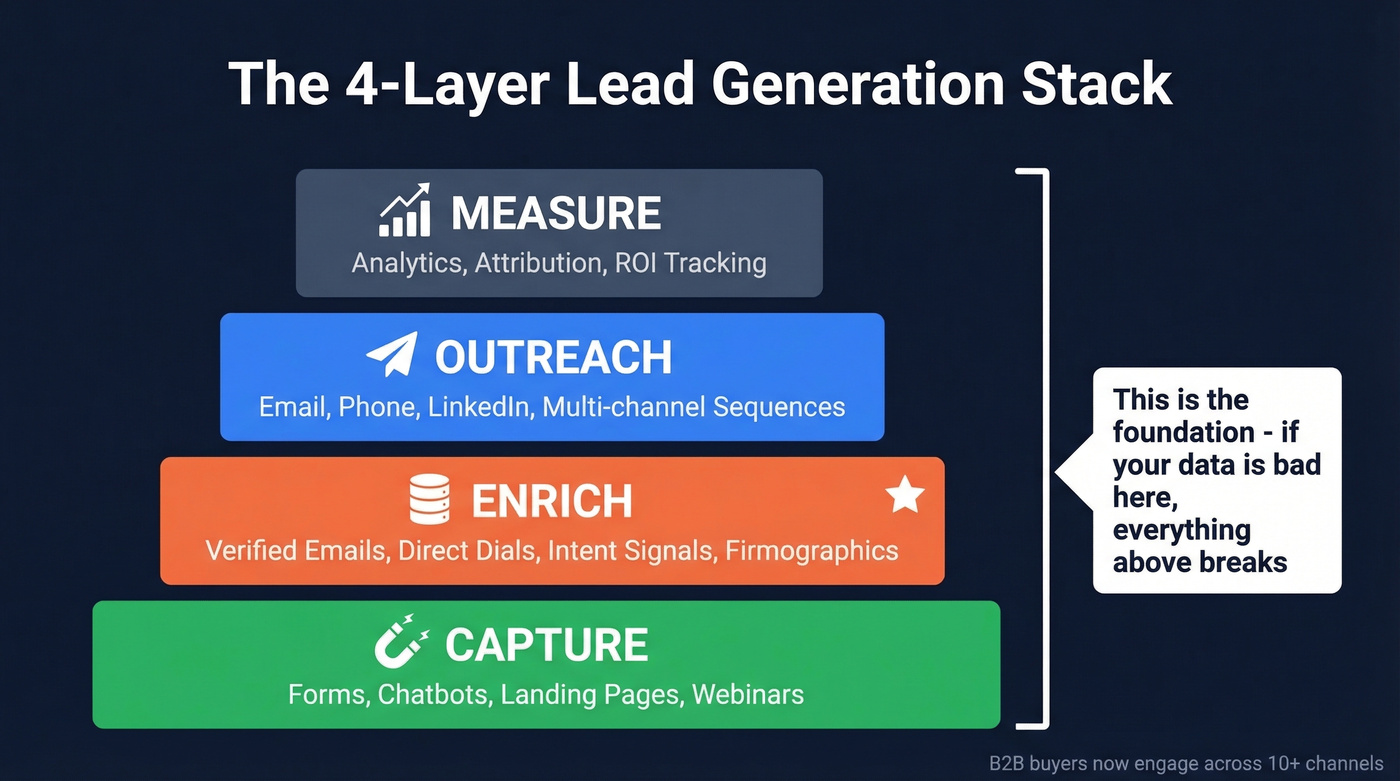
This matters more now because of channel sprawl. B2B buyers engage across an average of 10 channels - up from five in 2016. The market reflects this shift, growing from $7.4B in 2025 toward a projected $16.2B by 2034. Your tools need to feed a multi-channel motion, not just blast cold emails. That means the enrichment layer - verified emails, direct dials, intent signals, technographic data - is the foundation everything else sits on.
The channel data backs this up. 89% of B2B marketers already use LinkedIn, which drives 80% of B2B social media leads. Meanwhile, 73% of marketers say webinars produce their best quality leads. Your lead gen stack needs to support both warm inbound channels and cold outbound - which is why the enrichment layer matters so much. A webinar attendee is only valuable if you can match them to a verified email and phone number within hours, not weeks.
AI has made a measurable difference here, but narrowly. Businesses using AI for lead generation report 50% more sales-ready leads and up to 60% lower CAC. Companies deploying AI chatbots see a 64% increase in qualified leads, with real-time interaction boosting conversion by up to 20%. The real gains come from lead scoring, waterfall enrichment logic, and personalized sequencing - not from letting a chatbot write your entire outbound motion. The data still has to be clean first.
Here's the thing: if your deal size sits below $10k ACV, you probably don't need ZoomInfo-level data infrastructure. A focused two-tool stack with clean data will outperform a bloated five-tool enterprise suite every time.
How to Choose the Right Lead Generation Platform
Before you trial anything, get these non-negotiables straight.
Data Freshness Comes First
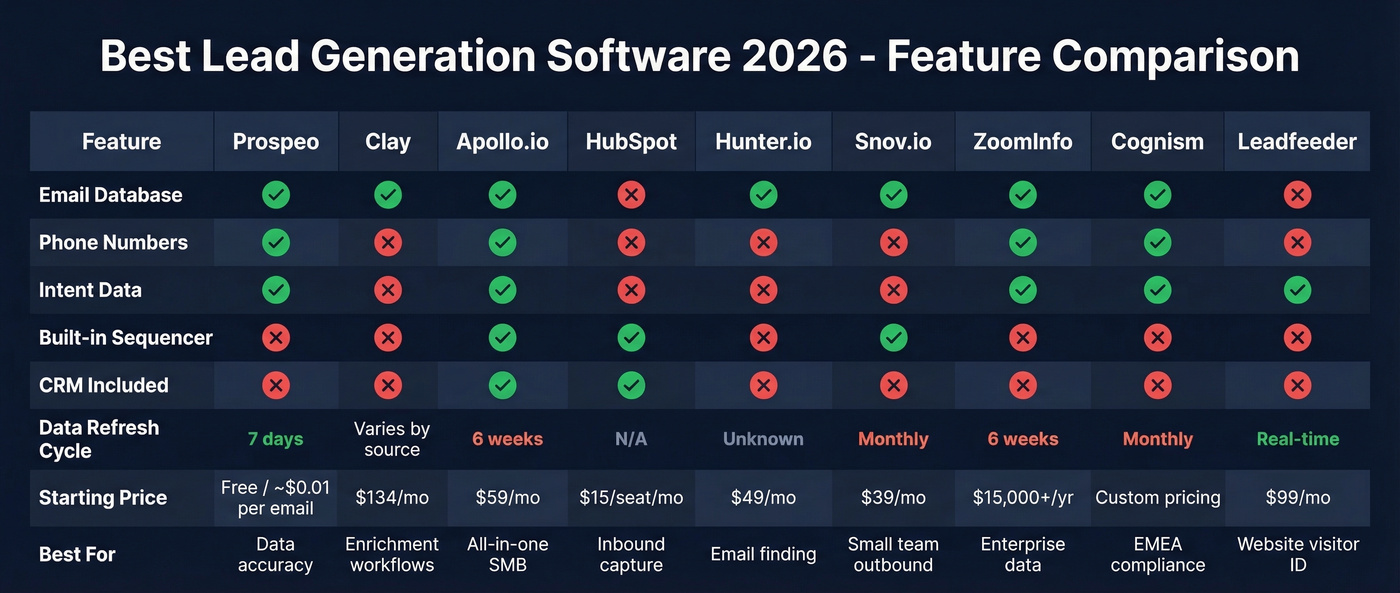
If a provider refreshes contacts monthly or quarterly, you're working with decaying data from day one. Look for weekly refresh cycles. The difference between a 7-day and a 6-week refresh shows up directly in bounce rates - and bounce rates compound into domain reputation damage that takes months to repair.
Run a 100-Lead Audit
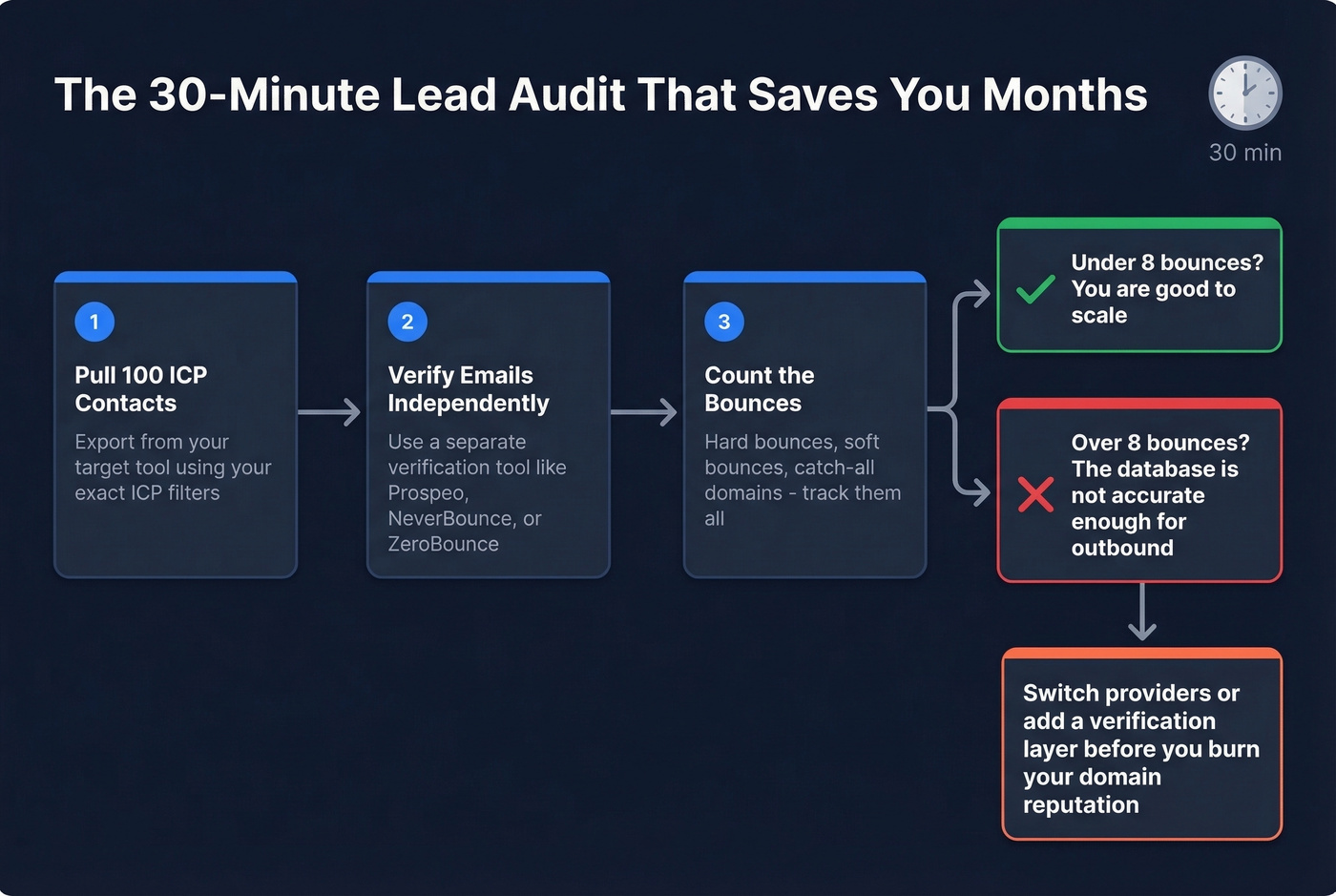
Pull 100 contacts from your ICP, export them, and verify the emails independently. If more than 8-10 bounce, the database isn't accurate enough for outbound at scale. This takes 30 minutes and saves you months of frustration.
Watch the Credit Math
Credit-based pricing sounds cheap until you realize a single enriched lead can cost 5-15 credits. At Clay's rates, that's $0.15-$1.12 per lead depending on how many data points you pull. Multiply that by your monthly volume and compare it to flat-rate alternatives.
Speed-to-lead matters more than feature count. The average conversion rate across B2B industries is just 2.9%. Every hour between a lead showing intent and your team reaching out erodes that number. Pick tools that get data into your outreach layer fast - native integrations with your sequencer and CRM aren't optional. (If you want a tighter process, map it to a lead generation workflow before you buy tools.)
Don't ignore compliance either. If you're selling into the EU or UK, your data provider needs to be compliant. Ask about opt-out enforcement and DPA availability before you sign.

You just read it: B2B contact data decays 30% per year. Most lead gen tools refresh every 6 weeks - Prospeo refreshes every 7 days. With 98% email accuracy and 300M+ verified profiles, teams book 26% more meetings than ZoomInfo users and 35% more than Apollo users.
Run that 100-lead audit against Prospeo's free tier and see for yourself.
The 9 Top Lead Gen Tools Reviewed
Prospeo - Best for Data Accuracy
Use this if you need the cleanest possible contact data as the foundation of your outbound stack. Prospeo's 300M+ professional profiles run through a 5-step verification process: 98% email accuracy, 143M+ verified emails, 125M+ verified mobile numbers with a 30% pickup rate, and a 7-day data refresh cycle versus the 6-week industry average.

The database includes 30+ search filters - buyer intent powered by Bombora across 15,000 topics, technographics, job changes, headcount growth, and funding signals. Teams using Prospeo book 26% more meetings than ZoomInfo users and 35% more than Apollo users.
Bad data breaks every downstream tool. Meritt switched to Prospeo and saw bounce rates drop from 35% to under 4%, with pipeline tripling from $100K to $300K per week. Snyk saw similar results across 50 AEs - bounce rates fell from 35-40% to under 5%, and AE-sourced pipeline jumped 180%.
Pricing is self-serve and transparent: ~$0.01 per email, free tier with 75 verified emails per month, no contracts. Native integrations with Salesforce, HubSpot, Smartlead, Instantly, Lemlist, Clay, Zapier, Make, and more.
Skip this if you need a built-in sequencer - pair it with Instantly or Lemlist for outreach. (If you're building the rest of the stack, start with these outbound lead generation tools.)
Clay - Best for Enrichment Workflows
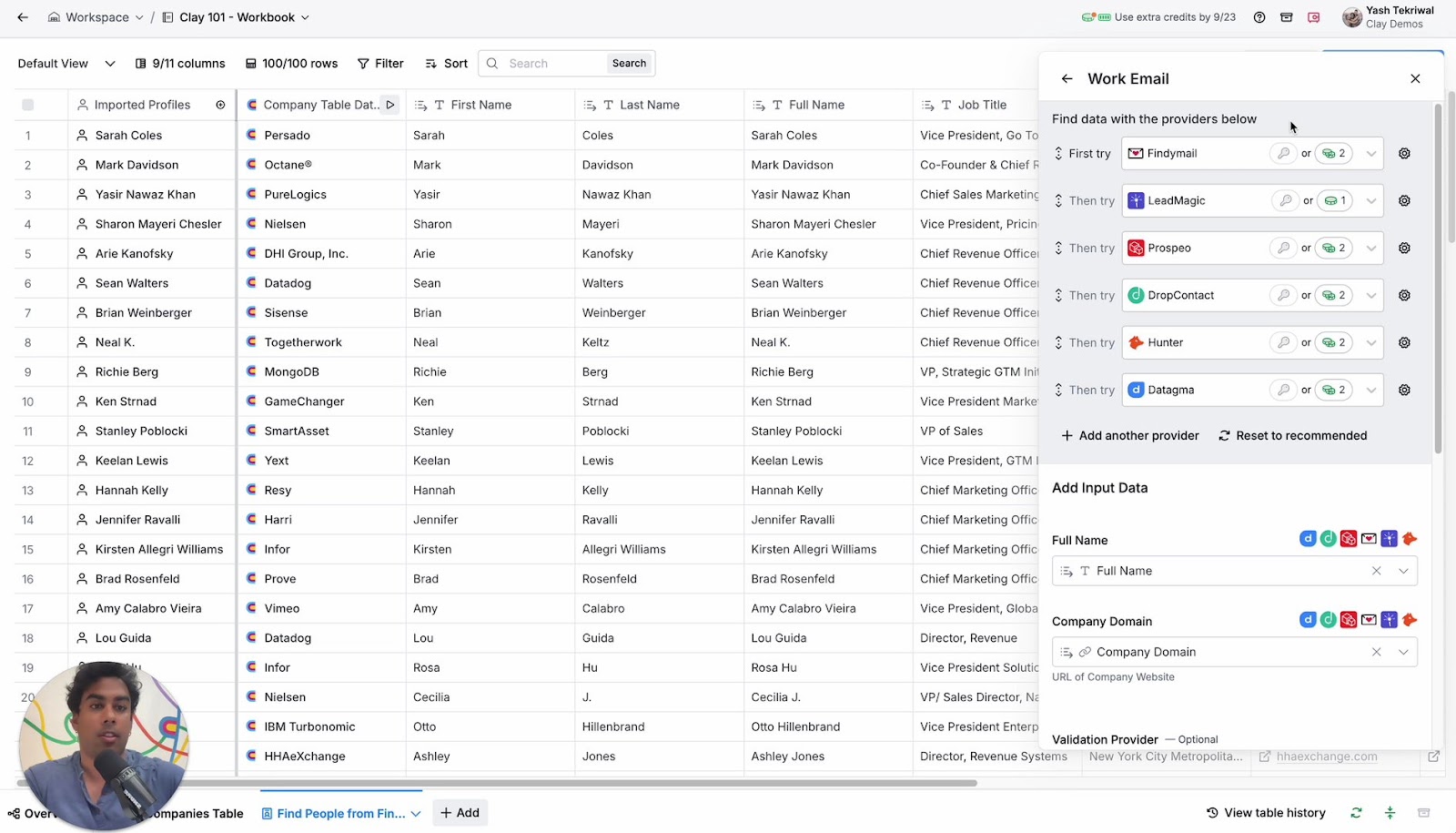
Clay's "smart spreadsheet" approach lets you waterfall across 50+ data sources - try Provider A, then B, then C for each contact - yielding 20-40% more data coverage than any single provider alone. On r/sales, Clay keeps coming up as a go-to enrichment tool, and the G2 rating of 4.9/5 across 200+ reviews is earned.
Let's talk credit math, because this is where teams get surprised.
| Plan | Monthly Cost | Credits | Cost per Enriched Lead |
|---|---|---|---|
| Free | $0 | 100 | - |
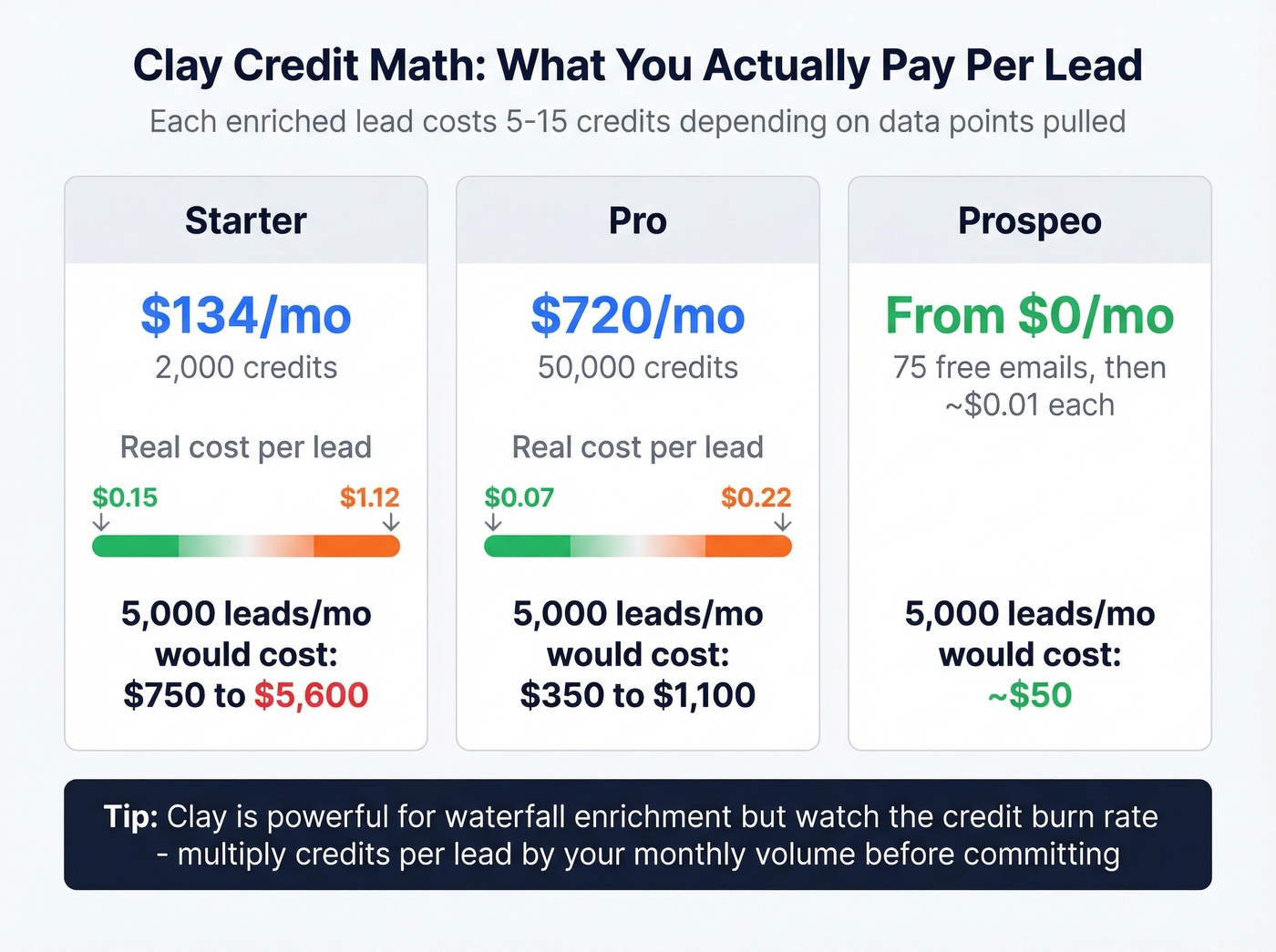
| Starter (annual) | $134 | 2,000 | $0.15-$1.12 |
| Pro (annual) | $720 | 50,000 | $0.07-$0.22 |
Each enriched lead costs 5-15 credits depending on data points. At Starter rates, your actual cost per lead lands between $0.15 and $1.12. A team enriching 5,000 leads per month could spend $750-$5,600 on credits alone. (For a deeper breakdown, see our guide to data enrichment services.)
Skip this if you want plug-and-play simplicity. Clay has a genuine learning curve - expect 2-3 weeks before your team is comfortable. And it doesn't include outreach, so you'll need a separate sending tool.
Apollo.io - Best All-in-One for SMBs
Apollo is the obvious starting point for most SMB teams. You get database, sequencing, and a lightweight CRM in one platform. Paid plans start at $59/mo (Basic), with Professional at $99 and Organization at $149. The free tier is generous enough to test the waters.
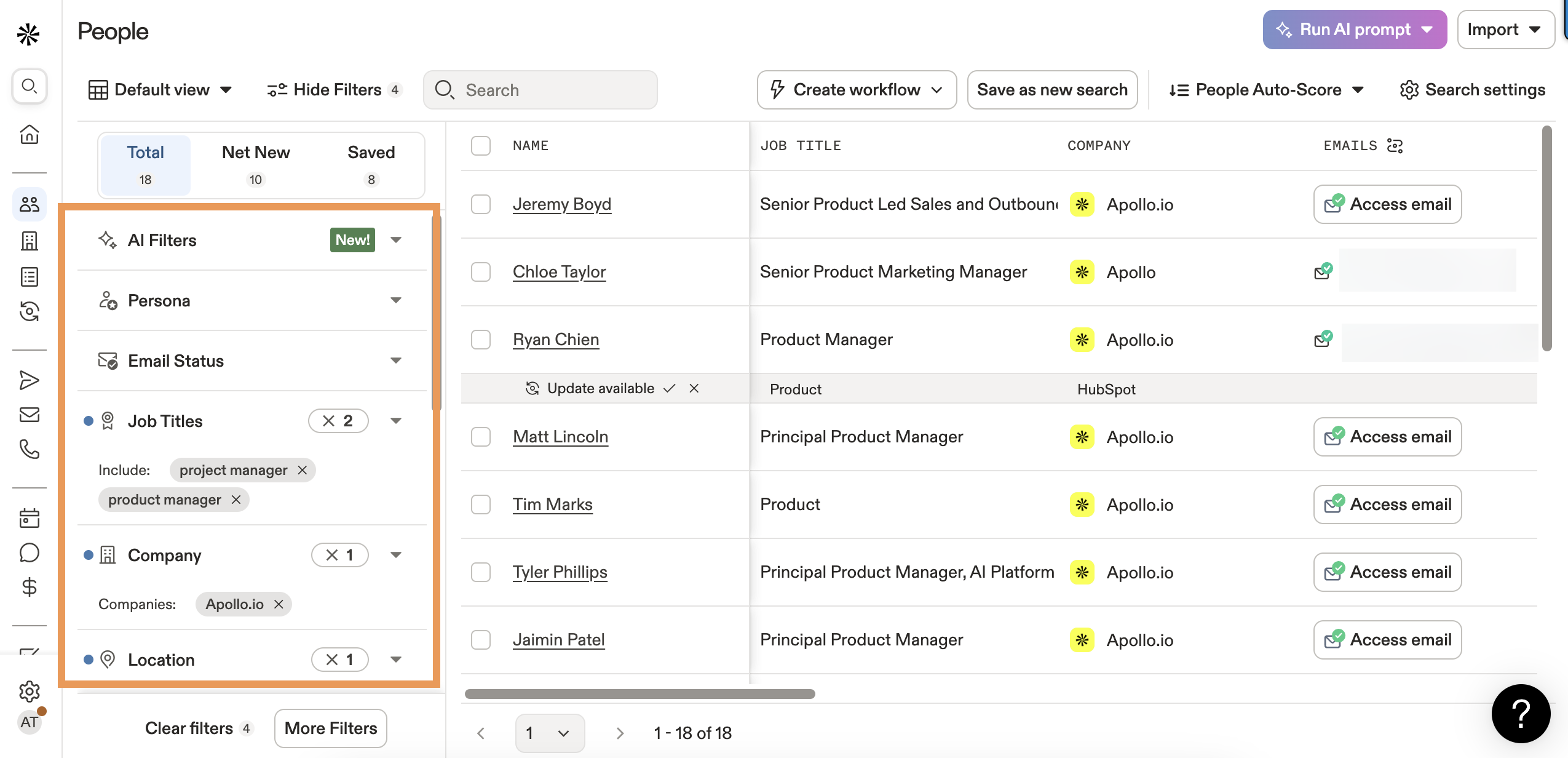
Here's the tradeoff. Community-reported email accuracy hovers around 65-70%, and the recurring complaint on Reddit is that the database feels outdated - especially for niche verticals and smaller companies. We've seen teams start at $59/mo and land at $150+ within a quarter as they add seats and hit credit ceilings.
Skip this if data accuracy is your top priority or you're targeting EMEA heavily. Apollo's strength is breadth and convenience, not precision. Pair it with a verification layer if bounce rates creep above 5%. (Benchmarks and fixes: email bounce rate.)
HubSpot - Best for Inbound Capture + CRM
HubSpot's inbound capture suite is best-in-class. Forms, landing pages, email marketing, and CRM all live in one ecosystem. Marketing Hub paid plans begin at $15/seat/mo, with higher tiers at roughly $90/seat/mo (Pro) and $150/seat/mo (Enterprise). If your lead gen motion is primarily inbound - content, SEO, webinars - HubSpot is the center of gravity everything else orbits.
The gap is outbound. There's no B2B contact database, no intent data layer, no direct dial coverage. Teams running outbound need to pair HubSpot with a data provider. The pricing also jumps significantly between tiers - that Starter plan and the Pro plan are very different products, and the feature gating between them catches teams off guard.
Hunter.io - Lightweight Email Finder
Hunter does one job well: finding email addresses at target companies. The domain search is excellent for identifying email patterns, and the starting price of $49/mo comes with rollover credits - a feature Reddit users consistently praise. It's the utility knife of email finding.
The limitations are real, though. You won't get phone numbers, intent data, or firmographic filters. Community sentiment suggests the finding rate has gotten worse lately, particularly for smaller domains. Think of Hunter as a complement to your primary data tool, not a replacement. (If you're comparing options, start with these Hunter alternatives.)
Snov.io - Small-Business Outbound
Snov.io bundles email warm-up, templates, and a contact database into a single platform starting at $39/mo (Starter) and $79/mo (Pro). For small teams who don't want to stitch together three separate tools, it's a compelling package with a database of 1.5B leads and 98% email verification accuracy.
The database skews toward volume over precision. Firmographic filtering is limited compared to enterprise-grade platforms, making Snov.io better suited for high-volume outreach to broad audiences than for surgical ABM targeting.
ZoomInfo - Enterprise Coverage
ZoomInfo has the deepest US firmographic database in the market. When you need enterprise-grade coverage - org charts, technographics, intent signals, and workflow automation across a large sales org - it's still the benchmark.
The #1 complaint on Reddit is price. A small-team contract runs $15k+/year, and a 10-seat deal with intent data and mobile numbers can hit $40-60k/year. Annual contracts with auto-renewal friction make it hard to leave. For most SMBs, you're paying for modules you'll never activate.
Instantly - Cold Email at Scale
Instantly isn't a database - it's a sending layer. The value is inbox scaling with unlimited email accounts, AI agents for automated follow-up sequences, and deliverability management. Pair it with a data provider for the contacts, then let Instantly handle the volume. Plans start around $30/mo for sending; their lead database add-on is separate. (If you're building sequences, use these sales follow-up templates as a baseline.)
Leadfeeder (Dealfront) - Website Visitor ID
Leadfeeder identifies anonymous companies visiting your website and surfaces them as actionable lead signals. It's GDPR-compliant with a European focus, making it a strong fit for EU-based teams. It's an inbound signal layer, not a contact database - pair it with an enrichment tool to get actual names and emails. Free plan available; paid starts around $99/mo.
Your lead gen stack is only as strong as your data layer. Prospeo gives you 30+ filters - intent data, technographics, job changes, funding - at $0.01 per email with no contracts. Stack Optimize built a $1M agency on it. Snyk scaled 50 AEs with under 5% bounce rates.
Stop paying enterprise prices for data that bounces - get 75 free verified emails now.
Pricing Comparison
The sticker price never tells the full story. Credit-based tools like Clay can look cheap until you multiply credits per lead by monthly volume. Flat-rate tools like Apollo look expensive until you realize you're getting sequencing and CRM included. Annual billing traps are another hidden cost - ZoomInfo's auto-renewal contracts and HubSpot's tier jumps mean your Year 2 spend can be dramatically higher than Year 1. Always calculate your true cost per enriched, contacted lead before committing.
| Tool | Best For | Starting Price | Model | Free Tier? |
|---|---|---|---|---|
| Prospeo | Data accuracy | ~$0.01/email | Credits | Yes (75 emails) |
| Clay | Enrichment | $134/mo | Credits | Yes (100 credits) |
| Apollo.io | SMB all-in-one | $59/mo | Per user | Yes (limited) |
| HubSpot | Inbound + CRM | $15/seat/mo | Per seat | Yes (CRM) |
| Hunter.io | Email finding | $49/mo | Credits (rollover) | Yes |
| Snov.io | Small biz outbound | $39/mo | Credits | Yes (limited) |
| ZoomInfo | Enterprise | ~$15k+/year | Annual contract | No |
| Instantly | Email sending | ~$30/mo | Subscription | No |
| Leadfeeder | Visitor ID | ~$99/mo | Subscription | Yes (limited) |
Recommended Stacks by Stage
The right stack depends on your team size and motion. Even the best lead generation software won't compensate for a mismatch between tool complexity and team capacity.
| Stage | Tools | Monthly Budget |
|---|---|---|
| Solo / early-stage | Data provider + Instantly or Lemlist + HubSpot free CRM | Under $100/mo |
| SMB (5-20 reps) | Data provider + Clay + HubSpot Pro or Pipedrive | $500-$1,500/mo |
| Mid-market (20+ reps) | Enterprise data + Clay + Salesforce + Outreach or Salesloft | $3,000-$8,000/mo |
Solo founder / early-stage: Start with a free data tier, add Instantly or Lemlist for outreach, and track deals in HubSpot's free CRM. Total cost: under $100/mo. This gets you verified contacts, automated sequences, and a place to track deals. Don't overcomplicate it.
SMB (5-20 reps): Layer Clay's enrichment workflows on top of your primary data provider, and run everything through HubSpot Pro or Pipedrive. Budget $500-$1,500/mo depending on volume. The combination of verified base data plus waterfall enrichment covers hard-to-reach contacts that no single database catches alone. In our experience, this is the sweet spot where most teams see the biggest jump in pipeline per dollar spent.
Mid-market (20+ reps): At this stage, integration quality matters more than any single tool's feature list. Pair your primary data source with Clay for enrichment, Salesforce for CRM, and Outreach or Salesloft for sequencing. Budget $3,000-$8,000/mo. We've seen mid-market teams waste months trying to force a cheap SMB stack to scale - it's almost always cheaper to invest in proper integrations upfront than to untangle a duct-taped workflow six months later.
For context on what these stacks should produce: the average B2B conversion rate is 2.9%, with form rates at 1.7% and call rates at 1.2%. On the cost side, SEO leads average $31 CPL, email $53, and webinars $72. If your stack is pushing CPL significantly above those benchmarks, something in the funnel is broken. (More benchmarks here: average B2B lead conversion rate.)
Mistakes That Kill Your Lead Gen
Vague ICP definition. One study found that narrowing ICP increased lead-to-opportunity conversion by 45%. If you can't describe your ideal customer in two sentences, you're not ready to buy a tool. (Use an ideal customer profile template to lock it in.)
Prioritizing volume over verification. Sending 10,000 unverified emails doesn't make you productive - it makes you a spammer. Deliverability damage takes months to repair, and the cost of rebuilding domain reputation dwarfs whatever you saved on a cheaper data provider.
Relying on purchased or stale lists. Third-party lists decay fast and carry compliance risk. Build your own lists with fresh data. A database that refreshes quarterly can be meaningfully stale by the time you use it - ask every vendor about their refresh cycle before you sign. (Related: Is It Illegal to Buy Email Lists?.)
Over-automating initial outreach. AI-generated first touches that read like AI-generated first touches get deleted. Automate follow-ups, not first impressions.
High-friction capture forms. Name and email. That's it for the first touch. Progressive profiling handles the rest. Every additional field drops conversion.
Buying five tools before defining ICP. We've seen this pattern repeatedly - teams stack tools hoping the technology will compensate for unclear targeting. It won't. Start with one data provider and one outreach tool, then add complexity as your motion matures.
FAQ
What's the difference between lead generation and lead capture software?
Lead generation software finds and qualifies prospects through databases, enrichment, and intent signals - it's outbound by nature. Lead capture software converts existing website traffic into leads through forms, chatbots, and landing pages. Most B2B teams need both: a data tool for outbound and a capture tool like HubSpot for inbound.
How much does lead generation software typically cost?
Lightweight email finders start around $39-$49/month. Full databases like Apollo run $59-$149/month per user. Enterprise platforms like ZoomInfo cost $15k+/year. Credit-based enrichment tools like Clay range from free to $720/month depending on volume. Budget $100-$500/mo for a functional SMB stack.
Which lead gen tool has the most accurate data?
Prospeo delivers 98% verified email accuracy with a 7-day refresh cycle - the highest in the category. ZoomInfo sits at 87% and Apollo at 79% in the same benchmarks. Always run a 100-lead test against your specific ICP before committing to any provider.
Do I need multiple lead generation tools?
Usually yes - most teams need a data/enrichment layer, a capture surface, and an outreach or CRM tool at minimum. The mistake is buying five tools before defining your ICP. Start with one data provider and one outreach tool, then add complexity as your motion matures.
Is AI actually useful in lead generation?
AI delivers measurable gains in lead scoring, enrichment waterfall logic, and personalized sequencing. Businesses using AI for lead gen report up to 50% more sales-ready leads and 60% lower CAC. The risk is over-automating outreach before your data is clean - AI amplifies bad data just as effectively as good data.