

The Best Prospecting Email Ever Written (And the System That Makes It Work)
You downloaded nine templates, swapped in your company name, and hit send on 500 emails. Four replies. Two were "please remove me." Sound familiar?
The problem isn't your writing. It's that templates are built for the sender, not the recipient - and 65% of decision-makers delete cold emails specifically because they're too sales-focused. Another 69% say AI-generated emails bother them unless they feel genuinely human. If you want to write the best prospecting email ever, you need a system, not a swipe file.
Why Your "Proven Template" Isn't Working
The average cold email reply rate in 2026 is 3.43%. Elite senders exceed 10%. That's a 3x gap, and it isn't explained by better subject lines or fancier merge tags.
The vibe on r/coldemail is blunt: most of what worked last year doesn't work the same way now. Inbox saturation punishes long intros, company-pitch paragraphs, and overly formal openers. What's left is a narrower path - shorter, sharper, more human - and it requires discipline, not a swipe file.
What You Actually Need
Three things. That's it.
One email, roughly 47 words, value-first. Not nine templates. One tight message built on a real observation about the recipient's business.
Infrastructure before copy. Bounce rate under 2%, no open tracking, verified list, custom sending domain. Bad plumbing kills good writing every time. (If you want the full deliverability checklist, see our Email Deliverability Guide.)
Follow up 3-5 times. 42% of replies come from emails 2+. A single send leaves nearly half your results on the table.
The Email, Annotated
Here's the structure that's working in 2026. Five parts, about 47 words, about 90 seconds to write once you've done your research.
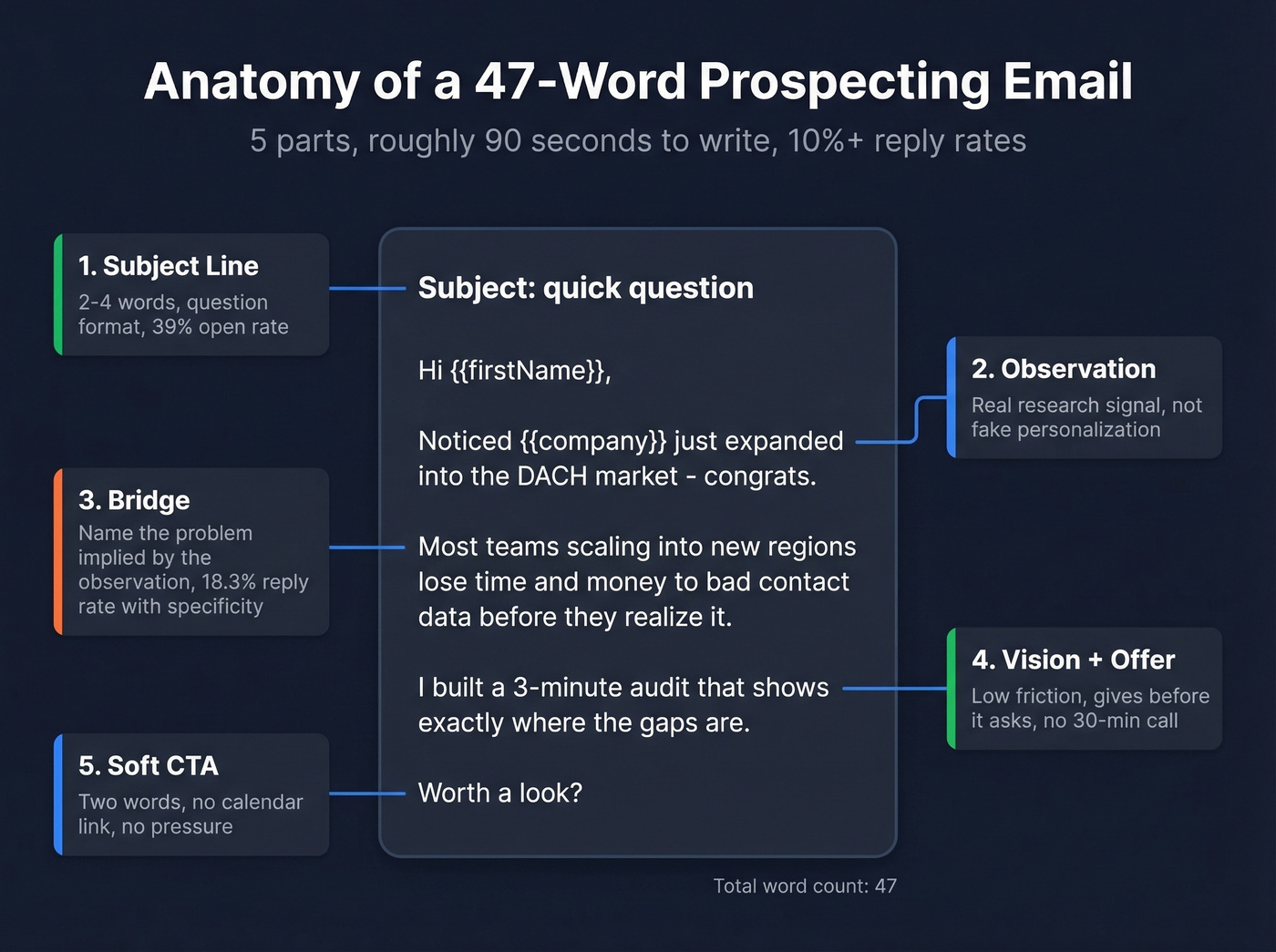
Subject: quick question
Hi {{firstName}},
Noticed {{company}} just expanded into the DACH market - congrats.
Most teams scaling into new regions lose time and money to bad contact data before they realize it.
I built a 3-minute audit that shows exactly where the gaps are.
Worth a look?
Let's break down why each line earns the next.
Line 1 - Observation. "Noticed {{company}} just expanded into the DACH market." This isn't name-dropping personalization. It's a signal you did actual research, and it earns the reader's attention for the next sentence. (More on this style of relevance-first messaging: Personalized Outreach.)
Line 2 - Bridge. "Most teams scaling into new regions..." You're naming a problem implied by the observation - a pattern you've seen, not an accusation. This kind of specificity is what separates 18.3% reply rates from 2.1%, based on a Warmer AI study of 2,847 emails.
Line 3 - Vision + Offer. "I built a 3-minute audit..." Low-friction, specific, gives before it asks. No "30-minute discovery call." (If you need stronger asks without sounding pushy, use these email call to action rules.)
Line 4 - Soft CTA. "Worth a look?" Two words. No calendar link, no pressure. Soft asks consistently outperform hard meeting requests.
One practitioner documented cutting from 141 words to under 56 and watching reply rates double from 3% to 6%. The 40-60 word range is the sweet spot right now.

Your 47-word email is only as good as the address it lands in. Prospeo's 98% email accuracy and 7-day data refresh mean sub-2% bounce rates - the exact infrastructure threshold this article recommends.
Meritt dropped bounces from 35% to under 4%. Your turn.
Data Behind Every Line
| Lever | What Works | Source |
|---|---|---|
| Subject line | 2-4 words, question-framed | Belkins (5.5M emails) |
| Email length | <60 words, 3-4 sentences | Instantly 2026 benchmark |
| Personalization | Specific business challenge | Warmer AI study (2,847 emails) |
| Target seniority | Directors (17.8% reply) | Warmer AI |
| Segment size | 21-50 recipients = 6.2% reply | Hunter (31M emails) |
| CTA | Soft ask ("Worth a look?") | Practitioner consensus |
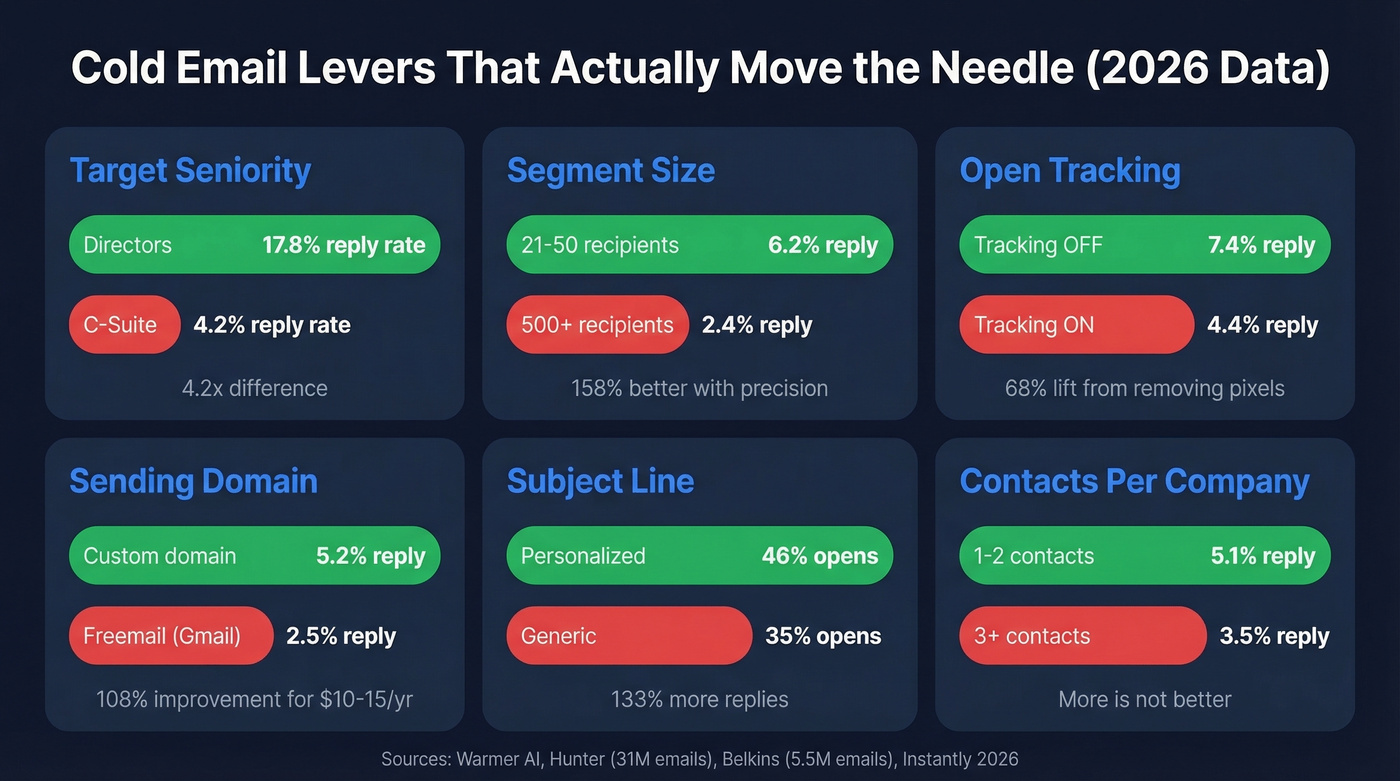
The subject line "Quick question" pulled 39% opens in one practitioner's campaigns. "Partnership opportunity" dropped below 19%. Personalized subject lines hit 46% open rates vs 35% without, and reply rates jump from 3% to 7% - a 133% increase from changing a handful of words. (If you want more options, pull from these cold email subject line examples.)
Here's the thing most cold email advice won't give you: targeting matters more than copywriting. Directors respond at 17.8% while C-suite sits at 4.2%. Small, tight segments of 21-50 recipients pull 6.2% reply rates vs 2.4% for lists of 500+. The "spray and pray" approach mathematically underperforms by 158%. In our experience, targeting directors over C-suite is the single most underrated lever in cold email - and the one most teams ignore because it feels counterintuitive. (To systematize this, start with an Ideal Customer Profile.)
Emailing 1-2 contacts per company yields 5.1% reply rates vs 3.5% for 3+ contacts. More isn't better. Precision is.
Infrastructure Nobody Talks About
You can write the best prospecting email ever and still get a 1% reply rate if your infrastructure is broken. This is the part nobody wants to hear, but it's where we've seen the biggest gains in real campaigns. (If you're diagnosing issues, start with email bounce rate benchmarks and codes.)
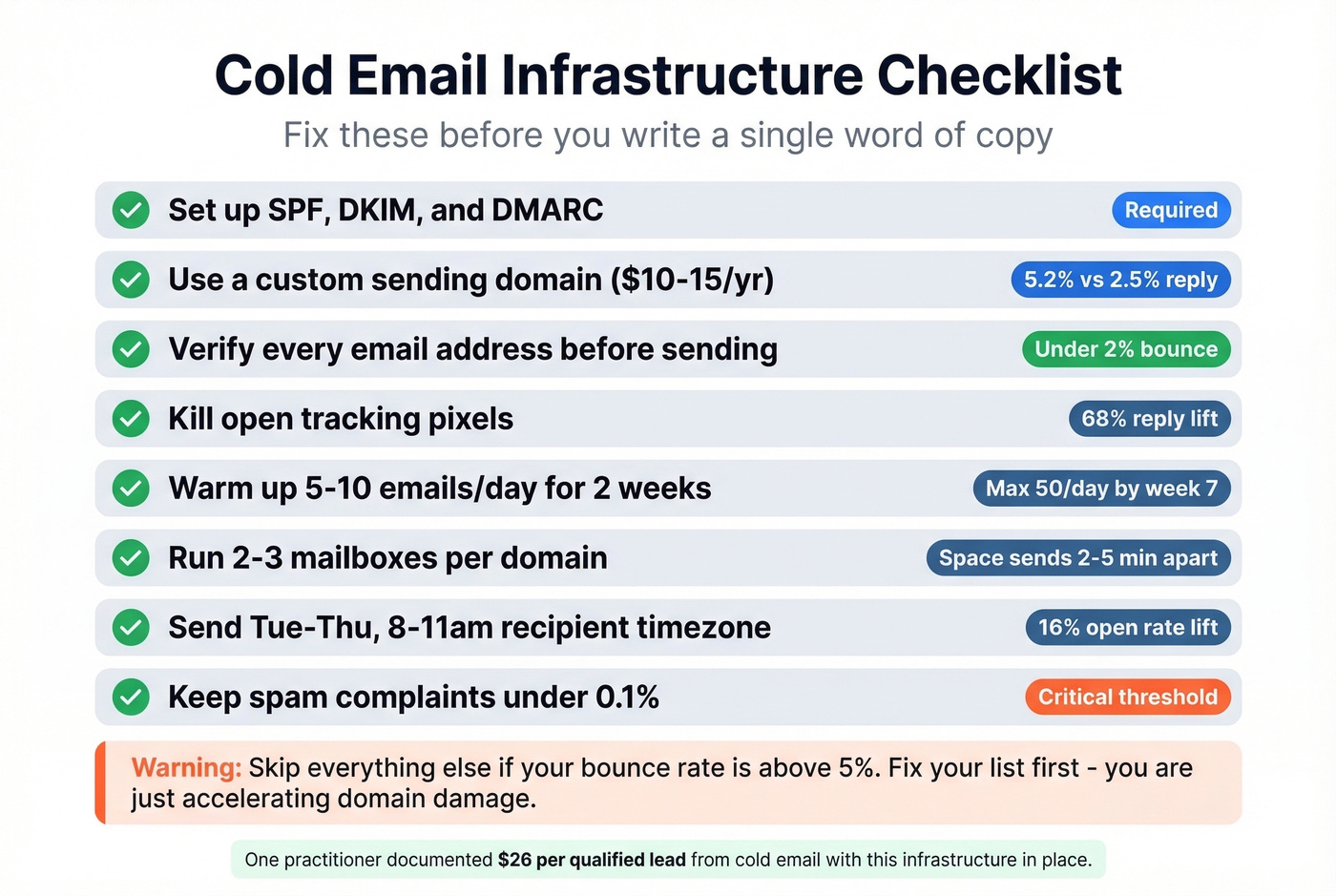
Kill open tracking. Campaigns without open tracking see 7.4% reply rates vs 4.4% with tracking - a 68% lift. Tracking pixels hurt deliverability. The data isn't worth it. (If you still need to understand the mechanics, read our guide to the email tracking pixel.)
Use a custom sending domain. Custom domains pull 5.2% reply rates vs 2.5% for freemail - a 108% improvement for around $10-15/year.
Warm up gradually: 5-10 emails/day for weeks 1-2, scaling to max 50/day per inbox by week 7+. At full capacity, split roughly 25 warm-up and 25 cold per inbox. Run 2-3 mailboxes per domain, space sends 2-5 minutes apart, and keep first touches plain text - no links, no images, no attachments. Set up SPF, DKIM, and DMARC. Keep spam complaints under 0.1%. (For safe sending limits, use this email velocity guide.)
Send Tue-Thu, 8-11am in the recipient's timezone. One practitioner saw a 16% open rate lift from timing alone. (More data here: best time to send cold emails.)
Get your bounce rate under 2%. One case study showed bounce dropping from 11% to under 2% while reply rate doubled from 3% to 6%. Prospeo's email verification runs 98% accuracy with a 7-day data refresh cycle, so you're not sending to stale addresses that tank your domain reputation. Their customer Meritt dropped bounce rates from 35% to under 4% and tripled their connect rate to 20-25%. Bad data wrecks campaigns faster than bad copy, and it's the easiest problem to fix.
One practitioner documented $420/month in total tooling costs generating 16 qualified leads - roughly $26 per qualified lead from cold email. That's hard to beat in any channel.
The Follow-Up Sequence
58% of replies come from email #1, but that means 42% come from follow-ups. Sending 3 messages instead of 1 increases replies by 106%. Here's the structure we've tested and refined:
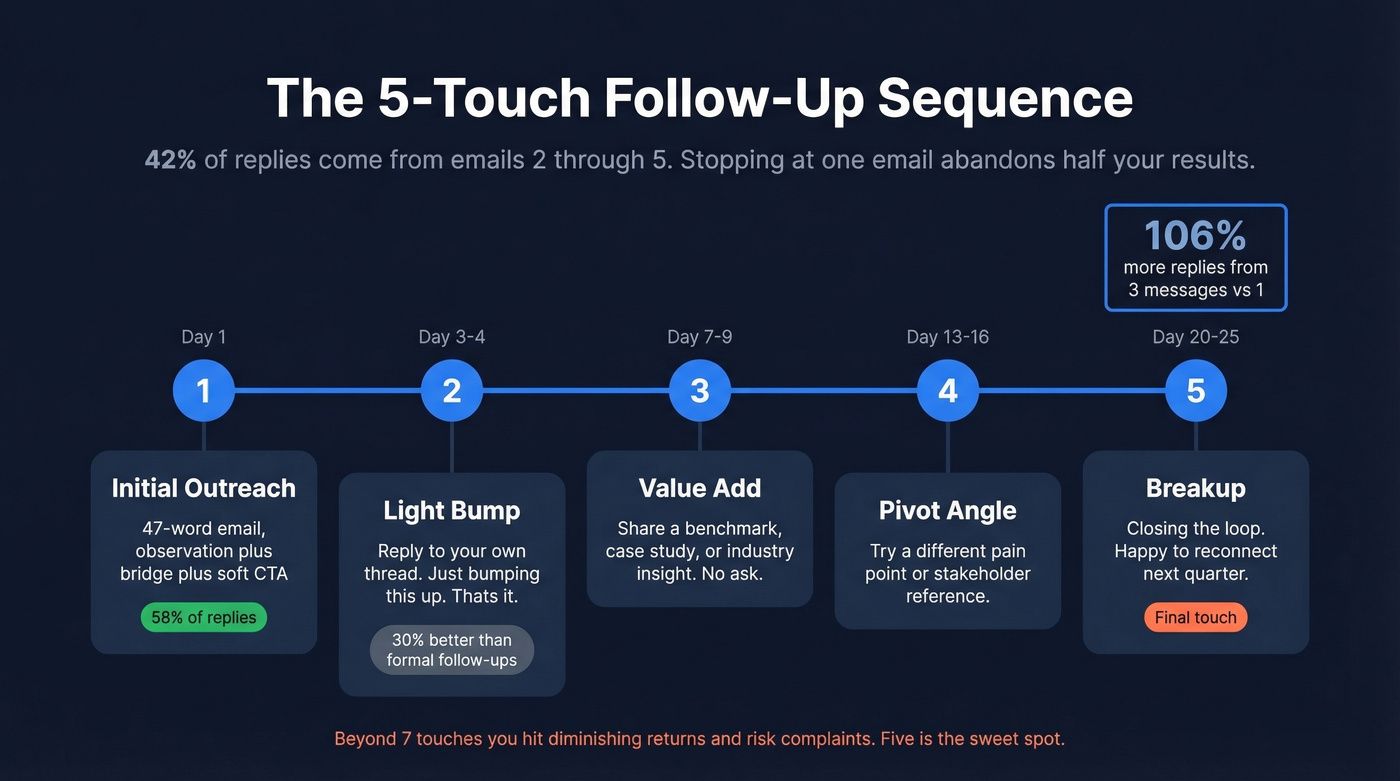
- Day 1 - Initial outreach. The email above.
- Day 3-4 - Light bump. Reply to your own thread: "Hey {{firstName}}, just bumping this up." That's it. Reply-style follow-ups outperform formal ones by roughly 30%. (More options: cold email follow-up templates.)
- Day 7-9 - Value-add. Share something useful - a relevant benchmark, a case study, a quick industry insight. No ask.
- Day 13-16 - Pivot angle. Try a different pain point or stakeholder reference.
- Day 20-25 - Breakup. "Closing the loop. If timing's off, happy to reconnect next quarter."
We've tested sequences from 3 to 9 touches. Five is the sweet spot. Beyond 7, you hit diminishing returns and risk complaints. But stopping at one email? That's abandoning half your results.
Skip the follow-up sequence entirely if your bounce rate is above 5%. Fix your list first - otherwise you're just accelerating domain damage.
Targeting directors over C-suite is the biggest reply-rate lever in cold email. Prospeo's 30+ filters let you pinpoint directors by department, headcount growth, buyer intent, and tech stack - then deliver verified emails at $0.01 each.
Build a 21-50 person segment in under two minutes.
FAQ
How Long Should a Prospecting Email Be?
Under 60 words. Instantly's 2026 benchmark shows top performers stay under 80 words, and practitioners consistently land in the 40-60 range - three to four sentences max. Longer emails signal "mass blast" to recipients and tank reply rates.
What Reply Rate Should I Expect?
The 2026 average sits around 3.43% to 4.5% depending on the dataset. Top-quartile senders hit 5.5%+, and elite performers exceed 10%. If you're below 3%, fix your infrastructure - bounce rate, domain reputation, sending volume - before rewriting copy.
How Do I Reduce Bounce Rate?
Verify every email address before it enters your sequence and target under 2% bounce. A 5-step verification process with catch-all handling and spam-trap removal catches stale addresses that simpler tools miss. Snyk cut bounce from 35-40% to under 5% across 50 AEs after switching their verification workflow.
What's the Best Cold Email Subject Line?
Keep it 2-4 words and frame it as a question. "Quick question" consistently pulled 39% open rates in practitioner campaigns. Personalized subject lines with the recipient's company name hit 46% opens vs 35% without. Avoid anything that reads like marketing copy - "ASAP," "exclusive offer," and "Hello, friend" all drag opens below 36%.