

The Best Sales Process for B2B in 2026: Stages, Benchmarks, and What Moves Win Rates
Up to 70% of reps missed quota in recent years, with average attainment hovering around 43%. Meanwhile, 86% of B2B purchases stall and 81% of buyers end up dissatisfied with the vendor they chose.
The problem isn't effort. It's process.
Most teams are running a pipeline built on stale data, the wrong qualification framework, and zero benchmarks to diagnose where deals actually die. We've watched this pattern repeat across hundreds of sales orgs, and the fix is almost always structural - not motivational. Here's what a best-in-class B2B sales process actually looks like, with the numbers to back it up.
The Short Version
Fix three things and you'll outperform most competitors:
- A 7-stage process with clear exit criteria - defined gates that prevent bad deals from consuming rep time.
- Stage-by-stage conversion benchmarks - so you know whether your MQL-to-SQL drop-off is a five-alarm fire or just Tuesday.
- The right qualification framework for your deal size - BANT and MEDDPICC aren't interchangeable.
One stat worth anchoring on: on deals over $50k, multi-threading boosts win rates by 130%. If you change nothing else, fix your data quality at stage 1 and multi-thread every deal worth winning.
The 7-Stage B2B Sales Process
Buyers define their purchase requirements 83% of the time before they talk to a rep. 94% now use LLMs during their buying process, which means they arrive at conversations more informed - and more opinionated - than ever.
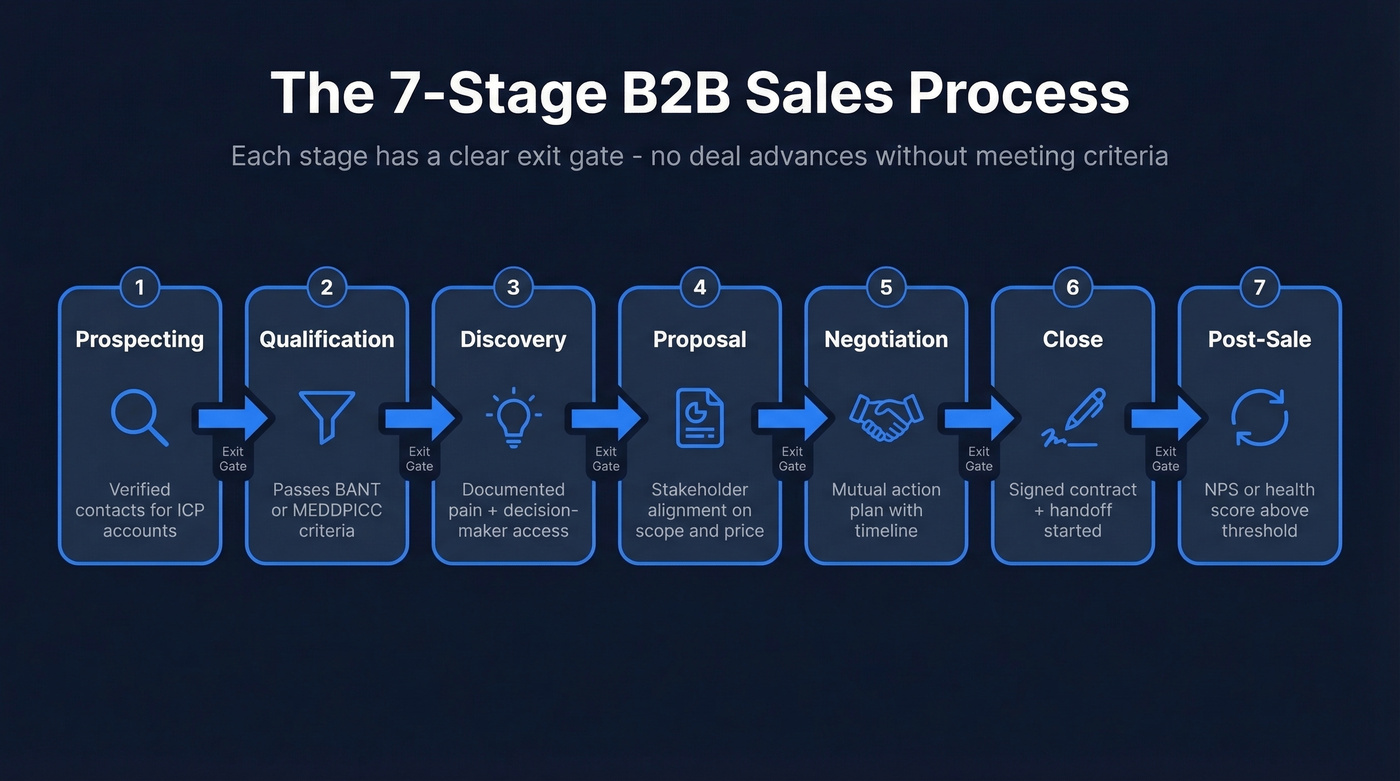
Your process needs to account for that reality. Here's the framework we recommend:
| Stage | Goal | Exit Criterion |
|---|---|---|
| Prospecting | Build qualified target list | Verified contact data for ICP-fit accounts |
| Qualification | Confirm fit + buying signals | Passes framework criteria (BANT/MEDDPICC) |
| Discovery | Map pain, stakeholders, timeline | Documented pain + access to decision-maker |
| Proposal | Present solution tied to pain | Stakeholder alignment on scope + pricing |
| Negotiation | Resolve objections + terms | Mutual action plan with timeline |
| Close | Get the signature | Signed contract + handoff initiated |
| Post-Sale | Onboard, expand, renew | NPS/health score above threshold |
The prospecting stage fails silently. Contact data decays 30% per year - people change jobs, emails go dead, phone numbers get reassigned. If reps are sending sequences to dead addresses, nothing downstream matters. Tools like Prospeo, which refresh data on a 7-day cycle, catch that decay before it tanks your outreach.
Benchmarks - What Good Looks Like
Without benchmarks, you're guessing. Here's what a healthy B2B funnel looks like, based on aggregate data across industries:
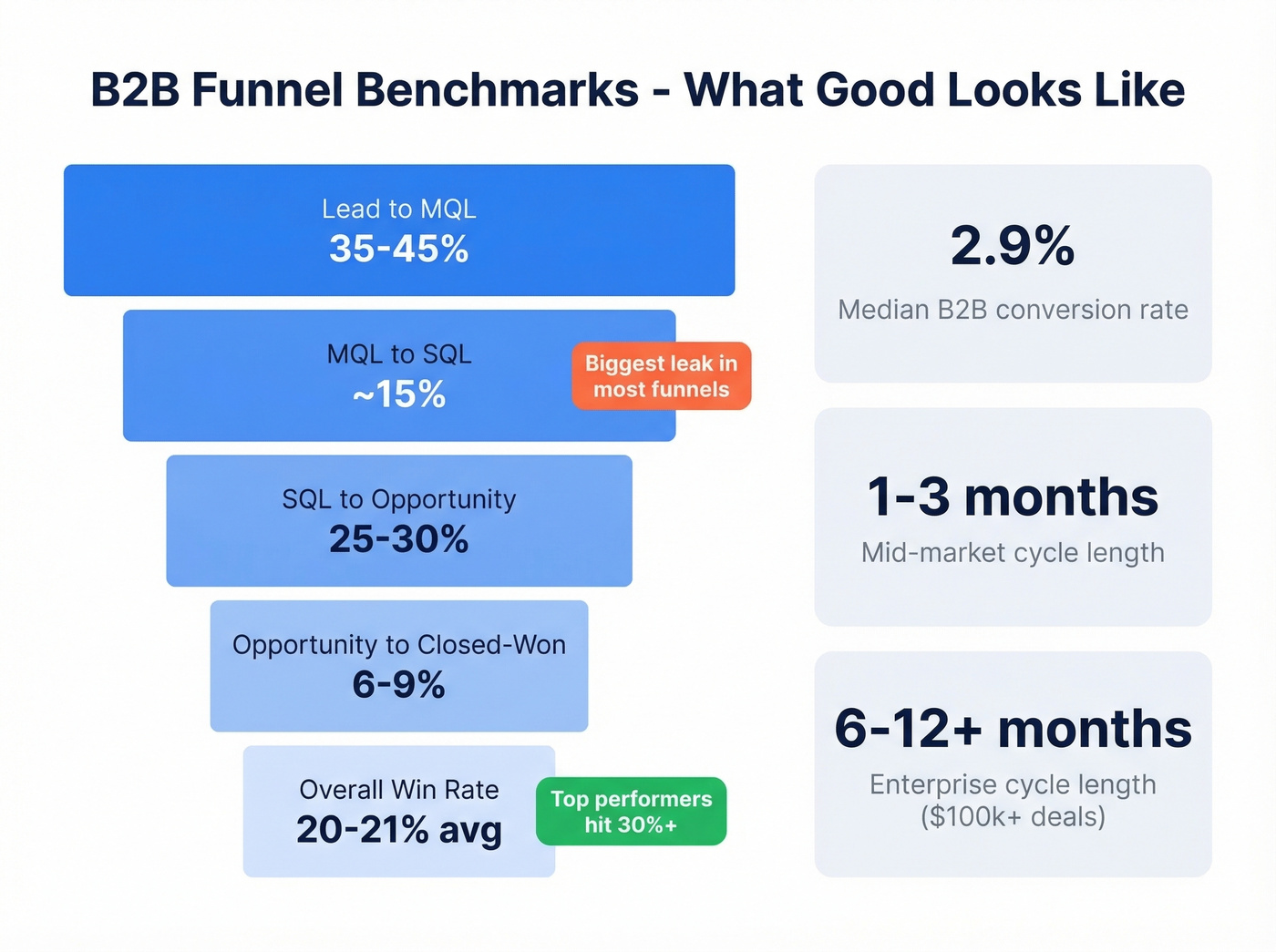
| Stage | Benchmark | Notes |
|---|---|---|
| Lead to MQL | 35-45% | Content + intent signals drive this |
| MQL to SQL | ~15% | Biggest leak in most funnels |
| SQL to Opportunity | 25-30% | Discovery quality matters here |
| Opp to Closed-Won | 6-9% | Multi-threading is the lever |
| Win Rate | 20-21% avg | Top performers hit 30%+ |
The median B2B conversion rate sits at 2.9%. In SaaS, expect anywhere from 1.1% to 7.0% depending on your sales model and average deal size. Cycle length scales accordingly: 1-3 months for mid-market, 6-12+ months for deals over $100k.
That MQL-to-SQL conversion at ~15% is where most teams hemorrhage pipeline. In our experience, this is where you discover that marketing's definition of "qualified" doesn't match sales reality. If your MQL-to-SQL rate is consistently above 25%, it usually means the MQL bar is set too high and you're under-counting demand. Counterintuitive, but we've seen it over and over.

That MQL-to-SQL leak? It often starts with bad contact data. Prospeo gives your reps 300M+ verified profiles with 98% email accuracy and a 7-day refresh cycle - so pipeline doesn't die at prospecting.
Stop feeding dead data into a process you spent months building.
Choose Your Qualification Framework
Here's the thing: the framework you pick matters less than whether you actually enforce it. That said, using BANT on a $200k enterprise deal is like bringing a checklist to a chess match.
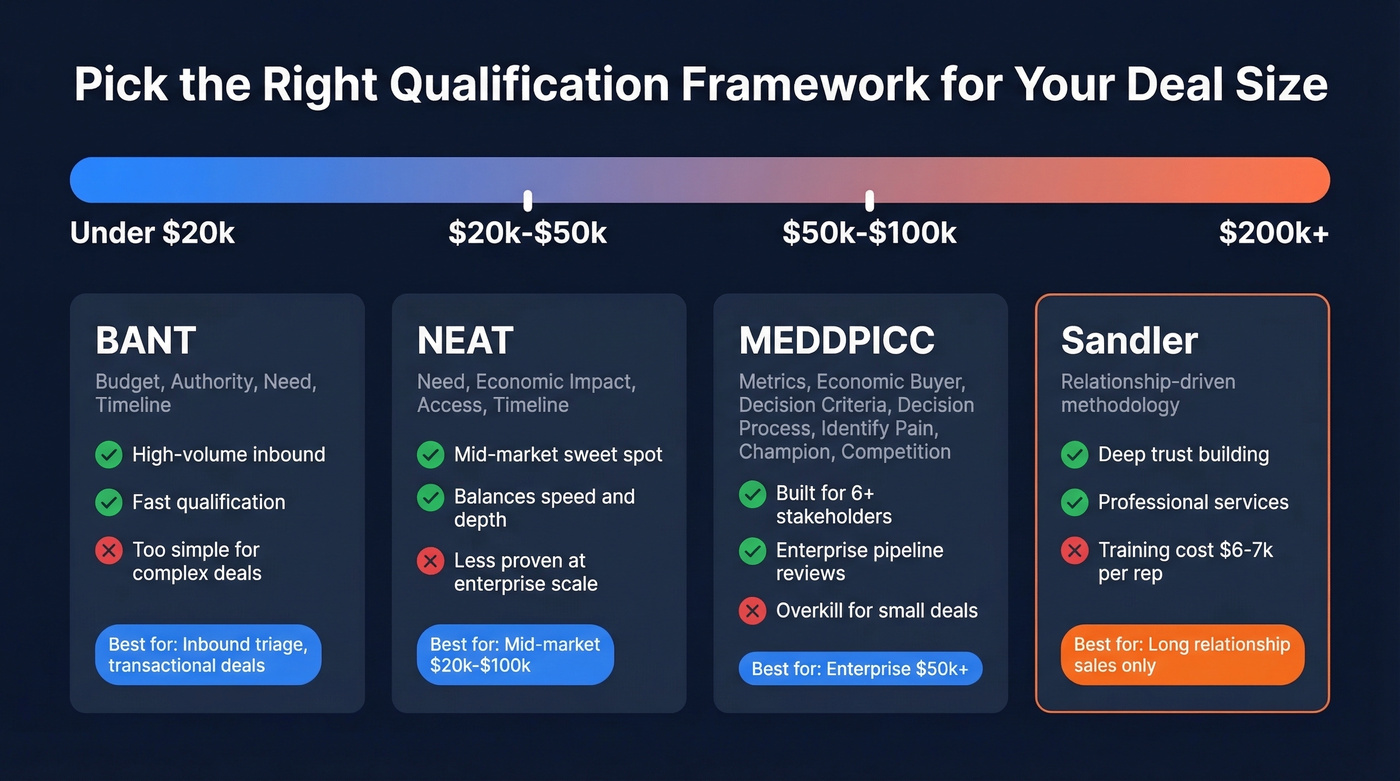
| Framework | Best For | Weak Spot |
|---|---|---|
| BANT | High-volume inbound, deals <$20k | Too simple for complex buys |
| MEDDPICC | Enterprise deals >$50k, 6+ stakeholders | Overkill for transactional sales |
| Sandler | Relationship-heavy services | Training cost ~$6-7k/rep |
| NEAT | Mid-market $20k-$100k | Less proven at enterprise scale |
Ask most sales leaders which framework they actually use, and the answer is almost always "a hybrid" - MEDDPICC for enterprise pipeline reviews, BANT for inbound triage, and gut instinct for everything in between. The consensus on r/sales backs this up: rigid framework adherence matters less than consistent stage reviews with documented criteria. Skip Sandler unless you're selling professional services with 12+ month relationships. The $6-7k per rep training cost doesn't pay back on transactional deals.
What Actually Moves Win Rates
Multi-thread every deal worth winning
An analysis of 1.8M opportunities found that closed-won deals have 2x as many buyer contacts as lost deals. For deals over $50k, multi-threading boosts win rates by 130%. We've seen teams lose six-figure deals because they were single-threaded on a champion who changed roles mid-cycle. Don't be that team.
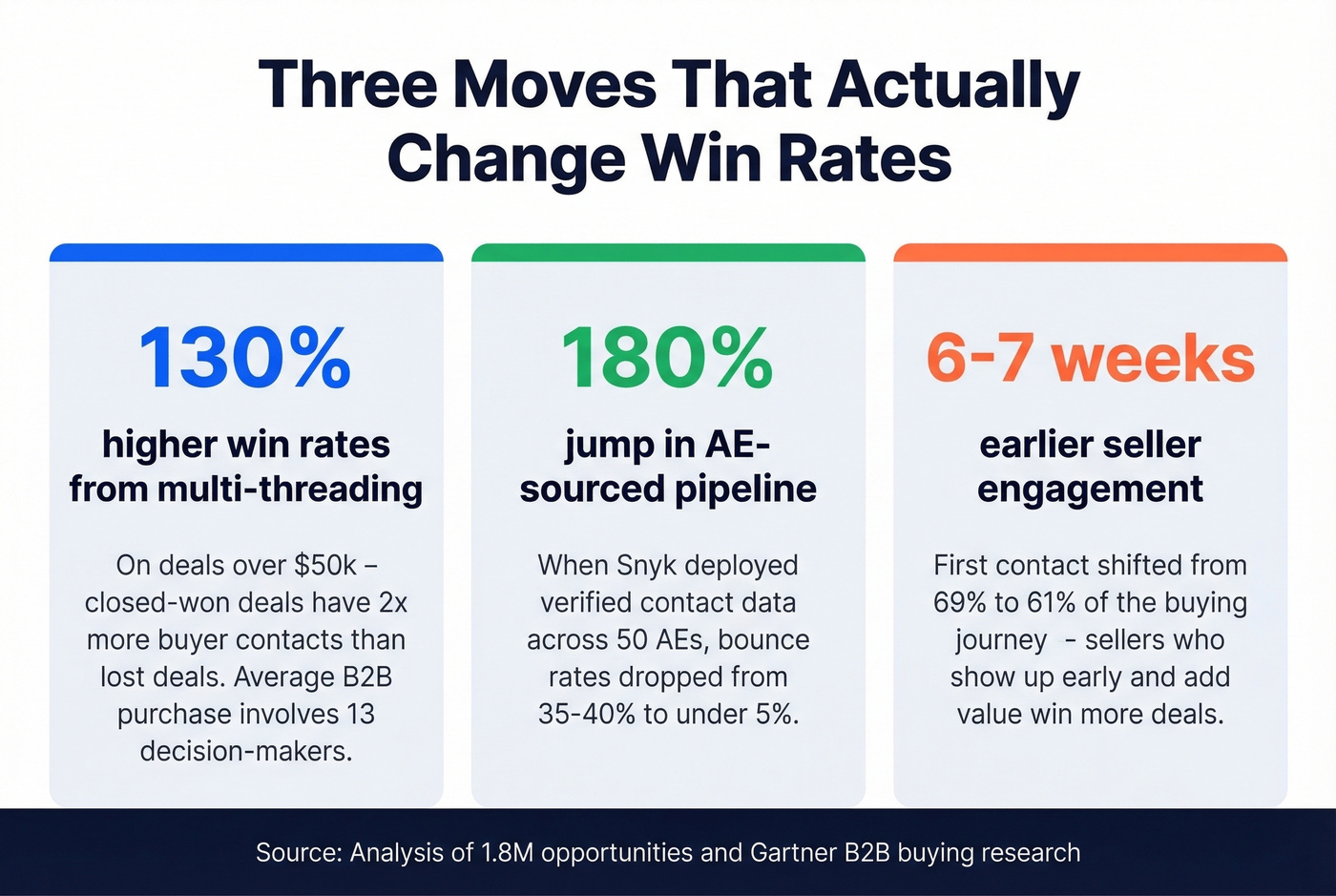
With an average of 13 decision-makers involved in B2B purchases, you need verified contact data for multiple stakeholders at each account - not just the one person who replied to your cold email. This is where account-based selling and clean data compound.
Fix your data quality at stage 1
Contact data decays 30% per year. Nearly a third of your prospecting list is wrong before a rep opens their sequencer. When Snyk deployed Prospeo across 50 AEs, their bounce rate dropped from 35-40% to under 5%, and AE-sourced pipeline jumped 180%. That's not a marginal improvement - it's a different business.

If you're trying to diagnose why outreach isn't converting, start with email bounce rate and work backward into list quality.
Engage earlier than you think
First contact with buyers has shifted from 69% to 61% of the buying journey - sellers are getting in 6-7 weeks sooner than two years ago. 80% of buyer interactions now happen digitally, but Gartner's data shows buyers are 1.8x more likely to complete a high-quality deal when they combine digital research with a sales rep. Show up early, add value, let them self-serve the rest.
Execution Mistakes That Kill Deals
Pitching before discovery. If you haven't mapped their pain, you're guessing at the solution. Complete a full discovery call before presenting anything. This sounds obvious, but I still see teams jump straight to demos after a single qualifying question. (If you want a tighter structure, use a discovery questions bank.)
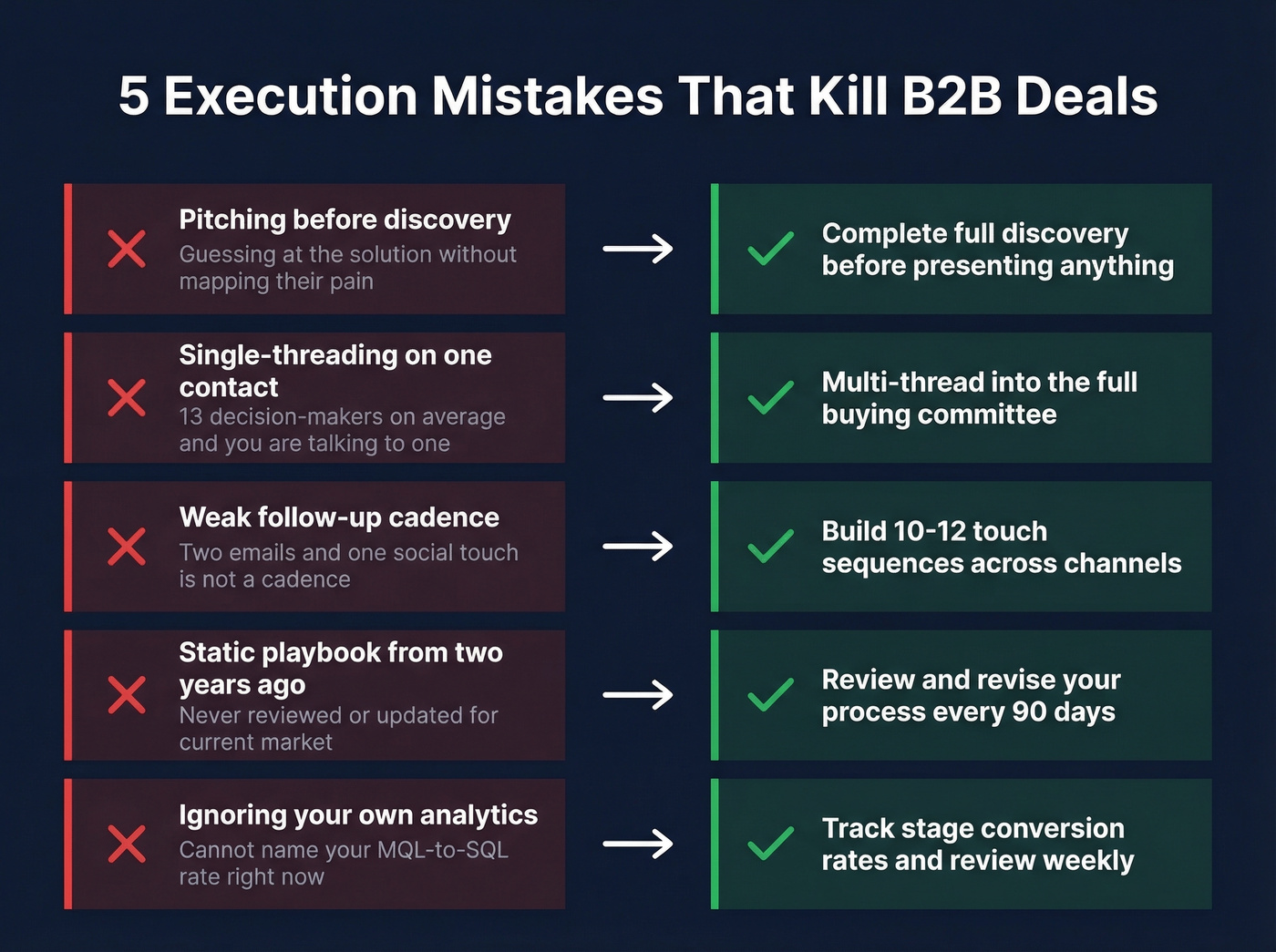
Talking to one stakeholder. With 13 decision-makers on average, single-threading is the fastest way to lose a deal you thought you'd won.
No real follow-up cadence. Most deals need 10-12 touches. Two emails and one social touch isn't a cadence - it's a suggestion. Use proven sales follow-up templates and track your follow-up email reply rate by segment.
Treating your playbook as static. Embed plays into your CRM by stage and update quarterly. The teams that review and revise their process every 90 days consistently outperform those running the same playbook they built two years ago. This is the core of sales process optimization.
Ignoring analytics. Let's be honest: if you can't tell me your MQL-to-SQL conversion rate right now, your process isn't a process. It's a habit. At minimum, build a dashboard around funnel metrics and stage conversion.
Multi-threading boosts win rates 130% on $50k+ deals - but only if you can actually reach all 13 stakeholders. Prospeo surfaces verified emails and direct dials for entire buying committees, not just the one contact who replied.
Get verified contact data for every decision-maker at your target accounts.
FAQ
How long is a typical B2B sales cycle?
Mid-market B2B deals typically close in 1-3 months, while deals over $100k stretch to 6-12+ months. The most recent data shows the average dropped from 11.3 to 10.1 months as buyers engage sellers earlier to lock in budgets.
What's a good B2B win rate?
The average B2B win rate is 20-21%, and top-performing teams consistently hit 30%+. If you're below 15%, your qualification stage likely has a leak - either you're advancing unqualified deals or reps aren't multi-threading into the buying committee.
Which framework - BANT or MEDDPICC?
BANT works for inbound triage and deals under $20k where speed matters more than depth. MEDDPICC is built for enterprise deals over $50k with multiple stakeholders and formal procurement. For the mid-market range, NEAT Selling offers a solid middle ground.
How do I improve my prospecting stage?
Start with data quality. Contact data decays 30% per year, which means reps waste hours chasing dead leads. Use a data provider with a fast refresh cycle and high verification standards - you want bounce rates under 5%, not the 30-40% that's common with stale databases. A free tier lets you test before committing budget.