

How to Build Rapport with Prospects - Without Being Cheesy
You're 15 seconds into a cold call and the prospect already sounds annoyed. Your manager's advice? "Be more personable." Cool. That's not a strategy - it's a personality test.
Here's what actually works when you need to build rapport with prospects: it's a preparation habit, not a personality trait. And 82% of sales professionals say relationship-building is the most crucial part of selling, so it's worth getting right.
Why Trust Beats Small Talk
Let's be honest about something most sales blogs won't say: stop trying to "build rapport." Build trust instead. Rapport is the byproduct. The reps who obsess over icebreakers miss the point entirely. Trust comes from preparation, relevance, and respect for the buyer's time - rapport follows naturally.
The numbers back this up. 96% of prospects do their own research before they'll talk to a rep, and 71% prefer doing that research independently. Only 27% of reps consistently hit quota, and 81% of revenue leaders say deals are more complex than they were two years ago. The reps who win aren't the most charming. They're the ones who earn trust in the first few minutes. Rapport also matters long after the first deal closes: it's what makes renewals, upsells, and tough account conversations easier because you're not starting from zero every time.
Pre-Call Research That Creates Connection
The best rapport-builders we've seen share one habit: a 30-second pre-call review. Before every dial, they scan the prospect's role, recent company news, and prior touchpoints. HubSpot's guidance on rapport-building questions recommends building questions from observation rather than fishing for information live. This kind of preparation is the foundation of finding common ground before the conversation even starts.
But here's the thing nobody talks about: if your contact data is stale, rapport is irrelevant. Calling someone who already left the company isn't just a wasted dial - it's a credibility hit with the gatekeeper. After switching to Prospeo, Snyk's 50-person sales team saw bounce rates drop from 35-40% to under 5%, and AE-sourced pipeline jumped 180%. With 98% email accuracy and a 7-day data refresh cycle, you're reaching the right person with current data. Connection starts there.

Cold Call Openers That Earn Trust Fast
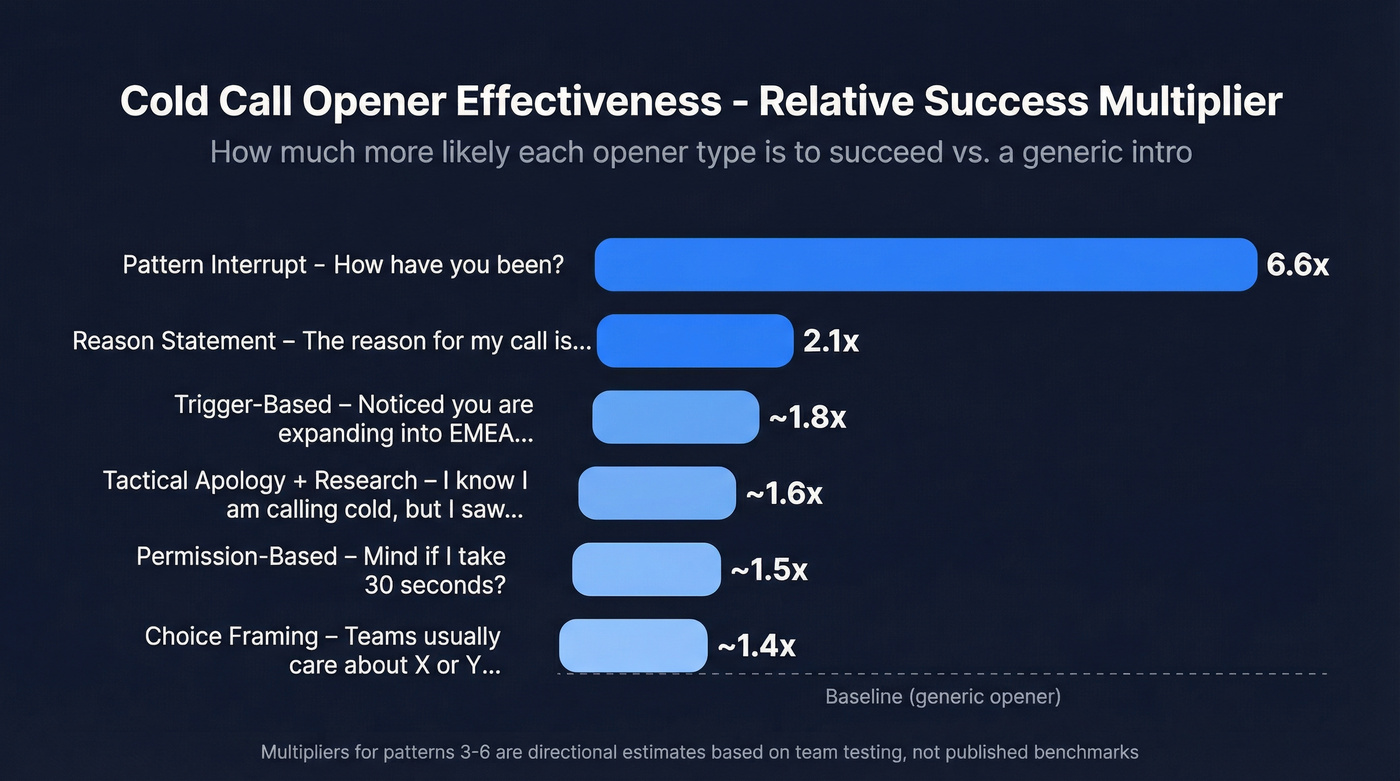
Average cold call success rates hover around 2.3%, but teams using structured openers and targeted lists hit 5-8%. The first 10 seconds determine whether you get 10 more. Here are six opener patterns worth testing - directional benchmarks, not gospel, but useful signals for A/B testing your team's approach.
| Opener Type | Example Line | Why It Works |
|---|---|---|
| Pattern interrupt | "How have you been?" | ~6.6x vs "How are you?" - implies prior relationship |
| Reason statement | "The reason for my call is..." | ~2.1x success rate - sets clear expectations |
| Permission-based | "Mind if I take 30 seconds?" | Prospect feels in control, lowers guard |
| Tactical apology + research | "I know I'm calling cold, but I saw your Q3 hiring..." | Signals preparation and self-awareness |
| Trigger-based | "Noticed you're expanding into EMEA - how's that going?" | Ties to real context they care about |
| Choice framing | "Teams usually care about X or Y - which is closer?" | Engages decision-making, not defensiveness |
The pattern interrupt works because it breaks the script the prospect expects. "How have you been?" creates a small cognitive disruption that buys you extra seconds. Pair it with a research-based observation and you've earned the right to keep talking.
A lot of reps push back on the "just be yourself" advice - and they're right to. The reps who close don't wing it; they prepare for it. Every opener above requires knowing something about the prospect before you dial. Establishing common ground is a research exercise, not a personality one. If you want a deeper framework for this, start with B2B cold calling benchmarks and scripts.

Every rapport technique in this article assumes one thing: you're reaching the right person. Stale data means wasted openers, burned credibility, and zero trust. Prospeo's 98% email accuracy and 7-day refresh cycle mean your research-backed opener actually lands with someone who still works there.
Stop building rapport with people who left the company six months ago.
Video and Phone Rapport Tactics
Remote selling changed everything. Gong's data shows closed deals used webcams 41% more often than lost deals. That correlation is hard to ignore. Mehrabian's communication research suggests 55% of meaning comes from body language and 38% from tone, which is why turning your camera on matters more than perfecting your script.
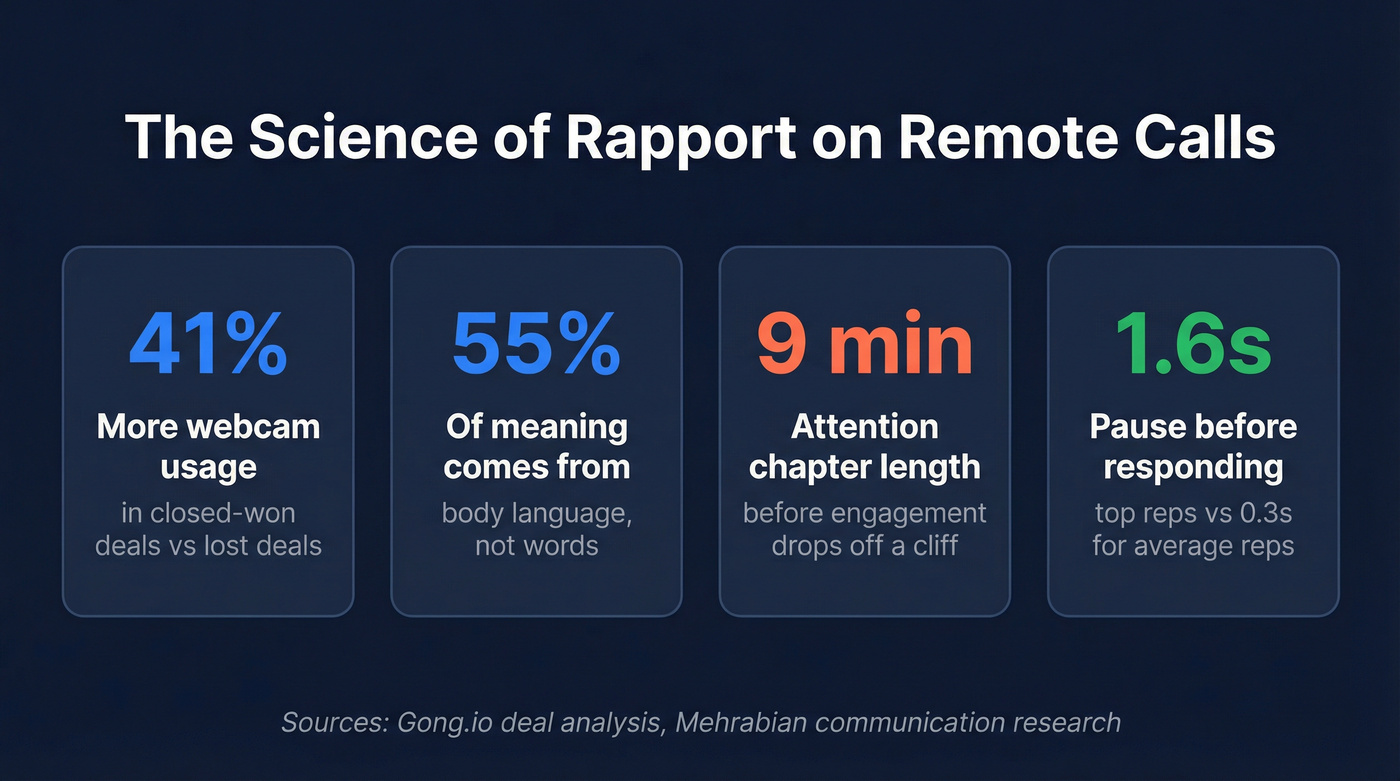
Structure matters too. Break demos into roughly 9-minute chapters because attention drops off a cliff after that mark.
And here's a subtle one we've noticed in our own call reviews: top-performing reps pause about 1.6 seconds before responding to an objection, compared to 0.3 seconds for average reps. That pause communicates that you're actually listening, not just waiting for your turn to talk. Reflective listening ties it together - a simple "So, if I'm hearing you correctly..." followed by a restatement of their concern does more for trust-building than any icebreaker ever will. (If you want to systematize this, build it into your sales coaching scorecards.)
Rapport Mistakes That Kill Deals
Five mistakes that show up repeatedly - and how to fix each one:
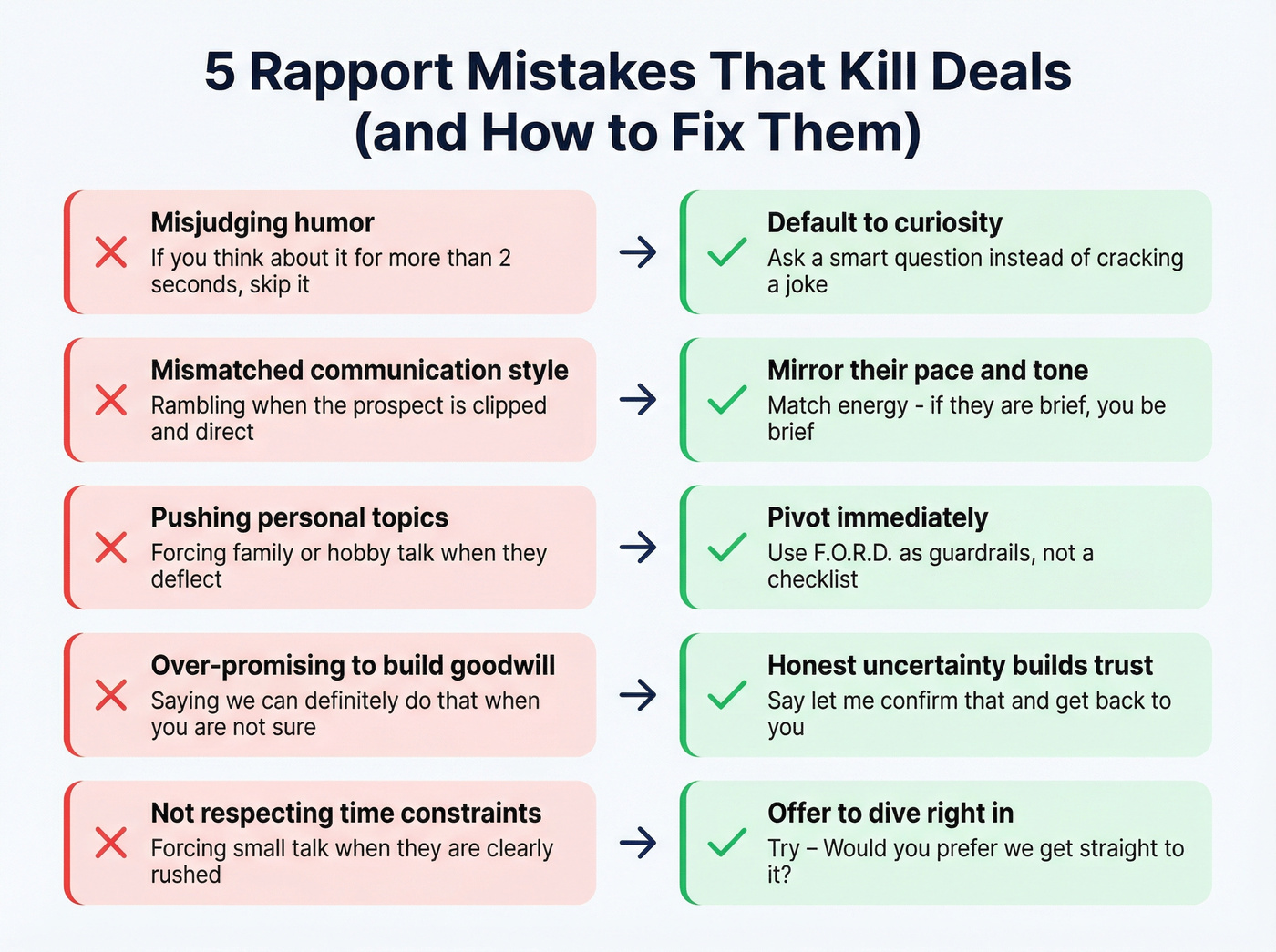
Misjudging humor. If you have to think about whether a joke will land for more than two seconds, skip it. The risk-reward is terrible on a first call.
Not matching communication style. Mirror the prospect's tone, pacing, and word choice. If they're clipped and direct, don't ramble. This is calibration, not mimicry.
Pushing personal topics. The F.O.R.D. framework (Family, Occupation, Recreation, Dreams) gives you guardrails, but read the room. If someone deflects a personal question, pivot immediately.
Over-promising to build goodwill. Saying "we can definitely do that" when you're not sure erodes trust faster than any awkward silence. Honest uncertainty - "Let me confirm that and get back to you" - builds more credibility than false confidence ever will. I've watched reps lose six-figure deals over a single promise they couldn't keep.
Not respecting time constraints. Forcing small talk when a prospect is clearly rushed backfires every time. For C-level calls, try: "We've got 30 minutes - would you prefer we dive right in?" That opener builds more trust than five minutes of forced chitchat.
Adapt Your Approach by Deal Size
SMB deals close in 2-3 touches. Rapport here means respecting the prospect's time - get to the point in under 60 seconds and demonstrate value immediately. Don't over-invest in relationship-building when the buyer just wants to know if you can solve their problem this week. A local connection, a shared city, a regional event, a mutual contact - any of these can accelerate trust in shorter cycles where every second counts. (This is also where a tight outbound calling strategy matters most.)
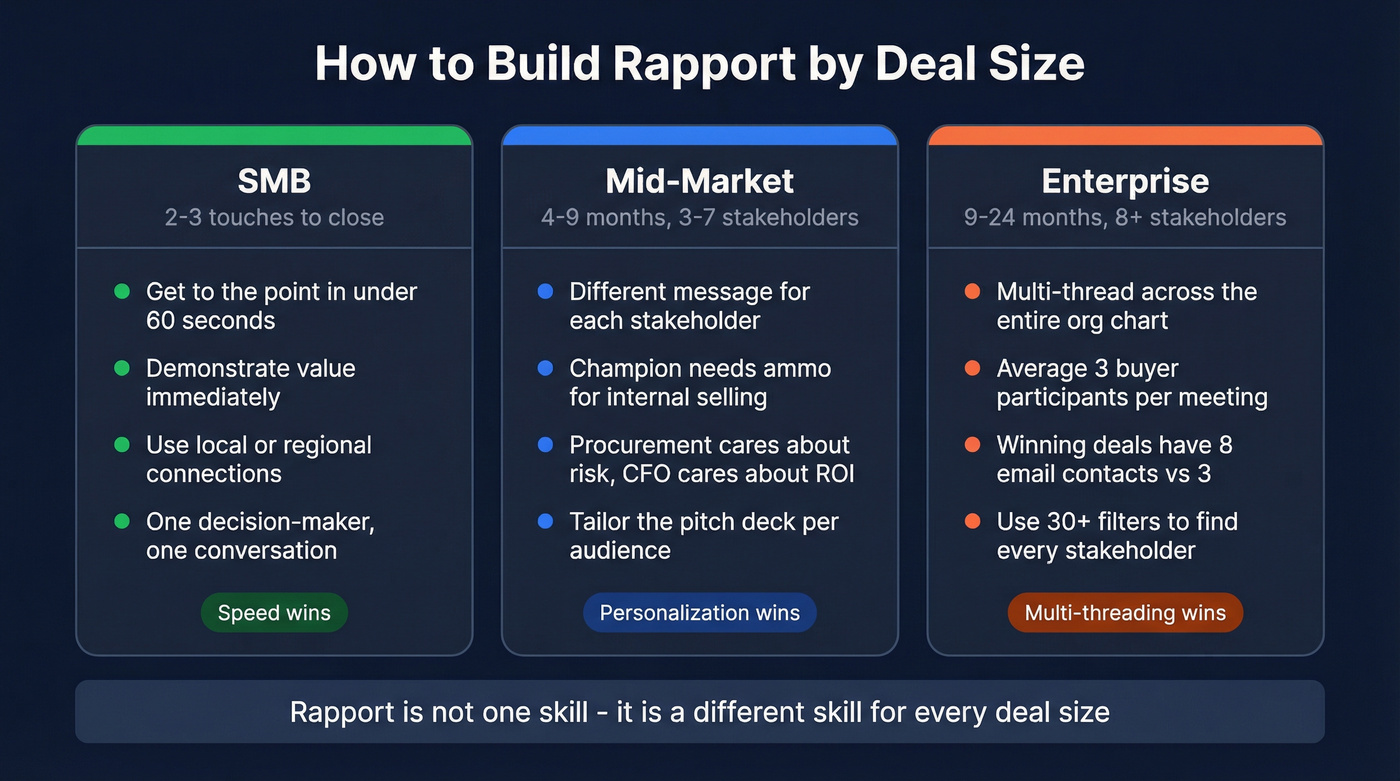
Mid-market cycles stretch 4-9 months with 3-7 decision-makers. Picture this: your champion loves the product, but procurement has never heard of you and the CFO only cares about ROI. Rapport isn't one conversation - it's a different conversation with each stakeholder. Skip the generic pitch deck and tailor your message to what each person actually cares about.
Enterprise deals run 9-24 months with 8+ stakeholders. Gong's analysis of 53,632 opportunities found winning deals average 3 buyer-side participants per meeting vs. 1 for closed-lost, and 8 email contacts vs. 3. Multi-threading is the mechanism that turns rapport into revenue. Finding the right stakeholders by role, department, and seniority across the org chart is where tools with deep search filters - Prospeo's 30+ filters are what we use internally - make this practical at scale instead of a manual nightmare. If you want the full definition + examples, see multithreading in sales.
Trigger-based openers only work when you have real signals. Prospeo gives you 30+ filters - buyer intent, job changes, headcount growth, funding - so every call starts with context that earns trust in seconds. At $0.01 per email, preparation doesn't need a budget committee.
Turn pre-call research from a chore into a competitive advantage.
FAQ
How do you build rapport on a cold call without small talk?
Lead with a pattern interrupt and a research-based observation. A trigger-based opener like "I noticed you're hiring three SDRs - are you scaling outbound?" earns more trust in five seconds than small talk ever could. Consistent rapport comes from preparation, not personality.
Does rapport matter in email outreach?
Yes - personalized first lines based on real context outperform templates by 2-3x in reply rates. But if your emails bounce, rapport never begins. You need verified data so your message actually lands before personalization can do its job.
How long should you spend on rapport before pitching?
Thirty to ninety seconds, max. Let the prospect set the tone, then match it. The C-level opener - "Would you prefer we dive right in?" - works because it signals respect for their time, not a need for small talk.