

How to Build Rapport in Sales Without Being Cheesy
"How's the weather out there in Phoenix?" Nobody has ever bought software because a rep asked about the weather. Yet somehow, building rapport in sales still gets reduced to forced small talk and fake enthusiasm - the exact behaviors that make buyers tune out.
Here's what rapport actually is, per a popular r/sales thread: asking good questions, sharing insights when appropriate, and actually listening. Not weather talk. Not death-by-PowerPoint. Not pretending you also love fly fishing. Reps already spend only 30% of their time selling. You can't afford to burn the first five minutes of every call on performative friendliness.
Rapport isn't a phase of the call. It's the entire call.
The Quick Version
If you read nothing else, do these three things:
- Research the prospect for 5 minutes before every call. Verify their name, current title, and one piece of recent company news.
- Match their energy in the first 10 seconds. If they sound rushed, be concise. If they're relaxed, slow down. Don't default to fake enthusiasm.
- Summarize what they said before you pitch anything. "So it sounds like your team is dealing with X - did I get that right?" proves you listened.
That's the whole framework. Everything below is the how and the why.
Why Rapport Drives Revenue
Rapport isn't a soft skill that's nice to have. It compresses sales cycles, and shorter cycles win more deals.
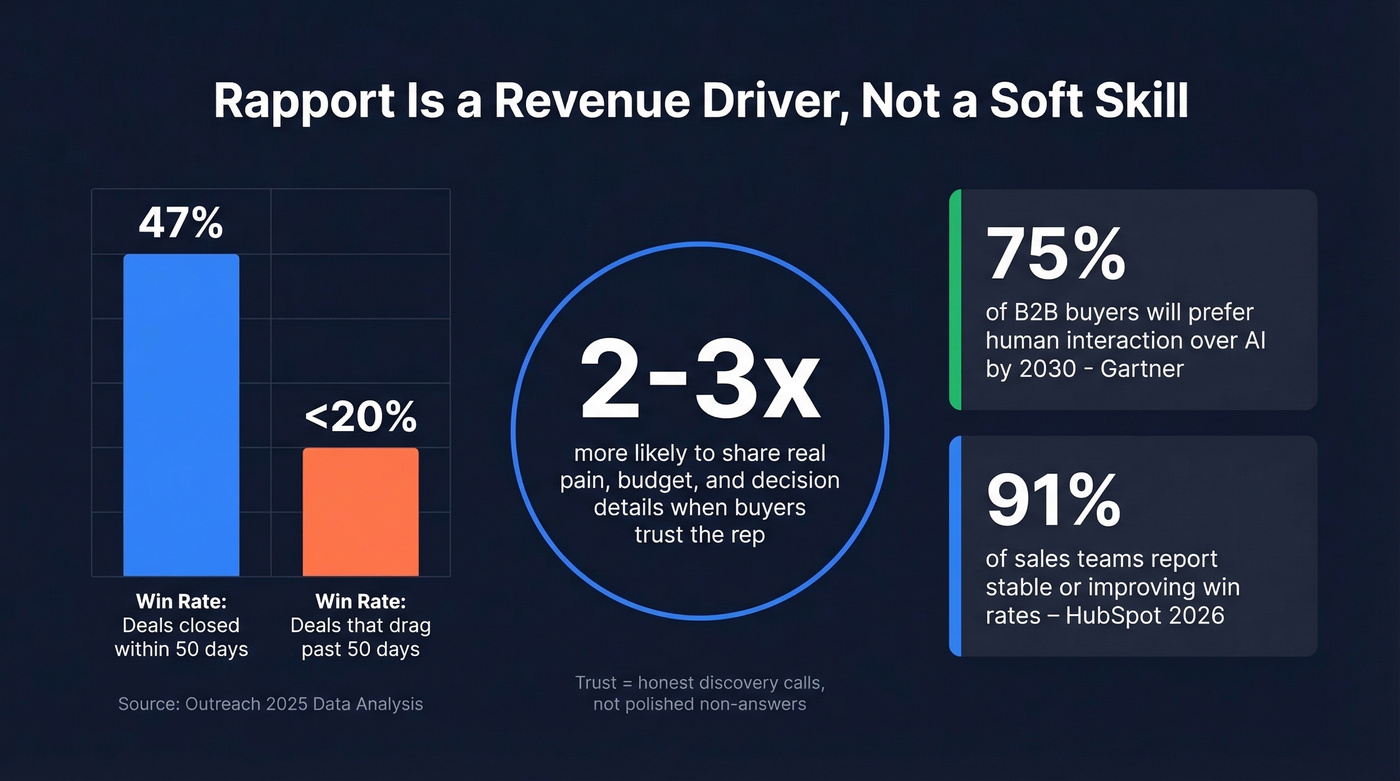
Outreach's data analysis found that opportunities closed within 50 days carry a 47% win rate - compared to under 20% for deals that drag past that window. Meanwhile, 34% of revenue teams report average sales cycles of one to two full quarters, which is a lot of time for rapport failures to compound. The longer a deal sits, the more likely a competitor enters, a champion leaves, or budget gets reallocated. Rapport is the mechanism that accelerates trust, which accelerates decisions.
Buyers who feel genuinely connected to a rep are 2-3x more likely to share deeper insights about their pain, budget, and decision process. The difference between a discovery call that surfaces real objections and one where the prospect gives you polished non-answers? Whether they trust you enough to be honest.
HubSpot's 2026 State of Sales report shows 91% of sales teams report win rates stable or improving. The teams winning aren't doing anything magical - they're building trust fast enough to close before deals go stale. And this matters even more going forward: Gartner predicts that by 2030, 75% of B2B buyers will prefer sales experiences that prioritize human interaction over AI. Rapport isn't getting automated away. It's becoming the competitive moat.
Five Techniques That Actually Work
Preparation over improvisation. The best rapport starts before you open your mouth. Spend 5-15 minutes researching the prospect's current role, recent company news, and any content they've published. Walking into a call with "I saw you just expanded into APAC" lands completely differently than "So, tell me about your company." Avoma's research shows 15-20 minutes of pre-call prep improves conversation quality across the board. If you want a repeatable system, borrow a few ideas from sales prospecting techniques that start with research, not scripts.
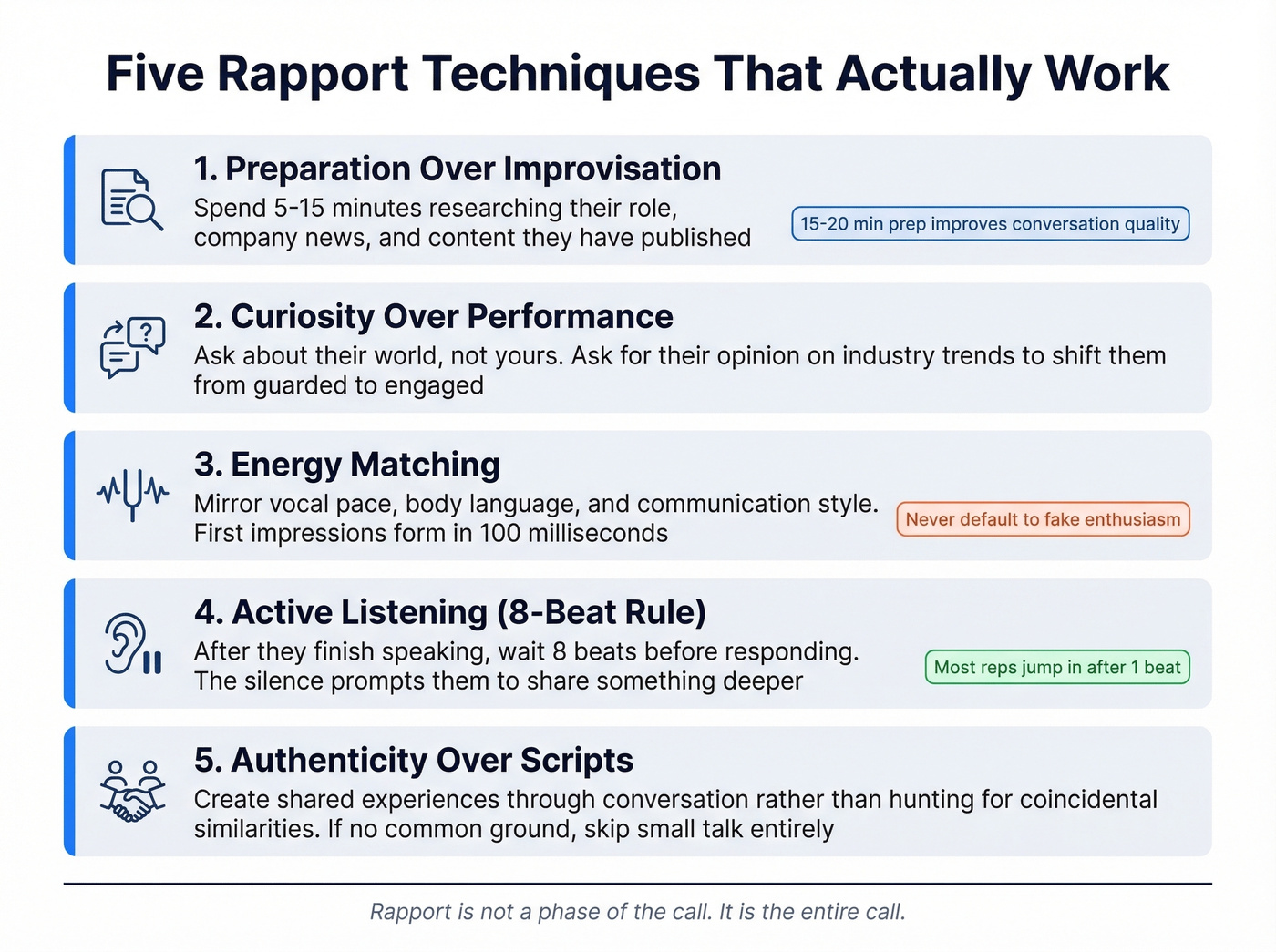
Curiosity over performance. Ask about their world, not yours. "What's the biggest bottleneck your team is hitting this quarter?" beats "Let me tell you about our platform." The best reps treat discovery like journalism - they want the real story, not the press release. One underrated tactic: ask for their opinion on an industry trend or a challenge you've seen at similar companies. When you ask for opinion, prospects shift from guarded to engaged because you're signaling that their perspective matters. (If you need prompts, keep a short bank of discovery questions.)
Energy matching across three dimensions. People form impressions of competence and trustworthiness in as little as 100 milliseconds. If your prospect picks up sounding tired and distracted, don't hit them with a caffeinated "HEY! Great to connect!" Match their body language on video, mirror their vocal pace and volume, and adapt to their communication style - whether that's data-driven and terse or conversational and exploratory. A calm, measured tone with a rushed executive builds more trust than forced enthusiasm ever will.
Active listening. Here's a tactic that sounds simple and is brutally hard in practice: after the prospect finishes speaking, wait eight beats before responding. Count them. The silence feels uncomfortable, but it proves you're actually processing what they said, and it often prompts them to keep talking and share something deeper. Most reps jump in after one beat. Don't.
Authenticity over scripts. The consensus on r/sales is clear: buyers can smell inauthenticity instantly. Being genuine doesn't mean being unprepared - it means not pretending to care about things you don't care about. There's a useful distinction between finding similarities ("Oh, you went to Michigan too!") and creating shared experiences through the conversation itself. The latter is more powerful and doesn't require coincidence. If you can't find genuine common ground, skip the small talk entirely and lead with a sharp, relevant question.
Scripts for Sales Calls
Every opener below is ranked by effectiveness. Use the one that fits the situation, not the one that feels safest.
Pattern Interrupt (Highest Impact)
"Hey [Name], how've you been?"
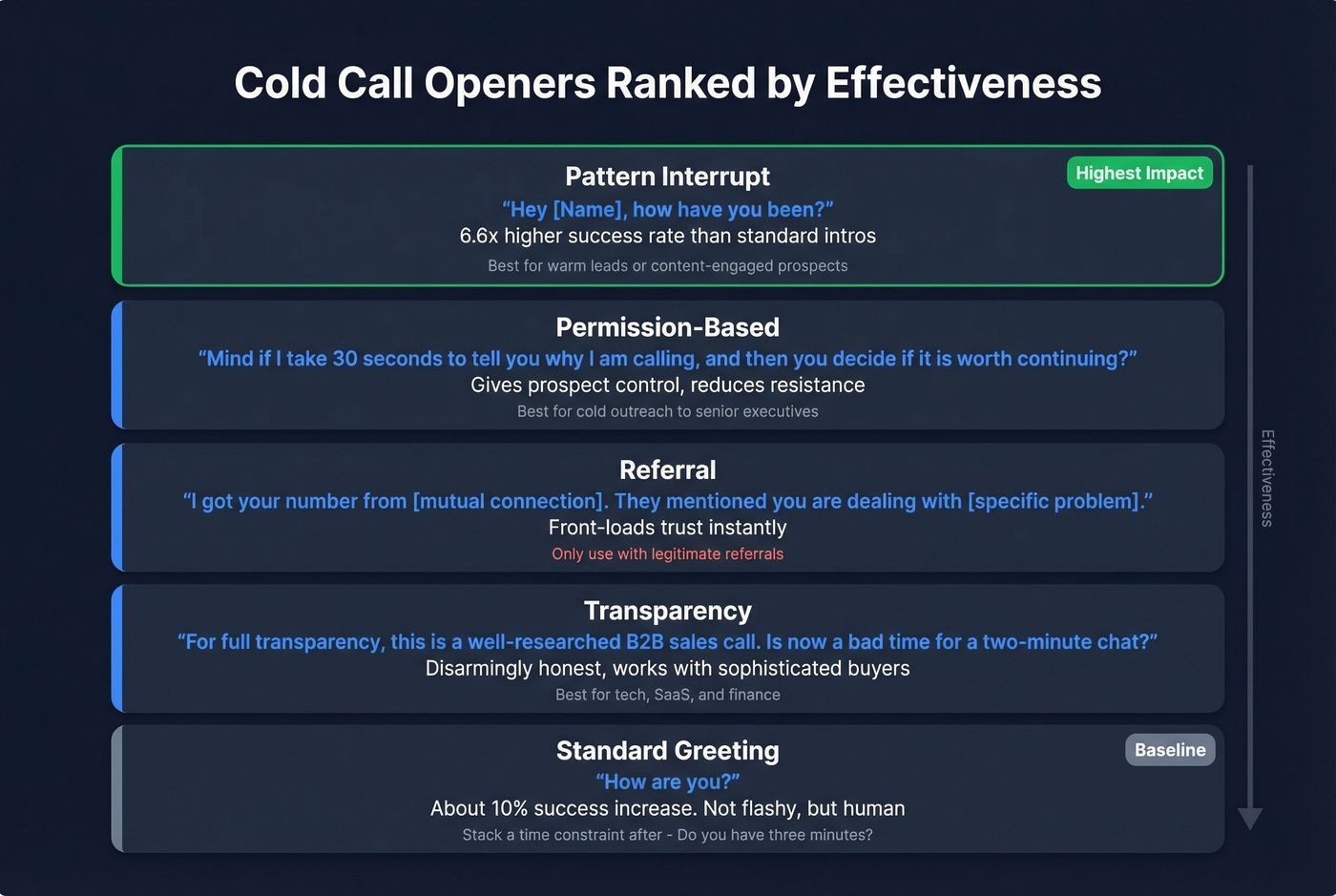
You've never spoken before. The casual familiarity breaks the prospect's mental script of "this is a cold call, say no." Data from Leads at Scale puts the success rate at 6.6x higher than a standard introduction. Use this when calling warm-ish leads or anyone who's interacted with your content. Skip it if the prospect has zero reason to recognize your name - it'll feel manipulative.
Permission-Based Opener
Imagine you're calling a VP of Sales who gets 15 cold calls a week. She's already annoyed before she picks up. Instead of launching into your pitch:
"Mind if I take 30 seconds to tell you why I'm calling - and then you decide if it's worth continuing?"
You just gave her control. Nobody likes feeling trapped on a call. The 30-second time box reduces resistance and, paradoxically, gets you more time. This is your go-to for cold outreach to senior executives. If you're building a full outbound motion, pair this with a consistent cold calling system.
Referral Opener
"I got your number from [mutual connection]. They mentioned you're dealing with [specific problem]."
Nothing builds instant credibility like a shared connection. This front-loads trust and gives the prospect a reason to stay on the line. Only use it with a legitimate referral - namedropping someone who barely knows you will backfire spectacularly.
Transparency Opener
Cognism's team uses this one for sophisticated buyers in tech, SaaS, and finance: "For full transparency, this is a well-researched B2B sales call. I know that's not what you were hoping for - is now a bad time for a two-minute chat?" It works because it's disarmingly honest. The prospect knows it's a sales call. Pretending otherwise insults their intelligence.
Standard Greeting (Baseline)
Gong's research found that simply asking "How are you?" increases cold call success by about 10%. Not flashy, but human. Use it as your fallback. Pro tip from Zendesk's script research: stack a time constraint after any opener - "Do you have three minutes?" - to reduce early hang-ups.
Once you're past the opener, transition to discovery with an open-ended question about their priorities. The opener earns you 60 seconds. The discovery question earns you the rest of the call. If you want a few ready-to-use options, keep talk track examples handy.

You just read that 5-15 minutes of pre-call research transforms rapport. Prospeo gives you 50+ data points per contact - current title, company growth signals, tech stack, and intent data - so you walk into every call with something real to say. No more Googling for 20 minutes.
Stop winging discovery calls. Start them with intel.
Mistakes That Kill Deals
Rapport before agenda. Opening with five minutes of small talk before explaining why you're calling makes you look like a time-waster. State your purpose within the first 15 seconds, then build connection through the conversation itself.
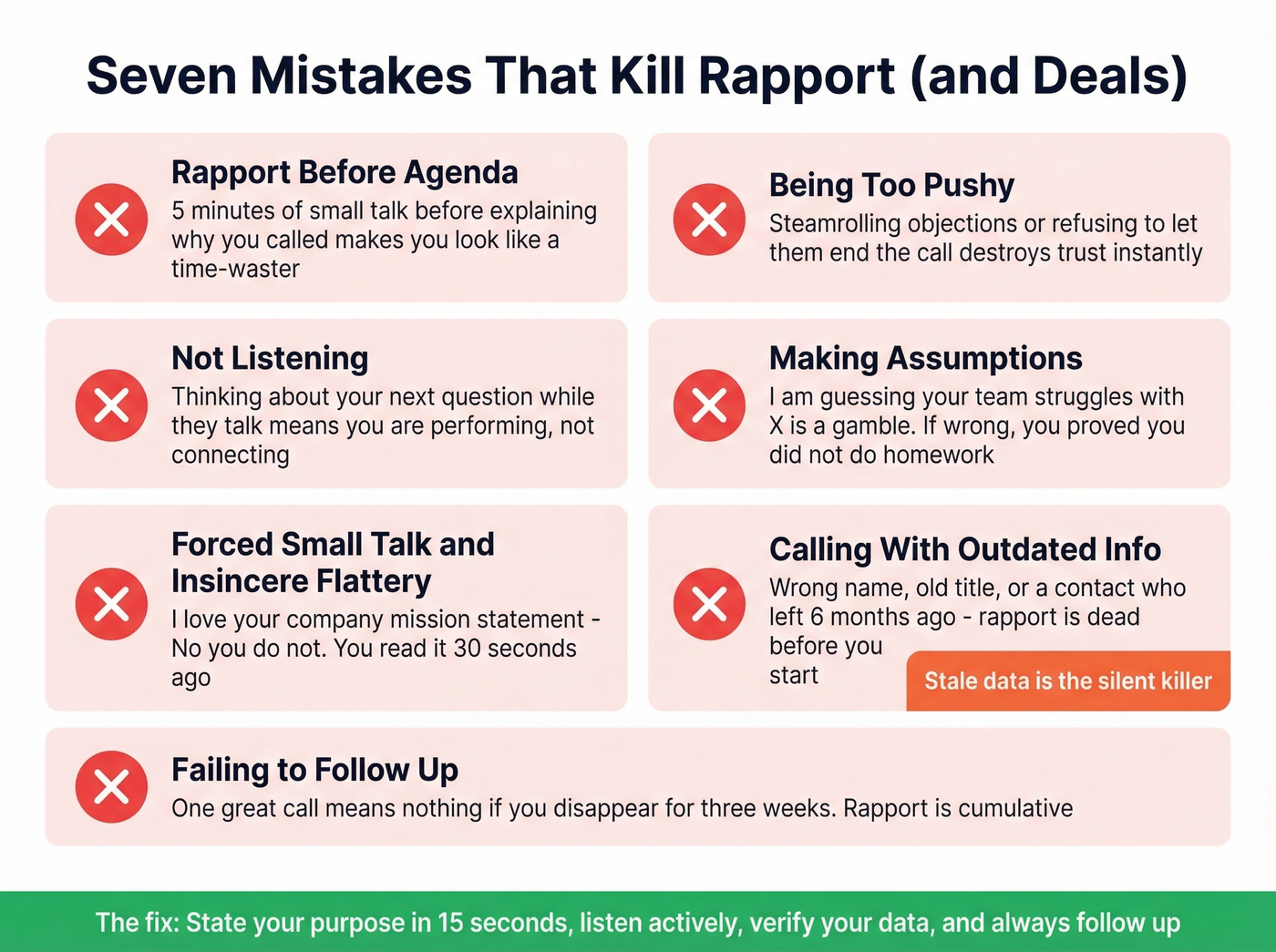
Not listening. Talking over the prospect is the fastest way to lose them. Use the "wait eight beats" tactic. If you're thinking about your next question while they're still talking, you're not listening - you're performing.
Forced small talk and insincere flattery. "I love your company's mission statement!" No you don't. You read it 30 seconds ago. Prospects can tell. If you can't find something genuinely interesting, skip the flattery and ask a real question.
Being too pushy. Dominating the conversation, steamrolling objections, or refusing to let the prospect end the call - all of these destroy trust instantly. Rapport requires respecting boundaries, including the boundary of "I'm not interested right now." (If this is a recurring issue, it’s often tied to sales communication habits, not “personality.”)
Making assumptions instead of asking. "I'm guessing your team struggles with X" is a gamble. If you're wrong, you've just proven you didn't do your homework. Ask open-ended questions and let them tell you.
Calling with outdated information. Mispronouncing a name, referencing an old title, or dialing a number that belongs to someone who left the company six months ago - all rapport killers before you even start. This is exactly why data hygiene matters. We've seen reps lose deals in the first 10 seconds because their CRM had a contact who'd changed roles three months prior. Stale data destroys rapport before any technique can save it. If you’re cleaning lists at scale, data enrichment services can help keep records current.
Failing to follow up. One great call means nothing if you disappear for three weeks. Rapport is cumulative. A single missed follow-up signals the relationship wasn't important to you. Use a simple system (or steal a few sales follow-up templates) so you don’t rely on memory.
Rapport on Video Calls
Only 15-25% of B2B buyers want to interact with reps in person, and the average buyer is 57% through their decision before they ever contact a vendor. Your video call might be the only real conversation you get.
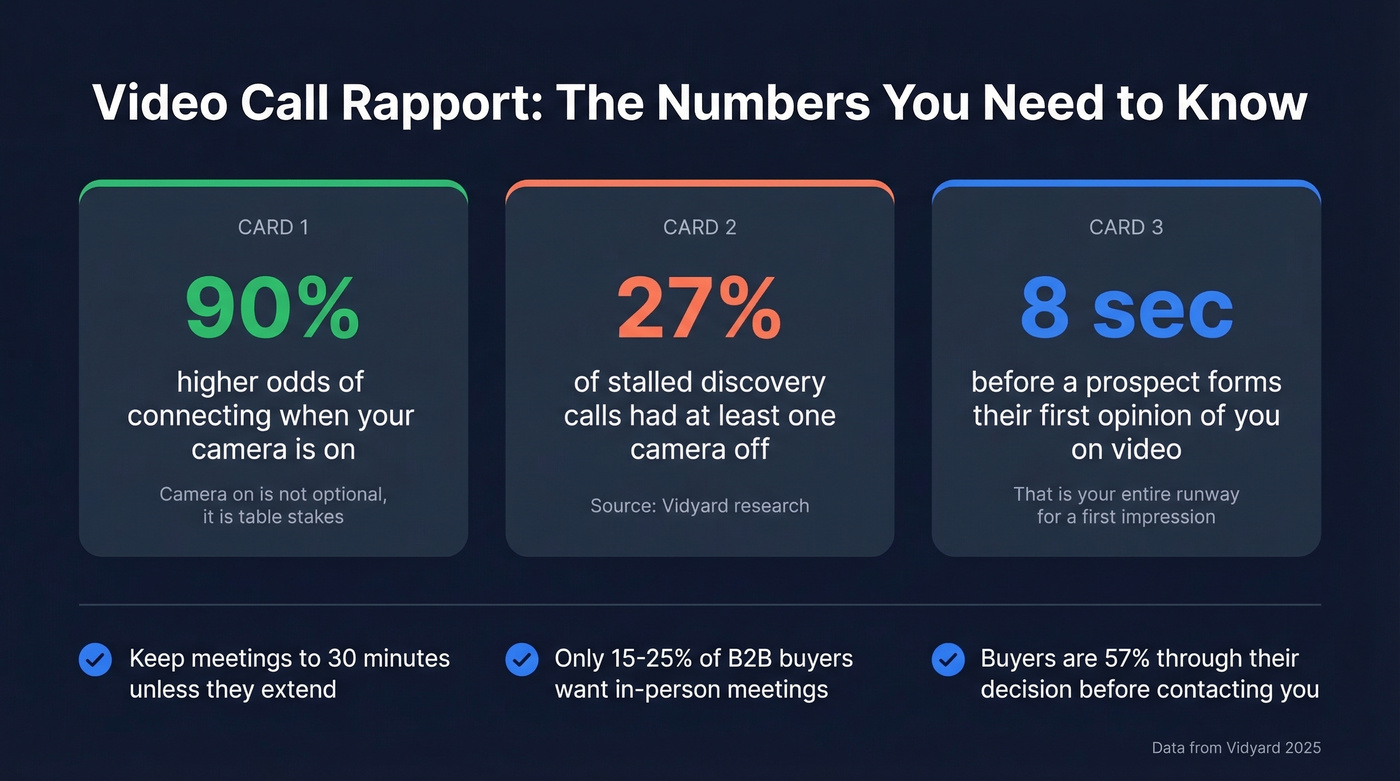
The data here is stark: keeping your camera on increases the odds of connecting with prospects by 90%. And 27% of stalled discovery calls had at least one party with their camera off. Camera on isn't optional - it's table stakes. You've got about 8 seconds before a prospect forms their first opinion of you on video. That's not much runway.
Beyond camera basics, keep meetings to 30 minutes unless the prospect explicitly extends. Use noise cancellation. And since body language is limited on video, your vocal tone carries more weight - match the prospect's pace and energy through your voice. A rushed monotone on Zoom kills rapport faster than a bad opener on the phone. For more practical structure, see these remote sales meeting tips.
Let's be honest: if your deal size is under $15k, you probably don't need a 45-minute discovery call. A tight 20-minute video call with strong prep will build more trust than a rambling hour-long session. Respect the prospect's time and they'll respect yours.
Rapport Across Cultures
Cultural ignorance kills more international deals than bad pricing. If you're selling across borders, your rapport playbook needs to adapt - connecting with clients in Tokyo requires a fundamentally different approach than connecting with buyers in Amsterdam.
| Region | Trust Style | Communication | Formality | First-Call Tip |
|---|---|---|---|---|
| US / UK / Australia | Fast (credentials) | Direct, results-first | Moderate | Lead with credentials |
| Japan / China / ME | Slow (relationship) | Indirect, patient | High | Invest in relationship first |
| Germany / Netherlands | Fast, fact-based | Very direct | Formal (titles) | Use titles, skip small talk |
| Spain / Italy / France | Relationship-first | Nuanced, personal | Moderate-formal | Expect personal conversation |
| Scandinavia | Collaborative | Informal, consensus | Low (first names) | Build rapport with the committee |
In Germany, use titles and last names until invited otherwise. In Scandinavia, first names come quickly, but decisions require the whole committee - connecting with just the champion won't close the deal. In Spain and Italy, expect relationship-building conversations before anyone discusses business specifics.
For teams selling into multiple European markets, the differences between Dutch directness and French formality alone can extend your sales cycle by months if you get it wrong.
Pre-Call Prep: The Cheat Code
Every technique above falls apart if you're working with bad data. Before any outbound call, confirm the prospect's current role, verify their direct number, check for recent company news, and scan any content they've published. This takes five minutes and transforms a cold call into a warm one.
Here's the thing: we've watched reps on our team waste entire mornings chasing contacts who'd left their companies months ago. The "bad data kills rapport" problem isn't theoretical - it's the most common reason good openers still fail. Calling someone who left the company three months ago, mispronouncing a name because your CRM has a typo, dialing a dead number and wasting 10 minutes tracking down the right one. We use Prospeo for pre-call verification - 300M+ professional profiles refreshed every 7 days, 143M+ verified emails at 98% accuracy, and 125M+ verified mobile numbers with a 30% pickup rate. Whatever tool you use, don't dial until you've confirmed the basics. Five minutes of prep is worth more than any opener script. If you’re building a repeatable workflow, start with a clear ideal customer profile so your research is focused.
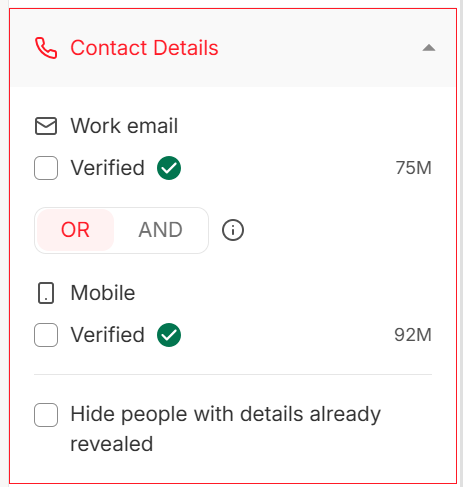
Rapport dies the second you mispronounce a name, reference an old title, or call someone who left the company six months ago. Prospeo refreshes every 7 days - not every 6 weeks - so you never open a call with outdated information that kills trust before you build it.
Stale data destroys rapport. Fresh data builds it.
FAQ
What is rapport in sales?
Rapport is the trust and mutual connection built through preparation, genuine curiosity, and active listening - not small talk. It's the quality of the entire interaction, from opener to follow-up. When done right, the prospect feels understood rather than sold to, which accelerates deal velocity.
How do you build rapport on a cold call?
Lead with a pattern-interrupt opener ("How've you been?"), reference something specific about their company, and match their energy within 10 seconds. Gong data shows this approach boosts connect rates by 6.6x. Pre-call research - verifying the contact's current role and direct dial - ensures you don't waste those critical first seconds.
What are strong rapport-building questions?
Focus on their world, not yours. Top examples: "What's the biggest challenge your team faces this quarter?" "What does success look like for this initiative?" "What have you tried so far that hasn't worked?" These open-ended questions surface real pain and signal genuine interest - far more effective than scripted small talk.
Does rapport matter in virtual sales?
Keeping your camera on increases rapport-building odds by 90%. Virtual calls strip away most body language cues, so vocal tone and thorough preparation carry even more weight. Stick to 30-minute meetings, use noise cancellation, and mirror the prospect's pace through your voice.