

Business Leads: What They Are, What They Cost, and How to Convert Them
Your marketing team generated 2,000 leads last quarter. Sales worked maybe 400 of them. Twelve closed. The rest? Sitting in a CRM graveyard - unqualified, uncontacted, or bouncing off invalid email addresses.
The problem isn't lead volume. It's everything that happens after a business lead enters your system. Bad qualification, slow follow-up, garbage contact data - these are the actual pipeline killers, and most teams don't have the benchmarks to diagnose which one is bleeding them dry.
We've spent years watching teams throw money at lead generation while ignoring the conversion mechanics that determine whether those leads ever become revenue. This guide gives you the benchmarks, frameworks, and channel comparisons to fix that. If you only read one section, make it "What a Business Lead Actually Costs" - it'll reframe your entire budget.
What Is a Business Lead?
A business lead is any person or company that's shown interest in what you sell - or matches the profile of someone who should. That interest can be explicit, like filling out a demo form, or inferred, like matching your ideal customer profile right after raising a Series B.
The lead generation industry is projected to hit $295B by 2027, growing at roughly 17% CAGR. That's a lot of money chasing a lot of contacts. Yet 61% of marketers say generating quality leads is their top challenge - not quantity, quality. The distinction matters because most of what follows is about separating signal from noise.
A lead isn't valuable until it's qualified, contacted, and moving through a pipeline. Everything before that is just a name in a spreadsheet.
Types of Business Leads
There are two ways to categorize leads, and you need both. The first is temperature - how aware and engaged the lead is. The second is lifecycle stage - where they sit in your marketing-to-sales handoff.
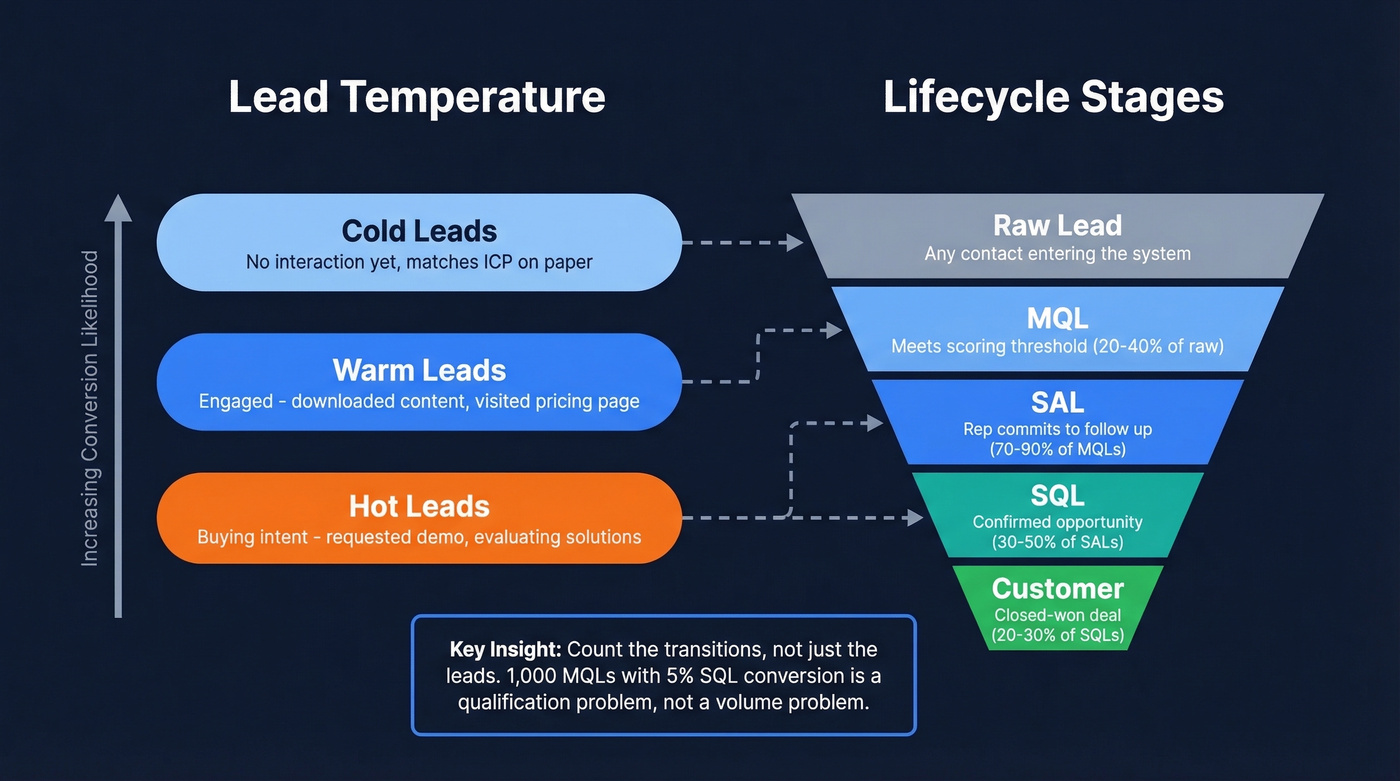
Cold leads haven't interacted with you. They match your ICP on paper but don't know you exist. Think purchased lists, outbound prospecting targets, or scraped conference attendees. Cold leads require the most effort and convert at the lowest rates, but they're often the only way to crack into net-new accounts.
Warm leads have engaged somehow - downloaded a whitepaper, attended a webinar, visited your pricing page. They know your name. The conversion math improves dramatically here because you're not starting from zero awareness.
Hot leads have signaled buying intent. They've requested a demo, responded to outreach, or told your chatbot they're evaluating solutions this quarter. These are the leads your sales team should be calling within minutes, not days.
The lifecycle taxonomy is more operational:
| Stage | Definition | Typical Conversion |
|---|---|---|
| Raw Lead | Any contact entering the system | - |
| MQL | Meets scoring threshold | 20-40% of raw leads |
| SAL | Rep commits to follow up | 70-90% of MQLs |
| SQL | Confirmed opportunity | 30-50% of SALs |
| Customer | Closed-won deal | 20-30% of SQLs |
MQL-to-SQL conversion rates vary wildly by industry - consumer electronics hits around 21%, while oil & gas sits closer to 12%. Benchmarking your funnel against a universal average is benchmarking against nothing.
Don't just count leads. Count the transitions. A team generating 1,000 MQLs with a 5% SQL conversion rate has a qualification problem, not a volume problem.
What a Business Lead Actually Costs
The global average cost per lead is $198. That number is almost useless on its own because CPL swings by roughly 10x depending on your industry and several-fold by company size.
CPL by Industry
| Industry | Avg CPL |
|---|---|
| eCommerce | $91 |
| HVAC | $92 |
| B2B SaaS | $237 |
| IT & Managed Services | $503 |
| Manufacturing | $553 |
| Legal Services | $649 |
| Financial Services | $653 |
| Higher Education | $982 |
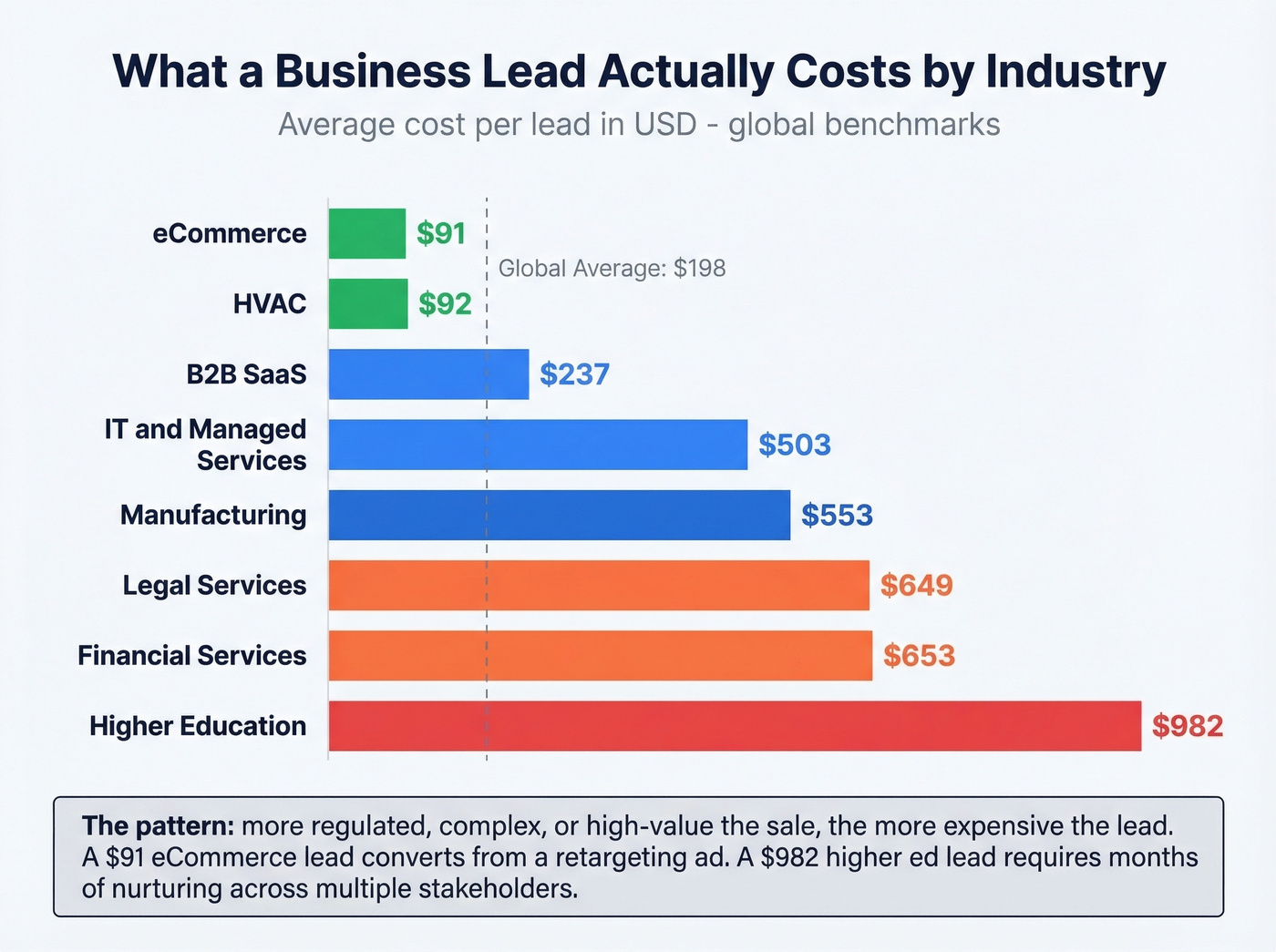
The pattern is straightforward: the more regulated, complex, or high-value the sale, the more expensive the lead. A $91 eCommerce lead converts from a retargeting ad. A $982 higher education lead requires months of nurturing across multiple stakeholders.
CPL by Company Size
| Company Size | Avg CPL |
|---|---|
| 2-50 employees | $47 |
| 51-200 employees | $100-150 |
| 201-1,000 employees | $200-250 |
| 1,000+ employees | $349 |
Larger companies pay more per lead because they're targeting larger companies - and those accounts have more gatekeepers, longer sales cycles, and higher expectations for personalized outreach.
Let's do the math on what this means in practice. If you're a mid-market SaaS company spending $237 per lead and converting at the industry average of 2.9%, you're paying roughly $8,172 in lead costs per customer before you factor in sales time, tools, and overhead. We've seen teams burn through $50K in a quarter on leads that never made it past the MQL stage, usually because they optimized for volume instead of fit.
If your average deal is under $10K annually, you can't afford a $237 CPL. You need cheaper channels, tighter targeting, or both. The companies winning at lead gen aren't spending more - they're wasting less.
Best Channels for Generating Leads
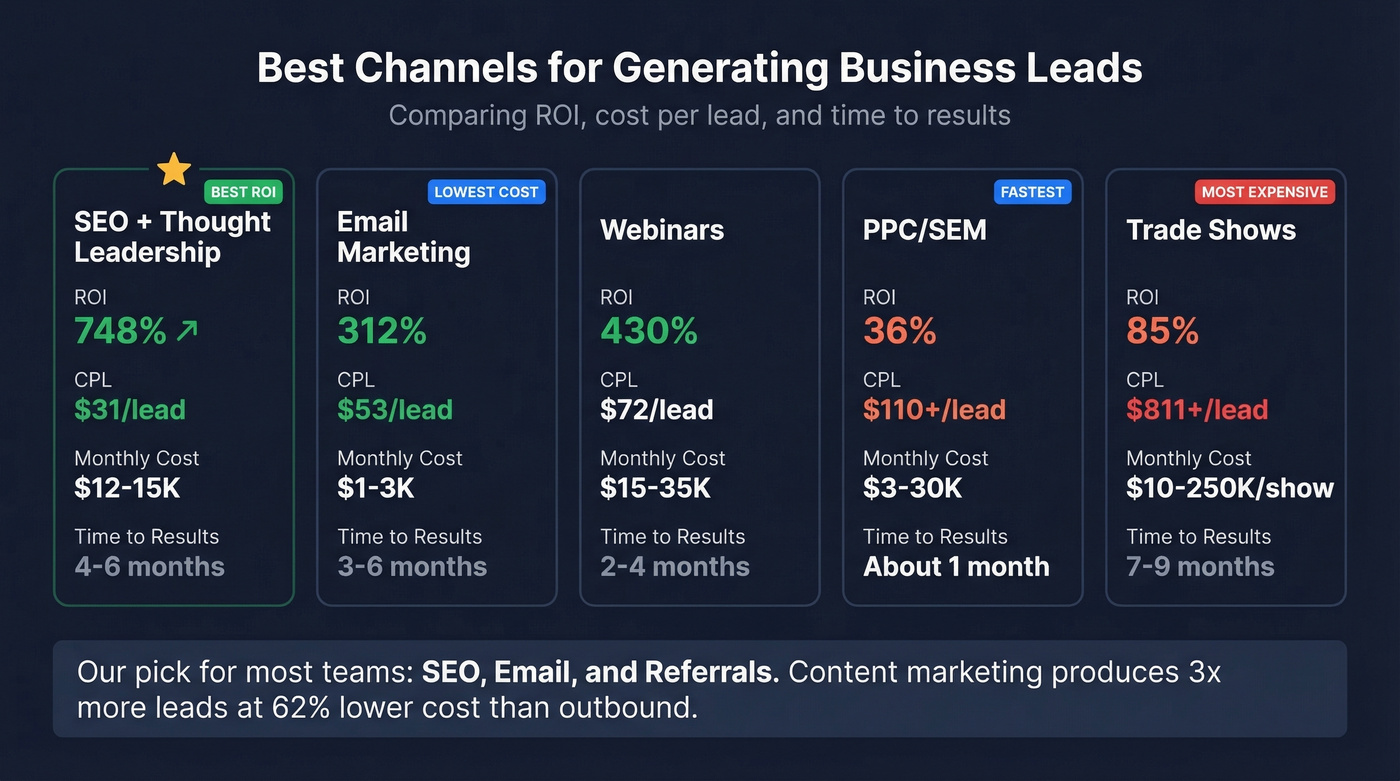
Not all channels are created equal. The differences are dramatic. Here's what First Page Sage's multi-year dataset shows:
| Channel | Monthly Cost | ROI | CAC | Time to Results |
|---|---|---|---|---|
| SEO + Thought Leadership | $12-15K | 748% | $647 | 4-6 months |
| Email Marketing | $1-3K | 312% | $510 | 3-6 months |
| Webinars | $15-35K | 430% | $603 | 2-4 months |
| PPC/SEM | $3-30K | 36% | $802 | ~1 month |
| Trade Shows | $10-250K/show | 85% | $1,390 | 7-9 months |
The cheapest CPL methods tell a similar story: SEO and retargeting come in at $31/lead, email at $53, and webinars at $72. Trade shows and traditional marketing sit at the other end - $811+ per lead.
Our pick for most teams: SEO, email, and referrals. SEO has the highest ROI and compounds over time. Email has the lowest barrier to entry - you can run meaningful campaigns for $1-3K/month. Referrals, while hard to scale, consistently produce the highest-quality leads because they arrive with built-in trust. Content marketing produces 3x more leads at 62% lower cost than outbound, making it the foundation for any team that can wait 4-6 months for compounding returns.
LinkedIn deserves a mention. It drives 80% of B2B social media leads, and 89% of B2B marketers use it for lead generation. For account-based plays and warm outreach, it's indispensable - just don't expect it to replace your inbound engine.
PPC deserves a caveat too. That 36% ROI looks terrible next to SEO's 748%, but PPC delivers results in weeks, not months. If you need pipeline now - say, you just closed a funding round and need to show traction - PPC is the lever you pull while SEO builds in the background.
The practitioner consensus across sales communities on Reddit aligns with the data: outbound email and SEO are the workhorses. Paid channels are accelerants, not foundations.
How to Qualify Leads
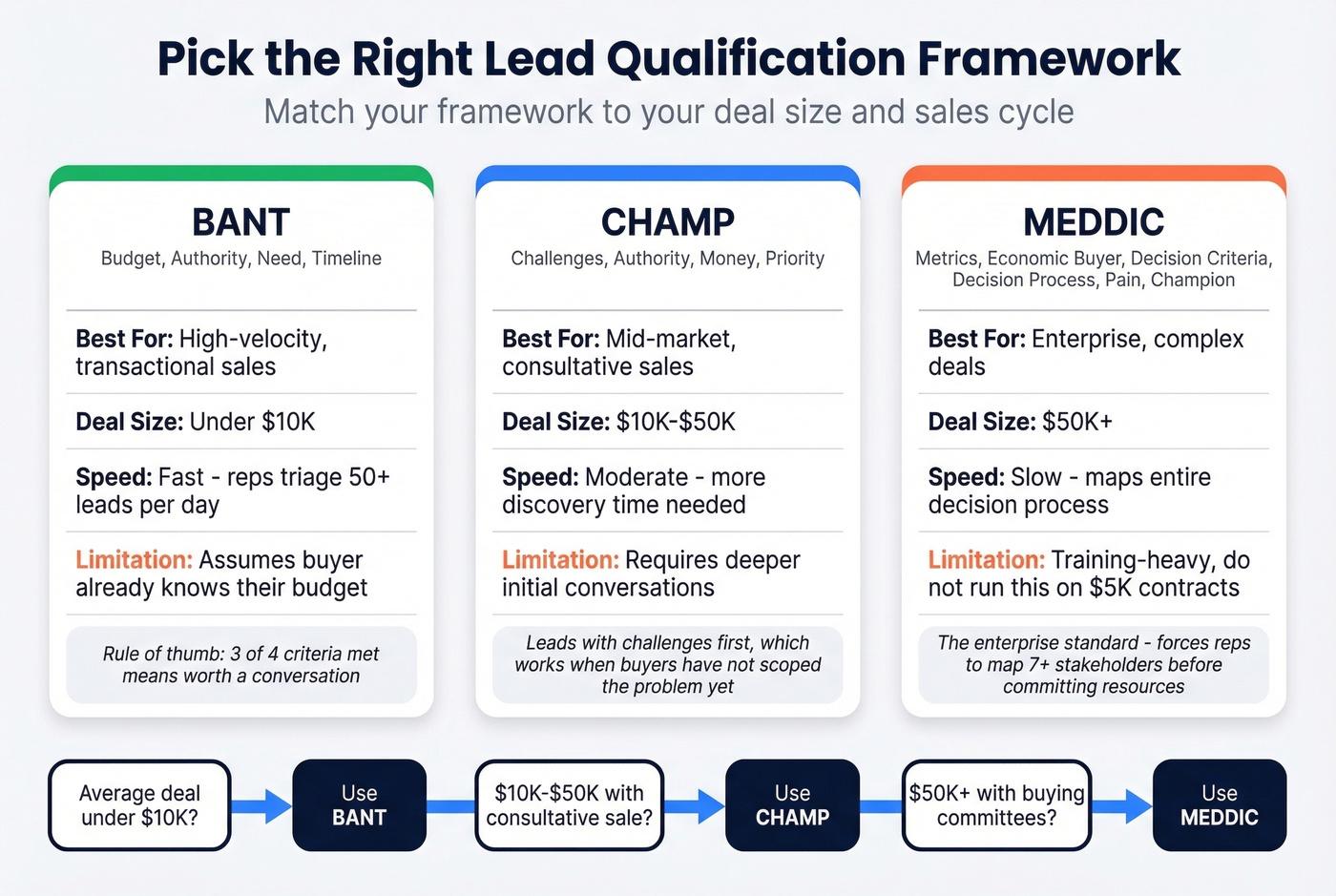
Qualification frameworks exist to answer one question: should a salesperson spend time on this lead?
| Framework | Stands For | Best For | Limitation |
|---|---|---|---|
| BANT | Budget, Authority, Need, Timeline | High-velocity, transactional | Assumes known budget |
| CHAMP | Challenges, Authority, Money, Priority | Mid-market, consultative | More discovery time |
| MEDDIC | Metrics, Economic Buyer, Decision Criteria/Process, Pain, Champion | Enterprise, complex | Training-heavy, slower |
BANT dates back to IBM in the 1950s, and people love to declare it dead. It's not dead - it's misapplied. For high-velocity inbound where reps triage 50+ leads a day, BANT's simplicity is a feature. The common heuristic: if a lead meets 3 of 4 BANT criteria, they're worth a conversation.
Where BANT breaks down is complex B2B deals. The average B2B purchase now involves seven or more stakeholders, so "Authority" isn't one person - it's a buying committee. CHAMP flips the framework to lead with challenges, which works better in consultative sales where the buyer hasn't scoped the problem yet, let alone a budget.
MEDDIC is the enterprise standard for a reason: it forces reps to map the entire decision process before committing resources. But it requires training, discipline, and enough deal value to justify the overhead. Don't run MEDDIC on a $5K annual contract. You'll spend more qualifying than closing.
Pick the framework that matches your average deal size and sales cycle length. Then actually enforce it.

You just read that the average B2B SaaS lead costs $237 - and most never convert because the contact data is wrong. Prospeo delivers 98% verified emails at ~$0.01 each, refreshed every 7 days. That's how teams cut bounce rates from 35% to under 4% and triple pipeline output.
Stop funding your CRM graveyard. Start filling it with leads that convert.
How to Score and Prioritize
Qualification tells you if a lead could buy. Scoring tells you if they're buying now. The best model combines two dimensions: Grade (A-F fit score) and Score (0-100 intent signal).
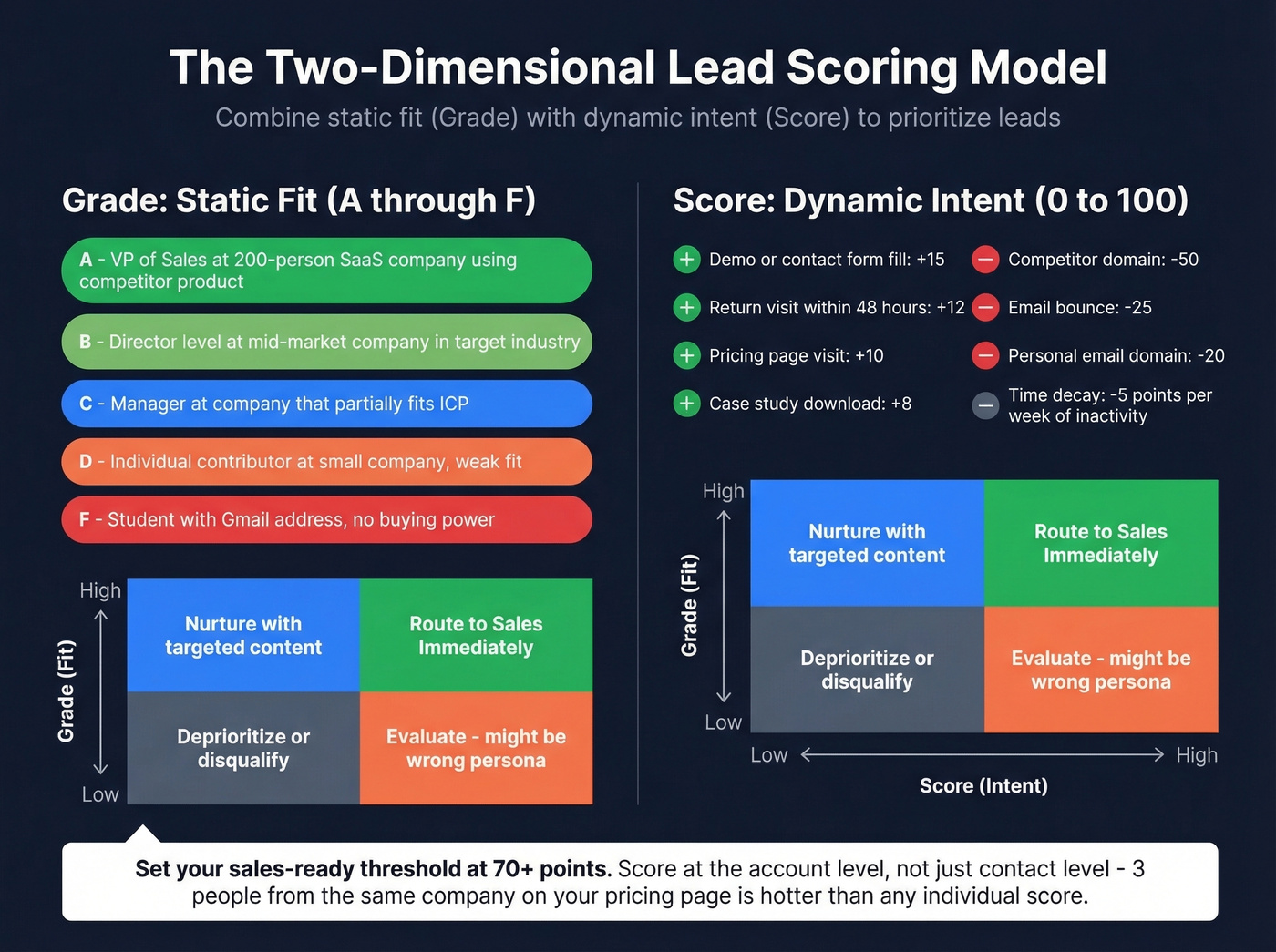
Grade measures static fit - does this person match your ICP? Think job title, company size, industry, tech stack. An A-grade lead is a VP of Sales at a 200-person SaaS company using your competitor's product. An F-grade is a student with a Gmail address.
Score measures dynamic intent - what are they doing right now? Here's a starter rubric:
- Pricing page visit: +10
- Demo or contact form fill: +15
- Case study download: +8
- Return visit within 48 hours: +12
- Email bounce: -25
- Personal email domain: -20
- Competitor domain: -50
Set your sales-ready threshold at 70+. Anything below gets nurtured. Anything above gets routed to a rep with context.
Two operational details most teams miss. First, add time-based decay - subtract 5 points per week of inactivity. In biotech, pipeline data decays at 22% per month, so without decay scoring, you'll have "hot" leads in your queue from six months ago that haven't opened an email since. Second, don't score email opens. Privacy changes from Apple MPP and proxy opens have made open tracking unreliable. Weight on-site behavior and form fills instead.
B2B decisions involve 11-13 stakeholders on average, each consuming 4-5 pieces of content. That means you need account-level scoring, not just contact-level. If three people from the same company are all visiting your pricing page, that account is hotter than any individual score suggests.
Start rule-based for transparency. Add AI-assisted scoring after you have 6+ months of conversion data to train on.
Speed-to-Lead: The Conversion Killer
Your marketing team just handed sales 2,000 webinar leads. It's Thursday afternoon. Reps plan to "get to them Monday." By Monday, you've already lost.
The data is brutal. Contacting a lead within one hour makes you roughly 7x more likely to qualify them versus waiting longer. Follow-up within that first hour converts at 53% - versus 17% after 24 hours. After a full day, the likelihood of qualifying drops by 98%+.
And yet, 79% of leads never convert into sales. Not because they were bad leads, but because of poor nurturing and slow follow-up. That stat should make every sales leader uncomfortable.
The fix isn't complicated: automated routing, real-time alerts, and a documented SLA between marketing and sales. "We respond to demo requests within 15 minutes during business hours" is a policy. "We'll get to it when we can" is a pipeline leak.
Five Mistakes That Kill Your Pipeline
Chasing Volume Over ICP Fit
Buying 10,000 contacts because they're cheap feels productive. It's not. If those contacts don't match your ideal customer profile, your reps waste hours on conversations that were never going to close. Define a sharp ICP with firmographic and technographic criteria before you spend a dollar on leads.
Slow Follow-Up
We covered the data above. If your average response time to inbound leads is measured in days, you're leaving the majority of your pipeline on the table. Set up automated alerts the moment a lead hits your scoring threshold, plus a written SLA between marketing and sales. That's the minimum.
Tracking Vanity Metrics
Downloads, pageviews, and "leads generated" look great in a board deck. They tell you nothing about revenue. Track pipeline created, pipeline velocity, and revenue attributed. If a channel generates 500 MQLs but zero SQLs, it's not working - kill it and reallocate.
No Segmentation
Sending the same nurture sequence to a CTO and a procurement manager is lazy and ineffective. They have different pain points, different decision criteria, and different content preferences. Segment by role, seniority, and buying stage. Personalize at least the first two touches.
Bad Contact Data
Here's a scenario we've watched play out dozens of times: a team buys 5,000 contacts for $500, loads them into their sequencer, and watches half bounce on the first send. Domain reputation tanks. Deliverability craters. Now even their good leads aren't seeing emails.
The fix is verification before outreach - every time, no exceptions. Prospeo's 5-step verification process catches bounces, spam traps, and catch-all domains before they torch your sender reputation. Meritt went from a 35% bounce rate to under 4% after switching their verification workflow, and their pipeline tripled from $100K to $300K per week. If you want a deeper benchmark-and-fix breakdown, see our guide to email bounce rate.
Tools for Finding Leads
Prospeo
Prospeo covers 300M+ professional profiles with 143M+ verified emails and 125M+ verified mobile numbers. The 98% email accuracy holds up in practice - Snyk's team of 50 AEs saw their bounce rate drop from 35-40% to under 5%, generating 200+ new opportunities per month.
The search filters go beyond firmographics: buyer intent data across 15,000 topics via Bombora, technographics, job changes, headcount growth, and funding signals let you find companies that match your ICP and are actively in-market. If you're building your targeting from scratch, start with an Ideal Customer Profile Template and then layer in firmographic and technographic data.
Pricing is self-serve and credit-based. The free tier gives you 75 verified emails per month plus 100 Chrome extension credits - enough to test data quality before committing. Paid plans run about $0.01 per email with no contracts and no sales calls required.
Apollo.io
Apollo's free tier is generous and the database is massive at 275M+ contacts. Paid plans start around $49-$99/user/month. It's the obvious starting point for SMB teams that want prospecting and sequencing in one tool. Apollo averages around 79% email accuracy, so verify before you send. If you're comparing options, our roundup of best sales prospecting databases can help.
HubSpot CRM
Free CRM with basic lead management. Paid plans start around $20-$30/month depending on the package. It's not a lead database - it's where leads go after you find them. If you're evaluating CRMs, see these examples of a CRM and our picks for best contact management software.
ZoomInfo
The enterprise standard. Database depth in the US is unmatched, but expect to pay $15K-$40K/year depending on seats and modules, and that's before intent data add-ons. The most common complaint on review sites: paying for modules you never activate. Skip this if your team is under 10 reps or your budget is under $20K/year for data tooling.
Qualification frameworks don't matter if your reps can't reach the lead. Prospeo gives you 300M+ profiles with 30+ filters - buyer intent, technographics, funding, headcount growth - so every business lead entering your pipeline is pre-qualified and reachable with verified emails and direct dials.
Qualify leads before you buy them. Filter by intent, tech stack, and growth signals.
Lead Generation in the AI Era
AI-powered lead generation yields 50% more sales-ready leads and up to 60% lower CAC - when it's applied correctly. Gartner reports AI-powered scoring reduces qualification time by roughly 30%. Those are real operational gains, especially when enterprise deals take 1-2 quarters to close and the compound effect of faster qualification across a 6-month cycle is significant.
But here's the contrarian take: AI won't replace lead generation. It'll make bad lead generation worse, faster. If your ICP is poorly defined, AI will scale that bad targeting. If your data is garbage, AI will personalize garbage outreach at volume. The fundamentals still matter more than the tooling. If you're building an AI-assisted system, start with lead scoring and a documented lead generation workflow.
The zero-click trend is reshaping top-of-funnel too. After seeing an AI Overview in search, only 8% of users click through to a website. Meanwhile, 83% of B2B buyers contact sales only after completing 70% of their research independently. Your prospects are forming opinions before you ever know they exist.
The first-party data advantage is growing as third-party cookies disappear. Teams that own their intent signals - website visitor identification, engagement scoring, CRM enrichment - will outperform those relying on rented audiences. The playbook is shifting from "buy more leads" to "understand the leads you already have." For what to watch next, see our lead generation trends.
FAQ
What is a business lead?
A business lead is any person or company that's shown interest in your product or matches the profile of someone who should be interested, based on firmographic and technographic data. Interest can range from filling out a demo form to simply fitting your ideal customer profile. Every prospect was a lead first, but most leads never become prospects.
How many leads does it take to close one deal?
Using average B2B benchmarks, roughly 100 raw leads produce about 30 MQLs, 12 SQLs, and 3 closed customers. Your ratio varies by industry, deal size, and sales cycle length, but 100:3 is a reasonable starting point for pipeline planning.
What's a good cost per lead in 2026?
The global average is $198, but that ranges from $47 for small companies to $982 in higher education. Benchmark against your industry and company size, not a universal number. If your CPL is below your industry average and your lead-to-customer conversion rate is healthy, you're in good shape.
How do I verify lead data before outreach?
Run your list through an email verification tool before loading it into any sequencer. Prospeo's free tier lets you verify 75 emails per month - enough to test data quality on a sample before committing budget. Catch bounces, spam traps, and invalid addresses before they damage your sender reputation.