

The Buyer Journey Funnel Explained - With Actual Numbers
You're building the board deck. The CMO wants a funnel slide showing how marketing drives pipeline. You pull up the CRM, run the numbers, and realize something uncomfortable - only 2.9% of your website visitors ever become qualified leads. The other 97.1% vanish. Your buyer journey funnel isn't a funnel. It's a colander.
That stat isn't an outlier. It's the average across 14 industries and 100M+ data points, and it exposes the core problem with how most teams think about the buying process: they obsess over stage-to-stage conversion rates while ignoring the massive pre-funnel leak where almost everyone drops off. Below: the actual benchmarks, the dark funnel data, and a KPI framework you can use in a real board meeting.
The Short Version
A buyer journey funnel has three core stages - Awareness, Consideration, Decision - but 73% of the journey happens before a buyer ever contacts you. The real optimization opportunity isn't your MQL-to-SQL handoff. It's detecting and engaging the 97% of visitors who never convert. Focus your measurement on one KPI per stage: qualified traffic growth (Awareness), MQL volume (Consideration), and SQL-to-close rate (Decision).
What Is a Buyer Journey Funnel?
A buyer journey funnel maps the stages a potential customer moves through from first realizing they have a problem to signing a contract. The simplest version has three stages: Awareness, Consideration, and Decision - also called ToFu (top of funnel), MoFu (middle of funnel), and BoFu (bottom of funnel).
Extended models stretch this to five or seven stages, adding Unawareness before Awareness and Retention plus Advocacy after the purchase. The AIDA framework (Attention, Interest, Desire, Action) is the classic marketing ancestor, and most modern B2B funnels are just AIDA with CRM-friendly labels bolted on.
Here's the thing: the funnel is a planning tool, not a prediction of behavior. Real buyers don't move neatly from stage one to stage two to stage three. They loop back, skip stages, and research in parallel across multiple channels - especially in B2B, where buying committees introduce overlapping timelines and conflicting priorities. A practitioner on r/marketing put it well: buyers jump around, multiple stakeholders enter at different times, and long cycles cause constant revisiting of earlier steps. The funnel gives you a shared vocabulary and measurement framework. It doesn't give you a crystal ball.
Funnel Stages Explained
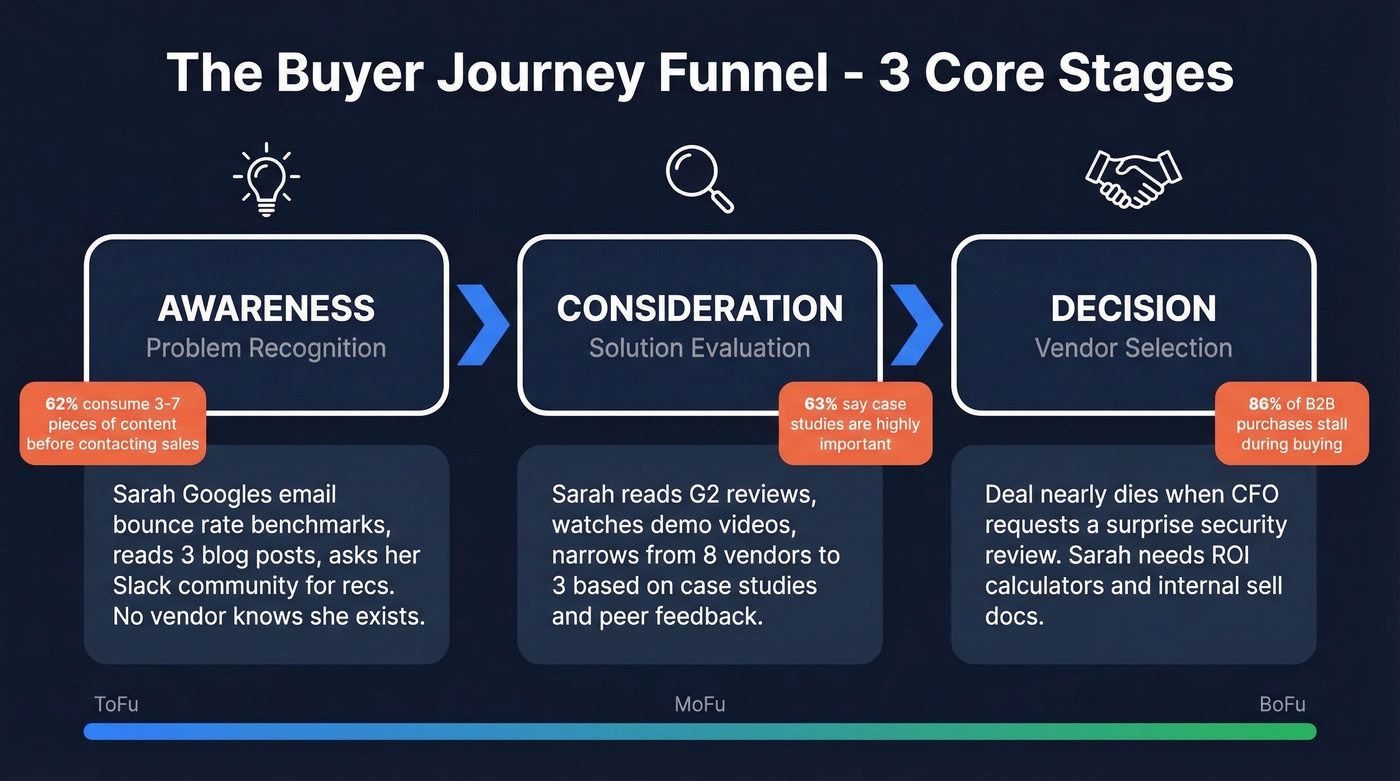
To make this concrete, imagine Sarah, a VP of Marketing at a 200-person SaaS company. Her team's outbound emails are bouncing at 30%, pipeline is stalling, and the CEO is asking questions. Sarah's journey through the funnel looks nothing like a straight line - but it hits every stage.
Awareness
This is where buyers realize they have a problem worth solving. They aren't evaluating vendors yet - they're forming a consideration set built from four sources, roughly in order of influence: vendors they've used successfully before, peer recommendations, brands already top-of-mind, and third-party aggregators like review sites and search engines.
Content consumption at this stage is heavier than most teams assume. 62% of B2B buyers consume 3-7 pieces of content before ever contacting a salesperson, and buyers consume roughly 13 pieces of content across the full purchasing journey. Meanwhile, 67% of customers prefer self-service over speaking to a company representative. Sarah starts by Googling "email bounce rate benchmarks," reads three blog posts, and asks her ops lead if anyone in their Slack community has recommendations. No vendor knows she exists yet.
Your move: Be in the consideration set before buyers start narrowing. Invest in educational content, community presence, and brand search volume - not gated lead magnets that nobody wants to fill out.
Consideration
Now the buyer is actively comparing solutions. They're evaluating vendors across eight core criteria: price, value, quality, utility, trust, speed, service, and differentiated features. This isn't a neat checklist - it's what Google's research team calls the "messy middle," a loop between exploration and evaluation.
63% of buyers say customer case studies are highly important at this stage, followed closely by independent expert research at 62% and product reviews at 59%. If your consideration-stage content is just feature comparison pages, you're missing what buyers actually want - proof from people like them.
Sarah is now reading G2 reviews, watching a demo video, and asking her network who's actually used each tool. She's narrowed from eight vendors to three.
Your move: Publish case studies with real numbers, not vague "we helped Company X grow." Make product reviews easy to find. The consideration stage is won by social proof, not sales decks.
Decision
By the time a buyer reaches the decision stage, 83% have already defined their requirements before talking to sales. The vendor conversation isn't about discovery - it's about validation and negotiation.
And yet, this is where things fall apart. 86% of B2B purchases stall during the buying process. Even more striking: 81% of buyers end up dissatisfied with the provider they ultimately choose. Sarah's deal almost dies when the CFO asks for a security review nobody anticipated. The decision stage isn't a victory lap. It's where internal politics, competing priorities, and procurement friction kill deals that looked certain.
Your move: Arm your champion with internal sell materials - ROI calculators, security docs, one-pagers for the CFO. The deal is won or lost in meetings you're not in.
A note on B2C: These benchmarks and dynamics are B2B-focused. B2C funnels typically compress into days or hours rather than months, involve one or two decision-makers instead of a committee, and rely more heavily on emotional triggers and price sensitivity. Same framework, different timescales.
Buyer Journey vs. Sales Funnel vs. Customer Journey
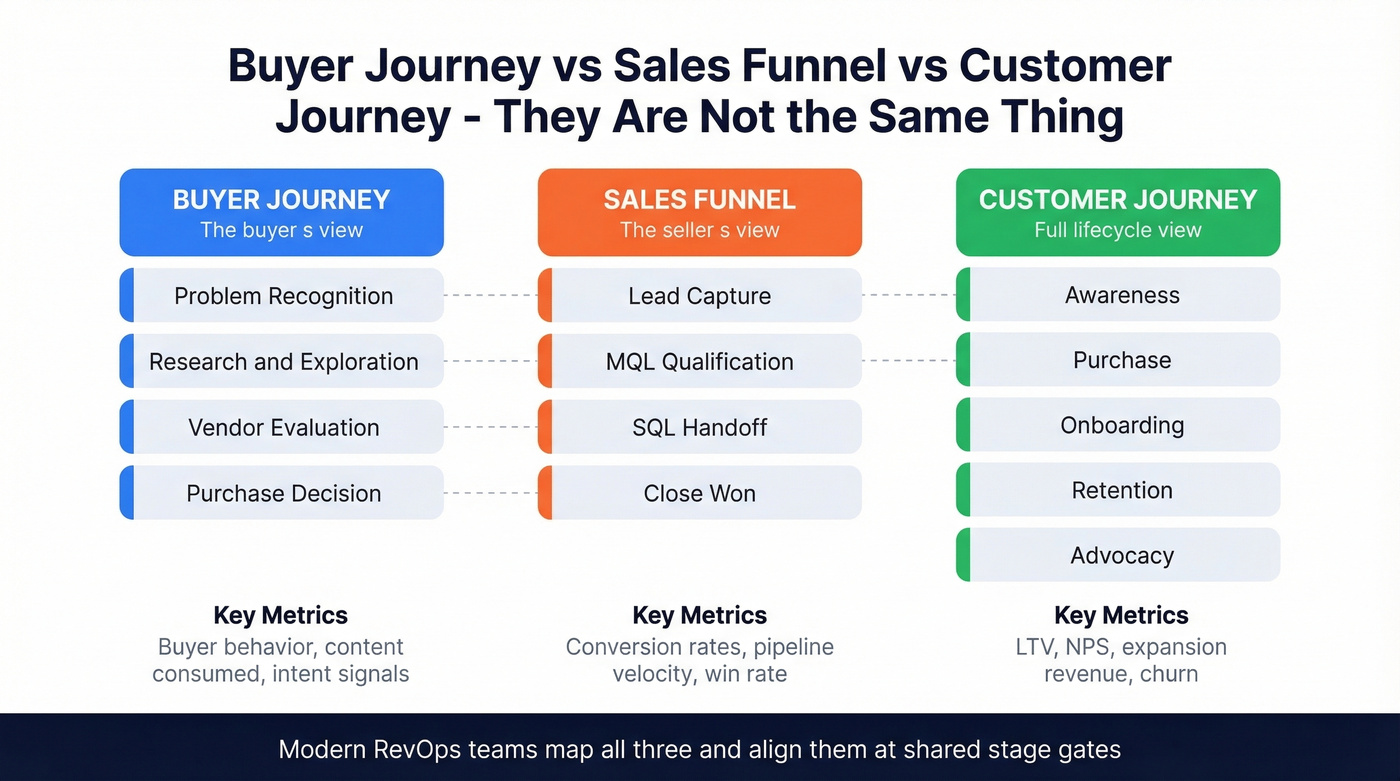
These three terms get used interchangeably, and they shouldn't.
| Buyer Journey | Sales Funnel | Customer Journey | |
|---|---|---|---|
| Perspective | Buyer's view | Seller's view | Full lifecycle |
| Stages | Problem → Research → Decision | Lead → MQL → SQL → Close | Awareness → Purchase → Advocacy |
| Measures | Buyer behavior & intent | Conversion rates & velocity | LTV, NPS, expansion |
The buyer journey describes how customers research and decide. The sales funnel describes how your team qualifies and converts. The customer journey spans the entire relationship, including post-sale retention and advocacy. Modern RevOps teams map all three and align them at shared stage gates - the handoff from MQL to SQL, for example, should correspond to a buyer moving from consideration to decision.
Conversion Benchmarks by Stage
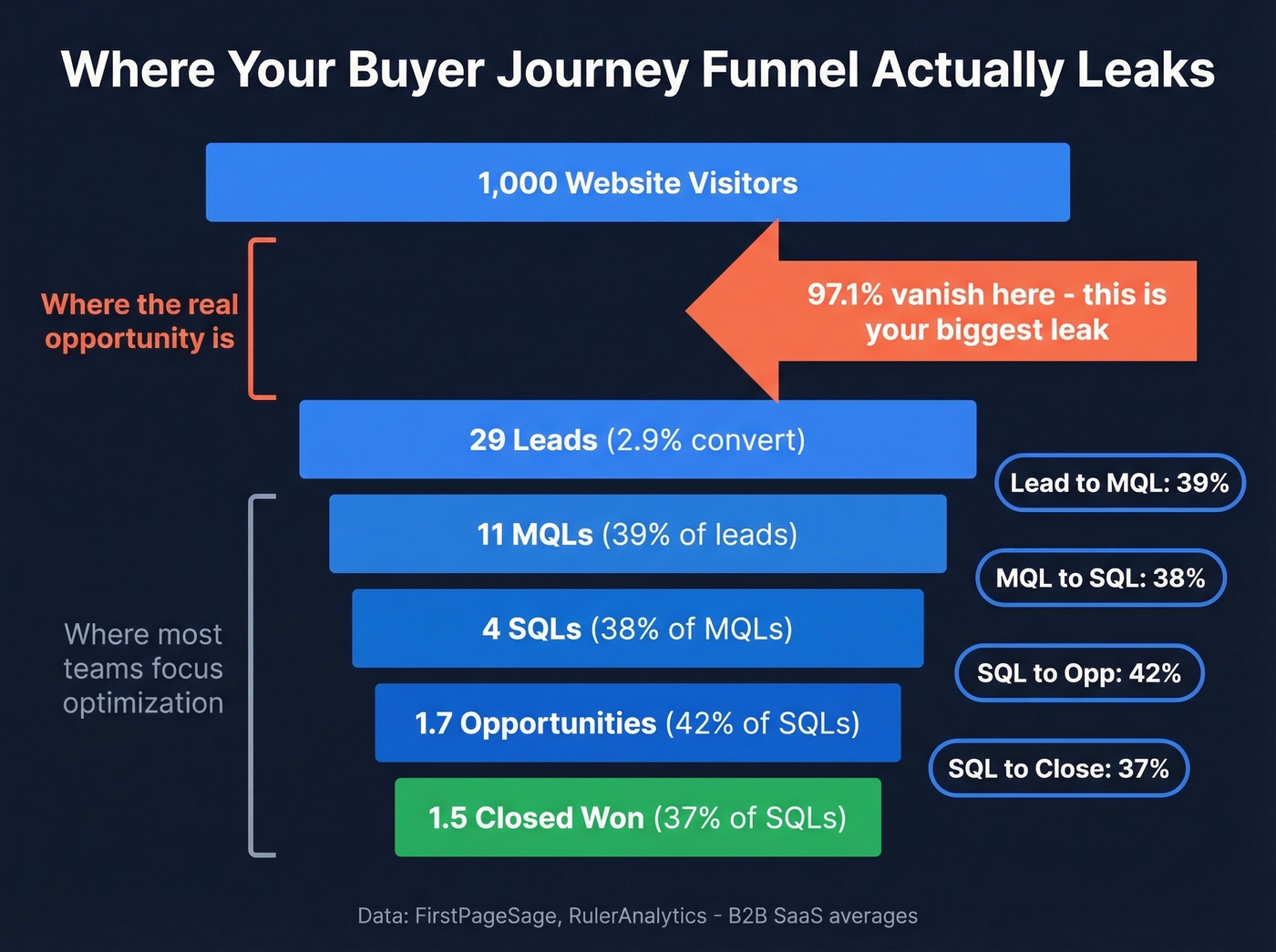
Here's where most buyer journey content goes vague. These B2B SaaS benchmarks from FirstPageSage are drawn from multi-year data across thousands of companies:
| Stage Transition | Conversion Rate |
|---|---|
| Lead → MQL | 39% |
| MQL → SQL | 38% |
| SQL → Opportunity | 42% |
| SQL → Closed Won | 37% |
Those numbers look reasonable - even healthy. So where's the leak?
It's pre-funnel. The average visitor-to-qualified-lead rate is just 2.9% (form rate 1.7%, call rate 1.2%). For every 1,000 website visitors, roughly 29 become leads. Of those 29, about 11 become MQLs, 4 become SQLs, and maybe 1.5 close.
In our experience, the pre-funnel leak is where most teams lose the plot. They'll spend weeks optimizing the MQL-to-SQL handoff by 3 percentage points while ignoring the 97% of visitors who never entered the funnel at all. The biggest opportunity is figuring out what those visitors are doing - and whether any of them are actually in-market. (If you want a deeper measurement layer, use a dedicated funnel metrics framework.)

Your buyer journey funnel leaks 97% of visitors before they ever convert. Prospeo's intent data tracks 15,000 topics so you can detect in-market buyers before they raise their hand - then reach them with 98% accurate emails.
Stop waiting for the 2.9% to convert. Go find the other 97%.
The Dark Funnel and Intent Signals
Buyers spend ~73% of their journey researching anonymously before contacting a vendor. That's nearly three-quarters of the buying process happening in complete darkness.
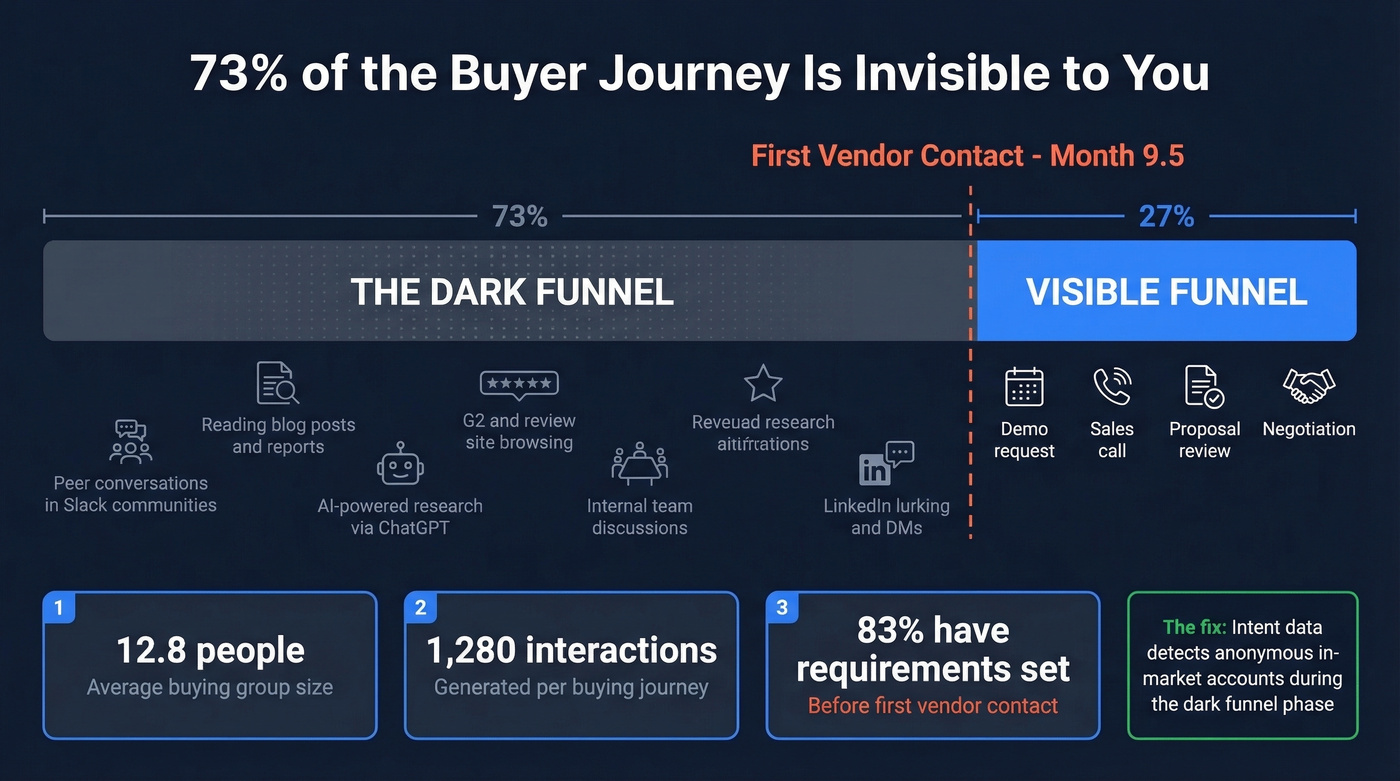
The visibility gap widens at every level. The average B2B buying journey spans 13 months, with first vendor contact happening around month 9.5. Buying groups average 12.8 people generating 1,280 interactions during that journey. Peer conversations, communities, private content, AI-generated research - all invisible to your attribution model.
When you combine that complexity with the fact that 83% of buying teams have requirements mostly set before vendor contact, the implication is stark: by the time someone fills out your demo form, the decision is largely made. You're either already in the consideration set, or you're not. This is why the intent marketing funnel - a model that uses behavioral signals to detect and engage buyers during their anonymous research phase - has become the operational replacement for the traditional demand gen playbook.
Look, we've seen this play out firsthand. Prospeo tracks 15,000 Bombora-powered intent topics layered across 300M+ professional profiles, which means you can detect anonymous in-market accounts while they're still in that invisible 73%. Instead of waiting for a form fill, you're identifying companies actively researching your category - with verified contact data to act on those signals immediately.
Most teams don't have a conversion problem. They have a visibility problem. If 73% of the journey is invisible and you're only optimizing the 27% you can see, you're rearranging deck chairs. Fix the dark funnel first, then worry about your nurture sequence.
How the Funnel Is Changing in 2026
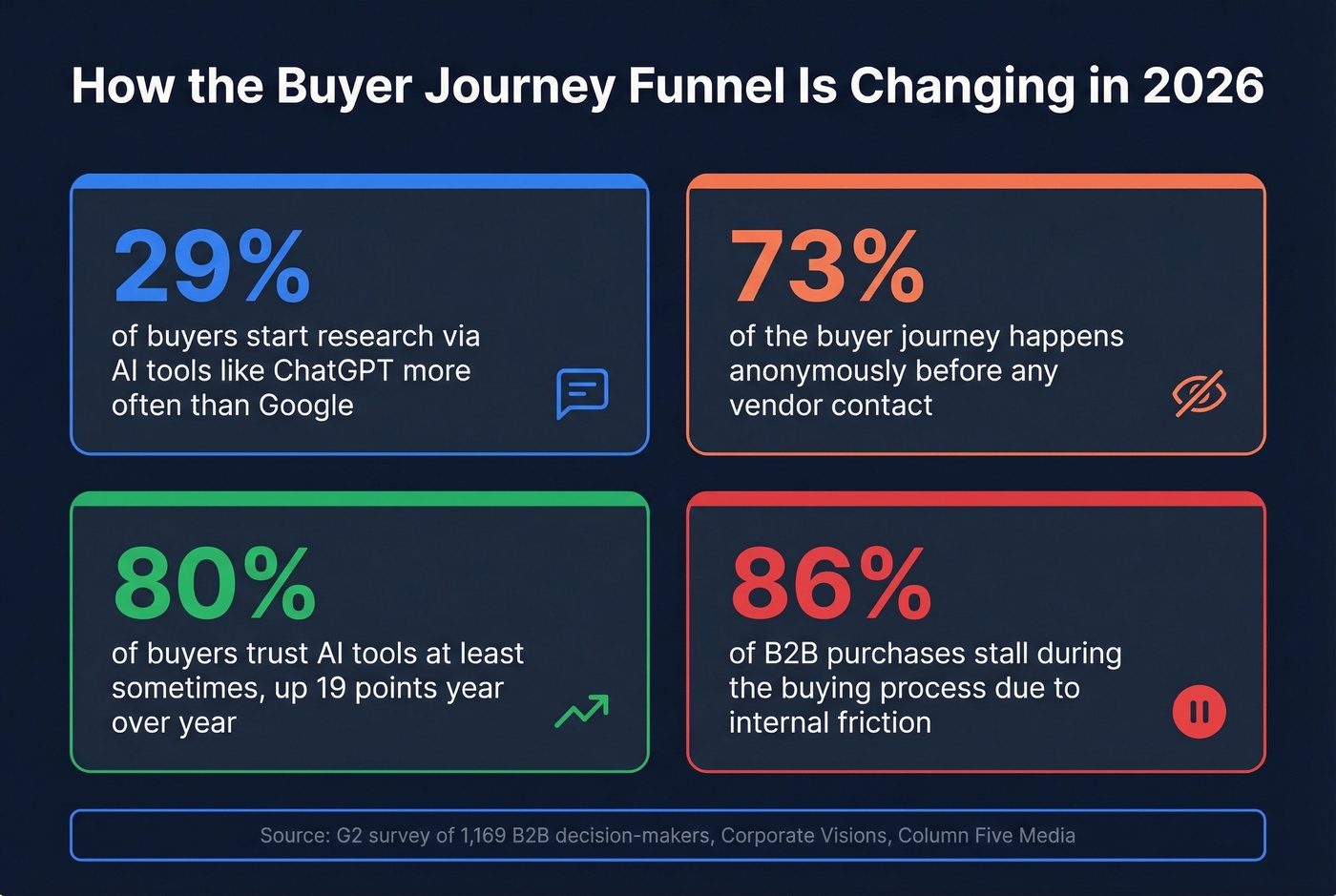
The funnel isn't dead, but it's mutating fast. A G2 survey of 1,169 B2B decision-makers reveals three shifts worth tracking.
AI as a Funnel Entry Point
29% of buyers now start research via ChatGPT-like tools more often than Google. Separately, 72% have encountered AI Overviews in search results, and 80% trust AI tools at least sometimes - up 19 points year-over-year. If your awareness-stage strategy is purely SEO-dependent, you're missing a growing channel. (Related: lead generation trends that are shifting budgets.)
Buyers Want Sales Later
Nearly two-thirds prefer engaging salespeople only in later stages, a 17-point jump from the prior year. 6sense data shows first vendor contact now happens at 61% of the journey, down from 69%, meaning buyers are engaging vendors earlier in their process - but strictly on their own terms.
Smaller Committees, Higher Stakes
The once-dominant 5-8 member buying committee is shrinking, with 3-4 member groups rising in software decisions. But 86% of IT pros still report 3+ stakeholders, and software purchases still pull in multiple functions. Fewer people with more individual influence makes multi-threading even more critical. Average sales cycle length has dropped from 11.3 months to 10.1 months - meaningful compression, but still a long time to maintain pipeline discipline.
KPIs by Funnel Stage
A funnel without metrics is a PowerPoint slide. If you measure one thing per stage, measure the bolded metric.
| Stage | Key Metric | Target/Benchmark | How to Measure |
|---|---|---|---|
| Awareness | Qualified traffic growth | MoM increase; bounce 26-40% | GA4, Search Console |
| Consideration | MQL volume | 39% of leads → MQL | CRM stage reports |
| Decision | SQL-to-close rate | 37% (B2B SaaS avg) | CRM pipeline analysis |
| Retention | NPS / expansion revenue | NPS > 40; net revenue retention > 110% | Survey + billing data |
Supporting metrics matter too. At awareness, track brand search volume and content engagement depth. During consideration, monitor site speed (target under 2 seconds) and content consumption patterns - are prospects reading one page or five? At decision, watch demo request volume and proposal-to-close ratio. Post-sale, referral rate is the leading indicator that your funnel is producing happy customers, not just closed deals. (If you need a pipeline view, start with pipeline health.)
How to Map Your B2B Buyer Journey
We've watched teams spend weeks on funnel mapping and produce something indistinguishable from a generic template. The difference between a useful map and a decorative one comes down to five steps. This process draws on FullFunnel's mapping approach, which includes a 7-stage model and a downloadable workbook with 45 interview questions - worth grabbing if you're doing this for the first time.
1. Segment your ICP. Don't map one generic journey. A 50-person startup and a 5,000-person enterprise have fundamentally different buying processes. Map each segment separately. (Use an Ideal Customer Profile template if you need one.)
2. Interview 10-15 recent customers. Ask about the moment they realized they had a problem, where they went for information, who else was involved, and what almost killed the deal. These conversations are the single highest-ROI activity in journey mapping. We've seen teams skip this step and end up with a funnel map that could belong to any company in their industry - generic to the point of uselessness.
3. Identify trigger events. What happened right before they started looking? A new hire, a funding round, a failed campaign, a competitor move. Trigger events tell you when to engage, not just who. (This is much easier with a system for how to track sales triggers.)
4. Map micro-steps per stage. Don't just write "Awareness → Consideration → Decision." Break each stage into 5-10 specific actions: read a blog post, ask a peer, watch a demo video, loop in the CFO. The more granular, the more useful.
5. Build a content matrix against the map. Match every micro-step to a content asset or touchpoint. Document the questions and objections each stakeholder has at each step - the champion's concerns at consideration stage are different from the CFO's at decision stage. Once you've identified decision-stage accounts, you need verified contact data to reach the right people; Prospeo's 98% email accuracy and 7-day data refresh mean you're reaching real inboxes, not bouncing off stale records. (If you're seeing high bounce, start with email bounce rate fundamentals.)
86% of B2B deals stall because your champion can't sell internally. Arm your team with verified direct dials (125M+ mobiles, 30% pickup rate) to reach every stakeholder on the buying committee - not just the one who filled out your form.
Reach the whole buying committee, not just one contact.
Buyer Journey Funnel FAQ
What's the difference between a buyer journey and a sales funnel?
The buyer journey describes the customer's perspective - how they research, evaluate, and decide. The sales funnel describes the seller's perspective - how leads are qualified and converted. Same process, opposite viewpoints. Modern RevOps teams map both and align them at shared stage gates like the MQL-to-SQL handoff.
How many stages should a buyer journey funnel have?
Start with three: Awareness, Consideration, Decision. Expand to five or seven once you have conversion data justifying the complexity. Most B2B SaaS teams use 5-7 stages aligned to CRM pipeline definitions, but three is enough to build a working measurement framework. Skip this if you're a team of five with no CRM pipeline stages defined - get the basics in place first.
How do you measure funnel performance?
Assign one primary KPI per stage: qualified traffic growth, MQL volume, SQL-to-close rate. Track stage-to-stage conversion rates against B2B SaaS benchmarks (39% Lead→MQL, 38% MQL→SQL, 37% SQL→Closed). Use intent data to measure the 73% that happens before form fills.
What tools help detect anonymous buyer activity?
You need three capabilities: a CRM with defined stages (HubSpot, Salesforce), intent data to detect anonymous research activity, and attribution software to connect touchpoints. Let's be honest - most teams bolt these together from three or four different vendors and spend months on integration. The fewer handoffs in your stack, the faster you'll actually act on the signals.