

Buyer Persona Development: Stop Building Fictional Characters, Start Mapping Buying Decisions
It's Tuesday morning and the VP of Marketing just pinged Slack: "Can someone update our buyer personas before the board deck?" Everyone nods. Someone opens a Google Doc from 2023 with a stock photo of "Marketing Mary," who enjoys hiking and reads industry blogs. Nobody's talked to an actual customer in two years. The personas get a fresh font, a new job title, and they're back in the deck - collecting dust by Friday.
That's what broken buyer persona development looks like at most companies.
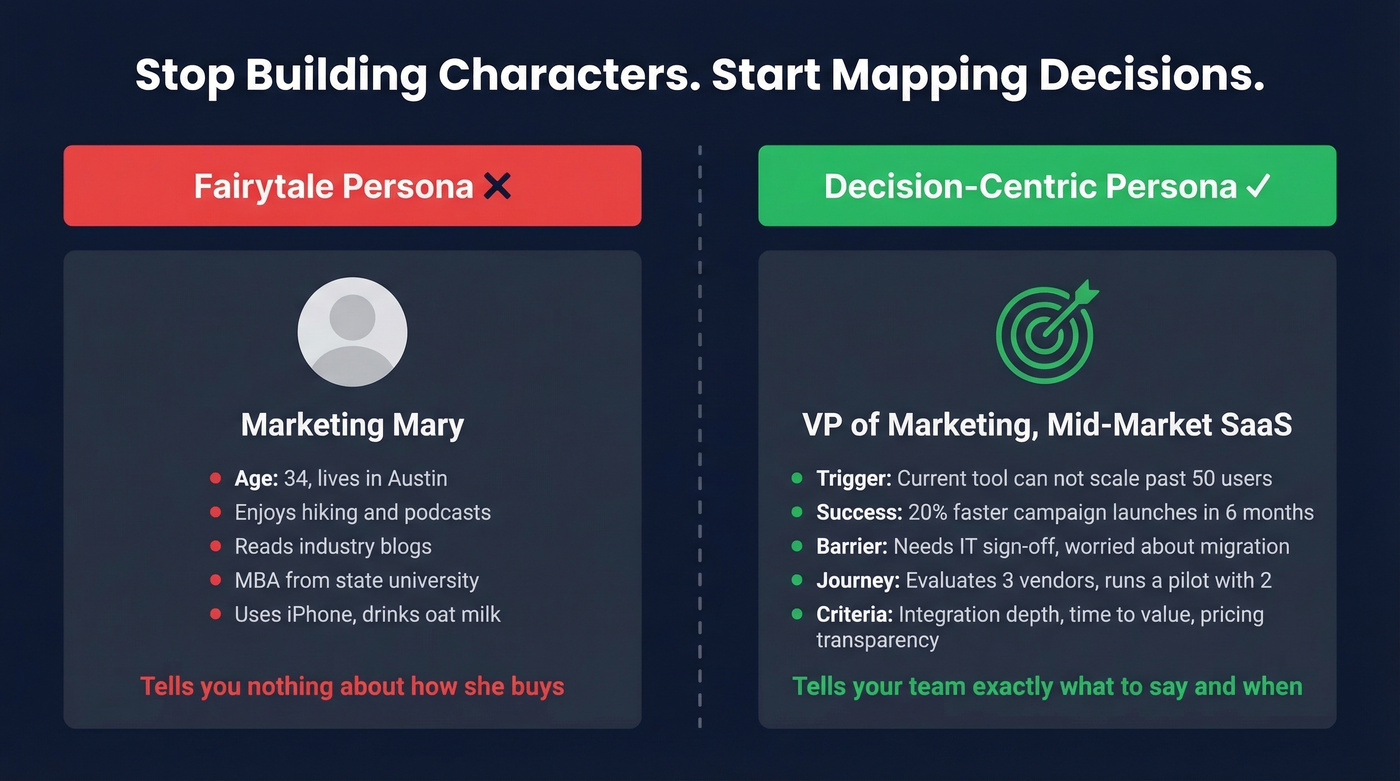
Practitioners on r/b2bmarketing call these "fairytale personas." They look professional, feel productive, and drive zero revenue. Developing a buyer persona the right way doesn't mean profiling a fictional character. It means mapping the buying decision - the priorities, barriers, and criteria that determine whether someone picks you or your competitor.
What You Need (Quick Version)
- Profile the buying decision, not the buyer's biography
- Interview 8-15 people per segment (start with sales and CS)
- Build 3-5 personas max
- Include one negative persona - who you don't want as a customer
- Update quarterly (light) and do an annual deep refresh with fresh interviews
- Map persona attributes to prospecting filters in a B2B data platform, or your personas never become pipeline
Persona vs. ICP vs. Target Audience
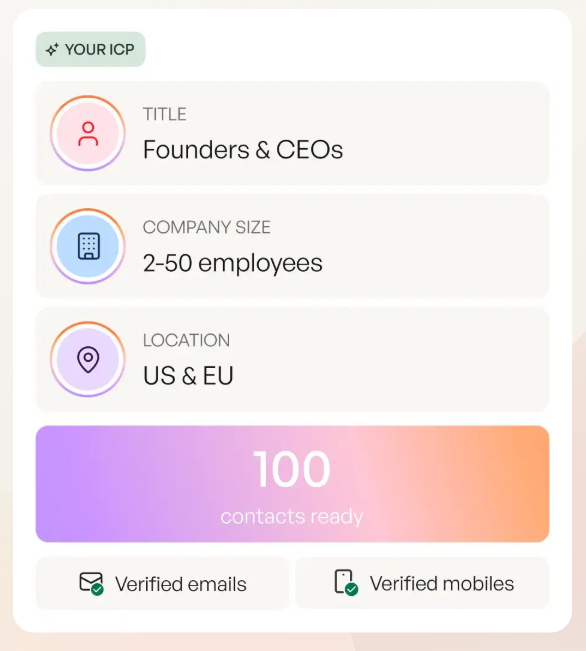
An ICP defines which companies are worth pursuing. A buyer persona defines who within those companies you're actually talking to. A target audience is the broadest grouping - everyone who might see your ads or content.
These three get used interchangeably, and it causes real problems.
Here's the failure mode HubSpot nails: targeting the right people at the wrong companies. You've built a perfect persona for a VP of Engineering, but you're pitching 10-person agencies that don't have one. Your ICP uses firmographics and market segmentation to filter accounts. Your persona uses decision criteria and buying behavior to shape messaging. Conflating them means your targeting is sharp but your pitch is generic - or vice versa.
| ICP | Buyer Persona | Target Audience | |
|---|---|---|---|
| Definition | Ideal company profile | Decision-maker archetype | Broad market segment |
| Scope | Account-level | Individual-level | Group-level |
| Answers | "Who should we sell to?" | "Why do they buy?" | "Who might see us?" |
| Usage | Account targeting, ABM | Messaging, sales enablement | Media planning, ads |
| Example | SaaS, 50-500 employees, Series B+ | VP Ops, 3-7 yr tenure, evaluating tools | Tech leaders, US/EMEA |
The Decision-Centric Framework
Here's the thing: most companies don't have a persona problem. They have a decision-mapping problem. They know who their buyer is on paper. They have no idea how that buyer actually decides.
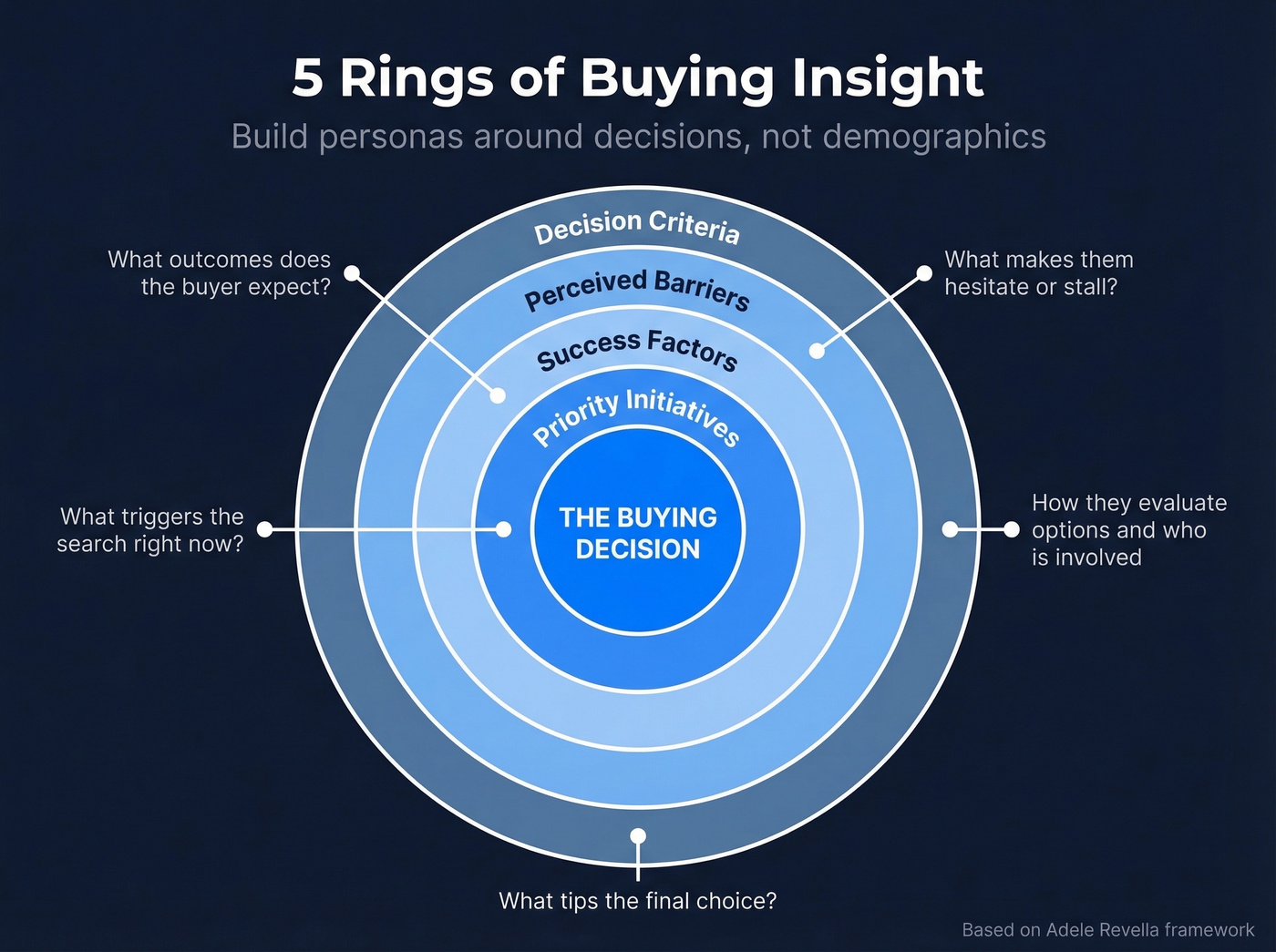
Adele Revella's 5 Rings of Buying Insight framework, rooted in the same Jobs-to-be-Done philosophy that drives modern product development, is the clearest model for fixing this. The five rings:
- Priority initiatives - what triggers the search for a solution right now?
- Success factors - what outcomes does the buyer expect?
- Perceived barriers - what makes them hesitate or stall?
- Buyer's journey - how do they evaluate options, and who else sits on the buying committee (champion, economic buyer, technical evaluator)?
- Decision criteria - what specific factors tip the final choice?
Each ring maps directly to content, sales enablement, and objection handling. A persona built around these five dimensions tells your team what to say and when. A persona built around demographics tells them nothing actionable.

You just mapped decision criteria, buying triggers, and success factors for each persona. Now operationalize them. Prospeo's 30+ search filters - including buyer intent, technographics, job changes, and department headcount - let you translate persona attributes directly into targeted prospect lists with 98% email accuracy.
Stop letting personas collect dust. Turn them into pipeline today.
How to Create Buyer Personas Step by Step
Start With Internal Interviews
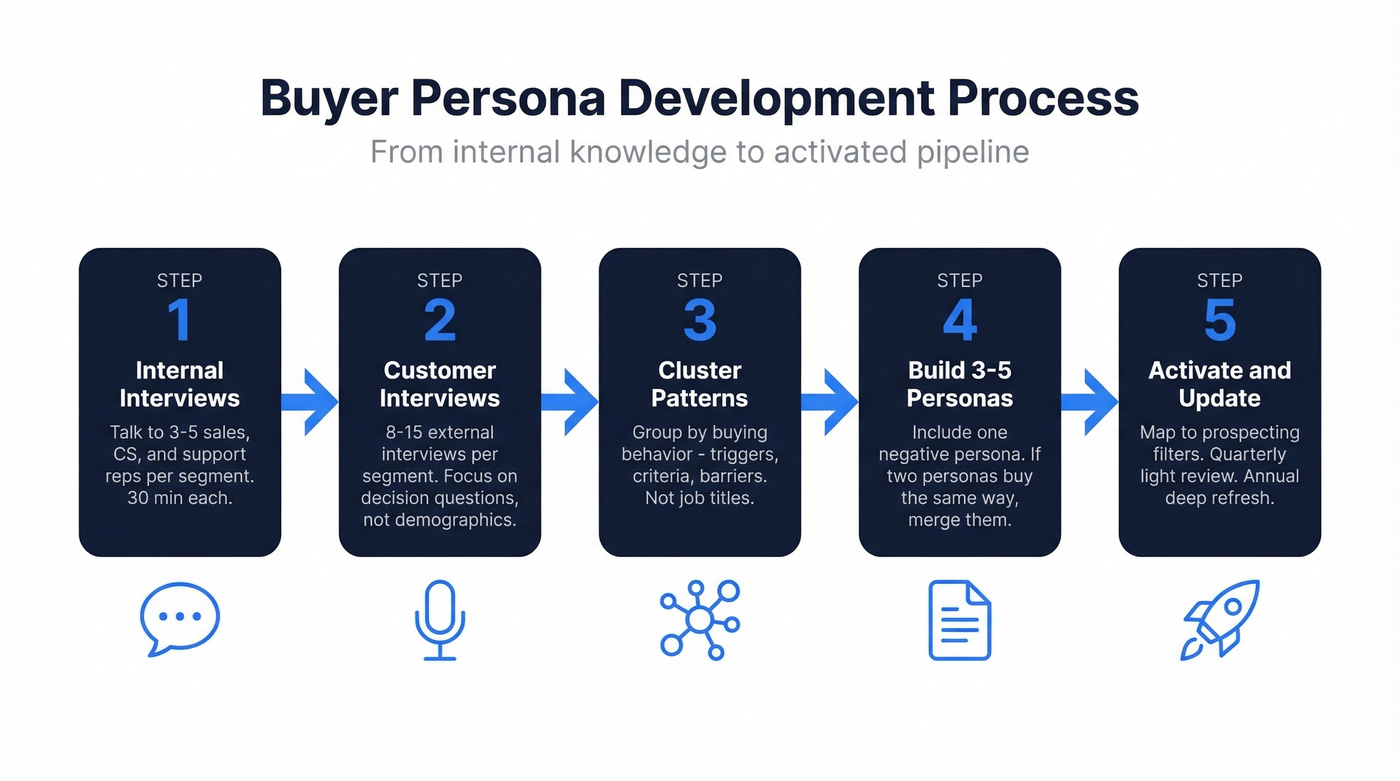
Don't schedule external customer interviews first. Your sales team, CS reps, and support agents already know the patterns - common objections, deal-breakers, the questions prospects always ask. Run 30-minute sessions with 3-5 internal stakeholders per persona segment. In our experience, this surfaces most of the themes before you ever talk to a customer, and it shows you exactly which gaps to probe externally.
If you want to make these interviews immediately useful for outbound, align them to your sales prospecting techniques and the objections your reps hear daily.
Interview Questions That Reveal Decisions
External interviews are where personas go from directional to actionable. Aim for 8-15 interviews per segment. HubSpot documented a case where interview-driven persona changes lifted a campaign's conversion rate by 40%, which shouldn't surprise anyone - you're finally writing to what buyers actually care about instead of what you assumed they cared about. Seven questions worth copying into your interview doc:
- What triggered your search for a solution?
- What were you using before, and what broke?
- Who else was involved in the decision?
- What criteria mattered most when comparing options?
- What almost stopped you from buying?
- What information was hardest to find during evaluation?
- What does success look like 12 months from now?
None of these ask about hobbies or podcast preferences. They're all decision-centric - designed to reveal what buyers are trying to accomplish, not who they are on paper.
If you need a tighter structure for these conversations, borrow from proven discovery questions frameworks.
Synthesize Into 3-5 Personas
After interviews, look for clusters. You'll find 3-5 distinct buying patterns - different triggers, different decision criteria, different barriers. That's your persona set.
Resist the urge to create more. We've worked with teams that had 15+ personas. Nobody remembered them. Nobody used them. And the messaging ended up so diluted it spoke to no one. Build at least one negative persona: the buyer who looks right on paper but churns fast, drains support, or never expands. Research from Cintell found that 71% of companies exceeding revenue goals have documented buyer personas, and that includes knowing who to exclude.
If churn is the pattern behind your negative persona, treat it like a measurable problem and run a simple churn analysis before you rewrite messaging.
Common Mistakes to Avoid
Biographical fiction over decision insight. If your persona doc has a name and hobbies but no decision criteria, it's a character sheet. Rebuild around the 5 Rings.
Over-segmentation. Consolidate to 3-5 personas based on distinct buying patterns, not minor demographic differences. If you can't articulate how two personas buy differently, merge them.
No customer input. The r/b2bmarketing consensus is blunt: fairytale personas built without sales or customer input - reflecting firmographics and buying committees, not just individual profiles - collect dust immediately. Skip this if you want a pretty deck slide. Don't skip it if you want pipeline.
No update cadence. A persona from 2024 is a liability in 2026. Assign an owner, run quarterly light reviews, and do an annual deep refresh with fresh interviews. Without governance, personas decay silently and your team keeps selling to a buyer who no longer exists.
No negative persona. You're spending pipeline energy on buyers who'll never close. Document the anti-persona explicitly.
Activate Your Personas
A persona that lives in a Google Doc doesn't work. Activation means embedding persona thinking into daily operations using what B2B International calls the Four W's: Who are we targeting? What messaging aligns to their decision criteria? Where are we showing up in channels they actually use? When are we reaching them at the right buying stage?
One B2B firm placed a large cardboard cutout of "Technical Tony" in their conference room to keep teams focused during planning. Extreme, but the principle is sound - personas need to be visible and referenced constantly, not buried in a wiki nobody opens. Teams that invest in developing buyer personas for business outcomes often see 10-30% improvements in key funnel metrics and up to 20% faster sales cycles.
To keep persona work tied to revenue, track it against funnel metrics instead of vanity engagement.
From Persona to Prospect List
Look - this is where most persona guides end, and where the actual work begins. You've got a persona doc that says "VP of Operations at mid-market SaaS companies, 100-500 employees, evaluating workflow automation tools." Great. So who do you actually call?
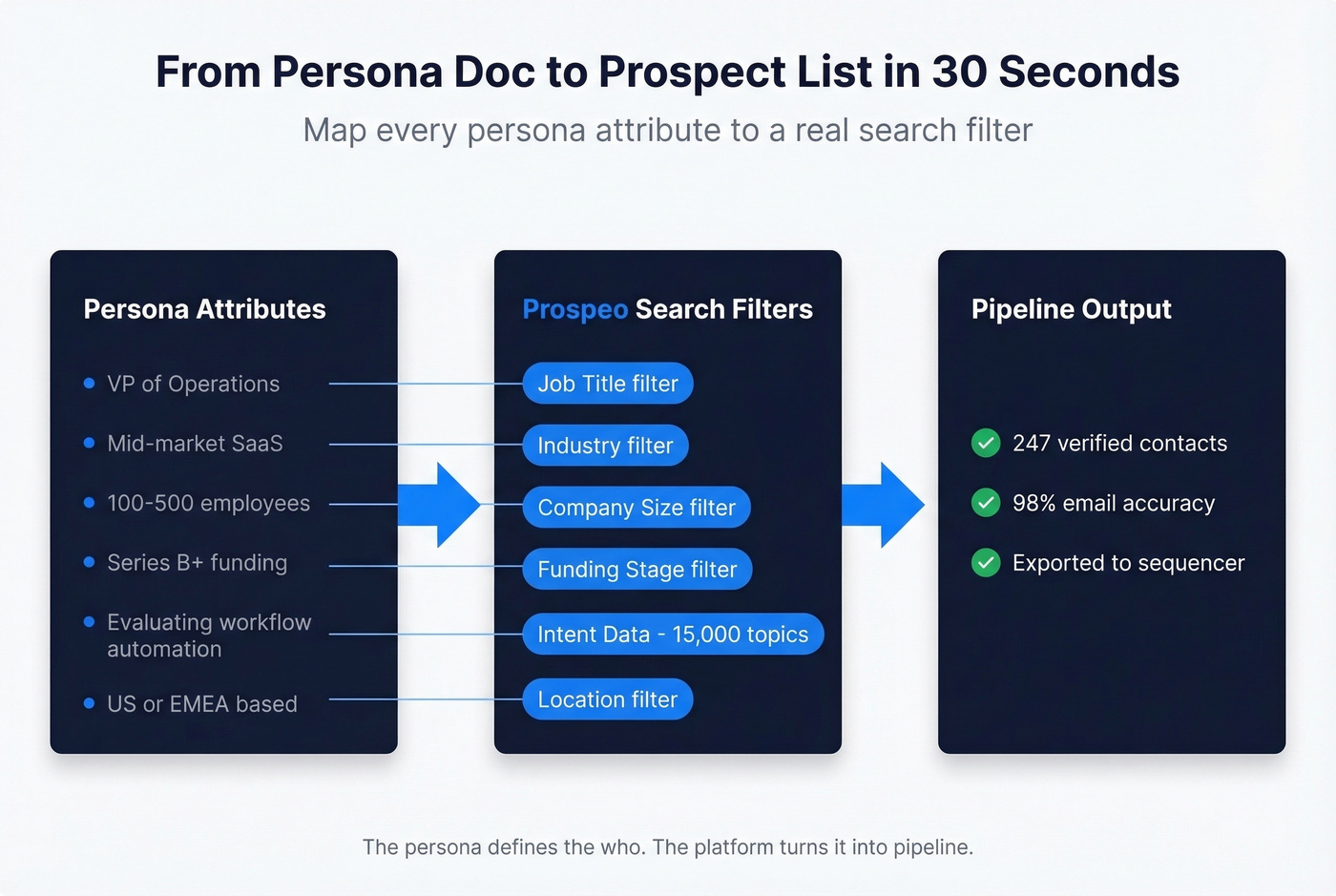
The bridge from persona to pipeline is mapping persona attributes directly to prospecting filters. Job title, industry, company size, tech stack, funding stage, buyer intent - these aren't abstract persona fields, they're search parameters. Your persona says "VP of Operations, mid-market SaaS, 100-500 employees, evaluating workflow automation." In Prospeo's B2B database, that's three filters and a 30-second search. Layer on intent data tracking 15,000 topics to find buyers actively researching your category, pull a verified list with 98% email accuracy, and export straight to your sequencer.
If you're formalizing those filters, start with a clean set of firmographic filters and then layer in firmographic and technographic data.
The persona defines the who. The platform turns it into pipeline.
Your negative persona is just as important as your ideal buyer. Prospeo's 300M+ profile database with intent data across 15,000 topics lets you filter out bad-fit accounts before they waste your team's time - and zero in on buyers actively researching solutions like yours, at $0.01 per verified email.
Target the right decision-makers and exclude the rest - automatically.
FAQ
How many buyer personas do I need?
Three to five covers the meaningful buying patterns for most B2B companies. Always include at least one negative persona to protect pipeline resources. If you can't differentiate two personas by how they buy, merge them into one.
How often should I update personas?
Run quarterly light reviews to check shifting titles, pain points, and competitive dynamics. Do an annual deep refresh with fresh customer interviews. A persona built on 2024 assumptions will actively mislead your 2026 strategy.
What's the biggest mistake in buyer persona development?
Building personas around demographics instead of buying decisions. If your persona doc describes who the buyer is but not how they evaluate, hesitate, and choose - it's fiction. Start with the 5 Rings of Buying Insight and work outward from decision criteria.
How do I turn a persona into an actual prospect list?
Map each persona attribute - job title, company size, industry, tech stack - to search filters in a B2B data platform. Apply intent data to find buyers actively researching your category, then export verified contacts directly to your CRM or sequencer. That's the gap most teams never close, and it's exactly where persona work starts paying for itself.