

The Practitioner's Guide to Buying B2B Data in 2026
Buying B2B data sounds simple - until your first campaign bounces at 19%. The SDR team blames the list. Marketing blames the SDRs. The CFO wants to know why you're paying enterprise prices for contacts that don't work. Bad data doesn't just waste money - it costs organizations $12.9M annually on average and poisons every system it touches. Your reps lose an estimated 500 hours per year just validating and correcting bad contact info.
B2B contact data decays at roughly 2.1% per month. That's 22.5% of your database going stale every year. Email addresses churn at 23-30% annually, and 18% of phone numbers change. So the question isn't whether you should purchase data. It's how to make the right decision without getting burned.
What You Need (Quick Version)
Three paths, depending on where you are:
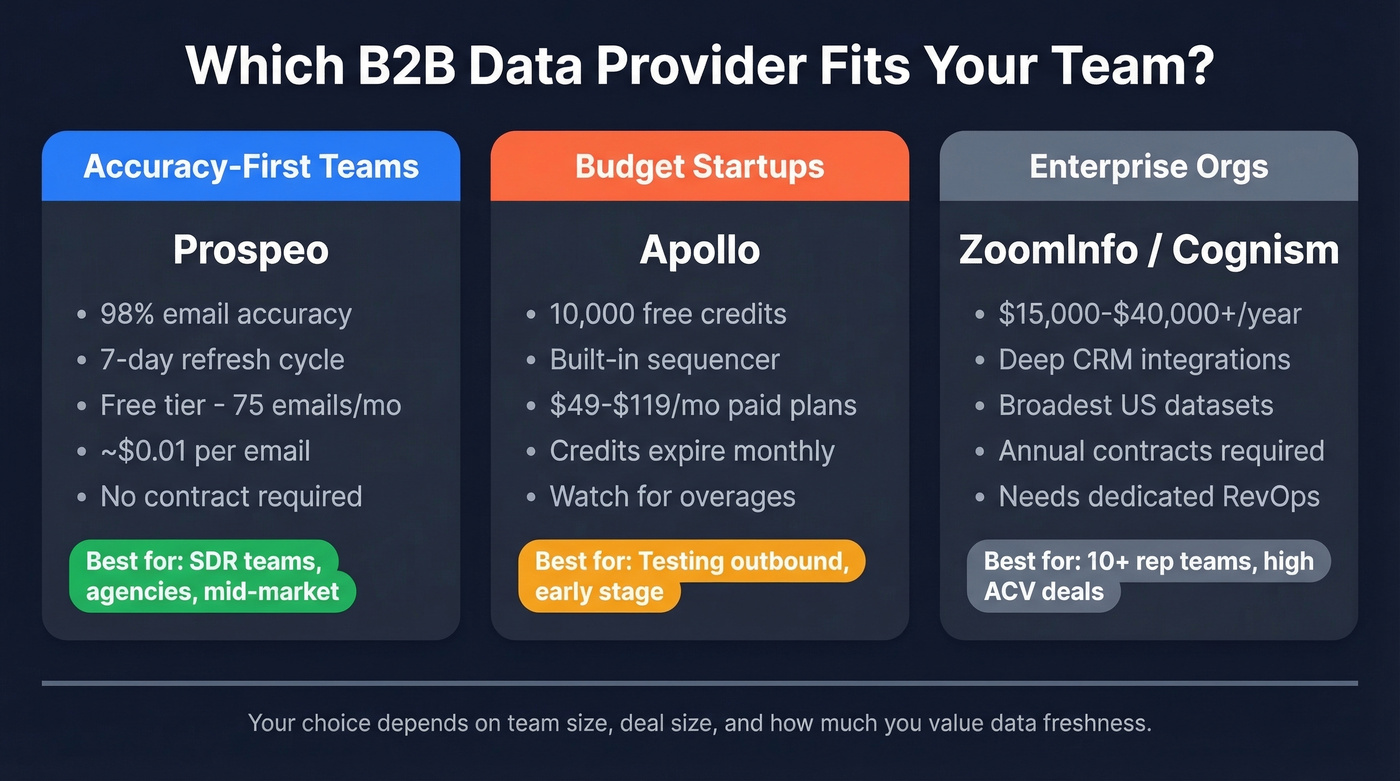
- Self-serve, accuracy-first teams: Prospeo. 98% email accuracy, 7-day refresh cycle, free tier with 75 verified emails/month. No contract, no sales call.
- Startups experimenting on a budget: Apollo. 10,000 free credits, decent coverage, good enough to validate whether outbound works before you spend real money.
- Enterprise with budget and headcount: ZoomInfo or Cognism. Deep integrations, broad datasets, org-wide deployment. Expect ZoomInfo around $15,000-$40,000+/year on an annual contract; Cognism typically runs $15,000+/year and often closer to ~$25,000/year depending on package.
What You're Actually Purchasing
Not all B2B data is the same, and the differences matter more than most vendors let on.
Contact data is the obvious one - emails, phone numbers, job titles. It's what your SDRs need to actually reach someone. Firmographic data describes the company itself: revenue, headcount, industry, location. This is how you filter for your Ideal Customer Profile before you ever pull a single contact.
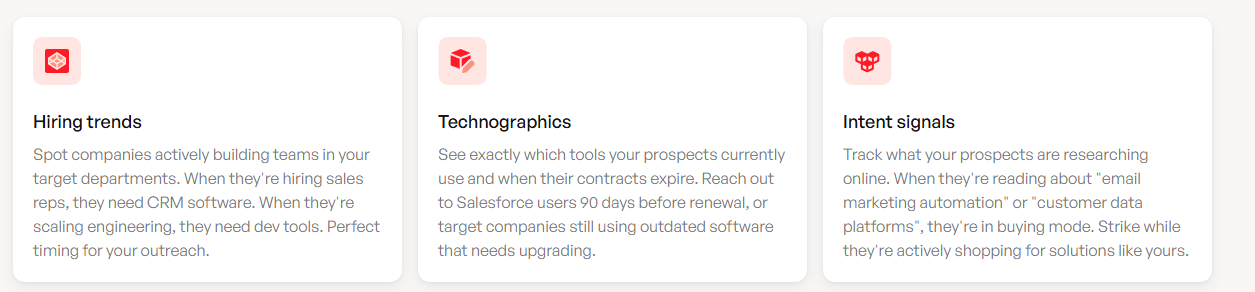
Technographic data tells you what software a company runs. If you sell a Salesforce integration, knowing which prospects already use Salesforce is the difference between a warm conversation and a wasted dial. Intent data is the newest layer - it tracks which companies are actively researching topics related to what you sell. When all four layers work together, you're not just acquiring names. You're building a targeting system.
Some providers sell data at different processing tiers - raw, cleaned, or multi-source enriched. Know which tier you're getting, because the price and accuracy differ dramatically. (If you’re comparing enrichment approaches, see data enrichment tools.)
Why Static Lists Fail
There's a fundamental split in how B2B data gets sold, and picking the wrong model will cost you more than picking the wrong vendor.
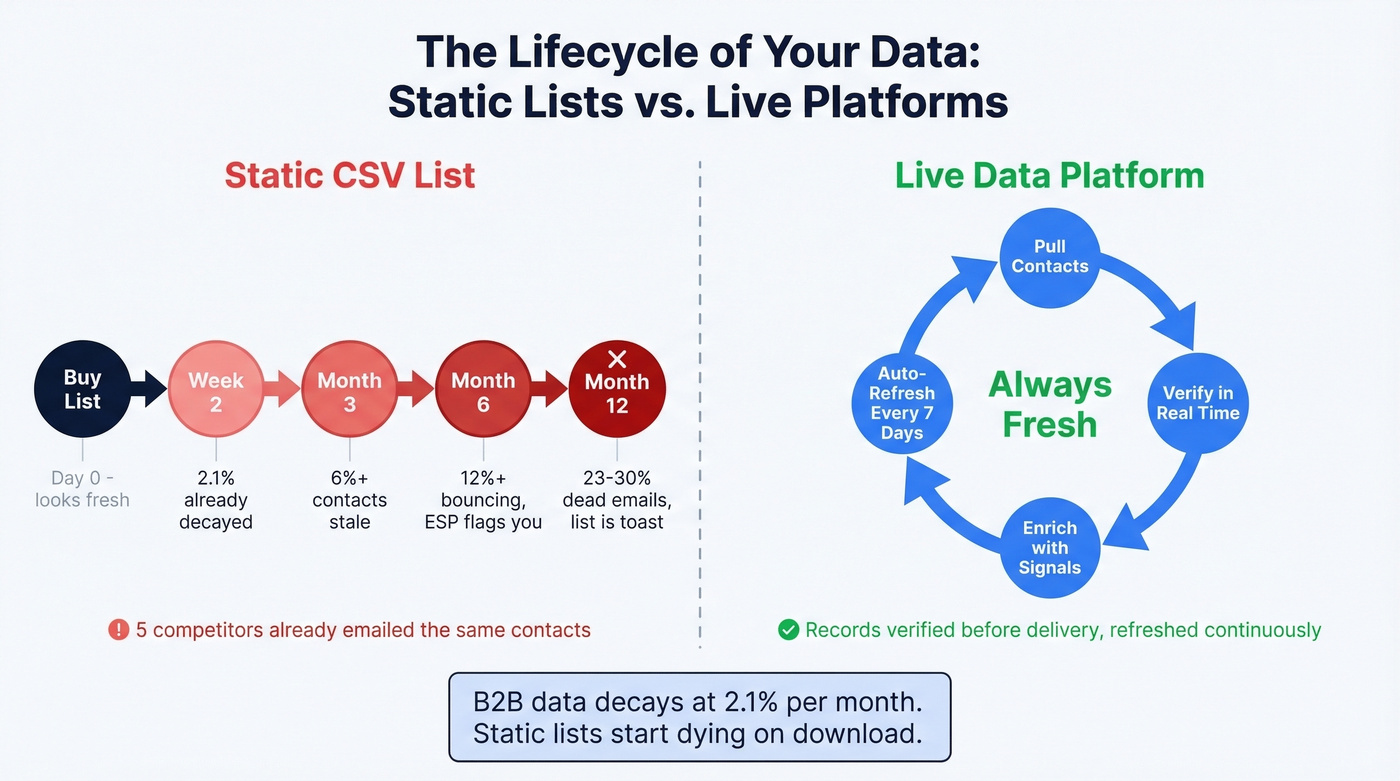
Static lists are CSV files you buy once. They're cheap, they're fast, and they start decaying the moment you download them. HubSpot has argued for years that purchasing lists is a bad idea, and their core point holds: an "opt-in" list from a vendor doesn't mean those contacts opted in to hear from your company. Most reputable ESPs - Mailchimp, HubSpot, ActiveCampaign - restrict or outright ban sending to purchased lists.
Worse, static lists get resold to dozens of buyers. By the time you email those contacts, they've already been hit by five of your competitors.
| Static Lists | Data Platforms | |
|---|---|---|
| Cost | Low upfront | Monthly/annual |
| Freshness | Decays immediately | Refreshed regularly |
| Verification | Rarely included | Real-time or near-real-time |
| ESP compliance | Often blocked | Generally accepted |
| Targeting | Fixed filters | Dynamic, layered |
The smarter approach is a platform that verifies records in real time and refreshes them on a cycle. That's where the market has moved, and it's where your budget should go. If you’re buying lists specifically, compare options in our guide to B2B list providers.
What B2B Data Actually Costs in 2026
Pricing in this space is deliberately opaque. Enterprise vendors hide behind "talk to sales" because their contracts vary wildly based on seats, modules, and how hard you negotiate. Here's what you'll actually pay:
| Provider | Pricing Model | Starting Price | Contract |
|---|---|---|---|
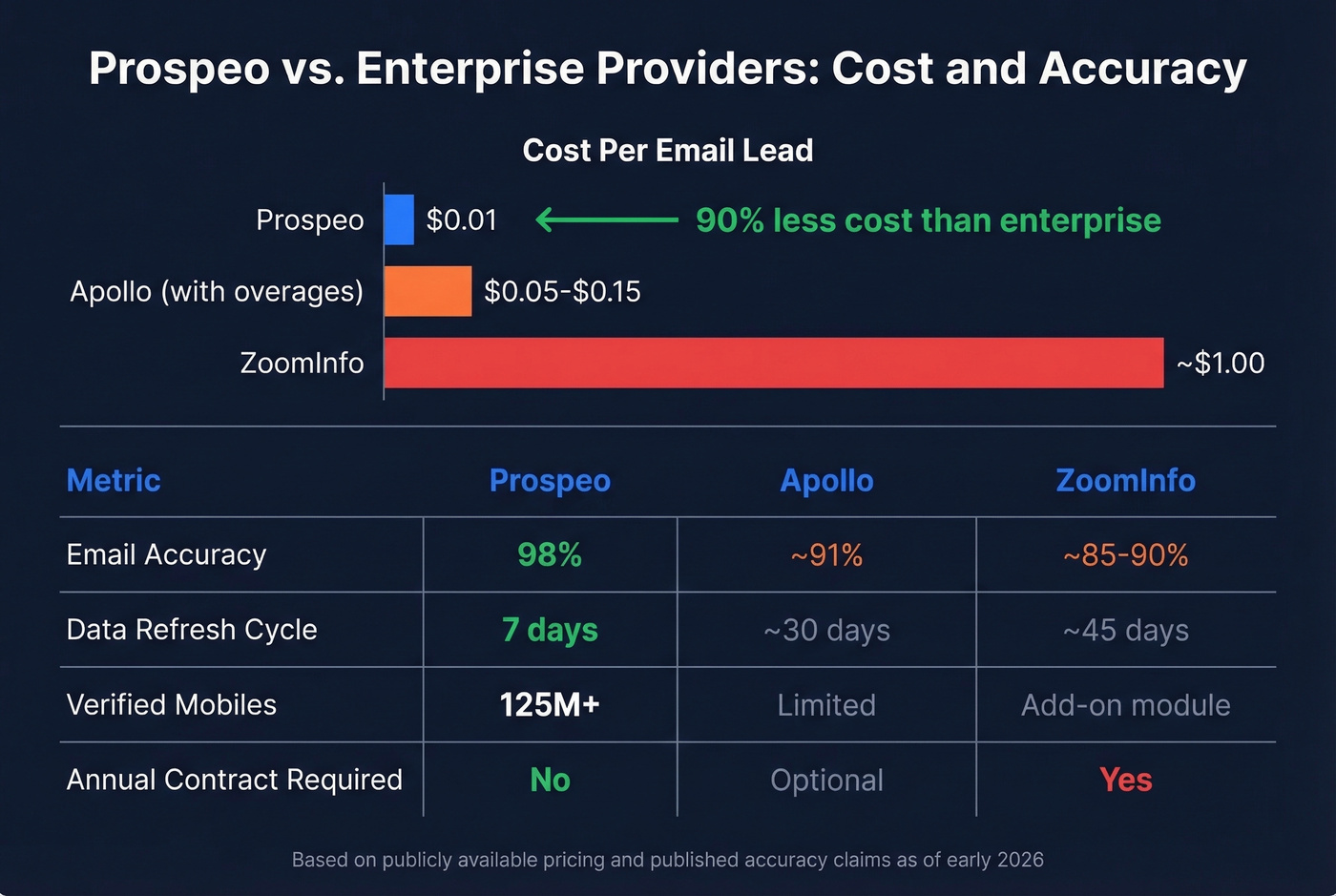
| Prospeo | Credit-based | Free (75 emails/mo), ~$0.01/email | No contract |
| Apollo | Per-user + credits | Free (10K credits), $49-$119/mo | Monthly/annual |
| Lusha | Credit-based | Free plan available, $49-$79/mo | Monthly/annual |
| UpLead | Credit-based | $99/mo (170 credits) | Monthly/annual |
| RocketReach | Subscription | Free (5 searches), from $39/mo | Monthly/annual |
| People Data Labs | Pay-per-record | From ~$0.01/record | API-based |
| ZoomInfo | Seat-based + modules | $15,000-$40,000+/yr | Annual (custom) |
| Cognism | Seat-based | $15,000+/yr (~$25,000/yr minimum) | Annual (custom) |
Platforms like Amplemarket start around $3,600/user/year, positioning them between mid-market and enterprise tiers.
Three pricing models dominate. Credit-based platforms charge per contact revealed - you pay for what you use. Per-user platforms charge a monthly seat fee plus credits for actions like mobile reveals and exports. Enterprise platforms bundle everything into an annual contract with seat minimums.
Here's the thing: Apollo's credit model looks cheap until you realize credits don't roll over and overages hit automatically. We've watched teams budget $400/month for Apollo and end up at $700+ once overages and mobile reveals kick in. A team of five reps burning through credits mid-month can see their bill jump with no warning.
A 10-seat ZoomInfo contract with intent data and mobile numbers can run $40,000+/year. That's real money for a Series A company. If your average deal size is under five figures, you almost certainly don't need ZoomInfo-level data. A self-serve platform at $0.01/email will outperform a $40K contract you can't fully utilize. (For broader comparisons, see our ranked list of the best B2B database options.)

You just read that bad data costs $12.9M annually and decays at 2.1% per month. Prospeo's 7-day refresh cycle kills decay before it starts. 98% email accuracy, 125M+ verified mobiles, and pricing at $0.01/email - no annual contract, no sales call required.
Stop buying data that's stale on arrival. Start with 75 free verified emails.
How to Evaluate a Provider
Record count is the metric every vendor leads with, and it's the least useful number you'll see. A database of 300 million contacts means nothing if half of them bounce. Across G2 and TrustRadius review sites, the most consistent complaint about any data provider isn't price - it's that the records are inaccurate or already outdated on delivery. If you want a deeper framework, start with data validation automation and build your checks into the workflow.
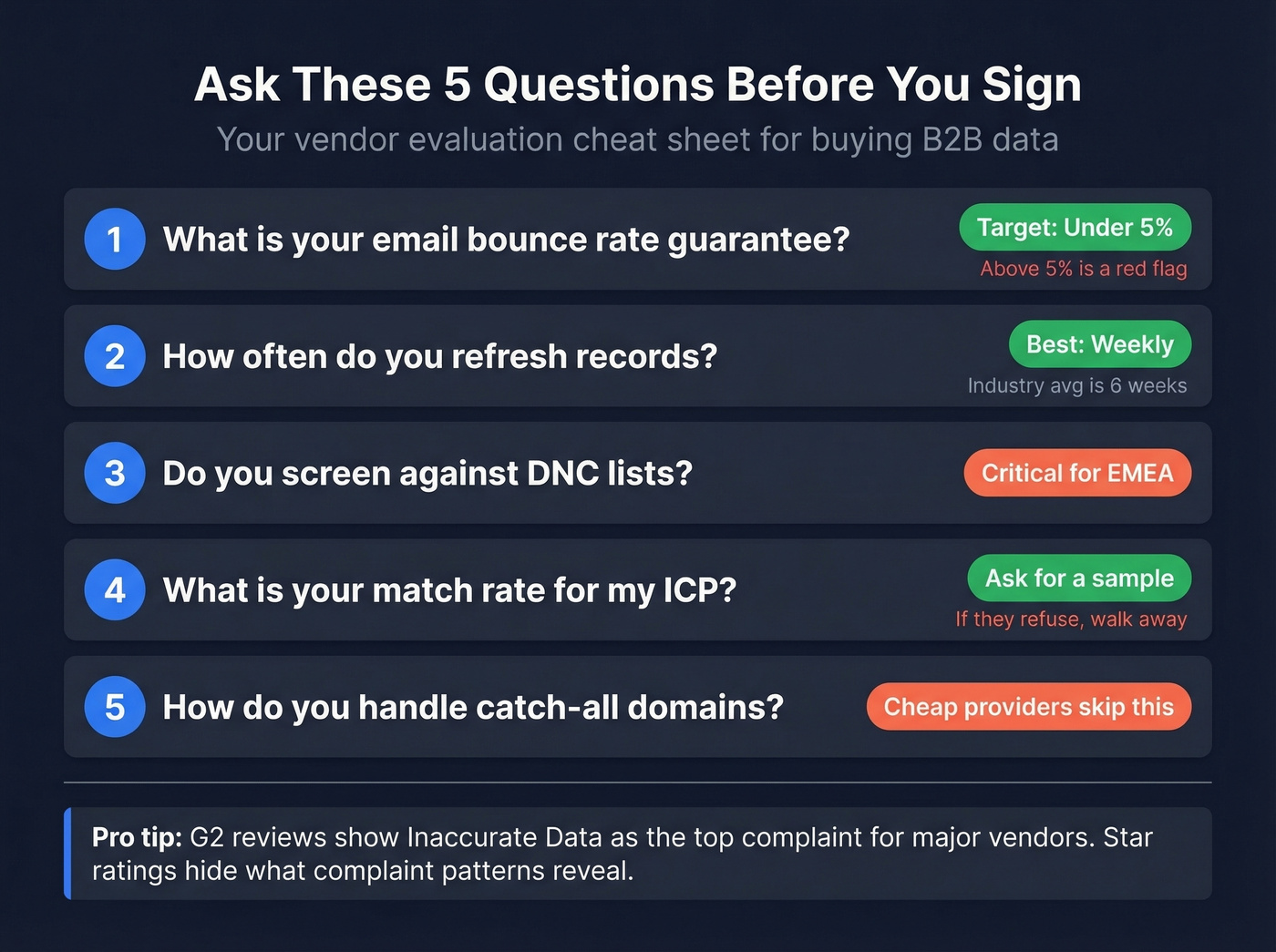
Ask every vendor these questions before you sign anything:
- What's your email bounce rate guarantee? Anything above 5% is a red flag. Push for a contractual SLA. (Related: check bounce.)
- How often do you refresh records? Industry average is around 6 weeks. The best platforms refresh weekly.
- Do you screen against DNC lists? Critical for phone-based outreach, especially for EMEA-focused teams subject to stricter regulations. (More on this in our B2B compliance guide.)
- What's your match rate for my ICP? Ask them to run a sample against your target accounts. If they won't, walk.
- How do you handle catch-all domains? These are the emails that accept everything but don't always deliver. Cheap providers ignore them entirely.
Sanity-check big record-count claims against public market-size baselines for your target region and segment. If a provider's numbers look impossibly large versus everyone else in the category, ask hard questions about where those extra records come from.
Let's be honest about G2 reviews for a second. On the ZoomInfo vs. Cognism compare page, "Inaccurate Data" shows up 232 times as a ZoomInfo con and 99 times for Cognism. Both carry a 4.5/5 rating, but the complaint patterns reveal what the star ratings hide.
How to Run a Data Pilot
Never commit to an annual contract without running a pilot first. This is the single best way to de-risk any data investment. Here's the framework we use:
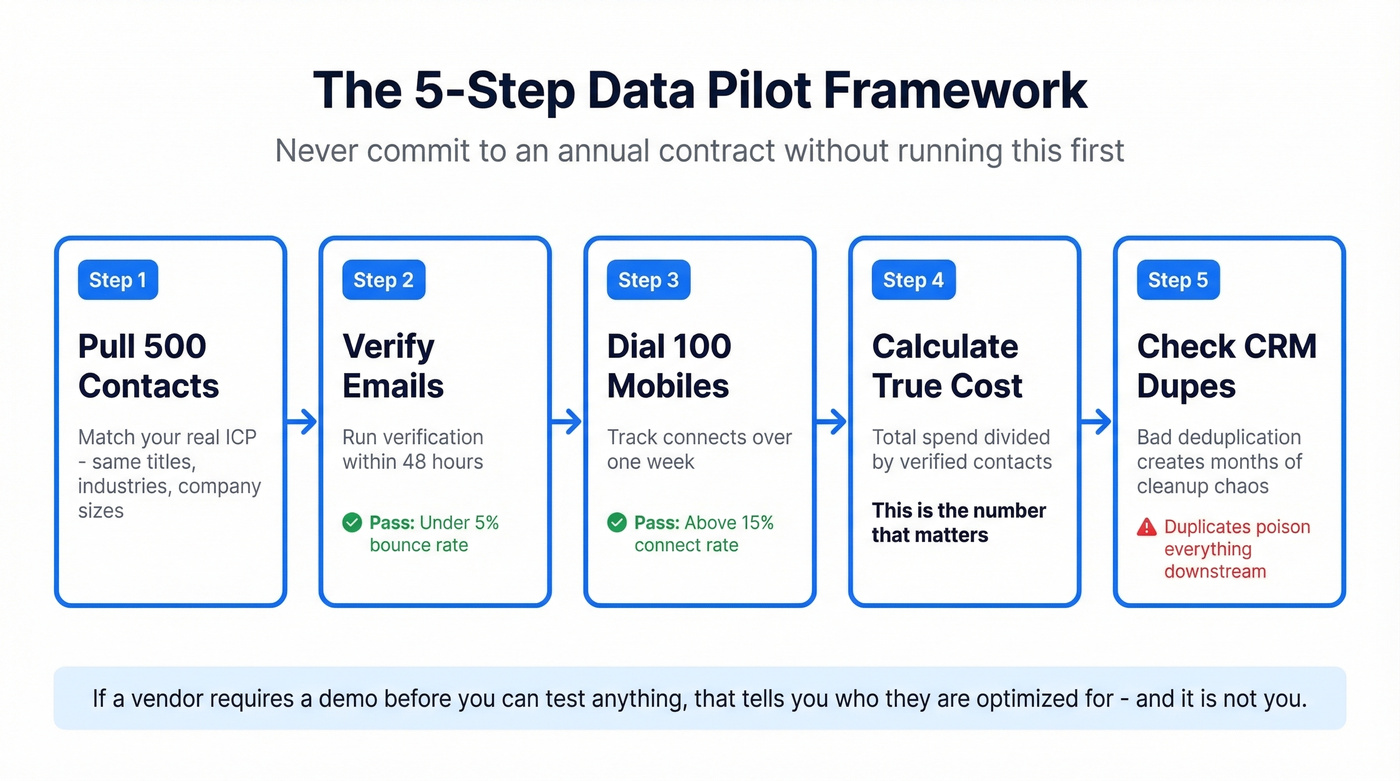
- Pull 500 contacts from the provider, targeting your actual ICP - same titles, industries, and company sizes you'd prospect into.
- Send a verification pass on all emails within 48 hours. Measure bounce rate. Your threshold: under 5%. (If you need tooling, compare options in our email verifier guide.)
- Dial 100 mobile numbers over one week. Track connect rate. Your threshold: above 15%. (Improve outcomes with these phone sales skills.)
- Calculate cost per verified contact. Total spend divided by contacts that actually verified. This is the number that matters, not cost per record.
- Check for duplicates in your CRM. Bad deduplication creates downstream chaos that takes months to clean up. (This is where CRM automation software can help.)
Several platforms let you sign up and pull data in minutes without a sales call. Start there. If a vendor requires a demo before you can test anything, that's a signal about who they're optimized for - and it isn't you.
Recommended Providers for 2026
Prospeo
Prospeo covers 300M+ professional profiles and 143M+ verified emails with 98% accuracy, plus 125M+ verified mobile numbers that hit a 30% pickup rate. The 7-day data refresh cycle is genuinely unusual - most competitors refresh every 4-6 weeks, which means their data is already decaying by the time you download it.

In our experience, the real differentiator is what happens downstream. One customer, Snyk, saw bounce rates drop from 35% to under 5% across 50 AEs, with AE-sourced pipeline up 180% and 200+ new opportunities per month. The platform includes 30+ search filters - buyer intent powered by Bombora across 15,000 topics, technographics, job changes, headcount growth, and funding signals - and pushes directly into Salesforce, HubSpot, Lemlist, Instantly, and Clay. These layered signals turn raw contact lists into actionable prospecting intelligence. At roughly $0.01 per email versus ZoomInfo's ~$1 per lead, you're looking at enterprise-grade data at 90% less cost. The free tier gives you 75 verified emails and 100 Chrome extension credits per month with no annual contract.
If you’re building a repeatable outbound motion around this, pair your data with a clear set of B2B prospecting strategies.
Apollo
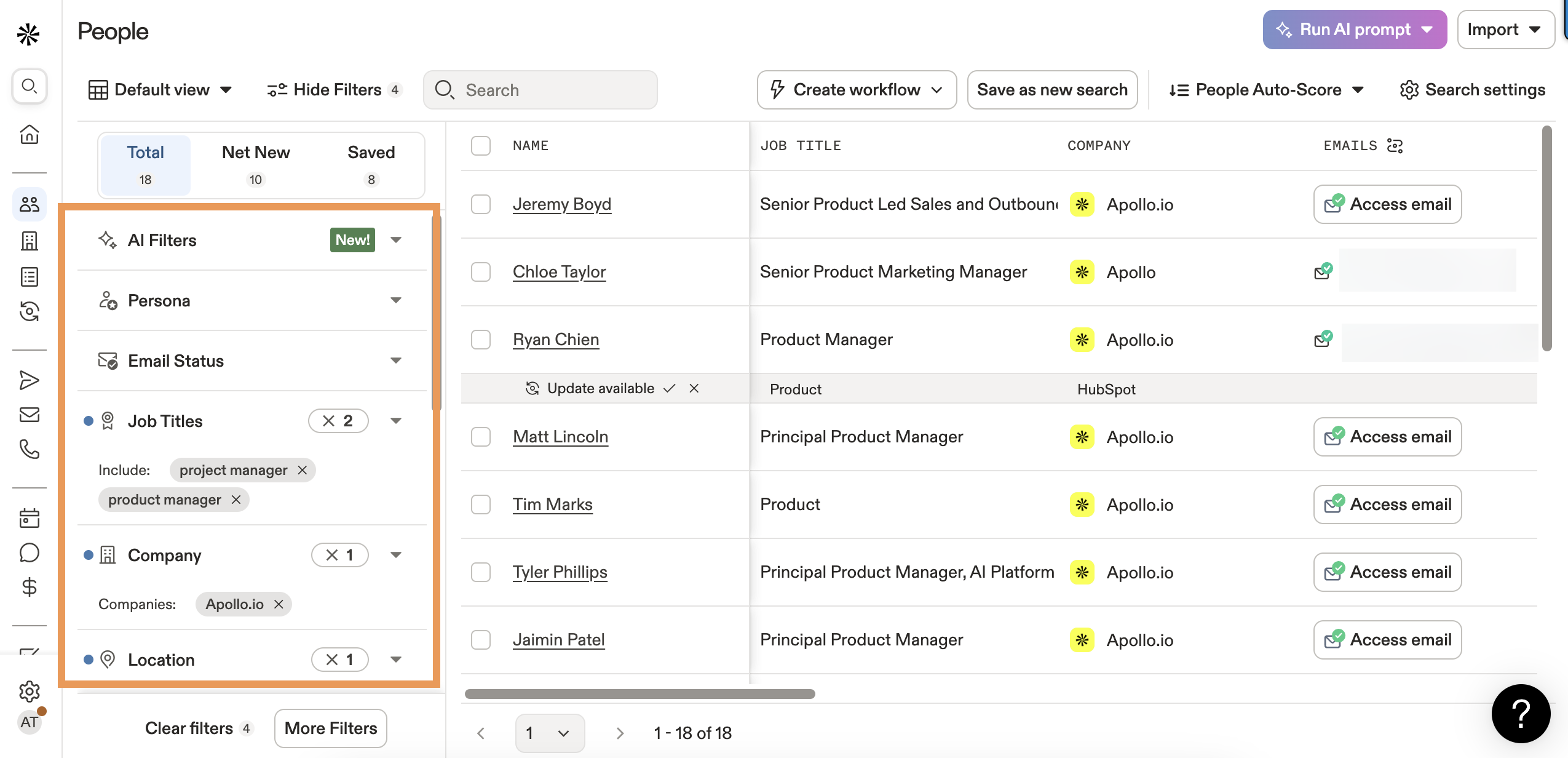
Apollo is the obvious starting point for startups testing outbound for the first time. The free tier includes 10,000 credits, a built-in sequencer, and enough functionality to run a real campaign without spending a dollar.
Paid plans range from $49/month (Basic) to $119/month (Organization, minimum 3 seats). The catch: credits expire monthly with no rollover, and automatic overages can spike your bill without warning. Apollo works beautifully at low volume. At scale, the credit economics get unpredictable. Use it to validate your ICP and outbound motion, then evaluate whether the unit economics hold as you grow.
ZoomInfo
The enterprise default. ZoomInfo has the deepest integrations, the broadest US dataset, and the most mature workflow tools in the market. It's also the most expensive - $15,000-$40,000+/year depending on seats and modules. G2 gives it 4.5/5 across 9,031 reviews, but those 232 "Inaccurate Data" complaints are worth noting. Best for organizations with dedicated RevOps and a need for org-wide deployment. Skip this if you're a team under 10 reps or your ACV doesn't justify the spend.
Cognism
Cognism is the strongest option for EMEA-heavy ICPs. They've got 90%+ coverage for European decision-makers and screen phone numbers against 15+ DNC lists - more than any other provider we've seen. Pricing typically starts at $15,000+/year and often lands closer to ~$25,000/year depending on package. Where Cognism wins over ZoomInfo: EMEA compliance and mobile verification. Where ZoomInfo still wins: US database depth and workflow breadth.
Quick Mentions
Lusha - Simple credit-based phone lookups. Free plan available, paid from $49-$79/month. Good for individual reps who just need direct dials.
UpLead - Solid mid-market option at $99/month for 170 credits with real-time email verification included.
RocketReach - Email-focused, with a free version (5 searches/month) and paid plans from $39/month. Decent for one-off lookups, less useful for volume prospecting.
The article makes it clear: if your deal size is under five figures, enterprise contracts are overkill. Prospeo gives you 300M+ profiles, 30+ ICP filters, intent data, and catch-all verification - the same targeting stack, 90% cheaper than ZoomInfo.
Enterprise-grade B2B data without the enterprise invoice. See for yourself.
Is Buying B2B Data Legal?
Short answer: yes, in most jurisdictions. The details depend on where your prospects are and how you use the data.
| Law | Scope | Key Requirement | Max Penalty |
|---|---|---|---|
| GDPR | EU/EEA | Lawful basis + disclosure + honor objections | EUR 20M or 4% of global turnover |
| CCPA/CPRA | California | Transparency + opt-out of sale/sharing | $2,500-$7,500/violation |
| CAN-SPAM | US (sending) | Accurate sender info + unsubscribe + physical address | $51,744/email |
GDPR isn't a blanket ban on B2B outreach. Article 6(1)(f) allows processing under legitimate interest, and Recital 47 explicitly recognizes direct marketing as a legitimate interest. The requirement most teams miss: you need to document a Legitimate Interest Assessment - a 1-3 page document explaining why your outreach is proportionate and necessary. Most companies skip this and hope for the best.
CAN-SPAM governs how you send, not how you source data. CCPA focuses on transparency and giving California residents the right to opt out of data sale or sharing.
Your compliance checklist: document a Legitimate Interest Assessment and update it annually. Sign Data Processing Agreements with every data vendor. Maintain suppression and opt-out lists - and actually honor them. Include unsubscribe mechanisms in every outreach message. Set data retention policies and enforce them.
FAQ
Is it legal to buy B2B contact data?
Yes, buying B2B contact data is legal in most jurisdictions. In the EU, GDPR permits B2B outreach under legitimate interest (Article 6(1)(f)) provided you document a Legitimate Interest Assessment and honor opt-out requests. In the US, CAN-SPAM regulates sending behavior, not data sourcing. California's CCPA requires transparency and opt-out rights for residents.
How much should I budget for B2B data?
Self-serve platforms start free, with paid tiers running about $0.01 per verified email. Mid-market tools like Apollo and Lusha cost $49-$119/month per user. Enterprise platforms like ZoomInfo and Cognism run $15,000-$40,000+ per year on annual commitments.
How often does B2B data go stale?
B2B contact data decays at roughly 2.1% per month, compounding to about 22.5% annually. Email addresses go outdated at 23-30% per year, and 18% of phone numbers change yearly. Look for providers with weekly refresh cycles rather than the industry-standard ~6 weeks - the difference in deliverability is significant.
What's the difference between buyer data and a contact list?
A simple contact list gives you names and emails. Buyer data layers behavioral signals, firmographic context, and intent indicators on top of that, revealing which prospects are actively in-market. It adds technographics, funding events, and topic-level research activity so your team can prioritize accounts most likely to convert rather than spraying messages at everyone who matches a job title filter.