

"Just Checking In" Emails Don't Work - Here's What to Send Instead
You've typed it, deleted it, typed it again. "Hi - just checking in on this." You send it anyway because you can't think of anything better. But 19% of professionals named "just checking in" the single most annoying email cliche in a Perkbox survey. The typical checking in email signals you've got nothing new to say, and recipients smell that instantly.
The fix isn't a cleverer synonym for "checking in." It's rethinking what a follow-up email should actually do. Stop writing a hollow check-in. Write a value-add email instead.
The Quick Version
- Add value every time you follow up. Each email needs a new angle, a resource, or a specific ask. "Bumping this" isn't a strategy. (More sales follow-up templates here.)
- Use the 3-7-7 cadence. Follow-ups on Day 3, Day 10, and Day 17 capture 93% of replies by Day 10 while keeping you under spam thresholds.
For context, [Belkins' analysis of 16.5 million cold emails](https://belkins.io/blog/cold-email-response-rates) found average reply rates dropped to 5.8%, down from 6.8% the prior year. Every percentage point matters more now.
Follow-Up Data in 2026
Here's the single most important stat in this article: hyper-personalized emails that reference specific business challenges hit an 18.3% reply rate versus 2.1% for generic pitches. That's an 8.7x difference. If you're only going to change one thing about your follow-ups, make it personalization. No subject line trick or send-time hack comes close.
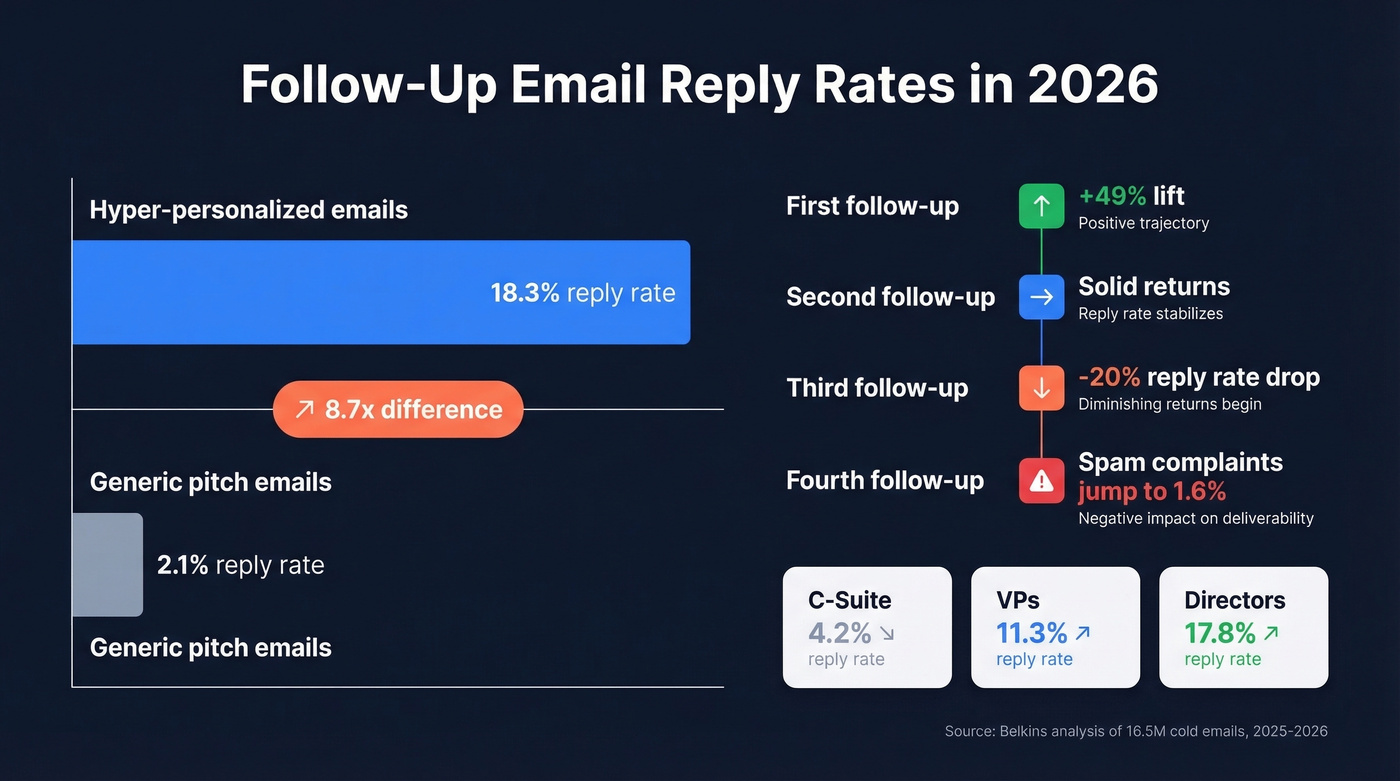
The first follow-up is the most valuable email in your sequence - it lifts replies by up to 49% compared to a single-touch send. But returns drop fast. By the third email, reply rates fall about 20%. By the fourth, spam complaints rise from 0.5% to 1.6%.
Seniority matters too. C-suite contacts reply at just 4.2%, Directors at 17.8%, VPs at 11.3%. If you're blasting the same follow-up to every title level, you're leaving replies on the table.
8 Templates That Replace the Check-In
One data point to keep in mind: timeline-based hooks ("I'm finalizing plans for next week") pull a 10.01% reply rate versus 4.39% for problem-based hooks. And a Boomerang analysis of 300,000+ threads found "Hey" pulled a 64% response rate versus 56.5% for "Dear." Skip the formality.
After a Meeting (No Next Steps)
Don't recap the entire meeting. Anchor to one specific takeaway.
Hey [Name], I keep thinking about what you said about [specific challenge]. I pulled together a quick framework that might help - attached. Worth 15 minutes Thursday to walk through it?
Proposal Sent, No Response
They got your proposal. Don't ask if they received it. Give them a reason to re-engage.
Hi [Name], I realized I didn't include the ROI breakdown for [specific use case you discussed]. Here's a one-pager that maps it out. Does it make sense to revisit this before your Q3 planning wraps?
Cold Outreach Follow-Up
Your first email didn't land. Don't repeat it - bring something new.
Hey [Name], since my last note, [their competitor or peer company] published their approach to [relevant challenge] - thought you'd find it useful: [link]. Happy to share what we're seeing work across similar teams.
Networking / Relationship Follow-Up
This is the one context where a genuine check-in works - but only if you bring something along with it.
Hi [Name], saw your team just [specific news - hire, launch, funding round]. Congrats. I came across [relevant article/resource] and thought of you. No ask - just wanted to pass it along.
Internal Project Nudge
Following up with a colleague who owes you something. Directness beats politeness here - skip the breakup email format for internal follow-ups, because it reads as passive-aggressive with people you work with every day.
Hey [Name], I'm pulling together the [deliverable] for [stakeholder] by Friday. Could you send over your section by end of day Wednesday? Let me know if that timeline doesn't work.
Recruiting Follow-Up
Candidates ghost. Give them an easy out.
Hi [Name], I'm wrapping up the interview schedule for this role by Friday. Still interested? A quick "yes" or "I'll pass" works - no hard feelings either way.
The "Schedule Lock" Ask
This one comes from r/sales, where a rep reported it consistently gets replies because it creates a logistical constraint rather than an open-ended ask.
Hey [Name], I'm finalizing my schedule for next week. Would Tuesday at 2 PM or Thursday at 10 AM work for a quick call?
The Breakup Email
Your last shot. Make it short, low-pressure, and easy to respond to. In our experience, the breakup email pulls more replies than any other follow-up in the sequence - people respond to finality.
Hi [Name], I've reached out a few times and I know you're busy. I'll close this out on my end. If things change, I'm an email away.
Subject Lines That Get Opened
Keep subject lines to 6-10 words - that range hits a 21% open rate. Personalized subject lines get 50% higher opens than generic ones; even dropping in a company name makes a measurable difference. For more ideas, see these email subject line examples.
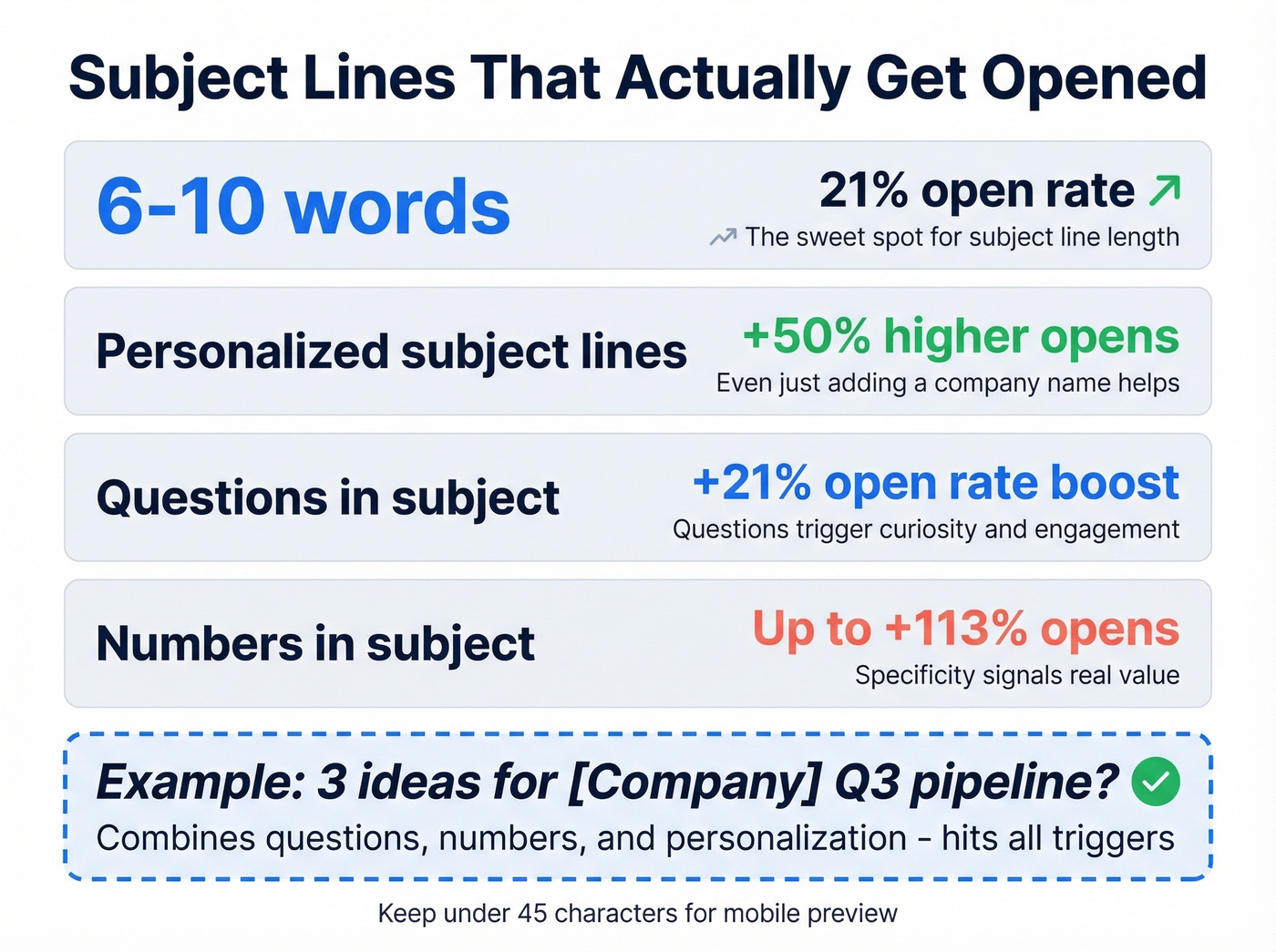
Questions boost opens by 21%, and numbers can increase opens by up to 113%. Combine both: "3 ideas for [Company]'s Q3 pipeline?" hits multiple triggers at once. One practical constraint: keep subject lines around 45 characters, which is the mobile preview cutoff on most devices.

Hyper-personalized follow-ups pull 8.7x more replies - but only if they reach real inboxes. Prospeo's 98% email accuracy and 7-day data refresh mean your carefully crafted check-ins don't bounce. At $0.01 per verified email, bad data stops killing your sequences.
Stop perfecting templates that land in dead inboxes.
Anatomy of a Reply-Worthy Follow-Up
The sweet spot is 50-125 words, with response rates above 50% in Boomerang's dataset. Belkins found 6-8 sentences optimal for cold emails specifically, pulling a 6.9% reply rate. Either way, stay under 200 words. If you want a deeper framework, use this email copywriting guide.
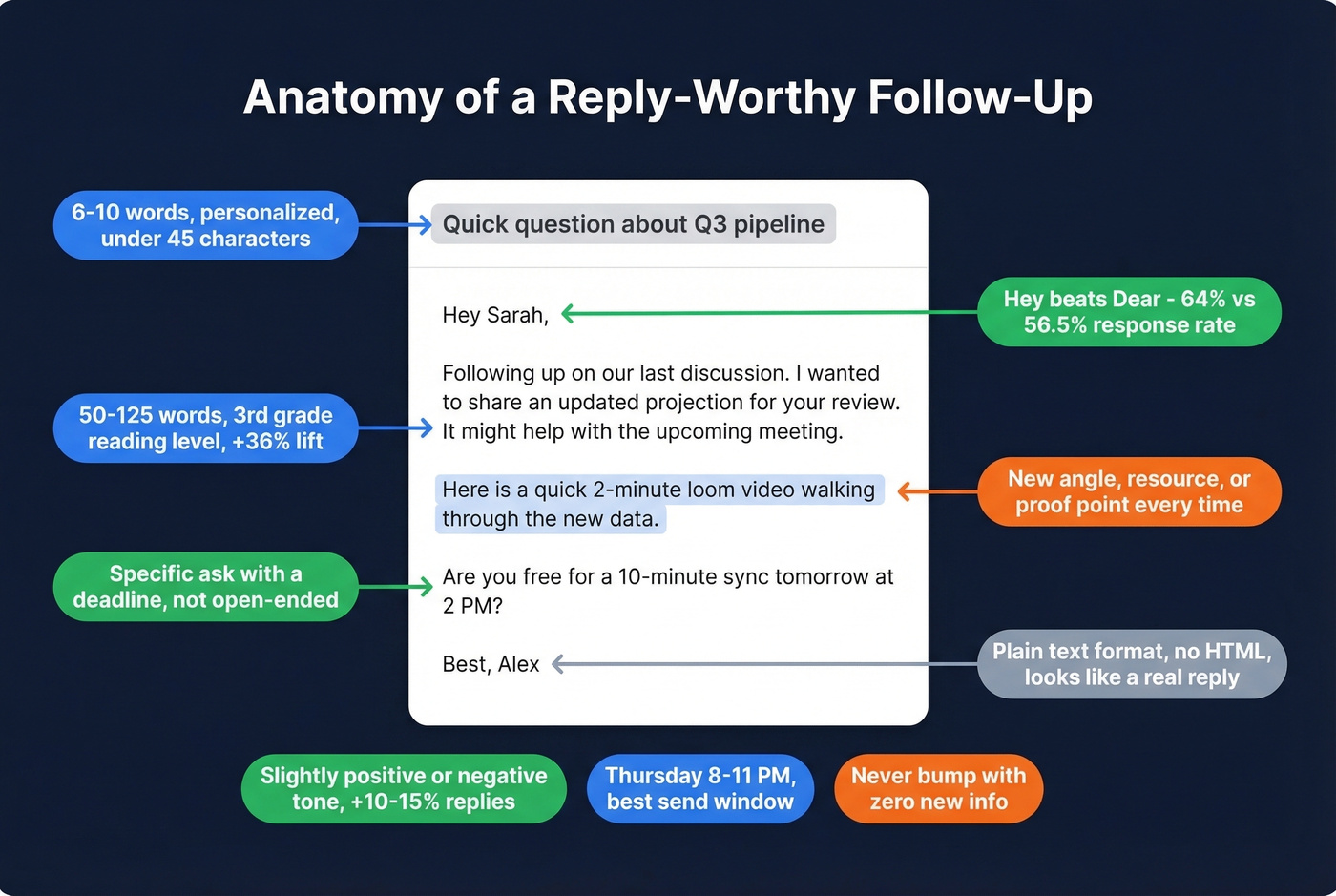
Write at a 3rd-grade reading level. That sounds absurd, but it delivers a 36% lift over college-level writing. Short words, short sentences, zero jargon. For tone, slightly positive or slightly negative emails outperform neutral ones by 10-15% - "excited to share this" or "I know timing is tight" both beat a flat, emotionless message. Always send plain text. Follow-ups that look like real replies, not marketing emails, get more responses.
The 3-7-7 Follow-Up Cadence
Most people either follow up too fast or give up too early. The 3-7-7 cadence solves both problems.
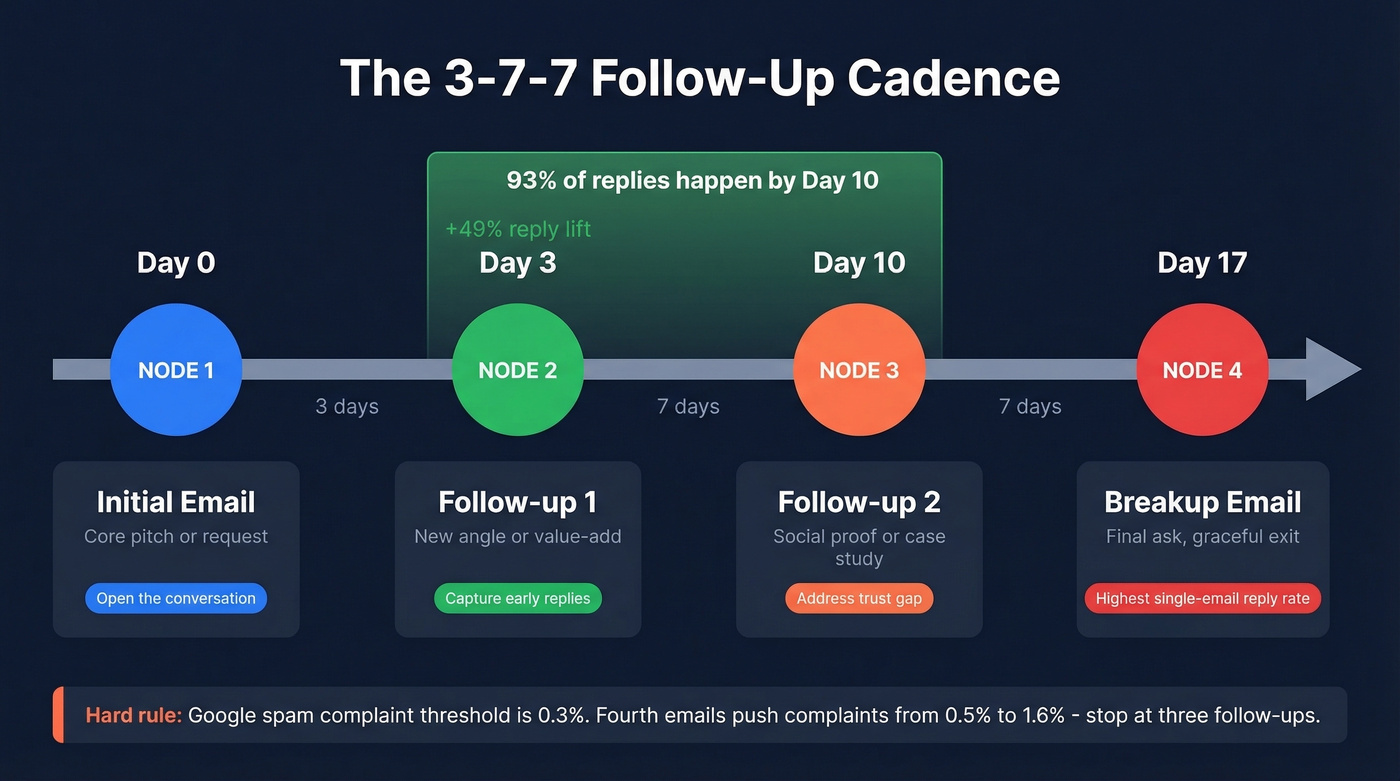
| Day | What to Send | Goal | |
|---|---|---|---|
| Initial | 0 | Core pitch / request | Open the conversation |
| Follow-up 1 | 3 | New angle or value-add | Capture early replies |
| Follow-up 2 | 10 | Social proof or case study | Address trust gap |
| Follow-up 3 | 17 | Breakup email | Final ask + graceful exit |
This captures 93% of replies by Day 10. After that, you're fighting diminishing returns and rising spam risk.
Send on Thursday, especially in the evening 8-11 PM window. Thursday pulls the highest reply rate at 6.87%, Monday the worst at 5.29%, and the 8-11 PM window sees peak responses at 6.52%. Sequences with 4-7 steps generate 3x the reply rate of 1-3 step sequences - but only if each step adds something new. (More data on the best time to send cold emails.)
One hard rule: Google's spam complaint threshold is 0.3%. Exceed it and your deliverability tanks across the board. If you're trying to protect inbox placement, start with an email deliverability guide.
Mistakes That Kill Follow-Up Replies
Bumping with no new info. "Just wanted to make sure you saw my last email" tells the recipient you've got nothing to add. Every follow-up needs a new angle, proof point, or resource.
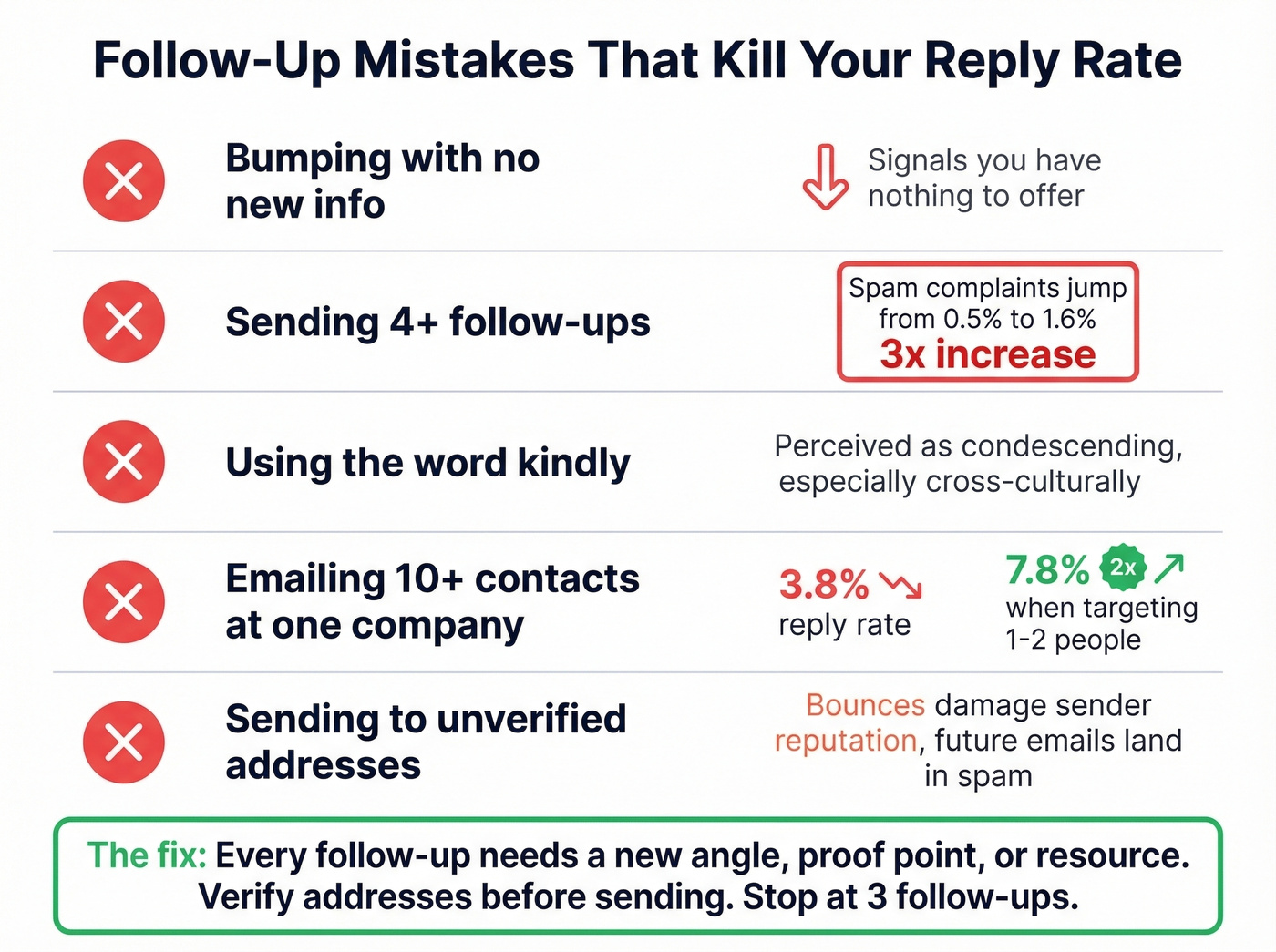
Over-following-up. By the fourth email, spam complaints rise from 0.5% to 1.6% - that's more than triple. We've seen teams torch their sender reputation by running 8- or 10-step sequences where emails 5 through 10 are just rephrased versions of email 1. Three follow-ups is the ceiling for most situations.
Using "kindly." A Reddit etiquette thread flagged "I just wanted to kindly follow up" as condescending - especially in cross-cultural communication. Drop it entirely.
Spraying the whole org. Emailing 10+ contacts at the same company drops your reply rate to 3.8%, versus 7.8% when you target 1-2 people. More emails doesn't mean more replies.
Sending to bad addresses. Here's the thing - bounces chip away at your sender reputation, and next week's follow-ups land in spam. Prospeo's 5-step verification flags invalid addresses and spam traps before you hit send, protecting the domain reputation you've built. If you need a process, start with email bounce rate benchmarks and fixes.
When a Check-In Email Is Actually Fine
Sometimes the situation genuinely calls for a check-in - a warm relationship, a stalled project, a candidate you're waiting on. The rules still apply: lead with something useful, keep it under 125 words, and include a specific ask with a deadline. The templates above work for every scenario where you'd normally default to "just checking in."
Verify Before You Follow Up
The best follow-up copy in the world doesn't matter if it bounces. Every bounced email damages your sender reputation, and once your domain gets flagged, even your good emails end up in spam.

Let's be honest: if your deal sizes are under $50k, bad data will cost you more in lost deliverability than any tool subscription. We've seen teams cut their bounce rate in half just by verifying before sending. Snyk dropped from 35-40% bounces to under 5%. Meritt went from 35% to under 4%. If you're building lists at scale, pair verification with data enrichment services.
C-suite replies at 4.2%, Directors at 17.8%. Knowing who to follow up with matters as much as what you say. Prospeo gives you 30+ filters - job title, buyer intent, company growth - so every follow-up hits the right person with the right context.
Send fewer check-ins to better contacts. Build your list in minutes.
FAQ
How many follow-up emails should I send?
Two to three. The first follow-up lifts replies by up to 49%, but by the fourth email spam complaints more than triple. The 3-7-7 cadence captures 93% of replies by Day 10 with just three follow-ups.
What's the best day and time to send a follow-up?
Thursday evening between 8-11 PM pulls the highest response rates. Thursday averages a 6.87% reply rate - the best of any weekday. Monday is the worst at 5.29%.
Is "just checking in" unprofessional?
Not exactly unprofessional, but 19% of professionals named it the most annoying email cliche. The real problem: it signals you've got nothing new to offer. Replace it with a specific reason to reply - a resource, a deadline, or a new data point.
How do I avoid follow-ups landing in spam?
Verify every address before sending. Bounces erode sender reputation fast. Prospeo's free tier lets you verify 75 emails per month with 98% accuracy, catching invalid addresses and spam traps before they damage your domain.