

Closing Call Best Practices: What 42,945 Sales Calls Actually Reveal
The call went perfectly. Your champion was nodding, the demo landed, you covered every objection. Then - nothing. No reply to your follow-up. No contract. Just silence.
36% of sales pros say closing is the hardest part of the job, and it's not because they lack technique. Most closing call advice focuses on what the rep does - but the data says that barely matters. What the buyer talks about predicts the outcome.
The Short Version
Your technique barely matters. An analysis of 42,945 closing calls found that talk/listen ratio, number of questions, and speaker switches are nearly identical between wins and losses. What the buyer raises unprompted is what separates the two.
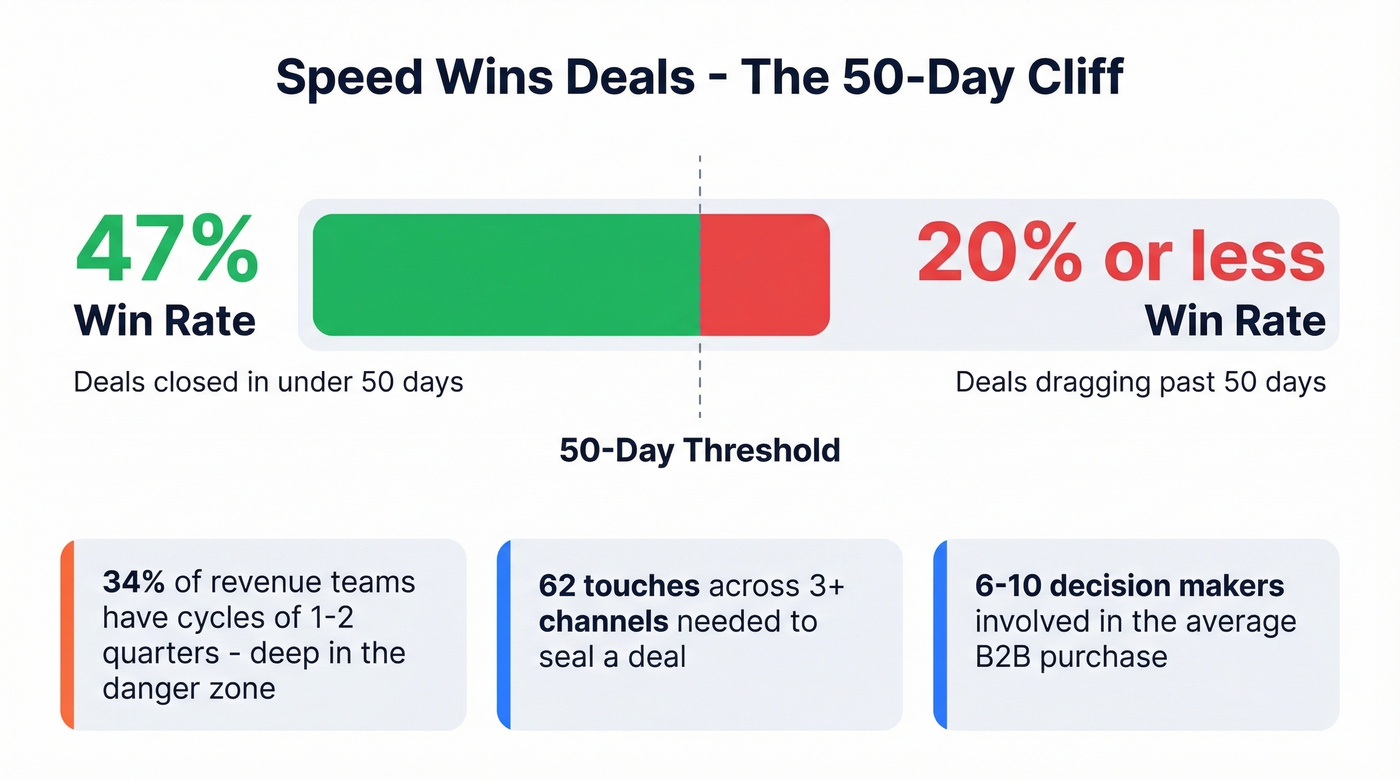
Speed kills (in a good way). Deals closed within 50 days win at 47%. After 50 days, win rates crater to 20% or lower.
Multi-threaded deals close at up to 5x the rate of single-threaded ones. Stop relying on one champion to carry your deal through a committee of 6-10 people.
What Actually Wins Closing Calls
The 42,945-call dataset found something that should make every rep rethink their approach. The behaviors reps typically optimize for - talk-to-listen ratio, question count, interactivity - look virtually identical between deals that close and deals that don't.
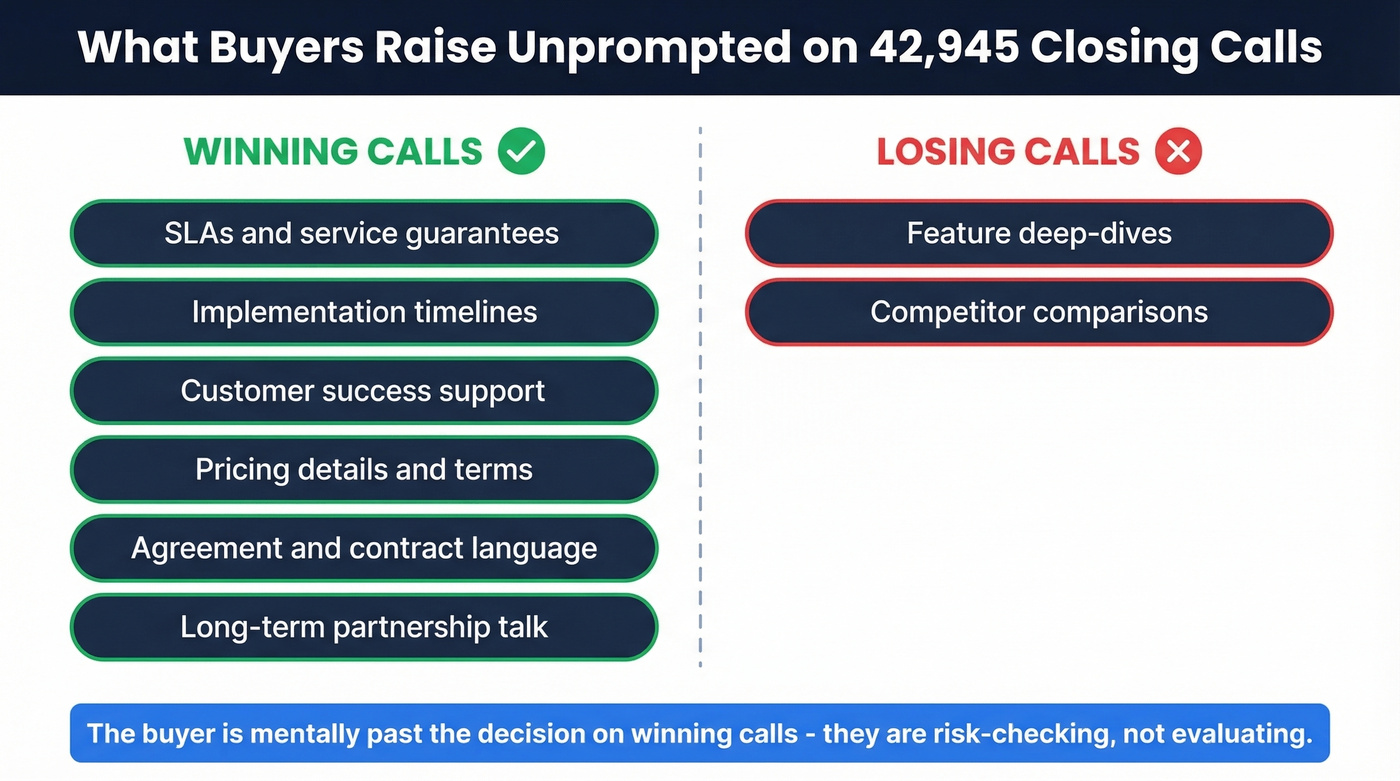
The meaningful difference? Topics the buyer raises unprompted. On winning calls, buyers bring up SLAs, implementation timelines, customer success support, pricing details, agreement terms, and long-term partnership language. These are "pre-purchase jitters" - signals that the buyer is mentally past the decision and into risk-checking mode. On losing calls, buyers talk about features and competitors. That gap tells you everything.
There's also a timing effect around competitive mentions. When competition comes up early in the sales cycle, win rates go up. When it surfaces late - on the final call itself - win rates drop. If your buyer is still comparison-shopping at the decision stage, you haven't differentiated enough upstream.
Here's the thing: your closing call isn't where deals are won or lost. It's where deals are confirmed or fumbled. A confused mind always says no.
2026 Benchmarks Worth Knowing
These numbers set the baseline for where your team should be.
| Metric | Benchmark |
|---|---|
| Average B2B close rate | ~29% |
| Win rate (<50 days) | 47% |
| Win rate (>50 days) | ≤20% |
| Most common win-rate bracket | 21-25% |
| Avg decision-makers (B2B) | 6-10 |
| Buying group stakeholders | 8-13 |
| Touches to seal a deal | 62 across 3+ channels |
| Objection handling lift | Up to 30% |
| Multi-thread win-rate lift | Up to 5x |
One nuance: you'll see a 43:57 talk-to-listen ratio cited as optimal for high-performing sales conversations generally. But on closing calls specifically, the 42,945-call analysis shows this metric doesn't differentiate wins from losses. By the final stage, what gets said matters far more than who says it.
The 47% vs. ≤20% split based on cycle length is the most actionable number here. 34% of revenue teams report average cycles of 1-2 quarters, which means a huge chunk of the market is operating in the danger zone by default.
If your average deal cycle exceeds 50 days, fixing that will do more for your win rate than any closing technique, script, or framework ever will. Sales process optimization is the most underrated closing skill in B2B sales. Full stop.
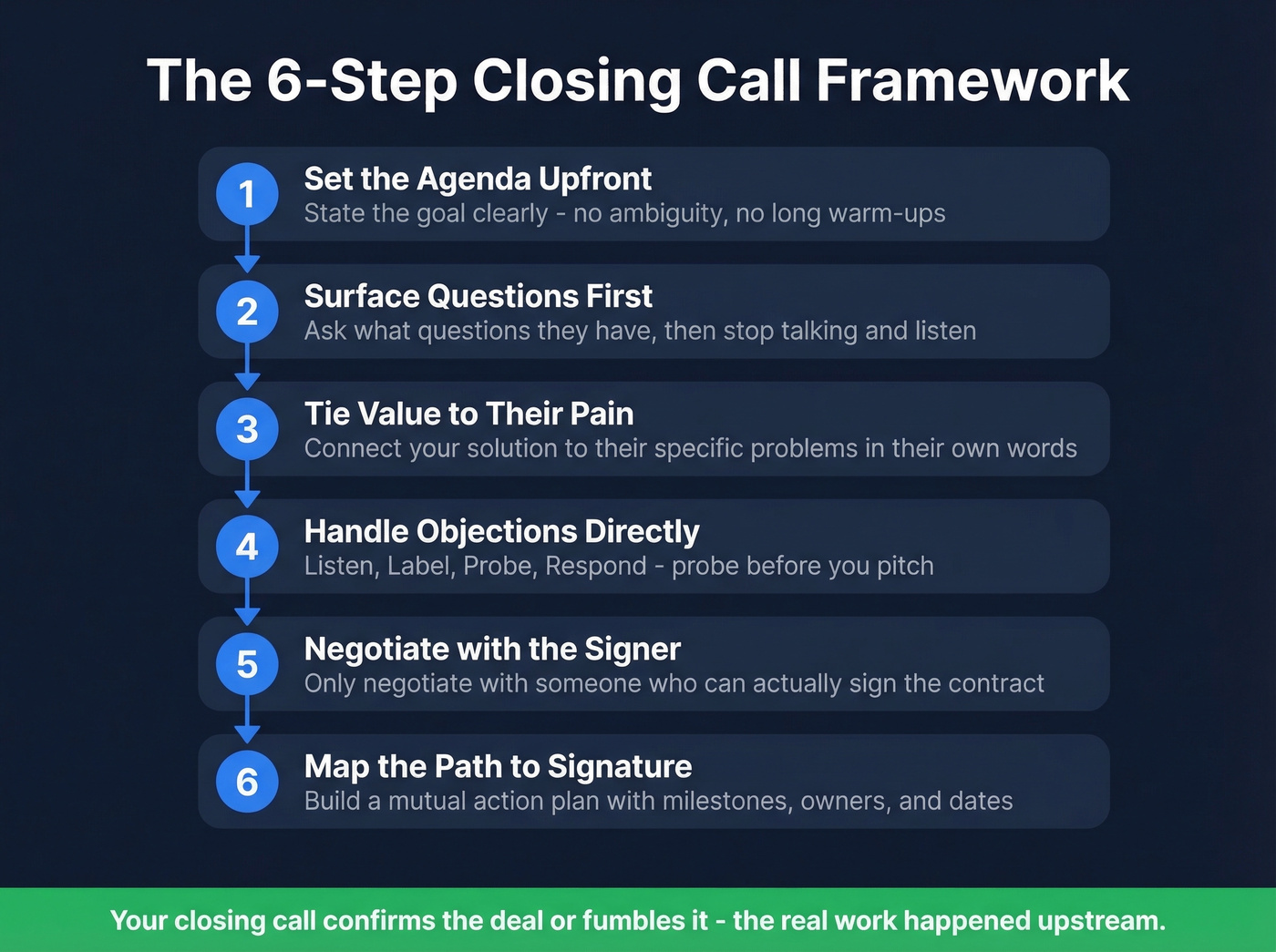
A Six-Step Closing Framework
Treat scripts as frameworks, not teleprompters. The best closing calls follow a structure but sound like a conversation.
1. Set the Agenda Upfront
Open with a direct goal statement. No ambiguity: "The goal of our call today is to get you started with [Company]." A clear agenda frames the conversation as a decision point, not another exploratory chat. Keep rapport to two minutes or less - your buyer already knows you. Long warm-ups signal you're stalling.
If this is a video call - and in 2026, most are - keep your camera on and minimize screen-sharing during decision moments. You need to read the room, and you can't do that while presenting slide 47. (More remote sales meeting tips help here.)
2. Surface Questions First
The Mr. Inside Sales "mute button" technique is underrated: after your opener, ask what questions they have and then actually stop talking. Let the buyer surface their concerns. Your silence is doing work. We've seen reps panic-fill the quiet with feature recaps, and it almost always backfires - the buyer was about to tell you exactly what they needed to hear.
3. Tie Value to Their Pain
This isn't the moment to re-run your feature deck. Connect what you do to the specific problems they've told you about across previous calls. If you can't articulate their pain in their own words by this stage, you've got a discovery questions problem, not a closing problem.
4. Handle Objections Directly
Objections on a closing call are a buying signal - the buyer is stress-testing the decision, not rejecting you. Use a simple loop: Listen → Label → Probe → Respond. The key principle is to probe before you pitch. "Can you tell me more about that concern?" beats "Let me explain why that's not an issue" every single time. (If you want a system, see how to reduce sales objection rate.)
5. Negotiate with the Signer
Know your maximum discount before the call starts. If you're negotiating with someone who can't sign the contract, you're wasting time. Price is the primary reason for deal loss only 17% of the time - top performers are 81% more likely to overcome price pressure by tying back to ROI and cost of inaction rather than caving on price. If you need a deeper playbook, use an anchor in negotiation.
6. Map the Path to Signature
This is where most reps drop the ball. Don't end the call with "I'll send over the contract." Build a mutual action plan with specific milestones, owners, and dates.
Here's a template you can steal:
- [Date] - Contract sent to [Buyer Name]
- [Date] - Legal review complete (Owner: [Buyer's Legal Contact])
- [Date] - Security questionnaire returned
- [Date] - Signed contract due back
- Fallback: If any step slips, [Rep] and [Champion] sync within 24 hours
Exchange cell numbers. One rep we spoke with recommends offloading detailed specs and pricing breakdowns into a single follow-up link so the call itself stays focused on the decision - solid advice.
Before this call, verify you have direct contact info for every stakeholder, not just your champion. Prospeo pulls verified emails and mobile numbers for the entire buying committee, with 98% email accuracy and a 30% mobile pickup rate. You don't want to discover on the closing call that you can't reach the CFO who needs to co-sign.

Multi-threaded deals close at 5x the rate - but only if you can actually reach the buying committee. Prospeo gives you verified emails and mobile numbers for all 6-10 stakeholders, not just your champion. 98% email accuracy, 30% mobile pickup rate.
Stop losing deals because you couldn't reach the CFO who co-signs.
Handling Objections That Stall Deals
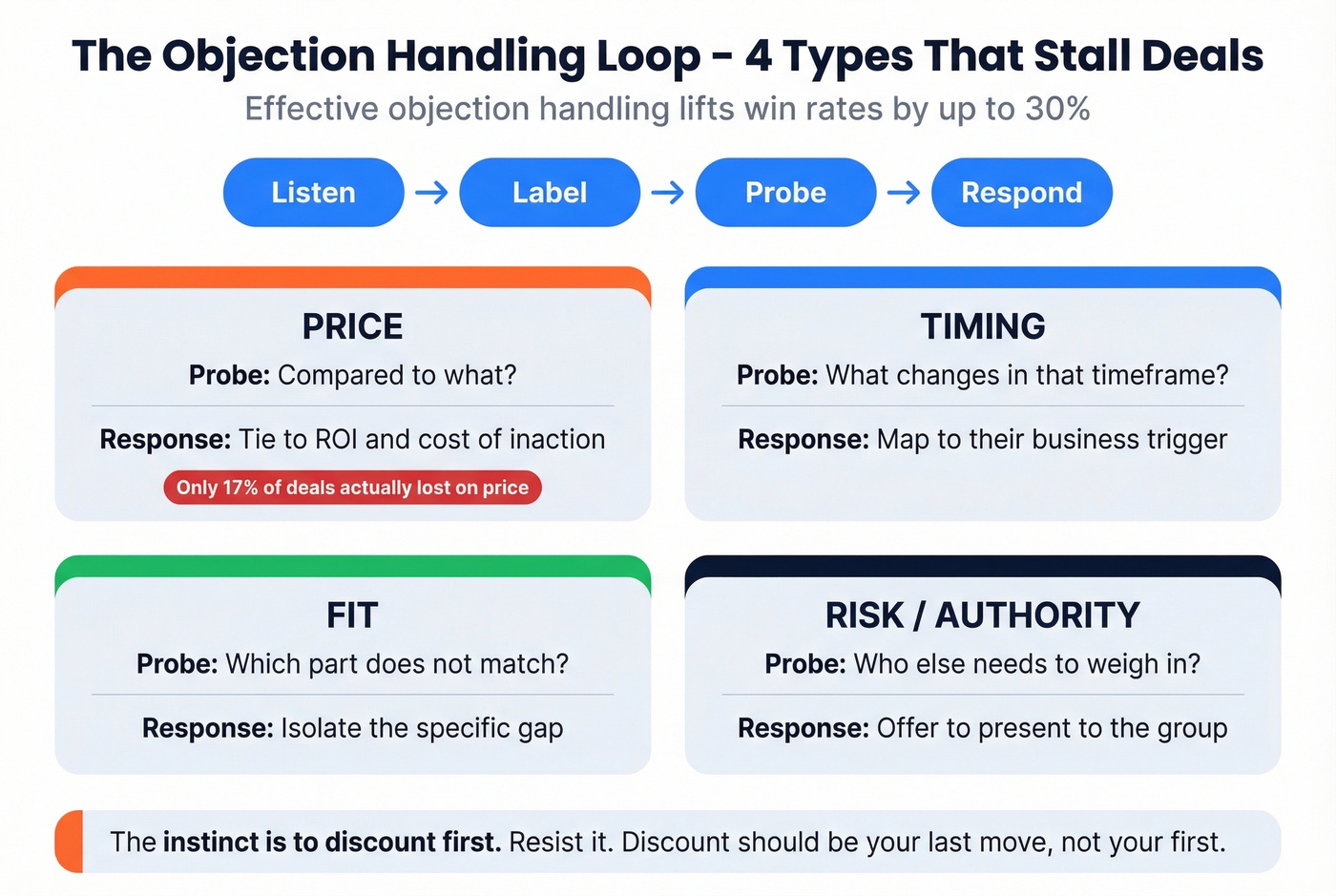
Effective objection handling can lift win rates by up to 30%. Most objections fall into four categories:
| Objection Type | Probing Question | Response Angle |
|---|---|---|
| Price | "Compared to what?" | Tie to ROI / cost of inaction |
| Timing | "What changes in [timeframe]?" | Map to their business trigger |
| Fit | "Which part doesn't match?" | Isolate the specific gap |
| Risk/Authority | "Who else needs to weigh in?" | Offer to present to the group |
The instinct when you hear "it's too expensive" is to discount. Resist it. Price is the stated reason for loss only 17% of the time - the real blocker is usually unclear value, unresolved risk, or a stakeholder you haven't reached. The discount conversation should be your last move, not your first.
Multi-Threading Your Deal
63% of B2B deals involve at least four decision-makers, and enterprise deals can easily hit 8-13 stakeholders. If your entire deal runs through a single champion, you're one job change away from a dead deal.
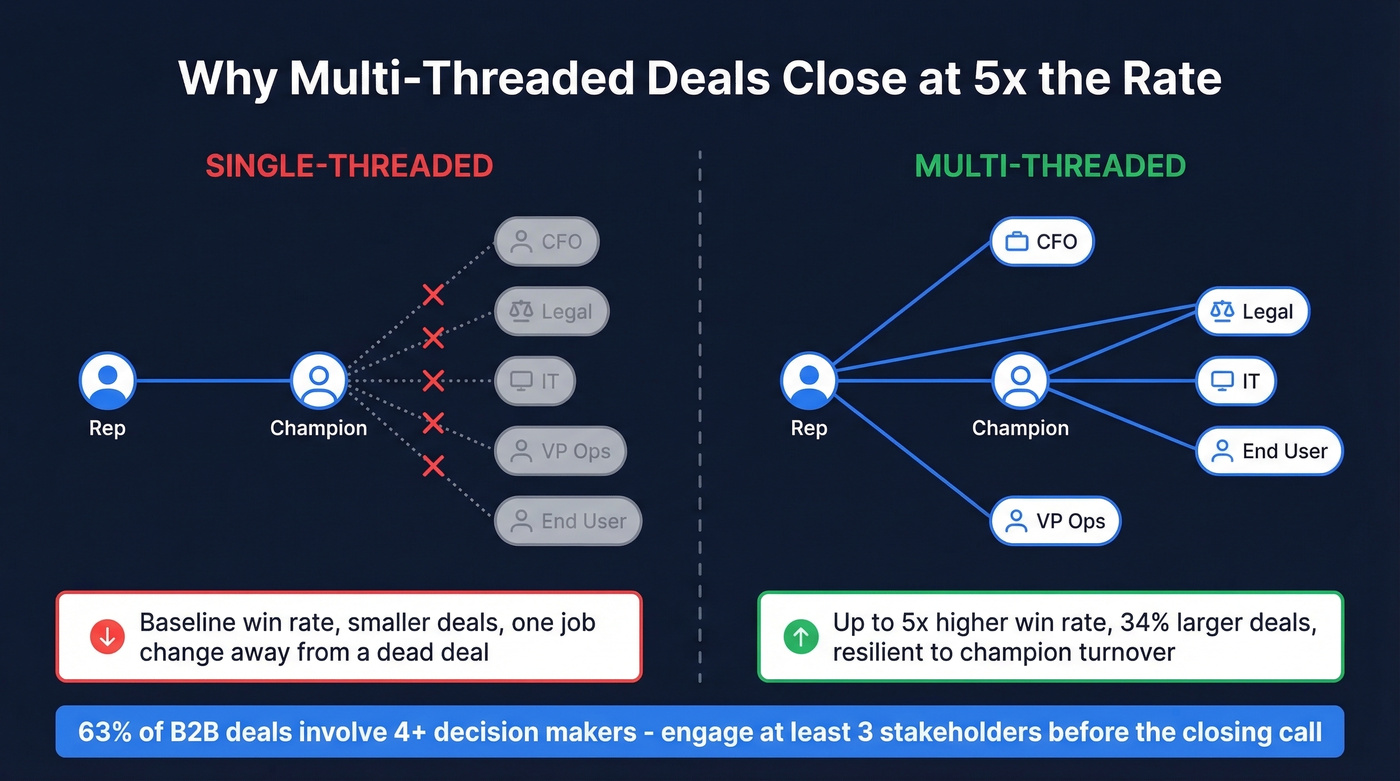
Multi-threaded deals close at up to 5x the rate and are 34% larger than single-threaded ones. The math is overwhelming.
Here's what multi-threading looks like in practice:
Map the buying committee early. Identify roles, influence levels, and relationships. Who's the economic buyer? Who's the technical evaluator? Who's the internal blocker nobody warned you about? (This is also core to account-based selling best practices.)
Engage at least 3 stakeholders before the closing call. Don't wait for your champion to "loop people in." Reach out directly with role-specific value. The consensus on r/sales is that waiting for introductions is the single biggest multi-threading mistake reps make - by the time your champion gets around to it, the deal's already stalling.
On the call, confirm alignment. Ask: "Is there anyone else who needs to see this before we move forward?" If the answer is yes, you're not on a closing call - you're on a pre-closing call. That's fine, but adjust your expectations and your next steps accordingly.
When a Two-Call Close Works Better
Not every deal closes on a single call. A two-call structure works well for high-ticket offers where the buyer hasn't built trust yet - common with paid leads or inbound from cold channels.
Call 1 is fit assessment, trust building, and a bird's-eye view of the solution. At the end, state the price and ask: "Is that investment realistic for you right now?" This filters out non-buyers before you invest a second call. Between calls, the buyer gathers internal approvals and surfaces objections. Call 2 becomes mostly Q&A and decision.
One practitioner reports ~90% show rates on the second call and ~90% close rates among attendees. That's one person's experience, not a universal benchmark - but the structure is sound for deals where a single call feels rushed.
Skip this approach for transactional deals under $10K or buyers who've already been through a full evaluation process. Adding a second call when the buyer's ready to sign just creates friction.
Mistakes That Wreck Closing Calls
We've seen these errors destroy deals repeatedly, and most happen before the call even starts:
Weak discovery. If you don't understand the buyer's pain by the closing call, no technique saves you. This is the root cause of most "closing problems" - they're actually discovery problems wearing a trench coat.
Chasing unqualified deals. Not every opportunity deserves a closing call. If budget, authority, or need isn't confirmed, you're performing for an empty room. (A tighter lead scoring model fixes a lot of this.)
Single-threading. One champion, one point of failure. Multi-thread or accept the risk.
No mutual action plan. "I'll send the contract" isn't a plan. Milestones, owners, dates - or the deal stalls in procurement limbo.
Inconsistent follow-up. 80% of sales require at least five follow-ups. Most reps quit after two. That's not persistence, it's abandonment. Use sales follow-up templates to keep it consistent.
Bad contact data. Calling wrong numbers, emailing outdated addresses, missing stakeholders entirely. Your prep is only as good as the data behind it. In our experience, bad data is the silent killer of deals that should've closed - you can't close someone you can't reach. (If you're cleaning and filling gaps, start with data enrichment services.)
Ignoring call etiquette. Rushing the buyer off the call, skipping a clear recap of next steps, or failing to confirm mutual commitments leaves the deal in limbo. End every call with a summary of who does what by when.
Deals that drag past 50 days see win rates crater to 20%. The fastest way to compress your cycle? Skip the inbox runaround and call decision-makers directly. Prospeo delivers 125M+ verified mobile numbers so your reps connect on the first attempt.
Close faster when every stakeholder's direct dial is already in your CRM.
FAQ
How long should a closing call last?
Most B2B closing calls run 30-45 minutes. Keep rapport under two minutes and spend the majority on objections, procurement mapping, and next steps. If you need more than 60 minutes, you likely have unresolved discovery gaps from earlier in the cycle.
What's the difference between a discovery call and a closing call?
Discovery identifies pain, budget, and decision-makers. A closing call confirms fit, handles final objections, and drives to a signed contract. Winning closing calls feature buyer-raised topics like SLAs and implementation timelines - not feature questions. If your buyer is still asking "what does it do?" you skipped a step.
How do I find direct contact info for the full buying committee?
Use a B2B data platform with verified mobile numbers and emails. Prospeo covers 300M+ profiles with 98% email accuracy and 125M+ verified mobiles - you can pull the entire committee's contact data in minutes using 30+ filters for role, seniority, and department. The free tier includes 75 email credits per month.
What does good closing call etiquette look like?
Good closing call etiquette means confirming every action item before you hang up, thanking the buyer for their time, and sending a written recap within the hour. Don't pressure the buyer into an immediate yes - instead, make the next step easy and specific so momentum carries through to signature.