

The Complete Guide to Being a Cold Caller in 2026
Your first week looks like this: 80 dials, 60 voicemails, 12 disconnected numbers, 6 "not interested" before you finish your sentence, and zero meetings booked. You go home wondering if you made a terrible career choice.
Here's what nobody told you on day one - the problem isn't being a cold caller. It's bad data and no process. Fix those two things and the math starts working in your favor fast.
What You Need (Quick Version)
If you're considering the job: Base pay runs $38K-$63K, with total comp landing between $53K-$91K. Commission-only roles are a red flag. Walk away from those.
If you just started: You need three things and only three things:
- A dialer ($30-$150/mo)
- A CRM (HubSpot free tier works)
Scripts and objection responses are below.
If you're hiring cold callers: Expect 50-100 dials/day, a 2.3% meeting conversion rate, and budget $40K-$70K OTE per rep. Or outsource for $5-$50/hr depending on location.
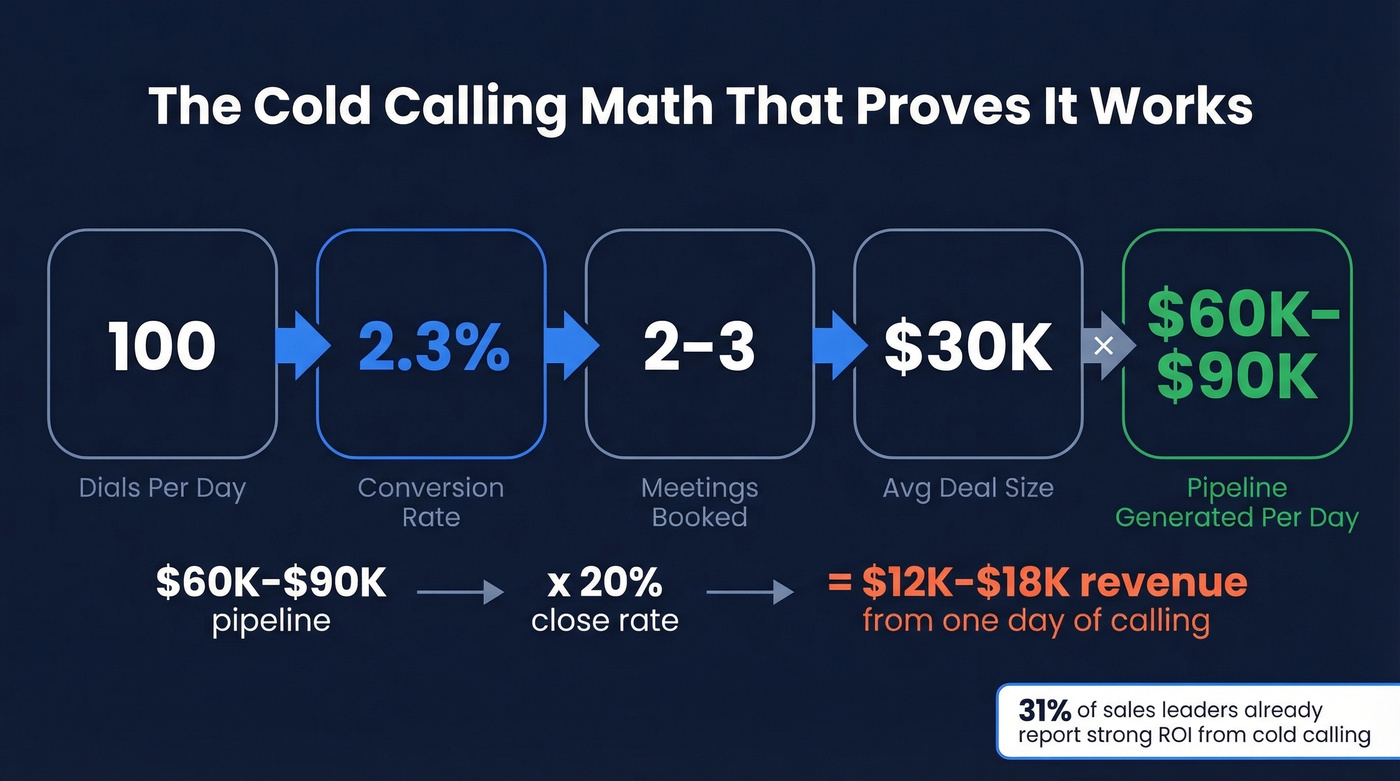
That 2.3% number sounds brutal until you do the math: 100 dials x 2.3% = 2-3 meetings. At a $30K average deal size, that's $60K-$90K in pipeline generated per day. Cold calling isn't dead. It's just unforgiving when you do it wrong.
What Is a Cold Caller?
Definition and Role
A cold caller reaches out to prospects who haven't expressed prior interest in a product or service. They're the first point of contact for new business - the person who turns a name on a list into a conversation.
The role spans industries. SaaS companies hire them to book demos. Insurance agencies use them to set appointments. Real estate teams have them calling expired listings and FSBOs. Financial services firms deploy them for wealth management prospecting.
Cold calling is distinct from warm calling, where the prospect has already engaged - downloaded a whitepaper, attended a webinar, filled out a form. Outbound callers work without that safety net, and every conversation starts from zero.
Cold Caller vs SDR vs BDR
These titles get used interchangeably, but they're different roles with different expectations.
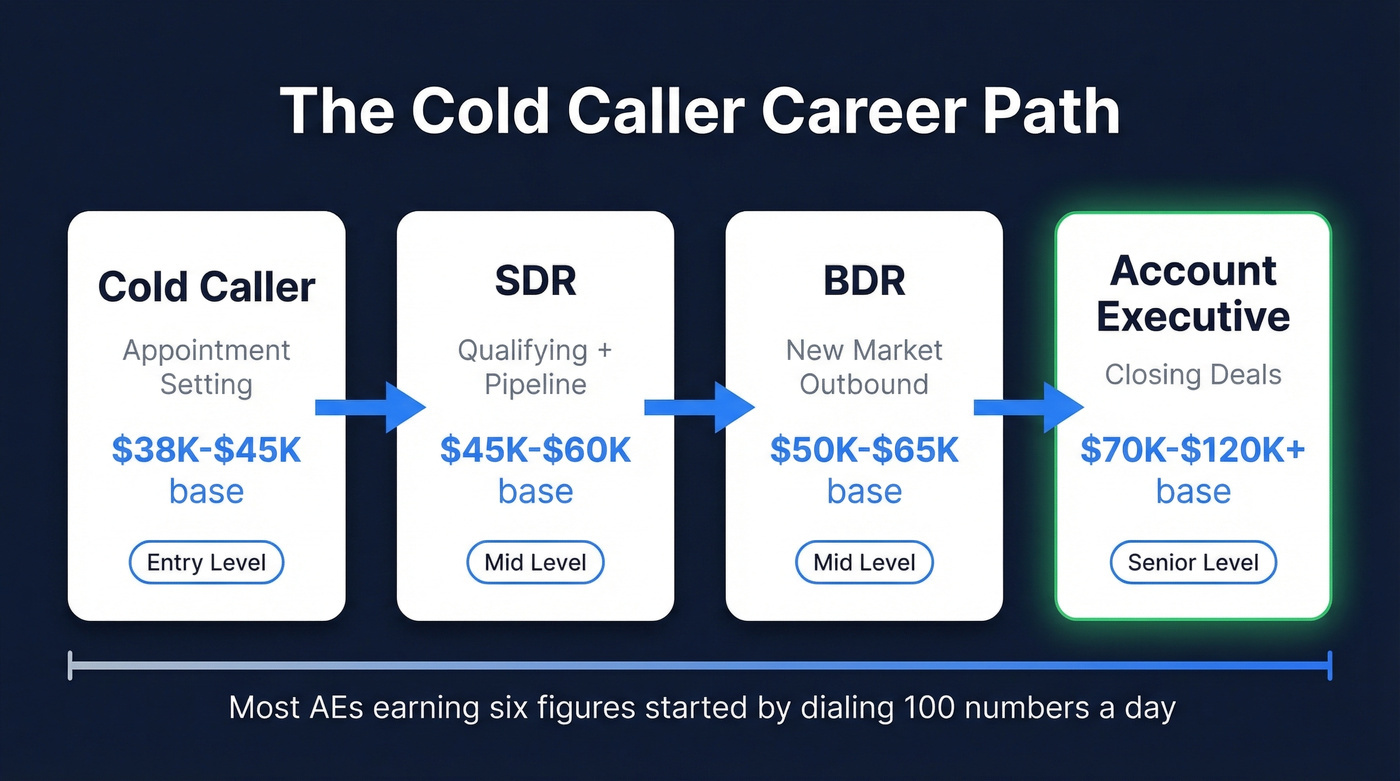
| Role | Primary Focus | Typical Level | Base Pay Range |
|---|---|---|---|
| Cold Caller | Appointment setting | Entry-level | $38K-$45K |
| SDR | Qualifying + pipeline | Mid-level | $45K-$60K |
| BDR | New market outbound | Mid-level | $50K-$65K |
| AE | Closing deals | Senior | $70K-$120K+ |
The career ladder is real. Appointment setter to SDR/BDR to Account Executive to Sales Manager. Most AEs earning six figures started by dialing 100 numbers a day. The entry point matters less than the trajectory.
Daily Responsibilities
The job is more structured than outsiders realize. A typical day breaks down like this:
- Outbound calling - 50-150 dials depending on your dialer and list quality
- Lead qualification - determining if the person you reached fits your ideal customer profile
- Script execution and objection handling - following talk tracks while sounding natural, then navigating "not interested" and "no budget" dozens of times daily
- Appointment setting - booking qualified meetings for AEs or senior reps
- CRM logging and follow-up - documenting every call outcome and re-engaging prospects who showed interest but didn't commit
- Feedback loops - reporting objection patterns and market signals back to marketing and sales leadership
Work formats vary. Some teams are fully in-office with shared energy and real-time coaching. Remote calling is increasingly common, and freelance or contract roles exist too, particularly in real estate and agency settings.
KPIs That Matter
Reps spend only about 15% of their day actually talking to prospects. The rest is ringing, voicemails, manual dialing, and CRM work. That's why the right tools matter so much.
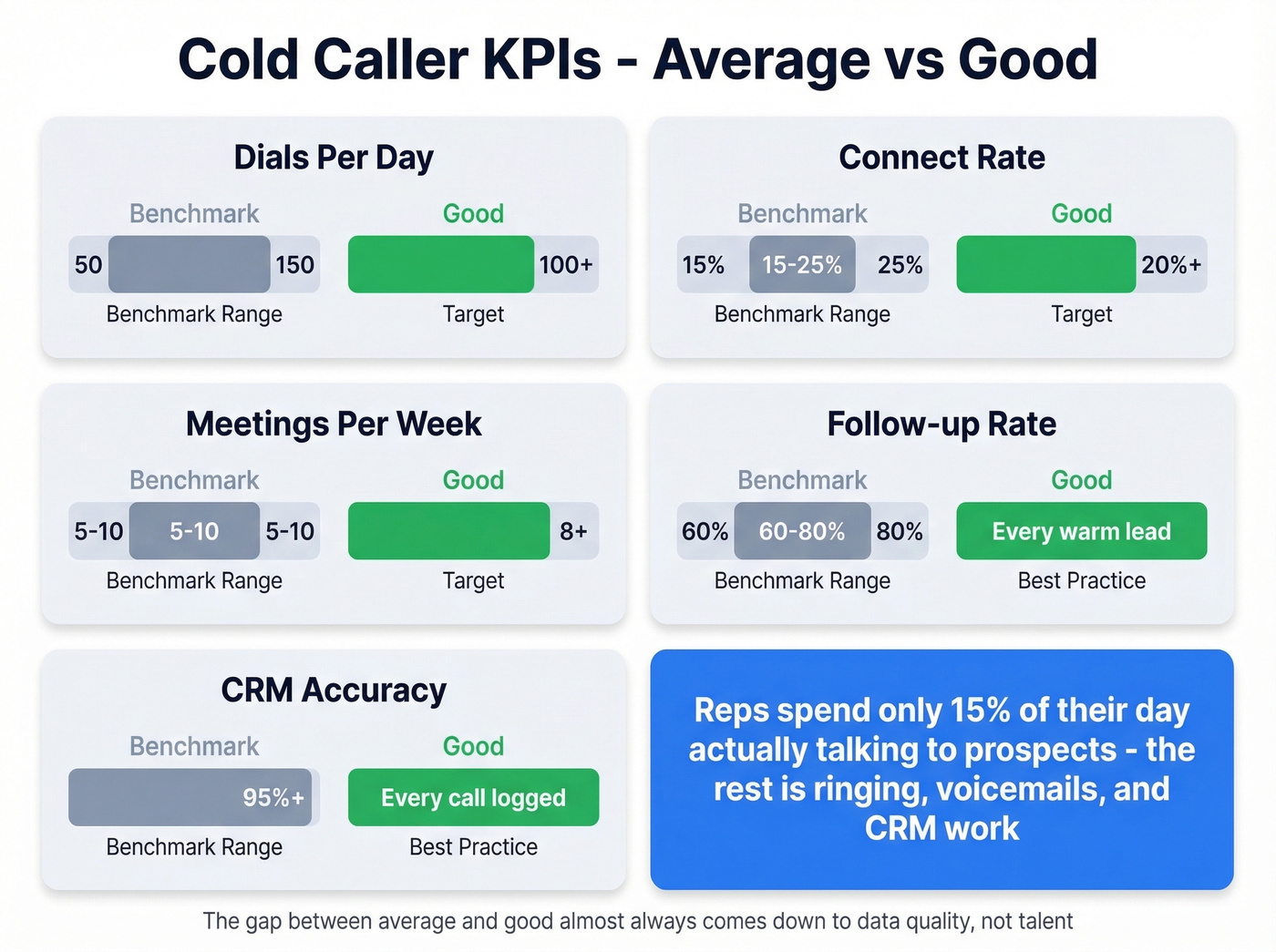
| Metric | Benchmark | What "Good" Looks Like |
|---|---|---|
| Dials/day | 50-150 | 100+ with a power dialer |
| Connect rate | 15-25% | 20%+ with verified data |
| Meetings/week | 5-10 | 8+ consistently |
| Follow-up rate | 60-80% of connects | Every warm lead re-engaged |
| CRM accuracy | 95%+ | Every call dispositioned |
The gap between "average" and "good" almost always comes down to data quality and dialer efficiency, not talent. A great rep on a bad list will lose to a mediocre rep on a verified list every single time.
How Much Do Cold Callers Make?
Base vs Total Compensation
Two major salary sources tell slightly different stories, and understanding why matters.
Salary.com pegs the average salary at $42,388/year as of March 2026 - roughly $20/hour. The 25th-to-75th percentile range sits at $37,439-$46,070.
Glassdoor's data shows a median total pay of $69K/year, with a range of $53K-$91K. The base pay component runs $38K-$63K, with additional pay from commissions and bonuses adding $15K-$28K.
The gap between these numbers isn't a contradiction - it's the difference between base-only compensation and on-target earnings. Salary.com skews toward base salary. Glassdoor captures the full picture. (If you're benchmarking offers, it helps to understand OTE in Sales too.)
Pay by Experience Level
| Experience | Base Salary | Total Comp (OTE) |
|---|---|---|
| Entry (<1 yr) | ~$38K | ~$53K |
| Mid (2-4 yrs) | ~$53K | $69K-$80K |
| Senior (5+ yrs) | ~$64K | $80K-$91K+ |
| Hourly/Contract | $15-$25/hr | Varies |
Here's the thing: commission-only cold calling jobs are a red flag. Good roles pay $38K-$63K base plus performance bonuses. If a company won't invest a base salary in you, they probably won't invest in training, tools, or data either. You'll burn out dialing garbage numbers for free.
High performers in enterprise SaaS and financial services can push well past $91K OTE, but those roles typically carry the SDR or BDR title by that point.
Does Cold Calling Still Work?
The Numbers
The average cold calling success rate landed at 2.3%, down from 4.82% the prior year. In our experience, the decline is largely driven by more teams cold calling with unverified data - inflating dial counts while tanking conversion rates.
It takes an average of 8 call attempts to reach a prospect. 49% of buyers prefer to be contacted via cold call, and 57% of C-level executives and VPs prefer phone contact over other channels. 81% of decision-makers engage with cold outreach when it's tailored to their company and context, which is why personalized openers convert so much higher than generic scripts. The demand side hasn't changed.
Let's reframe the ROI. If you make 100 dials at a 2.3% conversion rate, that's 2-3 meetings. If your average deal is $30K, you just generated $60K-$90K in pipeline in a single day. Even at a 20% close rate on those meetings, that's $12K-$18K in revenue from one day of calling. 31% of sales and marketing decision-makers already report strong ROI from cold calling.
The math works.
My hot take: if your average contract value sits below $10K, you probably don't need an outbound calling team at all. Cold email at scale will serve you better. Cold calling's ROI shines when the deal size justifies the human cost per dial. Above that threshold, it's one of the highest-ROI activities in sales. Below it, you're burning money.
Cold Calling vs Email vs Social
| Channel | Avg Conversion | Volume/Day | Best For |
|---|---|---|---|
| Cold call | 2.3% to meeting | 50-150 dials | High-intent, C-level |
| Cold email | 5.1% response | 100-300 sends | Scale, mid-market |
| Social selling | Highest per-touch | 20-40 touches | Relationship-heavy |
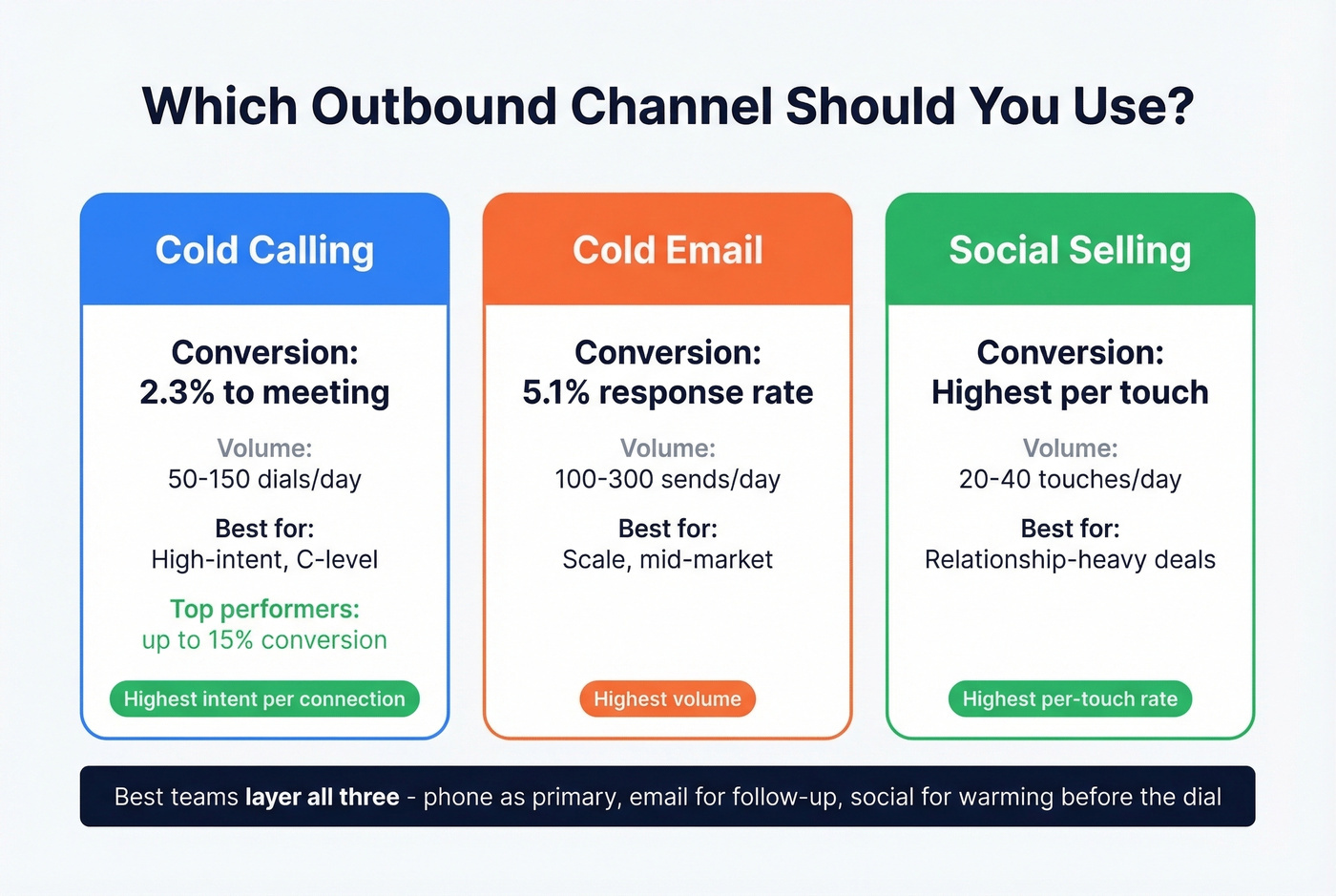
Cold calling has lower volume but higher intent per connection. When you get someone on the phone, you're in a real conversation - not competing with 47 other emails in their inbox. Top performers convert up to 15% of conversations into meetings. No other channel touches that per-interaction rate.
The best teams don't pick one channel. They layer all three: phone as the primary, email for follow-up and nurture, social for warming before the dial. (If you're building the full outbound motion, start with these sales prospecting techniques.)

You read it above: a great rep on a bad list loses to a mediocre rep on verified data. Prospeo gives cold callers 125M+ verified mobile numbers with a 30% pickup rate - 3x higher than ZoomInfo. Data refreshes every 7 days, so you stop wasting dials on disconnected numbers.
Turn your 100 daily dials into 20+ real conversations.
Scripts That Get Meetings Booked
Openers That Beat "Not Interested"
The first 10 seconds determine everything. Here are four opener frameworks with data behind them. (If you want more talk tracks, steal from these talk track examples.)
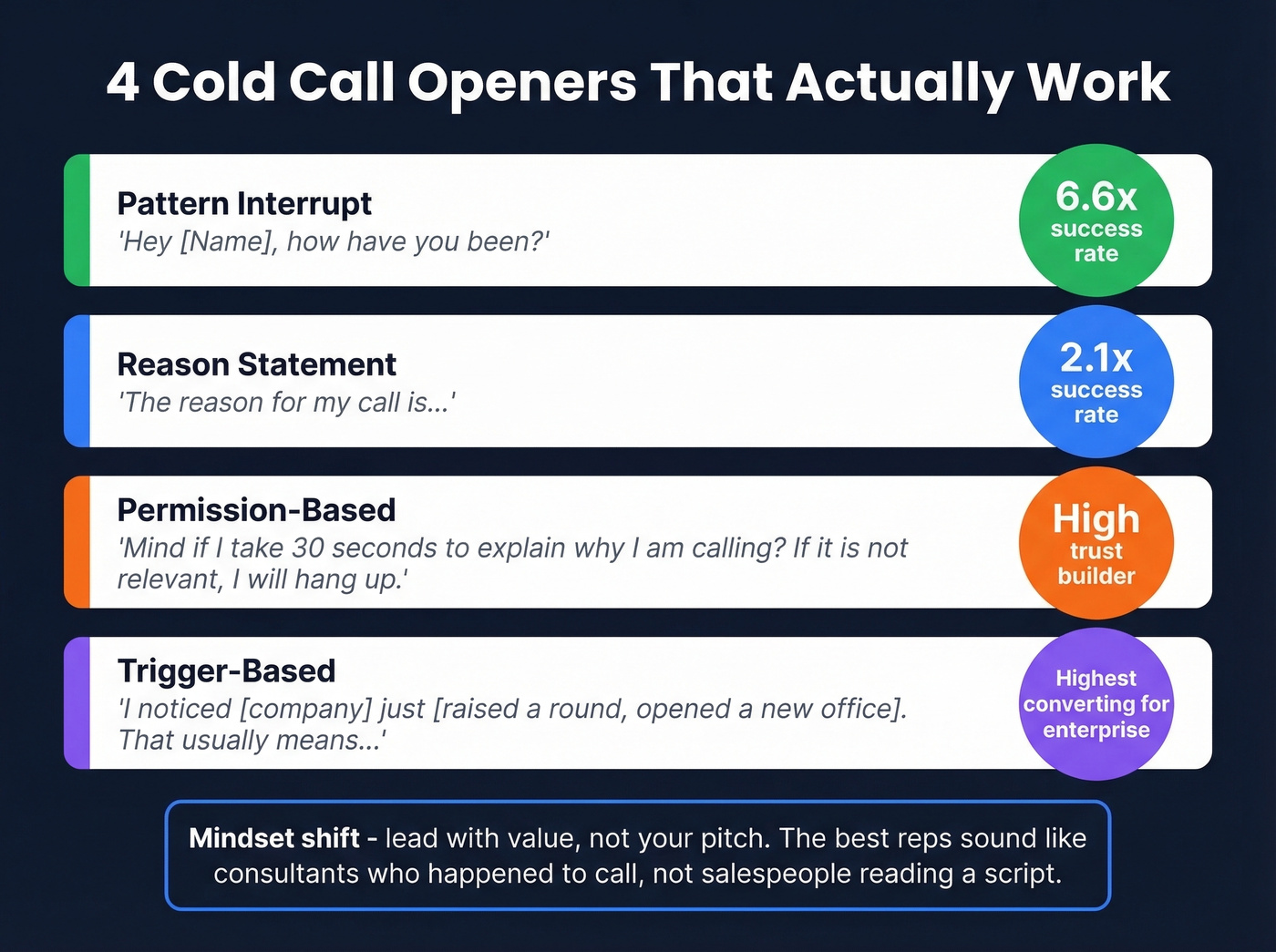
The pattern interrupt: "Hey [Name], how have you been?" This simple question generates a 6.6x higher success rate than jumping straight into a pitch. It disrupts the "salesperson" pattern and triggers a conversational response.
The reason statement: "The reason for my call is..." This framing delivers a 2.1x success multiplier. It signals respect for the prospect's time and gives them a reason to keep listening.
Permission-based: "Mind if I take 30 seconds to explain why I'm calling? If it's not relevant, I'll hang up." This works because it gives the prospect control. Most people say yes - and now they've committed to listening.
Trigger-based: "I noticed [company] just [raised a round / opened a new office / posted 5 SDR roles]. That usually means..." This shows you did homework. It's the highest-effort opener but also the highest-converting for enterprise deals.
A mindset shift that separates top performers from everyone else: lead with value, not your pitch. The best outbound reps sound like consultants who happened to call, not salespeople reading a script. If you can teach the prospect something about their own market in the first 30 seconds, you've earned the next five minutes.
Gatekeeper and Voicemail Scripts
Gatekeepers aren't obstacles - they're information sources. The Pipedrive approach works well: ask for help, learn the gatekeeper's name, then ask the best way to reach the decision-maker. "Hi, I'm hoping you can help me. I'm trying to reach whoever handles [function] - could you point me in the right direction?" Treat them as allies, not barriers.
For voicemails, brevity wins. Keep it under 30 seconds: your name, one sentence on why you're calling, and a clear callback instruction. "Hi [Name], this is [You] from [Company]. I'm calling because [one-sentence reason tied to their business]. My number is [number] - I'll try you again Thursday morning." No rambling value prop. No "I'd love to connect." Just signal and next step.
The "choose your own adventure" technique is worth stealing too: give the prospect two micro-options early in the call. "Would it be more helpful if I explained how we help with [problem A] or [problem B]?" A small "yes" early creates momentum for a bigger "yes" later.
Handling Objections Like a Pro
Not every objection is real. The Meritt framework distinguishes between genuine objections and fob-offs - and your response should differ dramatically. (If this is your biggest bottleneck, read our guide on cold call rejection.)
| Objection | Type | Response Strategy |
|---|---|---|
| "I'm not interested" | Fob-off | Earn 15 more seconds with one question |
| "I don't have time" | Fob-off | Respect it, ask for a better window |
| "Send me an email" | Fob-off | Agree, but qualify first |
| "We don't have budget" | Real | Ask about next budget cycle |
| "We already use someone" | Real | Ask what would need to change |
Fob-offs are reflexive. The prospect hasn't actually processed what you're offering - they're just trying to end the call. For "I'm not interested," try: "Totally fair - most people say that before they hear the specific reason I called. Can I share one thing in 15 seconds?" For "send me an email," go with: "Happy to. So I send the right thing - what's the biggest challenge you're dealing with in [area]?" Your job is to earn 15 more seconds, not overcome the objection.
Real objections deserve real engagement. Budget constraints, existing contracts, and timing issues are legitimate. Acknowledge them, ask a smart follow-up question, and set a future touchpoint. For "we already use someone," try: "Good - that tells me you see the value. What would need to change for you to consider an alternative?"
Energy and tone matter more than the exact words. We've seen reps use the same script with wildly different results. The difference is almost always confidence and pacing - not the language itself.
Essential Tech Stack
You don't need 15 tools. You need three: a dialer, a CRM, and a data provider. Everything else is optional until you're consistently booking meetings. (If you're shopping, start with this list of SDR tools.)
Dialers
Three types, each suited to different workflows.
Manual dialing is for high-touch, low-volume calling - enterprise AEs making 20 highly researched calls per day. No software needed beyond a phone.
Progressive/power dialers are the B2B standard. They auto-dial the next number when you're ready, eliminating dead time between calls. A good power dialer can double your calls per day compared to manual dialing. Most B2B teams should start here.
Predictive dialers dial multiple numbers simultaneously and connect you when someone answers. High-volume B2C play. They carry more compliance risk - abandoned calls and "telemarketer delay" can trigger TCPA issues. Skip these for B2B.
One stat worth knowing: prospects are four times more likely to answer local numbers. Local presence dialing - where your caller ID matches the prospect's area code - is a must-have feature in whatever dialer you pick. Pricing runs $30-$150/seat/month. PhoneBurner, Orum, and Nooks are solid options.
Data Providers
Your dialer is only as good as your list. Industry estimates suggest bad data wastes 25-30% of a rep's time - hundreds of hours per year spent on wrong numbers, outdated contacts, and people who left the company months ago.
We've tested most of the major providers. Prospeo covers 300M+ professional profiles with 125M+ verified mobile numbers and 143M+ verified emails, all refreshed on a 7-day cycle versus the six-week industry average. The 98% email accuracy rate means your sequences don't bounce, and the 30% mobile pickup rate means you're actually reaching people when you dial. One customer, Meritt, tripled pipeline from $100K to $300K/week after switching, with connect rates jumping 3x to 20-25%. At roughly $0.01 per lead versus $1+ on enterprise platforms like ZoomInfo, the economics aren't even close. (If you're comparing vendors, see our roundup of data enrichment services.)

CRM
HubSpot's free tier is enough for most people starting out. It handles contact management, deal tracking, and basic activity logging without costing anything. Salesforce is the move when you need complex reporting and tighter governance, but it typically runs $25-$165/user/month depending on edition and requires real configuration time. (If you're still deciding, here are more examples of a CRM.)
AI Tools
AI is reshaping the outbound workflow in 2026, and ignoring it puts you at a disadvantage. Real-time coaching tools like Cogito and Balto listen to your calls and surface objection-handling prompts mid-conversation - essentially giving you a cheat sheet while you talk. AI-powered call summaries from tools like Gong and Chorus auto-generate notes and next steps, cutting down the manual CRM work after calls.
Some teams are experimenting with AI voice agents for initial qualification, but the FCC's TCPA classification of AI voices as "artificial or prerecorded" means you need prior express written consent for those. For now, AI works best as a copilot for human callers, not a replacement. Budget $50-$200/seat/month for AI coaching tools.
8 attempts to reach a prospect is the average - but only if the number is real. Prospeo's 5-step verification and 7-day refresh cycle mean fewer dead dials, more connects, and more meetings booked. At $0.01 per lead, even entry-level reps can afford enterprise-grade data.
Fix your connect rate before you fix your script.
Compliance Rules for 2026
Look, most cold calling guides skip compliance entirely. That's irresponsible. One bad list can bankrupt a small company.
The TCPA Opt-Out Rule
The FCC's opt-out rule took effect April 11, 2025, and it changed the game:
- Consumers can revoke consent in any reasonable manner - text, email, verbal, carrier-level tools. You can't force them into a specific opt-out process.
- You must honor revocation within 10 days.
- An opt-out from robotexts extends to robocalls and vice versa - it's cross-medium.
- Statutory damages run $500-$1,500 per violation per class member. No need to prove actual injury.
The enforcement environment is brutal. TCPA lawsuits surged roughly 95% year-over-year in 2025, with class actions spiking 285% in September alone.
What Else to Watch
AI voice rules: The FCC classified AI-generated voices as "artificial or prerecorded" under the TCPA. If you're using AI voice agents for outbound, you need prior express written consent. No exceptions.
State mini-TCPAs: Texas SB 140 took effect September 1, 2025, expanding "telephone solicitation" to include texts and images, with treble damages and attorney's fees under the DTPA. Other states are following suit. You need to track regulations in every state you're calling into.
DNC compliance: Scrub your lists against the National Do Not Call Registry. It's basic, but we've seen teams skip it and pay the price.
STIR/SHAKEN: Caller ID authentication is now standard. If your calls show up as "Spam Likely," your connect rates crater. Make sure your dialer provider supports STIR/SHAKEN attestation.
Should You Outsource?
| Factor | In-House | US Outsourced | Offshore |
|---|---|---|---|
| Cost | $40K-$70K OTE/rep | $15-$50/hr | $5-$15/hr |
| Quality | Highest | Good | Variable |
| Control | Full | Moderate | Limited |
| Ramp time | 4-8 weeks | 1-2 weeks | 1-2 weeks |
In-house is the gold standard for quality and brand consistency. You control the messaging, the training, and the feedback loops. But it's expensive and slow to scale.
US-based outsourced callers run $15-$50/hr or $3K-$6.5K/month on retainer. Quality varies wildly by agency. The good ones sound indistinguishable from your internal team. The bad ones sound like they're reading a script for the first time - because they are.
Offshore is the budget play. One practitioner on r/salestechniques shared that they outsource at $40 per 100 leads, with conversion "not as good as me but very close." Offshore works for appointment setting and lead qualification. It struggles with complex discovery calls or highly technical products.
The hybrid model is increasingly common - offshore reps handle initial qualification, then hand warm leads to in-house staff for deeper conversations. For teams that aren't ready to hire full-time, this is often the smartest first move.
How to Become a Cold Caller
No degree required. Cold calling is one of the few high-earning career paths where you can start with zero credentials and reach six figures within 3-4 years.
Browse r/sales for an hour and you'll see the same pattern - new reps asking if the job gets easier. It does, but only if you fix your process first. The people who flame out in 6 months are the ones who never move past brute-force dialing into bad lists.
Industries actively hiring in 2026: SaaS, insurance, real estate, staffing agencies, financial services, and marketing agencies. Look for roles titled "cold caller," "appointment setter," "outbound sales rep," or "SDR." (If you're brand new, start with cold calling for beginners.)
The career ladder: Appointment Setter to SDR/BDR to Account Executive to Sales Manager. Each step roughly doubles your earning potential. Someone making $53K OTE as a cold caller can become an SDR at $70K, then an AE at $120K+, within 2-3 years.
Skills to develop from day one: objection handling until responses are reflexive, active listening so you talk less than 40% of the call, CRM proficiency because your future self will thank you, and time management to block and protect your dial time ruthlessly. If you're only going to work on one thing this month, make it active listening - the reps who ask better questions book more meetings than the reps who deliver better pitches. (A simple way to level up fast is to run a 30-60-90 day plan for sales reps.)
FAQ
Is cold calling dead?
No. 49% of buyers prefer phone contact, and 57% of C-level executives choose calls over other channels. At a 2.3% success rate, 100 dials yield 2-3 meetings - viable math at any deal size above $10K. The channel isn't dying; it's punishing teams that skip data verification.
How many calls should I make per day?
Between 50 and 150 dials depending on your dialer and list quality. With a power dialer and verified contacts, 100+ dials is standard. The number matters less than connect rate - 80 dials on a clean list beats 150 dials on garbage data every time.
What's the difference between a cold caller and a telemarketer?
Cold callers typically work B2B, qualifying leads and booking meetings for a sales team. Telemarketers usually work B2C, selling products directly on the call. The skills overlap, but the career paths diverge - outbound B2B calling leads to enterprise sales roles, while telemarketing rarely does.
What tools do I need to get started?
Three essentials: a power dialer ($30-$150/month), a CRM like HubSpot's free tier, and a verified data provider. Prospeo's free plan includes 75 emails and 100 Chrome extension credits monthly - enough to start building a clean list without spending anything.
Is cold calling legal in 2026?
Yes, but compliance is tighter than ever. The 2025 TCPA opt-out rule, state mini-TCPAs like Texas SB 140, and FCC rules on AI-generated voices all add requirements. Scrub lists against the National Do Not Call Registry, honor opt-outs within 10 days, and make sure your dialer supports STIR/SHAKEN. Violations carry $500-$1,500 per violation in statutory damages.