

Cold Calling for Dummies: A 2026 Beginner Guide
It's Monday morning. You've got a list of 100 numbers, a script you've rewritten four times, and a knot in your stomach. On r/sales, beginners post about spending a full month perfecting their script while subconsciously avoiding the phone - making five calls an hour and calling it "practice." We've watched new reps do this for weeks. Here's the truth most beginner guides skip: the biggest mistake isn't what you say. It's never dialing - or dialing numbers that don't work.
What You Need Before Your First Dial
- A verified call list. Bad numbers kill confidence faster than bad scripts. Verify before you start - you need live mobiles, not a stale spreadsheet from 2024.
- One simple script you've practiced out loud 10 times. Not memorized. Practiced. There's a difference.
- A commitment to 25+ dials on day one. The cold calling success rate is 4.82% - conversations that result in a booked meeting. Low volume guarantees zero results.
Real Benchmarks for Beginners
Let's get the numbers out of the way so you know what "normal" actually looks like.
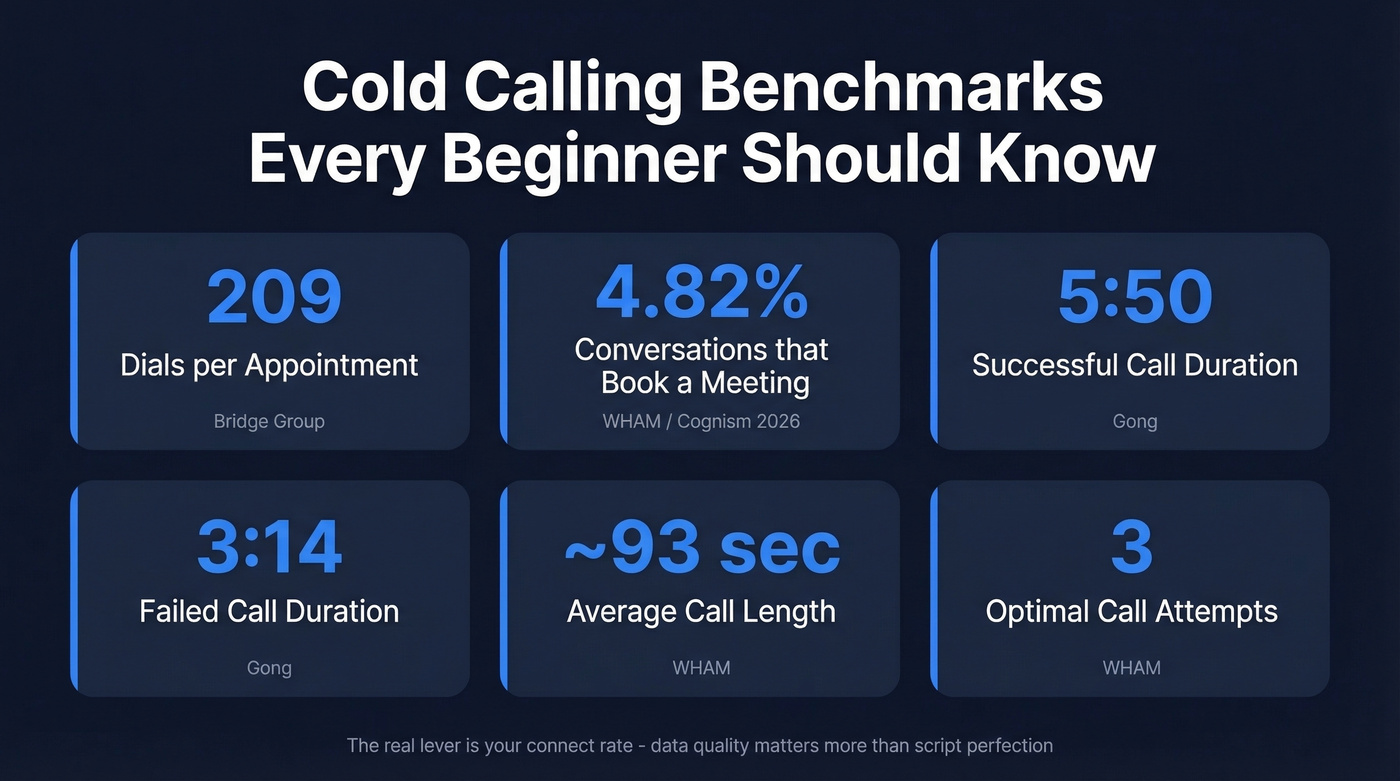
| Metric | Number | Source |
|---|---|---|
| Dials per appointment | 209 | Bridge Group |
| Success rate (conv to mtg) | 4.82% | WHAM / Cognism 2026 report |
| Successful call duration | 5:50 | Gong |
| Failed call duration | 3:14 | Gong |
| Average call length | ~93 sec | WHAM |
| Optimal call attempts | 3 | WHAM |
That 209-dials-per-appointment number looks brutal, but it includes unanswered calls, voicemails, and wrong numbers. The real lever is your connect rate - which is why data quality matters more than script perfection. Successful cold calls last nearly twice as long as failed ones. Only 10% of calls make it past 2 minutes, so if you're getting cut off fast, you're probably pitching too early or opening too generically.
Preparation Checklist
- ☐ Research each prospect (2-3 min). Check their title, recent company news, anything that gives you a reason to call beyond "I found your number." (If you need more ways to find targets, start with these sales prospecting techniques.)
- ☐ Verify your call list. Sales reps waste 27.3% of their calling time on bad contact data. B2B data decays about 2.1% per month. If your numbers are more than 60 days old, expect a lot of dead air. (If you're comparing vendors, see our guide to data enrichment services.)
- ☐ Scrub against the Do Not Call Registry. TCPA violations run $500-$1,500 per incident, and TCPA litigation surged nearly 95% in 2025. Calls are restricted to 8 AM-9 PM in the prospect's local time zone. This isn't optional. (If you're considering other channels, read our guide to cold texting.)

You just read that reps waste 27.3% of their calling time on bad data. Prospeo's Mobile Finder gives you 125M+ verified mobile numbers with a 30% pickup rate - that's 3x the industry average. At $0.01 per lead, fixing your call list costs less than one wasted hour of dialing dead numbers.
Stop practicing on voicemails. Start connecting with real prospects.
Your First Cold Calling Script
A Beginner-Friendly Template
Here's a complete flow you can use today. It's not magic - it's structure. Whether you're brand new to outbound or just switching industries, this framework keeps you on track without sounding like you're reading off a teleprompter. (For more talk tracks, see these talk track examples.)
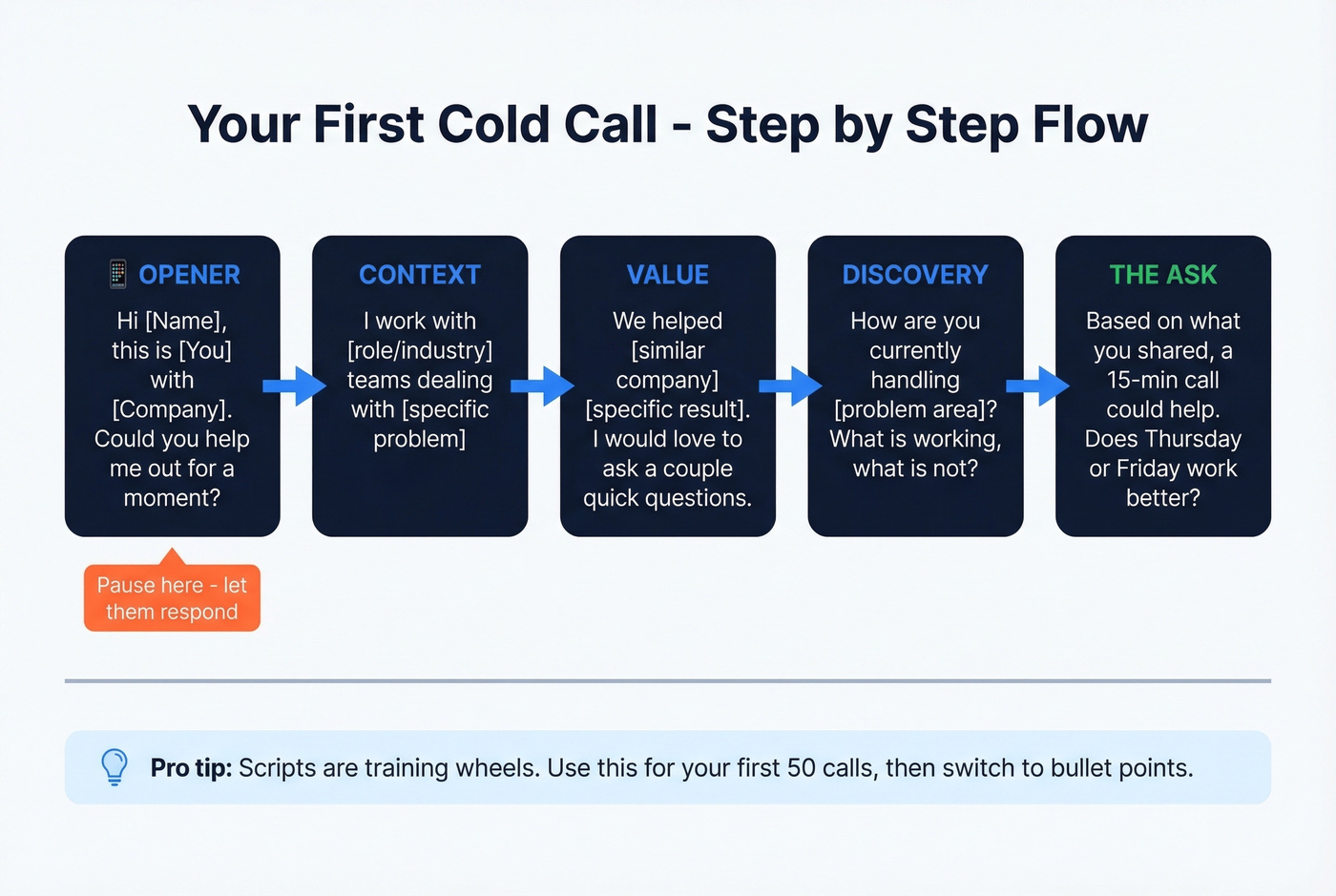
Opener: "Hi [First Name], this is [Your Name] with [Company]. Could you help me out for a moment?"
Pause. Let them respond. If they say yes or ask what's up:
Context: "I work with [role/industry] teams dealing with [specific problem]."
Value: "We helped [similar company or type] [specific result - save X hours, cut Z by half]. I'd love to ask a couple of quick questions to see if we can help."
Discovery: "How are you currently handling [problem area]? What's working, what's not?" (If you want a deeper bank of prompts, use these discovery questions.)
CTA: "Based on what you've shared, it'd be worth a 15-minute call to see if there's a fit. Does Thursday or Friday work better?"
Build Your Own
Every effective script has five components: introduction, context for why you're calling, a relevance connection to their world, a value proposition with proof, and a clear ask. ZoomInfo's framework breaks this down well if you want more templates. (You can also borrow from these sample elevator pitches to tighten your value line.)
One technique worth borrowing: the NEPQ pullback pattern. Saying "I'm not sure if we can help yet" reduces pressure and creates curiosity. Giving the prospect an easy "no" paradoxically leads to more "yes" outcomes - it signals you aren't desperate.
Scripts are training wheels. Use them for your first 50 calls, then switch to bullet points. The goal is to internalize the structure so you can have a real conversation, not recite a monologue. Record yourself on a few practice runs and you'll immediately hear where you sound robotic.
5 Objections You'll Hear Every Day
With buying groups now averaging 12 stakeholders, your prospect genuinely might not be the sole decision-maker. Objections often reflect organizational complexity, not personal disinterest. Here's how to handle the five most common ones. (If rejection is getting in your head, read our guide on cold call rejection.)
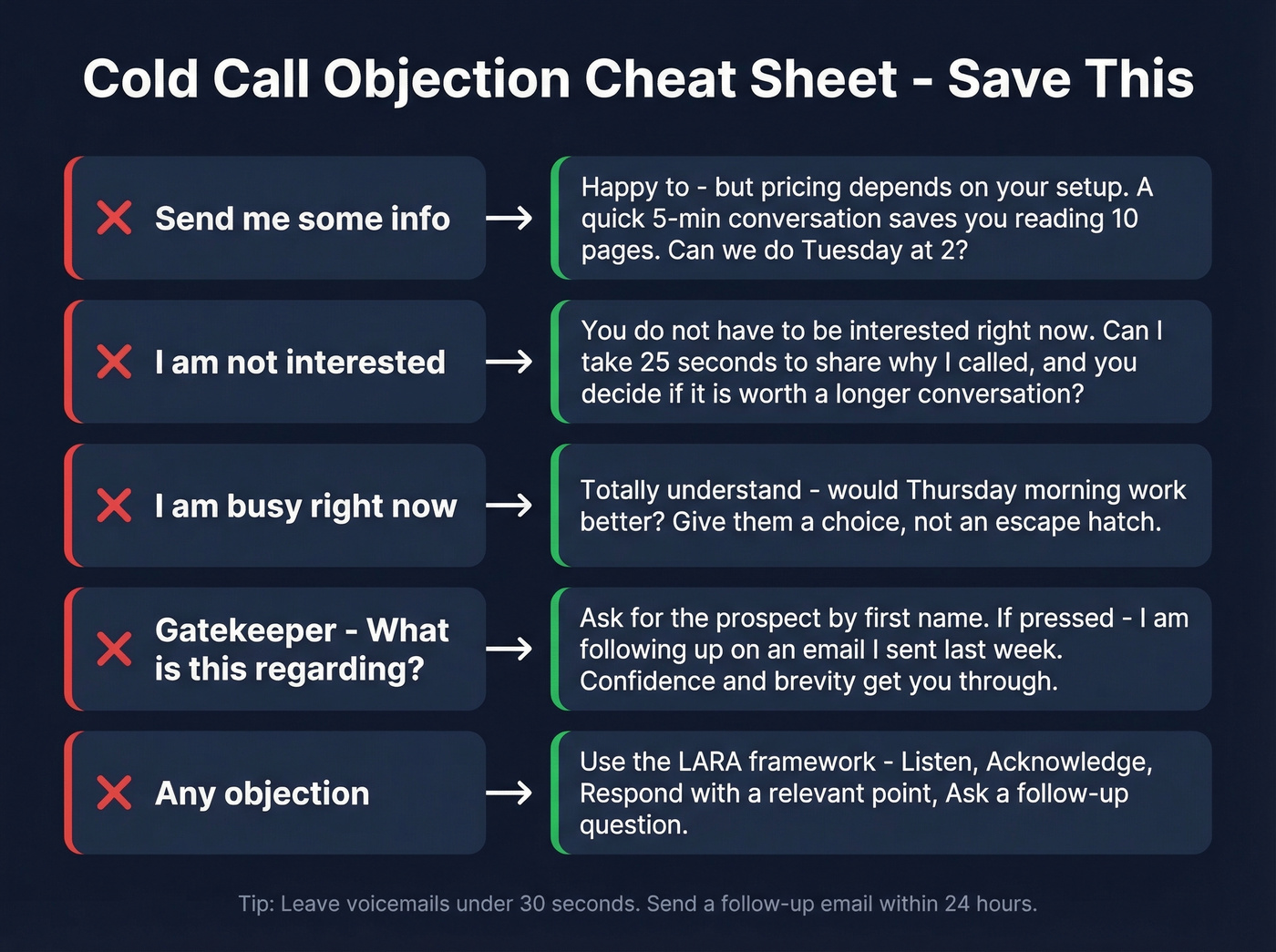
"Send me some info." This isn't a win - it's a polite no. Say: "Happy to - but pricing depends on your setup. A quick 5-minute conversation would save you reading 10 pages. Can we do Tuesday at 2?"
"I'm not interested." Don't argue. "You don't have to be interested right now. Can I take 25 seconds to share why I called, and you can decide if it's worth a longer conversation?"
"I'm busy right now." Respect it, but anchor a follow-up: "Totally understand - would Thursday morning work better?" Give them a choice, not an escape hatch.
Gatekeeper: "What's this regarding?" Different animal entirely. Don't explain your product to someone who can't buy it. Ask for the prospect by first name - "Is Sarah available?" - and if pressed, keep it brief: "I'm following up on an email I sent last week." Confidence and brevity get you through. Lengthy explanations get you screened.
Any objection (the LARA framework): Listen. Acknowledge what they said. Respond with a relevant point. Ask a follow-up question. This keeps the conversation alive instead of turning it into a debate you'll lose.
Quick follow-up rules: leave voicemails under 30 seconds - name, reason, number. Send a follow-up email within 24 hours referencing the call. (If you need copy/paste options, use these sales follow-up templates.)
Beginner Mistakes That Kill Results
In our experience, the same five mistakes account for most beginner failures. We've seen every one of these tank a new rep's first month.
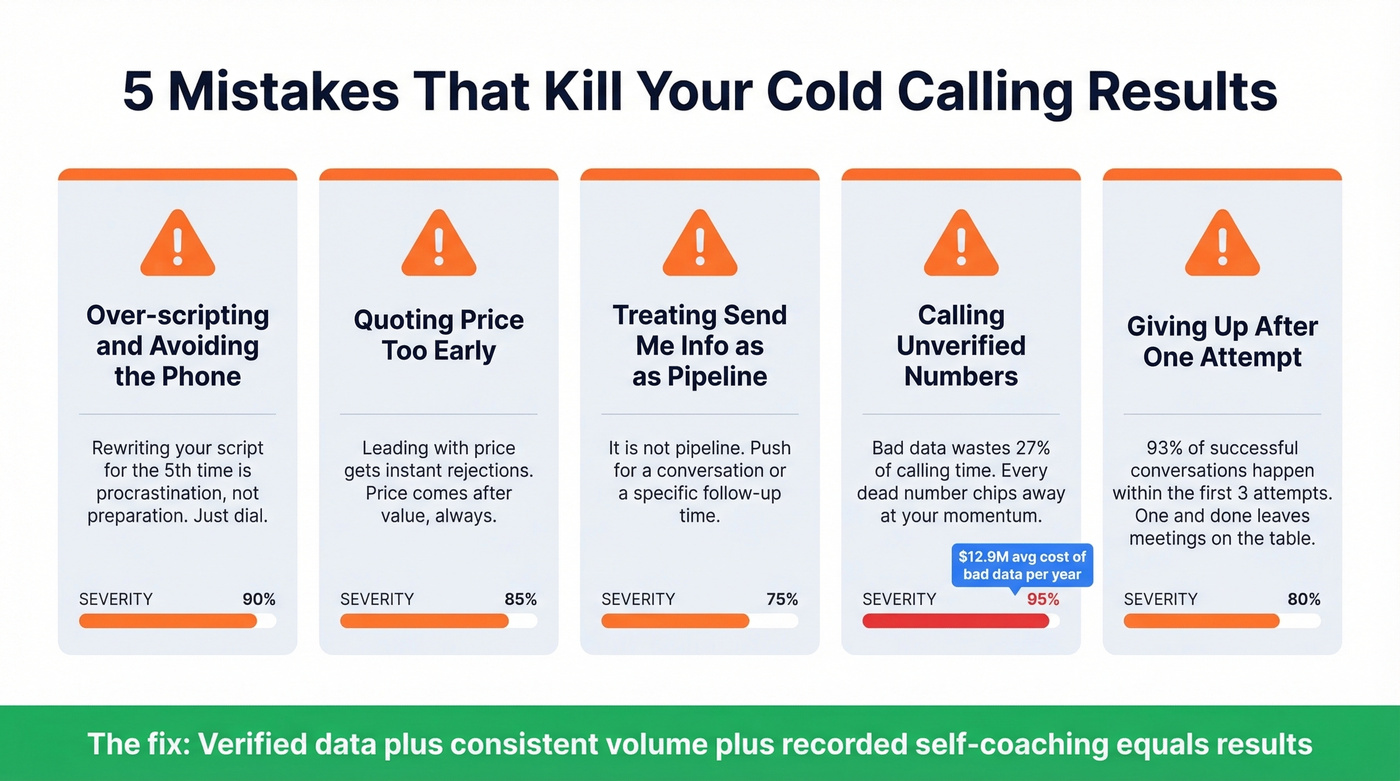
Over-scripting and avoiding the phone. Rewriting your script for the fifth time is procrastination, not preparation. The simplest cold calling 101 advice anyone can give you: pick up the phone and dial.
Quoting price too early. One Reddit poster was leading with "$600" on the first call and getting instant rejections. Price comes after value. Always.
Treating "send me info" as pipeline. It's not. Push for a conversation or a specific follow-up time. If you can't get either, that lead is cold.
Calling unverified numbers. Every dead number chips away at your momentum. Bad data costs companies an average of $12.9M per year - even at a small scale, the wasted time adds up fast. Skip this problem entirely by starting with verified mobiles. Prospeo's Mobile Finder covers 125M+ verified numbers refreshed every 7 days, with a 30% pickup rate, so you're calling humans instead of ghosts. (To build a repeatable process around this, set up a simple cold calling system.)
Giving up after one attempt. 93% of successful conversations happen within the first 3 call attempts. One and done is leaving meetings on the table.
Your Starter Tool Stack
You don't need 10 tools. You need three. Here's the thing: most beginners spend more time evaluating tools than making calls. Pick these and start dialing today. (If you're building a full stack, start with these SDR tools.)
A dialer. Manual dialing works for your first week. After that, a power dialer keeps you in rhythm without the chaos of predictive dialers that drop calls and burn through lists too fast. Expect $30-$150/user/month for SMB-friendly options, and look for local presence dialing - it significantly increases pickup rates.
A verified data source. This is where we've seen the biggest ROI for beginners, because bad data destroys morale before you've even developed your skills. Prospeo's free tier includes 75 emails and 100 Chrome extension credits per month - enough to test data quality before committing a dollar. Pair it with your dialer and you're calling real numbers from day one. (If you're sourcing lists on a budget, these free lead generation tools can help.)
A recording tool. Even a voice memo app works. Record your calls (where legally permitted), listen back, and coach yourself. This is the single highest-leverage practice habit for beginners who don't have a manager reviewing their calls. If you only do one thing from this guide besides dialing, make it this.
209 dials per appointment assumes most of those dials hit voicemail or wrong numbers. Prospeo refreshes every record on a 7-day cycle - not the 6-week industry average - so your list stays live. 15,000+ sales teams already use it to skip the dead air and reach real decision-makers.
Cut your dials-per-meeting in half with numbers that actually pick up.
It's Friday. You've made 200 dials this week, booked 3 meetings, and the knot is gone. That's what consistent volume on verified data does. The scripts get better with reps. The confidence comes from dials, not from reading one more beginner guide. Next week, review your recordings, identify your two weakest moments, and fix those. That's how reps improve - one call block at a time. (If you want a broader foundation, read our B2B sales explained guide.)
Start calling.
FAQ
What's the best time to cold call?
Tuesday is the highest-converting day for booking meetings. Aim for mid-week windows like 10 a.m. to 2 p.m. and 4 p.m. to 5 p.m. in the prospect's local time zone. Friday can generate conversations, but it's typically worse for confirmed bookings.
How many dials should a beginner make per day?
Aim for 40-60 dials daily. At a ~5% success rate, that's roughly 2-3 real conversations per day - enough to learn patterns, practice objection handling, and start building pipeline. Anything under 25 dials means you aren't getting enough at-bats to improve.
How do I get verified phone numbers for cold calling?
Use a data platform that refreshes records weekly, not monthly - stale data is the silent killer of call blocks. Avoid scraping random directories; bad data wastes 27% of your calling time before you even open your mouth. Look for providers with verified mobile databases and pickup rate guarantees so you're spending your energy on conversations, not voicemails.