

B2B Cold Email Templates: What 50M+ Emails Reveal About What Actually Works
A RevOps lead we know ran the same "proven" cold email B2B template across three campaigns last quarter. First campaign: 8.2% reply rate. Third campaign, same template, different list: 2.1%. The template didn't break - the market got tired of seeing it.
That's the core problem with B2B cold email templates in 2026. Everyone's running the same playbook, and prospects can smell it.
What You Need (Quick Version)
- Templates are the last 20%. Targeting, deliverability, and offer quality are the other 80%.
- Keep emails 40-60 words. Shorter emails outperform longer ones across every large cold email dataset we've seen.
- 2-4 word subject lines win. They hit 46% open rates in a 5.5M email study.
- Verify your list before sending. None of this matters if your bounce rate climbs above 3-4% and torches your domain reputation.
Why Most B2B Cold Emails Fail
The template isn't why your cold emails aren't working.
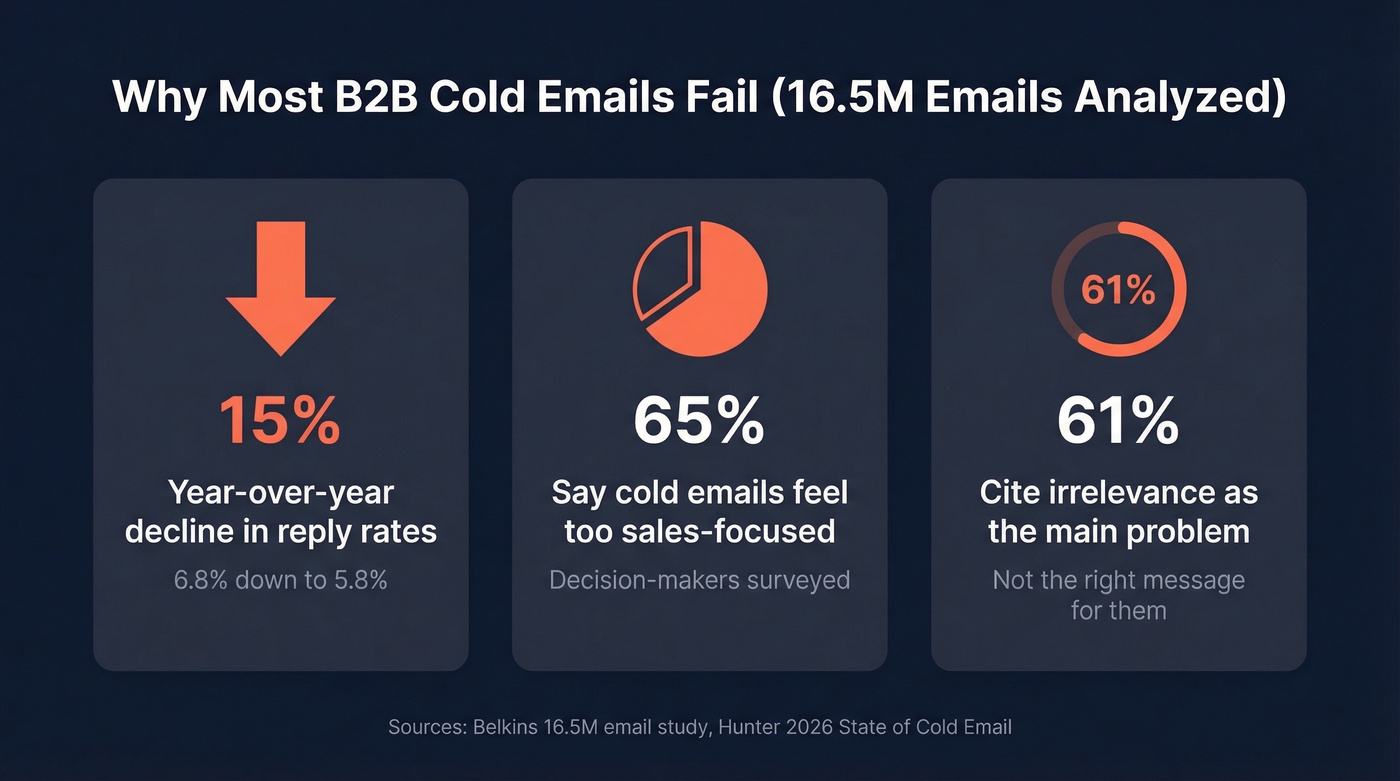
Belkins analyzed 16.5M cold emails and found average reply rates dropped from 6.8% to 5.8% year-over-year - a 15% decline. Hunter's 2026 report backs this up: 65% of decision-makers say cold emails fail because they feel "too sales-focused." Another 61% cite irrelevance.
As one r/coldemail practitioner put it: there's no "best" template. The moment one gets shared widely, thousands copy it and it dies from pattern fatigue.
Rules Before the Templates
Internalize these constraints before you touch a single template. They matter more than any copy trick.
Your list size matters more than your words. Hunter's 31M-email dataset shows campaigns sent to 21-50 recipients hit a 6.2% reply rate. Campaigns blasted to 500+ recipients? Just 2.4%. Belkins found the same pattern: targeting 1-2 contacts per company yields 7.8% replies versus 3.8% when you spray 10+ contacts at the same org. Tight targeting doubles your results before you write a word.
Keep it absurdly short. 6-8 sentences hit a 6.9% reply rate in Belkins' data. Under 200 words consistently beats longer. Every word beyond that costs you replies.
Lead with offer quality, not personalization theater. "Hey {{first_name}}, noticed you're hiring" isn't personalization - it's a mail merge. "Audit your top 3 landing pages with a recorded Loom" is far more compelling than "30-minute discovery call."
Use a soft CTA. "Worth a conversation?" outperforms "Are you free Thursday at 2pm?" Hard scheduling asks create friction. Soft asks create curiosity. (If you want more options, pull from these email call to action patterns.)
Let AI handle real personalization. A workflow that scrapes a prospect's recent post and uses GPT to generate a custom first line can lift response rates roughly 3x versus generic openers. The key word is "real triggers" - a funding round, a job posting, a product launch - not "I saw your company is doing great things." (More on building this into AI cold email outreach workflows.)
Here's the thing: if your average deal size is under five figures, you probably don't need a 12-step sequence with AI-personalized video thumbnails. A tight list, a clean offer, and 40 words will outperform the overengineered campaign every time.
Subject Lines That Get Opens
Belkins analyzed 5.5M emails and the pattern is unmistakable. Shorter wins. If you need inspiration, borrow from these cold email subject line examples.
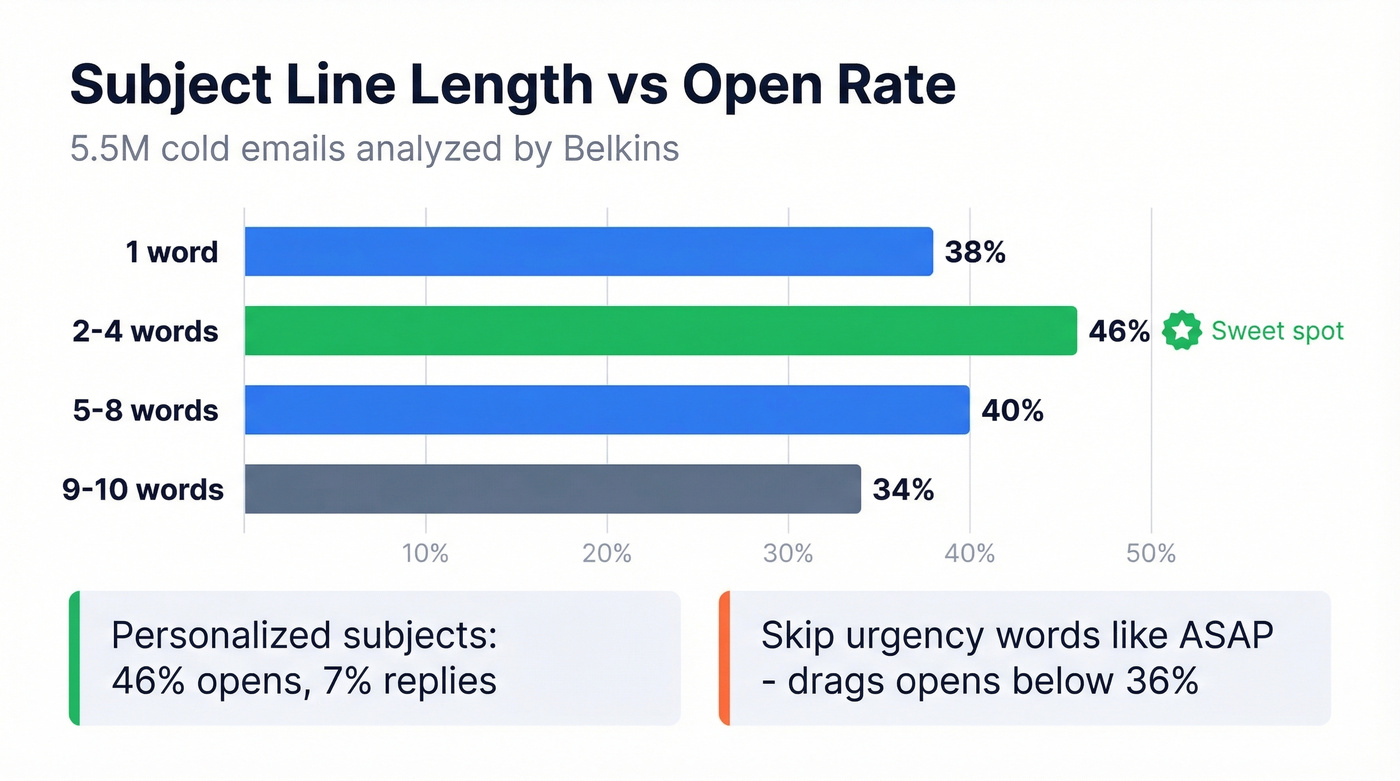
| Word Count | Open Rate |
|---|---|
| 1 word | 38% |
| 2-4 words | 46% |
| 9-10 words | 34-35% |
Personalized subject lines referencing the recipient's company, role, or a specific trigger hit 46% open rates versus 35% without - that's a 31% lift in opens and a 133% lift in reply rate (7% vs. 3%). Question-style subjects also averaged 46% opens, making them the top-performing format.
Skip urgency words like "ASAP" and generic greetings like "Hello, friend." Both drag opens below 36%.

Every template above dies the moment it hits an invalid email. Bounces above 3-4% torch your domain reputation - and no subject line trick fixes that. Prospeo's 5-step verification delivers 98% email accuracy, refreshed every 7 days, so your cold emails actually reach the inbox.
Stop perfecting templates that bounce. Start with a list you can trust.
5 Proven Cold Email B2B Templates
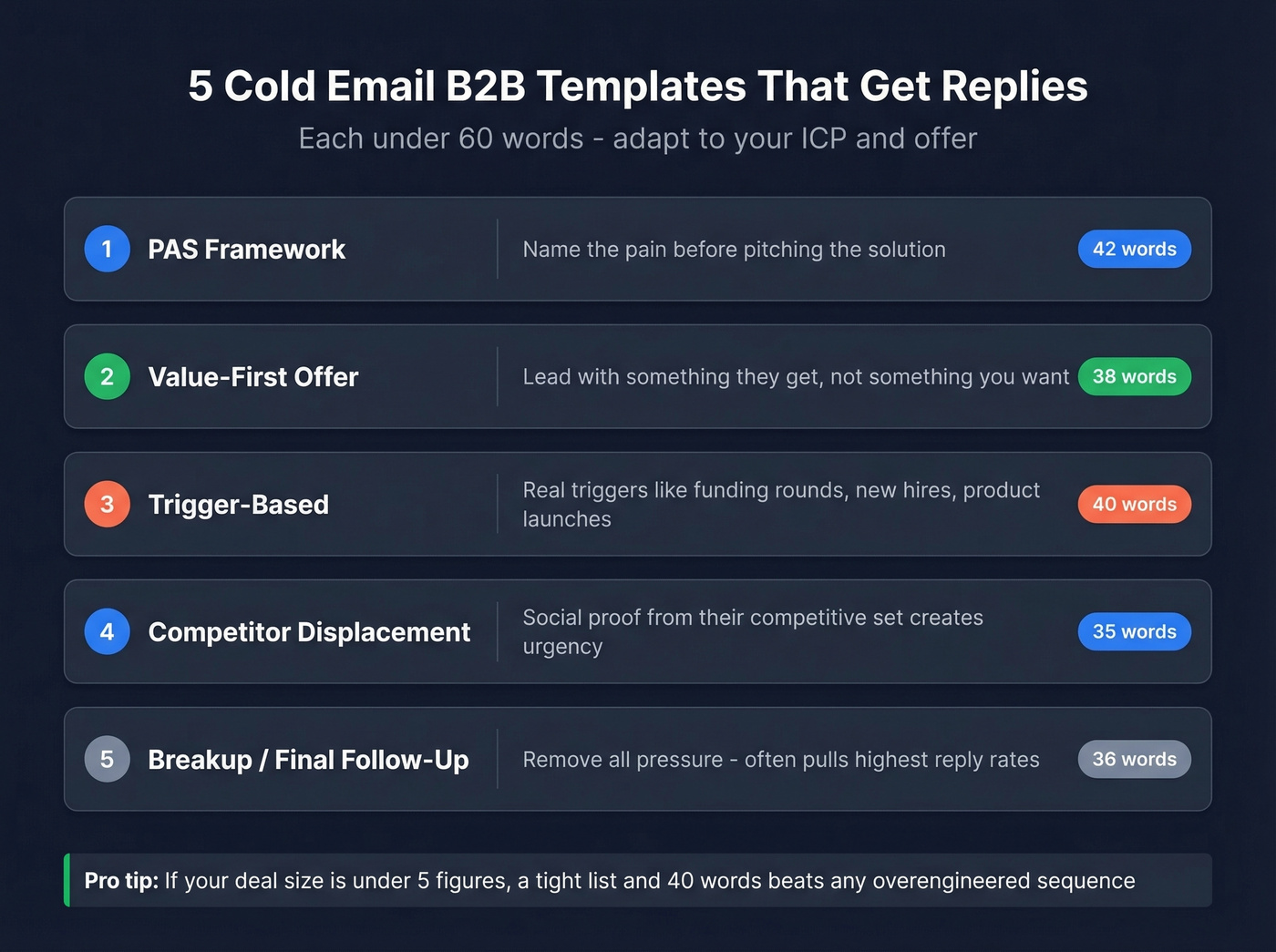
These are skeletons, not scripts. Adapt every one to your ICP, your offer, and your voice. Each clocks in under 60 words. (If you’re building a full multi-touch flow, start with a B2B cold email sequence instead of isolated sends.)
1. PAS Framework
{{First name}}, most {{role}} at {{company type}} waste {{specific time/money}} on {{problem}}.
We helped {{similar company}} cut that by {{specific result}} in {{timeframe}}.
Worth a quick look?
Names the pain before pitching the solution. 42 words - well under the ceiling where reply rates drop. (Deep dive: PAS Framework.)
2. Value-First Offer
{{First name}}, I put together a {{specific deliverable - audit, teardown, benchmark}} of {{their company/product}}.
{{One specific finding or insight}}.
Happy to send it over - no strings.
Leads with something they get, not something you want. The "no strings" CTA reduces friction. 38 words. We've seen this framework consistently outperform the standard pitch-first approach, especially for prospects who've never heard of you.
3. Trigger-Based
{{First name}}, saw {{specific trigger - funding round, new hire, product launch}}.
When {{similar companies}} hit that stage, they usually run into {{specific problem}}.
We built {{solution}} specifically for that. Interested?
Real triggers beat fake personalization. 40 words. If you don't have a real trigger, skip this template entirely - a forced trigger reference is worse than no personalization at all. (To operationalize this, use a system for how to track sales triggers.)
4. Competitor Displacement
{{First name}}, a few {{role}} at companies like {{their competitors}} switched from {{incumbent tool}} to us last quarter.
Main reason - {{one specific advantage}}.
Curious if that resonates?
Social proof from their competitive set creates urgency without saying "ASAP." 35 words.
5. Breakup / Final Follow-Up
{{First name}}, I've reached out a couple times - I'll take the hint.
If {{problem}} becomes a priority, here's a {{resource link}} that might help either way.
No hard feelings.
A clean way to close the loop. 36 words. Don't underestimate this one - we've seen breakup emails pull higher reply rates than the initial send because they remove all pressure.
Follow-Up Cadence
Don't send one email and move on. 60% of replies come after the second follow-up, and Hunter's data shows 3-message sequences produce 106% more replies than single messages. If you want plug-and-play follow-ups, use these cold email follow-up templates.
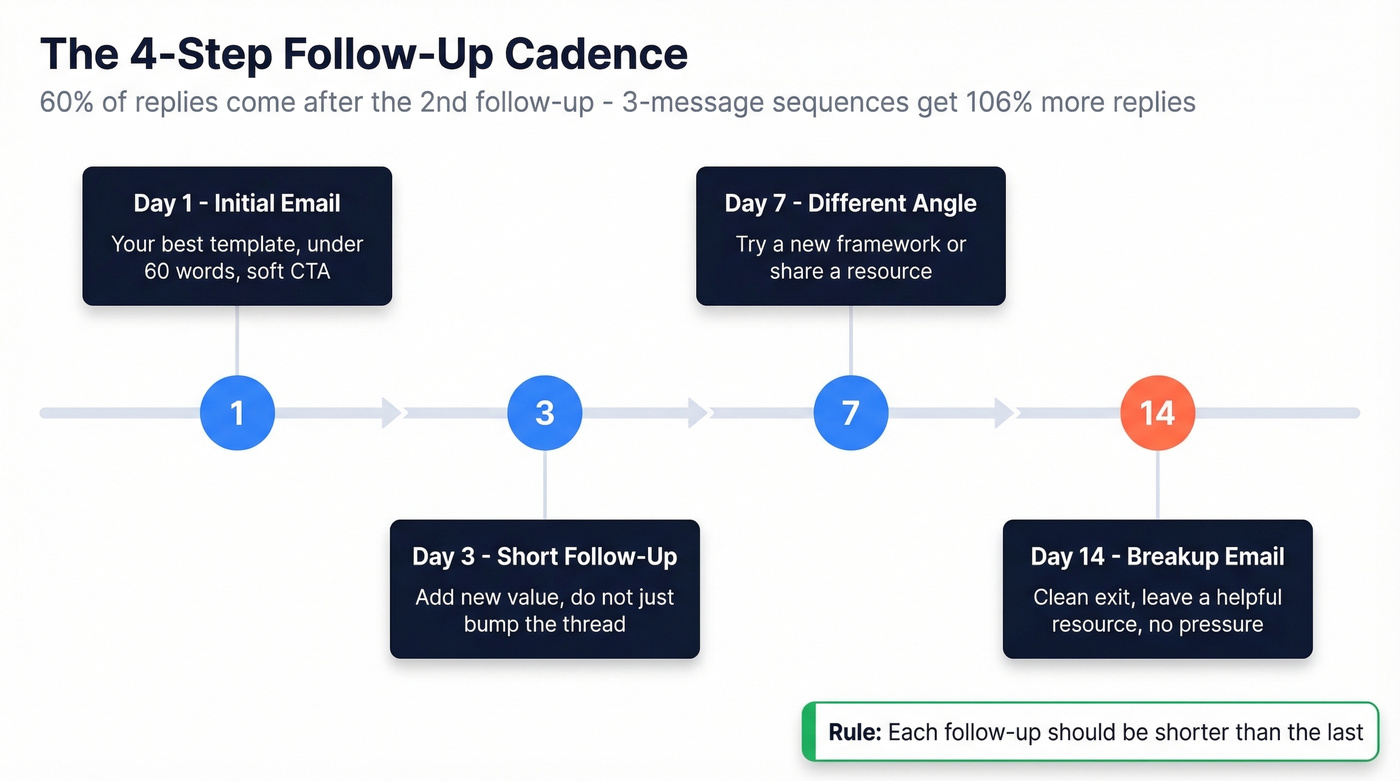
- Day 1 - Initial email
- Day 3 - Short follow-up (add new value, don't just "bump")
- Day 7 - Different angle or resource
- Day 14 - Breakup email
Keep each follow-up shorter than the last. If your Day 3 follow-up is longer than your original email, you're doing it wrong.
Before You Hit Send
Your template is irrelevant if your emails never reach the inbox. This checklist matters more than your copy. (For the full system, see our email deliverability guide.)
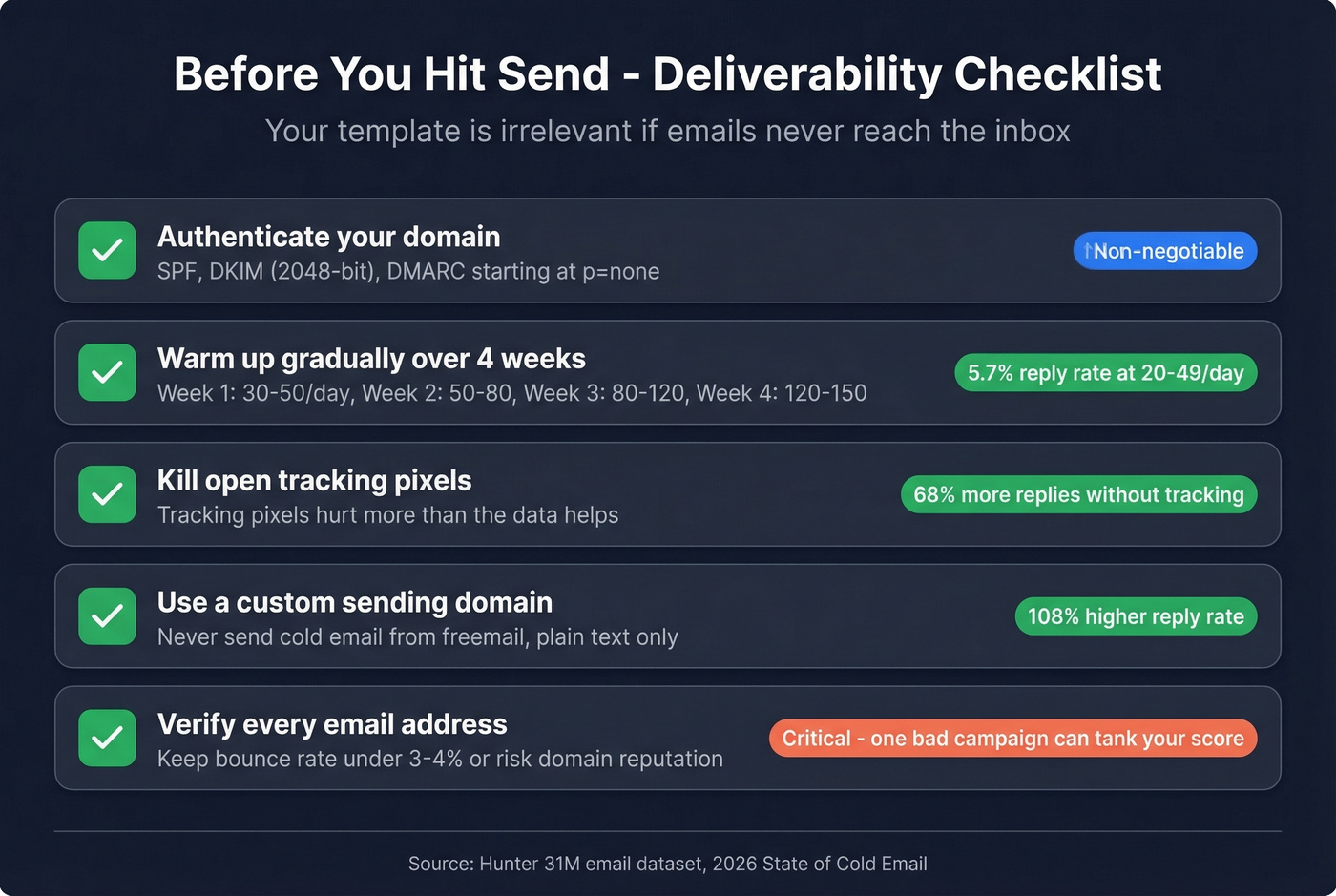
Authenticate your domain. SPF, DKIM (2048-bit keys), and DMARC. Start DMARC at p=none, then tighten to quarantine once alignment is clean. Non-negotiable. (If you’re troubleshooting, start with DMARC alignment.)
Warm up gradually. Week 1: 30-50 emails/day. Week 2: 50-80. Week 3: 80-120. Week 4: 120-150 - but only if bounces stay under 3%. Hunter's data shows the sweet spot is 20-49 emails per day per account, which produces a 5.7% reply rate. (Related: safe email velocity limits.)
Kill open tracking. We've tested this ourselves and the data is overwhelming. Hunter's 31M-email dataset found sequences without open tracking pixels hit 7.4% reply rates versus 4.4% with tracking - a 68% lift. The tracking pixel is hurting you more than the data is helping. (If you still need it, understand email tracking pixels first.)
Use a custom sending domain. Custom domains produce 108% higher reply rates than freemail (5.2% vs. 2.5%). Plain text only for cold outreach.

Verify every address before you send. A single campaign with a dirty list can tank your sender score for weeks. Prospeo's 5-step verification process catches spam traps and honeypots with 98% email accuracy, and data refreshes every 7 days instead of the 6-week industry average. The free tier covers 75 emails per month - enough to validate a test list before you scale. (Benchmarks + fixes: email bounce rate.)
Stay Legal
CAN-SPAM (US): Valid physical address, clear opt-out, honor requests within 10 business days. Penalties run up to $53,088 per email.
GDPR (EU/UK): B2B cold email is permissible under Article 6(1)(f) legitimate interest. Document your assessment.
CASL (Canada): Implied consent covers existing business relationships within 24 months. Honor unsubscribes within 10 business days.
Let's be honest - most teams treat compliance as an afterthought until they get burned. Build opt-out handling into your workflow from day one.
Trigger-based emails pull 3x more replies - but only if you can find the right contacts fast. Prospeo gives you 30+ filters including job changes, funding rounds, and hiring signals across 300M+ profiles, so every template lands on a prospect with a real reason to reply.
Find prospects with real triggers at $0.01 per verified email.
FAQ
What reply rate should I expect from B2B cold emails?
Expect 4.5-5.8% on average based on Hunter and Belkins datasets. Top performers hit 10-15% by combining tight targeting (under 50 recipients per campaign) with verified contact data and sub-60-word messages.
How many follow-ups should I send?
Three follow-ups is the sweet spot - 3-message sequences produce 106% more replies than single messages. Use a Day 1/3/7/14 cadence and make each follow-up shorter than the last.
How do I keep cold emails out of spam?
Authenticate your domain (SPF, DKIM, DMARC), warm up gradually over 4 weeks, and verify your entire list before sending. Prospeo's 5-step verification catches spam traps and honeypots - the free tier (75 emails/month) lets you validate a test list before scaling.
Do cold email B2B templates still work in 2026?
Templates work as starting frameworks, not copy-paste scripts. Belkins' data shows reply rates declining 15% year-over-year as prospects see the same patterns. Customize every template with real triggers, tight targeting, and a genuine offer to stay above the noise.