

How to Use Cold Email for Selling Products (Not Software)
You just got back from a trade show with 200 business cards and a product buyers loved in person. Now you need to turn that into orders at scale. Every cold email guide on the internet assumes you're selling SaaS - demos, free trials, annual contracts. Cold email for selling products is a different game entirely: samples, MOQs, wholesale margins, and buyers who think in pallets, not seats.
This is the playbook for product sellers. If your average deal is under $10k and you're moving physical goods, this'll save you months of trial and error.
What You Need Before Sending a Single Email
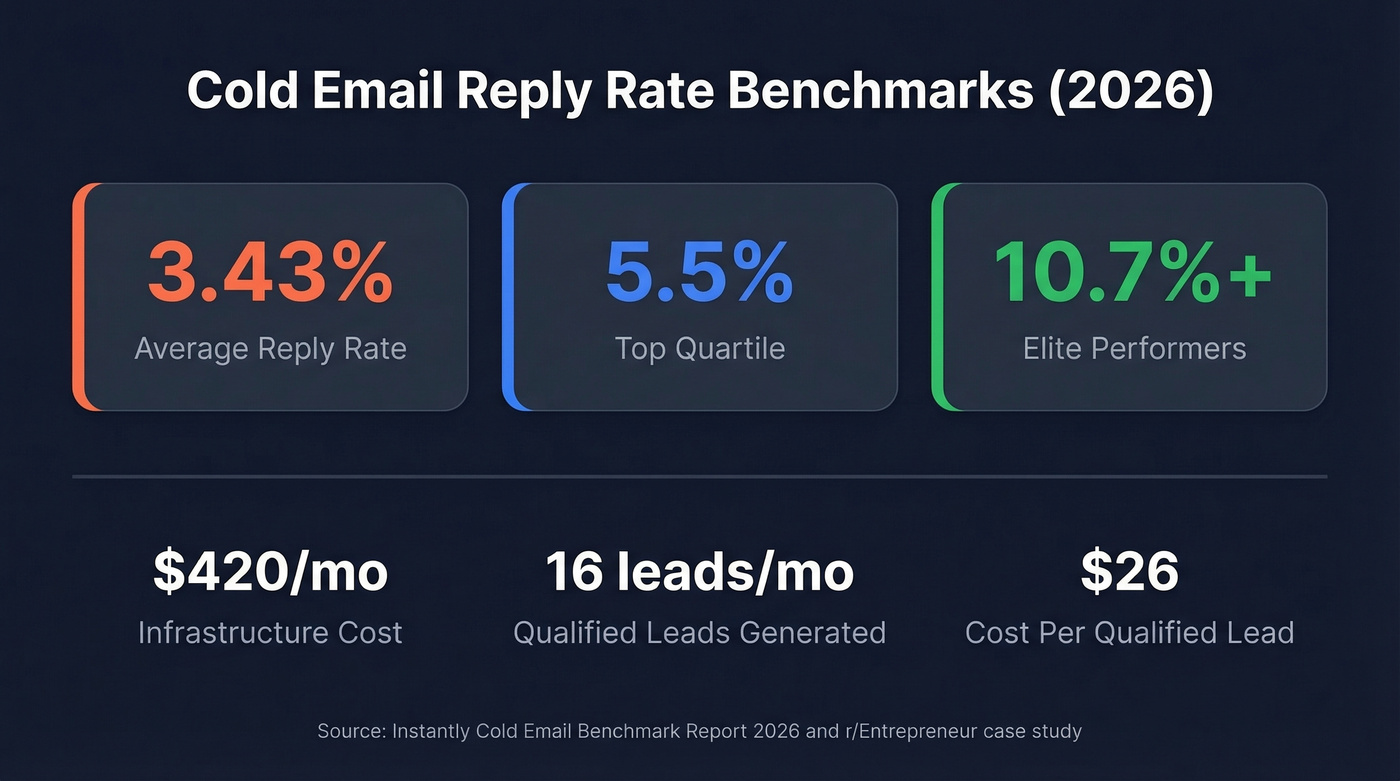
The average cold email reply rate in 2026 is 3.43%. Top quartile campaigns hit 5.5%+, and elite performers reach 10.7%+. One founder on r/Entrepreneur documented going from 3% to 6% after rebuilding infrastructure and cleaning their list - over 62 days, not overnight. That founder spent roughly $420/month on infrastructure and generated 16 qualified leads per month, working out to about $26 per qualified lead.
To get there, you need three things:
- A verified prospect list - not a purchased one. (If you need a system, start with lead enrichment before you verify.)
- Secondary sending domains with SPF, DKIM, and DMARC configured. Use an email deliverability guide to avoid missing basics.
- A sending tool like Instantly ($37/mo) or Woodpecker ($29/mo) to automate sequences. If you're comparing options, see AI bulk email senders.
Fix infrastructure before you touch copywriting. That's the order of operations, and most product sellers get it backwards.
Compliance and Deliverability
CAN-SPAM applies to all commercial email, including B2B. Penalties run up to $53,088 per email. Every message needs a valid physical address, a clear opt-out mechanism, and honest header information. Honor opt-outs within 10 business days.
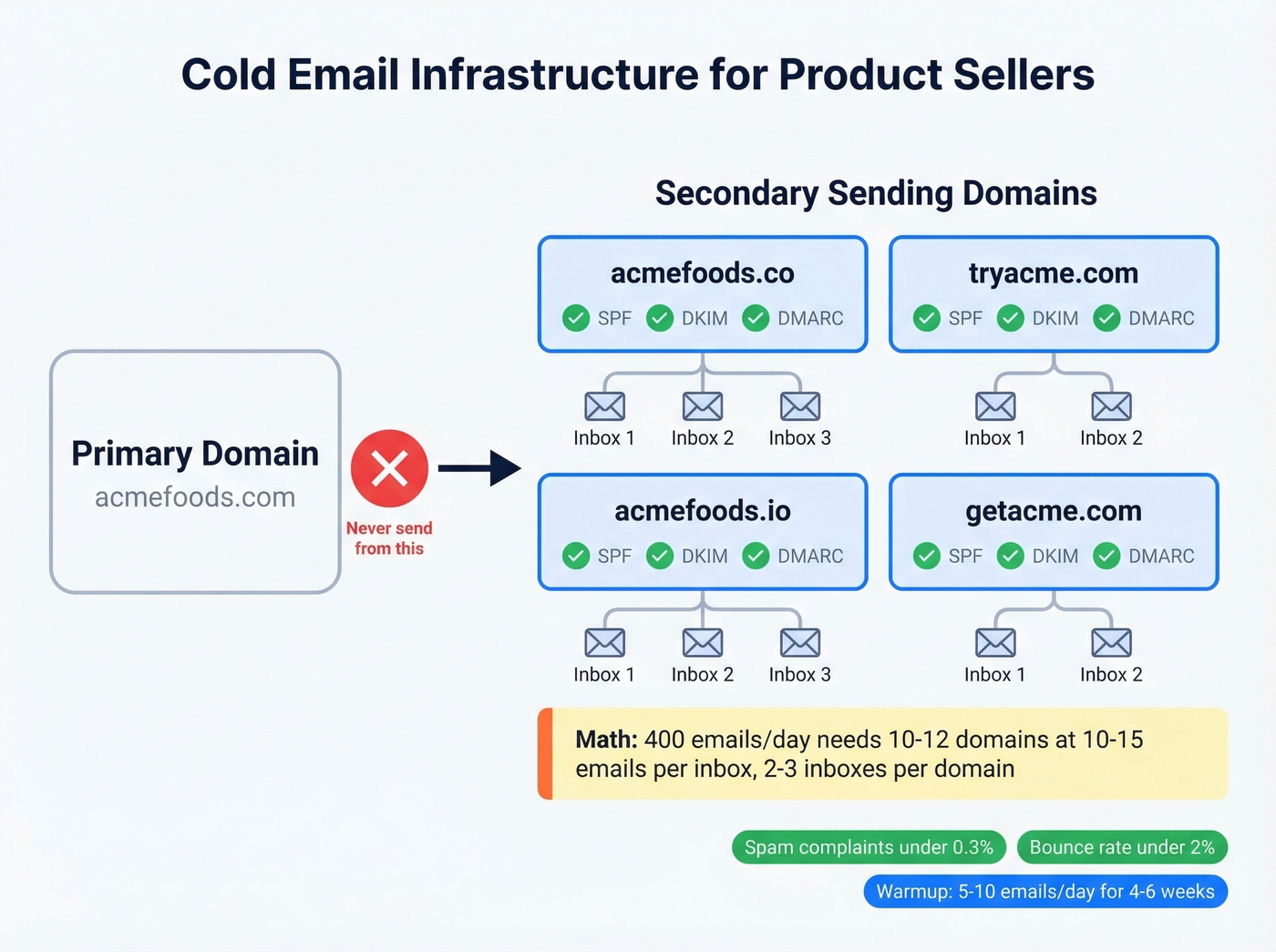
On the technical side, Google, Yahoo, and Microsoft now enforce bulk sender rules requiring SPF, DKIM, and DMARC authentication. The thresholds that matter:
- Spam complaint rate: under 0.3% (Track it with email reputation tools.)
- Bounce rate: under 2% (Use email bounce rate benchmarks to diagnose issues fast.)
- Warmup ramp: start at 5-10 emails/day, scale over 4-6 weeks (See email velocity for safe scaling.)
Never send from your primary business domain. Set up secondary lookalike domains - if you sell via acmefoods.com, send from acmefoods.co or tryacme.com. Run 2-3 inboxes per domain, capping each at 10-15 emails per day.
To send 400 emails daily, you'll need roughly 10-12 domains. A popular r/coldemail guide breaks down this exact math, and the consensus is clear: more domains at lower volume beats fewer domains at high volume every time.

Build Your Prospect List
Purchased lists are a deliverability death sentence. That Reddit founder reported bounce rates of 11% on purchased data - well above the 2% threshold that triggers mailbox provider penalties. After switching to verified contacts, bounces dropped below 2% and reply rates doubled. If you're building from scratch, follow a repeatable lead generation workflow so list quality doesn't decay.

That Reddit founder cut bounces from 11% to under 2% by switching to verified data. Prospeo's 5-step email verification delivers 98% accuracy - so your product samples reach real buyers, not dead inboxes. At ~$0.01/email, verifying your entire retail prospect list costs less than a single returned sample shipment.
Stop shipping samples to people who never got your email.
Building a prospect list of retail buyers, distributors, and purchasing managers by hand takes hours. Prospeo's database has 300M+ profiles with 30+ filters - search by industry, company size, job title, and even buyer intent signals across 15,000 topics. Find the exact buyers who stock products like yours, with verified emails ready to drop into your cold email sequences.
Find retail buyers actively looking for new products to stock.
Templates That Work for Physical Products
Your first email isn't supposed to close a sale. It's supposed to start a conversation. Buyers decide whether to read or delete in about 2.7 seconds - your first line needs to earn the second. Resist the urge to pitch your full product line, attach a catalog, and ask for a PO all at once.
The structure is a stripped-down version of PAS (Problem-Agitate-Solution), adapted for product outreach where the "solution" is a tangible sample, not a demo link: relevance, value, one CTA. If you want to tighten the writing, use a proven email copywriting framework.
Product-specific offers that reduce friction:
- Free sample (you cover shipping)
- Trial order with net-60 terms
- Low MOQ for first-time buyers
No attachments in email one - they hurt deliverability. Link to a clean product page instead. And watch your pronouns: aim for a 1:2 ratio of "I/my" to "you/your." The email should be about their business, not yours.
In follow-ups, include your MSRP, wholesale discount tiers, and the retailer margin buyers can expect. That's the math they need to say yes.
Template 1: First Touch - Sample Offer
Subject: Quick question about [store name]'s [category]
Hi [First Name],
I noticed [store name] carries [competitor brand / related category]. We make [product] - [one-sentence differentiator, e.g., "organic hot sauces with a 68% reorder rate at retail"].
Happy to send a free sample pack so you can taste before committing. Want me to ship one over?
[Your name]
Template 2: Follow-Up - Social Proof + Pricing
Subject: Re: Quick question about [store name]'s [category]
Hi [First Name],
Following up - [product] is currently in [X stores / X locations]. Retailers are seeing [margin %] margins at our suggested MSRP of [$X].
Wholesale starts at [$Y] with a [Z]-unit MOQ. Here's our [one-sheet link].
Worth a quick look?
Template 3: The Breakup
Subject: Should I close your file?
Hi [First Name],
I've reached out a few times about [product]. Totally understand if the timing isn't right.
If you'd like to revisit later, just reply and I'll circle back in [Q3 / after the holidays / etc.]. Otherwise, I'll stop reaching out.
Thanks either way.
Keep every email under 80 words. That Reddit case study found cutting from 141 words to under 56 was a key lever in doubling reply rates.
Subject Line Rules
Keep subject lines under 45 characters for mobile. Personalized subject lines get 50% higher open rates, and questions outperform statements by 21%. Including numbers can boost opens by up to 113% - so "68% reorder rate - worth a sample?" beats "Great product for your store" every time. For more ideas, pull from these email subject line examples.
Make Ordering Frictionless
Once a buyer says yes, don't make them chase you for next steps. Include a Google Form or Typeform for sample requests, a Stripe or PayPal link for trial orders, or a downloadable PO template for enterprise buyers. The fewer steps between "yes" and "shipped," the higher your conversion.
We've seen product sellers lose warm leads simply because they didn't have an order form ready when the reply came in. Prepare templated replies for common objections - price, MOQ, shipping costs, exclusivity requests - so you can respond within hours, not days. If you need ready-to-use language, adapt these sales follow-up templates.
Follow-Up Cadence for Product Outreach
58% of replies come from email one. The other 42% come from follow-ups, which means skipping them cuts your results nearly in half. Here's the uncomfortable truth: 70% of salespeople stop after one email. A single follow-up increases reply chances by 25%, and sequences of 4-7 touchpoints can triple response rates.
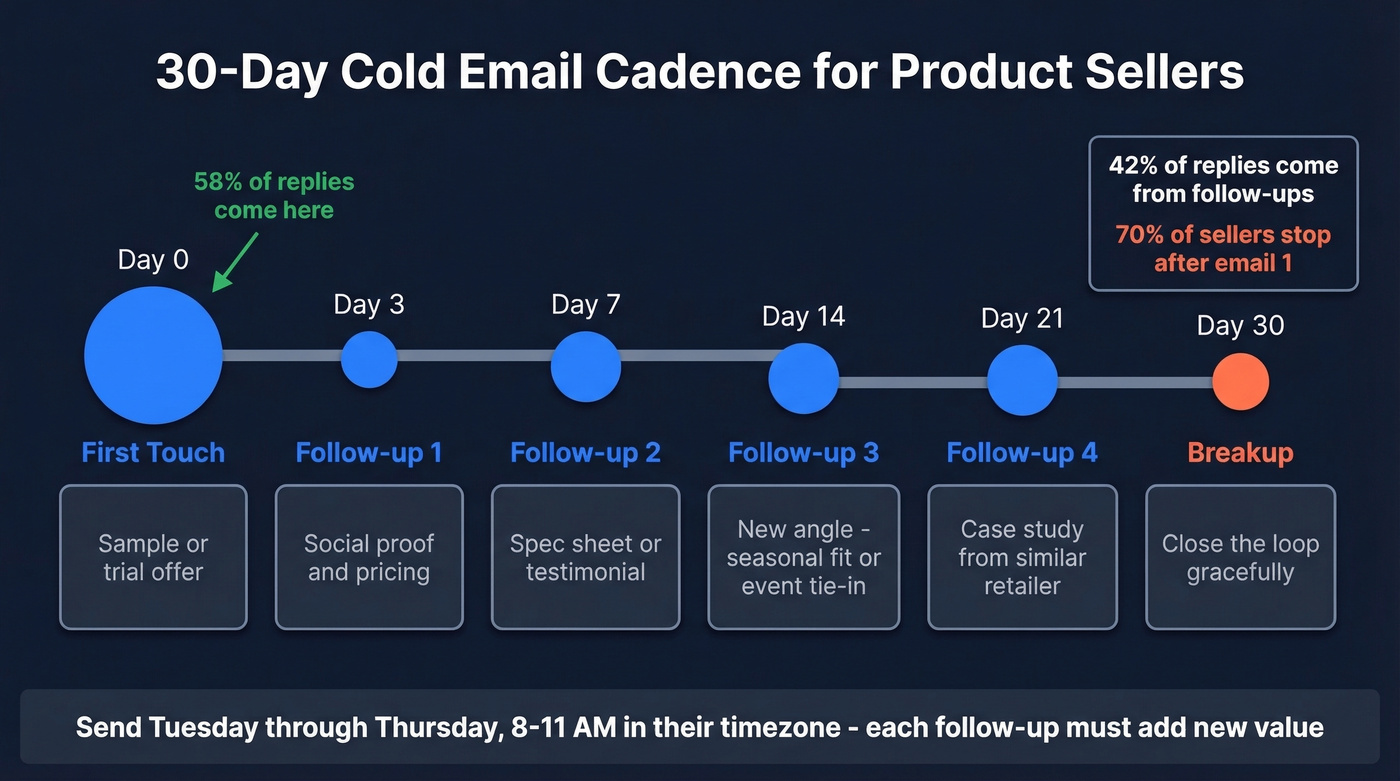
| Day | Purpose | |
|---|---|---|
| 0 | First touch | Sample/trial offer |
| 3 | Follow-up 1 | Social proof + pricing |
| 7 | Follow-up 2 | Spec sheet or testimonial |
| 14 | Follow-up 3 | New angle (seasonal fit, event tie-in) |
| 21 | Follow-up 4 | Case study from similar retailer |
| 30 | Breakup | Close the loop gracefully |
Send Tuesday through Thursday, 8-11 AM in the recipient's timezone. Each follow-up should add new value - don't just "bump" the thread. If follow-up 2 is the same vague "circling back" as follow-up 1, you're training the buyer to ignore you. For more sequencing ideas, see cold email follow-up templates.
Mistakes That Kill Product Campaigns
The most common failure mode isn't bad copy - it's bad infrastructure. Sending from your primary domain, skipping warmup, and using purchased lists will tank your campaigns before a single buyer reads your subject line.
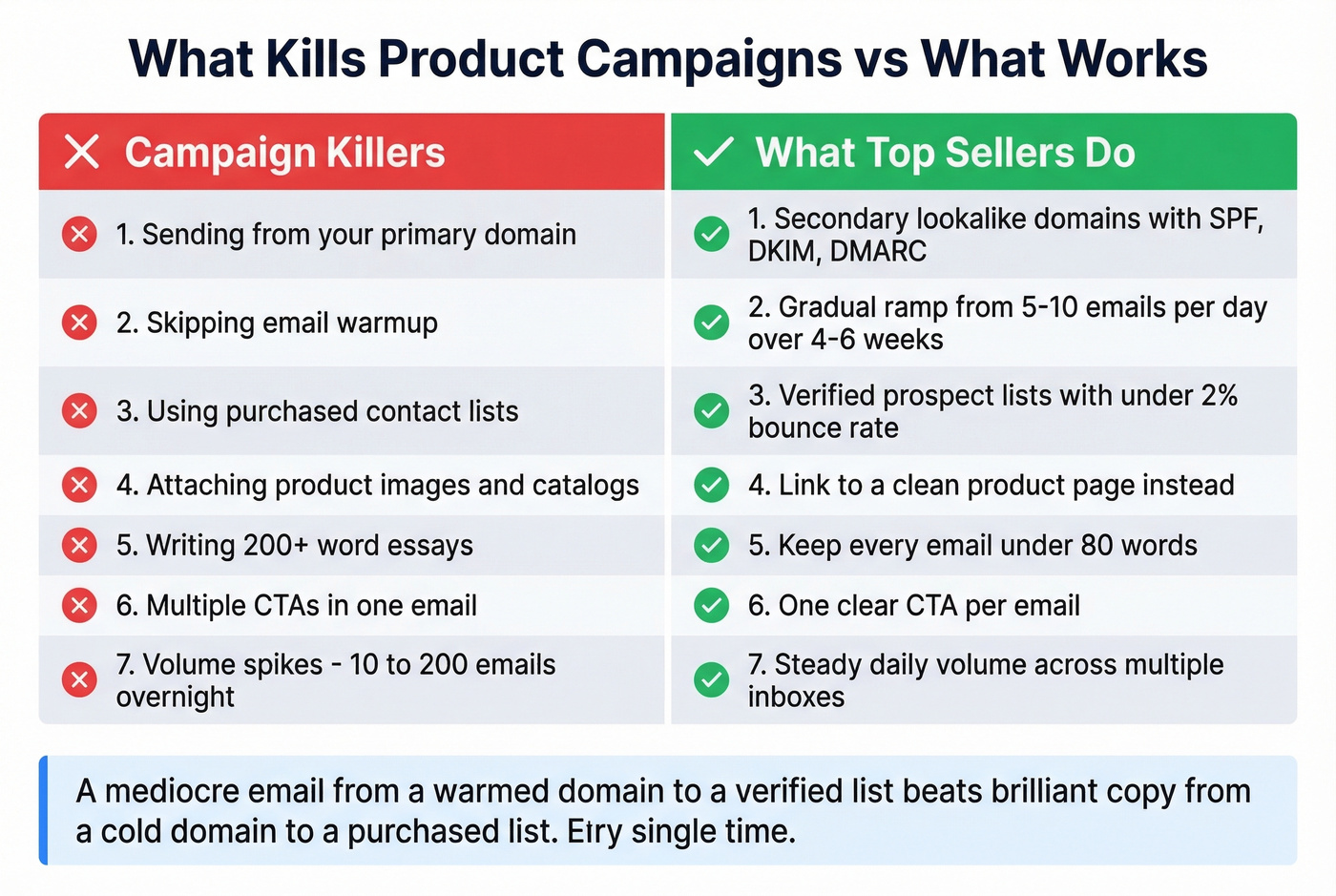
The second most common failure is overloading the first email. Attaching product images, including multiple CTAs, writing 200-word essays - all of it hurts. In our experience, the sellers who struggle most are the ones who treat cold email like a digital catalog instead of a conversation starter. Look, we get it. You're proud of your product and you want to show everything off. But the first email's only job is to get a reply.
A few more that we see kill campaigns consistently: no follow-up plan beyond email one, missing unsubscribe links (a CAN-SPAM violation), HTML-heavy formatting with multiple images, and volume spikes. Going from 10 to 200 emails overnight destroys sender reputation. Skip any of these basics and it doesn't matter how good your product is.
Here's the thing: Most product sellers don't have a copywriting problem. They have a data and infrastructure problem. A mediocre email sent from a warmed domain to a verified list will outperform brilliant copy sent from a cold domain to a purchased list. Every single time.
Recommended Sending Tools
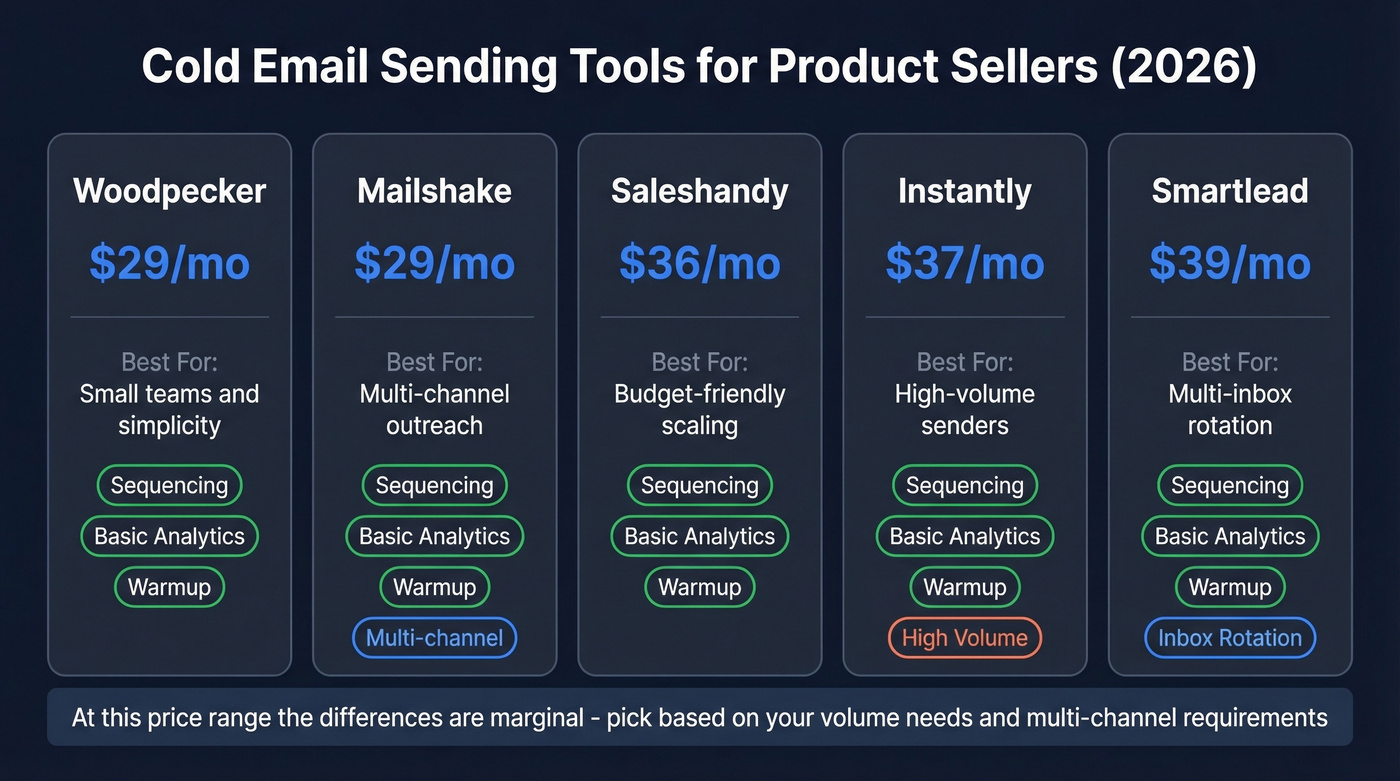
For actually sending sequences, you need a dedicated tool. Here are the ones worth considering:
| Tool | Starting Price | Best For |
|---|---|---|
| Woodpecker | $29/mo | Small teams, simplicity |
| Mailshake | $29/mo | Multi-channel outreach |
| Saleshandy | $36/mo | Budget-friendly scaling |
| Instantly | $37/mo | High-volume senders |
| Smartlead | $39/mo | Multi-inbox rotation |
All five support sequencing and basic analytics, and most teams pair them with warmup and inbox rotation. At this price range, the differences are marginal - pick based on your volume needs and whether you want multi-channel features or just email. If you're building a full outbound stack, compare SDR tools.
FAQ
How many emails should I send per day when selling products?
Start at 5-10 emails per day per inbox during warmup, scaling over 4-6 weeks. At full capacity, aim for 10-15 per inbox with 2-3 inboxes per domain. That gives you 30-45 sends per domain daily without triggering spam filters.
Should I attach product photos to my outreach?
No. Attachments hurt deliverability across Gmail, Outlook, and Yahoo. Link to a clean product page or a hosted one-sheet instead. Save the full catalog for after they reply.
How do I find email addresses for retail buyers and distributors?
Use a B2B database with filters for job title, industry, and company size to target purchasing managers, buyers, and procurement contacts. Always verify before sending - bounce rates above 2% damage your domain reputation and tank future campaigns.
Does cold email actually work for physical products?
Yes - and in many ways it works better than for software. Physical products have a built-in advantage: you can offer free samples. That tangible, low-risk offer consistently outperforms "book a demo" CTAs. The key is treating cold email for selling products as a conversation starter, not a catalog, and backing it with verified data and proper sending infrastructure.