

How to Run a Cold Email Marketing Campaign That Gets Replies in 2026
You sent 200 emails from your primary domain last Tuesday. By Thursday, your entire company's email was landing in spam - including invoices to existing clients. We've watched it happen to three teams this quarter alone.
Cold email isn't email marketing. Email marketing goes to people who opted in. A cold email marketing campaign goes to strangers you've researched and believe are a fit. The rules, the infrastructure, and the writing are completely different. Conflate the two and you'll torch your sender reputation before your first follow-up goes out.
Before launching any campaign, you need secondary domains and authentication. You need a verified list - 98% accuracy minimum or your domain burns. You need sub-80-word plain-text emails with a micro-ask CTA, sent across 4-7 touches spaced 3-4 days apart. The average reply rate in 2026 is 3.43%. Top performers hit 10.7%+. Everything below walks through the full strategy so you can get there.
2026 Campaign Benchmarks
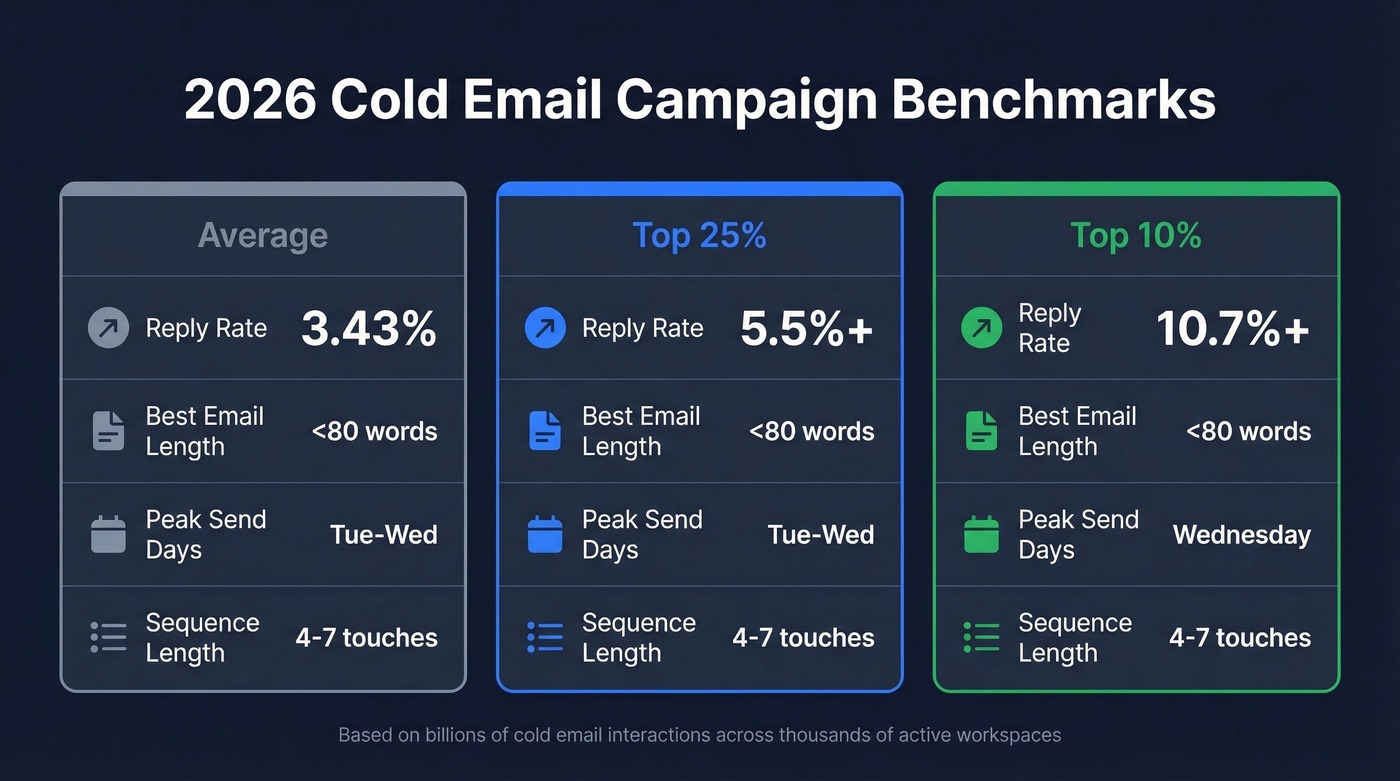
Here's what good actually looks like, based on analysis of billions of cold email interactions across thousands of active workspaces:
| Metric | Average | Top 25% | Top 10% |
|---|---|---|---|
| Reply rate | 3.43% | 5.5%+ | 10.7%+ |
| Best email length | <80 words | <80 words | <80 words |
| Peak send days | Tue-Wed | Tue-Wed | Wednesday |
| Sequence length | 4-7 touches | 4-7 touches | 4-7 touches |
If you're above 3%, you're outperforming most senders. Practitioners on r/coldemail consistently report that 2-4% reply rates are realistic at scale - ignore guru screenshots showing 25%+ from cherry-picked 50-person campaigns. Reddit sentiment in 2026 skews pessimistic as inboxes get more crowded, which makes infrastructure and data quality the real differentiators.
Six Steps to Launch Your Campaign
1. Set Up Sending Infrastructure
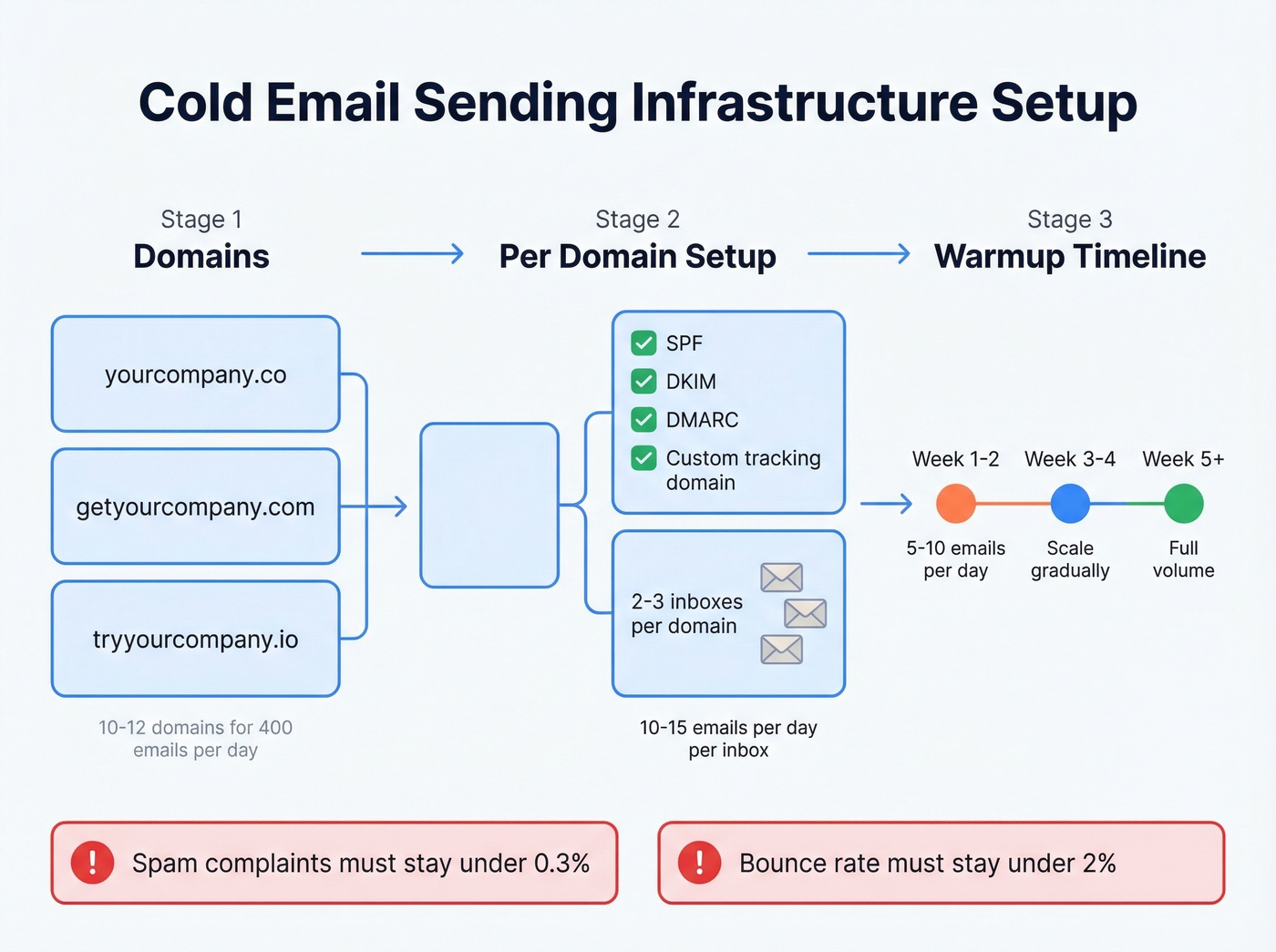
This is where most campaigns die before they start. Never send cold email from your primary domain. Buy secondary domains - variations like yourcompany.co, getyourcompany.com, tryyourcompany.io.
The non-negotiable checklist:
- SPF, DKIM, DMARC configured on every sending domain
- Custom tracking domain (branded CNAME, allow 72 hours for DNS propagation)
- Warmup running for 2-3 weeks before any cold sends go out
Keep volume to 10-15 emails per day per inbox, and run 2-3 inboxes per domain. So if you need to send roughly 400 emails a day, you're looking at 10-12 domains worth of capacity. Start warmup at 5-10 emails/day and scale over 4-6 weeks.
One wrinkle worth flagging: Google has cracked down on automated warmup tools - GMass even discontinued its automated warmup feature after the crackdown. If your warmup service gets flagged, your domain takes the hit. Use a reputable warmup feature built into your sending platform, or run a manual warmup by emailing colleagues and having them reply.
Hard limits: spam complaints must stay under 0.3% and bounces under 2%. Exceed either and you're burning domains.
2. Build a Verified Prospect List
Define your ICP before you source a single email. Job title, company size, industry, geography, tech stack - nail these down first.
A tight list of 500 perfect-fit prospects will outperform a loose list of 5,000 every time. We've seen teams buy 5,000-email lists from cheap providers, bounce at 18% on the first send, and permanently destroy their domain reputation in a single afternoon. That's not a copy problem. It's a data problem.
Here's the thing: most cold email failures are actually data failures wearing a copy-problem disguise. Tools like Prospeo give you 75 verified emails per month on the free tier, which is enough to validate your first campaign before spending a dollar. At scale, you're paying about $0.01 per email with 98% accuracy on a 7-day refresh cycle - the kind of freshness that keeps bounce rates where they need to be.

3. Write Emails That Get Replies
Keep it under 80 words. Plain text. One link maximum. A micro-ask CTA - "Worth a 10-minute call?" beats "Schedule a demo to learn how our platform can transform your revenue operations."
A Belkins study of 5.5M emails found personalized subject lines hit 46% open rates versus 35% without - a 31% lift. Reply rates jumped from 3% to 7%. For subject lines specifically, 30MPC's analysis of 85M+ cold emails found 1-4 word subject lines perform best, and all-lowercase formatting drives the highest opens.
One counterintuitive finding: empty subject lines boost opens by ~30% but tank replies by 12%. It's a gimmick. Skip it.
Use this skeleton for every email:
Line 1: Relevant trigger or observation about their company. Line 2: What you do + one proof point. Line 3: Micro-ask CTA.
Stop obsessing over first-line personalization. "I saw you posted on LinkedIn about..." is noise at this point. Personalize the who - your targeting and list quality - not the what. A relevant offer to the right person beats a flattering opener to the wrong one every time.
Let's be honest: if your average deal size is under $5k, you probably don't need cold outreach at all. The infrastructure cost, domain management, and time investment only pay off when each closed deal moves the needle. Below that threshold, warm introductions and referrals will outperform cold sends consistently.
4. Design Your Sequence
The sweet spot is 4-7 touchpoints spaced 3-4 days apart. 58% of replies come from your first email, but the remaining 42% come from follow-ups. Stopping after one email leaves nearly half your replies on the table.
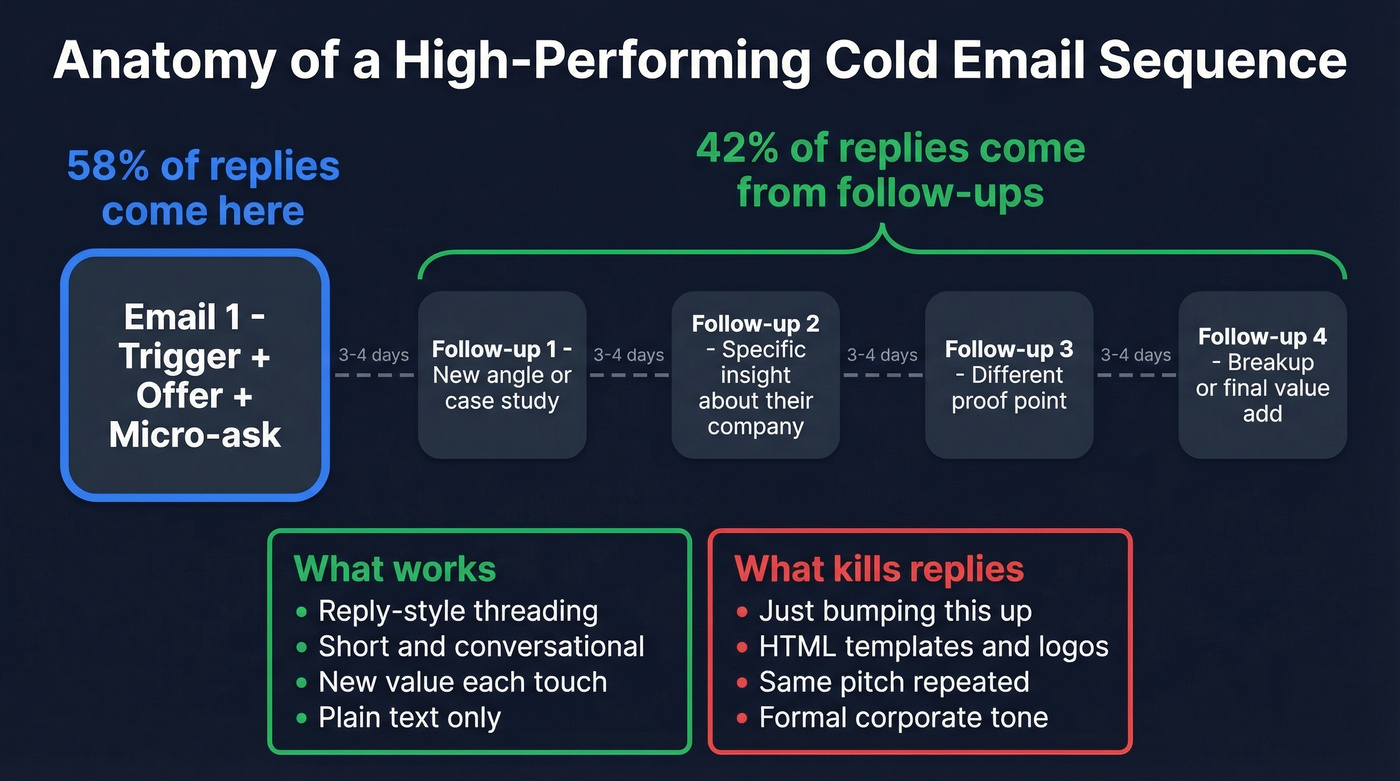
Each follow-up should add new value - a different angle, a relevant case study, a specific insight about their company. "Just bumping this up" is the fastest way to get marked as spam. Reply-style follow-ups that are short, conversational, and stripped of formatting outperform formal reminders by roughly 30%. We tested this across multiple client campaigns last quarter and the pattern held every time: the emails that looked like they came from a real person replying to their own thread crushed the polished ones. If you want plug-and-play copy, start with these follow-ups.
5. Stay Legal
Cold email is legal in most jurisdictions, but penalties for getting it wrong are steep.
| Regulation | Consent? | Opt-Out Deadline | Max Penalty |
|---|---|---|---|
| CAN-SPAM | No (opt-out model) | 10 business days | up to $51,744/email |
| GDPR | Consent or legit interest | Immediate | EUR 20M or 4% revenue |
| CASL | Express or implied | Immediate | $10M CAD |
Every cold email needs a physical mailing address, a non-deceptive subject line, and a working opt-out mechanism. Washington State set a precedent in 2025 with a Supreme Court ruling tied to $500-per-email penalties for misleading subject lines - at least eight lawsuits have been filed under that precedent since. Don't get cute with your subject lines.
6. Measure and Iterate
Track three numbers religiously. Reply rate - benchmark against the tiers above. Bounce rate - pause immediately if it exceeds 2% (see bounce rate benchmarks). Spam complaints - pause if they cross 0.3% (run an email spam checker before scaling).
A/B test one variable per week. Subject line one week, CTA the next, send time the week after. Testing multiple variables simultaneously tells you nothing useful. If your numbers are below average, fix your list quality and infrastructure before touching your copy - in our experience, bad data is the culprit about 80% of the time.

The article says it plainly: most cold email failures are data failures. One bad send at 18% bounce rate destroys your domain permanently. Prospeo's 98% email accuracy and 7-day refresh cycle keep your bounce rate under 2% - the hard limit that separates campaigns that scale from campaigns that burn.
Stop burning domains. Start with data that's verified this week.
Mistakes That Kill Campaigns
- Brochure-style copy. Write like a human, not a landing page (more on email copywriting).
- Skipping follow-ups. 42% of replies come after the first touch. That's not a rounding error (use these sales follow-up templates).
- Over-formatting. Banners, logos, HTML templates all trigger spam filters. Plain text wins.
- Spray-and-pray targeting. Destroys deliverability and your brand reputation simultaneously (use sales prospecting techniques instead).
- Using unverified data. If your bounce rate exceeds 5%, the problem is your data source, not your copy. Full stop.

Recommended Tool Stack
You need three things. Don't overcomplicate it.
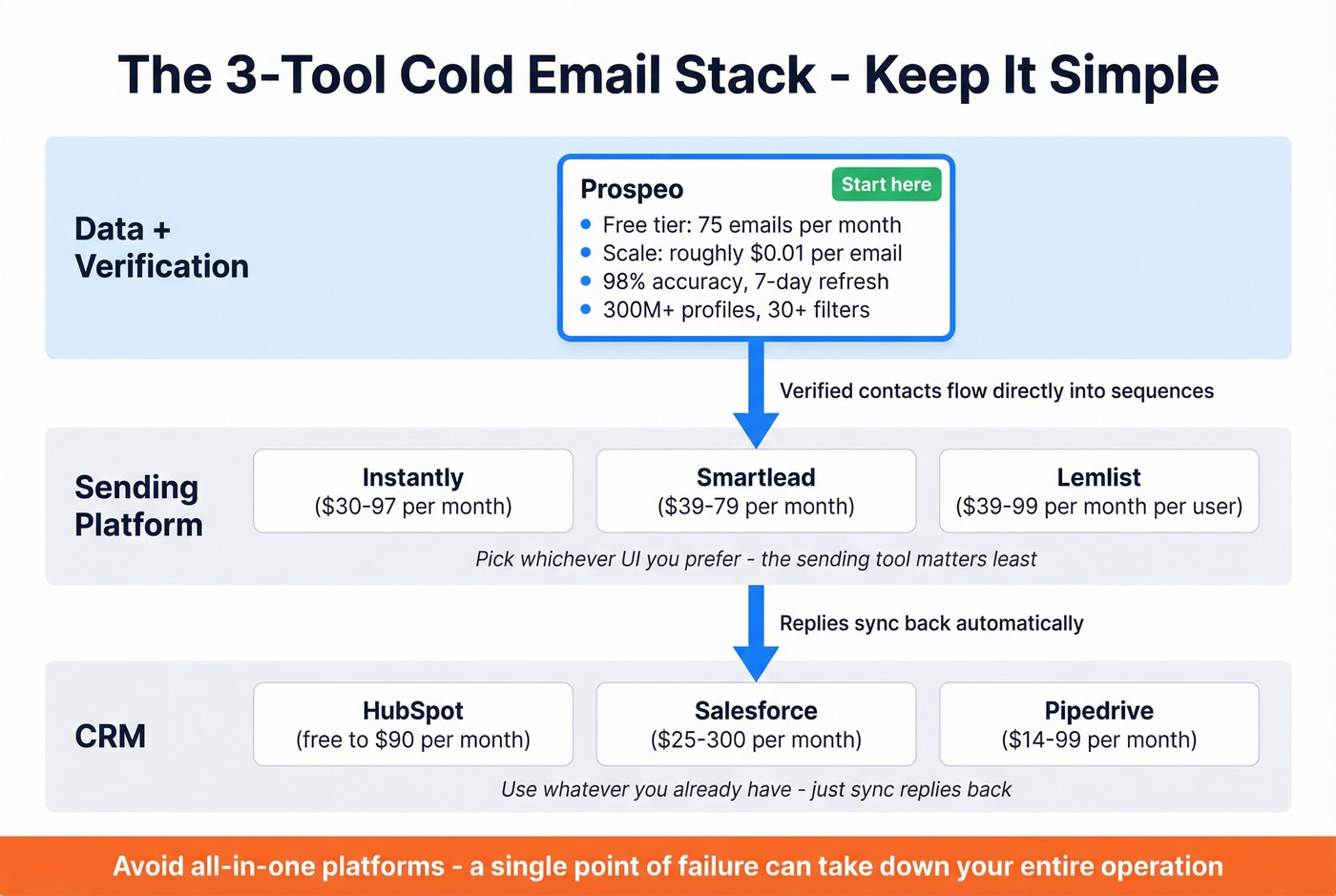
Sending platform: Instantly (~$30-97/mo), Smartlead (~$39-79/mo), or Lemlist (~$39-99/mo per user). All three handle warmup, rotation, and sequencing. The sending tool matters less than your data and deliverability setup - pick whichever UI you prefer and move on. If you're still dialing in safe volume, read up on email velocity.
Data + verification: Prospeo. Free tier to start, roughly $0.01/email at scale, no contracts. It integrates natively with all three sending platforms above, so verified contacts flow straight into sequences without CSV gymnastics. Stack Optimize built from $0 to $1M ARR using this exact workflow - 94%+ deliverability, bounce rates under 3%, zero domain flags across all their clients. If you're comparing providers, start with email list providers and data enrichment services.
CRM: Whatever you already use. HubSpot (free-$90/mo), Salesforce ($25-300/mo), Pipedrive ($14-99/mo). Just make sure replies sync back so nothing falls through the cracks (here’s how to connect outreach tool to CRM).
Skip tools that bundle everything into one platform unless you've outgrown the modular approach. All-in-one solutions tend to be mediocre at each individual function, and when your sending tool is also your data provider, a single point of failure can take down your entire operation.
You just mapped out 10-12 domains, 30+ inboxes, and weeks of warmup. Don't feed that infrastructure garbage data at $1/lead. Prospeo gives you 300M+ profiles with 30+ filters - intent, technographics, headcount growth - so your sub-80-word emails reach the exact ICP you defined in Step 2. All at $0.01 per email.
Build the tight 500-person list that outperforms the loose 5,000.
FAQ
What reply rate should I expect?
The 2026 industry average is 3.43%. Top-quartile senders hit 5.5%+, and the top 10% exceed 10.7%. If you're above 3%, you're outperforming most outbound teams. Ignore guru screenshots showing 25%+ - those are cherry-picked micro-samples that don't hold at any real volume.
How many follow-ups should I send?
Send 4-7 total touchpoints, spaced 3-4 days apart. 58% of replies come from the first email, but 42% come from follow-ups. Stopping after one send leaves nearly half your potential responses on the table.
Is cold email legal?
Yes, with rules. CAN-SPAM requires opt-out links, a physical address, and non-deceptive subject lines. GDPR requires legitimate interest documentation. CASL requires express or implied consent. Penalties range from $500/email in Washington State to $51,744/email under CAN-SPAM.
How do I keep cold emails out of spam?
Use secondary domains with SPF/DKIM/DMARC authentication, warm up inboxes for 2-3 weeks, keep volume under 15 emails/day/inbox, verify every address before sending, and monitor complaints. Pause immediately if spam complaints exceed 0.3% or bounces cross 2%.