

Cold Email Personalization AI: The 4-Layer System That Fixes Reply Rates
Your AI wrote a brilliant opening line about the prospect's Series B. It referenced their podcast appearance. It matched their casual tone. Then the email bounced - because the address was wrong.
That's cold email personalization AI in 2026. Teams obsess over the prompt while 17% of cold emails never reach the inbox due to bad data. The average reply rate sits at 3.43%. One operator on Reddit spent hours per prospect on deep manual personalization, hit 10% replies - then got ghosted on every follow-up. Personalization depth isn't the bottleneck. Data quality is.
What You Actually Need
AI personalization is a 4-layer system: data, enrichment, generation, delivery. Most people optimize layer 3 (the prompt) while ignoring layers 1 and 2. We've watched this pattern repeat across dozens of outreach teardowns, and it's the single most common mistake.
The lean stack: Prospeo for data and enrichment (free-$39/mo) + ChatGPT ($20/mo) + Instantly ($30/mo) = $50-89/mo. The expensive version with Clay Explorer ($349/mo) + SmartWriter ($149/mo) + Instantly runs $528/mo. Same workflow, 6x the cost.
The 4-Layer System Explained
You don't need a dedicated AI personalization tool. You need verified data and a good prompt.
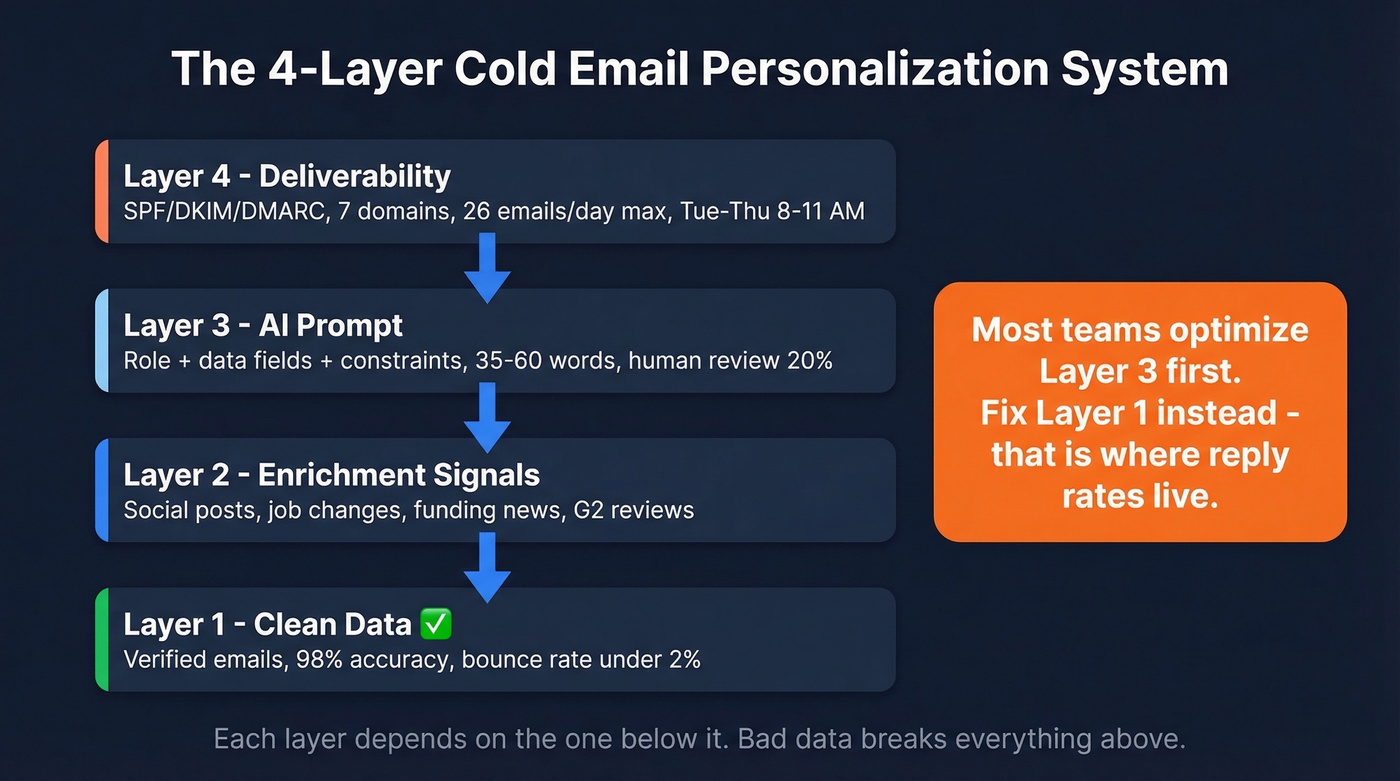
Standalone icebreaker tools like Lyne.ai (~$0.30/contact), SmartWriter (starts at $59/mo), and Warmer.ai (starts at $97/mo) were the 2022-2023 approach - web scrapers feeding GPT-3. In 2026, the workflow is modular. Pick the best tool for each layer and connect them.
Layer 1 - Clean Data
If your email list bounces at 11-35% (numbers we've seen repeatedly in Reddit threads and client audits), no amount of AI-generated personalization saves you. One operator on r/Entrepreneur rebuilt their entire infrastructure and dropped bounce rates from 11% to under 2%. That single change was the biggest driver in doubling their reply rate from 3% to 6%.
Prospeo's 5-step verification - catch-all handling, spam-trap removal, honeypot filtering - delivers 98% email accuracy across 143M+ verified emails with a 7-day refresh cycle, compared to the 6-week industry average. Stack Optimize built to $1M ARR on that data with 94%+ client deliverability and under 3% bounce rates across every campaign. At ~$0.01 per email, it's the cheapest insurance policy in your stack.
If you want a broader comparison of providers, start with the B2B database benchmarks and accuracy tests.
Layer 2 - Enrichment Signals
Clean emails get you to the inbox. Enrichment gives the AI something worth saying. Before generating copy, collect per prospect:
- Last 3-5 social posts or published content
- Job changes within 90 days - the golden window for personalized outreach
- Company news: funding, acquisitions, product launches
- G2 reviews or customer complaints - underrated copy inputs that most teams ignore entirely
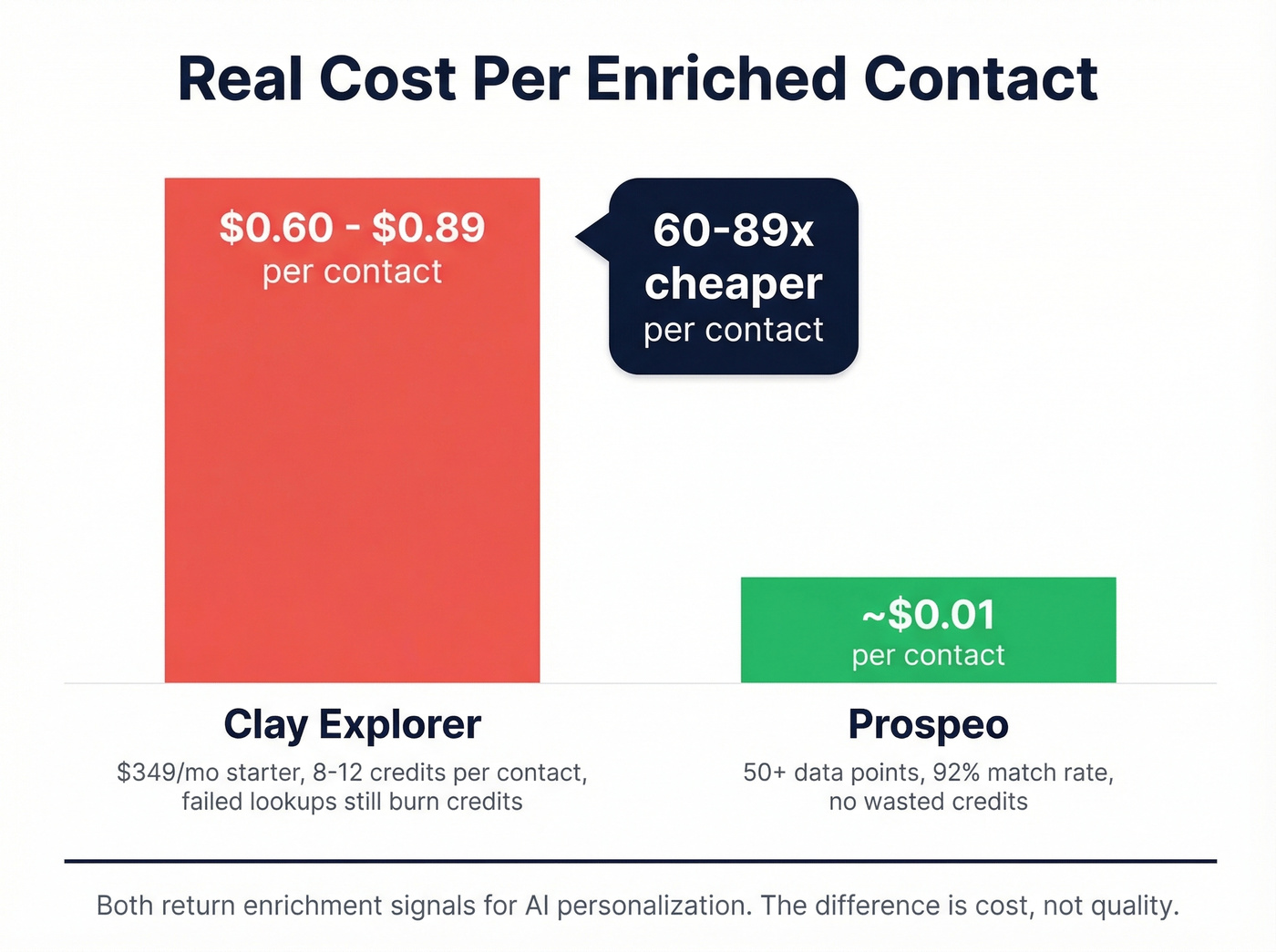
Clay is the popular enrichment choice, but real costs bite. Starter runs $149/mo for 2,000 credits, a single contact burns 8-12 credits, and failed lookups still consume credits. Effective cost per enriched contact: $0.60-$0.89 before you've written a word. Prospeo's enrichment API returns 50+ data points per contact at a 92% match rate, and you can layer in intent data tracking 15,000 topics via Bombora to prioritize in-market buyers before spending time on personalization.
If you're evaluating vendors, compare the current data enrichment tools landscape before committing to a credit-based model.
Layer 3 - The AI Prompt
This is where everyone starts. It should be where you finish.
The best prompt structure follows Instantly's framework:
Role: You're a founder emailing a {{JobTitle}} at a {{Industry}} company. Data fields: Use ONLY {{Industry}}, {{TechStack}}, {{NewsHeadline}}, {{CompanyDescription}}. Constraints: 35-60 words. Conversational. No hype. No exclamation points. If NewsHeadline exists, reference it briefly; otherwise use industry/tech detail. End with a polite 15-minute ask. Critical: Do not invent facts. Output only the two opening sentences.
Layer in Cotera's constraint block: one observation per email (more feels stalkerish), no generic compliments, under 65 words total. Here's the thing - AI will misread layoffs as growth or interpret a pivot as expansion. One team sent 200 AI-drafted emails without review and got 3% replies. They cut to 50 with a human review gate and hit 9%.
Review 20% of drafts before sending. Always.
If you need more examples beyond prompts, use a personalized outbound email framework to standardize what “good” looks like across reps.
Layer 4 - Deliverability
None of the above matters if Gmail flags you. That Reddit operator who doubled their reply rate made these changes:
- Expanded from 3 to 7 sending domains, max 26 emails/day each
- Send window: Tue-Thu, 8-11 AM recipient timezone
- Bounce rate dropped from 11% to under 2% after switching to verified lists
- SPF, DKIM, DMARC configured on every domain
Gmail's spam complaint threshold is 0.1%. Even popular platforms like Apollo have deliverability that isn't always as strong, and Instantly's shared infrastructure carries risk at lower tiers - which is why practitioners prioritize sender authentication and timezone-aware sending regardless of tool choice.
Let's be honest about what spam filters actually detect. They don't flag "AI-ness." They detect repetitive phrasing at scale - exactly what AI produces when you send 500 emails from the same prompt. Vary your prompts, cap daily volume, and keep copy under 60 words.
If you’re troubleshooting, start with Gmail inbox placement and then work through email reputation before changing tools.

The 4-layer system breaks down at Layer 1 without verified data. Prospeo's 5-step verification delivers 98% email accuracy across 143M+ emails - refreshed every 7 days, not 6 weeks. Stack Optimize built to $1M ARR with under 3% bounce rates on Prospeo data. At ~$0.01/email, it's the cheapest layer in your stack.
Stop feeding brilliant AI copy into dead email addresses.
Benchmarks That Matter
| Metric | Number |
|---|---|
| Avg reply rate | 3.43% |
| Avg open rate | 27.7% |
| Never reach inbox | 17% |
| Replies from follow-ups | 42% |
| Top 10% reply rate | 15-23% |
| Director response rate | 17.8% |
| C-suite response rate | 4.2% |
| Best copy length | Under 56 words |
| Best subject line | "Quick question" (39% opens) |
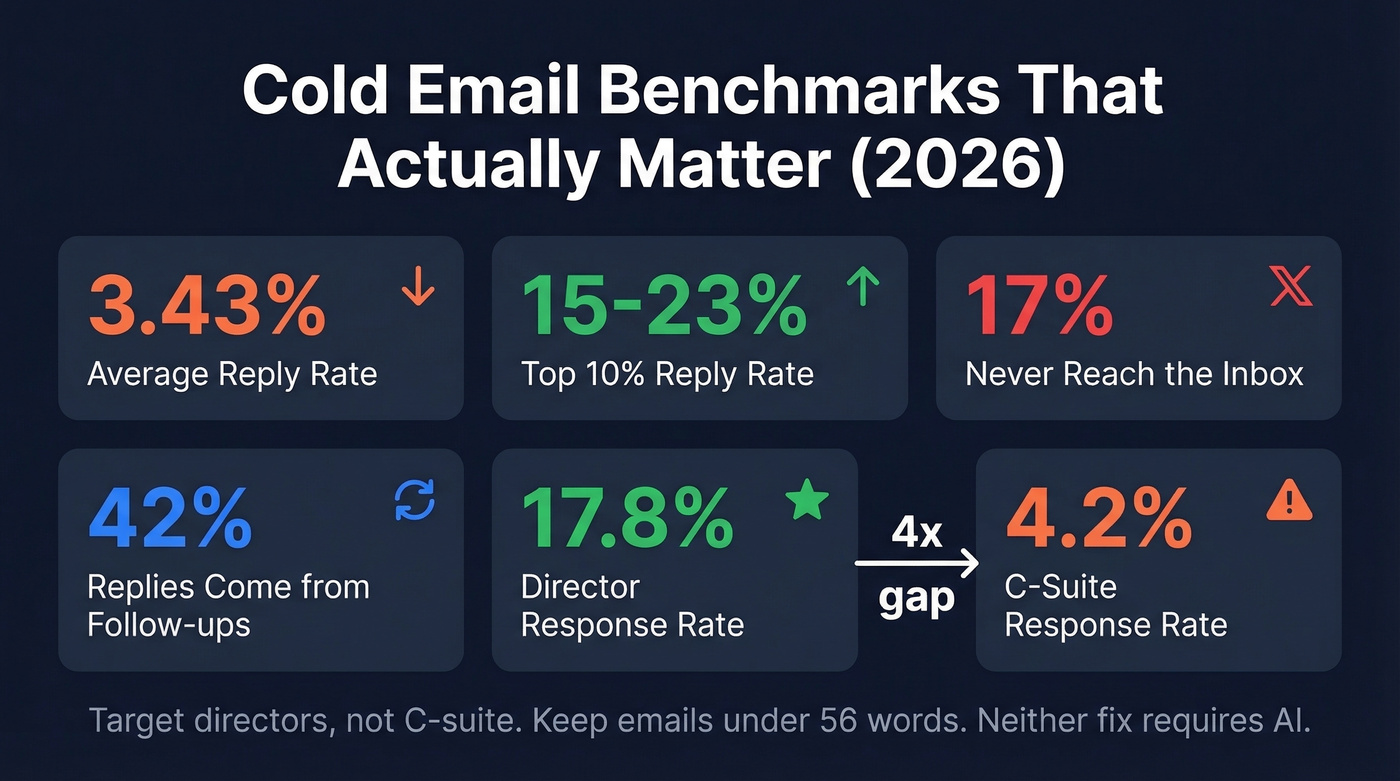
The director vs. C-suite gap is the most underrated lever in cold email. Targeting directors instead of C-suite increased response rates from 4.2% to 17.8% across 427 campaigns - a 4x improvement that has nothing to do with AI. That Reddit operator also cut email length from 141 to under 56 words, which was one of several changes that doubled replies. Neither fix involves a prompt. Both involve decisions made before you open ChatGPT.
For more context on performance ranges, compare these numbers to broader cold email success rate benchmarks.
Lean Stack vs. Expensive Stack
| Component | Lean ($50-89/mo) | Expensive ($528/mo) |
|---|---|---|
| Data + Enrichment | Prospeo (free-$39) | Clay Explorer ($349) |
| AI Generation | ChatGPT ($20) | SmartWriter ($149) |
| Delivery | Instantly ($30) | Instantly ($30) |
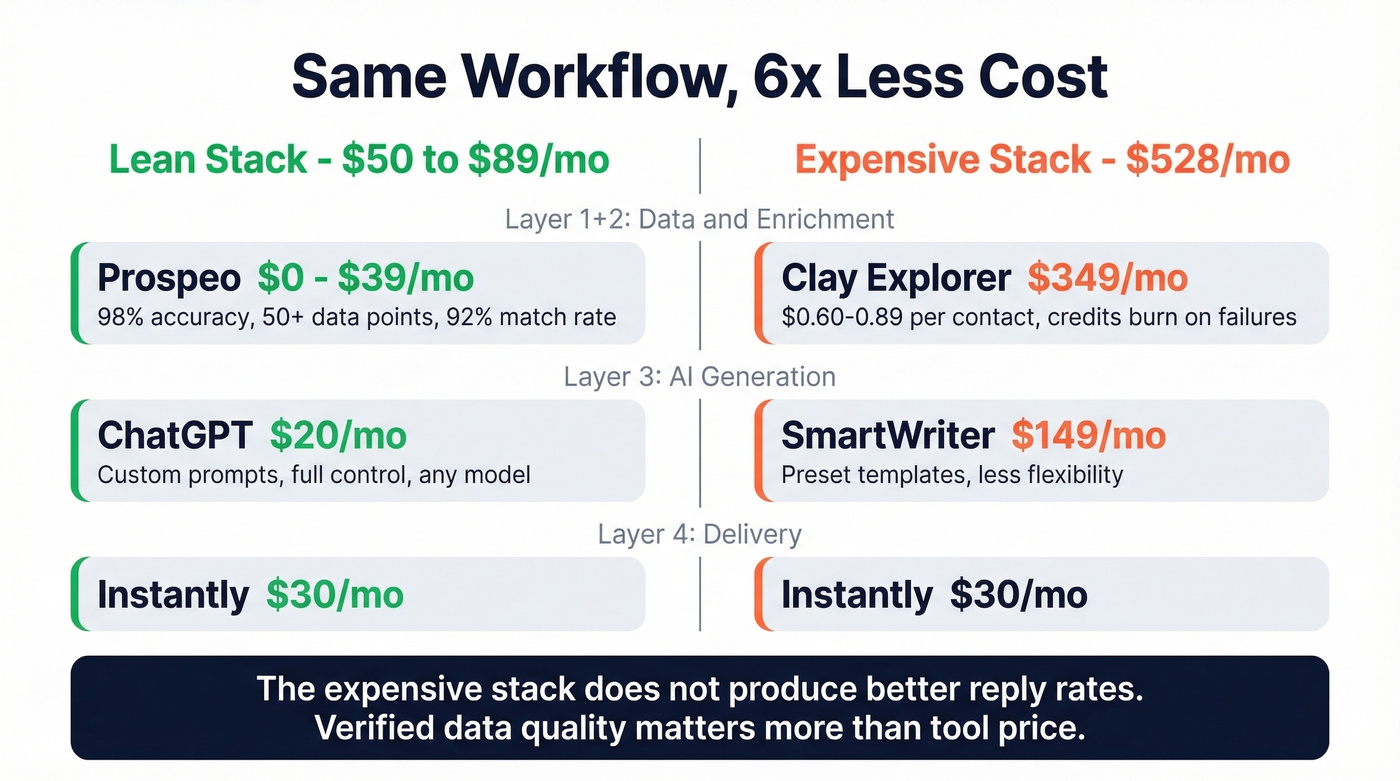
Same 4-layer workflow. The lean stack costs 6x less.
Lavender ($29-$89/seat) is a useful optional add-on for the QA step - it grades drafts in real time but doesn't generate emails. Skip it if you're running fewer than 200 emails per week; manual review is faster at that volume. When evaluating AI tools for personalizing cold emails, start with the cheapest combination that covers all four layers before scaling spend.
If you’re building the sending side of the stack, compare outbound email automation options and keep a set of drip campaign templates ready for follow-ups.
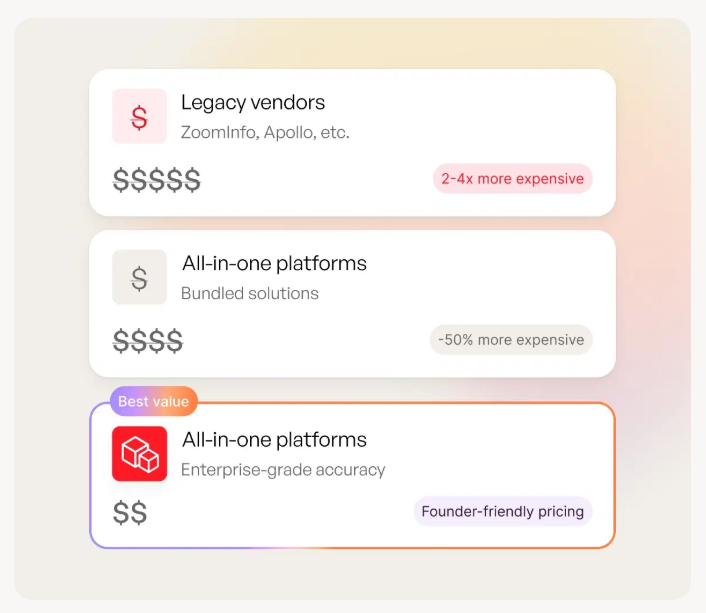
Skip the $349/mo Clay bill. Prospeo's enrichment API returns 50+ data points per contact at a 92% match rate - plus Bombora intent data across 15,000 topics. Layer 2 enrichment that gives your AI something worth saying, without burning credits on failed lookups.
Same enrichment depth, one-sixth the cost. Build the lean stack.
FAQ
Does AI-personalized cold email outperform templates?
Field results show 8-12% reply rates with AI personalization vs. 2-3% with templates - but only when the data layer is clean and a human reviews ~20% of drafts before sending. Without that review gate, AI barely beats templates.
Can spam filters detect AI-written emails?
Spam filters detect repetitive phrasing patterns at scale, not AI authorship. Vary prompts across batches, cap daily sends per domain at 25-30, and keep copy under 60 words. The pattern triggers filtering, not the author.
What's the cheapest way to start?
Prospeo's free tier (75 verified emails/month) plus ChatGPT's free tier plus Instantly ($30/mo) gets you running for $30/month. Upgrade the data layer first as you scale - that's where reply rates live. The AI prompt is the easy part; verified contacts are the bottleneck.
Is AI personalization worth the cost at scale?
At scale, ROI depends entirely on data quality. Teams running AI-personalized outreach on verified lists consistently see 3-4x the reply rates of generic blasts. Teams running the same AI on unverified lists waste budget on bounces and spam complaints. Fix the foundation before scaling the generation layer.