

How to Write a Cold Email Proposal That Actually Gets Replies
You just spent two hours crafting the perfect cold email proposal - personalized opener, clean formatting, a PDF attachment with your pricing deck. It bounced. Or worse, it landed in spam and you'll never know.
The gap between "great pitch" and "pitch that gets read" isn't copywriting talent. It's infrastructure, data hygiene, and knowing what actually moves reply rates in 2026.
"Cold email proposal" means two different things depending on who you are. You're either writing a cold email that proposes a service, partnership, or idea to someone who doesn't know you, or you're evaluating a proposal for a cold email campaign - the kind an agency sends with line items for domains, inboxes, and warm-up schedules. We're covering both here.
What You Need Before Sending
Before templates, before subject lines, nail these three things:
- Fix your infrastructure first. SPF, DKIM, DMARC, warm-up. Templates are useless if emails hit spam. Gmail and Outlook enforce authentication requirements for bulk senders - this isn't optional. (If you want the full checklist, use this email deliverability guide.)
- Keep the email under 80 words, one ask, human tone. The average cold email reply rate is 3.43%. Elite campaigns break 10%. Short, specific emails are what separate the two. If you need more angles, borrow from these emails that get responses.
- Verify every email on your list before sending. One bad batch can hurt your domain reputation for weeks. (More on email bounce rate benchmarks and what to do when it spikes.)
Cold Email Benchmarks Worth Knowing
Here's what "good" actually looks like right now:
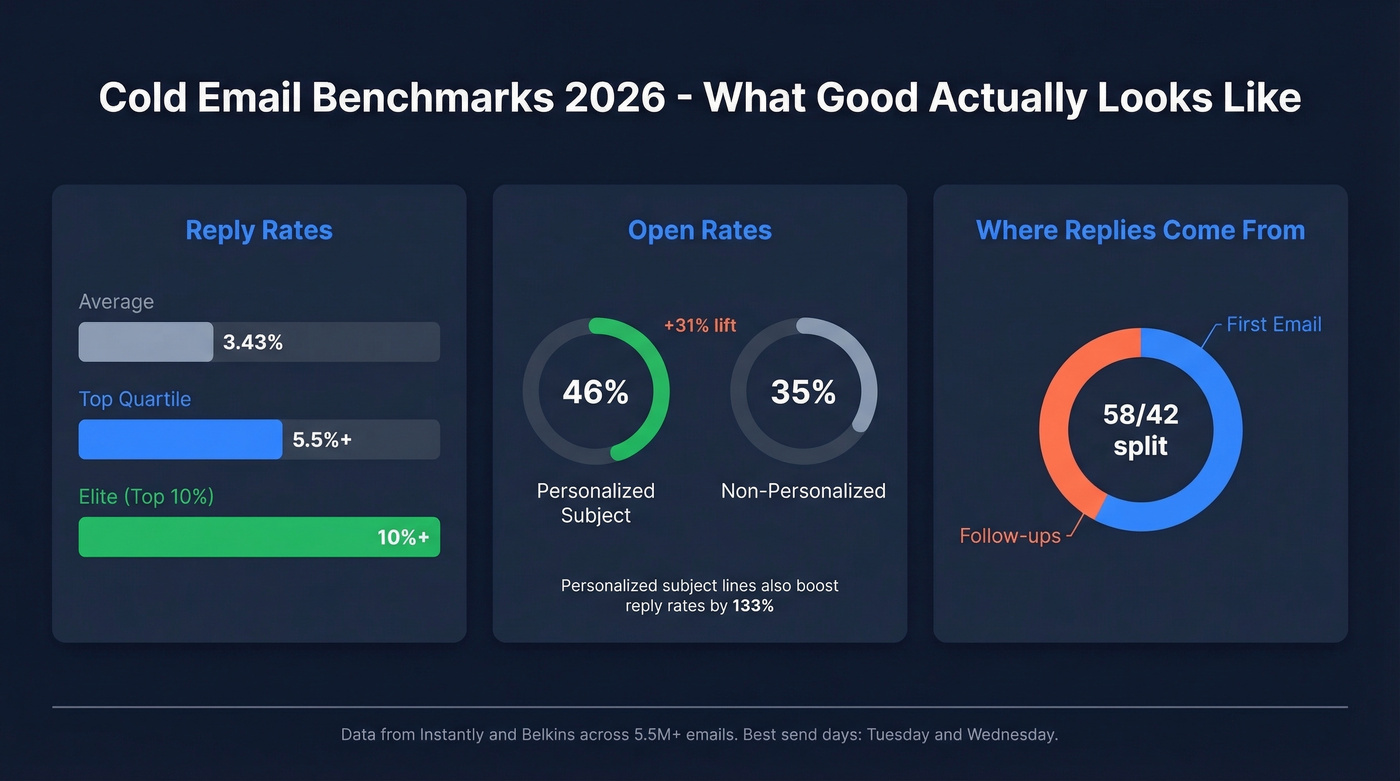
| Metric | Average | Top Quartile | Elite (Top 10%) |
|---|---|---|---|
| Reply rate | 3.43% | 5.5%+ | 10%+ |
| Open rate (personalized subject) | 46% | - | - |
| Open rate (non-personalized subject) | 35% | - | - |
| Replies from first email | 58% | - | - |
| Replies from follow-ups | 42% | - | - |
Reply rate and "replies by step" data from Instantly. Subject line open-rate data from Belkins across 5.5M emails.
A few things jump out. First, 58% of replies come from the first email - so your initial message matters more than your sequence. Second, personalized subject lines drive a 46% open rate versus 35% without. That personalization gap is even starker on replies: 7% reply rate with personalized subject lines versus 3% without, a 133% increase. Third, only 5% of senders personalize every email, which means the bar is shockingly low if you're willing to do the work.
Send on Tuesday or Wednesday - Wednesday sees the highest reply rates across Instantly's dataset. (If you want a deeper breakdown, see the best time to send cold emails.)
The teams hitting 10%+ aren't using magic templates. They're running clean infrastructure, verified lists, and short emails with relevant personalization.
Deliverability Setup
Here's the thing: the best pitch in the world doesn't matter if it lands in spam. Deliverability is the foundation, and it's where most people skip steps.
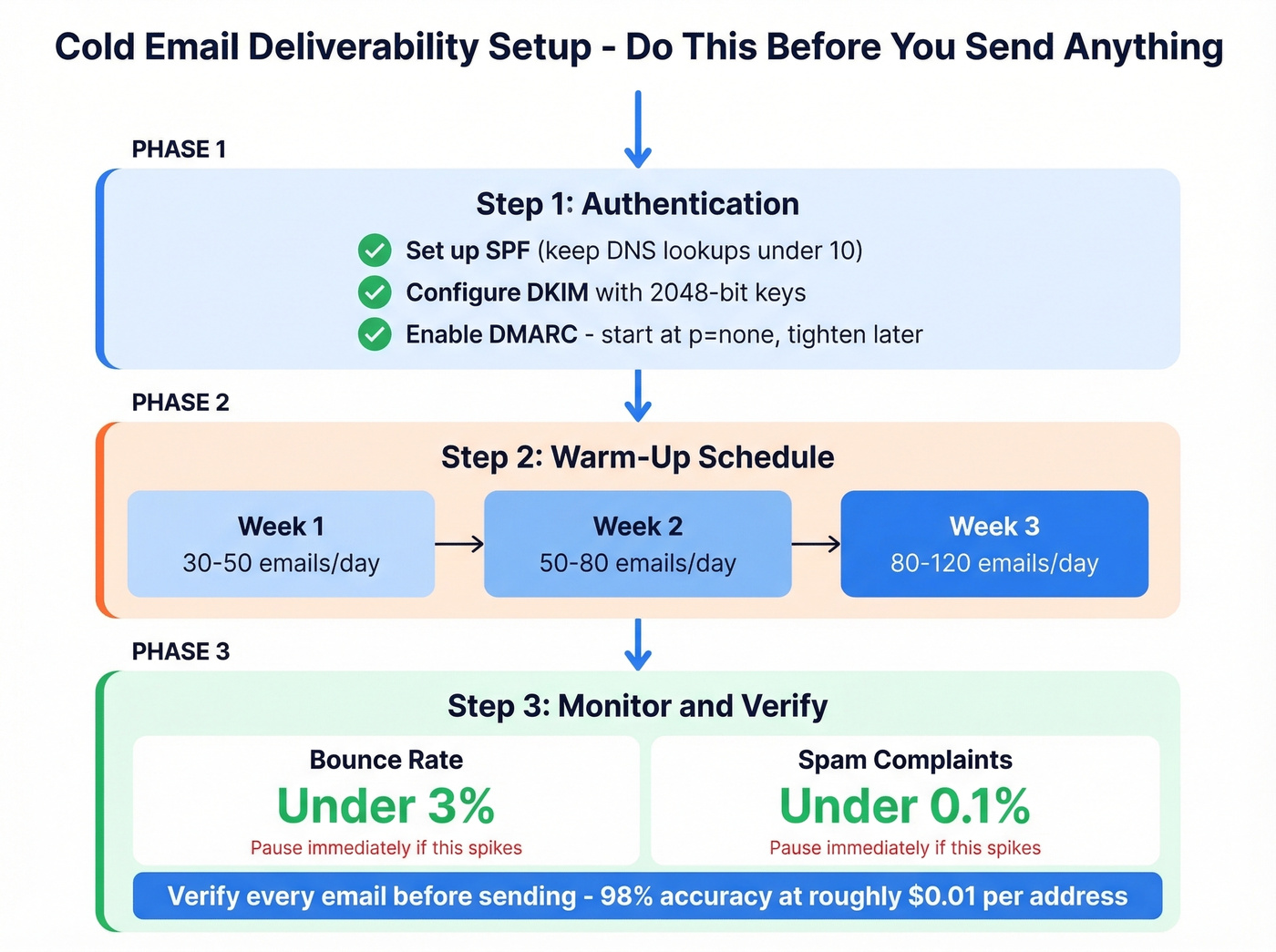
Authentication is non-negotiable. Gmail has required SPF, DKIM, and DMARC for bulk senders since February 2024. Outlook followed in May 2025 for high-volume senders. If you haven't set these up, stop reading and go do it now. Start DMARC at p=none with reporting enabled, then tighten to quarantine or reject once you've confirmed alignment. (If you want to go deeper on alignment, read DMARC alignment.) Use 2048-bit DKIM keys and keep your SPF DNS lookups under 10. (Need syntax help? See SPF record examples.)
Warm up before you send. A new mailbox needs at least two weeks of ramp-up: start at 30-50 emails/day in week one, build to 50-80 in week two, then 80-120 in week three. Only push volume higher if your metrics stay clean. (Related: email velocity limits and safe ramp schedules.)
Monitor your guardrails. Bounce rate must stay under 3%. Spam complaints under 0.1% per mailbox. If either spikes, pause immediately and diagnose. Nearly half of senders don't even track bounce rates - that alone explains most deliverability problems.
Bad data is one of the fastest ways to wreck deliverability. Before you launch any campaign, verify every email address on your list. Prospeo's 5-step verification process catches invalid addresses at 98% accuracy, and at roughly $0.01 per email it's the cheapest line item in your stack.
We've seen this play out firsthand. Stack Optimize built their agency to $1M ARR by making list verification non-negotiable: sub-3% bounce rates, zero domain flags across all clients.

How to Write a Cold Email Proposal
We've tested dozens of variations, and the pattern is consistent: short, human, and specific beats long, polished, and generic every time. Structure your email around a problem they have, why it matters now, and your specific solution - Problem-Agitate-Solution compressed into 3-4 sentences.
A practitioner thread on r/EmailMarketingMastery backs this up: ultra-short emails outperform long pitches. "Relevance personalization" - referencing a recent company event, a specific pain point, or an industry shift - works far better than dropping {first_name} into a template. (For more frameworks, see personalized outreach.)
A good heuristic: for every time you write "I" or "my," use "you" or "your" twice. Keep the focus on them.
Your CTA should be a low-pressure question, not a demand. "Would it make sense to chat for 15 minutes this week?" beats "Book a call here" every time. (More examples: email call to action.) And never attach a PDF proposal to a cold email - people don't open attachments from unknown senders, and it can get your message deleted on sight. Link to a hosted proposal page instead. It's cleaner, and hosted pages let you see whether the prospect actually viewed it.
A/B test your subject lines weekly. Run the variant on 20% of your list, then roll the winner to the remaining 80%. If you're sending to EU contacts, ensure GDPR compliance - use a valid lawful basis and include an easy opt-out.
Template A: Service Pitch
Subject: quick idea for {{company}}
Hi {{first_name}},
Noticed {{company}} is scaling the SDR team - congrats. We helped [similar company] cut their ramp time from 10 weeks to 4 by rebuilding their outbound data stack.
Put together a short breakdown of what we'd do differently for your team. Here's the link: [proposal page URL]
Worth a look?
{{your name}}
Opens with a specific observation, not flattery. Social proof is compressed into one sentence. The CTA is a question, not a calendar link. The proposal lives on a hosted page, not an attachment.
Template B: Partnership Proposal
Subject: {{first_name}} - partnership idea
Hi {{first_name}},
We work with 200+ B2B SaaS companies on outbound infrastructure. Your audience overlaps almost perfectly with ours.
I sketched out a co-marketing concept that could drive pipeline for both teams. Takes 2 minutes to read: [proposal page URL]
Open to exploring it?
{{your name}}
Establishes mutual value immediately. Quantifies your reach without bragging. The "2 minutes to read" framing reduces friction.
Template C: Proposal Delivery (Warm Lead)
This one's different - the prospect already knows you. They've replied, you've had a call, and now you're sending the actual proposal. The goal isn't to sell; it's to make the next step effortless.
Subject: Re: our conversation - proposal inside
Hi {{first_name}},
Great chatting earlier. As promised, here's the proposal covering scope, timeline, and pricing: [proposal page URL]
Happy to walk through it live if anything needs clarification. Does Thursday or Friday work?
{{your name}}
Keeps the thread alive, links instead of attaching, and offers two specific days rather than an open-ended "let me know." Once a client is already engaged, you can use this same thread to introduce an upsell proposal - a short message framing additional services as a natural extension of the current scope rather than a separate sales pitch.

Every bounced cold email proposal chips away at your domain reputation. Prospeo's 5-step verification delivers 98% email accuracy at ~$0.01 per address - the cheapest insurance in your outbound stack. Stack Optimize used it to maintain sub-3% bounce rates across every client campaign on their way to $1M ARR.
Verify your prospect list before you hit send.
Subject Lines That Get Opens
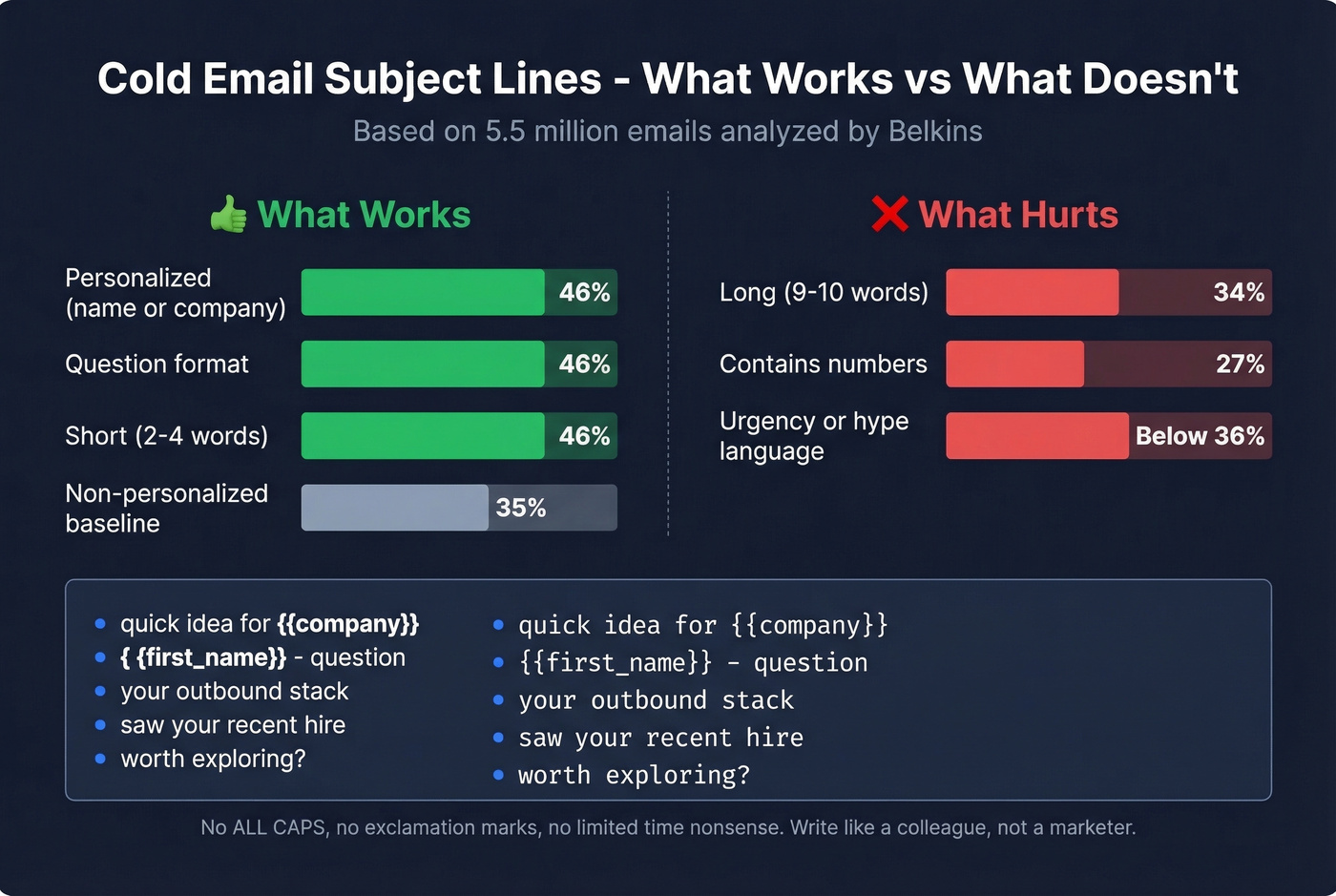
Subject lines are where most cold emails die. The Belkins study across 5.5 million emails gives us hard numbers:
| Subject Line Style | Open Rate |
|---|---|
| Personalized (name/company) | 46% |
| Question format | 46% |
| Non-personalized | 35% |
| 2-4 words | 46% |
| 9-10 words | 34-35% |
| Contains numbers | 27% |
| Urgency/hype phrasing | Below 36% |
Keep it short, make it personal, and frame it as a question when possible. Numbers in subject lines don't help - 27% open rate versus 28% without. Urgency language ("ASAP," "don't miss this") drags opens below 36%.
Five subject lines worth testing:
quick idea for {{company}}{{first_name}} - questionyour outbound stacksaw your recent hireworth exploring?
No ALL CAPS, no exclamation marks, no "limited time" nonsense. These read like a colleague sending a note, not a marketer running a blast. (If you want a bigger swipe file, use these cold email subject line examples.)
Follow-Up Sequence
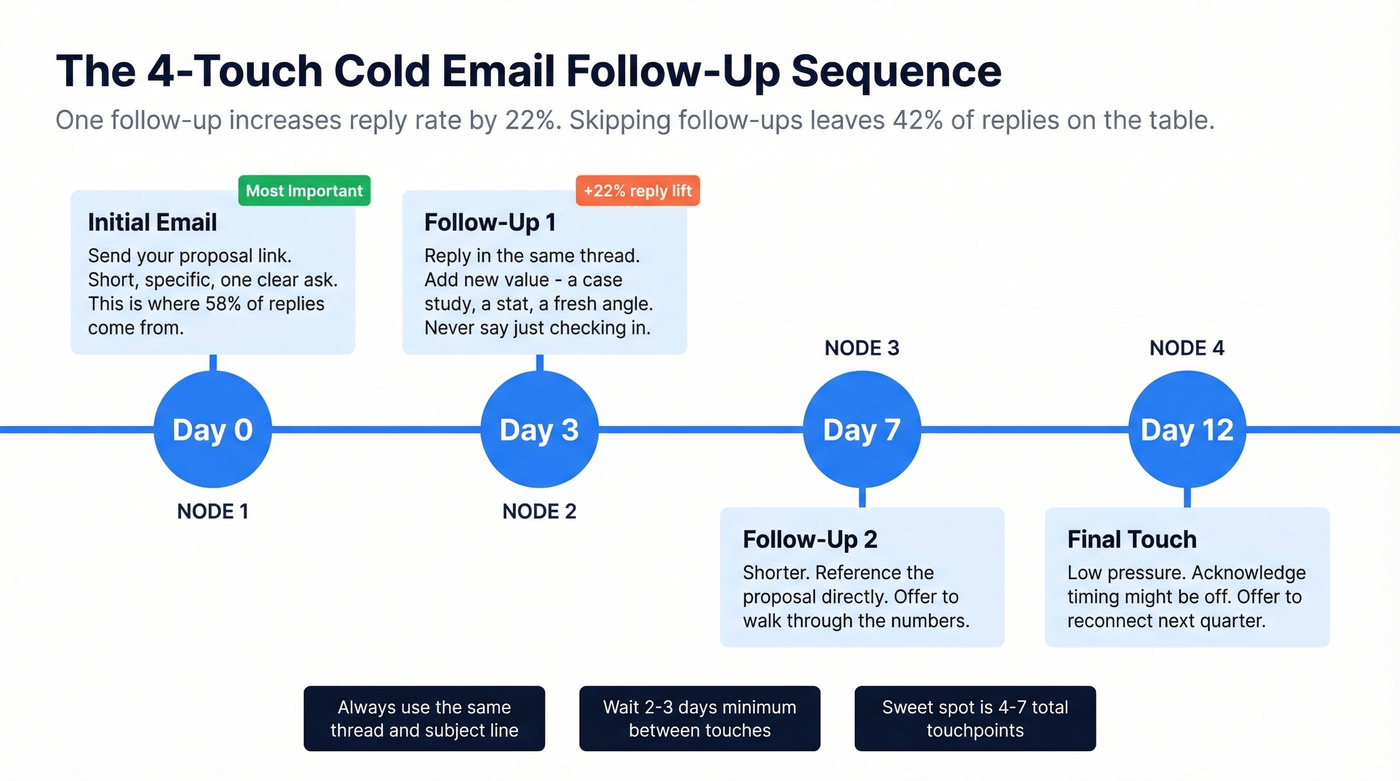
One follow-up increases reply rate by 22%. Since 42% of all replies come from follow-ups, skipping them means leaving nearly half your potential responses on the table.
Here's a practical sequence:
- Day 0: Send the initial email with your proposal link.
- Day 3: Follow up in the same thread. Write it like a reply, not a new pitch - Instantly's data shows casual reply-style follow-ups outperform formal ones by roughly 30%. Add new value: a relevant case study, a specific stat, or a fresh angle on their problem. Not "just checking in." (More options: cold email follow-up templates.)
- Day 7: Second follow-up. Shorter. Reference the proposal directly: "The proposal I sent covers X - happy to walk through the numbers if it'd help."
- Day 12: Final touch. Brief, low-pressure: "Totally understand if the timing's off. Happy to reconnect next quarter if that's better."
Send every follow-up in the same thread, same subject line. This preserves context and avoids cluttering their inbox. Wait 2-3 days between touches minimum. In our experience, the first follow-up matters more than the fourth - invest your best writing there.
The same discipline applies when you're on the other side of the table. If you've submitted a bid or RFP response, a well-timed follow-up after submission uses the same principles: stay in the same thread, add new value with each touch, and keep the tone conversational rather than desperate.
The sweet spot is 4-7 total touchpoints. Under 4 quits too early. Beyond 7, you're hitting diminishing returns unless each touch genuinely adds something new.
What a Campaign Proposal Includes
If you're evaluating an agency proposal for cold email services - or building one yourself - here's what the line items typically look like. This breakdown comes from a real agency proposal shared on r/coldemail:
| Line Item | Typical Cost |
|---|---|
| 10 domains (.com) | ~$100/year |
| 20 inboxes (Google Workspace) | ~$156/month |
| Email automation tool | ~$100/month |
| 14-day warm-up period | Included in setup |
| Setup fee (one-time) | ~$600 |
| Deliverability + copywriting | ~$800/month |
DIY total: $200-400/month for domains, inboxes, and automation. Agency-managed: $1,000-2,500/month depending on volume and service level.
Red flags in a proposal: no mention of deliverability management, no warm-up plan, no reporting cadence, and no explanation of how they handle bounces. If an agency can't tell you their bounce rate targets, walk away.
Let's be honest - email verification at ~$0.01/email is the cheapest line item in the entire stack, but skipping it is the most expensive mistake you can make. One burned domain costs you weeks of warm-up and thousands in lost pipeline. Most teams don't need a $2,500/month agency. They need clean data and a disciplined sending schedule.
Mistakes That Kill Your Pitch
Six ways to guarantee your outreach proposal gets ignored:
Pitching the wrong person. If your proposal lands with someone who can't say yes, it dies in their inbox. Research the org chart before you send.
Making it about you, not them. "We're the leading provider of..." - nobody cares. Lead with their problem, not your resume.
No proof. No case study, no portfolio, no specific results. Prospects need evidence you've done this before.
Zero personalization. Generic templates get generic results. Reference something specific to their company, their role, or their industry.
Attaching a PDF instead of linking. People don't open attachments from unknown senders. Link to a hosted proposal page - it's cleaner and trackable.
Sending to unverified lists. One bad batch torches your sender reputation for weeks. The emails can be fine all along - the data is often the real problem.
Skip the agency if your monthly send volume is under 5,000 emails. At that scale, a good automation tool, verified data, and the templates above will get you further than paying someone $2K/month to do the same thing.
Relevance personalization beats {{first_name}} tokens - but you need real data to pull it off. Prospeo gives you 30+ filters including job changes, headcount growth, and buyer intent across 15,000 topics so every cold email proposal lands with context that matters.
Build hyper-targeted prospect lists in minutes, not hours.
FAQ
How long should a cold email proposal be?
Under 80 words. Instantly's benchmark data shows the best-performing campaigns keep emails under 80 words - three to four sentences covering who you are, why you're reaching out, and one clear ask. Anything longer and you're losing readers before they reach your CTA.
Should I attach my proposal as a PDF?
No. Link to a hosted proposal page instead. People don't open attachments from strangers, and some email clients flag them as risky. Hosted pages are safer, build more trust, and let you track exactly when a prospect views your proposal.
How do I keep cold emails out of spam?
Set up SPF, DKIM, and DMARC on your sending domain. Warm up new inboxes for at least two weeks before sending at volume. Verify every address before sending and keep bounce rate under 3% and spam complaints under 0.1%.
What's a good reply rate for a cold email proposal?
The average cold email reply rate is 3.43%, while top-quartile campaigns hit 5.5%+ and elite senders break 10%. If you're below 3%, audit your list quality, subject lines, and email length before blaming the offer itself.