

Cold Email Stats in 2026: Benchmarks That Actually Predict Meetings
A RevOps lead we know ran a deliverability audit last quarter. His team's open rate looked great - 47%. His reply rate? 1.8%. Half those "opens" were Apple Mail bots, and a third of his emails were landing in spam. He'd been optimizing the wrong metric for six months.
Cold email still works. But the metrics most teams track don't tell you whether it's working. The latest cold email stats paint a clear picture: what follows is pulled from datasets covering billions of emails - the benchmarks that separate teams booking meetings from teams burning domains.
The Five Metrics That Matter
Track them in this order:
- Positive reply rate - replies that aren't "unsubscribe me." Good: 1.5%+. Elite: 3%+.
- Meeting booked rate - the only metric your CEO cares about. Good: 1-2% of emails sent.
- Bounce rate - the silent killer. Keep it under 2%. Above 5% and you're damaging your domain.
- Reply rate - total replies including opt-outs. Good: 5.5%+. Elite: 10.7%+.
- Inbox placement rate - what percentage lands in the inbox, not spam. Benchmark: 87.6%.
Notice what's missing? Open rate. We'll get to why.
Here's the thing most teams get wrong: reply-rate problems are almost always data quality and deliverability problems before they're copy problems. Bad emails bounce, bounces tank your domain reputation, and a damaged domain means even your best copy lands in spam. Fix the data first.
Cold Email Got Harder - Here's How Much
The decline is measurable. In 2024, the average cold email reply rate sat around 5.1% across multiple analyses. In January 2026, Instantly's analysis of billions of cold email interactions puts the overall average at 3.43%. That's a 33% drop in roughly 18 months.
Google and Yahoo's sender requirements, rolled out in early 2024, made authentication mandatory and set hard spam complaint ceilings. Apple Mail Privacy Protection broke open tracking. Inbox providers got smarter at filtering unsolicited email. And the sheer volume of outbound increased as tools got cheaper and AI made it trivially easy to generate sequences.
The result: 95% of cold emails fail to generate replies, and 17% never reach the inbox due to bounces and spam filtering. The teams still getting results aren't writing better subject lines - they're running cleaner data, warming domains properly, and treating deliverability as the foundation.
2026 Benchmarks: Average vs Good vs Elite
Overall Performance Tiers
Based on data from Instantly's 2026 benchmark report, Mailshake's industry analysis, and Saleshandy's operational stats:
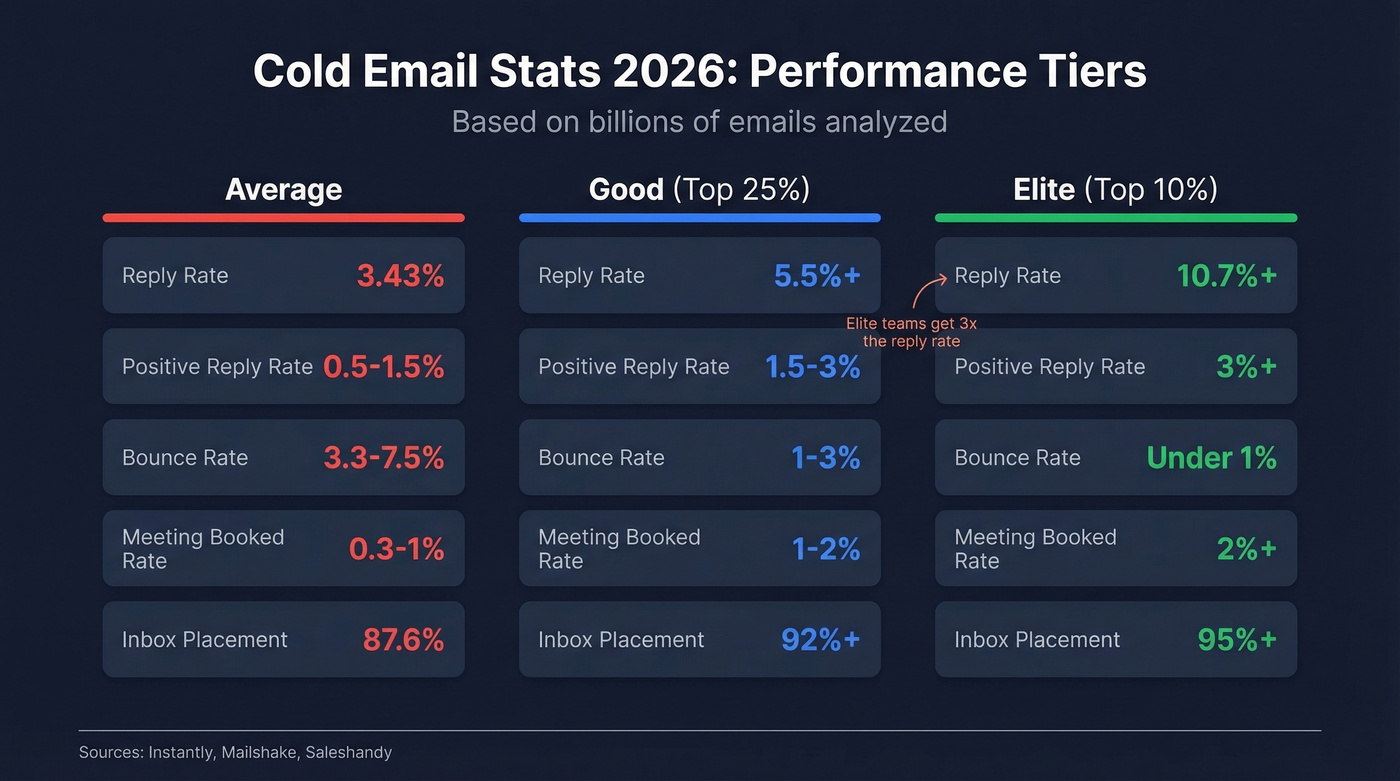
| Metric | Average | Good (Top 25%) | Elite (Top 10%) |
|---|---|---|---|
| Reply rate | 3.43% | 5.5%+ | 10.7%+ |
| Positive reply rate | 0.5-1.5% | 1.5-3% | 3%+ |
| Bounce rate | 3.3-7.5% | 1-3% | <1% |
| Meeting booked rate | 0.3-1% | 1-2% | 2%+ |
| Inbox placement | 87.6% | 92%+ | 95%+ |
The gap between average and elite is enormous - elite campaigns get 3x the reply rate. And look at bounce rate: average teams run 3.3-7.5%, while elite teams keep it under 1%. That's not a coincidence. Clean data drives everything downstream.
It takes roughly 306 cold emails to generate one B2B lead at average performance. Elite teams cut that number dramatically - not by writing better emails, but by sending to better lists and landing in more inboxes.
If you want a tighter operational view of what to measure beyond replies, map these benchmarks to your funnel metrics so you can see where the drop-off actually happens.
B2B Benchmarks by Industry
Averages lie. A 3% reply rate is terrible for an agency selling to SMBs and perfectly fine for a SaaS company selling to enterprise. These b2b cold email statistics vary dramatically by vertical.
| Industry | Avg Reply Rate | Good Reply Rate | Elite Reply Rate | Meeting-to-Opp Conversion |
|---|---|---|---|---|
| SaaS / Tech | 1.5-3% | 3-5% | 5%+ | 15-20% |
| Agencies / Consulting | 2.5-4.5% | 4.5-7% | 7%+ | 20-25% |
| Professional Services | 2-3.5% | 3.5-5% | 5%+ | 30-40% (elite) |
Professional services firms don't necessarily get the highest reply rates, but elite ones convert 30-40% of booked meetings into qualified opportunities - nearly double the 15-20% average. If you're in professional services, your real advantage is meeting quality, not reply volume.
Agencies consistently outperform SaaS on raw reply rates because they're targeting smaller companies with less sophisticated spam filtering and shorter decision cycles. SaaS teams selling into enterprise should benchmark against their own vertical, not the overall average. (If you're building a repeatable outbound motion, pair this with sales prospecting techniques that match your ICP.)
Open Rates Are Dead
How Apple MPP Broke Tracking
Apple Mail Privacy Protection preloads tracking pixels via Apple's proxy servers. The pixel fires whether or not a human ever reads the email. Your email tool reports an "open" that never happened.
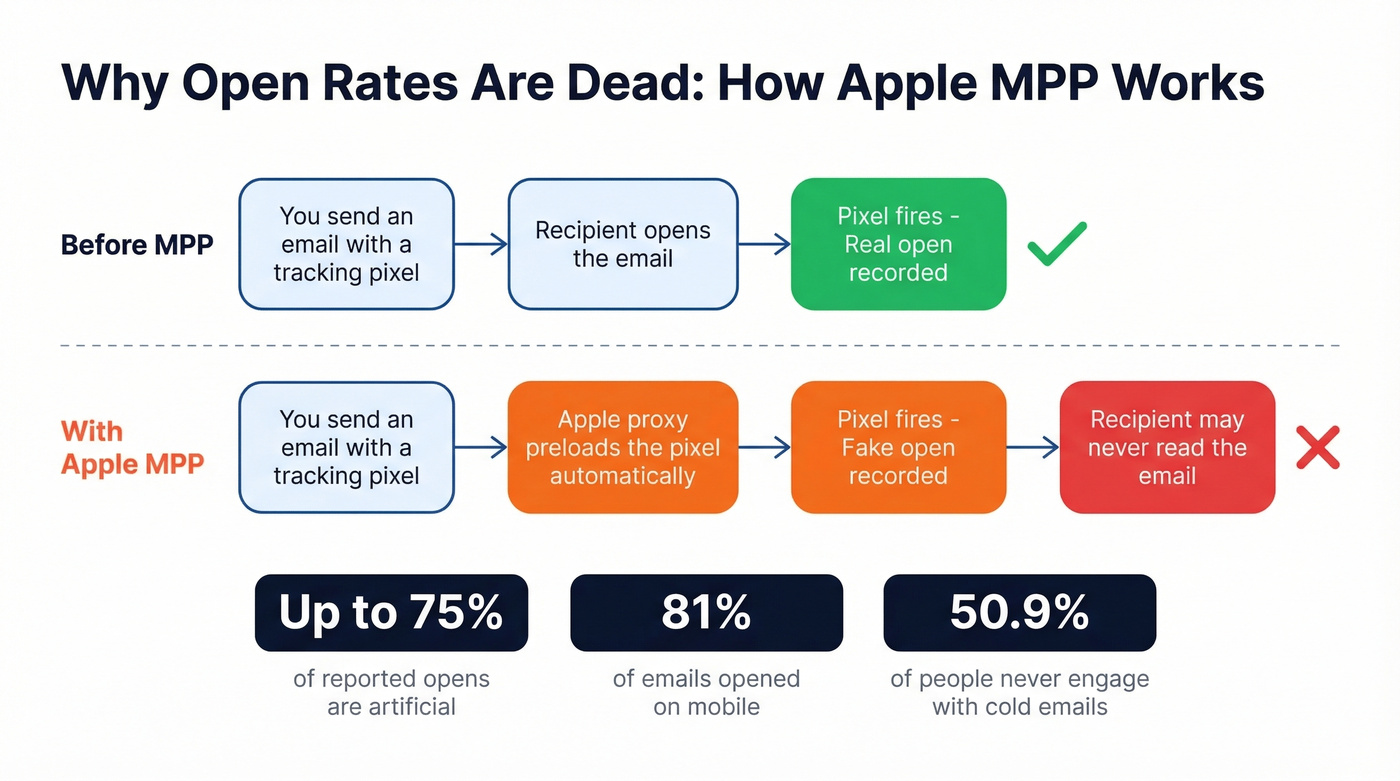
MPP doesn't just add noise - it systematically inflates open rates. In some segments, up to 75% of reported opens are artificial. Since 81% of emails are opened on mobile devices - where Apple Mail is heavily used - the distortion is massive. Focus Digital's data shows open rates ranging from 25.71% in SaaS to 46.31% in energy management, a spread so wide it's practically meaningless as a benchmark when MPP inflates every number.
MPP also blocks your recipient's IP address, open timestamps, geolocation, and device type. Even if the underlying mailbox is Gmail, reading it through Apple Mail triggers MPP. You're not just losing accuracy - you're losing the ability to segment by engagement.
If you still need to understand what’s happening under the hood, see how email tracking pixels work (and where they break).
What to Track Instead
Sopro, which has analyzed 151 million outreach data points, doesn't consider open rates an effective metric for measuring cold outreach performance. We agree.
Track clicks if your email includes a link. Track replies - they can't be faked by a proxy server. Track meetings booked. These are human actions that require intent.
If you're still reporting open rates to leadership, you're reporting fiction.

You just saw the data: bounce rates above 5% damage your domain, and the average team runs 3.3-7.5%. Prospeo's 5-step email verification delivers 98% accuracy - keeping you under that 2% bounce ceiling. Every email is refreshed on a 7-day cycle, not the 6-week industry average that leaves you sending to dead inboxes.
Stop optimizing copy when your data is the real problem.
The Follow-Up Myth
The conventional wisdom says send 4-7 follow-ups. The data says that advice is dangerously oversimplified.
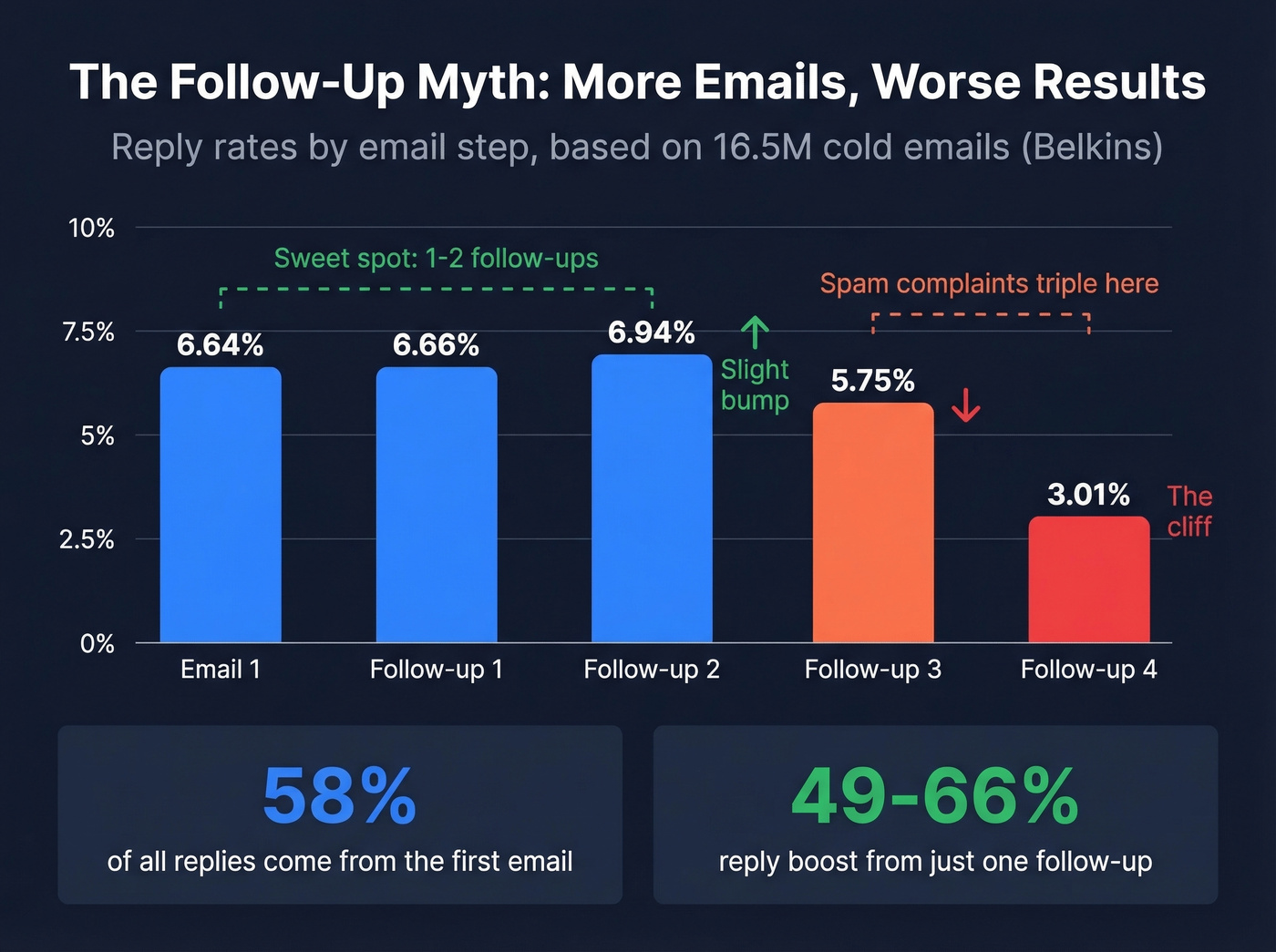
Belkins analyzed 16.5 million cold emails across 93 business domains and found that the highest reply rate - 8.4% - comes from the initial email alone. 58% of all replies come from step 1. The remaining 42% spread across all subsequent follow-ups combined, meaning no single follow-up step comes close to matching the initial email's contribution.
The real problem: sending 4+ emails in a sequence more than triples unsubscribe and spam complaint rates. You're not just getting diminishing returns - you're actively damaging your sender reputation for future campaigns.
The founder behavior curve from Belkins' data tells the story: 6.64% initial, 6.66% after one follow-up, 6.94% after two (a slight bump), then a cliff - 5.75% by the third and 3.01% by the fourth.
The Sweet Spot
One to two follow-ups hit the best risk/reward balance. The first follow-up alone boosts replies by 49-66% over a single email. Space them 3-4 days apart.
Beyond that, the math turns against you. SMBs tolerate more follow-ups; enterprises punish persistence. If you're selling to Fortune 500 procurement teams, three emails is probably your ceiling.
If you need plug-and-play copy for those steps, use these cold email follow-up templates and adapt them to your offer.
Belkins' data also shows that a message + visit combo on professional profiles hits an 11.87% reply rate - suggesting that switching channels after email two outperforms sending email five. Martal's research backs this up: coordinated email, social, and phone outreach can boost results by up to 287%.
Let's be honest: the "send 7 follow-ups" advice comes from tools that charge per email sent. More emails = more revenue for them. The data doesn't support it.
Subject Lines, Timing, and Length
Bookmark this section - these are the tactical levers that move numbers once your deliverability is solid.
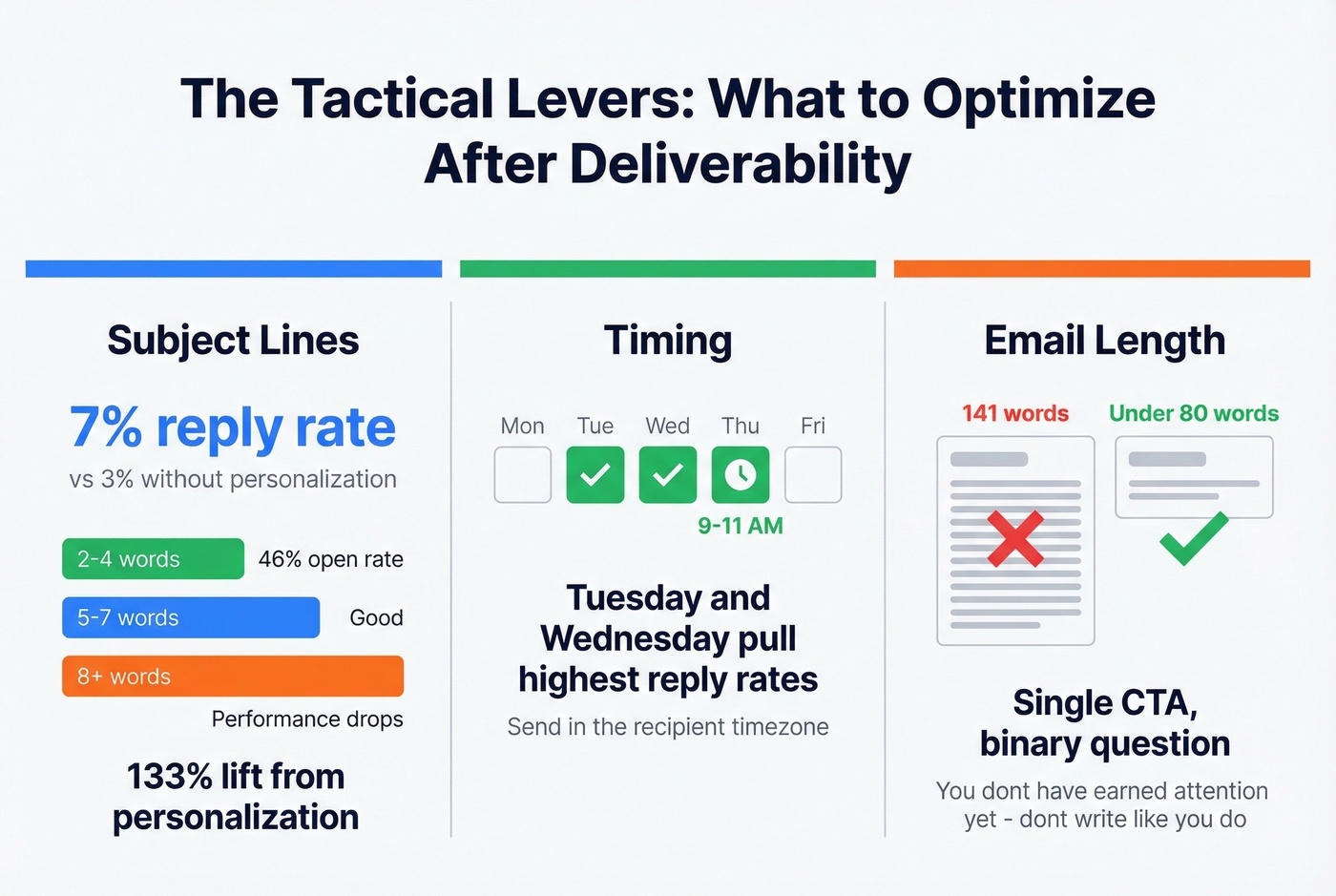
Subject lines: Personalized subject lines generate a 7% reply rate vs 3% without - a 133% lift across 5.5 million emails. Two to four word subject lines hit the highest open rates at 46%. After 7 words, performance drops steadily. (For more angles, see cold email subject line examples.)
Timing: Tuesday and Wednesday pull the highest reply rates across datasets. Thursday 9-11 AM gets the highest opens, per Focus Digital. One practitioner on r/Entrepreneur reported a 16% open improvement shifting sends to Tuesday-Thursday, 8-11 AM in the recipient's timezone. If you want a deeper breakdown, use this best time to send cold emails guide.
Length: Top-performing cold emails run under 80 words. Single CTA, binary question ("worth a 15-min call?"), problem-first positioning. That same r/Entrepreneur practitioner cut email length from 141 words to under 56 and saw measurable improvement.
A note on the Gong counterpoint: Gong's research suggests longer emails can outperform short ones for booking meetings, but that data includes warm and inbound sequences where context is already established. For true cold outreach to strangers, sub-80 words consistently wins. You don't have earned attention yet - don't write like you do.
One more thing: EmailToolTester found 50.9% of consumers usually don't engage with cold emails, and 13.7% delete them straight away. That's why short, human-sounding copy with specific details beats polished generic paragraphs every time.
Deliverability Changed the Game
Google and Yahoo's Sender Rules
In February 2024, Google and Yahoo's sender requirements for anyone sending 5,000+ messages per day. SPF, DKIM, and DMARC authentication is mandatory. Spam complaint rates must stay below 0.3%, with Gmail recommending under 0.10%. One-click unsubscribe via RFC 8058 must be implemented, with opt-outs processed within two days.
If you’re auditing your setup, start with DMARC alignment and then validate your SPF record.
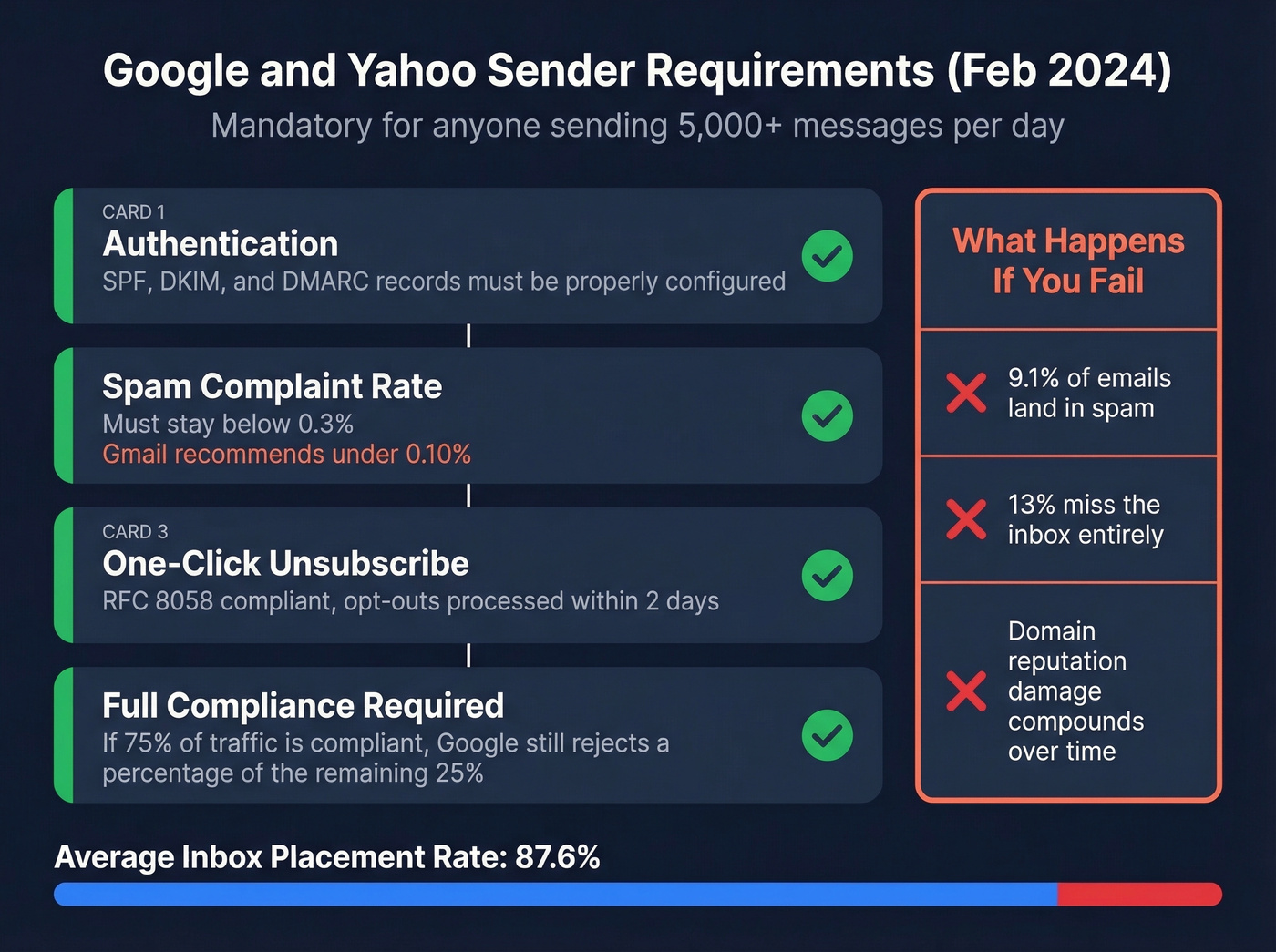
The enforcement is granular. If 75% of your traffic is compliant, Google still rejects a percentage of the remaining 25%.
Impact on Outbound Campaigns
Spam placement sits at 9.1% across sources, and inbox placement rate averages 87.6% - meaning about 13% of your emails don't land where they should. Sopro's data suggests almost 20% get flagged. These numbers underscore why authentication and sender reputation now matter more than copywriting.
Domain warming isn't optional anymore - it's infrastructure. Teams ramp from 5-10 emails per day to 150+ over 4-6 weeks. Skip the warmup and your fresh domain gets flagged immediately. (More on safe ramping in email velocity.)
The consensus on r/coldemail is clear: deliverability work is the single highest-ROI activity in cold outbound. Clean deliverability yields 15-25% more replies without changing a single word of copy.
Data Quality Is the Real Lever
The Chain Most People Miss
Bad data leads to bounces, bounces damage domain reputation, damaged reputation tanks inbox placement, and lower placement kills replies. Every link in that chain is measurable, and the fix starts at the beginning.
A practitioner on r/Entrepreneur documented this exact recovery. His reply rate had cratered from 8% to 3% over 18 months. The fix wasn't better copy - it was infrastructure. He expanded from 3 to 7 sending domains, capped each at 26 emails per day, and dropped his bounce rate from 11% to under 2% through manual verification. Reply rate climbed from 3% to 6% in 62 days. Total stack cost: $420/month, generating 16 qualified leads per month - roughly $26 per qualified lead.
How to Fix It
Pre-send email verification is the foundation. Every email you send to a bad address is a small tax on your domain reputation. Enough bad addresses and you're paying that tax on every future campaign. (If you want the full breakdown, start with email bounce rate and work backward.)
We've seen this play out across thousands of campaigns. Prospeo's 5-step verification handles the edge cases most tools miss - catch-all domain verification, spam-trap removal, and honeypot filtering - delivering 98% email accuracy. It integrates directly with Instantly, Smartlead, and Lemlist, so verified contacts flow straight into your sequences. Stack Optimize built their agency to $1M ARR using this approach, maintaining 94%+ deliverability, under 3% bounce, and zero domain flags across all clients.
If you’re cleaning lists at scale, compare options in data enrichment services to avoid sending to stale records.
The verification step takes minutes. The domain damage from skipping it takes months to repair.
The Economics of Cold Email
At 306 emails per B2B lead at average performance, a team sending 1,000 emails per week generates roughly 13 leads per month. The practitioner case study above hit 16 qualified leads on a $420/month stack - beating the benchmark because his deliverability was dialed in.
The economics only work if your emails actually land. Verifying a 10,000-contact list costs about $100 at roughly $0.01 per email. Compare that to the cost of domain damage from a 10% bounce rate: weeks of degraded deliverability, lost pipeline, and potentially burning a domain entirely.
Cold email remains one of the cheapest customer acquisition channels available. But the margin between profitable and wasteful is almost entirely determined by data quality and deliverability - not copy, not timing, not subject lines. Whether your average deal is $5k or $50k, clean, verified emails aren't optional. That's non-negotiable at any deal size.
It takes 306 cold emails to generate one lead at average performance. Elite teams cut that number by sending to verified contacts, not stale lists. Prospeo gives you 300M+ profiles with 30+ filters - buyer intent, job changes, technographics - so every email goes to someone who might actually reply.
Send fewer emails. Book more meetings. Start with better data.
FAQ
What's a good cold email reply rate in 2026?
5.5%+ puts you in the top quartile; 10.7%+ is elite. The overall average is 3.43% based on Instantly's analysis of billions of sends. Below 3%, focus on deliverability and list quality before rewriting copy.
Are open rates still reliable?
No. Apple Mail Privacy Protection inflates open rates by preloading tracking pixels - up to 75% of reported opens are artificial. Track reply rates and meetings booked instead; those require human intent.
How many follow-ups should I send?
One to two. Belkins' 16.5-million-email study found 4+ emails more than triple unsubscribe and spam complaint rates. The first follow-up boosts replies 49-66%; after that, switch channels.
What's the cheapest way to fix bounce rates?
Pre-send email verification at ~$0.01 per contact. A 5-step verification process with catch-all handling, spam-trap removal, and honeypot filtering delivers 98% accuracy. A 10,000-contact list costs about $100 to verify - far less than repairing a burned domain.
Where can I find reliable cold email statistics?
Instantly's 2026 benchmark report, Belkins' follow-up studies, and Saleshandy's operational data are the most useful. Cross-reference multiple sources - vendor benchmarks often skew optimistic toward their own platform's users.