

Cold Email Strategy for 2026: Infrastructure, Copy, and Everything Between
A RevOps lead we know rebuilt their cold email strategy from scratch last quarter. Same ICP, same offer, same reps. They changed the infrastructure, swapped their data source, and cut their email copy in half. Reply rate doubled from 3% to 6%, and their bounce rate dropped from 11% to under 2%.
Cold email isn't dead. But the way most teams run it absolutely is.
Why Most Cold Outreach Fails
Cold email in 2026 is an infrastructure problem first, a data quality problem second, and a copywriting problem third. Get those in order and you'll outperform 90% of senders.
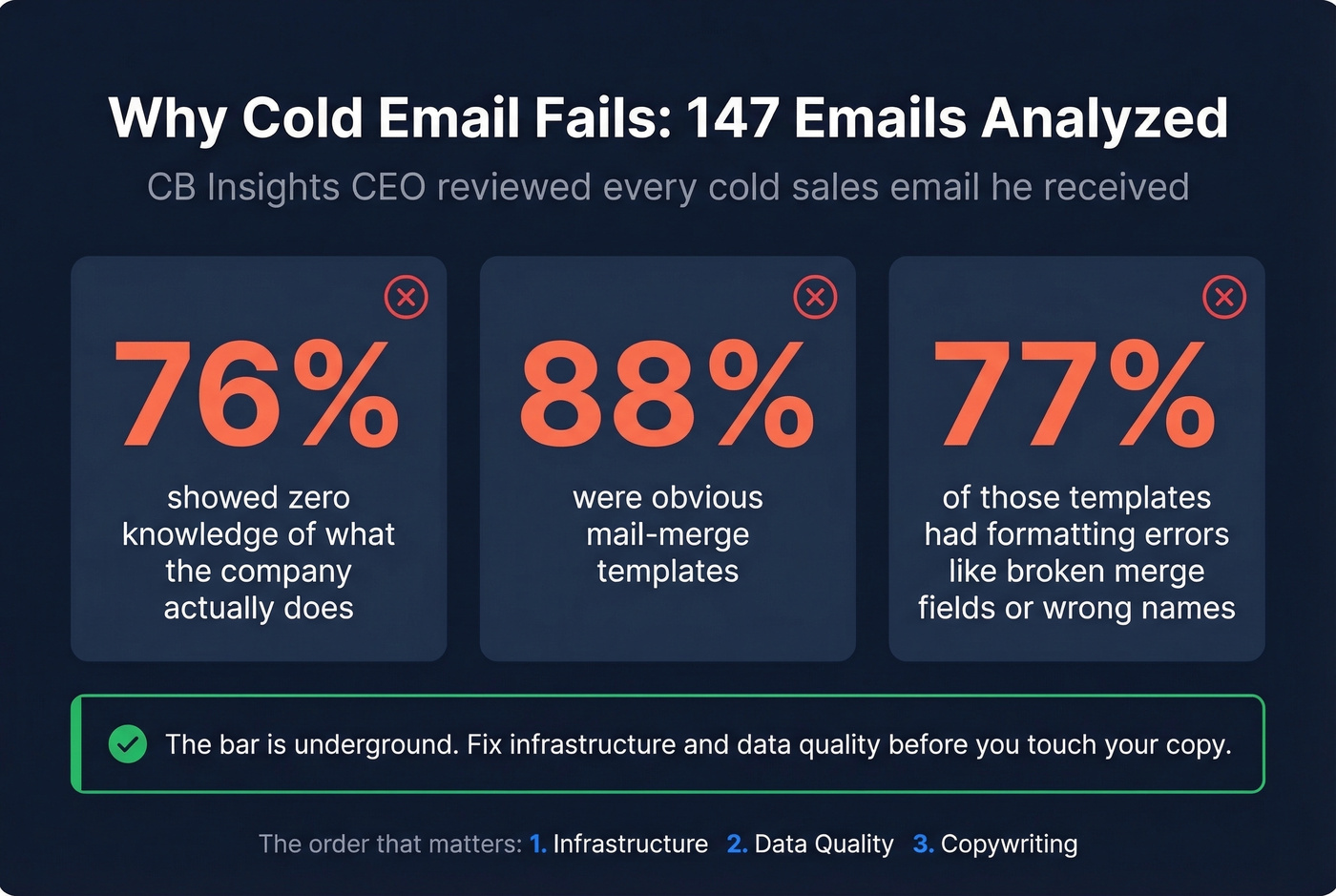
CB Insights' CEO analyzed 147 cold sales emails he'd received. 76% showed zero knowledge of what CB Insights actually does. 88% were obvious mail-merge templates, and 77% of those had formatting errors - broken merge fields, wrong names, mismatched company references. The bar is underground. Most cold email advice focuses on subject lines and templates, which is like optimizing your golf swing when you're playing on a highway. The emails never reach the inbox, the data is stale, the prospect list is a purchased CSV from 2023 with an 11% bounce rate, and the sender wonders why they're getting flagged as spam.
A founder on r/coldemail shared their results from 147,000 cold emails sent in a single year: 1.2% positive reply rate. That sounds brutal until you do the math - 1,764 conversations, 40 qualified calls. That's a business. But only if your infrastructure holds up at that volume.
Realistic Benchmarks for 2026
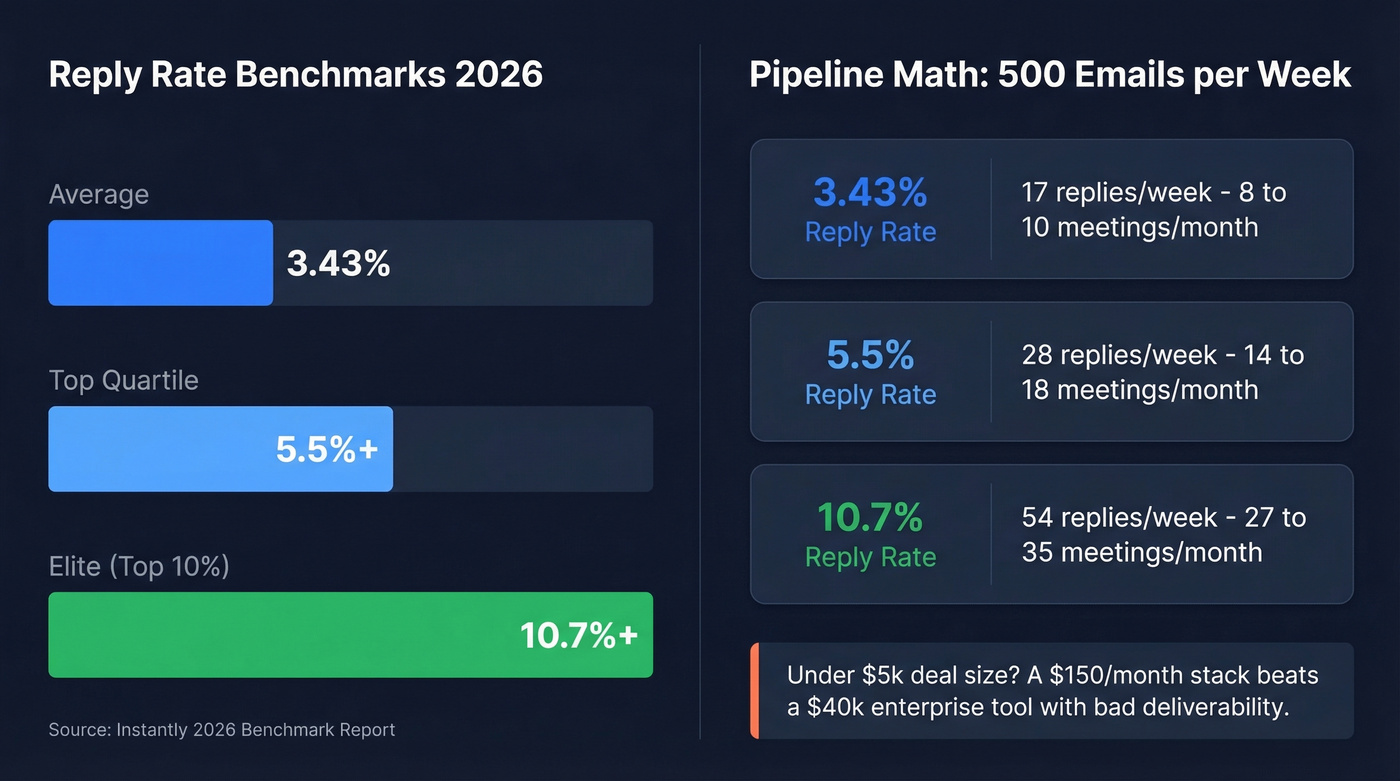
The Instantly 2026 Benchmark Report analyzed campaigns across their platform:
| Tier | Reply Rate |
|---|---|
| Average | 3.43% |
| Top Quartile | 5.5%+ |
| Elite (Top 10%) | 10.7%+ |
Average open rates hover around 27.7% across B2B, but open rates are increasingly unreliable as a metric - especially if you're correctly disabling open tracking (more on that later).
If you're hitting 3% reply rate, you're already outperforming most senders. The teams hitting 10%+ haven't found magic templates. They've nailed infrastructure, list quality, and relevance.
Here's the pipeline math. Say you send 500 emails per week - very achievable with proper infrastructure. At 3.43%, that's 17 replies per week, roughly 70 per month. Even if only half are positive and a quarter convert to calls, you're booking 8-10 meetings monthly from a single channel. At 5.5%, those numbers nearly double.
If your average deal size is under $5k, you probably don't need a $40k/year sales intelligence platform. A $150/month stack with verified data and solid infrastructure will outperform an enterprise tool with bad deliverability every single time.
Infrastructure Setup (The Part Everyone Skips)
A common theme on r/coldemail is that infrastructure is where "almost everyone screws up." Sending from your main domain, skipping warmup, ignoring DNS - these aren't minor mistakes. They're campaign killers. If you want the full technical breakdown, start with an email deliverability audit before you scale volume.
DNS Authentication
As of 2025, Google and Yahoo enforce bulk sender requirements, and Microsoft has similar rules. Every sending domain needs three DNS records:
SPF tells receiving servers which IPs can send on your behalf. DKIM cryptographically signs your emails to prove they haven't been tampered with. DMARC tells servers what to do when SPF or DKIM fail - start with p=none, then move to p=quarantine.
Skip any of these and you're fighting deliverability with one hand tied behind your back. You also need a custom tracking domain - a branded CNAME rather than your sending tool's shared tracking domain. DNS propagation takes up to 72 hours, so set this up before anything else.
Domain Strategy and Scaling Math
Never send cold email from your primary domain. Buy secondary lookalike domains. If your company is acme.com, use getacme.com or acmehq.com. Stick with .com TLDs when possible - .co or .io can work too, but avoid .xyz, .biz, or anything that looks disposable.
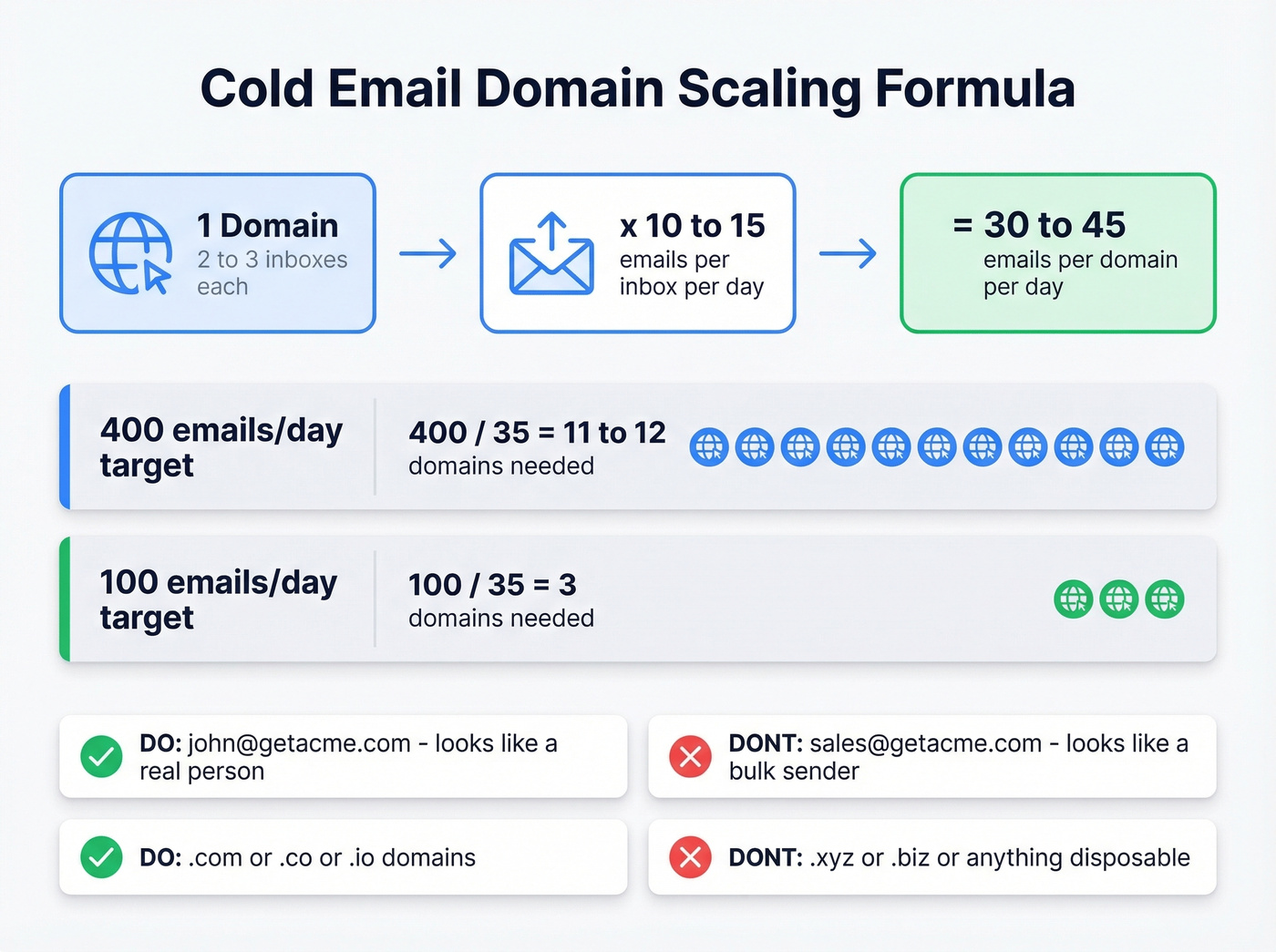
Here's the math:
Scaling formula: 2-3 inboxes per domain x 10-15 emails per inbox per day = 30-45 emails per domain per day.
To send 400 emails/day: 400 / 35 (midpoint) = ~11-12 domains needed.
To send 100 emails/day: 100 / 35 = ~3 domains.
Use nominative sender addresses (john@getacme.com) rather than generic ones (sales@getacme.com). Each inbox should look like a real person's mailbox.
Warmup Protocol
Every new domain and inbox needs warmup before you send a single cold email. Minimum 14 days. 21 days is safer. Start at 5-10 emails per day and ramp gradually. Keep warmup running even after you launch campaigns - it maintains your sender reputation.
The compliance thresholds you're targeting: spam complaints under 0.3%, bounces under 2%, inbox placement above 80%. (If you’re pressure-testing volume, map it to safe email velocity first.)
One practitioner on r/Entrepreneur documented their rebuild: they went from 3 domains to 7, capped each at 26 emails per day, and saw their reply rate climb from 3% to 6%. Infrastructure isn't glamorous, but it's where campaigns are won or lost.
Build a Verified Prospect List
Here's where most teams burn their domain reputation before they even start. That same practitioner reported a bounce rate of 11% when using purchased lists. After switching to manual verification, it dropped to under 2%. That single change was one of the biggest levers in their entire rebuild.
The thresholds: under 2% bounce rate is safe. Above 5% and you risk domain blocks from major providers. Between 2-5% is a warning zone where you're degrading reputation with every send.
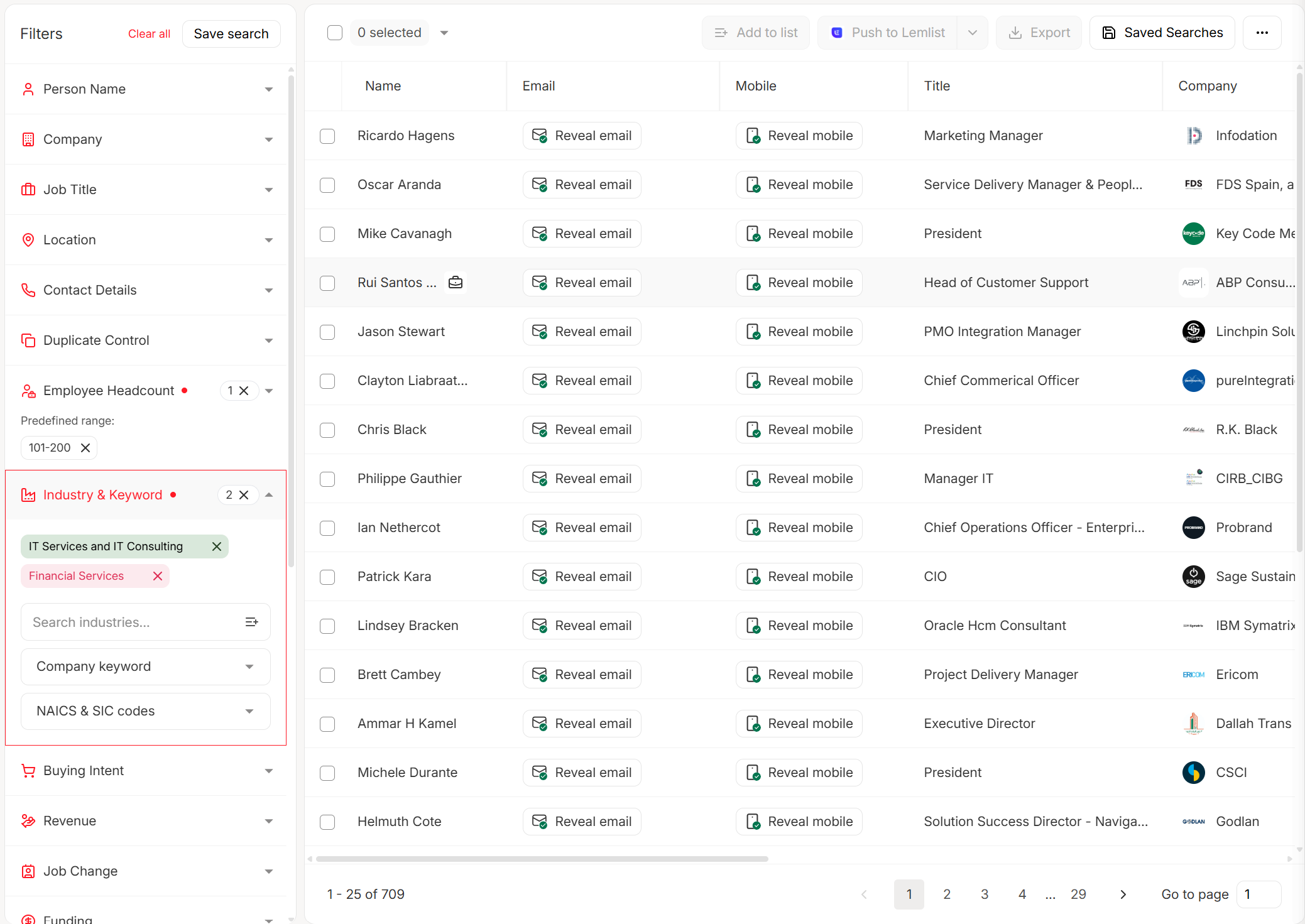
Prospeo handles this at the source - every email goes through a 5-step verification process with catch-all handling, spam-trap removal, and honeypot filtering before it hits your list. The result is 98% email accuracy, keeping you well under that 2% bounce threshold without manual cleanup. Data refreshes every 7 days versus the 6-week industry average, so you're not emailing people who changed jobs last month.
Use verified data if: you value your domain reputation at all. Skip purchased lists: always. (If you want to compare options, see data enrichment services and email list providers.)
Subject Lines That Work
An analysis of 85M+ cold emails found the sweet spot is 1-4 words, all lowercase except proper nouns. Salesy techniques - urgency words, ALL CAPS, excessive punctuation - reduce open rates by up to 17.9%.
One team tested subject lines systematically: "Quick question" pulled 39% opens, company-name subject lines hit 33%, and "Partnership opportunity" cratered below 19%. Casual and specific beats formal and generic every time. If you need a swipe file, start with these cold email subject line examples.
The empty subject line trick gets mentioned a lot. It boosts opens by 30% but drops replies by 12%. It's a gimmick that gets attention without building trust. Your subject line's job isn't to maximize opens - it's to set the right expectation so the people who open actually read and reply.
Keep it short. Keep it lowercase. Make it sound like something a colleague would type.

The article says it clearly: above 5% bounce rate and you risk domain blocks. Prospeo's 5-step verification delivers 98% email accuracy with catch-all handling and spam-trap removal - so your cold email infrastructure stays clean at any volume.
Stop burning domains on bad data. Start with emails that actually land.
Messaging That Gets Replies
Elite performers in the 2026 benchmark data keep their first-touch emails under 80 words. That's not a suggestion - it's what separates the top 10% from everyone else.
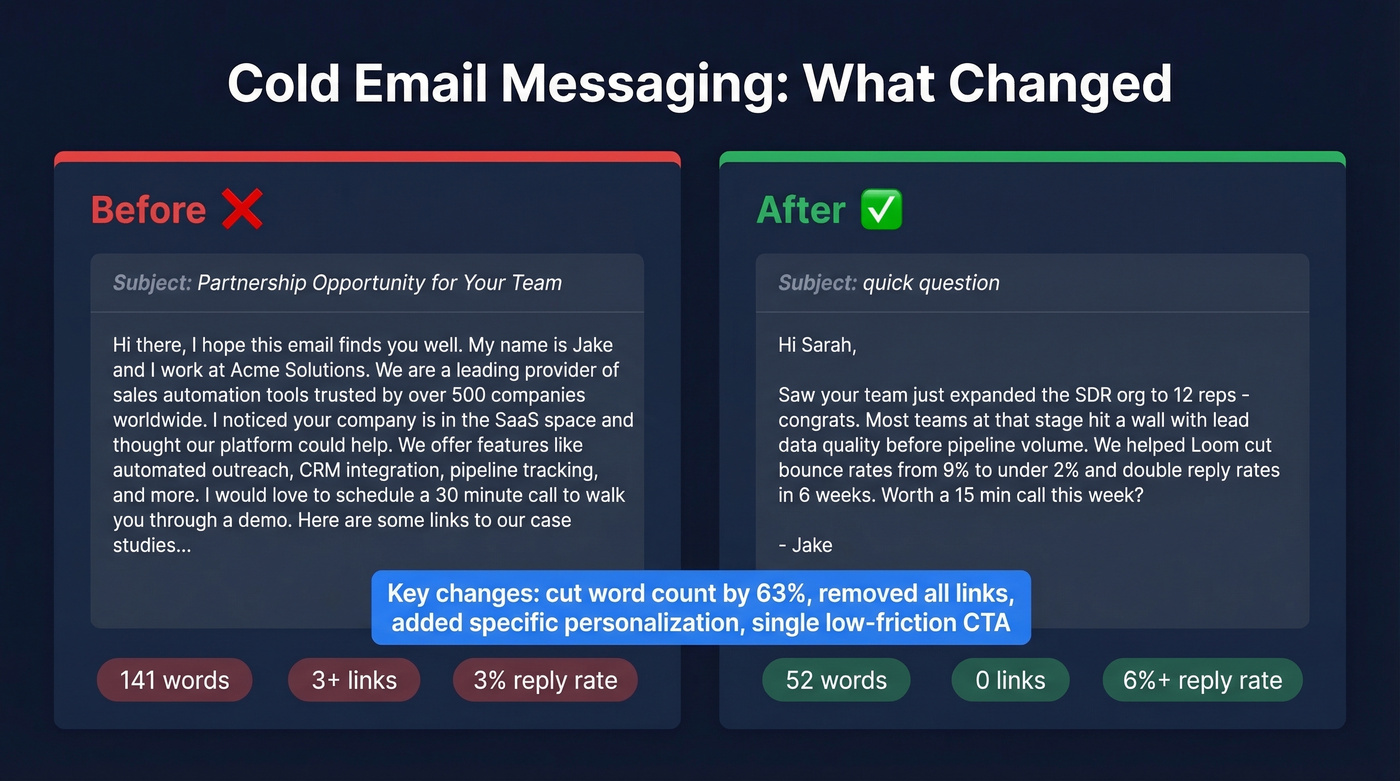
One practitioner cut their emails from 141 words to under 56 and doubled their reply rate. The CB Insights teardown found that 44% of cold emails included at least one link, and over 20% had three or more. Fewer links consistently correlates with better performance - every link is a potential spam trigger and a distraction from your single ask. For a deeper framework, see email copywriting.
The structure that works:
Line 1: Why you're reaching out, specific to them - not "I noticed your company..."
Line 2-3: The problem you solve, framed in their language
Line 4: Single, low-friction CTA
Subject: quick question
Hi {{first_name}},
{{custom_message}}
We help {{industry}} teams cut {{specific_pain}} by {{specific_outcome}} - similar to what we did for {{reference_company}}.
Worth a 15-min call this week?
{{sender_name}}
That's 40-50 words with the merge fields filled in. One link at most. One CTA. No "I hope this finds you well." The reader decides in 3 seconds whether to reply or archive. Make those seconds count.
A/B Testing Cadence
Elite performers A/B test subject lines and opening lines weekly. The rule: change one variable at a time and let it run for at least 100 sends before drawing conclusions. Start with subject lines since they have the most measurable impact on open rates, then move to opening lines and CTAs. Teams that test weekly compound small gains into massive performance gaps over a quarter.
Personalization at Scale
Let's be honest: "Hi {{first_name}}, I saw your company is in {{industry}}" isn't personalization. It's a merge field. True personalization means referencing something specific enough that the prospect knows a human was involved.
The workflow that's working in 2026: scrape recent posts or content from your prospects, feed them into GPT-4o mini with a prompt that generates a custom first line, export as a CSV with a custom_message column, and map it to your sending tool's merge field. Teams running this workflow report roughly 3x the response rate versus generic outreach. (More ideas: personalized outreach.)
Before you write personalized lines, you need data to personalize with. Prospeo's enrichment returns 50+ data points per contact - job title, company size, tech stack, funding stage, department headcount. Knowing a prospect's company just raised a Series B or uses a specific competitor's tool gives you a hook that "I noticed your company" never will.
Follow-Up Sequence Design
58% of replies come from the first email. That means 42% come from follow-ups - and fewer than 20% of senders even bother sending a second email. Following up is the single easiest way to outperform your competition.
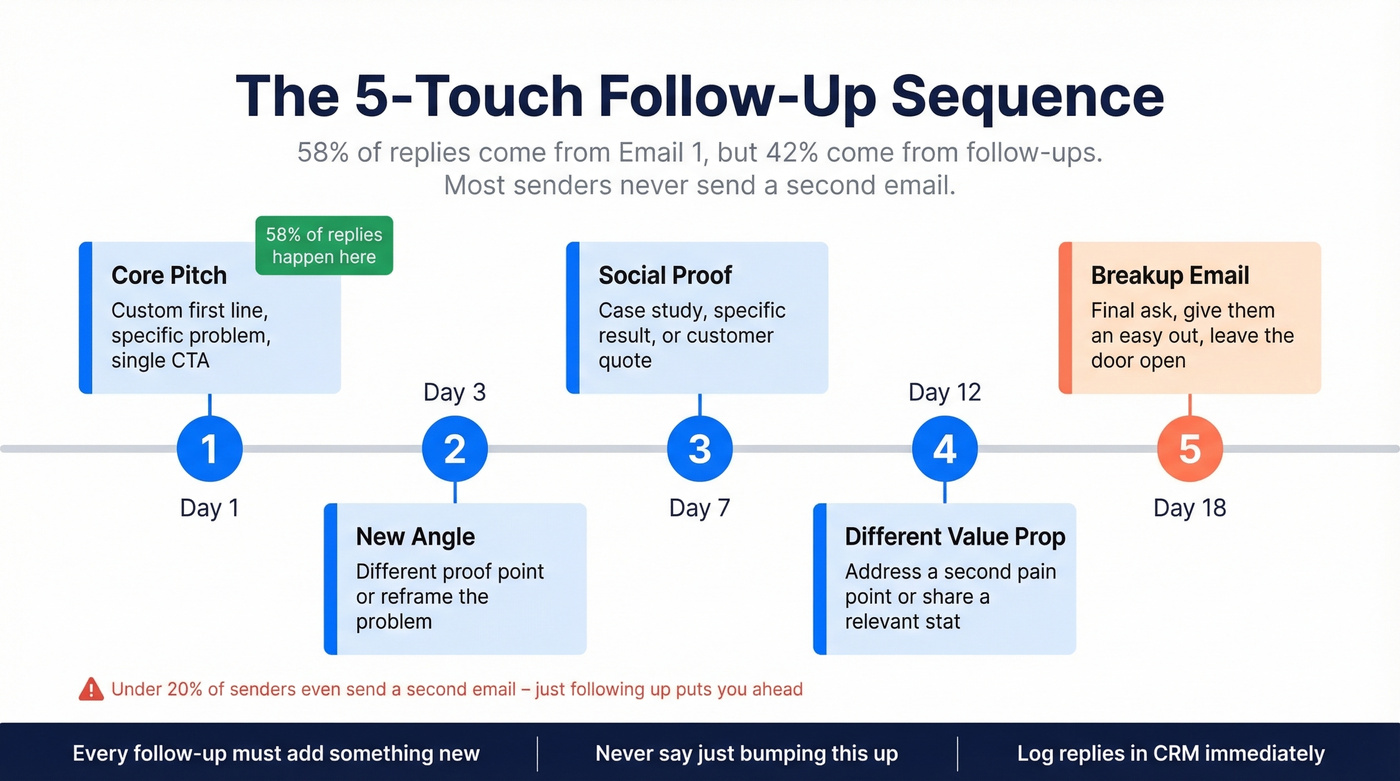
The sweet spot is 4-7 touchpoints over 14-21 days:
| Touchpoint | Day | Purpose |
|---|---|---|
| Email 1 | Day 1 | Core pitch, custom first line |
| Email 2 | Day 3 | New angle or proof point |
| Email 3 | Day 7 | Case study or social proof |
| Email 4 | Day 12 | Different value prop |
| Email 5 | Day 18 | Breakup / final ask |
Every follow-up must add something - a new stat, a different angle, a relevant case study. "Just bumping this to the top of your inbox" is the cold email equivalent of "per my last email." Don't do it. If you want plug-and-play copy, use these cold email follow-up templates.
Once a prospect replies, the cold email phase is over. Log the conversation in your CRM immediately, tag the lead source, and hand off to your pipeline workflow. The gap between "got a reply" and "booked a meeting" is where most teams leak pipeline - usually because nobody owns the handoff.
Advanced Techniques Worth Testing
Turn off open tracking. An analysis of 44M emails found that campaigns with open tracking disabled achieved a 2.36% reply rate versus 1.08% with tracking on. More than double. Open tracking pixels add invisible images that spam filters detect. The deliverability hit isn't worth the vanity metric.
Send Tuesday through Thursday, 8-11am in the recipient's timezone. One team tested this rigorously and saw opens increase 16% compared to random send times. Wednesday consistently shows the highest engagement. Avoid Mondays and Fridays. (If you want a tighter playbook, see best time to send cold emails.)
Warm the cold. The founder who sent 147k cold emails had a revelation: when he shifted to "joining conversations people are already having" - reaching out to prospects who'd recently engaged with relevant content or showed buying signals - his reply rate jumped to 34%. At that point, the outreach isn't really cold anymore, and that's the point.
This shift from pure volume-based outbound to signal-based outreach is the biggest trend reshaping cold email in 2026. Instead of emailing every VP of Sales at mid-market SaaS companies, you target the ones actively researching solutions in your category. Prospeo tracks 15,000 intent topics via Bombora - layer those signals on top of your ICP filters and the difference in reply rates is dramatic.
Recommended Tool Stack
One practitioner documented their entire stack cost at $420/month, generating 16 qualified leads monthly. Here's what an end-to-end outbound stack looks like:
| Tool | Category | Best For | Starting Price |
|---|---|---|---|
| Prospeo | Data + Verification | Verified emails + enrichment | Free (75/mo); ~$0.01/email |
| Instantly | Sending + Warmup | High-volume sending | ~$30-97/mo |
| Smartlead | Sending + Warmup | Multi-inbox rotation | ~$39-94/mo |
| Lemlist | Sending + Personalization | Multichannel sequences | ~$39-99/mo per user |
| Apollo | All-in-One | Budget-conscious teams | Free (100 credits/mo); $59/mo |
| GMass | Gmail-Based Sending | Low-volume senders | Free (50/day); $25-55/mo |
| Saleshandy | Sending | Cost-effective scaling | ~$25-66/mo |
| HubSpot | CRM | Pipeline tracking | Free tier available |
Your sending tool is only as good as your data. Pick one sending platform - Instantly and Smartlead are the two most popular on Reddit right now - and use HubSpot's free CRM to track everything. A verified-data provider plus Instantly plus HubSpot runs under $150/month and handles everything from prospecting to pipeline. (If you’re evaluating categories, start with SDR tools.)
Apollo deserves a mention as an all-in-one option - its free tier is generous and it bundles data with sequencing. The tradeoff is data accuracy: we've seen higher bounce rates from Apollo's database compared to dedicated verification tools. If you're sending at scale, the cost of bad data - domain reputation damage, wasted sends - exceeds the cost of a separate verification layer.
Skip GMass if you're planning to send more than 200 emails a day. It's great for founders doing low-volume outreach from Gmail, but it doesn't scale the way Instantly or Smartlead do.
Scaling to 400+ cold emails per day means nothing if half your contacts changed jobs last month. Prospeo refreshes every record every 7 days - 6x faster than the industry average - so your prospect lists stay current and your reply rates stay high.
Fresh data every 7 days, starting at $0.01 per verified email.
Compliance Checklist
Cold email is legal in most jurisdictions. But the rules differ, and the penalties are steep.
| CAN-SPAM (US) | GDPR (EU) | CASL (Canada) | |
|---|---|---|---|
| Consent | Opt-out | Opt-in (or legit interest) | Opt-in (express/implied) |
| Unsubscribe | 10 business days | Without delay | 10 business days |
| Max penalty | $50,120/violation | 20M EUR or 4% revenue | $10M CAD/violation |
For US-based B2B cold email under CAN-SPAM: include a physical mailing address, don't use deceptive subject lines, provide a visible unsubscribe mechanism, and honor opt-outs within 10 business days.
GDPR is stricter. If you're emailing prospects in the EU, you need either explicit consent or a legitimate interest basis. Most B2B cold emailers rely on legitimate interest, but you need to document your reasoning and make opt-out frictionless. CASL in Canada requires some form of consent before you send, though implied consent exists for certain business relationships.
Bulk senders also need RFC 8058 one-click unsubscribe headers - most sending tools handle this automatically, but verify yours does.
FAQ
What's a good cold email reply rate in 2026?
Average is 3.43%. Top quartile hits 5.5%+, and elite campaigns reach 10.7%+. Focus on infrastructure and list quality before optimizing copy - those two levers move the needle more than any template.
How many follow-ups should I send?
Send 4-7 emails over 14-21 days. 58% of replies come from the first email, but 42% come from follow-ups - and fewer than 20% of senders even send a second. That gap is pure lost pipeline.
How do I keep cold emails out of spam?
Set up SPF, DKIM, and DMARC on every sending domain. Use secondary domains with 2-3 inboxes each. Warm up for 14-21 days minimum. Keep bounces under 2% by verifying every email before sending. Turn off open tracking and keep spam complaints below 0.3%.
How long should a cold email be?
Under 80 words for the first touch. The top 10% of performers all stay under this threshold. One CTA, one link maximum, zero fluff.
Is cold email legal?
Yes, in most jurisdictions. CAN-SPAM in the US requires an opt-out mechanism and real sender info. GDPR in the EU requires legitimate interest documentation. CASL in Canada requires some form of consent. Penalties reach up to 20M EUR under GDPR, so get the basics right from day one.