

Cold Email Subject Lines for CEOs: What Actually Gets Opened in 2026
You've tried "Quick question about [Company]" and gotten crickets. Every SDR on the planet sends that line. CEOs have seen it thousands of times, and the problem isn't your email body or your offer - it's that 93% of 1,000+ CEOs struggle with email management, so your subject line gets triaged into the delete pile alongside dozens of others before anyone reads a word.
The average CEO receives about 120 emails a day. Some tech leaders handle 700-800. They scan for roughly 10 seconds, and executive assistants screen the rest. C-suite open rates run 15-22%, with reply rates hovering at 0.5-1.5%. That's roughly half the general cold email average of 3.43%. The bar isn't just higher - it's a fundamentally different game.
Stop collecting subject line swipe files. Start collecting triggers.
Three Rules Before You Write a Word
- 1-4 words. An analysis of 85M+ cold emails found this is the ideal subject line length. Shorter than you think.
- Lowercase everything. All-lowercase subject lines have the highest open rates. Proper nouns are the only exception.
- Trigger-based personalization. A recent trigger - funding round, earnings call, new hire, expansion - can lift reply rates from 2% to 15%.
One prerequisite: verified email data. If 16.9% of emails never reach the inbox, your subject line is irrelevant before it's ever seen.
What 85M Emails Reveal About Subject Line Performance
The most useful dataset on cold email subject lines comes from a 30 Minutes to President's Club analysis of 85M+ cold emails. The findings are counterintuitive if you've been writing subject lines like marketing copy.
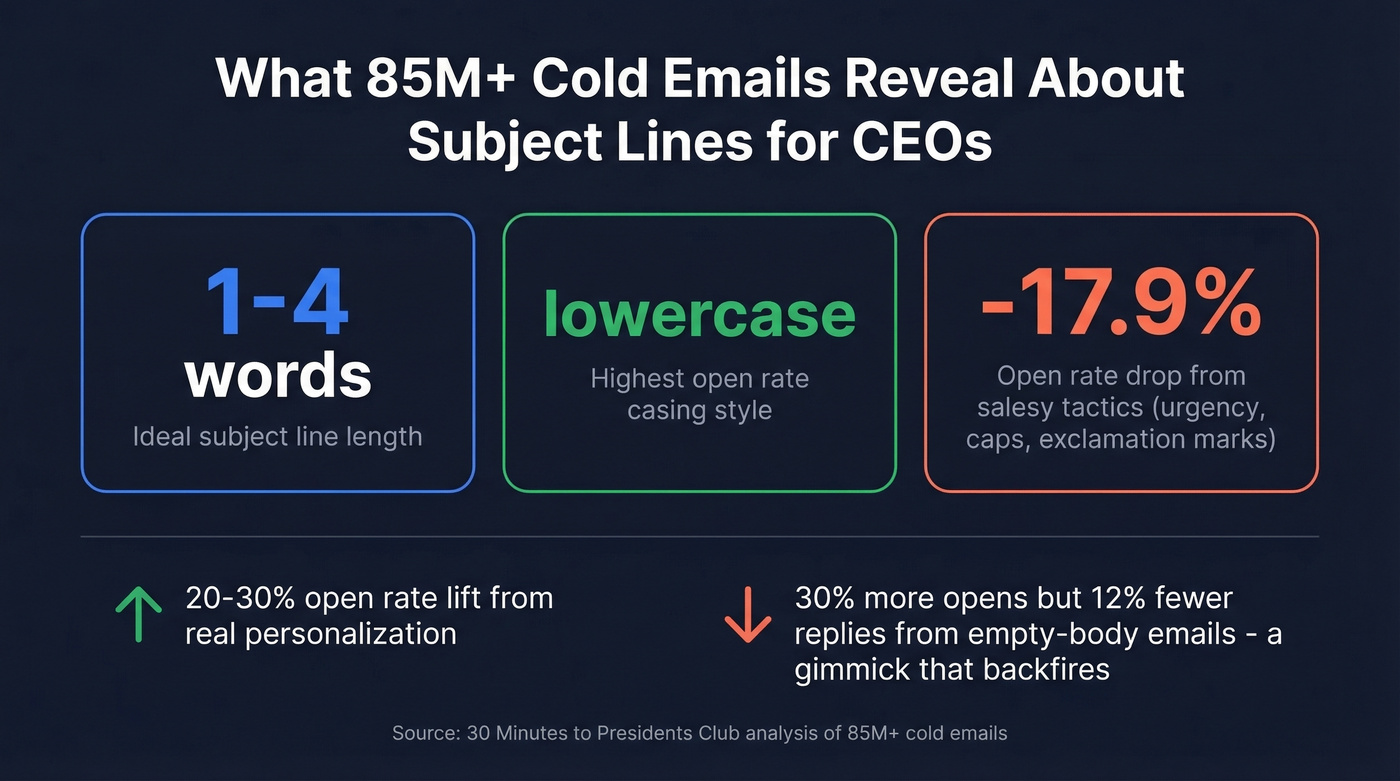
Length matters more than cleverness. Gong data referenced in the analysis shows 1-4 words is the ideal range. Not 6-10. Not "enough to explain your value prop." Four words or fewer. CEO inboxes are scanned on mobile, where clients truncate after roughly 33-43 characters, and 55% of email opens happen on mobile - 42% of recipients delete non-optimized emails within 3 seconds.
Casing signals intent. All-lowercase subject lines outperform title case and sentence case. They look like internal emails, not marketing blasts. This is the "internal camouflage" technique: your outreach should look like something a colleague sent, not something a vendor crafted.
Salesy techniques are poison. Urgency words, exclamation marks, ALL CAPS - these reduce open rates by 17.9%. Personalized subject lines lift opens 20-30% on average, but "{First name}, quick question" isn't personalization. "Saw your Series B news" is.
Two counterintuitive findings worth calling out: subject-only emails (empty body) boost opens by 30% but tank replies by 12%, a gimmick that backfires with CEOs who expect substance. And some guides suggest non-sequitur subject lines ("I am the walrus!") to stand out through sheer absurdity. The 85M email analysis doesn't support this as a consistent tactic. Absurdity might get an open, but it rarely gets a reply from someone running a company.
20 Subject Lines That Get CEOs to Open
The specific words matter less than the category they fall into. Each of these 20 lines follows a pattern backed by the data above. Pick the category that matches your situation, then adapt.
If you want more patterns to remix, see these email subject line examples.
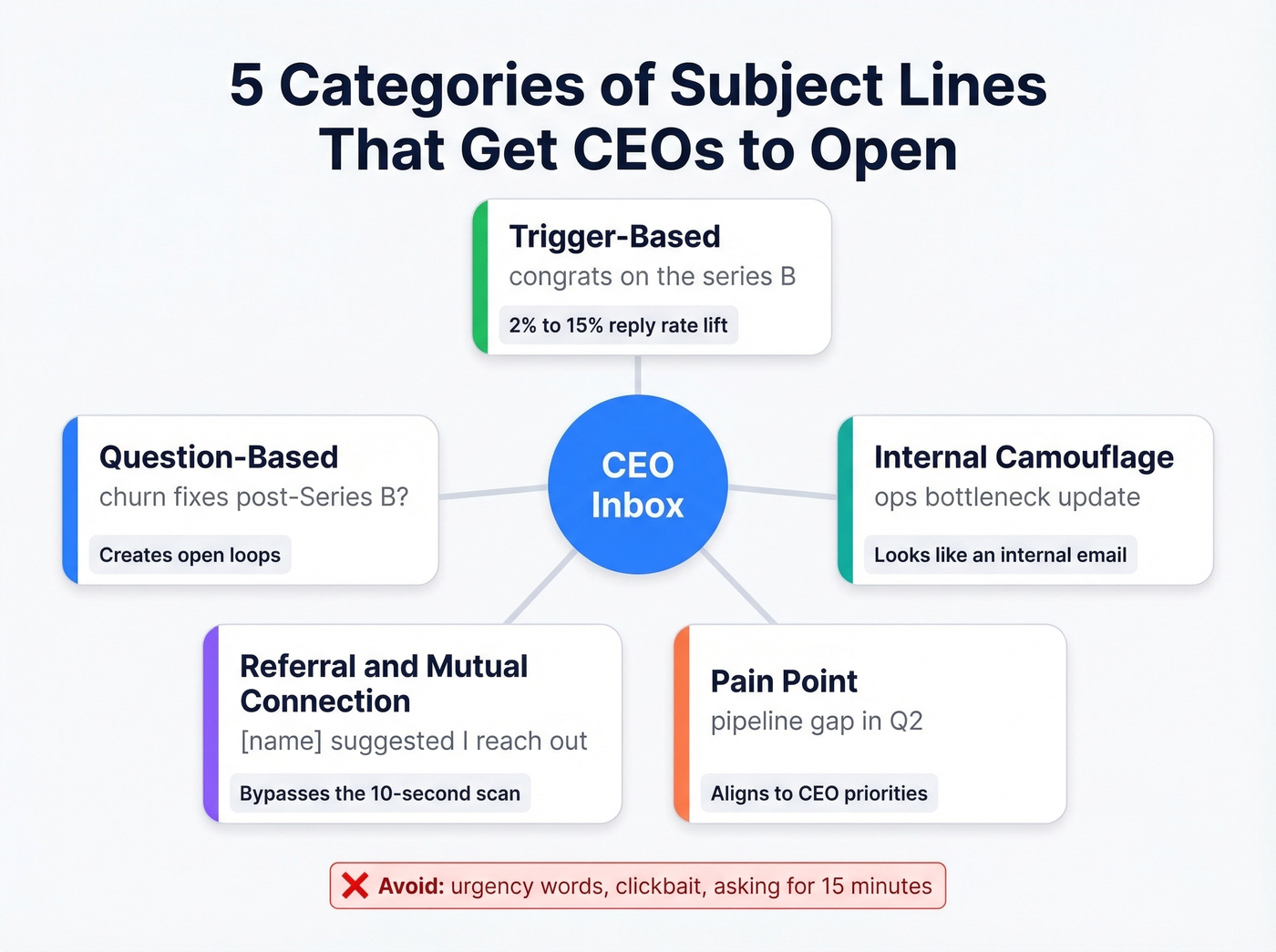
Trigger-Based Lines
Trigger personalization is the single highest-leverage move in CEO outreach. It lifts reply rates from 2% to 15% because it proves you did homework.
- "congrats on the series B" - Send within 48 hours of a funding announcement. The CEO is thinking about scaling; you're relevant.
- "saw the VP sales opening" - A hiring surge signals budget and pain. This says "I know what you're building."
- "re: Q3 earnings call" - For public companies. Reference a specific metric they discussed. CEOs notice when outsiders pay attention to their numbers.
- "your move into APAC" - Competitive expansion is top-of-mind. Tie your outreach to a strategic bet they've already made public.
Question-Based Lines
Questions create open loops. A soft question works well - especially when your CTA stays soft too.
- "churn fixes post-Series B?" - Specific enough to feel researched, open enough to invite a reply.
- "quick thought on Q1" - Vague but intriguing. Works best when the email body delivers a genuinely useful insight.
- "scaling ops or hiring?" - Frames a strategic tension the CEO is likely navigating. Forces a mental answer.
- "who owns pipeline there?" - A routing question. CEOs often forward these to the right person, which is still a win.
Referral and Mutual Connection
Recognized names bypass the 10-second scan filter. Nothing else comes close.
- "[name] suggested I reach out" - The gold standard. A warm intro compressed into a subject line.
- "met at SaaStr - follow up" - Event-based familiarity. Works within 2 weeks of the event.
- "fellow [community] member" - Shared groups and peer networks create instant trust.
- "[name] on your board mentioned..." - Powerful but use carefully. Only works if the connection is real.
Pain Point Lines
Growth consistently tops CEO priority lists. Pain point subject lines align your outreach to what they're already thinking about.
- "pipeline gap in Q2" - Direct, specific, and tied to a time-bound concern.
- "cutting CAC 30% in SaaS" - Outcome-led with a concrete number. The CEO clicks to see if it's credible.
- "competitor just launched X" - Competitive threat gets attention. Use only when you have real intel.
- "risk in your renewal cycle" - For CEOs at companies with subscription revenue. Risk language triggers executive attention.
Internal Camouflage Lines
Internal-looking subject lines outperform marketing-style ones consistently. These mimic what a direct report would send.
- "new sales trainer hire" - Looks like an internal update. Gets opened before the CEO realizes it's external.
- "re: Q2 pipeline gap" - The "re:" prefix suggests an ongoing thread. Use sparingly - overuse erodes trust fast.
- "ops bottleneck update" - Reads like a status report. The email body needs to deliver real value to justify the framing.
- "headcount plan question" - Feels like an internal ask. Works best when your product actually relates to hiring or team scaling.
Lines to Avoid
For every line that works, there's a category that kills your chances. These patterns reduce open rates by up to 17.9% and signal "mass blast" to every CEO who sees them:
- "Exclusive offer for [Company]!" - Screams marketing. Instant delete.
- "Can I get 15 minutes?" - You haven't earned that yet.
- "[First name], you won't believe this" - Clickbait formatting. CEOs believe very little from strangers.
The 6-Part CEO Email Structure
A great subject line gets the open. The email structure gets the reply. Here's the framework that works, based on campaigns pulling 25-40% reply rates when properly personalized:
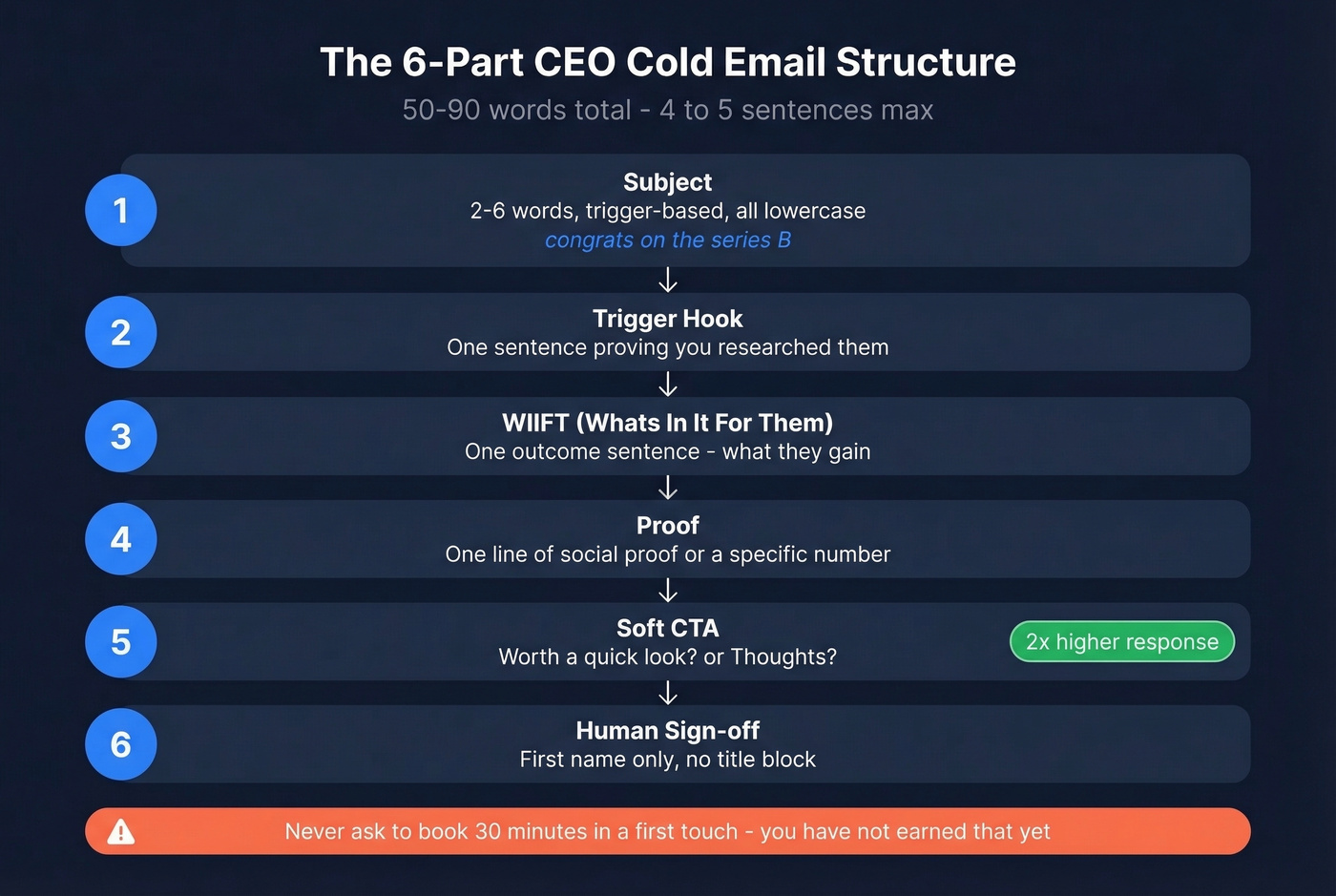
- Subject (2-6 words) - trigger-based, lowercase
- Trigger hook - one sentence proving you researched them
- WIIFT (What's In It For Them) - one outcome sentence
- Proof - one line of social proof or a specific number
- Soft CTA - "Worth a quick look?" or "Thoughts?" (more in our email call to action guide)
- Human sign-off - first name only, no title block
Keep the whole thing to roughly 50-90 words, or 100-150 when you need more proof. Emails over 250 words get 3x lower reply rates. Four to five sentences max for a first touch.
| CTA Type | Example | Response Impact |
|---|---|---|
| Soft CTA | "Worth a look?" | 2x higher response vs calendar-link requests |
| Hard CTA | "Book 30 min?" | ~50% lower response |
Here's the thing: never ask a CEO to "book 30 minutes" in a first touch. You haven't earned that yet. And when you follow up, make it casual - follow-ups that read like replies outperform formal follow-ups by 30%. If you need a starting point, use these cold email follow-up templates.

You read it above: 16.9% of cold emails never reach the inbox. Your subject line doesn't matter if the email bounces. Prospeo's 5-step verification delivers 98% email accuracy - so every trigger-based, lowercase, 1-4 word subject line you craft actually lands in the CEO's inbox.
Stop perfecting subject lines for emails that bounce.
Real Subject Lines That Worked
Data is useful. Real examples are better. Here are two practitioner cases from BuiltInBoston's sales pros roundup that show what deep personalization looks like in practice.
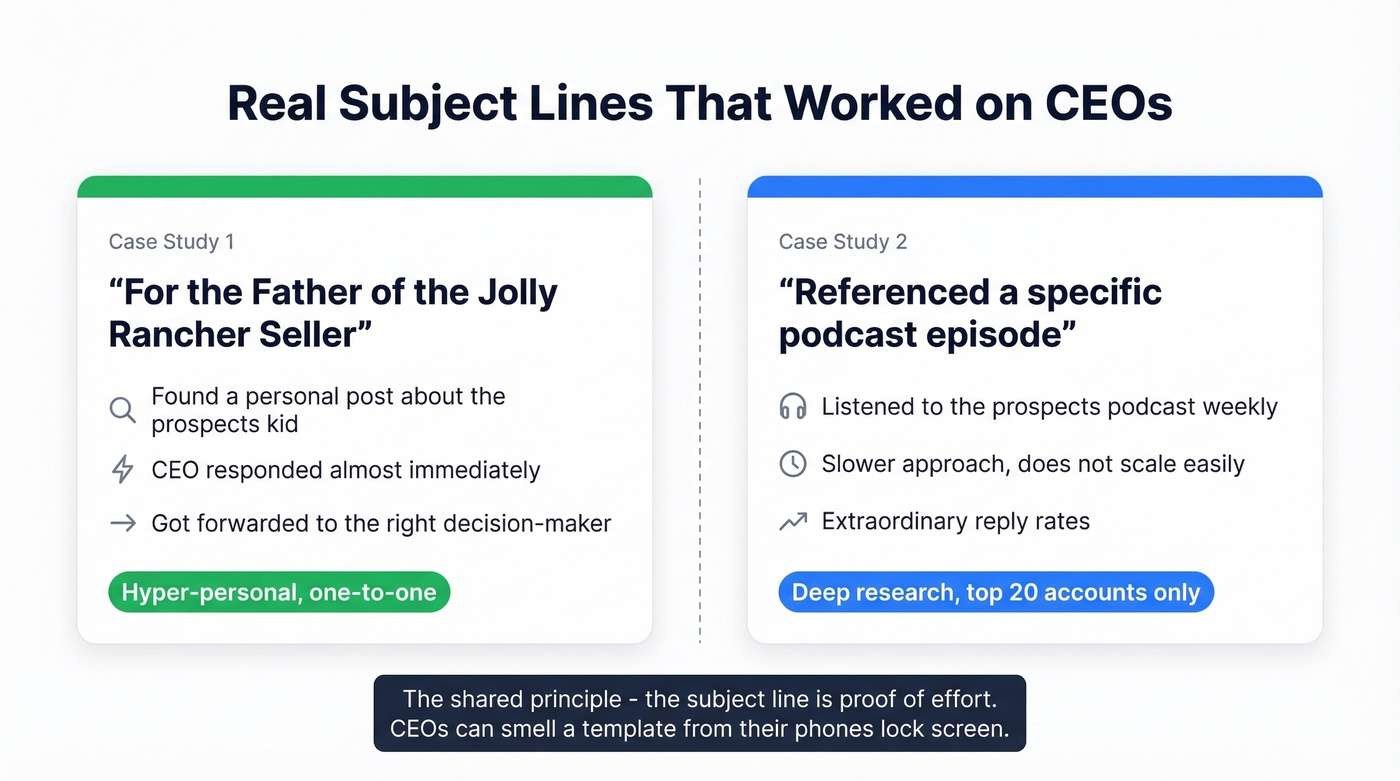
One sales rep found a prospect's post about their kid selling Jolly Ranchers at school. The subject line: "For the Father of the Jolly Rancher Seller." The response was almost immediate - the CEO forwarded the email internally and referred the rep to the right decision-maker. That's the power of a subject line that proves you see the person, not just the title.
Another practitioner takes a different approach entirely: listening to a prospect's podcast weekly and writing subject lines that reference specific episodes. It's slower. It doesn't scale. But the reply rates are extraordinary because the CEO knows this person actually pays attention.
Both approaches share one principle: the subject line is proof of effort. CEOs can smell a template from their phone's lock screen.
If your average deal size is under $15k, you probably don't need this level of personalization for every prospect. Save the podcast-listening approach for your top 20 accounts and use trigger-based lines for the rest. The ROI math only works when the deal size justifies the research time.
Adapting Lines by Role and Use Case
The principles above focus on CEO outreach, but the same frameworks apply across different audiences with small tweaks.
Recruiters respond to the same trigger-based approach - reference a specific job posting or hiring surge instead of a funding round. Marketers engage best when you lead with a metric (open rate, CAC, pipeline contribution) rather than a vague benefit. Partnership outreach works best with mutual benefit framing: "co-marketing idea for [Company]" outperforms "partnership opportunity" every time.
For investor outreach, reference traction or a specific metric, not just "exciting startup opportunity." And PR pitches to journalists should mirror the internal camouflage approach - make it look like a tip, not a press release.
The best outreach subject lines share one trait regardless of audience: they prove you understand the recipient's world before asking for anything. (If you need a broader system, start with these sales prospecting techniques.)
Make Sure Your Email Actually Arrives
Most cold email guides skip email verification entirely, which tells you the authors haven't run a campaign at scale. The reality is brutal: 160 billion spam emails hit inboxes daily. An 84% inbox placement rate means 16.9% of your emails never reach the inbox at all, and another 10.5% land in spam. Your carefully crafted subject line is worthless if it bounces or hits a junk folder.
Before you send a single email, handle the technical foundation:
- Authentication: SPF, DKIM, and DMARC configured on your sending domain (see SPF and DMARC)
- Warm-up: 2-4 weeks of gradual volume increase on new domains
- Volume caps: 30-50 emails per day per inbox, max (use an email velocity baseline)
- Spam triggers to avoid: ALL CAPS, "guaranteed," "act now," "100% free," excessive exclamation marks (run an email spam checker)
High bounce rates poison your sender reputation - ISPs flag your domain, and future emails from it land in spam even when the addresses are valid. We've seen teams go from 35-40% bounce rates to under 5% just by running CEO email lists through Prospeo before sending. The 5-step verification process catches bad addresses, spam traps, and honeypots, delivering 98% email accuracy with a 7-day data refresh cycle. The free tier gives you 75 email verifications plus 100 Chrome extension credits per month - enough to test whether list quality is your bottleneck.

Trigger-based personalization lifts CEO reply rates from 2% to 15%. Prospeo tracks funding rounds, job changes, and headcount growth across 300M+ profiles with a 7-day data refresh - so you catch the Series B or VP Sales opening before your competitors do.
Catch CEO triggers while they're still fresh - not six weeks late.
How to Test Your Subject Lines
Open rates are a vanity metric. Apple Mail Privacy Protection broke them. Positive reply rate is the only number that matters for CEO outreach.
Here's a testing framework that produces usable data. We've found that teams testing with fewer than 250 contacts per variant end up chasing noise instead of signal.
- Sample size: 250+ contacts per variant. Push toward 500+ if you can.
- One variable at a time. Test subject line length OR casing OR personalization type. Never all three at once.
- Run for a full week. CEO response patterns vary by day - Tuesday through Wednesday performs best, but you need the full cycle.
- Measure positive replies only. "Not interested" and auto-replies don't count.
- Sequence depth: The sweet spot is 4-7 touchpoints. 58% of replies come from the first email, but 42% come from follow-ups. Don't give up after one send. (More on sequence management.)
- Best send windows: 7:30-9:30am or 4:30-6:00pm in the CEO's local time zone.
When choosing variants for A/B tests, keep them meaningfully different - testing "quick question" against "quick thought" won't teach you anything. Test across categories: a trigger-based line against a pain-point line, or a question against an internal camouflage approach. That's where the real learnings are.
FAQ
What reply rate should I expect from CEO cold emails?
C-suite cold email averages 0.5-1.5% positive reply rate, roughly half the general cold email benchmark of 3.43%. Top performers hit 2-4% by combining trigger-based subject lines with verified contact data and multi-touch sequences of 4-7 emails.
How long should a subject line be for CEO outreach?
One to four words, based on the 85M email dataset. Stay under 43 characters for mobile rendering. Lowercase outperforms title case consistently - it mimics internal emails and avoids the "marketing blast" signal.
What's the best day to email a CEO?
Wednesday consistently performs highest, with Tuesday and Thursday close behind. Send between 7:30-9:30am or 4:30-6:00pm in the CEO's local time zone. Avoid Mondays (inbox backlog) and Fridays (mental checkout).
Should I use the CEO's first name in the subject line?
A first-name token alone isn't real personalization - it's mail merge. A trigger reference like "Saw your Series B news" beats "{First name}, quick question" every time. CEOs respond to proof of research, not dynamic fields.
How do I verify CEO email addresses before sending?
Run your list through a verification tool before any campaign. Prospeo's 5-step process catches spam traps, honeypots, and catch-all domains at 98% accuracy - the free tier includes 75 verifications per month. Teams using unverified lists typically see 35%+ bounce rates that destroy sender reputation.